Postal History · Royal Navy · North America and West Indies Station

H.M.S. Indefatigable

Bermuda · 1901 and 1903

A farthing-franked letter in the Floating Dock, and a newspaper from County Cork for her captain.

◆

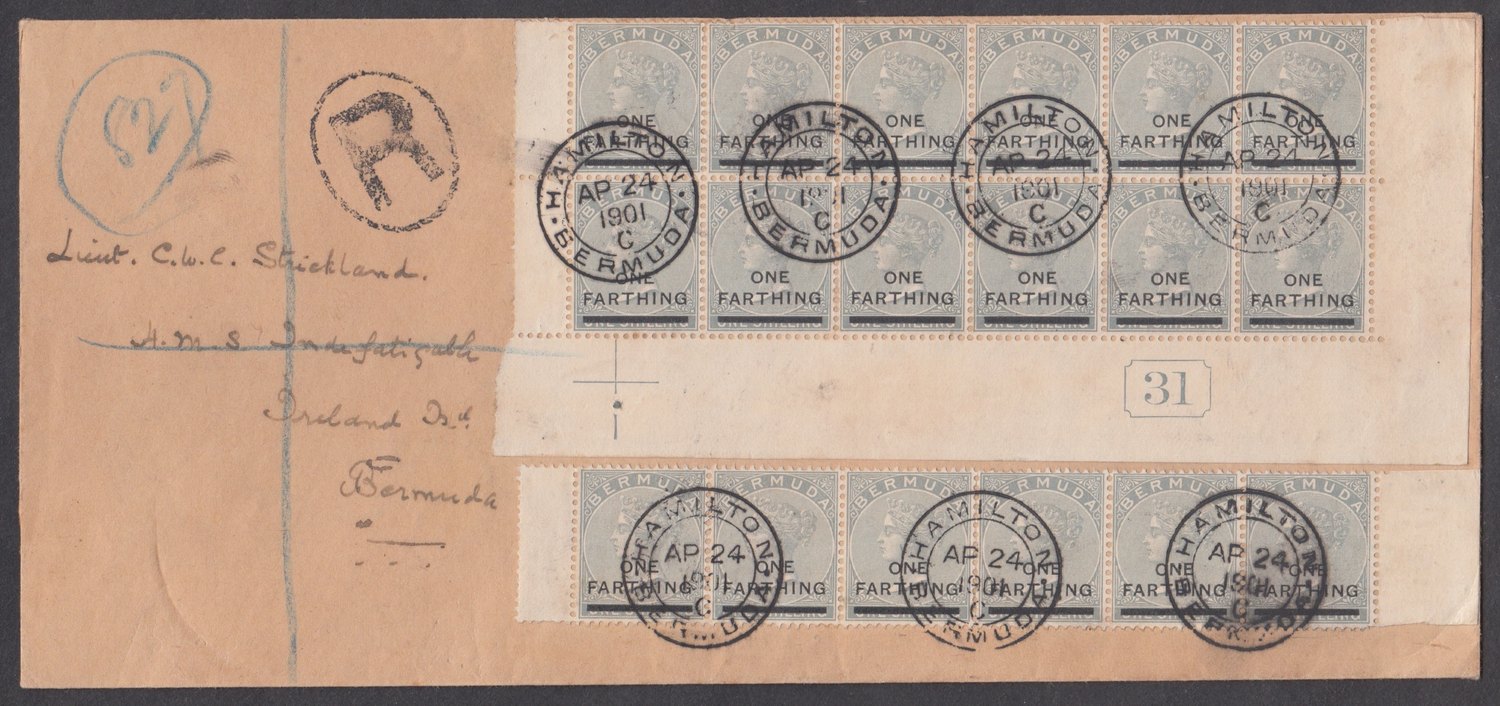
This is a registered letter sent across Bermuda, from Hamilton to the Dockyard at Ireland Island, to Lieutenant C.W.C. Strickland of H.M.S. Indefatigable. It’s franked with eighteen of the new One Farthing stamps, a block of twelve and a strip of six, with the plate number 31 still in the margin. The Royal Gazette showed that his ship was sitting in the Floating Dock when it arrived, and I found Lieutenant Strickland himself at a gymkhana a few weeks later, losing a race because he didn’t do up his coat. It’s turned into a good story for such a simple cover.

Since then I’ve found a second item for the same ship: a newspaper wrapper posted in County Cork in September 1903 to her captain, which reached Bermuda just as she was getting ready to leave.

I

The cover

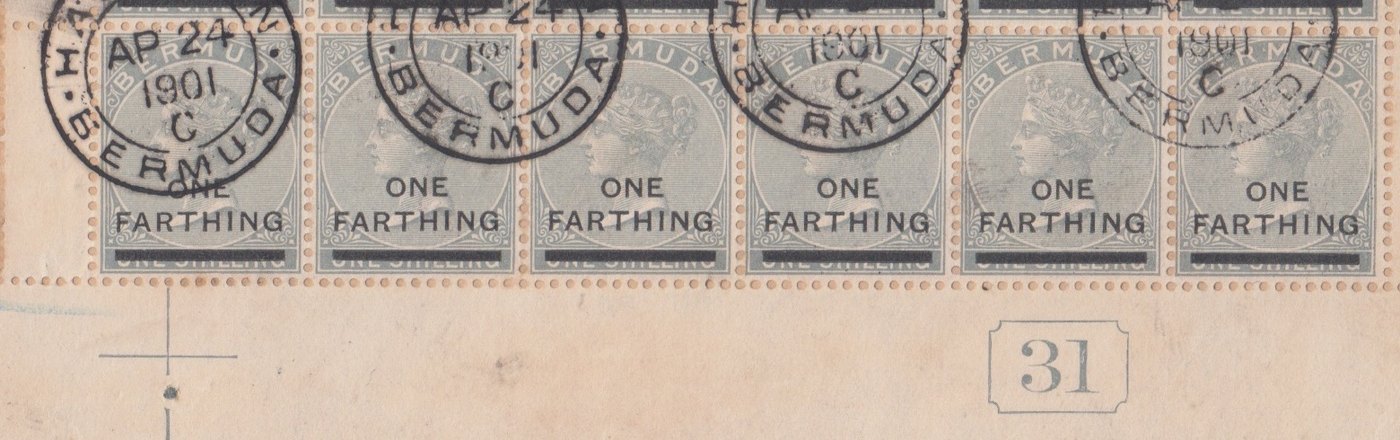
Long buff registered envelope addressed in ink to Lieut. C.W.C. Strickland, H.M.S. Indefatigable, Ireland Island, Bermuda, with a blue crayon registration cross, a black oval R and a circled blue crayon registration number, franked with a block of twelve and a strip of six grey One Farthing on one shilling surcharges with the plate number 31 in the lower margin, all tied by Hamilton Bermuda datestamps AP 24 1901 code C
Registered at Hamilton, 24 April 1901, to Lieutenant Strickland at Ireland Island
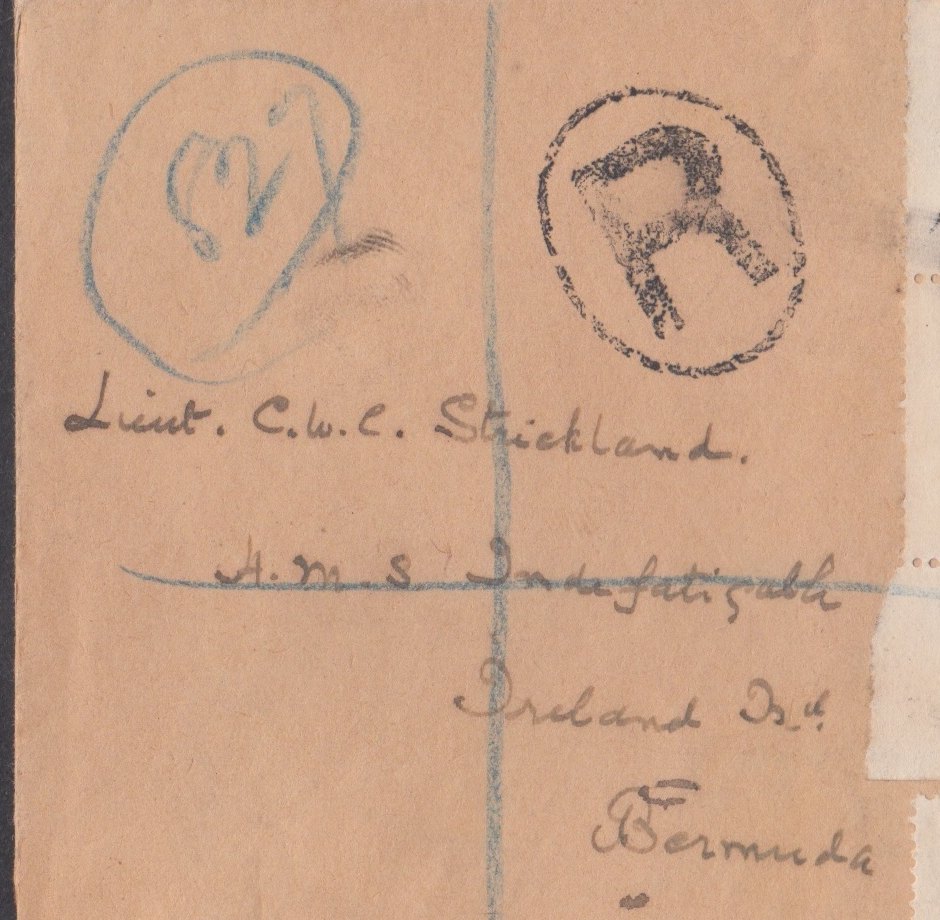
Close-up of the left of the envelope: the circled blue crayon registration number, the black oval R handstamp, the blue crayon registration cross and the address Lieut. C.W.C. Strickland, H.M.S. Indefatigable, Ireland Isd, Bermuda
The address, the oval R and the registration number 827 in blue crayon
  • Addressed to Lieut. C.W.C. Strickland, H.M.S. Indefatigable, Ireland Island
  • Franking 18 × ¼d on 1s grey “ONE FARTHING”: a block of 12 and a strip of 6, plate number 31
  • Rate 4½d, overpaid (2d registration plus 1d per ½ oz)
  • Datestamp Hamilton, Ludington type H7, code C, AP 24 1901
  • Registration Oval R; blue crayon cross; registration no. 827
  • Backstamp Ireland Island, Ludington type H7, 25 April 1901

The envelope is addressed in ink to Lieutenant Strickland on the Indefatigable. It went registered: there’s the black oval R, the blue crayon cross, and the registration number 827 circled in blue crayon at top left. The stamps are tied by seven strikes of the Hamilton double-circle datestamp, AP 24 1901, code C, which is Ludington’s type H7. On the back is the Ireland Island arrival stamp for the next day, 25 April, in the same H7 type, and nothing else.

“Lieut. C.W.C. Strickland. / H.M.S. Indefatigable / Ireland Isd / Bermuda”

The address
II

Eighteen farthings

Close-up of the bottom row of the block of twelve grey One Farthing surcharges on the one shilling, the original value barred out, tied by Hamilton AP 24 1901 datestamps, with the sheet margin below showing a printer's cross guide mark and the plate number 31 in a box
The foot of the block, with the plate number 31 in the margin

The One Farthing on 1s grey was Bermuda’s provisional for the new ¼d rate. Ludington records it as issued on 11 January 1901, a fortnight before Queen Victoria died, and on the Alert page I have one used just eight days later. By April the post office still had plenty, and this cover uses eighteen of them. The block and the strip both come from the bottom right of the pane, and the block keeps the margin with the plate number 31 in its box.

Eighteen farthings is 4½d. Registration within Bermuda was 2d at the time and letters were 1d per ½ oz (Proud, The Postal History of Bermuda, p.141). A single-weight registered letter needed 3d. 4½d doesn’t match any exact weight step, so the cover is overpaid by at least ½d. It could have been a heavy letter, since it’s a long envelope and might have held quite a bit. It could just as easily have been franked to show off the new stamps. I can’t tell which, and I’d lean towards the second.

III

In the Floating Dock

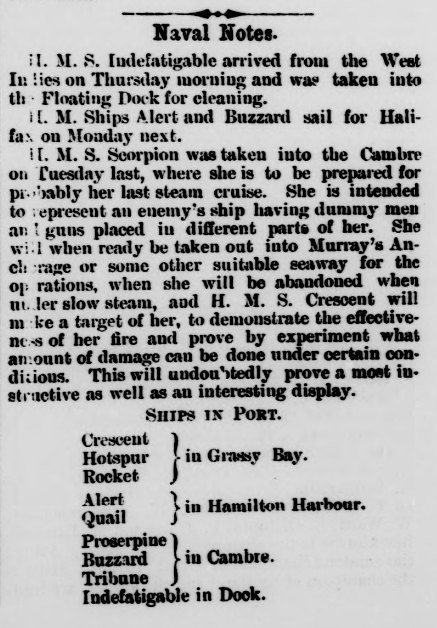
Royal Gazette Naval Notes: H. M. S. Indefatigable arrived from the West Indies on Thursday morning and was taken into the Floating Dock for cleaning; H. M. Ships Alert and Buzzard sail for Halifax on Monday next; H. M. S. Scorpion to be prepared as a target; Ships in Port: Crescent, Hotspur and Rocket in Grassy Bay, Alert and Quail in Hamilton Harbour, Proserpine, Buzzard and Tribune in Cambre, Indefatigable in Dock
Royal Gazette, 20 April 1901: into the Floating Dock, and “Indefatigable in Dock”
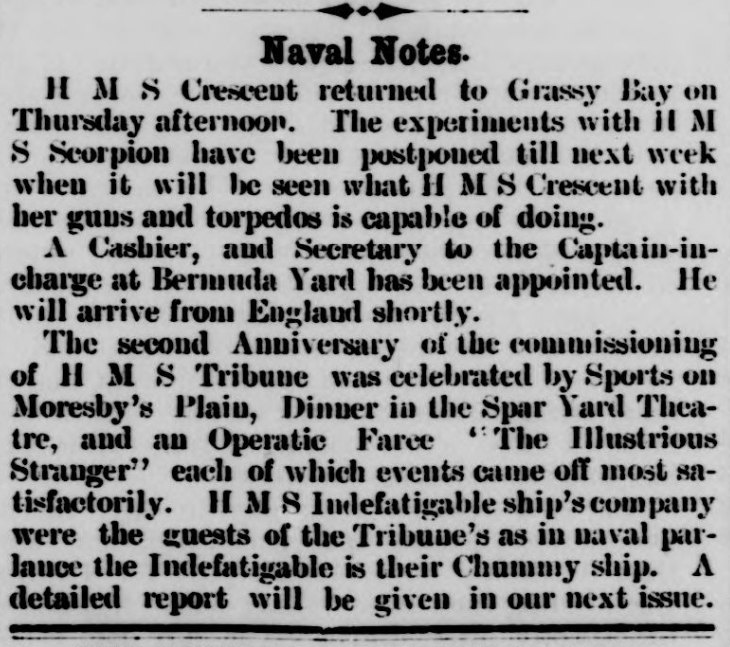
Royal Gazette Naval Notes: the second anniversary of the commissioning of H M S Tribune was celebrated by sports on Moresby's Plain, dinner in the Spar Yard Theatre and an operatic farce, The Illustrious Stranger; H M S Indefatigable ship's company were the guests of the Tribune's as in naval parlance the Indefatigable is their Chummy ship
Royal Gazette, 11 May 1901: the Tribune’s “Chummy ship”
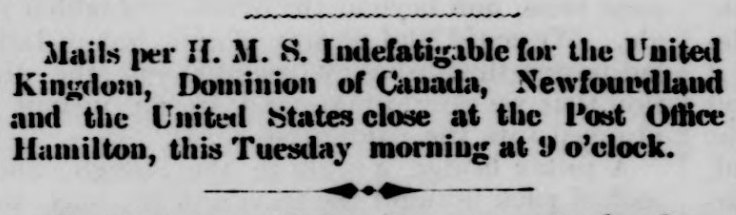
Royal Gazette notice: Mails per H. M. S. Indefatigable for the United Kingdom, Dominion of Canada, Newfoundland and the United States close at the Post Office Hamilton, this Tuesday morning at 9 o'clock
Royal Gazette, 25 June 1901: mails per H.M.S. Indefatigable
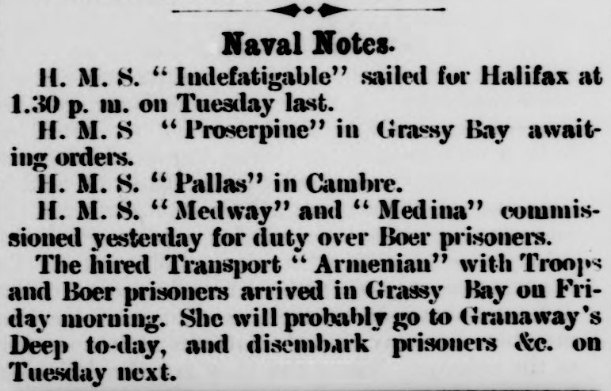
Royal Gazette Naval Notes: H. M. S. Indefatigable sailed for Halifax at 1.30 p.m. on Tuesday last; Proserpine in Grassy Bay awaiting orders; Pallas in Cambre; Medway and Medina commissioned for duty over Boer prisoners; the hired transport Armenian with troops and Boer prisoners arrived in Grassy Bay
Royal Gazette, 29 June 1901: sailed for Halifax
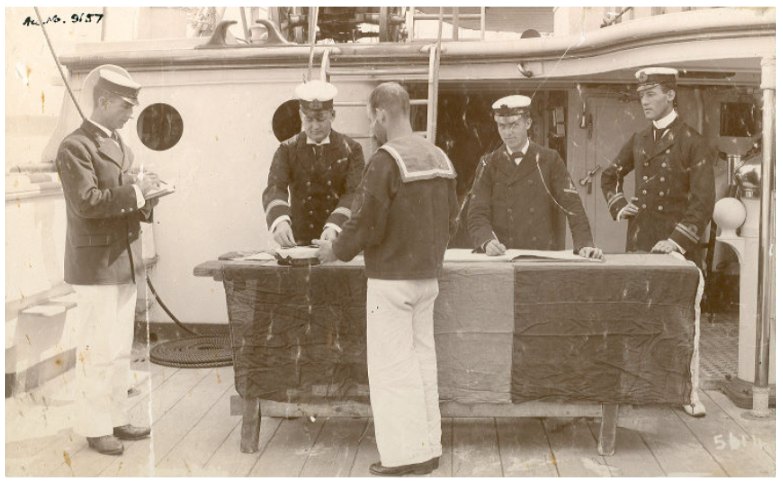
Sepia photograph on the deck of H.M.S. Indefatigable: officers in frock coats and caps stand at a table covered with a flag, one writing in a ledger, as a sailor in a jumper and white trousers comes up to be paid
Pay day on board H.M.S. Indefatigable at Halifax, where she was headed. Photograph by the Notman Studio, published in Halifax and Its Attractions, 1902. Nova Scotia Archives

The Indefatigable had been in the West Indies. On 13 April the Gazette reported “H. M. S. Psyche for Barbados to relieve Indefatigable.” A week later it had her back:

“H. M. S. Indefatigable arrived from the West Indies on Thursday morning and was taken into the Floating Dock for cleaning.”

Royal Gazette, 20 April 1901

That was Thursday 18 April. The list of ships in port ends simply “Indefatigable in Dock.” So when this letter reached Ireland Island on 25 April, Lieutenant Strickland’s ship was high and dry in the Dockyard. On 7 May she was “still in Dock.”

She stayed in Bermuda well into June. On 9 May her men were guests at the Tribune’s second commissioning anniversary: sports on Moresby’s Plain, then dinner and an operatic farce in the Spar Yard Theatre. The Gazette explained that “in naval parlance the Indefatigable is their Chummy ship.” Through May and early June the notes say she “remains for the present.” She had steam trials in the third week of June. Then, on Tuesday 25 June, the Gazette carried this notice:

“Mails per H. M. S. Indefatigable for the United Kingdom, Dominion of Canada, Newfoundland and the United States close at the Post Office Hamilton, this Tuesday morning at 9 o’clock.”

Royal Gazette, 25 June 1901

She “sailed for Halifax at 1.30 p. m.” that afternoon, carrying the colony’s mail. I like that the ship this letter was sent to ended her stay by carrying everyone else’s.

IV

Lieutenant Strickland

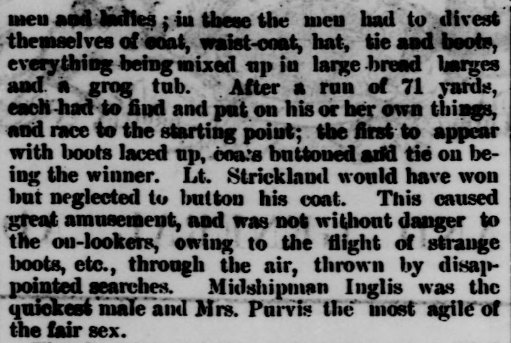
Royal Gazette report of the Crescent's At Home: in the jumble race the men had to divest themselves of coat, waist-coat, hat, tie and boots, everything mixed up in large bread barges and a grog tub; after a run of 71 yards each had to find and put on his or her own things and race back; Lt. Strickland would have won but neglected to button his coat, which caused great amusement and was not without danger to the on-lookers, owing to the flight of strange boots through the air; Midshipman Inglis was the quickest male and Mrs. Purvis the most agile of the fair sex
Royal Gazette, 25 May 1901: the jumble race at the Crescent’s “At Home”

The Gazette introduced the Crescent’s gymkhana like this: “From early morning on Monday 21st of May the men of H. M. S. Crescent were busy preparing Moresby’s plain for a gymkana ‘at home.’” The Gazette has it as Monday 21st of May, but the 21st was a Tuesday, so it must have been Monday the 20th. Even the Gazette slipped up now and then.

A gymkhana, which the Gazette spells “gymkana”, was an afternoon of novelty races and games of skill, part sports day and part garden party. The word came from British India, where it first meant a sports ground, and the Army and Navy took both the word and the idea with them around the world. This one had tent-pegging on bicycles with oranges for pegs and boarding pikes for lances, putting on the golf green, a potato race for the ladies, and the Admiral handing out the prizes at the end. “Almost all Bermuda was there,” including the Governor and the Admiral. One event was a “jumble” race. The men’s coats, waistcoats, hats, ties and boots went into large bread barges and a grog tub, and the first runner back dressed, with boots laced and coat buttoned, was the winner:

“Lt. Strickland would have won but neglected to button his coat. This caused great amusement, and was not without danger to the on-lookers, owing to the flight of strange boots, etc., through the air, thrown by disappointed searches.”

Royal Gazette, 25 May 1901

The Gazette doesn’t name his ship, but the Indefatigable was in port and I’ve found no other Lieutenant Strickland on the station. I’m almost certain it’s our man.

He was Charles Walter Campbell Strickland, born on 27 February 1873, the son of Walter Kennedy Strickland, of the Stricklands of Boynton, and Alice Christian Campbell. He had been a lieutenant since 31 December 1894 and was promoted to commander on 31 December 1904. He spent most of his later career in harbours: King’s Harbour Master at Plymouth from 1909 to 1912, brief commands of the old Theseus and Mars, then King’s Harbour Master at Pembroke through most of the war. In June 1918 he went to Sheerness as Assistant King’s Harbour Master. Three months later, on 14 September 1918, he was killed in a railway accident, just before the war ended. He is buried in Charlton Cemetery, Greenwich.
Nine weeks at Bermuda

The ship on one side, the letter on the other.

The Indefatigable
The letter
11 Jan 1901
The stampThe ONE FARTHING surcharge is issued.
13 Apr
The shipPsyche sails to relieve her in the West Indies.
18 Apr
The shipArrives from the West Indies and goes into the Floating Dock.
24 Apr
The letterRegistered at Hamilton, code C.
25 Apr
The letterArrives at Ireland Island.
7 May
The ship“Still in Dock.”
9 May
The shipGuests of the Tribune, her “Chummy ship”.
20 May
StricklandThe unbuttoned coat at the Crescent gymkhana (the Gazette says 21st).
20–22 Jun
The shipSteam trials.
25 Jun
The shipCarries the mails; sails for Halifax at 1.30 p.m.
1903

A newspaper for the captain

V

The wrapper

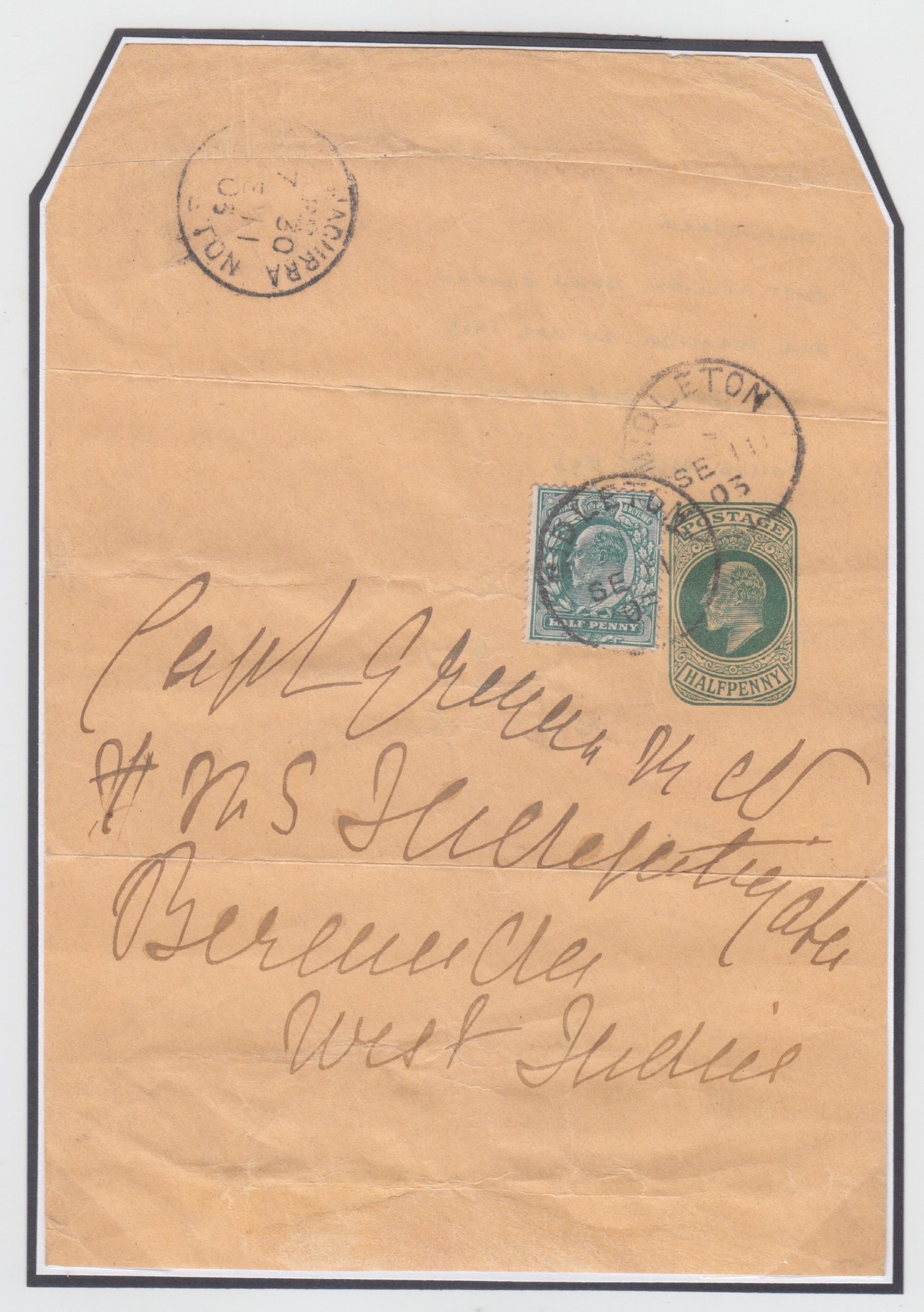
Buff Great Britain halfpenny King Edward VII newspaper wrapper with an extra halfpenny King Edward VII stamp, both cancelled by Midleton datestamps of SE 11 03, a second Midleton strike above, an Owenacurra datestamp at top left, and the address in a large looping hand: Capt Grogan R.N., H.M.S. Indefatigable, Bermuda, West Indies
Posted at Owenacurra, County Cork, 11 September 1903, to Captain Grogan
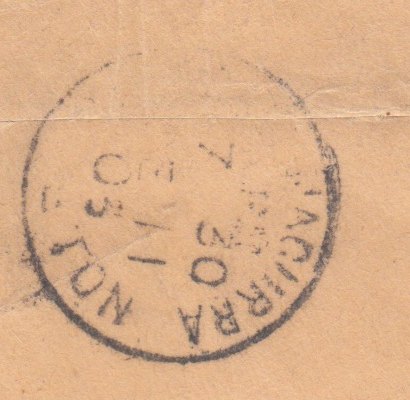
Close-up of the Owenacurra single-circle datestamp, struck at an angle, 7.30 p.m., 11 September 1903
Owenacurra, 7.30 p.m., 11 September 1903
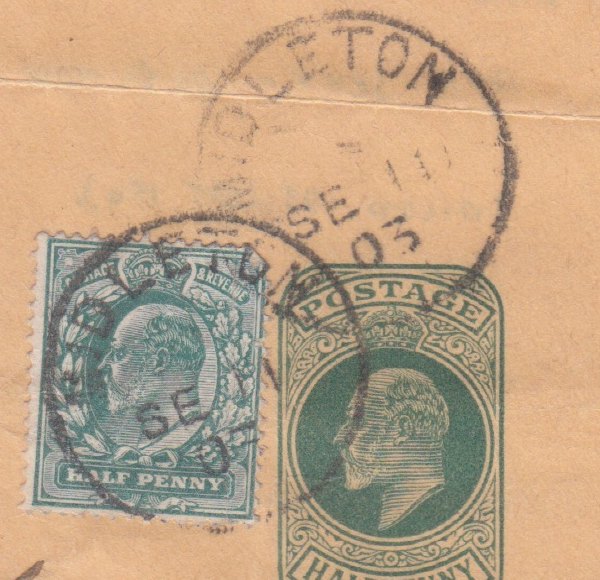
Close-up of the halfpenny blue-green King Edward VII stamp and the printed halfpenny wrapper stamp, both cancelled by Midleton datestamps, SE 11 03
The two halfpennies, cancelled at Midleton the same day
  • Addressed to Capt. Grogan R.N., H.M.S. Indefatigable, Bermuda, West Indies
  • Franking ½d KEVII newspaper wrapper, uprated with a ½d KEVII stamp
  • Rate 1d: printed papers abroad, ½d per 2 oz
  • Datestamps Owenacurra, 7.30 p.m., 11 September 1903; Midleton, 11 September 1903

This is a British ½d King Edward VII newspaper wrapper, uprated with a ½d stamp, and addressed in a big looping hand to Captain Grogan of the Indefatigable. Whatever paper it held is long gone, but the wrapper kept its postmarks.

“Capt Grogan R.N. / H.M.S. Indefatigable / Bermuda / West Indies”

The address

Top left is a datestamp of Owenacurra, 7.30 p.m. on 11 September 1903. The Owenacurra is the river that runs through Midleton in east County Cork, and this looks like a small sub-office named after it, sending its mail on to Midleton. Both stamps are cancelled at Midleton the same day.

1d paid for a newspaper of up to about 4 oz at the overseas printed-paper rate of ½d per 2 oz. Midleton is only a few miles from Queenstown, where the Atlantic liners called, so I’d guess it crossed to New York and came down to Bermuda on the mail steamer, perhaps ten days or so in all. That would put it in Bermuda around 20–24 September.

VI

A summer at the Dockyard

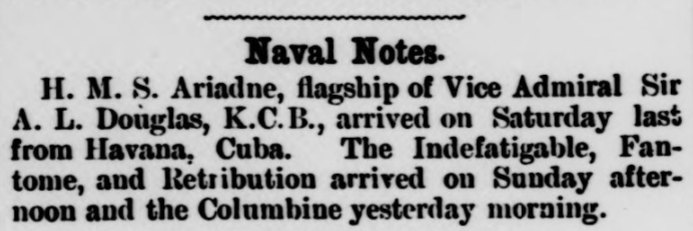
Royal Gazette Naval Notes: H. M. S. Ariadne, flagship of Vice Admiral Sir A. L. Douglas, K.C.B., arrived on Saturday last from Havana, Cuba; the Indefatigable, Fantome and Retribution arrived on Sunday afternoon and the Columbine yesterday morning
Royal Gazette, 24 March 1903: in from Havana on Sunday afternoon
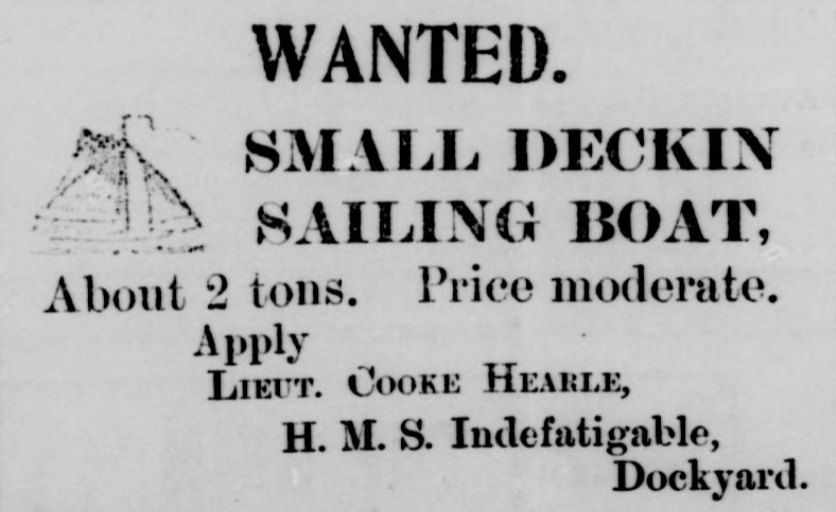
Royal Gazette advertisement with a small woodcut of a sailing boat: WANTED, Small Deckin Sailing Boat, about 2 tons, price moderate, apply Lieut. Cooke Hearle, H.M.S. Indefatigable, Dockyard
Royal Gazette, 2 June 1903: Lieutenant Cooke-Hurle wants a boat
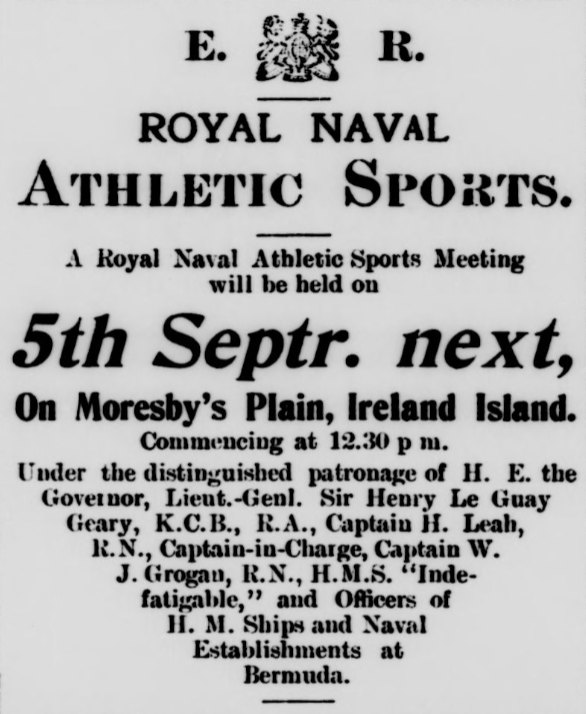
Royal Gazette notice headed E R with the royal arms: Royal Naval Athletic Sports Meeting to be held on 5th September next on Moresby's Plain, Ireland Island, commencing at 12.30 p.m., under the patronage of the Governor, Lieut.-Genl. Sir Henry Le Guay Geary, Captain H. Leah, R.N., Captain-in-Charge, Captain W. J. Grogan, R.N., H.M.S. Indefatigable, and officers of H.M. Ships and Naval Establishments at Bermuda
Royal Gazette, 14 July 1903: the sports notice, naming Captain W. J. Grogan
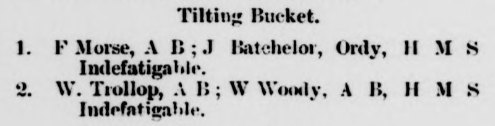
Royal Gazette prize list: Tilting Bucket, 1. F Morse, A B and J Batchelor, Ordy, H M S Indefatigable; 2. W. Trollop, A B and W Woody, A B, H M S Indefatigable
Royal Gazette, 12 September 1903: first and second in the Tilting Bucket

The Indefatigable came up from the West Indies with the squadron in March 1903. She left Kingston for Havana on 12 March, and the Gazette of 24 March reported that she had “arrived on Sunday afternoon”, the 22nd. In early April she was in Grassy Bay and “will shortly come into Cambre.”

After that the Gazette goes quiet about her, but her officers didn’t. At the end of May an advert ran:

“WANTED, Small Deckin Sailing Boat, about two tons, price moderate. Apply Lieut. Cooke Hearle, H.M.S. Indefatigable, Dockyard.”

Royal Gazette, 30 May 1903

The paper spells him that way in the advert. In September it gives him as Lieutenant W. A. Cooke-Hurle of the Royal Marines. I like to think he got his boat for the summer.

On Saturday 5 September came the Royal Naval Athletic Sports on Moresby’s Plain, “under the distinguished patronage of” the Governor, the Captain-in-Charge and “Captain W. J. Grogan, R.N., H.M.S. ‘Indefatigable’.” Her men did well. Private Keane of the Royal Marines was placed in the 100 yards and the obstacle race, and her sailors were second and third in the three-legged race. They also took first and second in the Tilting Bucket, which the Gazette says “caused a lot of ducking to the competitors and a fund of merriment to the onlookers.”

VII

The bridge and the storm

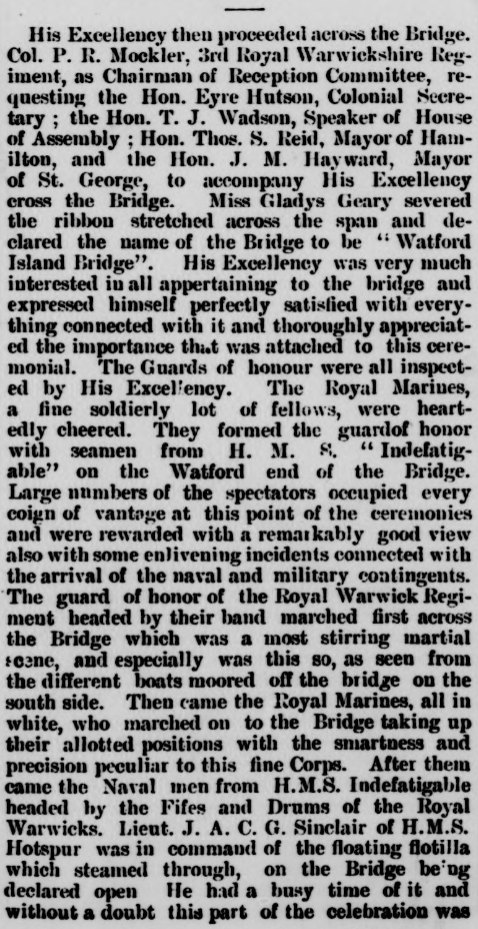
Royal Gazette report of the opening of the Watford Island Bridge: Miss Gladys Geary severed the ribbon and declared the name of the bridge; the Royal Marines formed the guard of honour with seamen from H. M. S. Indefatigable on the Watford end of the bridge; the naval men from H.M.S. Indefatigable were headed by the Fifes and Drums of the Royal Warwicks
Royal Gazette, 26 September 1903: the guard of honour at Watford Island Bridge
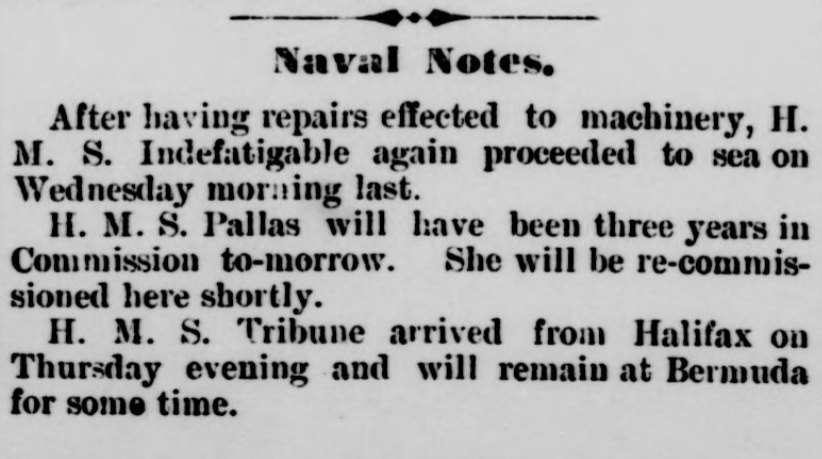
Royal Gazette Naval Notes: after having repairs effected to machinery, H. M. S. Indefatigable again proceeded to sea on Wednesday morning last; H. M. S. Pallas three years in commission; H. M. S. Tribune arrived from Halifax on Thursday evening
Royal Gazette, 10 October 1903: “again proceeded to sea”

On Thursday 24 September the Governor opened the Watford Island Bridge, linking Somerset to Watford, Boaz and Ireland Islands and doing away with the old horse ferry. The Indefatigable provided the guard of honour at the Watford end: Royal Marines “all in white”, then “the Naval men from H.M.S. Indefatigable headed by the Fifes and Drums of the Royal Warwicks.” Lieutenant Cooke-Hurle sat on the reception committee. So the ship was very much still in Bermuda when this wrapper would have arrived.

Four days later, on 28 September, the worst gale since 1899 swept over Bermuda, wrecking property at Boaz and Ireland Island. Somerset, with its four-day-old bridge, escaped lightly. I don’t know whether the Indefatigable was at sea or in port that day. All the Gazette tells me is this:

“After having repairs effected to machinery, H. M. S. Indefatigable again proceeded to sea on Wednesday morning last.”

Royal Gazette, 10 October 1903

That was 7 October. The word “again” suggests she’d already tried once. She reached Halifax on 30 October.

VIII

Captain Grogan

The wrapper’s addressee was the ship’s captain, William John Grogan, born in 1858. He commanded the Indefatigable from August 1902 to January 1905. A Royal Navy captain with a newspaper sent from east Cork makes me wonder whether he had family near Midleton, but that’s only a guess.

His later career wasn’t a happy one. In February 1906 he took command of the armoured cruiser Donegal. Within weeks she ran aground near Suez, and the court martial found him at fault and severely reprimanded him. He retired as a rear-admiral. In November 1914 he went back to sea as a temporary captain in the Royal Naval Reserve, commanding the armed yacht Sapphire II, and he drowned on 14 March 1915.

A summer at Bermuda, 1903

The ship on one side, the wrapper on the other.

The Indefatigable
The wrapper
12 Mar 1903
The shipSails from Kingston for Havana.
22 Mar
The shipArrives at Bermuda from Havana.
Early Apr
The shipIn Grassy Bay, then into the Cambre.
End May
The shipLieutenant Cooke-Hurle wants a sailing boat.
5 Sep
The shipRoyal Naval Athletic Sports on Moresby’s Plain.
11 Sep
The wrapperPosted at Owenacurra, 7.30 p.m.; Midleton the same day.
c. 20–24 Sep
The wrapperProbably reaches Bermuda.
24 Sep
The shipGuard of honour at the Watford Island Bridge.
28 Sep
BermudaThe great gale.
7 Oct
The shipSails again after machinery repairs.
30 Oct
The shipArrives at Halifax.
7 Nov
The shipTo Sydney, Cape Breton.
22 Nov
The shipSails from Halifax for Bermuda.
15 Dec
The shipAt Port Royal, Jamaica.

The Ship

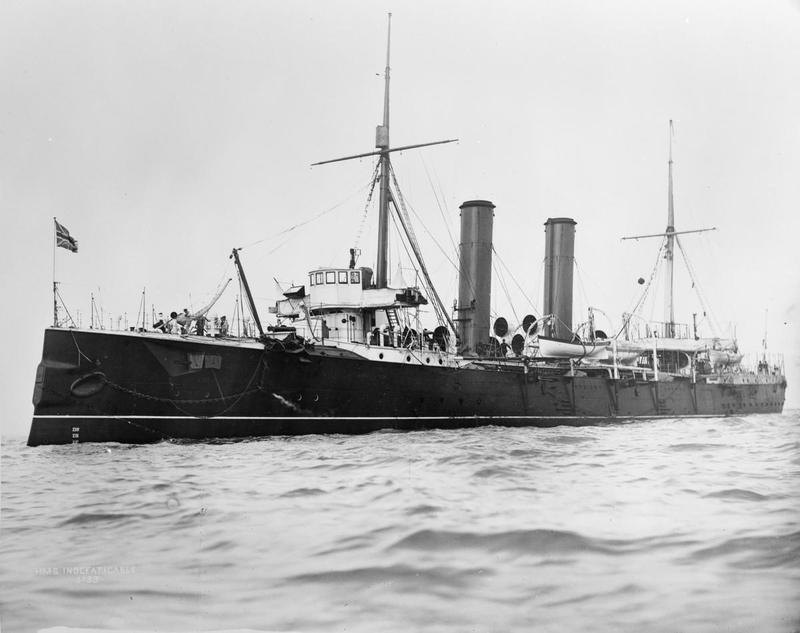
Photograph of the cruiser HMS Indefatigable at anchor in 1894, a long black hull with two tall funnels, two masts with yards, boats along her sides and the white ensign flying at the stern

H.M.S. Indefatigable

H.M.S. Indefatigable was an Apollo-class second-class protected cruiser, built by the London and Glasgow Shipbuilding Company at Govan and launched on 12 March 1891. She was one of the ten of her class sheathed in wood and copper for tropical service. She was on the North America and West Indies Station from 1899 to 1903, mostly at Halifax and Bermuda, and was recommissioned at Bermuda in January 1900. In December 1902 she was sent to join the Anglo-German blockade of Venezuela. She went into reserve at Portsmouth in 1905, came back to the station with the 4th Cruiser Squadron in 1906, and was renamed Melpomene on 11 January 1910 so the name could go to a new battlecruiser. That battlecruiser was the Indefatigable lost at Jutland. The old cruiser was sold for breaking up on 7 October 1913.

BuiltGovan, launched 12 March 1891
TypeApollo-class second-class cruiser, 3,400 tons
GunsTwo 6-inch, six 4.7-inch
StationNorth America & West Indies, 1899–1903
CaptainW. J. Grogan (1902–05)
FateRenamed Melpomene 1910; sold 1913

Photograph, 1894: Imperial War Museum (Q 21381), via Wikimedia Commons.

Still to find out

If you can help with any of these, I’d be very pleased to hear from you.

References

Two plain pieces of paper, two years apart: one sent across the Sound to a lieutenant whose ship was in dock, and one sent across the Atlantic to a captain whose men were lining a brand-new bridge.