Postal History · Royal Navy · North America and West Indies Station

H.M.S. Medina

Bermuda · 22 November 1903

A Dockyard postcard home to Deal from one of Bermuda’s two flat-iron gunboats.

◆

This is a plain picture postcard of the Dockyard, but the writer has headed it “H.M.S. Medina, Bermuda, 22.11.03”. That puts it in the last few months of the ship’s naval life. Medina and her sister Medway were two odd little “flat-iron” gunboats that spent years at the Dockyard, and in 1901 they were brought out of reserve to guard the Boer prisoner islands. I like the card because it’s so ordinary: a sailor saying thank you for something that came in the last mail.

I

The card

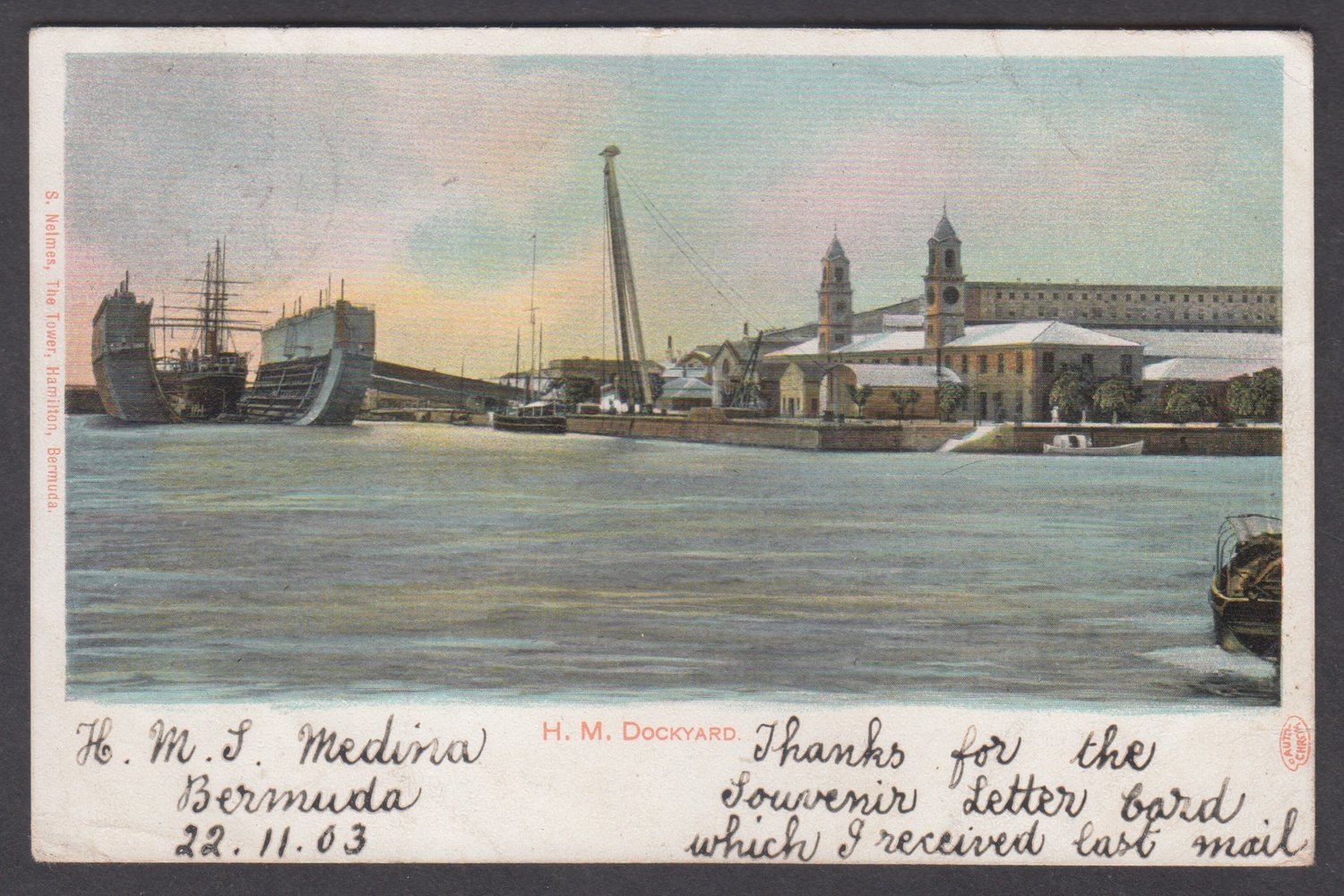
Coloured picture postcard of H.M. Dockyard, Bermuda, published by S. Nelmes, The Tower, Hamilton: the floating dock with a ship inside it on the left, the Dockyard clock towers and buildings on the right, calm water in the foreground; along the bottom, in ink, H.M.S. Medina, Bermuda, 22.11.03, Thanks for the Souvenir Letter Card which I received last mail
S. Nelmes’ view of H.M. Dockyard, written aboard Medina on 22 November 1903
  • Card Coloured picture postcard, “H.M. Dockyard”, S. Nelmes, The Tower, Hamilton
  • Headed H.M.S. Medina, Bermuda, 22.11.03
  • Addressed to Mr S. Baker, 123 Middle Street, Deal, Kent, England
  • Postmark Mangrove Bay, part strike
  • Stamp Removed

The picture is S. Nelmes’ coloured view of H.M. Dockyard, published from The Tower in Hamilton. The floating dock is on the left with a ship inside it, and the Dockyard clock towers are on the right. It has an undivided back, marked “This side for address only”, so the message had to squeeze in along the bottom of the picture:

“H.M.S. Medina / Bermuda / 22.11.03 / Thanks for the Souvenir Letter Card which I received last mail”

The message

There’s no signature. The card is addressed to Mr S. Baker, 123 Middle Street, Deal, Kent. Deal was a naval town, and I suspect the souvenir letter card was a Deal one, sent out to remind him of home, but that’s a guess for now.

Someone has removed the stamp, leaving a thinned patch on the back. Only the edge of the datestamp survives, reading “MANG…”, which is Mangrove Bay in Somerset. I’d have expected a card from a Dockyard ship to go through Ireland Island, so perhaps the writer was ashore in Somerset that day.
II

Out to Bermuda

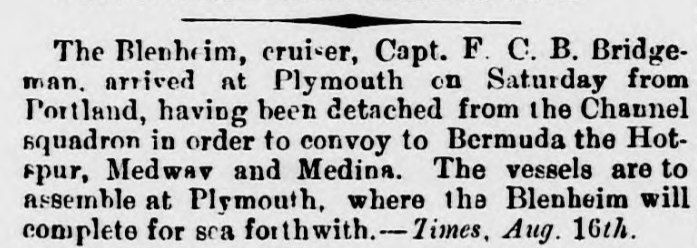
Royal Gazette, quoting the Times of 16 August: the Blenheim, cruiser, Capt. F. C. B. Bridgeman, arrived at Plymouth on Saturday from Portland, having been detached from the Channel squadron in order to convoy to Bermuda the Hotspur, Medway and Medina; the vessels are to assemble at Plymouth, where the Blenheim will complete for sea forthwith
Royal Gazette, 31 August 1897: the convoy assembles at Plymouth
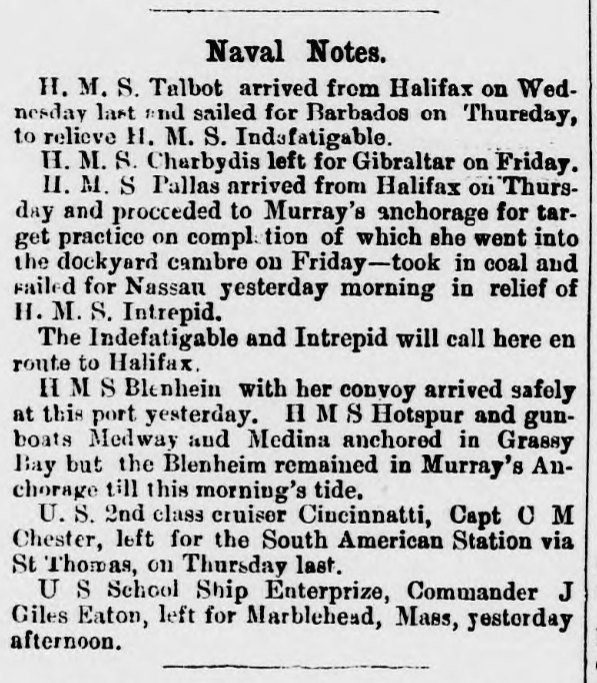
Royal Gazette Naval Notes: Talbot arrived from Halifax and sailed for Barbados; Charybdis left for Gibraltar; Pallas arrived from Halifax; H M S Blenheim with her convoy arrived safely at this port yesterday; H M S Hotspur and gunboats Medway and Medina anchored in Grassy Bay but the Blenheim remained in Murray's Anchorage till this morning's tide
Royal Gazette, 28 September 1897: “arrived safely at this port yesterday”

Medina and Medway didn’t come out on their own. In August 1897 the cruiser Blenheim was detached from the Channel Squadron to escort them and the old turret ship Hotspur, Bermuda’s new port guardship, across the Atlantic. The little gunboats carried sails, but they weren’t built for ocean work. The four ships assembled at Plymouth.

They arrived on Monday 27 September 1897. The Gazette reported the next day:

“H M S Blenheim with her convoy arrived safely at this port yesterday.”

Royal Gazette, 28 September 1897

Hotspur and the “gun-boats Medway and Medina” anchored in Grassy Bay, while Blenheim stayed in Murray’s Anchorage until the morning tide.

III

Guarding the Boer prisoners

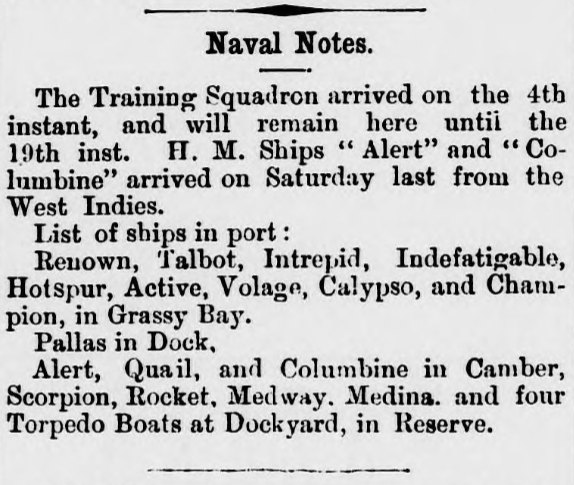
Royal Gazette Naval Notes: the Training Squadron arrived on the 4th instant; Alert and Columbine arrived from the West Indies; list of ships in port: Renown, Talbot, Intrepid, Indefatigable, Hotspur, Active, Volage, Calypso and Champion in Grassy Bay; Pallas in Dock; Alert, Quail and Columbine in Camber; Scorpion, Rocket, Medway, Medina and four Torpedo Boats at Dockyard, in Reserve
Royal Gazette, 8 March 1898: “at Dockyard, in Reserve”
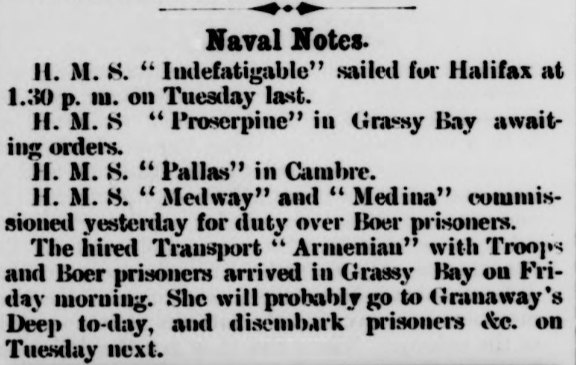
Royal Gazette Naval Notes: Indefatigable sailed for Halifax on Tuesday last; Proserpine in Grassy Bay awaiting orders; Pallas in Cambre; H. M. S. Medway and Medina commissioned yesterday for duty over Boer prisoners; the hired transport Armenian with troops and Boer prisoners arrived in Grassy Bay on Friday morning
Royal Gazette, 29 June 1901: “commissioned yesterday for duty over Boer prisoners”
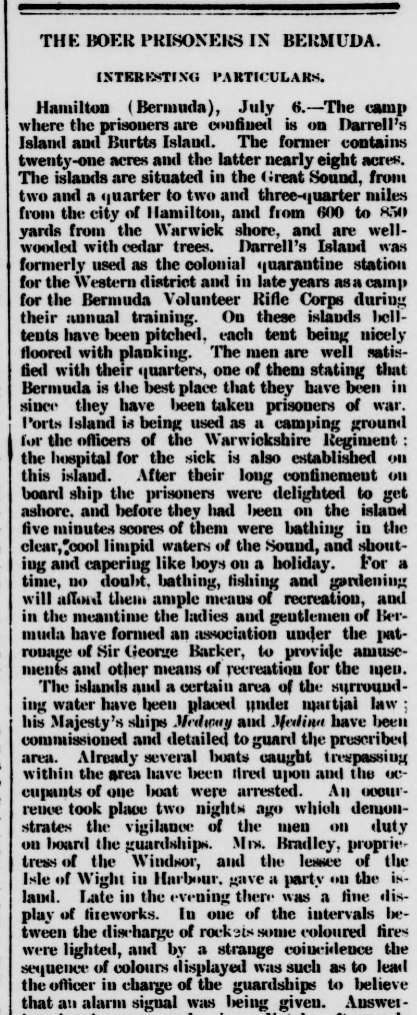
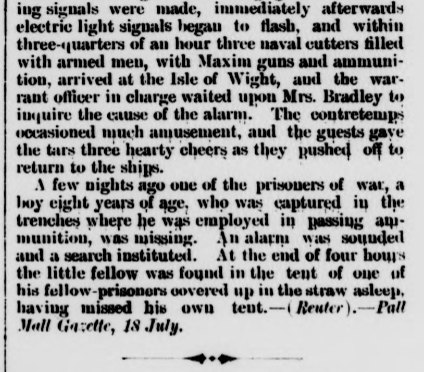
Royal Gazette, The Boer Prisoners in Bermuda, Interesting Particulars, Hamilton, July 6: describes the camps on Darrell's and Burtts Islands in the Great Sound; the islands and the surrounding water placed under martial law; His Majesty's ships Medway and Medina commissioned and detailed to guard the area; boats trespassing fired upon; Mrs Bradley, proprietress of the Windsor and lessee of the Isle of Wight in Harbour, gave a party with fireworks, and the sequence of coloured fires led the officer in charge of the guardships to believe an alarm signal was being given
Royal Gazette, 17 August 1901: “The Boer Prisoners in Bermuda”
Continuation of the Royal Gazette article: answering signals were made, electric light signals began to flash, and within three-quarters of an hour three naval cutters filled with armed men, with Maxim guns and ammunition, arrived at the Isle of Wight; the guests gave the tars three hearty cheers as they pushed off; also the story of an eight-year-old prisoner found asleep in another tent; Reuter, Pall Mall Gazette, 18 July
The article continued: the false alarm, from the Pall Mall Gazette, 18 July 1901

For the next few years there wasn’t much for them to do. By March 1898 the Gazette lists them at the Dockyard “in Reserve”, alongside Scorpion, Rocket and four torpedo boats.

The Boer War changed that. Bermuda was chosen to hold prisoners of war, and the first camps were on Darrell’s Island and its neighbour in the Great Sound. The two gunboats were made ready for guard duty, and on Saturday 29 June 1901 the Gazette reported them:

“commissioned yesterday for duty over Boer prisoners.”

Royal Gazette, 29 June 1901

The hired transport Armenian had come into Grassy Bay with the first prisoners that same Friday morning. The islands and the water around them were put under martial law, and boats that strayed into the area were fired on.

My favourite piece is a Reuter report from Hamilton, picked up by the Pall Mall Gazette and reprinted in the Royal Gazette that August. Mrs Bradley, proprietress of the Windsor and lessee of the “Isle of Wight in Harbour”, gave an evening party on the island with fireworks. Between the rockets some coloured fires were lit, and by chance the order of the colours matched an alarm signal. The officer in charge of the guardships took it as one:

“within three-quarters of an hour three naval cutters filled with armed men, with Maxim guns and ammunition, arrived at the Isle of Wight”

Royal Gazette, 17 August 1901

The guests gave the sailors three cheers as they pushed off. I can’t say whether those cutters came from Medina or Medway, but I like that a ship named after the river on the Isle of Wight ended up guarding one.

IV

Slate grey and up for sale

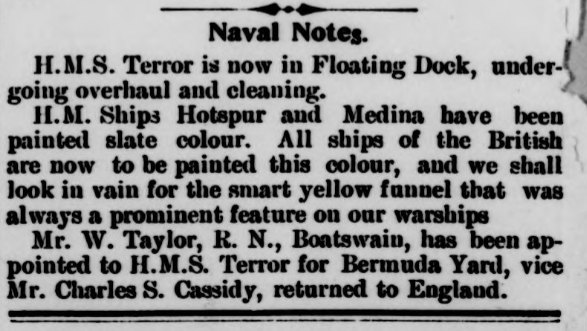
Royal Gazette Naval Notes: H.M.S. Terror is now in Floating Dock undergoing overhaul and cleaning; H.M. Ships Hotspur and Medina have been painted slate colour; all ships of the British are now to be painted this colour, and we shall look in vain for the smart yellow funnel that was always a prominent feature on our warships; Mr W. Taylor, R.N., Boatswain, appointed to H.M.S. Terror
Royal Gazette, 6 January 1903: “painted slate colour”
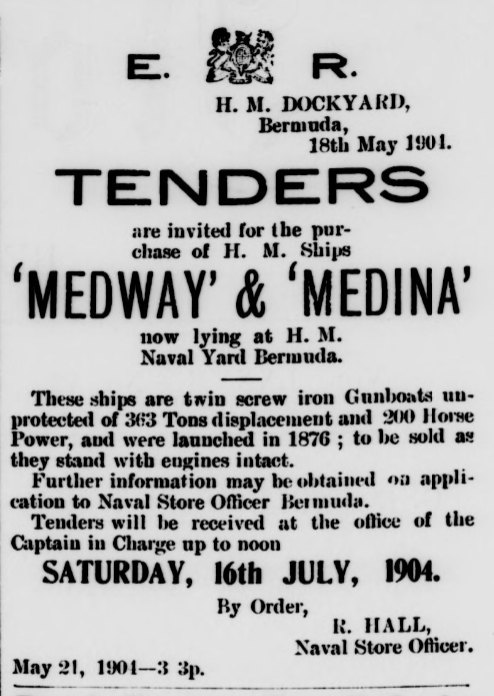
Royal Gazette notice headed E.R. with the royal arms: H.M. Dockyard, Bermuda, 18th May 1904; Tenders are invited for the purchase of H.M. Ships Medway and Medina now lying at H.M. Naval Yard Bermuda; these ships are twin screw iron Gunboats unprotected of 363 Tons displacement and 200 Horse Power, and were launched in 1876; to be sold as they stand with engines intact; tenders will be received at the office of the Captain in Charge up to noon Saturday, 16th July, 1904; by order, R. Hall, Naval Store Officer
Royal Gazette, 24 May 1904: tenders invited for “Medway” and “Medina”

By January 1903 the old paint scheme was on its way out. The Gazette of 6 January noted that “Hotspur and Medina have been painted slate colour”, and was sorry about it:

“we shall look in vain for the smart yellow funnel that was always a prominent feature on our warships”

Royal Gazette, 6 January 1903

So when my card was written that November, Medina was a grey ship.

She didn’t last much longer. On 18 May 1904 the Naval Store Officer, R. Hall, invited tenders for “H. M. Ships ‘Medway’ & ‘Medina’ now lying at H. M. Naval Yard Bermuda.” The notice describes them as twin-screw iron gunboats of 363 tons and 200 horse power, launched in 1876, “to be sold as they stand with engines intact”. Tenders closed at noon on Saturday 16 July 1904. I haven’t yet found who bought her.

Seven years at Bermuda

The ship on one side, the card on the other.

The Medina
The card
3 Aug 1876
The shipLaunched by Palmers at Jarrow.
Aug 1897
The shipAssembles at Plymouth with Medway, Hotspur and Blenheim.
27 Sep 1897
The shipArrives at Bermuda and anchors in Grassy Bay.
Mar 1898
The shipIn reserve at the Dockyard.
28 Jun 1901
The shipCommissioned to guard the Boer prisoners.
Jul 1901
The shipThe fireworks false alarm at the Isle of Wight.
Jan 1903
The shipPainted slate colour.
22 Nov 1903
The cardWritten aboard and posted at Mangrove Bay to Deal.
18 May 1904
The shipOffered for sale at the Dockyard.
16 Jul 1904
The shipTenders close.

The Ship

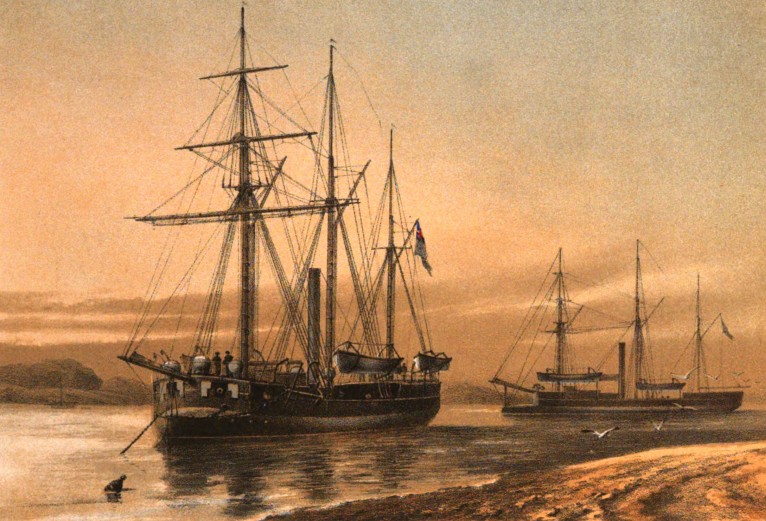
Colour lithograph of the gunboat Medina at anchor close to a sandy shore at dusk, with three masts, yards on the foremast, a single tall funnel, a low iron hull and the white ensign flying; a second gunboat of the same class lies further off to the right

H.M.S. Medina (1876)

Medina was the name ship of a class of twelve iron gunboats built by Palmers at Jarrow, and was launched on 3 August 1876. The Medinas were a development of George Rendel’s “flat-iron” gunboats: shallow, beamy hulls that carried a few heavy guns. Unusually for flat-irons, they were rigged as three-masted barquentines, and they had a bow rudder. She was first a tender to the Duke of Wellington at Portsmouth. She was re-armed in 1892, came out to Bermuda in 1897, and was offered for sale there in 1904.

Medway’s hull is thought to be the wreck at Meyer’s (Myers) Slip in St. George’s Harbour, surveyed by East Carolina University in 2008, although the archaeologists allowed that it could be either sister. What happened to Medina after the sale I don’t yet know.

She is not to be confused with the P&O liner Medina, commissioned as H.M.S. Medina in 1911 to carry King George V and Queen Mary to the Delhi Durbar.

BuiltPalmers, Jarrow, launched 3 August 1876
TypeMedina-class iron screw gunboat, 363 tons, 200 hp
Guns3 × 64-pdr as built; 2 × 4.7-inch QF from 1892
StationBermuda, 1897–1904
FateOffered for sale at Bermuda, 1904

H.M. Gun Boat Medina, colour lithograph after W. F. Mitchell, published 1 December 1880 by Griffin & Co., Portsmouth. She is shown as built, with her barquentine rig.

Still to find out

If you can help with any of these, I’d be very pleased to hear from you.

References

It’s a simple card, but it puts a man aboard Medina in her last year of service, still writing home from Bermuda the autumn before she was put up for sale.