Postal History · Royal Navy · Training Squadron

H.M.S. Active

Bermuda · January 1895

A Hamilton stamp dealer touts for business in a ship nobody could leave.

◆

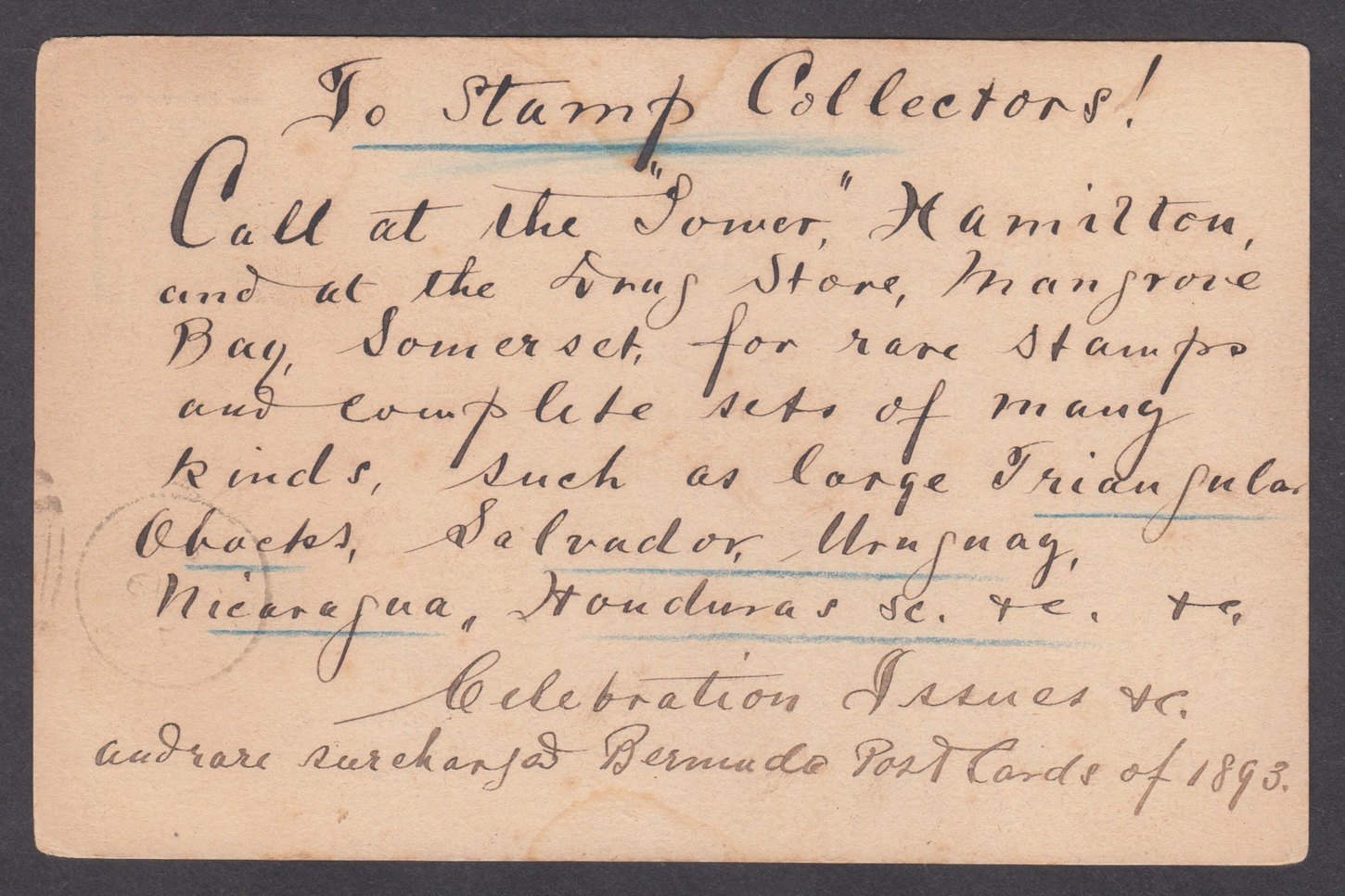
This is one of my favourite kinds of card, because it has nothing to do with the Navy’s business and everything to do with Bermuda’s. It’s a local halfpenny card from a Hamilton shop, written in a fine copperplate to “The Gun-Room Officers, H.M.S. ‘Active’, Ireland Island”, trying to sell them stamps. What makes me smile is that when it arrived, not one of them could get ashore to buy any.

I

“To Stamp Collectors!”

Message side of the card in a large copperplate hand: To Stamp Collectors! Call at the Tower, Hamilton, and at the Drug Store, Mangrove Bay, Somerset, for rare stamps and complete sets of many kinds, such as large Triangular Obocks, Salvador, Uruguay, Nicaragua, Honduras etc. Celebration Issues etc. and rare surcharged Bermuda Post Cards of 1893, with several words underlined in blue crayon
The message side, with the best words underlined in blue
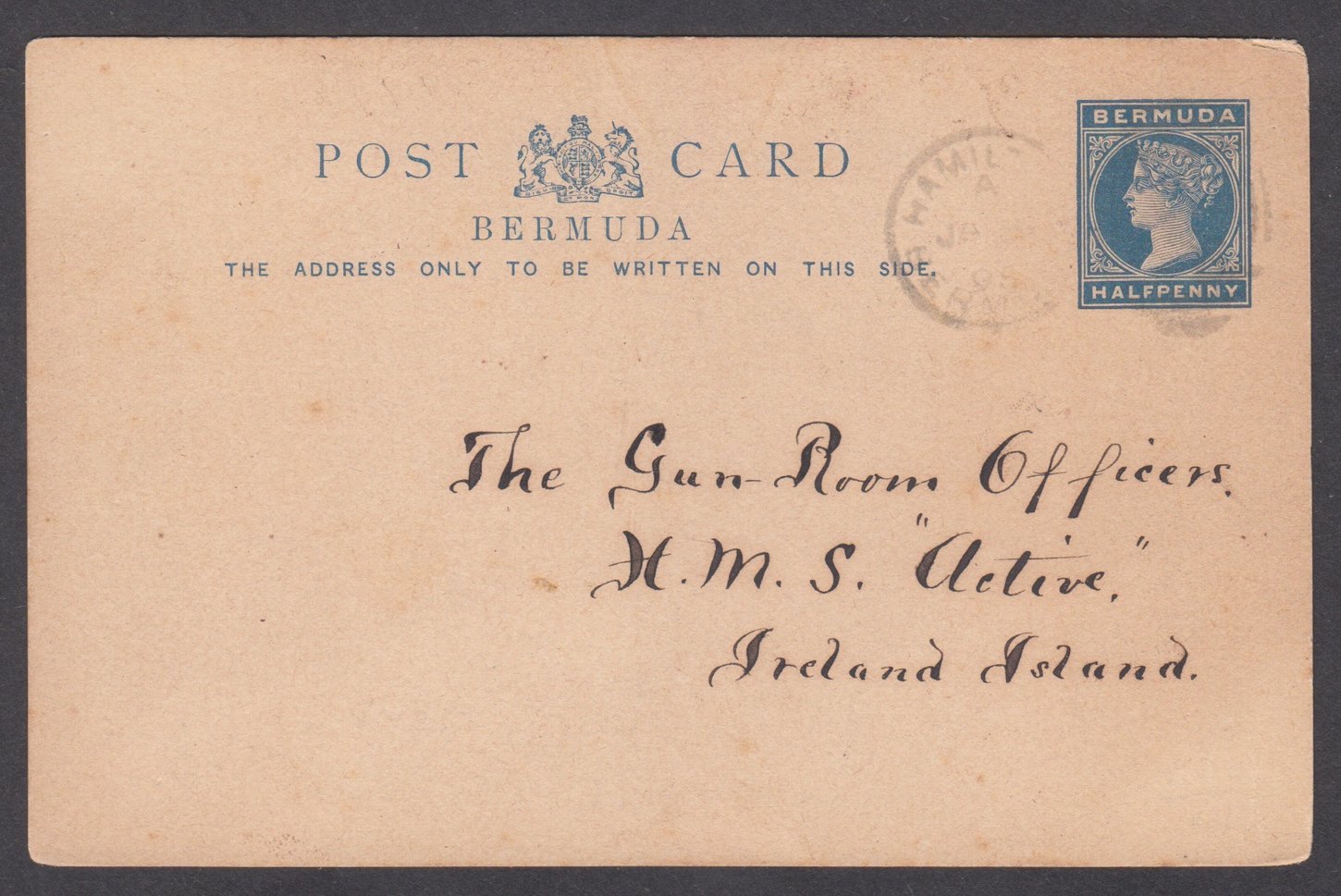
Bermuda halfpenny postal stationery card in blue, addressed in copperplate to The Gun-Room Officers, H.M.S. Active, Ireland Island, the printed stamp cancelled by the Hamilton duplex with code A and JA 95
The address side: to the gunroom of H.M.S. Active
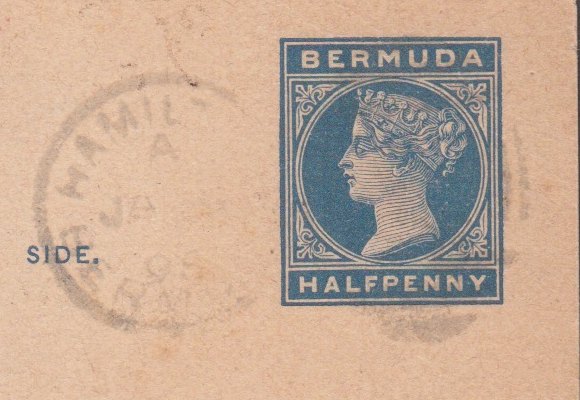
Close-up of the HAMILTON duplex datestamp, code letter A, January 1895, beside the printed halfpenny stamp
HAMILTON K4 duplex, A, January 1895
  • Card Bermuda ½d postal stationery card, local use
  • Despatch HAMILTON K4 duplex, A (morning), January 1895, day unreadable
  • Arrival IRELAND ISLAND K4 duplex, A (morning), JA 19 95, partial
  • From S. Nelmes, The Tower, Hamilton
  • Addressed to The Gun-Room Officers, H.M.S. Active, Ireland Island

“To Stamp Collectors! Call at the ‘Tower,’ Hamilton, and at the Drug Store, Mangrove Bay, Somerset, for rare stamps and complete sets of many kinds, such as large Triangular Obocks, Salvador, Uruguay, Nicaragua, Honduras &c. &c. &c. Celebration Issues &c. and rare surcharged Bermuda Post Cards of 1893.”

The card is the blue Bermuda halfpenny card for local use. It was posted at Hamilton and cancelled with the HAMILTON K4 duplex, code A, the morning collection, in January 1895, though the day can’t be read. On the back is a partial IRELAND ISLAND K4 duplex, also code A, which I read as 19 January 1895. So it was very likely posted at Hamilton and delivered at the Dockyard the same morning. The names of the stamps are underlined in blue crayon, as if the writer wanted the young men to see the exciting words first.

It’s addressed to the gunroom, not to anyone by name. The gunroom was the mess of the junior officers: the sub-lieutenants, midshipmen and naval cadets. Active was the flagship of the Training Squadron, so her gunroom would have been full of teenage boys, just the age for stamp collecting. Whoever wrote this knew his market.
II

S. Nelmes of The Tower

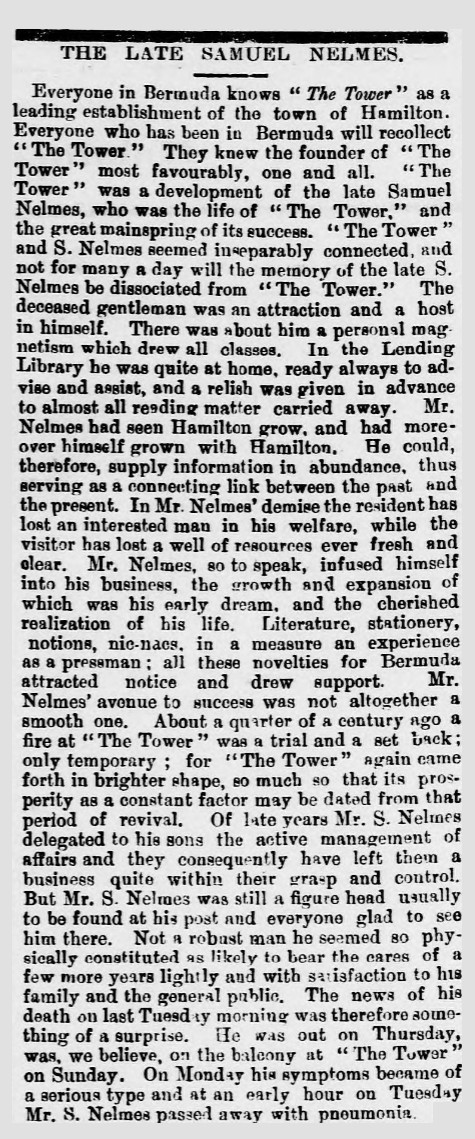
Royal Gazette obituary, The Late Samuel Nelmes: everyone in Bermuda knows The Tower as a leading establishment of the town of Hamilton; literature, stationery, notions, nic-nacs; of late years Mr S. Nelmes delegated to his sons the active management of affairs; the news of his death on last Tuesday morning was therefore something of a surprise
Royal Gazette, 2 April 1895: “The Late Samuel Nelmes” (opening part)
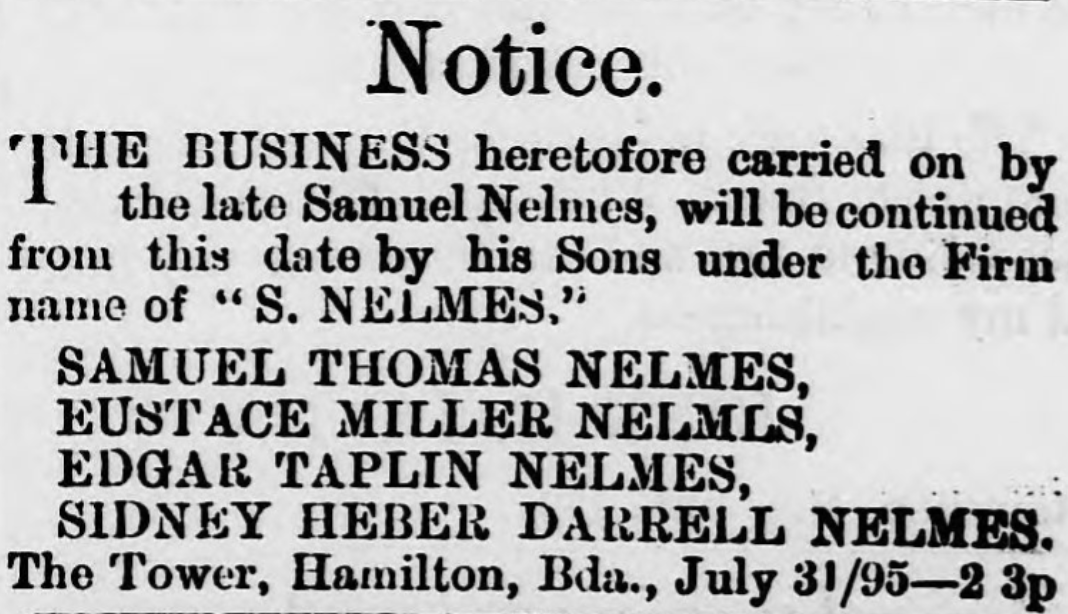
Royal Gazette notice: the business heretofore carried on by the late Samuel Nelmes will be continued from this date by his sons under the firm name of S. Nelmes: Samuel Thomas Nelmes, Eustace Miller Nelmes, Edgar Taplin Nelmes, Sidney Heber Darrell Nelmes. The Tower, Hamilton, July 31, 1895
Royal Gazette, July 1895: the sons carry on the business as “S. Nelmes”

The card isn’t signed, but The Tower was the business of S. Nelmes, one of Hamilton’s best-known shops and a name that ran through Bermuda trade for decades. When Samuel Nelmes died, the Gazette wrote that “everyone in Bermuda knows ‘The Tower’”. He had built it up from a lending library and stationer’s into a store for “literature, stationery, notions, nic-nacs” and novelties of every kind. By 1895 the firm was clearly dealing in stamps and postal stationery as well, and this card is the proof.

The timing is interesting. Samuel Nelmes died of pneumonia on 26 March 1895, about two months after this card was posted. His obituary says that in his last years he had handed the active management to his sons, though he was still to be found at his post. So the card was most likely the work of one of the four sons, Samuel Thomas, Eustace Miller, Edgar Taplin or Sidney Heber Darrell Nelmes, who carried the business on under the old name, “S. Nelmes”.

The list is a snapshot of what was exciting in stamps in 1895. The big triangular stamps of Obock, the French colony on the Gulf of Aden, were brand new and just the sort of thing a boy would want. The Central American republics were turning out colourful sets, including the “celebration issues” of 1892–93 for the 400th anniversary of Columbus.

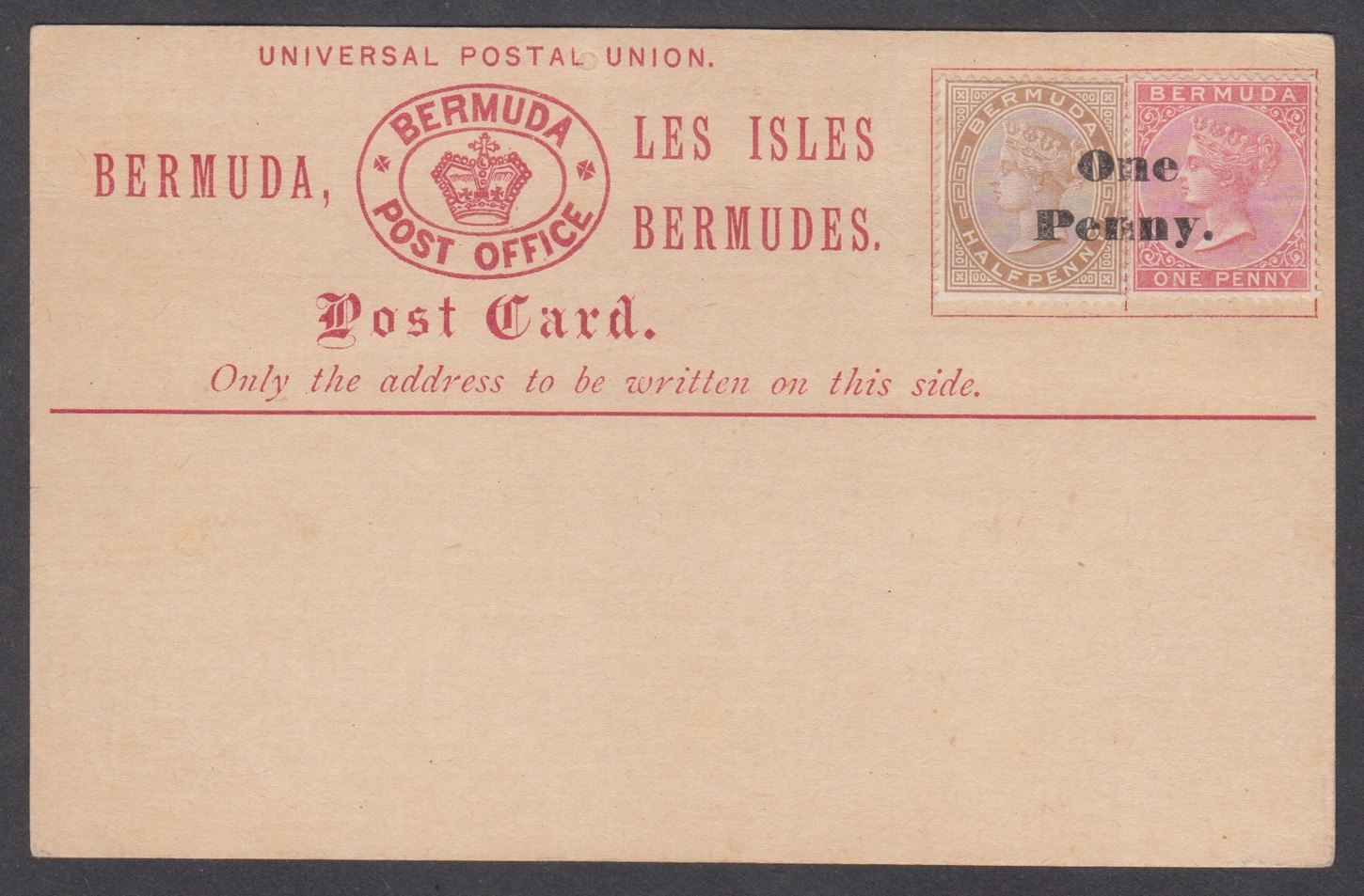
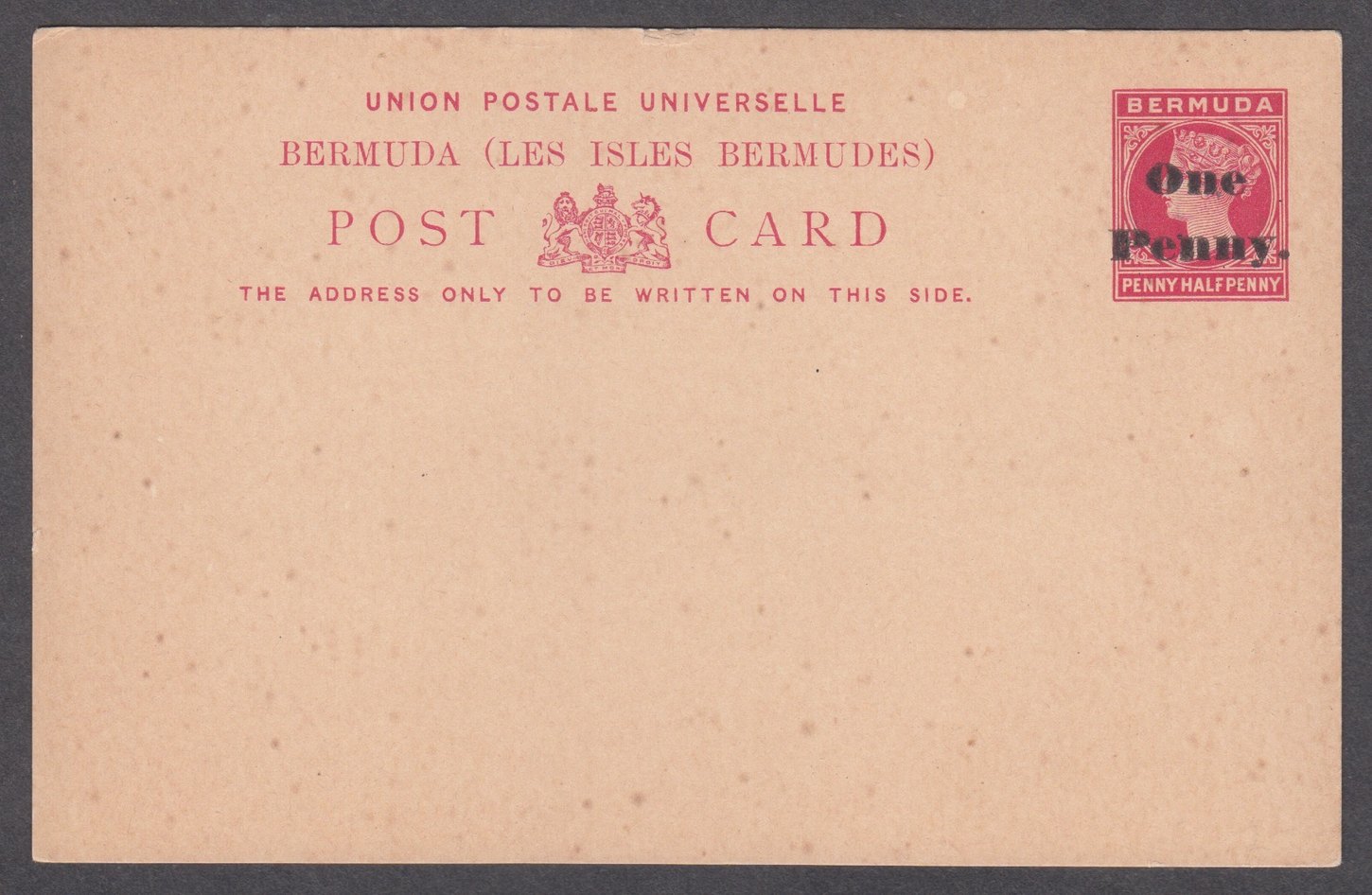
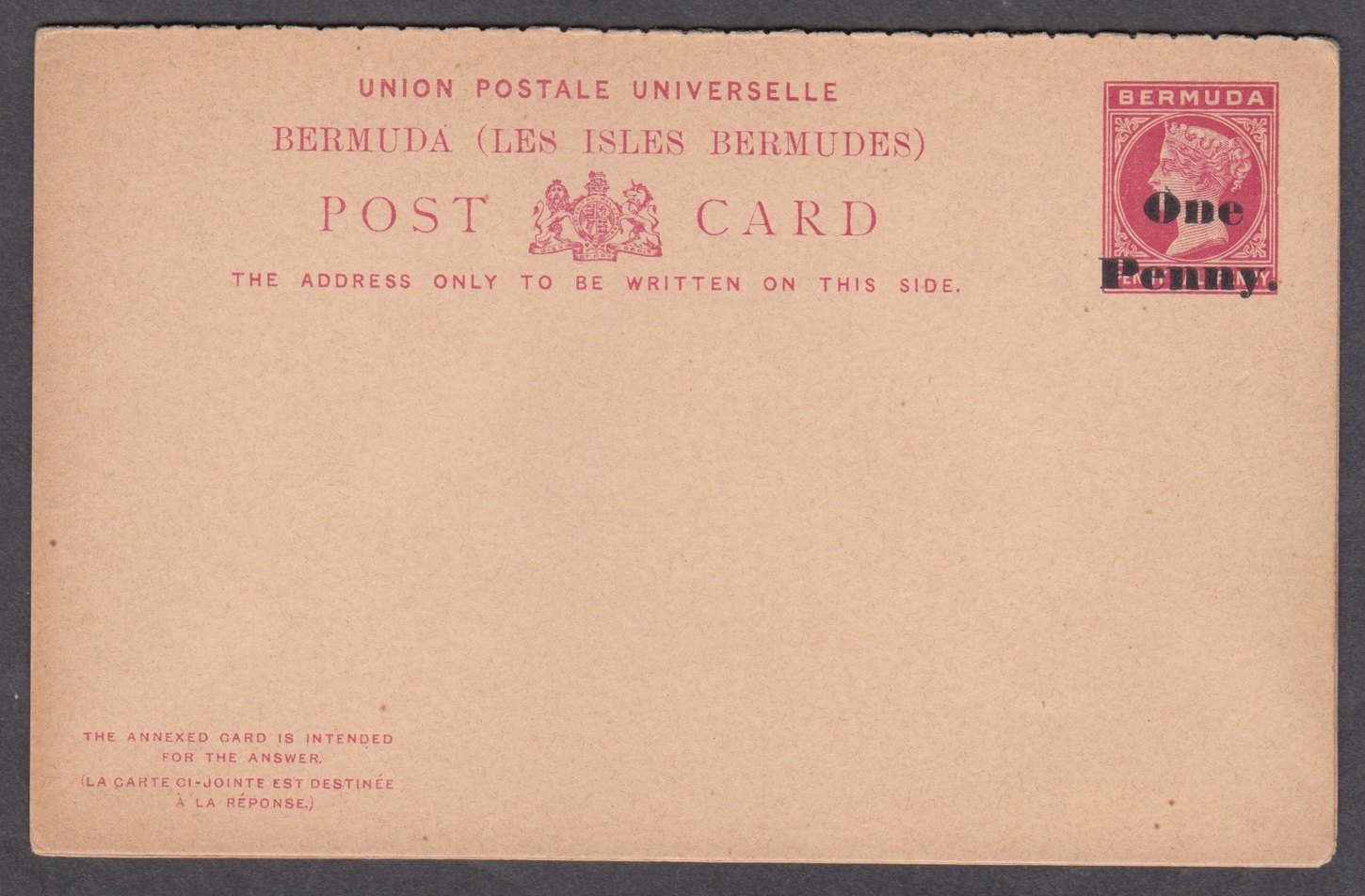
Last on the list, and to me the most interesting, are the “rare surcharged Bermuda Post Cards of 1893”. That year, when the overseas postcard rate came down to a penny, the Post Office made three different One Penny provisionals from old card stock, all shown below. The rarest are old cards that already had a halfpenny and a penny stamp stuck on, overprinted “One Penny.” across the stamps. Only 87 were done, and they were bought up by Arthur Cleveland Cox Jones, a clerk at the Hamilton Post Office. The other two were the printed 1½d postcard, of which 6,116 were surcharged, and the 1½d reply card, of which 414 were done. Nelmes could have meant any of the 1893 overprint cards, but within eighteen months or so they were already being sold as rarities, and he knew it.

The second shop in the advert, the Drug Store at Mangrove Bay in Somerset, was only a short trip from the Dockyard. The Navy was clearly in mind.

The three One Penny provisional cards of 1893

Bermuda Universal Postal Union post card of the old crown-in-oval design with halfpenny brown and one penny rose stamps affixed side by side and surcharged One Penny. in black across them, unused
The 1893 One Penny provisional, unused. Only 87 of these cards were surcharged.
Bermuda penny halfpenny carmine Union Postale Universelle postal card surcharged One Penny. in black across the printed stamp, unused
The 1½d postcard surcharged One Penny, unused. 6,116 were surcharged.
Bermuda penny halfpenny carmine Union Postale Universelle reply card surcharged One Penny. in black across the printed stamp, unused, with the note that the annexed card is intended for the answer
The 1½d reply card surcharged One Penny, unused. 414 were surcharged.
III

A squadron in quarantine

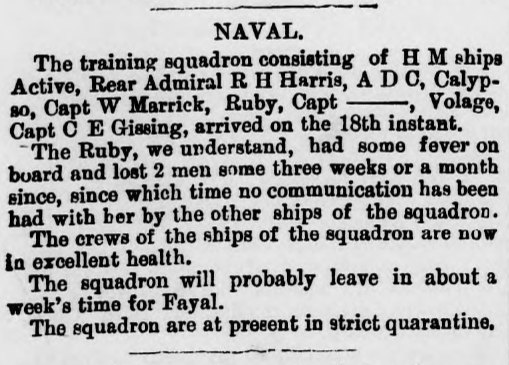
Royal Gazette, Naval: the training squadron of H M ships Active, Rear Admiral R H Harris, Calypso, Ruby and Volage arrived on the 18th instant; the Ruby had some fever on board and lost 2 men some three weeks or a month since; the squadron will probably leave in about a week for Fayal; the squadron are at present in strict quarantine
Royal Gazette, 22 January 1895
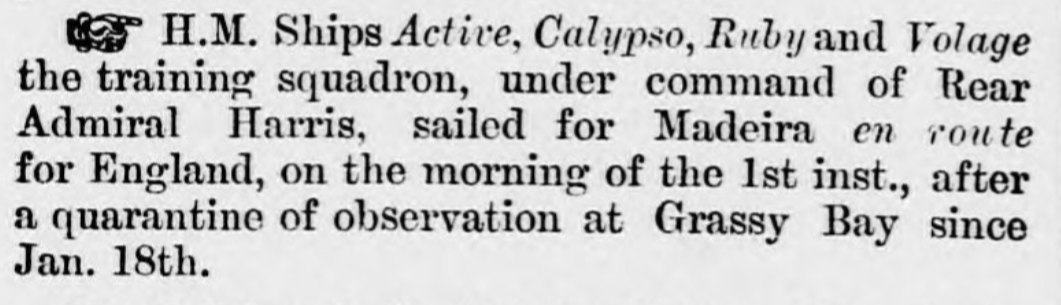
Royal Gazette: H.M. Ships Active, Calypso, Ruby and Volage, the training squadron under command of Rear Admiral Harris, sailed for Madeira en route for England on the morning of the 1st inst., after a quarantine of observation at Grassy Bay since Jan. 18th
Royal Gazette, 12 February 1895

The Training Squadron of Active, Calypso, Ruby and Volage, under Rear Admiral R. H. Harris, arrived at Bermuda from the West Indies on 18 January 1895. The Gazette reported that the Ruby had had fever on board and lost two men, and that “the squadron are at present in strict quarantine”.

Captain George King-Hall of the Volage remembered it in his diary: “On arrival at Bermuda we were all put into quarantine, though Commodore tried to isolate Volage only.” His own ship had lost a man to “black vomit”, a grim name for yellow fever.

The ships lay in Grassy Bay for a fortnight under what the Gazette later called “a quarantine of observation”, and sailed for Madeira on their way home on the morning of 1 February. So the card from The Tower, posted the morning after they arrived, reached a ship full of keen young collectors who weren’t allowed ashore. I’d love to know whether any of them ever made it to the shop.

The Ship

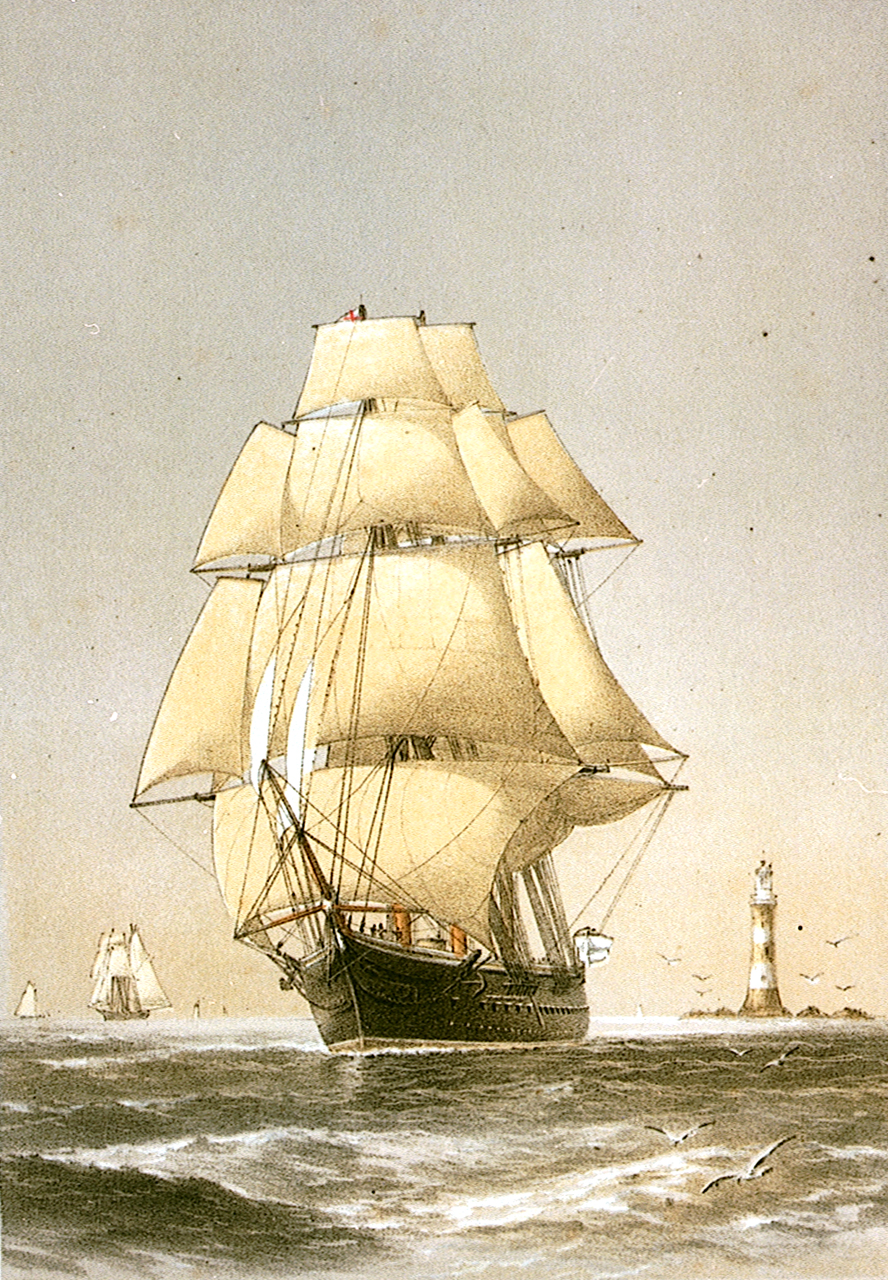
Coloured lithograph of H.M.S. Active under full sail, seen from ahead, with a lighthouse and another sailing ship in the distance

H.M.S. Active

The Active was an iron screw corvette of the Volage class, built by the Thames Ironworks at Blackwall and launched on 13 March 1869. Her iron hull was sheathed in wood and copper, and she was a full-rigged ship with an engine. From 1873 she was the Commodore’s ship on the Cape of Good Hope and West Coast of Africa station. Some of her men were landed in the Ashanti War of 1874, and in the Zulu War of 1879 a naval brigade from her fought at Inyezane and was besieged at Eshowe.

In 1885 she became the flagship of the new Training Squadron of sailing corvettes, cruising each winter to the West Indies or the Atlantic islands with cadets and boys under training. She was the last square-rigged warship to leave Portsmouth Harbour under sail. She was paid off in 1898 and sold for scrap on 10 July 1906.

BuiltThames Ironworks, Blackwall, launched 13 March 1869
TypeVolage-class iron screw corvette
Displacement3,078 tons
FlagRear Admiral R. H. Harris, Training Squadron, 1893–95
SquadronFlagship, Training Squadron, 1885–98
FateSold for scrap, 10 July 1906

Lithograph of H.M.S. Active: National Maritime Museum, Greenwich, London (public domain), via Wikimedia Commons.

Still to find out

If you can help with either of these, I’d be very pleased to hear from you.

References

It’s a small thing, a shopkeeper’s circular on a halfpenny card. But it shows a Hamilton business watching the harbour, knowing exactly who was on board a training ship and what they might want to buy, and getting its card out the morning after she arrived. That’s why I like it.