Postal History · Royal Navy · North America and West Indies

H.M.S. Cleopatra

Bermuda · January 1893 & March 1895

A midshipman’s hurried card home, and an invitation to a children’s party.

◆

The Cleopatra was on the North America and West Indies station from the end of 1892 until the spring of 1895, and I have a card from each end of her commission. Both are Bermuda postal stationery cards written on board. One is a young midshipman’s apologetic note home, almost certainly to his mother. The other tells a lady in Hamilton how to get to a party. On their own they’d be pleasant enough, but what brings them to life is a little book, The Cruise of H.M.S. Cleopatra, 1892–1895, written by the ship’s staff surgeon, William Tait, and printed at Plymouth when she came home. With it I can put a name to one writer and tell you what the party was.

Not to be confused with the earlier H.M.S. Cleopatra, a 26-gun sixth rate, and Captain Milne’s letter from her at Bermuda in November 1840.

I

“No time to myself”

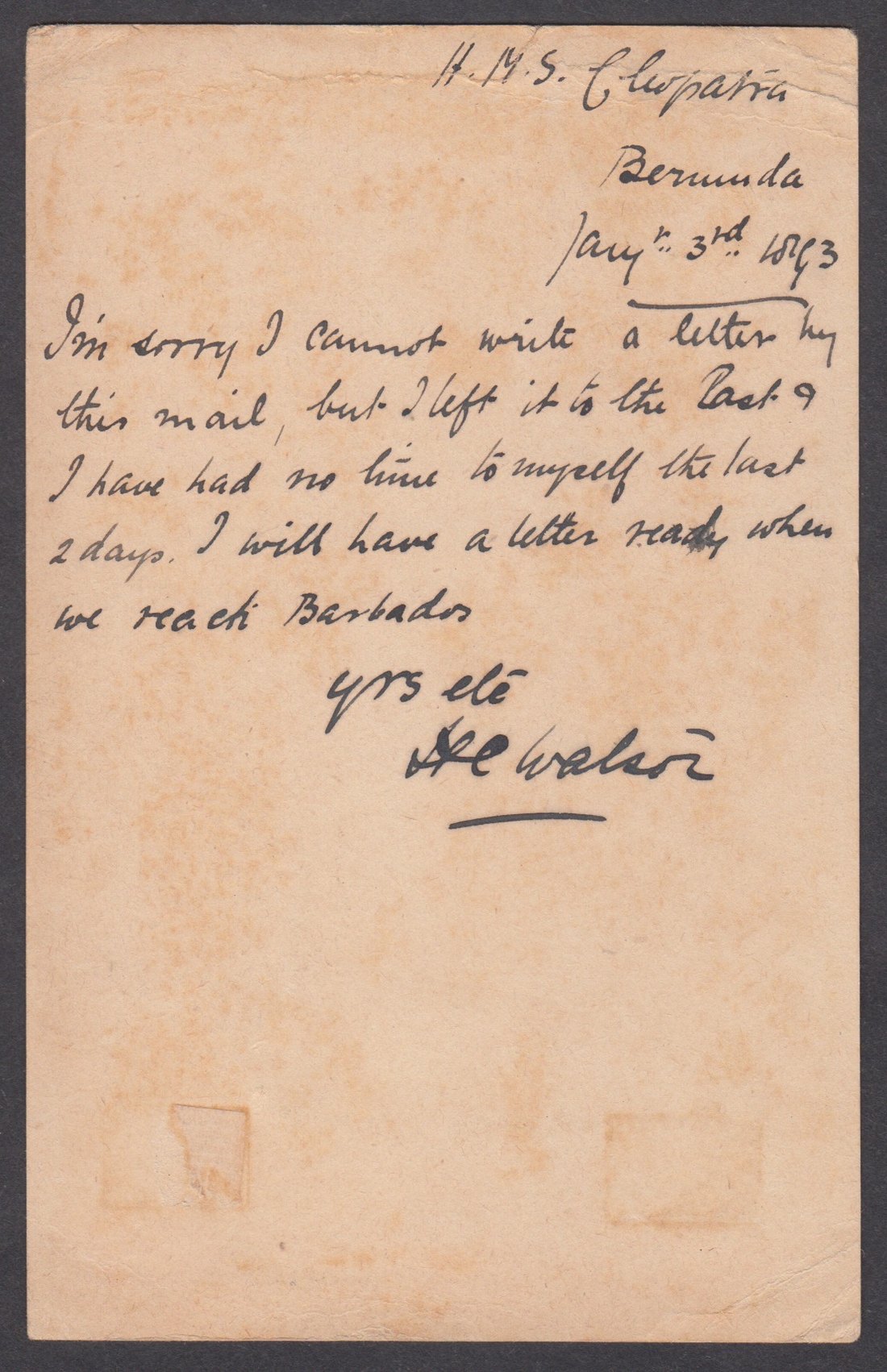
Message side of the card, headed H.M.S. Cleopatra, Bermuda, Jany 3rd 1893: I'm sorry I cannot write a letter by this mail, but I left it to the last and I have had no time to myself the last 2 days. I will have a letter ready when we reach Barbados. Yrs etc, H C Watson
The message side, signed H. C. Watson
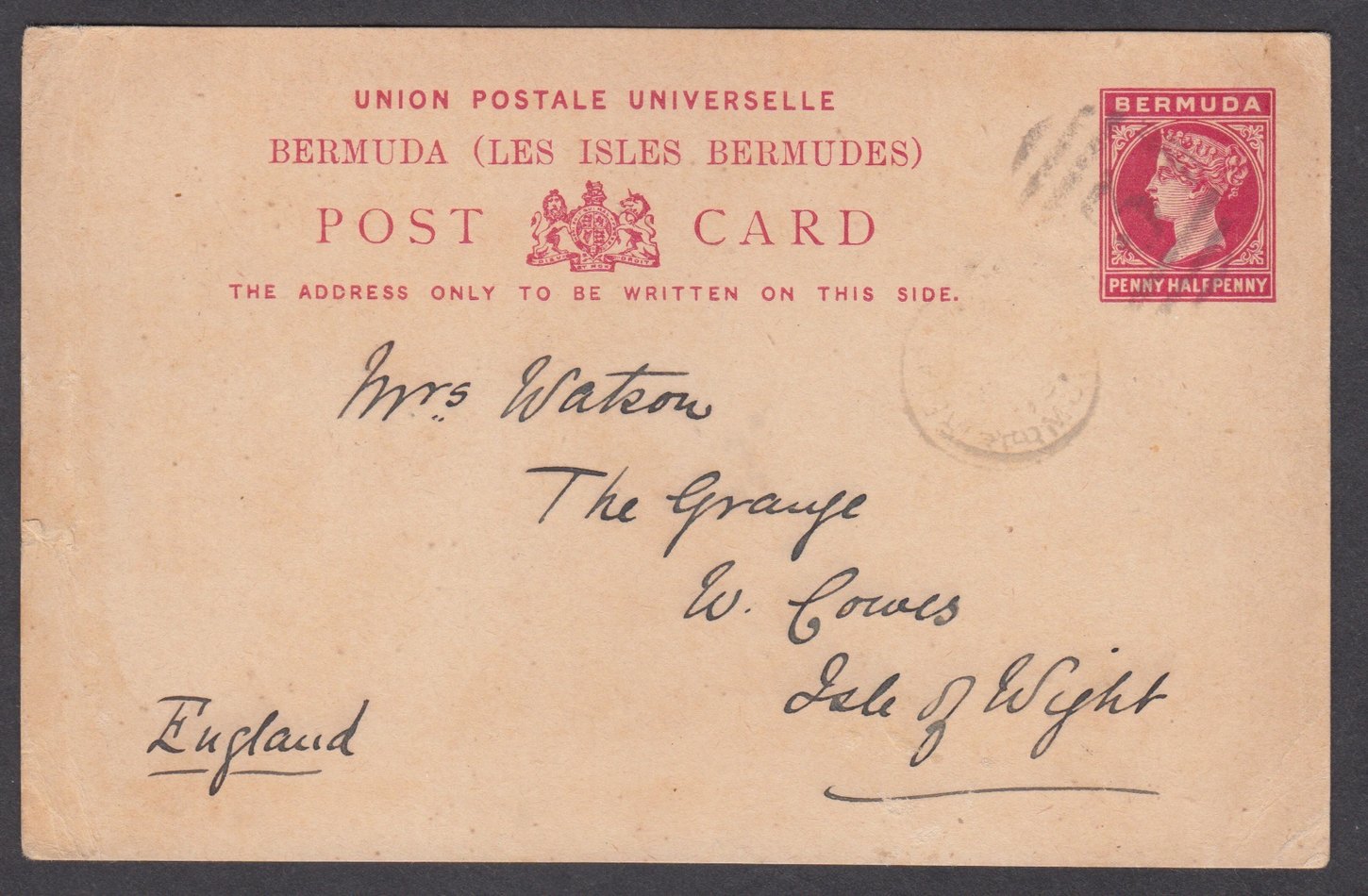
Bermuda penny halfpenny Union Postale Universelle postal stationery card in red, addressed to Mrs Watson, The Grange, W. Cowes, Isle of Wight, England, the printed stamp cancelled by a faint barred duplex with a faint circular datestamp below
The address side: to Mrs Watson, West Cowes, Isle of Wight
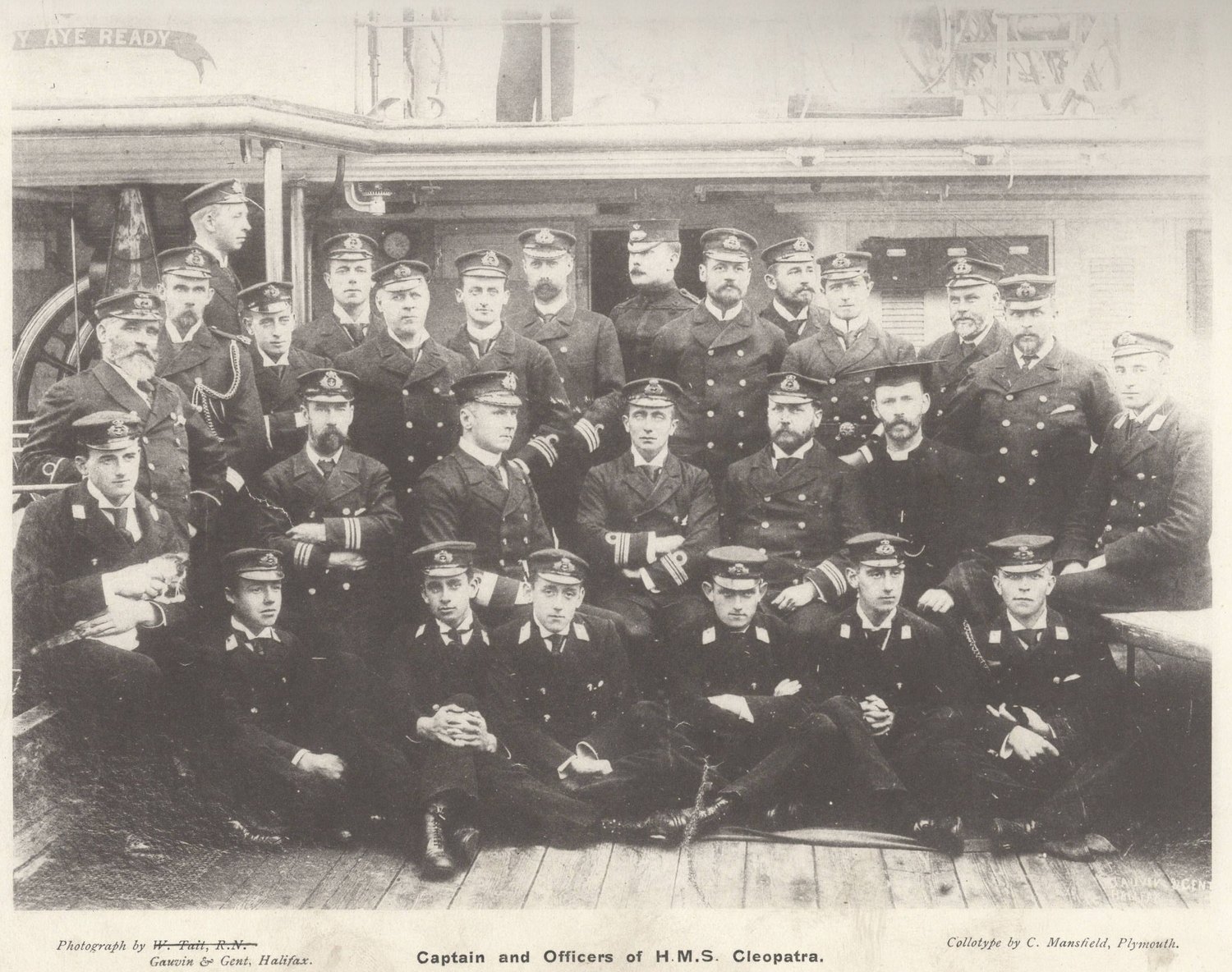
Photograph of the Captain and Officers of H.M.S. Cleopatra grouped on deck, the senior officers standing and seated behind, a row of young midshipmen sitting on the deck in front; photograph by Gauvin and Gentzel, Halifax
“Captain and Officers of H.M.S. Cleopatra”. Watson is probably one of the midshipmen in the front row
  • Written H.M.S. Cleopatra, Bermuda, 3 January 1893
  • Card Bermuda 1½d Union Postale Universelle postal stationery card
  • Datestamp IRELAND ISLAND K4 duplex, date unreadable (3 or 4 January 1893)
  • Writer Midshipman Horace C. Watson
  • Addressed to Mrs Watson, The Grange, West Cowes, Isle of Wight, England

“I’m sorry I cannot write a letter by this mail, but I left it to the last & I have had no time to myself the last 2 days. I will have a letter ready when we reach Barbados.”

The card is the red Bermuda 1½d Union Postale Universelle card, the correct rate for a postcard to England. It’s addressed to “Mrs Watson, The Grange, W. Cowes, Isle of Wight, England” and signed “Yrs etc, H C Watson”. It was posted at the Dockyard and cancelled with the IRELAND ISLAND K4 duplex. The date in the datestamp is too faint to read, but it can only be the 3rd or 4th of January 1893.

I didn’t know who H. C. Watson was until I opened Tait’s book. On page 6, in the list of officers who commissioned the ship on 21 September 1892, is Midshipman Horace C. Watson. So this is a young midshipman, a few months into his first big commission, writing almost certainly to his mother because he’d left his letter too late. I like it because anyone who has ever been away from home has written this card.

West Cowes was the yachting town on the Isle of Wight, a short steamer ride across the Solent from Southampton and Portsmouth. It’s a nice destination to find on a Bermuda card, but I haven’t yet found out anything more about Mrs Watson or The Grange.
II

The fleet sails

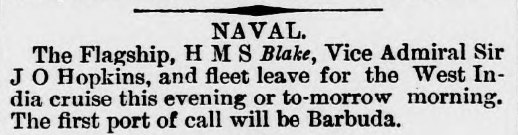
Royal Gazette, Naval: The Flagship, H M S Blake, Vice Admiral Sir J O Hopkins, and fleet leave for the West India cruise this evening or to-morrow morning. The first port of call will be Barbuda
Royal Gazette, 3 January 1893
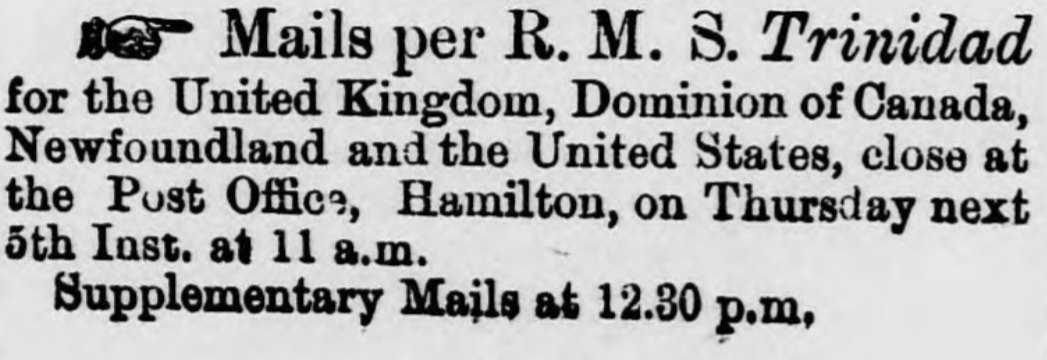
Royal Gazette notice: Mails per R.M.S. Trinidad for the United Kingdom, Dominion of Canada, Newfoundland and the United States, close at the Post Office, Hamilton, on Thursday next 5th inst. at 11 a.m. Supplementary mails at 12.30 p.m.
Royal Gazette, 3 January 1893: the mail closing on the 5th

His excuse holds up. The Cleopatra had only reached Bermuda on 7 December 1892, after 23 days crossing from Madeira. Tait says they spent the month in Grassy Bay, apart from six days in the Camber coaling, so the end of the year was taken up getting a new ship ready for her first cruise.

The Royal Gazette of 3 January 1893 reported that the flagship Blake, with Vice Admiral Sir J. O. Hopkins, and the fleet would leave for the West India cruise “this evening or to-morrow morning”. Tait records that Cleopatra left Grassy Bay on the evening of the 3rd for Murray’s Anchorage, and weighed at 8 a.m. the next morning in company with the Blake, Tourmaline, Mohawk and the rest of the squadron.

The same issue of the Gazette announced that the mails by the RMS Trinidad for the United Kingdom would close at Hamilton on Thursday the 5th. I think that’s the mail Watson meant. By the time it closed, he’d be at sea, so a card was all he could manage, and his letter would have to wait for Barbados.

III

“Returning after the Party”

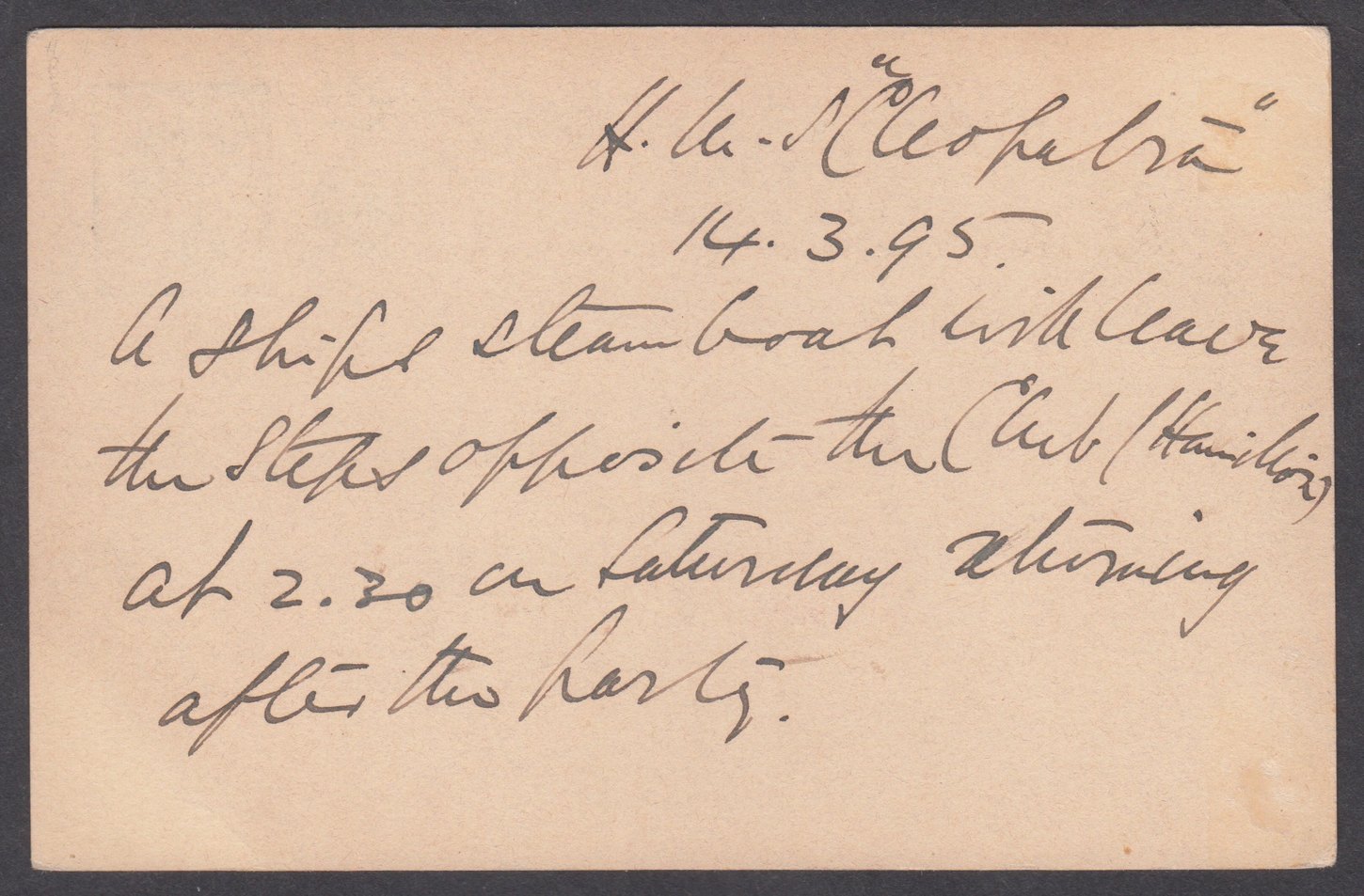
Message side of the card, headed H.M.S. Cleopatra 14.3.95: A Ship's steamboat will leave the Steps opposite the Club (Hamilton) at 2.30 on Saturday returning after the Party
The message side: the steamboat from Hamilton
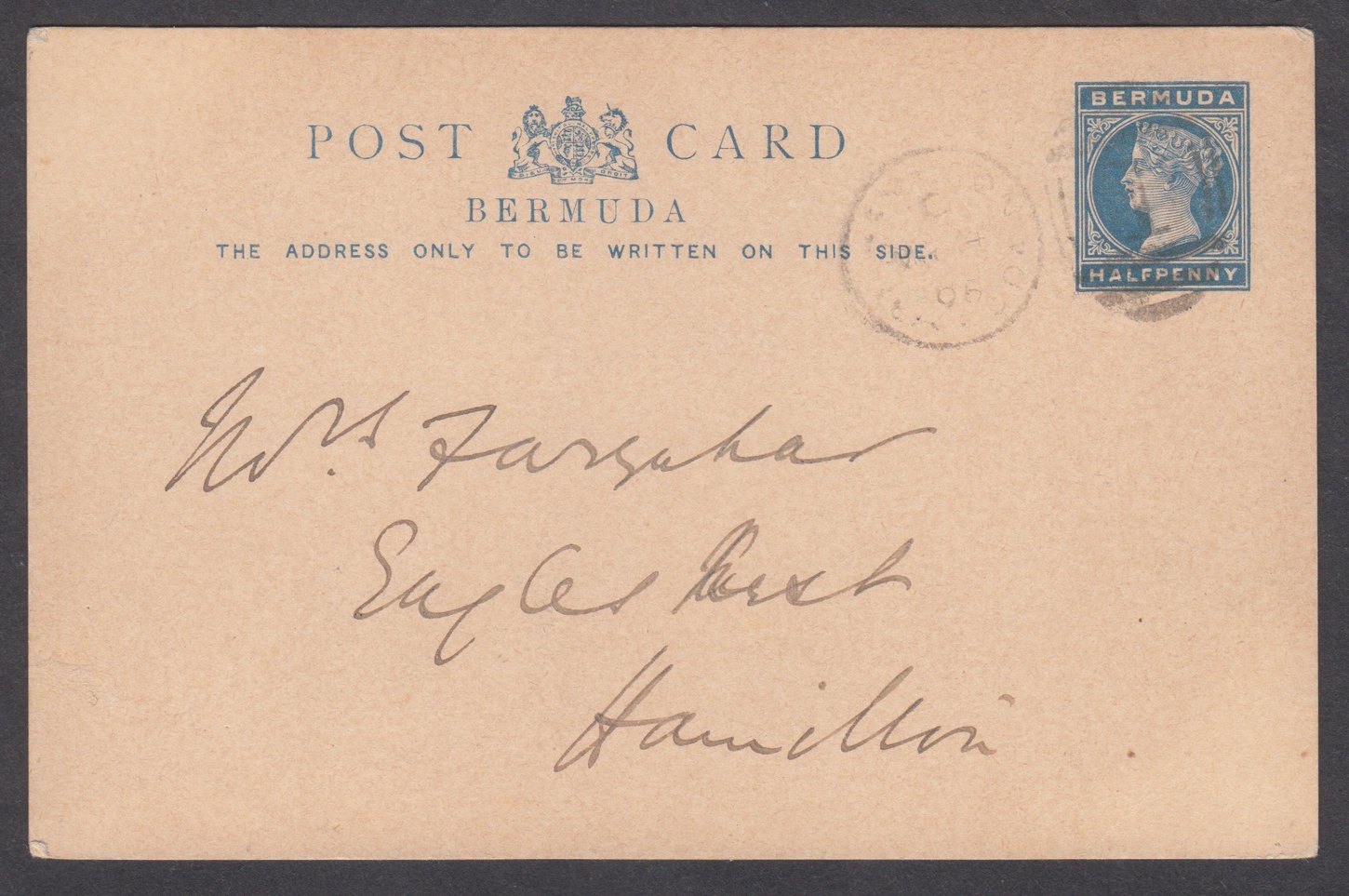
Bermuda halfpenny postal stationery card in blue, addressed to Mrs Farquhar, Eagles Nest, Hamilton, the printed stamp cancelled by the Hamilton duplex with a faint circular datestamp to the left
The address side: to Mrs Farquhar, Eagles Nest, Hamilton
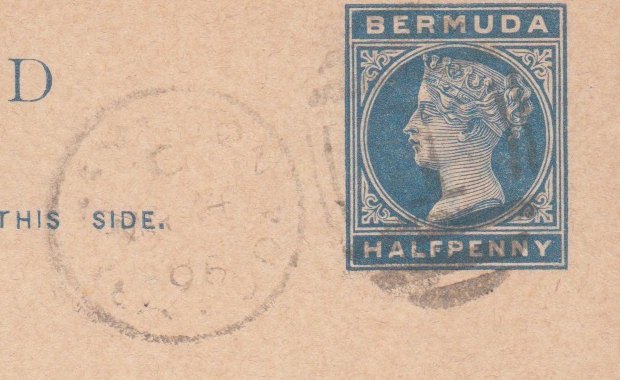
Close-up of the faint HAMILTON duplex datestamp of 14 March 1895 beside the printed halfpenny stamp and its barred obliterator
HAMILTON K4 duplex, C, 14 March 1895
  • Written H.M.S. Cleopatra, 14 March 1895
  • Card Bermuda ½d postal stationery card, local use
  • Datestamp HAMILTON K4 duplex, C (evening), 14 March 1895
  • Addressed to Mrs Farquhar, Eagles Nest, Hamilton

“A Ship’s steamboat will leave the Steps opposite the Club (Hamilton) at 2.30 on Saturday returning after the Party.”

The second card is the blue Bermuda halfpenny card for local use, addressed to “Mrs Farquhar, Eagles Nest, Hamilton”. It’s headed “H.M.S. Cleopatra 14.3.95” and was posted the same day at Hamilton, cancelled with the HAMILTON K4 duplex, code C, the evening collection. It isn’t signed. Written on board but posted in town, it was probably one of several brought up to Hamilton and posted together, but that’s a guess.

The 14th of March 1895 was a Thursday, so the Saturday was the 16th. The card doesn’t say what the party was. Tait’s book does.

IV

A children’s party on board the Shah

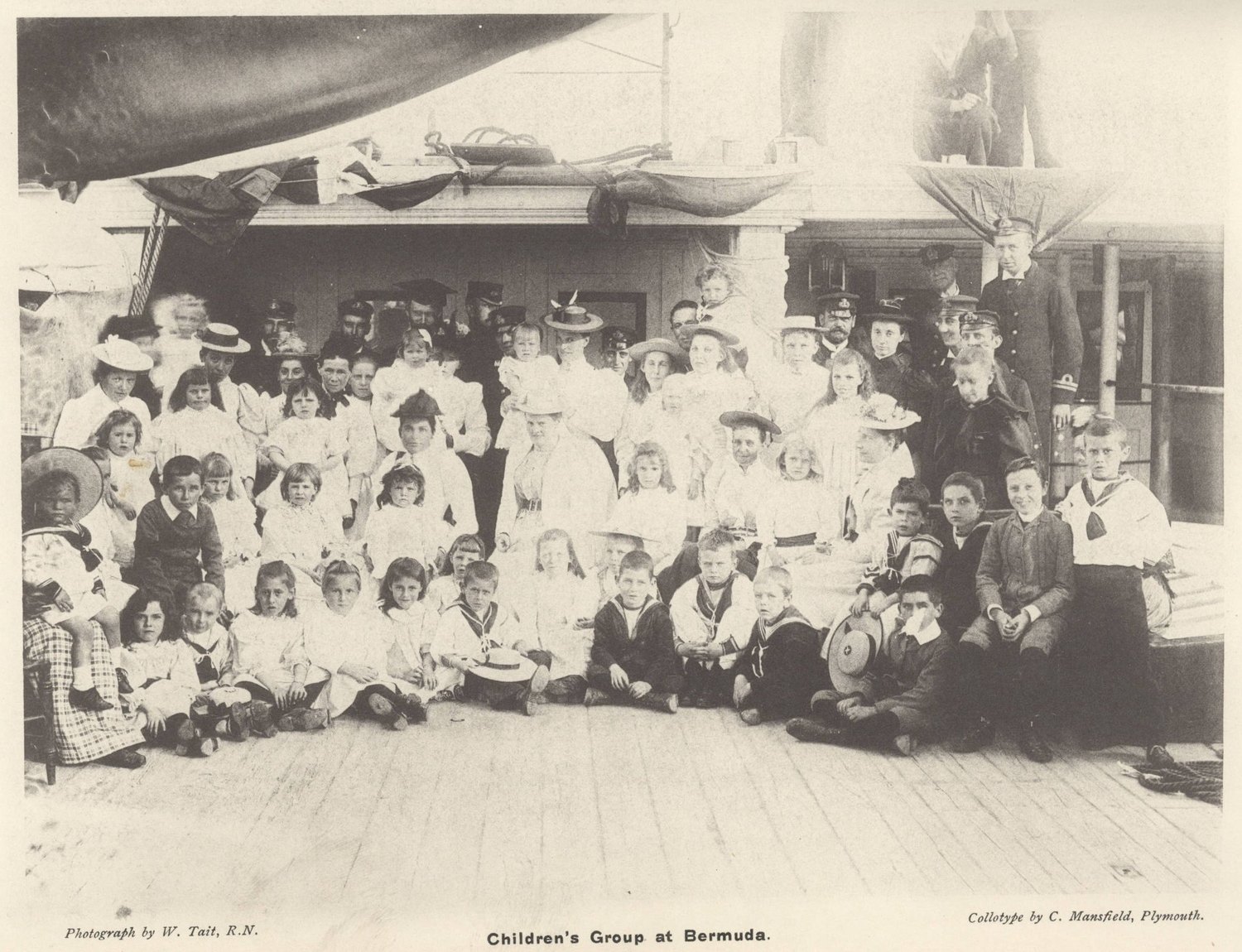
Photograph from Tait's book captioned Children's Group at Bermuda: dozens of children in white dresses, sailor suits and straw hats seated on a ship's deck under bunting and an awning, with ladies and naval officers standing behind
“Children’s Group at Bermuda”, photographed by Tait, almost certainly at the first party in April 1894
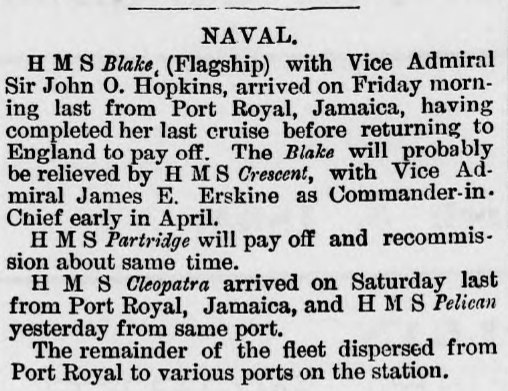
Royal Gazette, Naval: H M S Blake with Vice Admiral Sir John O. Hopkins arrived on Friday morning last from Port Royal, Jamaica, having completed her last cruise before returning to England to pay off; H M S Cleopatra arrived on Saturday last from Port Royal, Jamaica, and H M S Pelican yesterday from the same port
Royal Gazette, 5 March 1895

The Cleopatra came back to Bermuda from Port Royal, Jamaica, at the beginning of March 1895. The Gazette has her arriving on Saturday the 2nd; Tait says the 3rd. She went into dock, and her officers and men moved across to the old receiving ship Shah while the work was done. Then Tait writes:

“We gave a children’s party on board the Shah, similar to the one of the previous year”

The children enjoyed their games and went home laden with toys, he says, but many missed “our charming hostess of last year”. That was Mrs Curzon-Howe, the captain’s wife. The year before, in April 1894, with Cleopatra docked for repairs to her shaft, they had given a children’s party on the Shah with Mrs Curzon-Howe as hostess. Each child got a toy, a photograph was taken of them all on deck, and afterwards each was given a copy of it.

That photograph is surely the “Children’s Group at Bermuda” in Tait’s book. It’s placed with his account of the 1894 party, so it shows the first one, not the party on my card. But it must have looked much the same on the 16th: the same ship, the same kind of crowd, and many of the same children a year older.

The party Tait mentions is the only one during that stay in Bermuda, and a ship’s steamboat from Hamilton to the Dockyard on a Saturday afternoon fits it perfectly. I haven’t been able to find a report of it in the Royal Gazette.

V

The Farquhars of Eagles Nest

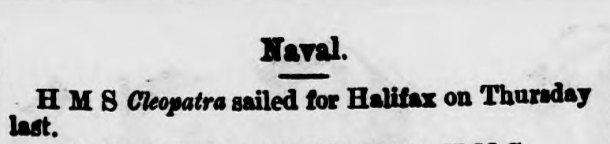
Royal Gazette, Naval: H M S Cleopatra sailed for Halifax on Thursday last
Royal Gazette, 30 April 1895
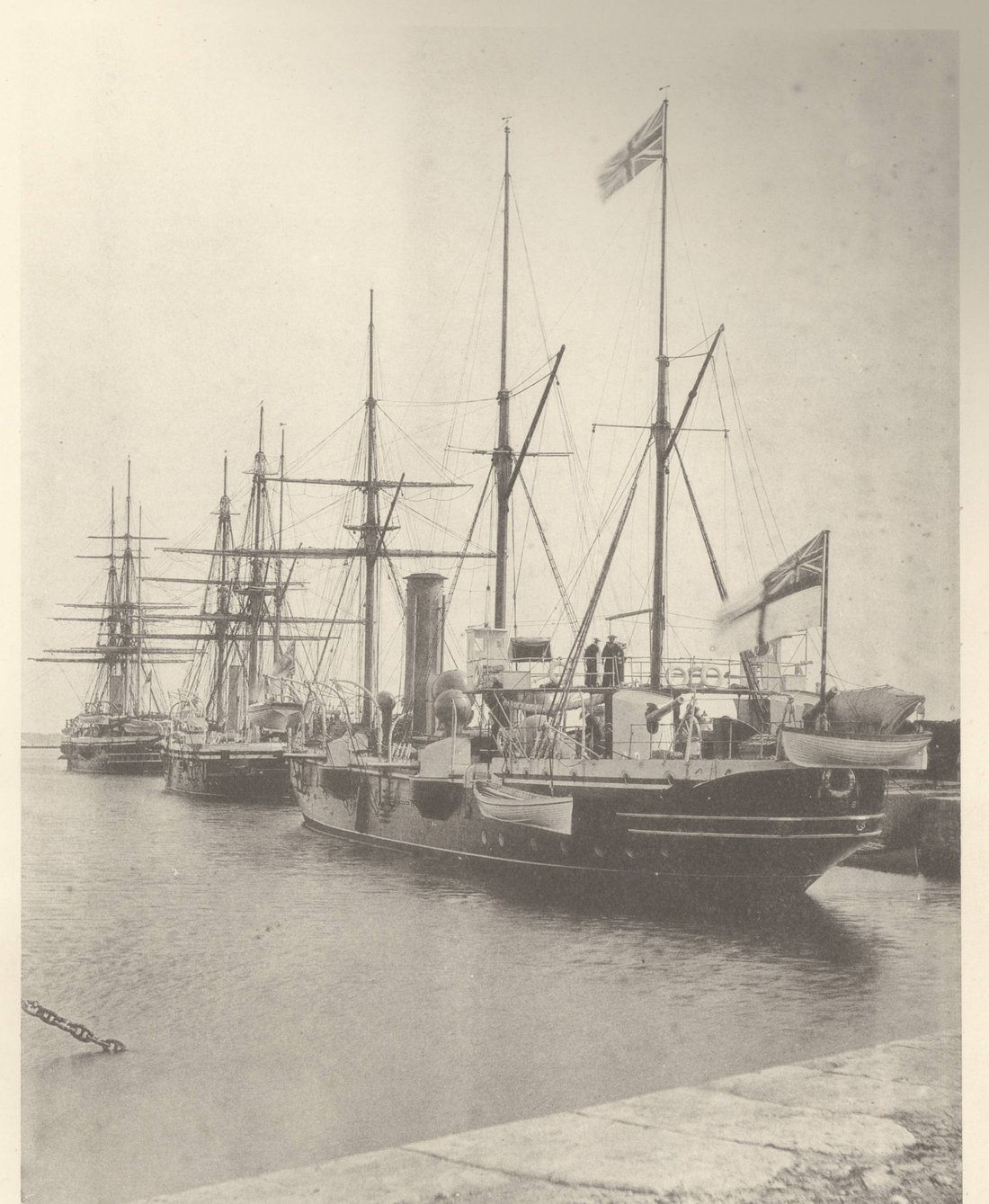
Photograph from Tait's book captioned Three Fisheries Ships: a small steam gunboat flying the White Ensign alongside a quay, with two larger sailing warships moored beyond
“Three Fisheries Ships”, photographed by Tait: the Newfoundland fishery work that took Cleopatra north each summer

The name Farquhar rang a bell. On my H.M.S. Buzzard page there’s a card of August 1894 to Commander Arthur Murray Farquhar at St John’s, Newfoundland, from a lady in Bermuda promising to find him a house. He had married Helen McNeill the year before, and I guessed he wanted the house so his wife could come out for the winter when the squadron came south.

Seven months later, here is a Mrs Farquhar at Eagles Nest in Hamilton, with Buzzard on the station and in Bermuda that spring. I’m fairly sure the house was found and this is the same family, but I can’t prove it. It’s the kind of link I enjoy most, when one item in the collection answers a question left by another.

Cleopatra left Bermuda for the last time on Thursday 25 April 1895, for Halifax and her final fishery season in Newfoundland. Buzzard and Pelican went north at the same time.

The ship and the post

The ship on one side, the two cards on the other.

The ship
The post
21 Sep 1892
CleopatraCommissioned at Keyham for the North America and West Indies station.
7 Dec 1892
CleopatraArrives at Bermuda from Madeira.
3 Jan 1893
CardMidshipman Watson’s card home, posted at Ireland Island.
4 Jan 1893
CleopatraSails with the fleet for the West Indies.
23 Apr 1894
CleopatraThe first children’s party on the Shah, Mrs Curzon-Howe as hostess.
2–3 Mar 1895
CleopatraBack at Bermuda from Jamaica and into dock.
14 Mar 1895
CardThe steamboat card to Mrs Farquhar, posted at Hamilton in the evening collection (C).
16 Mar 1895
CleopatraThe second children’s party on the Shah.
25 Apr 1895
CleopatraSails for Halifax and Newfoundland.

The Ship

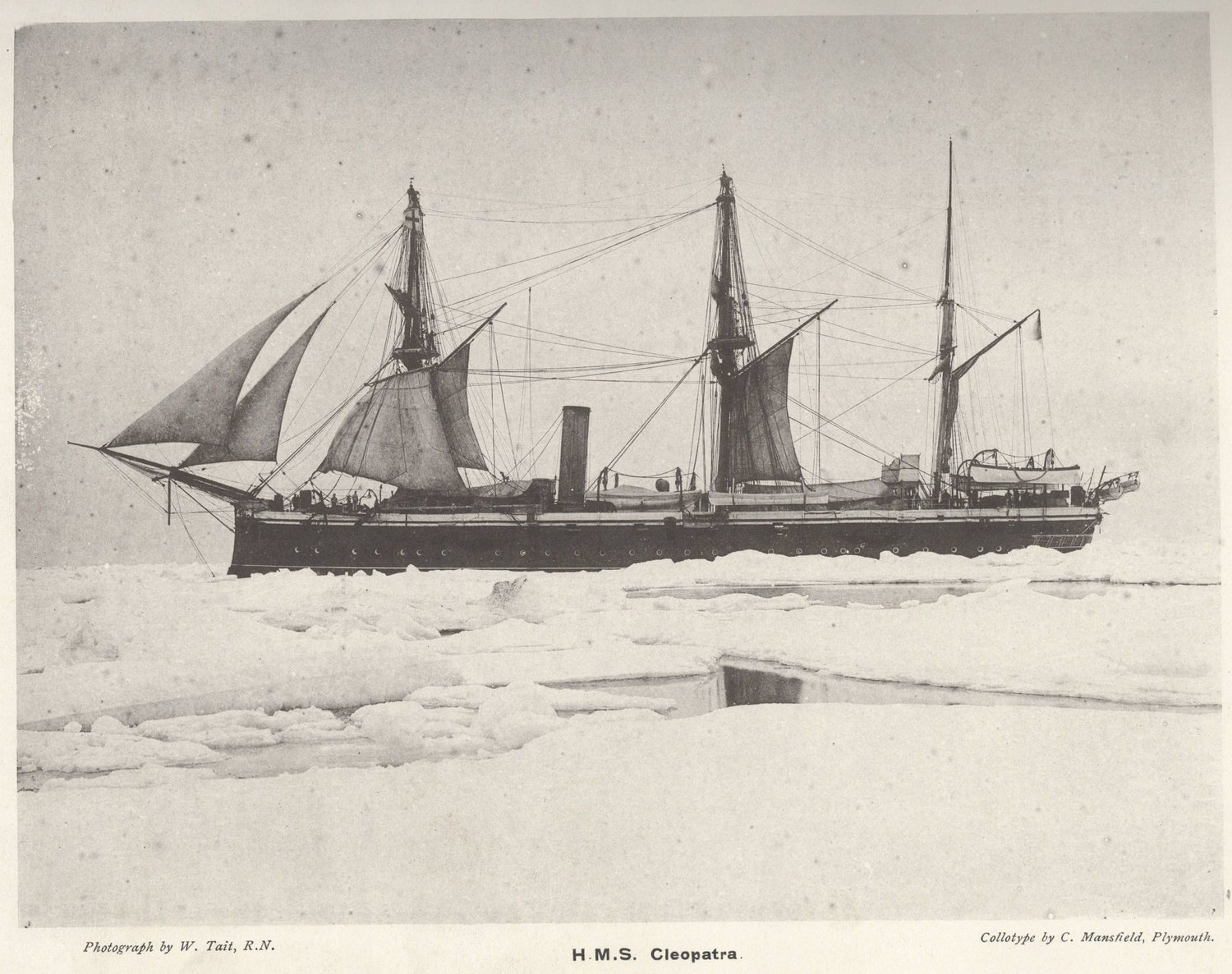
Photograph of H.M.S. Cleopatra, a three-masted barque-rigged corvette with a single funnel and some sail set, lying among broken pack ice, from Tait's book

H.M.S. Cleopatra

The Cleopatra was one of the nine Comus-class steel corvettes, built by John Elder & Co. at Govan and launched on 1 August 1878. She carried sail on three masts as well as her engines, and was re-rated a third class cruiser in 1888. Tait gives her armament in 1892 as four 6-inch and eight 5-inch breech-loaders, with quick-firing and machine guns, and a complement of 285 officers and men.

On this commission she spent the winters in the West Indies and the summers in Newfoundland, as the Commodore’s ship for the fishery protection under Captain the Hon. Assheton Curzon-Howe. In 1894 she was at Bluefields during the trouble on the Mosquito Coast of Nicaragua, and that June she was held fast in the ice for three days in the Strait of Belle Isle. Tait’s photograph above may well have been taken then. She came home in 1895, was a training ship in 1902–03, and went into harbour service in 1905. She was renamed Defiance III in 1922 and sold for scrap in July 1931.

BuiltJohn Elder & Co., Govan, launched 1 August 1878
TypeComus-class screw corvette, later 3rd class cruiser
Displacement2,380 tons
CaptainHon. A. G. Curzon-Howe (1892–95)
StationNorth America and West Indies, 1892–95
FateRenamed Defiance III 1922, sold 1931

Photographs from William Tait, The Cruise of H.M.S. Cleopatra, 1892–1895: the ship in the ice and “Three Fisheries Ships” by W. Tait, R.N.; the captain and officers by Gauvin & Gentzel, Halifax.

Still to find out

If you can help with any of these, I’d be very pleased to hear from you.

References

Two cards, written two years apart, and both of them really about getting somewhere: a letter that would have to wait for Barbados, and a steamboat at half past two. Without Dr Tait’s little book I’d have the cards but not the people.