Postal History · Royal Navy · North America and West Indies Station

H.M.S. Crescent

Bermuda · 1896

The flagship’s first winter at Bermuda, in three envelopes.

◆

These three envelopes all come from the first half of 1896, when the new cruiser Crescent was flagship of the North America and West Indies Station and Bermuda was her winter home. One came out from the Admiralty in London to a lieutenant on board. The other two went home from Ireland Island to the same lady in Surrey, and somebody on the ship drew all over them in pen and ink. I like the contrast. One is about as official as an envelope can be, with a department stamp and the Admiralty seal. The other two show what somebody did with a pen and a spare evening.

I

A letter from the Hydrographer

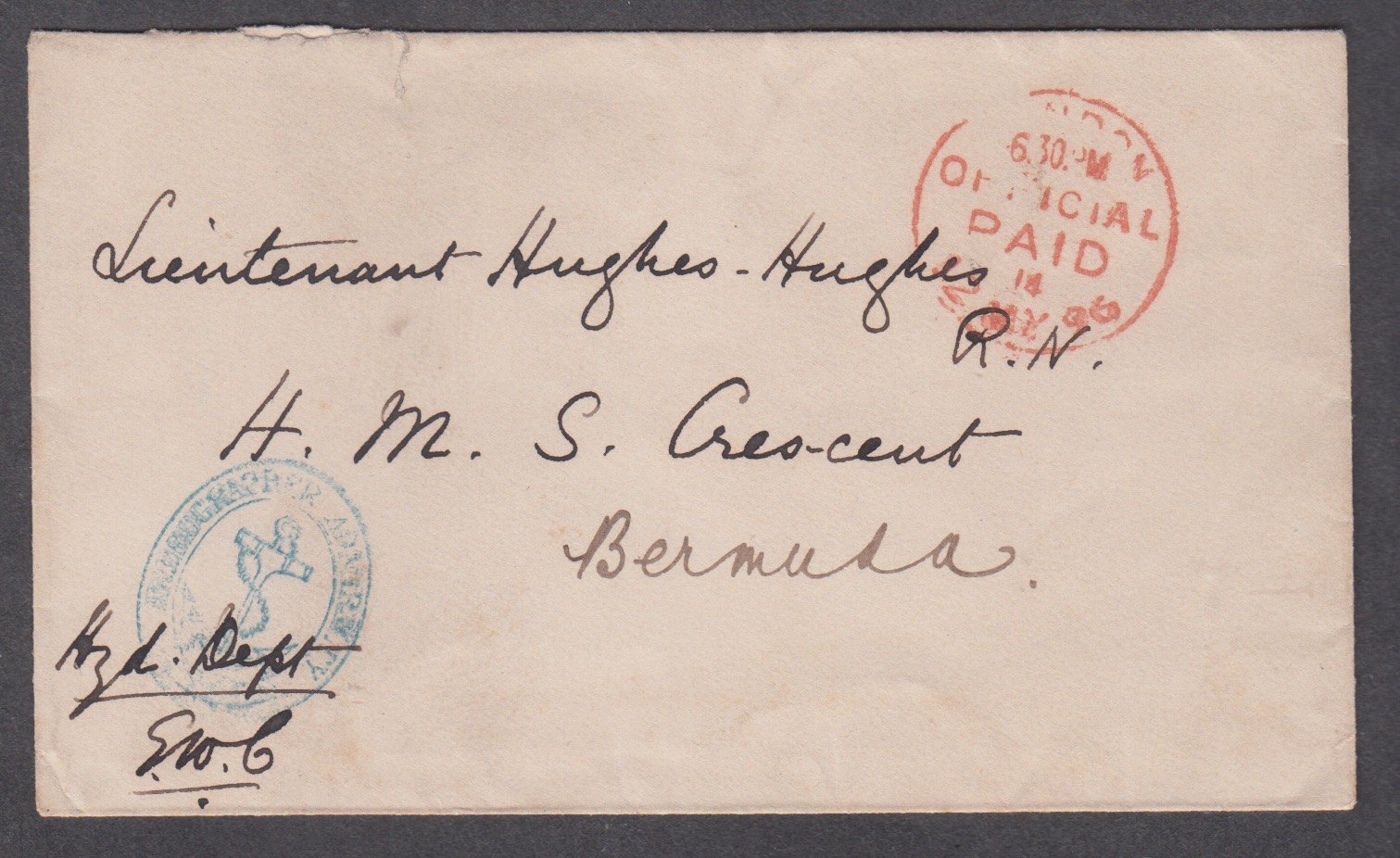
Envelope addressed in ink to Lieutenant Hughes-Hughes R.N., H.M.S. Crescent, Bermuda, with a red LONDON OFFICIAL PAID datestamp at top right and, at lower left, a blue oval HYDROGRAPHER ADMIRALTY handstamp with Hyd. Dept and S.W.L. written over it
Front: LONDON OFFICIAL PAID, 12 May 1896
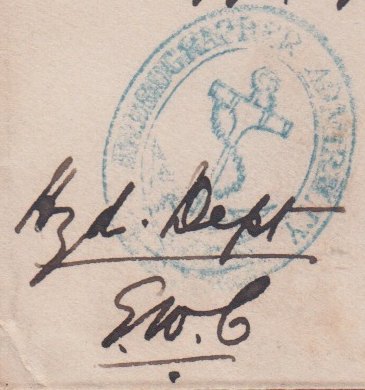
Close-up of the blue oval HYDROGRAPHER ADMIRALTY handstamp with a fouled anchor in the centre, overwritten in ink Hyd. Dept, underlined, and S.W.L. below
The Hydrographer’s handstamp, with “Hyd. Dept / S.W.L.”
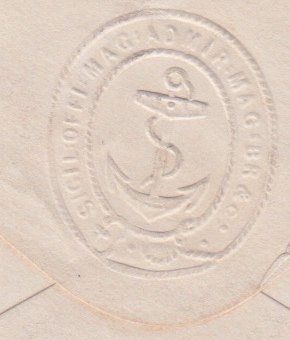
Close-up of the colourless embossed Admiralty seal on the back flap: a fouled anchor inside an oval band lettered SIGIL OFF MAG ADMIR MAG BR &c
The Admiralty seal embossed on the back flap
  • Posted London, 6.30 PM, 12 May 1896
  • Marking LONDON OFFICIAL PAID datestamp in red
  • Sender Hydrographic Department, Admiralty: oval HYDROGRAPHER ADMIRALTY handstamp in blue, manuscript “Hyd. Dept / S.W.L.”
  • Back Embossed Admiralty seal on the flap
  • Addressed to Lieutenant Hughes-Hughes R.N., H.M.S. Crescent, Bermuda
  • Provenance Pitts, Spink, 24 October 2017, lot 1077

This one came out from London to the flagship. It’s addressed in a careful hand to “Lieutenant Hughes-Hughes R.N., H.M.S. Cres-cent, Bermuda”, with “Crescent” broken across the middle as if the writer was copying it out letter by letter.

It needed no stamp. The red LONDON OFFICIAL PAID datestamp shows that the department paid the postage. It reads 6.30 PM, with 14 in the centre and the date, 12 MY 96, in the lower arc. The department is named twice in the lower left corner. There’s a blue oval HYDROGRAPHER ADMIRALTY handstamp with a fouled anchor, and written over it “Hyd. Dept”, with “S.W.L.” below. That’s the Admiralty’s Hydrographic Department, the office that made the Navy’s charts, in London S.W.

On the back the flap carries the Admiralty seal, embossed without colour: a fouled anchor inside an oval reading SIGIL OFF MAG ADMIR MAG BR &c. That’s short for the Latin for “Seal of the Office of the Lord High Admiral of Great Britain”. Whoever opened the letter took care not to tear through it.

Whether it found Lieutenant Hughes-Hughes at Bermuda is another matter. The Crescent got back from a cruise round the West Indies on 20 May and sailed for Halifax on the 27th, taking the mails for Halifax with her. A letter that left London on 12 May might just have caught her, or it might have followed her north. There’s no arrival mark to tell us.

I don’t yet know who Lieutenant Hughes-Hughes was, or why the Hydrographer was writing to him. A letter from the chart office suggests he had something to do with navigation or surveying, but that’s a guess for now.
II

The fairy and the doves

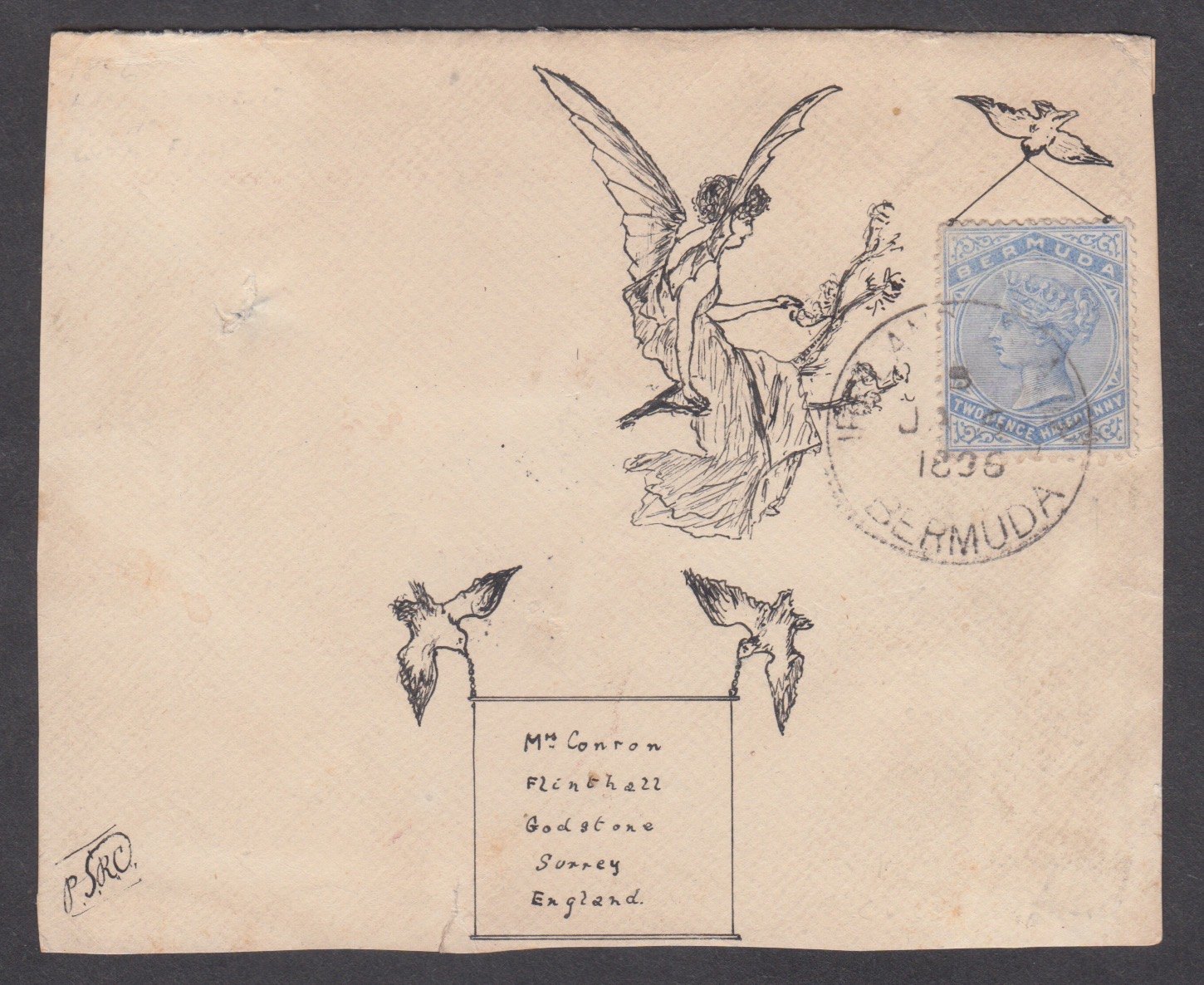
Envelope front decorated in pen and ink: a winged fairy in a long dress sits on a flowering branch; a flying bird above carries the Bermuda 2½d blue stamp on two strings; below, two birds hold up a framed panel on chains with the address Mrs Conron, Flinthall, Godstone, Surrey, England; the stamp is cancelled by a Bermuda datestamp showing J and 1896; P.S.R.C. written at lower left
Front: the 2½d stamp carried by a bird, January 1896
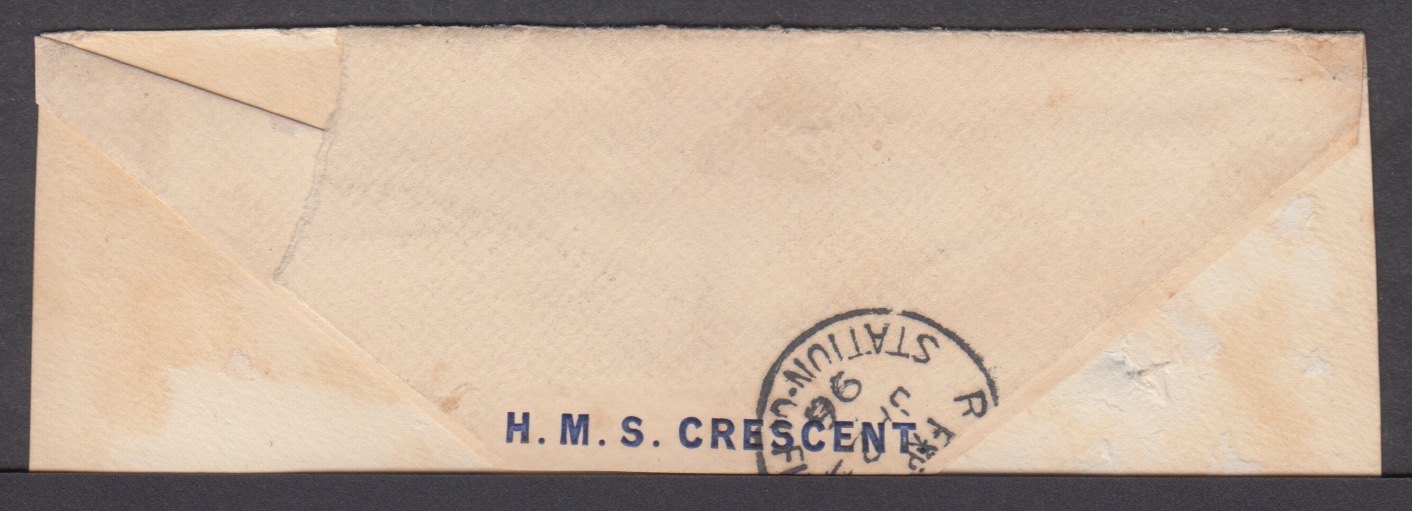
Surviving part of the back flap with H.M.S. CRESCENT printed in blue capitals and part of a STATION arrival datestamp dated 1896
What survives of the back: “H.M.S. CRESCENT” printed in blue, and the “… STATION” arrival stamp
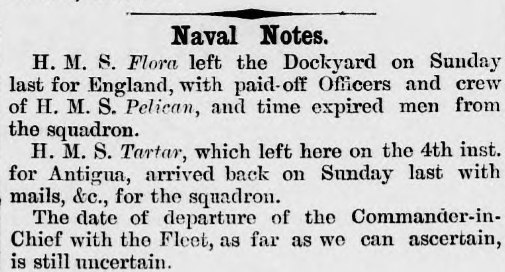
Royal Gazette Naval Notes: HMS Flora left the Dockyard for England with the paid-off crew of Pelican; HMS Tartar arrived back from Antigua with mails for the squadron; the date of departure of the Commander-in-Chief with the Fleet, as far as we can ascertain, is still uncertain
Royal Gazette, 14 January 1896: the fleet’s departure “still uncertain”
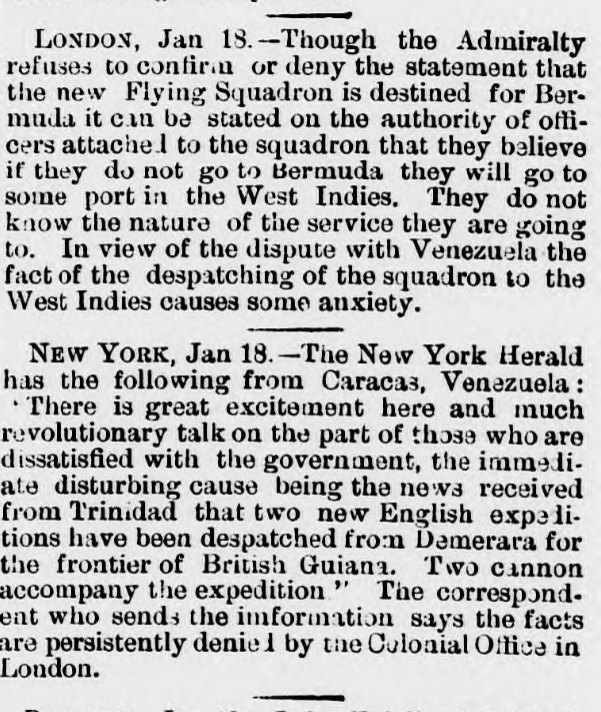
Royal Gazette: London, January 18, though the Admiralty refuses to confirm or deny that the new Flying Squadron is destined for Bermuda, its officers believe that if they do not go to Bermuda they will go to some port in the West Indies, and in view of the dispute with Venezuela this causes some anxiety; New York, January 18, the New York Herald reports great excitement in Caracas at news of two English expeditions sent from Demerara to the frontier of British Guiana
Royal Gazette, 21 January 1896: the Flying Squadron rumoured for Bermuda
  • Posted Ireland Island, Bermuda, 3 or 5 January 1896
  • Stamp Bermuda 2½d blue, Queen Victoria
  • Datestamp Ireland Island type H5, in use from 1 January 1896: a very early use
  • Arrival “… STATION”, 23 January 1896, on the back
  • Back flap “H.M.S. CRESCENT” printed in blue
  • Addressed to Mrs Conron, Flinthall, Godstone, Surrey, England
  • Initials “P.S.R.C.” at lower left
  • Provenance Dennis Mitton; Argyll Etkin, October 2022, lot 262 (with III)

This is the first of two envelopes from the Crescent to Mrs Conron at Flint Hall, Godstone, in Surrey, and both are covered in pen-and-ink drawings. On this one a winged fairy in a long dress sits on a flowering branch. Above her a bird flies off with the stamp hanging from two strings, and below, two more birds hold up a framed panel on chains with the address written inside it.

The 2½d stamp paid the ordinary letter rate to Britain. It’s cancelled at Ireland Island with the new datestamp, type H5, which came into use on 1 January 1896. The date reads 3 or 5 January, so this is a very early use, only days after the new datestamp arrived.

Most of the back has been cut away, leaving only part of the flap, but that’s enough to show the ship’s name printed on it in blue capitals. Partly under the name is the arrival stamp. I can read “STATION” and what looks like 23 January 1896, but not the office.

The timing is interesting. In late November the Gazette had said the squadron would leave on 2 January for its winter cruise round the West Indies. Yet here is the flagship’s mail going from Ireland Island a day or two later, and by 14 January the Gazette could only say the departure was “still uncertain”. In fact she stayed at Bermuda all winter. I haven’t found the Admiralty’s reason, but it was an anxious few weeks. In December President Cleveland’s message on the Venezuela boundary had the London papers talking of war with the United States, and of British demands on Venezuela being “enforced by the admiral commanding the West India station”, which meant Erskine. Then in mid-January came reports that the new Flying Squadron, hurriedly put together after the Kaiser’s Kruger telegram, might be sent to Bermuda or the West Indies. It never came, but it’s easy to see why the Commander-in-Chief might have kept his flagship at home that month.

In the bottom left corner is “P.S.R.C.”, written with a little flourish. I think these are the writer’s initials, and the C surely stands for Conron. Mrs Conron may have been his wife or his mother. I’d love to know who he was.

III

Cupid and the swan

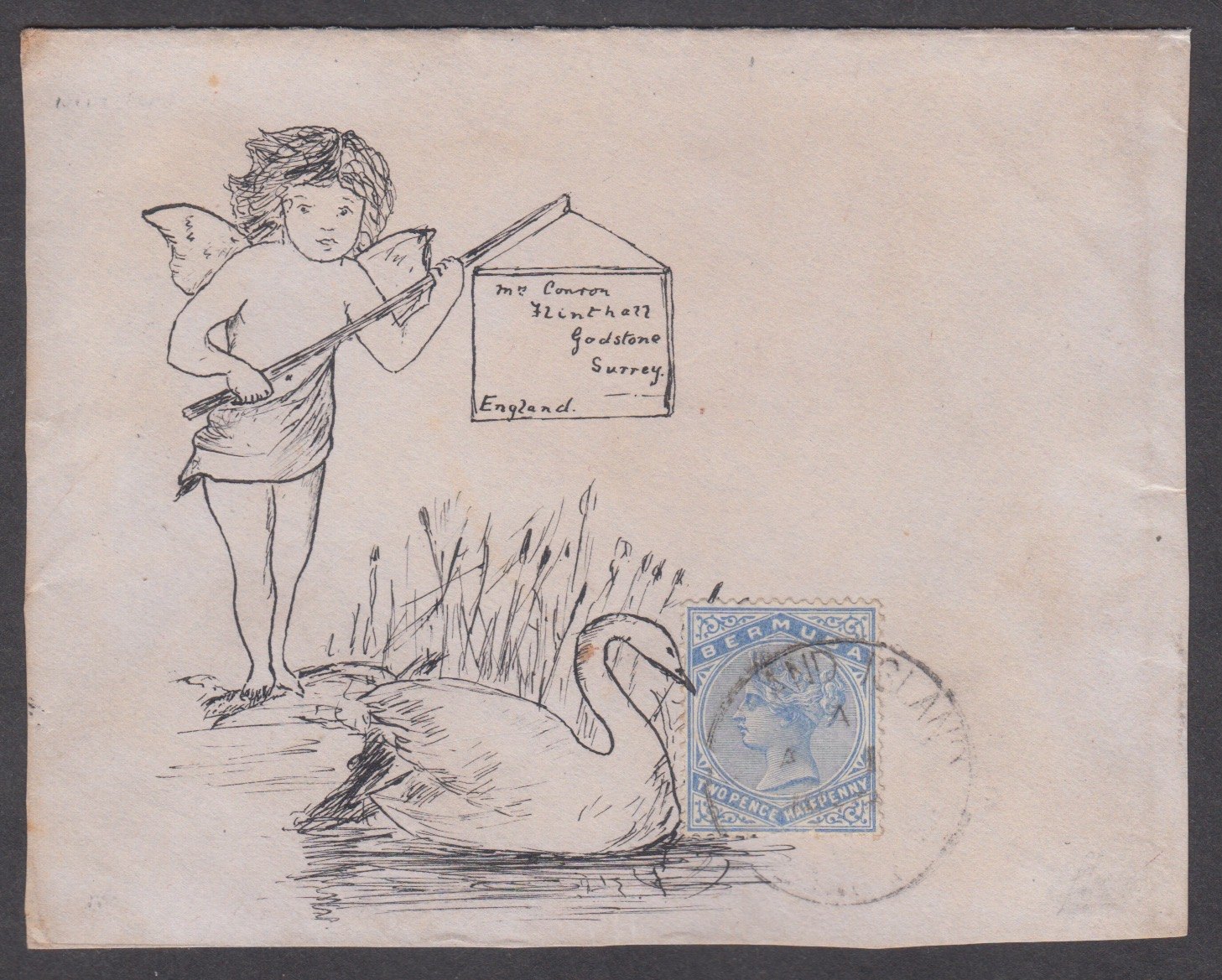
Envelope front decorated in pen and ink: a barefoot winged cupid stands on a bank holding a pole from which hangs a drawn envelope with the address Mrs Conron, Flinthall, Godstone, Surrey, England; below, a swan swims among bulrushes towards the Bermuda 2½d blue stamp, which is cancelled by an Ireland Island datestamp
Front: the swan looking straight at the stamp, April 1896
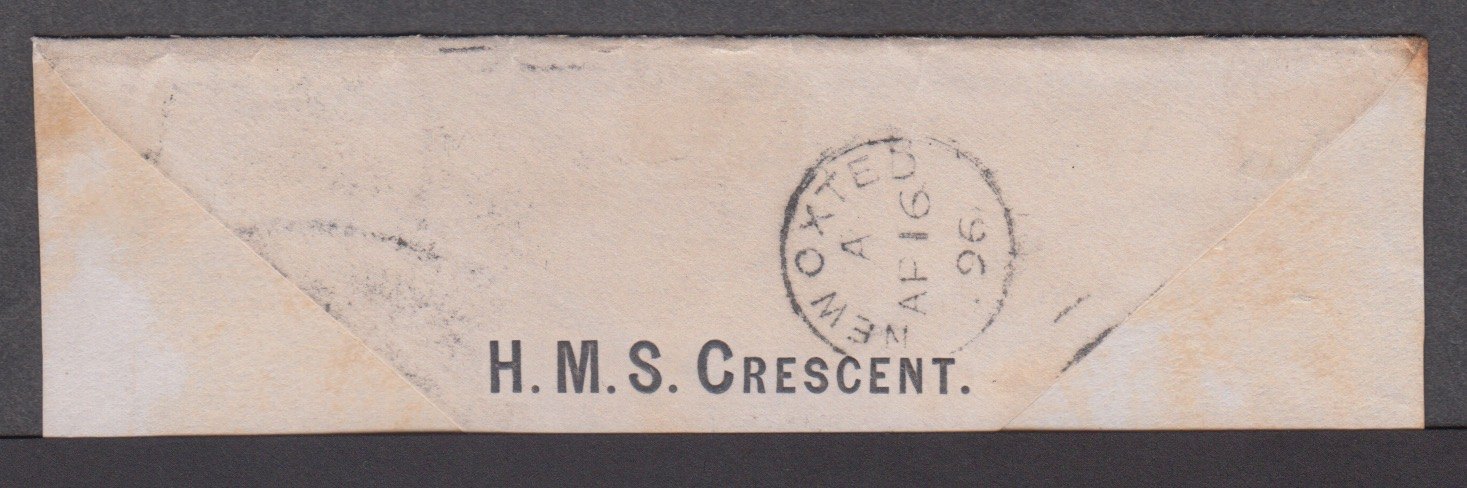
Surviving part of the back flap with H.M.S. CRESCENT. printed in black and a NEW OXTED datestamp, A, AP 16 96
What survives of the back: “H.M.S. CRESCENT.” printed in black, and NEW OXTED, 16 April 1896
  • Posted Ireland Island, Bermuda, early April 1896
  • Stamp Bermuda 2½d blue, Queen Victoria
  • Datestamp Ireland Island type H5, code A; the day is lost
  • Arrival NEW OXTED / A / AP 16 / 96, on the back
  • Back flap “H.M.S. CRESCENT.” printed in black
  • Addressed to Mrs Conron, Flinthall, Godstone, Surrey, England
  • Provenance Dennis Mitton; Argyll Etkin, October 2022, lot 262 (with II)

The same address in the same hand, three months later. This time a barefoot cupid stands on a bank holding up a pole, and from the pole hangs the address, written inside a little drawn envelope. Below him a swan swims among the bulrushes, and the stamp sits just where the swan is looking.

The stamp is cancelled with the same Ireland Island datestamp, type H5, code A, but the date in it has gone. The back helps. Again only part of the flap survives, with the ship’s name printed on it, and beside the name is a clear NEW OXTED arrival stamp for 16 April 1896. Oxted is the next village to Godstone. Working back from the voyage time, the letter was probably posted in the first few days of April.

The flaps on the two covers aren’t the same. On the January cover the name is printed in blue; on this one it’s in black, in a different type and with a full stop at the end. So the ship had at least two printings of her envelopes.

The Crescent was still at Bermuda when this was posted. Three weeks later, on Saturday 25 April, she finally sailed for the West Indies.

IV

The flagship at Bermuda, 1895–96

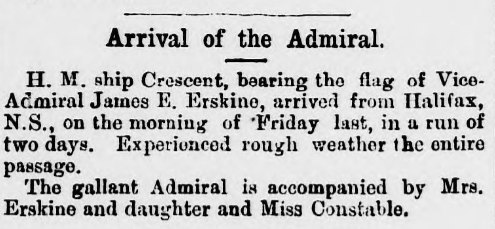
Royal Gazette report headed Arrival of the Admiral: H.M. ship Crescent, bearing the flag of Vice-Admiral James E. Erskine, arrived from Halifax on Friday last in a run of two days after rough weather; the Admiral is accompanied by Mrs Erskine and daughter and Miss Constable
Royal Gazette, 19 November 1895: the Admiral arrives
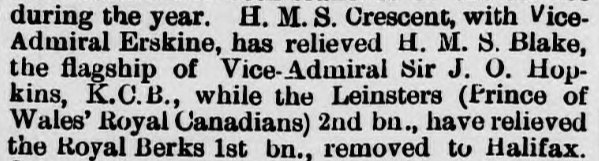
Royal Gazette: H.M.S. Crescent, with Vice-Admiral Erskine, has relieved H.M.S. Blake, the flagship of Vice-Admiral Sir J. O. Hopkins
Royal Gazette, 7 January 1896: she relieves the Blake
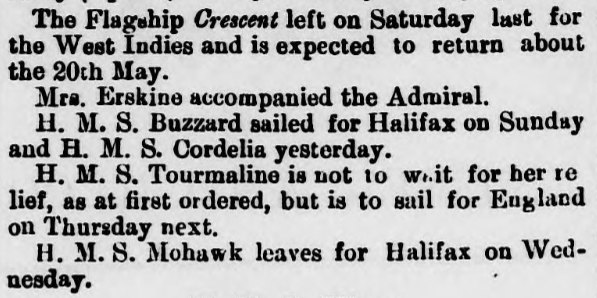
Royal Gazette: the flagship Crescent left on Saturday last for the West Indies and is expected to return about the 20th May; Mrs Erskine accompanied the Admiral
Royal Gazette, 28 April 1896: off to the West Indies
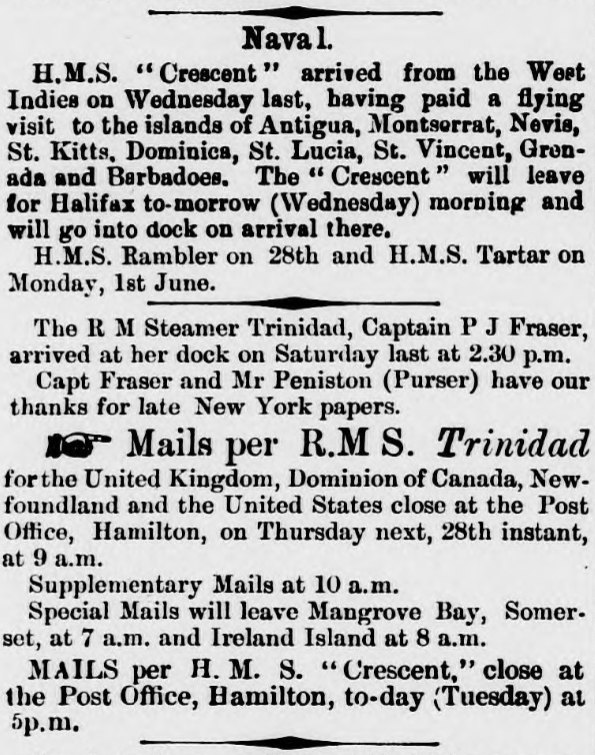
Royal Gazette: H.M.S. Crescent arrived from the West Indies on Wednesday last after a flying visit to Antigua, Montserrat, Nevis, St Kitts, Dominica, St Lucia, St Vincent, Grenada and Barbados, and will leave for Halifax tomorrow; also a notice that mails per H.M.S. Crescent close at the Post Office, Hamilton, today at 5 p.m.
Royal Gazette, 26 May 1896: back, and the mails go by the flagship

The Crescent brought Vice-Admiral James Erskine down from Halifax in November 1895, arriving on Friday the 15th “in a run of two days” after rough weather the whole way. Mrs Erskine and their daughter came with him. By the new year the Gazette was reporting that she had relieved the old flagship Blake.

The winter cruise that should have started on 2 January didn’t happen, and the Gazette shows a flagship busy at Bermuda instead. Late in January a naval brigade of marines and bluejackets from the fleet landed at the Dockyard and marched to Moresby Plain behind the flagship’s band, for drill under her gunnery lieutenant, C. D. Granville. In February she went out for her quarterly target practice. At the naval regatta at the end of the month her boats were in nearly every race, and the Admiral’s Cup was “cleverly won by the Pinnace of H.M.S. Crescent”.

There was a sad night in April too. In the early hours of 15 April the steamboat Triton, on her way back to Hamilton from the flagship, ran down the little ferry Sylvia in Two Rocks Passage, and a passenger, John William Jillard, was drowned.

On 25 April she sailed at last for a short cruise in the West Indies, with Mrs Erskine on board. She made a flying visit to Antigua, Montserrat, Nevis, St Kitts, Dominica, St Lucia, St Vincent, Grenada and Barbados and was back on 20 May. A week later she left for Halifax and the summer, and the Gazette gave notice that the mails would go with her: “Mails per H.M.S. ‘Crescent,’ close at the Post Office, Hamilton, to-day (Tuesday) at 5 p.m.” She reached Halifax on the evening of 28 May.

Little Boy Blue

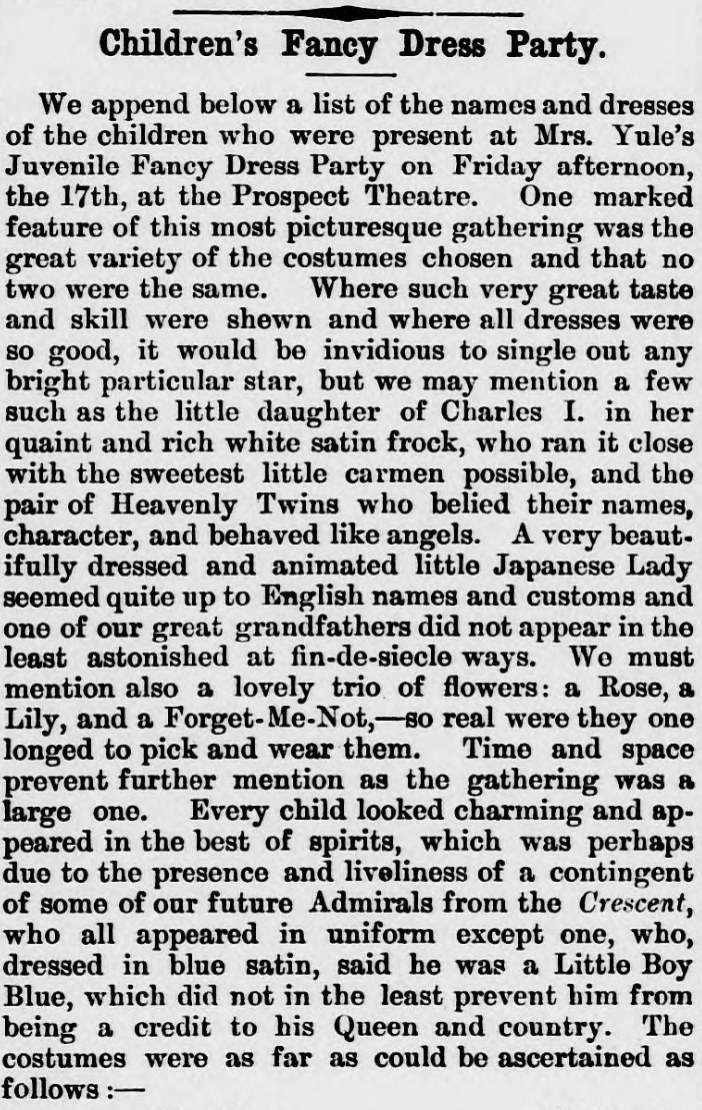
Royal Gazette report headed Children's Fancy Dress Party, describing Mrs Yule's juvenile fancy dress party at the Prospect Theatre on Friday 17th, and a contingent of future Admirals from the Crescent who all appeared in uniform except one, who, dressed in blue satin, said he was a Little Boy Blue
Royal Gazette, 28 January 1896: Mrs Yule’s fancy dress party
Line from the list of costumes: Master H F C Kitchener, R N, Little Boy Blue
From the list of costumes: “Master H F C Kitchener, R N”

With the squadron kept at Bermuda, the midshipmen had time for parties. On Friday 17 January Mrs Yule gave a children’s fancy dress party at the Prospect Theatre. The Gazette thought the children were in the best of spirits, “which was perhaps due to the presence and liveliness of a contingent of some of our future Admirals from the Crescent”. They all came in uniform except one, who turned up in blue satin as Little Boy Blue.

The list of costumes gives his name: “Master H F C Kitchener, R N”. That’s Henry Franklin Chevallier Kitchener, then 17, son of Henry Kitchener and nephew of Herbert Kitchener, at that time Sirdar of the Egyptian Army and later Lord Kitchener of Khartoum. He stayed in the Navy, became Viscount Broome when his uncle died in 1916, and retired a captain. He died in 1928.

The Admiral’s daughter was there too: Miss Veronica Erskine came as Yum-Yum.

The flagship’s first winter

The ship on one side, the letters on the other.

The ship
The letters
15 Nov 1895
CrescentArrives at Bermuda from Halifax with Vice-Admiral Erskine.
1 Jan 1896
Ireland IslandThe new type H5 datestamp comes into use.
2 Jan
CrescentThe planned start of the winter cruise. It doesn’t happen.
3 or 5 Jan
The fairyPosted at Ireland Island to Mrs Conron.
17 Jan
CrescentHer midshipmen at Mrs Yule’s fancy dress party; Kitchener as Little Boy Blue.
18 Jan
LondonReports that the new Flying Squadron may be sent to Bermuda.
23 Jan
The fairyArrives in England.
Feb
CrescentQuarterly target practice; her pinnace wins the Admiral’s Cup at the regatta.
early Apr
The cupidPosted at Ireland Island to Mrs Conron.
15 Apr
BermudaThe Triton, returning from the flagship, sinks the ferry Sylvia; one man drowned.
16 Apr
The cupidArrives at New Oxted.
25 Apr
CrescentSails for a short cruise in the West Indies.
12 May
The HydrographerLetter posted in London to Lieutenant Hughes-Hughes.
20 May
CrescentBack at Bermuda from the West Indies.
27–28 May
CrescentSails for Halifax with the mails; arrives the next evening.

The Ship

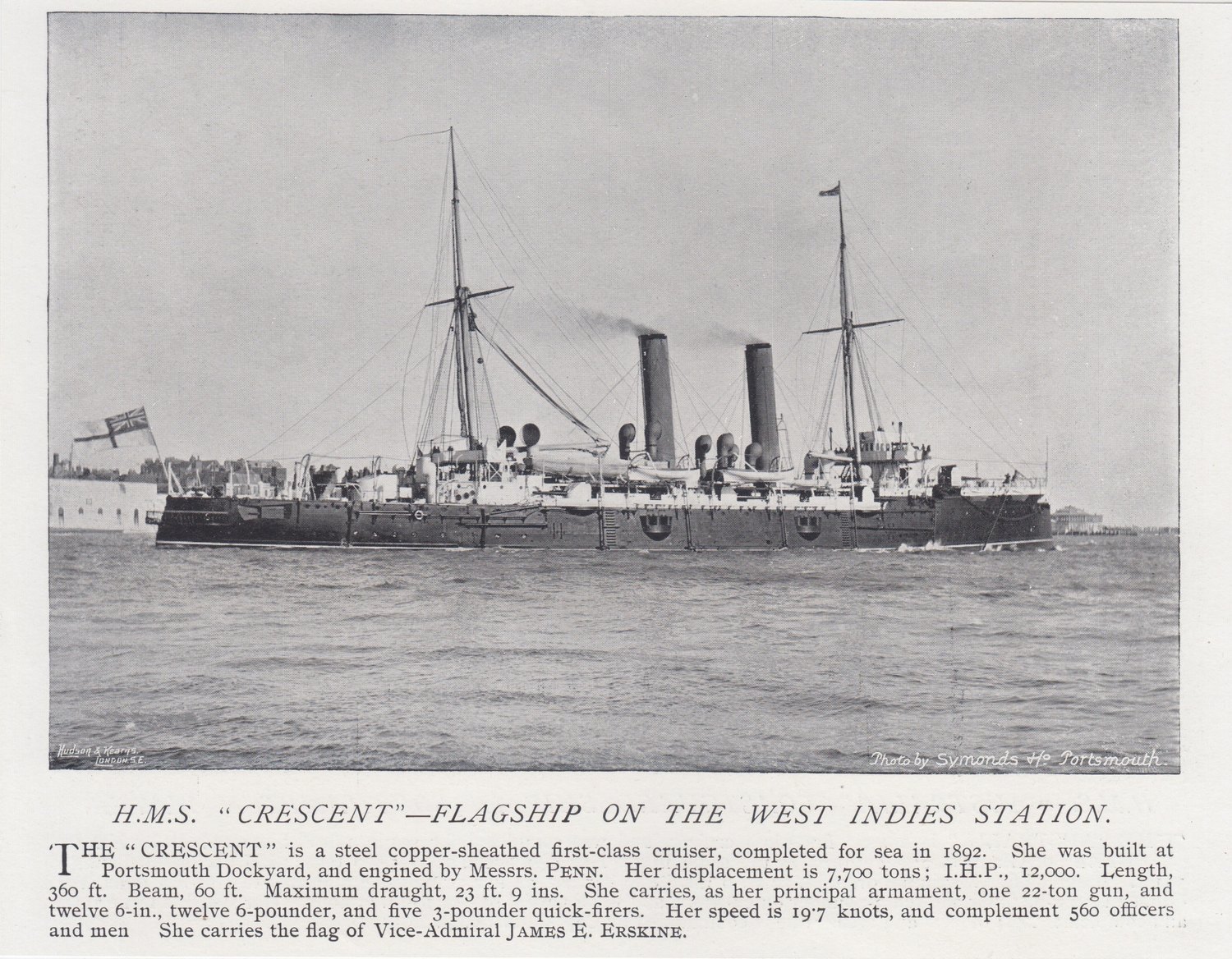
Page from The Navy and Army Illustrated: photograph of HMS Crescent under way, broadside view, two tall funnels, two masts and a White Ensign at the stern, captioned H.M.S. Crescent, Flagship on the West Indies Station, with a paragraph describing her as a steel copper-sheathed first-class cruiser built at Portsmouth and carrying the flag of Vice-Admiral James E. Erskine

H.M.S. Crescent

HMS Crescent was a first-class protected cruiser, built at Portsmouth Dockyard. She was laid down in October 1890, launched on 30 March 1892 and completed in 1894. She and her sister the Royal Arthur were a modified version of the Edgar class, intended as flagships for foreign stations, and her hull was sheathed in copper for long service away from a dockyard.

Vice-Admiral James Erskine became Commander-in-Chief of the North America and West Indies Station in April 1895, with his flag in the Crescent and Captain Francis Powell in command. She spent her winters at Bermuda and her summers at Halifax until Erskine handed over to Sir John Fisher in 1897. In the summer of 1898 she was commanded by Prince George, Duke of York, later King George V, on a cruise round Ireland and Scotland that ended at Cowes week. It was his last active service afloat. Seven years before, he had commanded the gunboat Thrush on this station.

She came back to Bermuda and Halifax as flagship of Vice-Admiral Sir Frederick Bedford from 1899 to 1902. She served in the First World War and was sold for breaking up in September 1921.

BuiltPortsmouth Dockyard, launched 1892
TypeFirst-class protected cruiser, Edgar class
Displacement7,700 tons
GunsOne 9.2-inch, twelve 6-inch
FlagVice-Admiral James E. Erskine, 1895–1897
CaptainFrancis Powell, 1895–1897
FateSold for breaking up, 1921

The Navy and Army Illustrated, 1896. Photograph by Symonds & Co., Portsmouth.

Still to find out

If you can help with any of these, I’d be very pleased to hear from you.

Provenance and references

Three envelopes from one ship in one winter, and between them they show both sides of a flagship’s mail: a stiff official letter from the Admiralty coming in, and somebody’s drawings going home to Surrey. I’d still like to put a name to the artist.