Postal History · Royal Navy · North America and West Indies Station

H.M.S. St George

Ireland Island · 30 October 1905

A seaman in the boys’ training squadron writes home to Chesham, from “Bermuda or Elsewhere”.

◆

This is an ordinary picture postcard, a coloured view of Hamilton with the message squeezed in along the bottom. It was written by a seaman in H.M.S. St George, one of the cruisers of the Particular Service Squadron that came out to Bermuda for the autumn of 1905. He’s sorry he hasn’t written sooner and wants to know that his allotment papers have arrived. I like it because it’s so plain, and because of how he gives his address: “Bermuda or Elsewhere”.

I

“Dearest Friends”

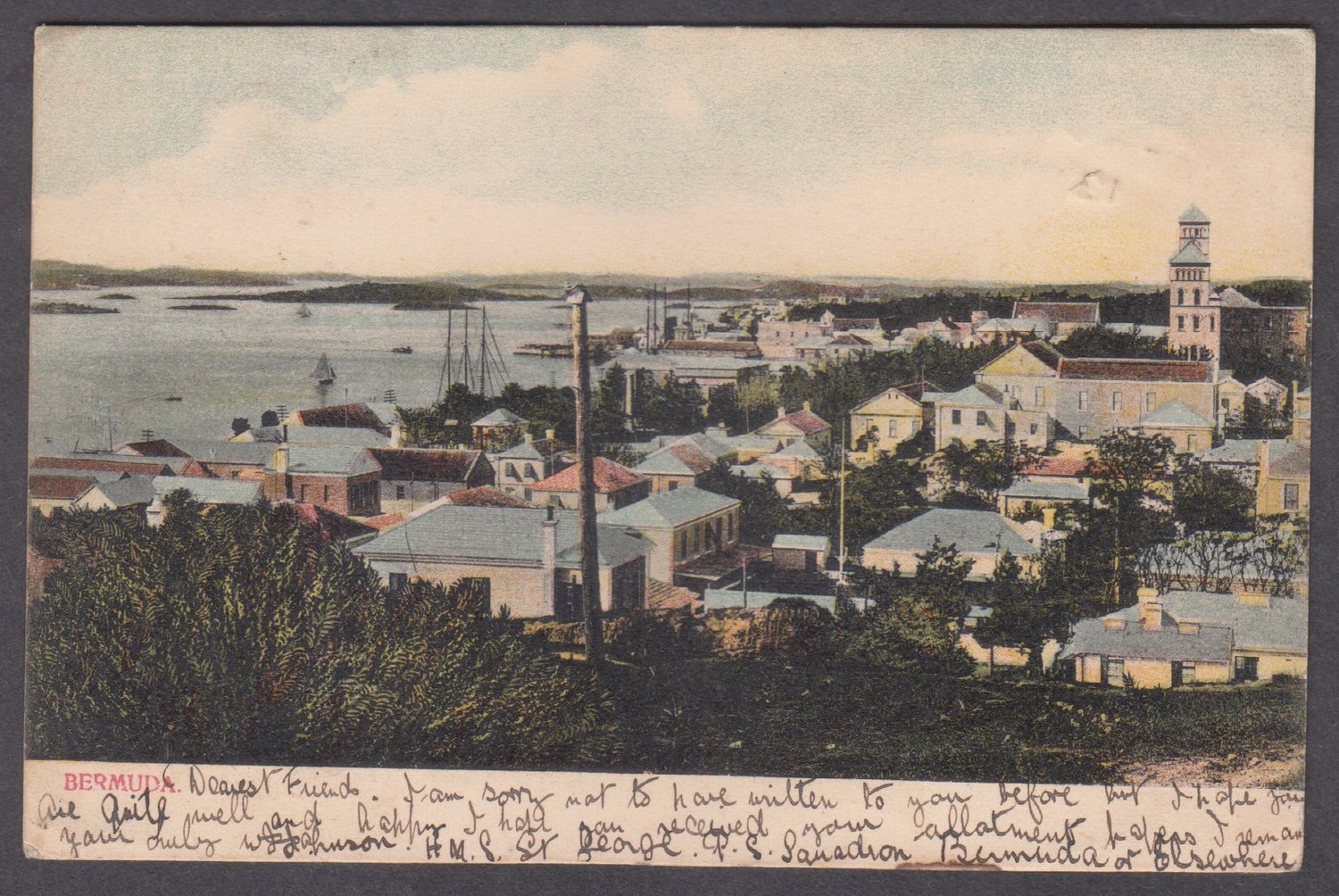
Coloured picture postcard captioned BERMUDA in red: a view from a hillside over the rooftops of Hamilton to the harbour, with sailing ships at the wharves, islands beyond, and the tower of the Cathedral on the right; along the bottom margin a message in ink reads Dearest Friends. I am sorry not to have written to you before but I hope you are quite well and happy. I hope you received your allotment papers. I remain yours truly W. J. Johnson. H.M.S. St George. P.S. Squadron, Bermuda or Elsewhere
“Bermuda”: Hamilton and the harbour, with Johnson’s message along the foot
Close-up of the message written in ink along the bottom margin of the picture side of the card, signed W. J. Johnson, H.M.S. St George, P.S. Squadron, Bermuda or Elsewhere
The message, close up
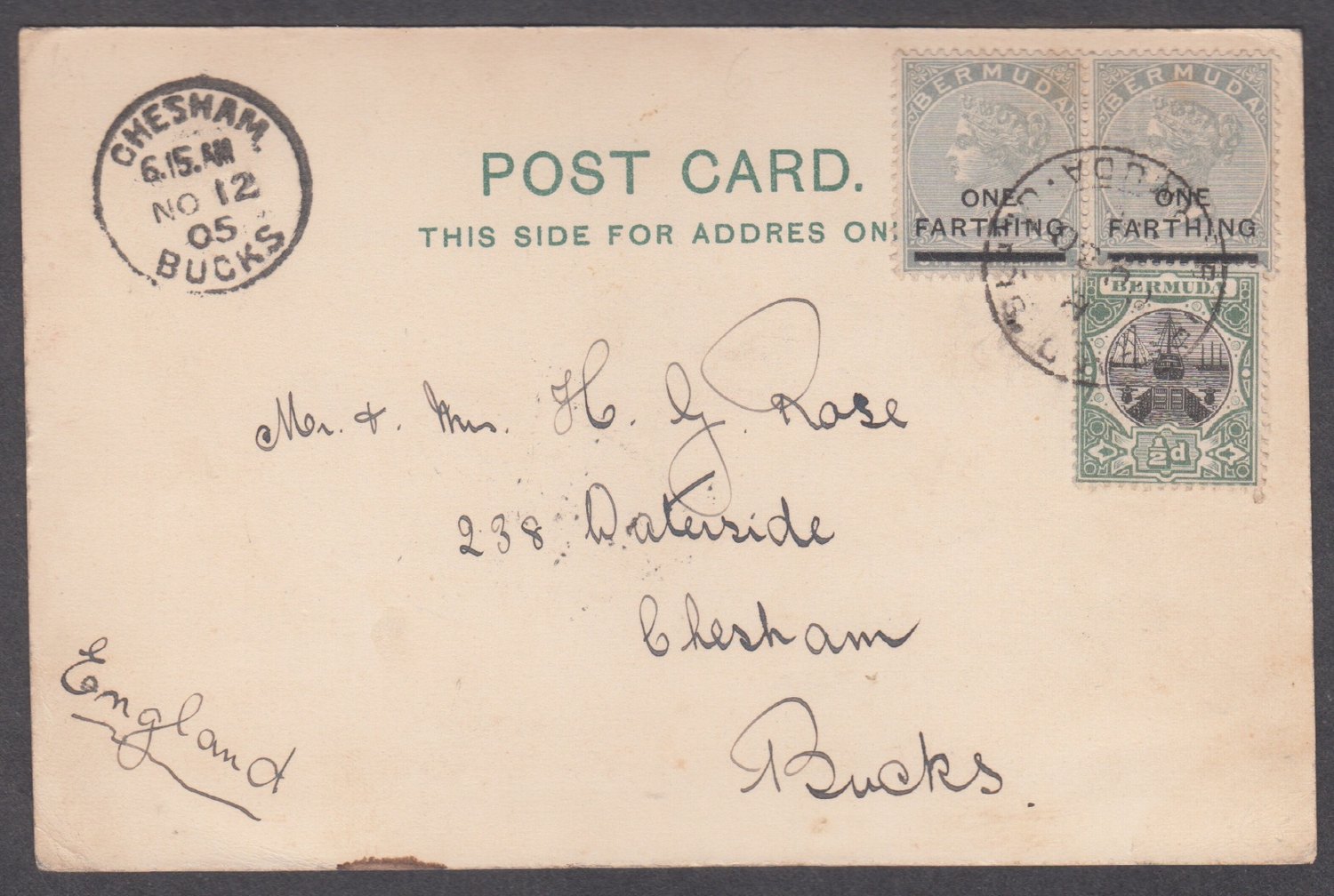
Address side of the postcard, printed POST CARD, This side for address only: a pair of Bermuda ONE FARTHING surcharges on the 1s grey and a ½d Dock stamp in black and green, tied by an Ireland Island Bermuda datestamp; a Chesham Bucks arrival datestamp of 6.15 AM, 12 November 1905, at top left; addressed in ink to Mr and Mrs H. G. Rose, 238 Waterside, Chesham, Bucks, with England written at the lower left
¼d pair and ½d Dock, Ireland Island, to Mr & Mrs H. G. Rose, Chesham
  • From W. J. Johnson, H.M.S. St George, P.S. Squadron
  • Addressed to Mr & Mrs H. G. Rose, 238 Waterside, Chesham, Bucks, England
  • Card “Bermuda”, coloured view of Hamilton, undivided back
  • Stamps Pair of ONE FARTHING on 1s grey (1901) and ½d Dock
  • Postmark Ireland Island, Bermuda, type H7, 30 October 1905
  • Arrival Chesham, Bucks, 6.15 a.m., 12 November 1905
  • Rate 1d, the postcard rate to England

The picture is a view over the rooftops of Hamilton to the harbour, with the Cathedral tower on the right, and the card is simply captioned “Bermuda”. Johnson wrote his message in ink along the bottom margin:

“Dearest Friends. I am sorry not to have written to you before but I hope you are quite well and happy. I hope you received your allotment papers. I remain yours truly W. J. Johnson. H.M.S. St George. P.S. Squadron, Bermuda or Elsewhere.”

Bermuda, October 1905

He posted it at Ireland Island, the Dockyard post office, on Monday 30 October 1905, and it reached Chesham thirteen days later, at a quarter past six on the morning of 12 November. It’s franked with a penny, the right rate for a postcard to England, made up from a pair of the 1901 ONE FARTHING surcharges on the old Victorian 1s grey and a ½d Dock. In 1905 the back of a Bermuda card was still “for address only”, so the message had to go on the picture side.

The allotment papers are the interesting bit. A seaman could allot part of his pay to someone at home, who then drew it each month, and it sounds as if Johnson had set one up for the Roses. But he calls them “Dearest Friends”, not Mother or Father, so I’d love to know who they were to him. The “P.S. Squadron” is the Particular Service Squadron, the seagoing training squadron for boys and young seamen. And “Bermuda or Elsewhere” is a sailor’s honest answer to where a reply should be sent.
II

The squadron at Bermuda

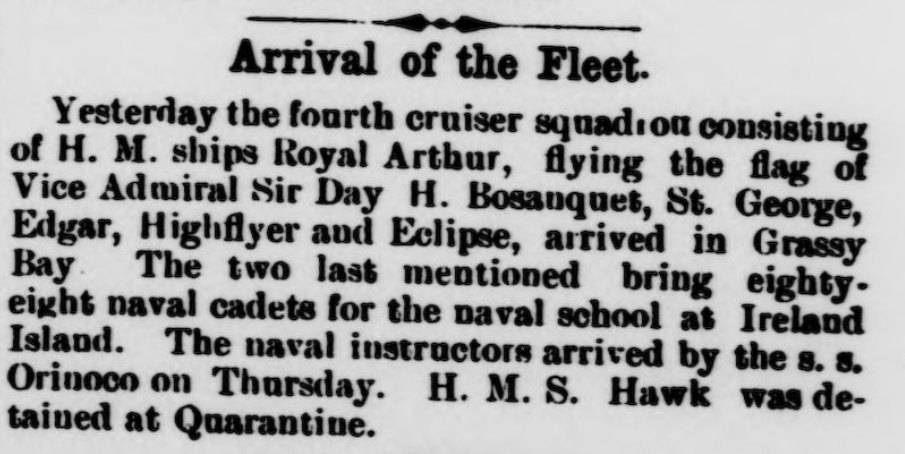
Royal Gazette, Arrival of the Fleet: Yesterday the fourth cruiser squadron consisting of H. M. ships Royal Arthur, flying the flag of Vice Admiral Sir Day H. Bosanquet, St. George, Edgar, Highflyer and Eclipse, arrived in Grassy Bay. The two last mentioned bring eighty-eight naval cadets for the naval school at Ireland Island. The naval instructors arrived by the s. s. Orinoco on Thursday. H. M. S. Hawk was detained at Quarantine
Royal Gazette, 7 October 1905: the squadron arrives
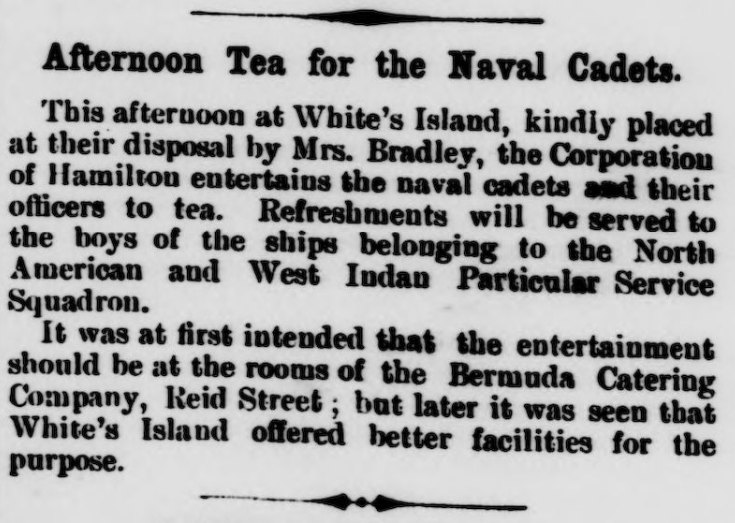
Royal Gazette, Afternoon Tea for the Naval Cadets: This afternoon at White's Island, kindly placed at their disposal by Mrs. Bradley, the Corporation of Hamilton entertains the naval cadets and their officers to tea. Refreshments will be served to the boys of the ships belonging to the North American and West Indian Particular Service Squadron. It was at first intended that the entertainment should be at the rooms of the Bermuda Catering Company, Reid Street; but later it was seen that White's Island offered better facilities for the purpose
Royal Gazette, 21 October 1905: tea for the cadets and boys
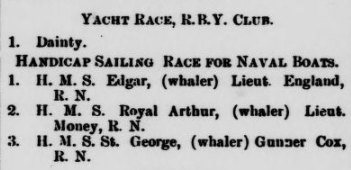
Royal Gazette prize list: Yacht Race, R.B.Y. Club, 1. Dainty. Handicap Sailing Race for Naval Boats: 1. H.M.S. Edgar, whaler, Lieut. England, R.N.; 2. H.M.S. Royal Arthur, whaler, Lieut. Money, R.N.; 3. H.M.S. St. George, whaler, Gunner Cox, R.N.
Royal Gazette, 24 October 1905: St George’s whaler third

St George had been at Bermuda the winter before. She sailed for England with Ariadne, Gibraltar and Hawke on 4 April 1905 (they have a page of their own), but by the autumn she was back. On Saturday 7 October the Royal Gazette reported that the fourth cruiser squadron had come into Grassy Bay the day before: Royal Arthur, flying the flag of Vice-Admiral Sir Day Bosanquet, with St George, Edgar, Highflyer and Eclipse, the last two bringing eighty-eight naval cadets. Hawke came too, and was held at Quarantine.

Two weeks later Bermuda celebrated the centenary of Trafalgar. On Saturday 21 October the Corporation of Hamilton gave tea at White’s Island to the cadets and their officers, and refreshments were served to “the boys of the ships belonging to the North American and West Indian Particular Service Squadron”. The Gazette’s report the following Tuesday says two hundred bluejackets and seventy boys sat down to tea on the lawn tennis ground. There was a regatta too, and in the handicap sailing race for naval boats St George’s whaler, under Gunner Cox, came third behind Edgar and Royal Arthur. Bosanquet wrote to the Mayor afterwards to thank the Corporation for the prizes and “the splendid tea given to the Cadets and boys”.

Johnson posted his card nine days after the tea. I’d like to think he was one of the two hundred on the lawn, but I can’t prove it.

III

Not here for Christmas

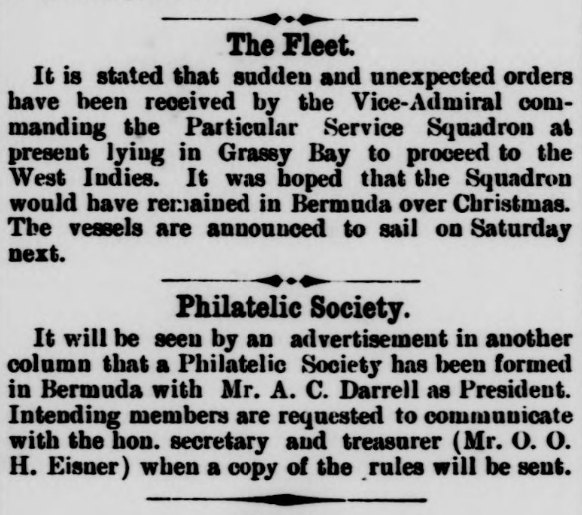
Royal Gazette: The Fleet. It is stated that sudden and unexpected orders have been received by the Vice-Admiral commanding the Particular Service Squadron at present lying in Grassy Bay to proceed to the West Indies. It was hoped that the Squadron would have remained in Bermuda over Christmas. The vessels are announced to sail on Saturday next. Below it: Philatelic Society. It will be seen by an advertisement in another column that a Philatelic Society has been formed in Bermuda with Mr. A. C. Darrell as President. Intending members are requested to communicate with the hon. secretary and treasurer (Mr. O. O. H. Eisner) when a copy of the rules will be sent
Royal Gazette, 5 December 1905: sudden orders, and a new Philatelic Society
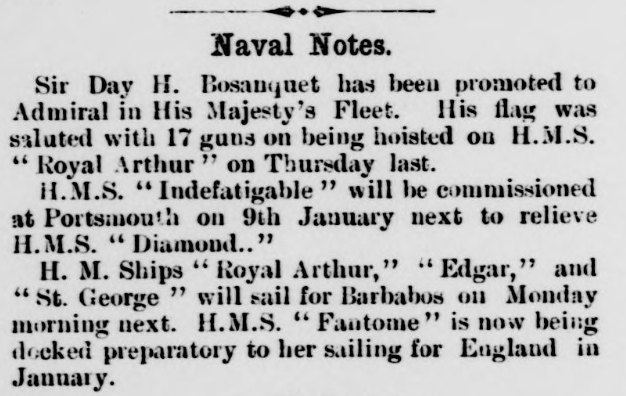
Royal Gazette Naval Notes: Sir Day H. Bosanquet has been promoted to Admiral in His Majesty's Fleet. His flag was saluted with 17 guns on being hoisted on H.M.S. Royal Arthur on Thursday last. H.M.S. Indefatigable will be commissioned at Portsmouth on 9th January next to relieve H.M.S. Diamond. H. M. Ships Royal Arthur, Edgar, and St. George will sail for Barbados on Monday morning next. H.M.S. Fantome is now being docked preparatory to her sailing for England in January
Royal Gazette, 9 December 1905: sailing for Barbados

The squadron had expected to spend Christmas at Bermuda. On 5 December the Gazette reported that “sudden and unexpected orders” had come for the Particular Service Squadron to go to the West Indies, and that the ships would sail on Saturday. They didn’t quite make Saturday. On the 9th the paper said that Royal Arthur, Edgar and St George would sail for Barbados on Monday morning, the 11th. The same notice reports Bosanquet’s promotion to full Admiral, his flag saluted with seventeen guns when it was hoisted in Royal Arthur.

The dealer’s note with the card says St George was the flagship, but the Gazette is clear that the flag was in Royal Arthur.

I couldn’t leave out the paragraph underneath the fleet news on the 5th. A Philatelic Society had just been formed in Bermuda, with A. C. Darrell as President and O. O. H. Eisner as secretary and treasurer. Johnson’s card was already in Chesham by then, but it’s nice to see stamps getting a mention in the same column.

April to December 1905

The ship on one side, the card on the other.

The ship
The card
Tue 4 Apr
The shipSails from Bermuda for England with Ariadne, Gibraltar and Hawke.
Fri 6 Oct
The shipBack in Grassy Bay with Royal Arthur and the fourth cruiser squadron.
Sat 21 Oct
The shipTrafalgar Centenary: tea at White’s Island; her whaler third in the sailing race.
Mon 30 Oct
The cardPosted at Ireland Island: “Bermuda or Elsewhere”.
Sun 12 Nov
The cardArrives at Chesham, 6.15 a.m.
Tue 5 Dec
The ship“Sudden and unexpected orders” for the West Indies.
Mon 11 Dec
The shipSails for Barbados with Royal Arthur and Edgar.

The Ship

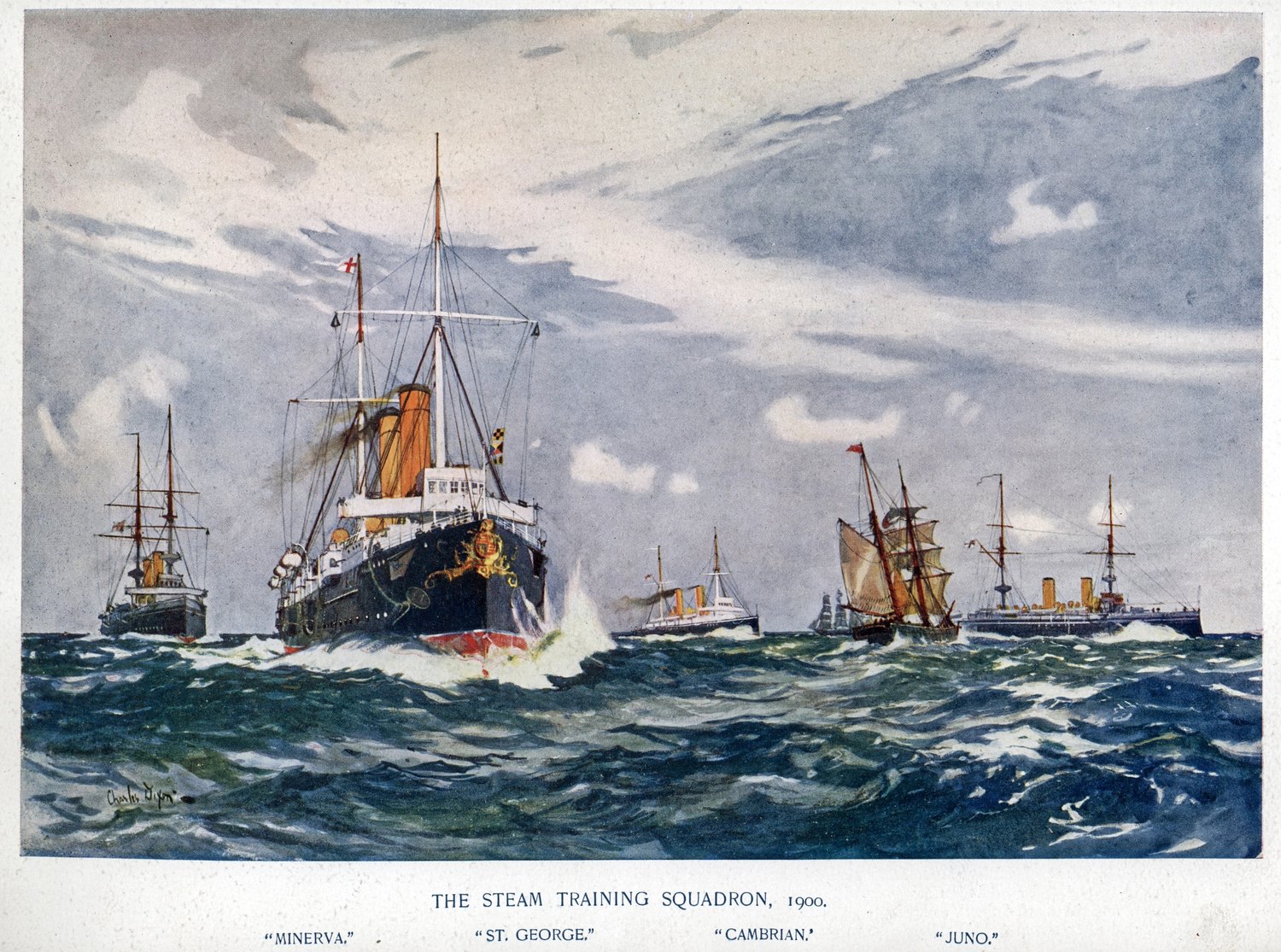
Colour painting by Charles Dixon titled The Steam Training Squadron, 1900: the cruiser St George, black hull, white upperworks and two buff funnels, comes towards the viewer through a green and white sea with a gilded crest on her bow; Minerva steams on the left, Cambrian and Juno on the right, with a fishing boat under brown sails between them, beneath a big grey and blue sky; the ships are named beneath the picture

H.M.S. St George

St George was an Edgar-class first-class protected cruiser, built by Earle’s at Hull, launched on 23 June 1892 and completed in October 1894. She went out to the Cape as flagship of Rear-Admiral Harry Rawson, and on 27 August 1896 she led the ships that bombarded the Sultan’s palace at Zanzibar, the forty-minute war often called the shortest in history. The next year her men were at Benin. In 1901 she was one of the two escorts for the royal yacht Ophir on the Duke and Duchess of Cornwall and York’s tour of the Empire, and she then led the Cruiser Squadron, the Navy’s seagoing training squadron.

From 1904 to 1906 she was a boys’ training ship on the North America and West Indies Station, which is where Johnson comes in. She went into reserve at Devonport in 1906, became a depot ship in 1909, served through the First World War, and was sold for breaking up at Plymouth on 1 July 1920.

The painting is Charles Dixon’s The Steam Training Squadron, 1900, with St George in the centre. She was doing the same job then as in 1905, taking boys to sea.

BuiltEarle’s, Hull; launched 23 June 1892
TypeEdgar-class first-class protected cruiser
Guns2 × 9.2-in, 10 × 6-in; 7,350 tons
StationNorth America and West Indies, boys’ training ship, 1904–06
FateSold for breaking up, Plymouth, 1 July 1920

The Steam Training Squadron, 1900: Minerva, St George, Cambrian and Juno. Painting by Charles Edward Dixon, via Wikimedia Commons.

Still to find out

If you can help with any of these, I’d be very pleased to hear from you.

References

It’s only a few lines in ink along the foot of a view card, but it puts a name to one of the men in St George at Bermuda in the autumn of 1905, and it tells us a little about who was waiting for him at home.