Postal History · Royal Navy · North America and West Indies Station

H.M.S. Euryalus

Bermuda · April 1908

Two cards from a sailor in the flagship: the price of Front Street, and the passage home.

◆

These are two simple cards, never posted, written in April 1908 by the same sailor in H.M.S. Euryalus, flagship of the North America and West Indies Station. One is a view of Front Street with a few lines to Minnie and his verdict on Bermuda’s shops; the other tells home when to expect him, and that he has toothache. He signs neither and addresses neither, so I think they went home together in an envelope. One is headed “H.M.S. Euryalus” and the other just has the date, but the hand and the ink are the same.

I

“More expensive than Bond Street”

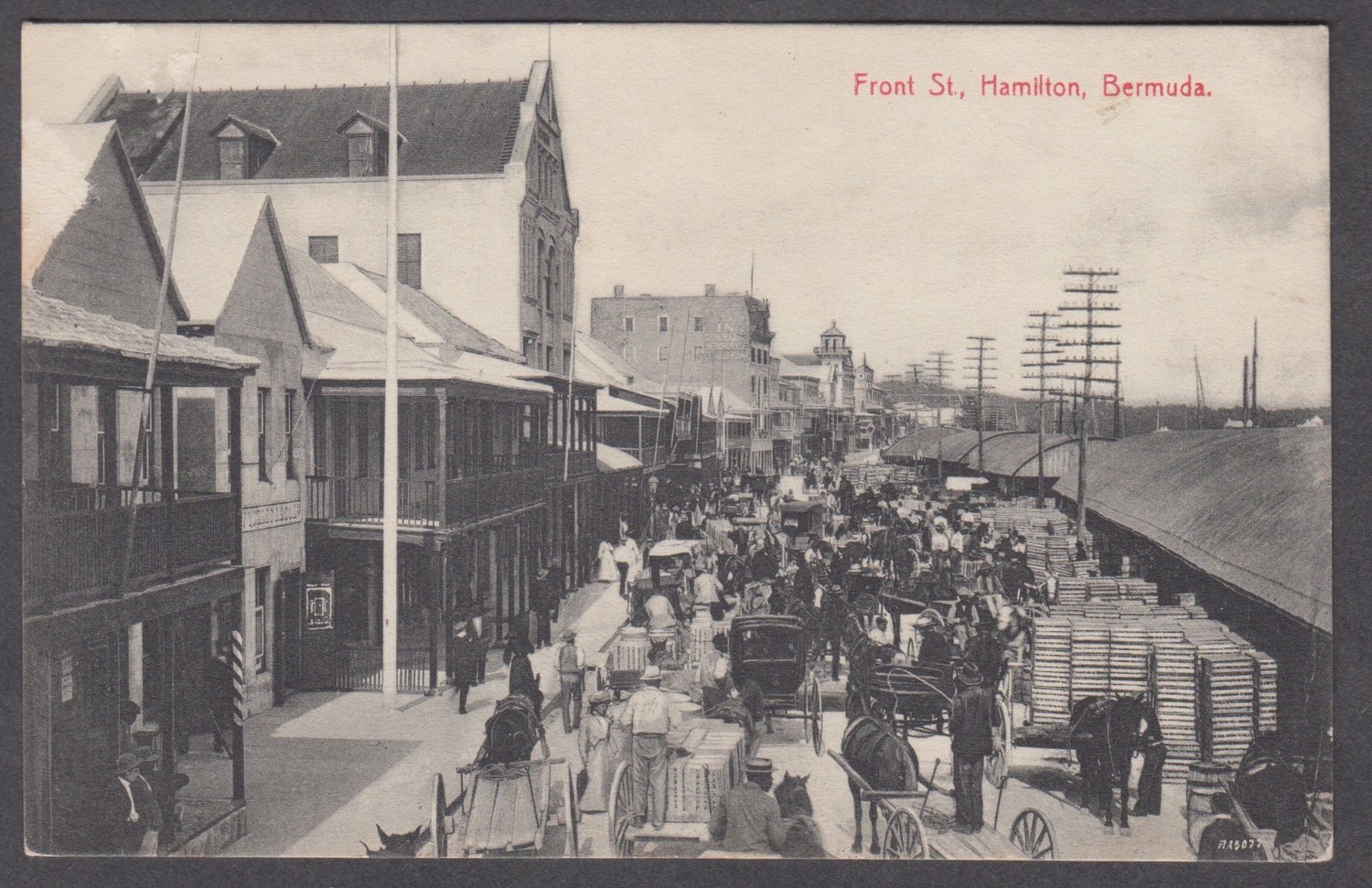
Black and white picture postcard captioned in red Front St, Hamilton, Bermuda: a view along Front Street from an upper floor, with two-storey buildings and verandahs on the left, a crowd of horse-drawn carts and carriages in the road, and stacks of wooden crates beside the long roofs of the wharf sheds on the right, telegraph poles running into the distance
“Front St, Hamilton, Bermuda”
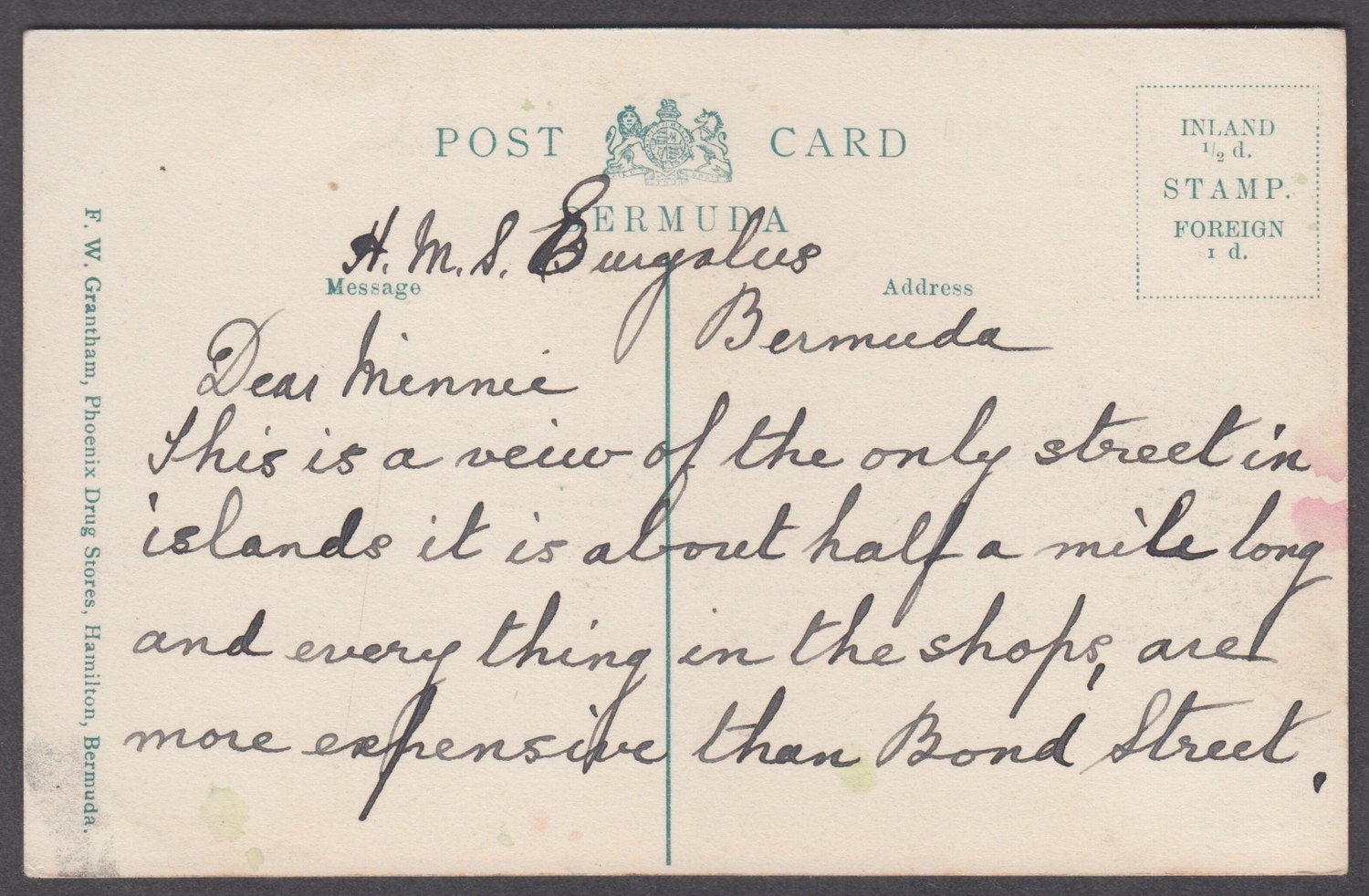
Message side of the postcard, printed POST CARD with the royal arms and BERMUDA, Message and Address, a stamp box reading Inland half penny, Foreign 1d, and the imprint F. W. Grantham, Phoenix Drug Stores, Hamilton, Bermuda up the left edge; written across both halves in ink: H.M.S. Euryalus, Bermuda. Dear Minnie, This is a view of the only street in islands it is about half a mile long and every thing in the shops are more expensive than Bond Street. No stamp, postmark or address
Headed “H.M.S. Euryalus”, to Minnie
  • From A sailor in H.M.S. Euryalus (unsigned)
  • To “Minnie”; no address
  • Card “Front St, Hamilton, Bermuda”, divided back
  • Publisher F. W. Grantham, Phoenix Drug Stores, Hamilton
  • Postage None; unposted
  • Date Not dated; almost certainly April 1908

He heads the card “H.M.S. Euryalus”, writes “Bermuda” across the address side, and then just carries on across both halves:

“Dear Minnie. This is a view of the only street in islands it is about half a mile long and every thing in the shops are more expensive than Bond Street.”

H.M.S. Euryalus, Bermuda

He doesn’t sign it. With no stamp, no postmark and no address, I think it was either tucked into a letter home or never left his kit bag. Bond Street suggests he knew London, but I can’t say more than that, and I’d love to know who Minnie was.

The card was published by F. W. Grantham of the Phoenix Drug Stores in Hamilton. The view looks along Front Street from an upper window, with the wharf sheds on the right, crates stacked high (onions, I’d guess) and the road jammed with carts and carriages. Calling it the only street was a bit unfair, but for a sailor ashore for the afternoon it was probably the one that mattered.

The card isn’t dated. The Royal Gazette shows that Euryalus was only at Bermuda in the spring of 1907 and the spring of 1908, but the second card below, dated 15 April 1908, is in the same hand, with the same pen and ink, and I’m as sure as I can be that the two were written at the same time.
II

“We leave here on April 26th”

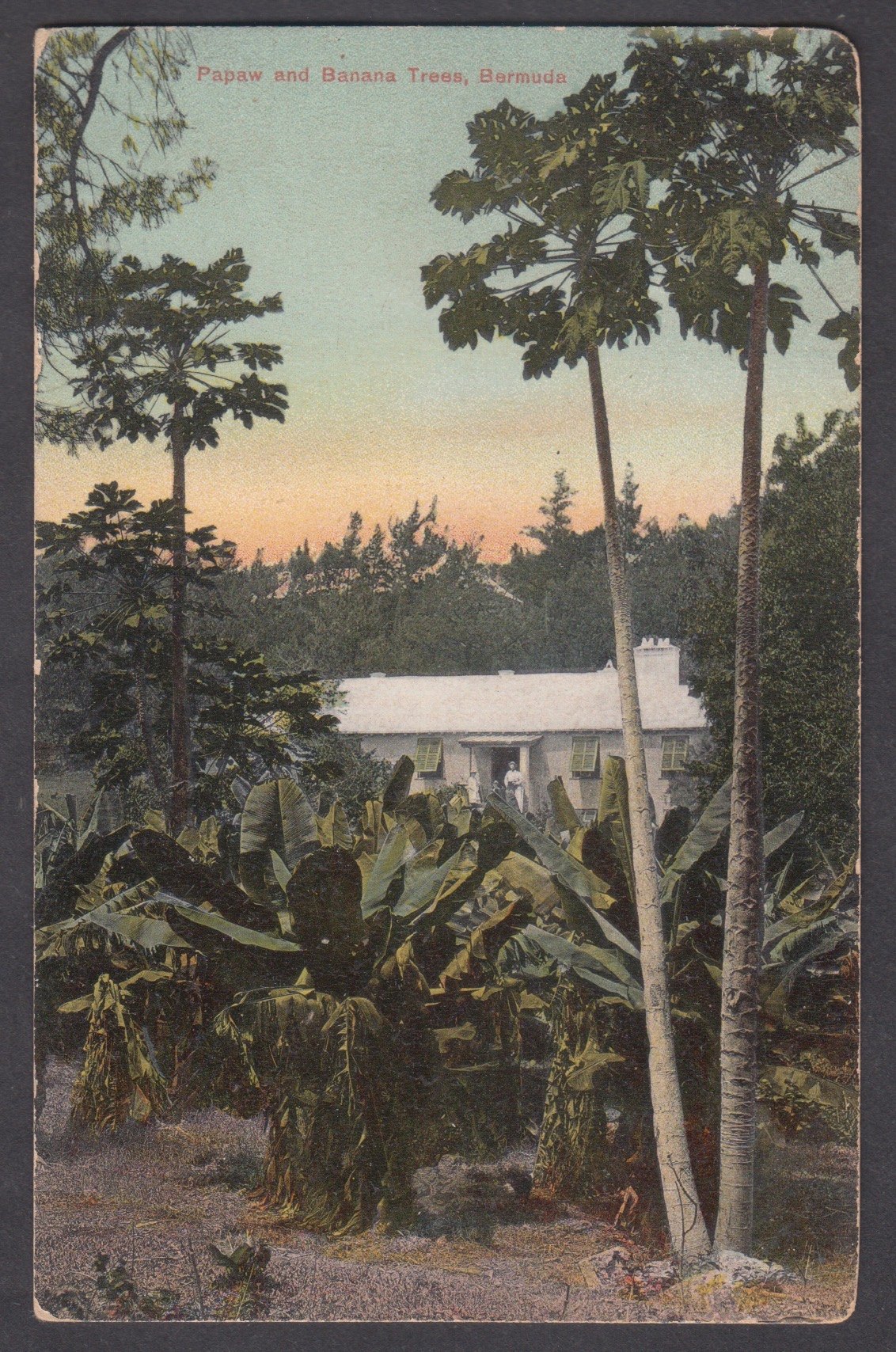
Upright coloured picture postcard captioned in red Papaw and Banana Trees, Bermuda: two tall slender papaw trees and a thick stand of banana plants in front of a long white-roofed Bermuda cottage with green shutters, two figures in the doorway, cedar trees behind and an orange and pale blue evening sky
“Papaw and Banana Trees, Bermuda”
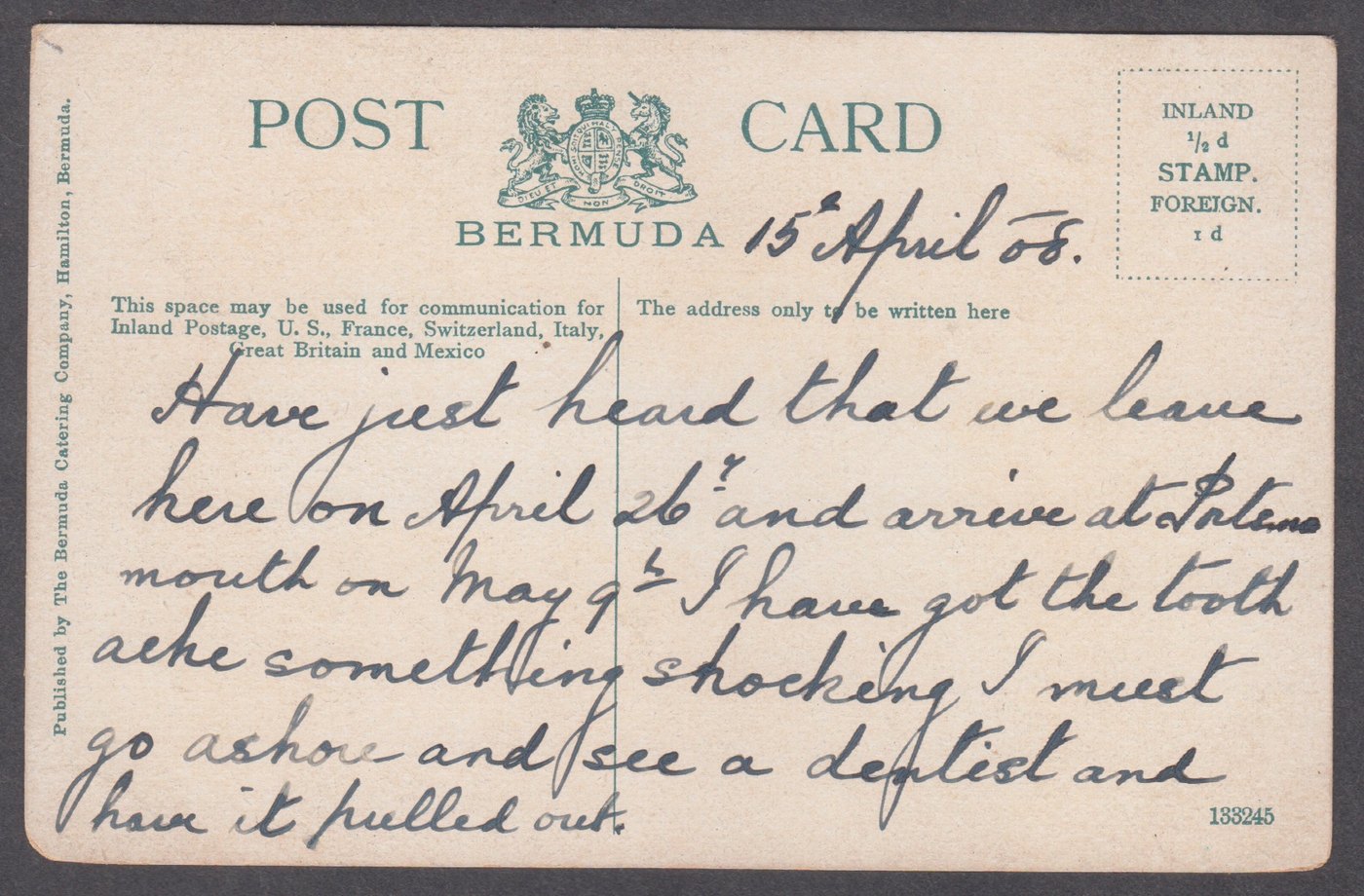
Message side of the postcard, printed POST CARD with the royal arms and BERMUDA, This space may be used for communication for Inland Postage, U.S., France, Switzerland, Italy, Great Britain and Mexico, The address only to be written here, a stamp box reading Inland half penny Stamp Foreign 1d, the number 133245, and up the left edge Published by The Bermuda Catering Company, Hamilton, Bermuda; written across both halves in ink: 15th April 08. Have just heard that we leave here on April 26th and arrive at Portsmouth on May 9th. I have got the tooth ache something shocking I must go ashore and see a dentist and have it pulled out. No stamp, postmark or address
Dated “15th April 08”, in the same hand
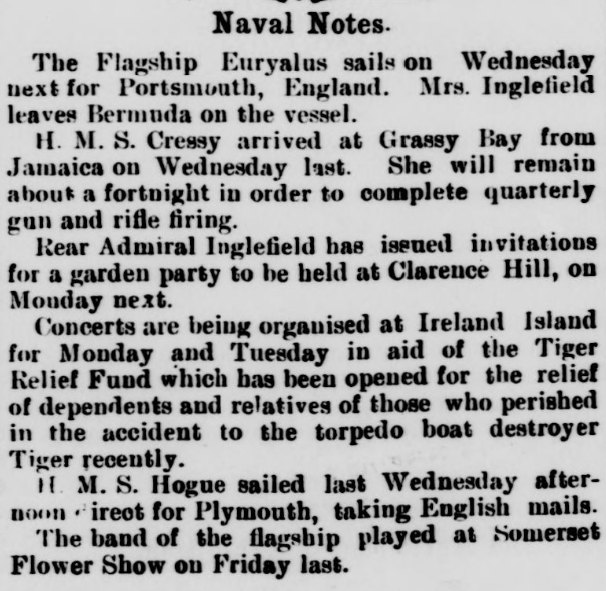
Royal Gazette, Naval Notes: The Flagship Euryalus sails on Wednesday next for Portsmouth, England. Mrs. Inglefield leaves Bermuda on the vessel. H.M.S. Cressy arrived at Grassy Bay from Jamaica on Wednesday last. She will remain about a fortnight in order to complete quarterly gun and rifle firing. Rear Admiral Inglefield has issued invitations for a garden party to be held at Clarence Hill, on Monday next. Concerts are being organised at Ireland Island for Monday and Tuesday in aid of the Tiger Relief Fund. H.M.S. Hogue sailed last Wednesday afternoon direct for Plymouth, taking English mails. The band of the flagship played at Somerset Flower Show on Friday last
Royal Gazette, 25 April 1908: “sails on Wednesday next for Portsmouth”
  • From The same sailor in H.M.S. Euryalus (unsigned)
  • To Not named; no address
  • Card “Papaw and Banana Trees, Bermuda”, divided back
  • Publisher The Bermuda Catering Company, Hamilton; no. 133245
  • Postage None; unposted
  • Date 15 April 1908

This time he dates the card, “15th April 08”, but doesn’t name the ship. He has news:

“Have just heard that we leave here on April 26th and arrive at Portsmouth on May 9th. I have got the tooth ache something shocking I must go ashore and see a dentist and have it pulled out.”

Bermuda, 15 April 1908

That fits the flagship exactly. On 25 April the Royal Gazette announced that Euryalus would sail “on Wednesday next for Portsmouth, England”, and she left on 29 April with the mails, three days later than he’d been told.

Put this card beside the Minnie card and the handwriting, the pen and ink, and the habit of writing straight across both halves of the back are all the same. One is headed “H.M.S. Euryalus” and the other just carries the date, but I’m convinced they’re from the same man and were written together.

The picture side is one of the Bermuda Catering Company’s coloured views, papaw and banana trees in front of a white-roofed cottage. It’s a lovely Bermudian scene, though I suspect the toothache was occupying him more than the scenery. I hope the dentist was quick.

III

The flagship comes to Bermuda

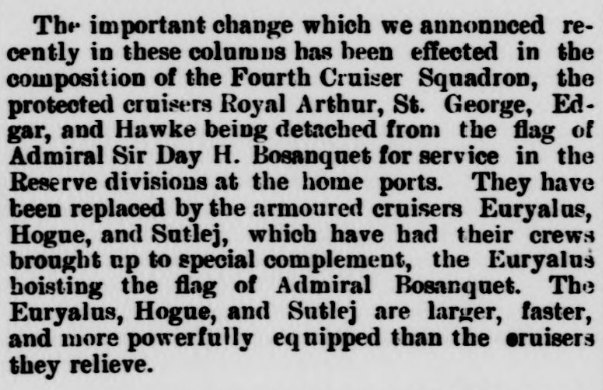
Royal Gazette: The important change which we announced recently in these columns has been effected in the composition of the Fourth Cruiser Squadron, the protected cruisers Royal Arthur, St. George, Edgar, and Hawke being detached from the flag of Admiral Sir Day H. Bosanquet for service in the Reserve divisions at the home ports. They have been replaced by the armoured cruisers Euryalus, Hogue, and Sutlej, which have had their crews brought up to special complement, the Euryalus hoisting the flag of Admiral Bosanquet. The Euryalus, Hogue, and Sutlej are larger, faster, and more powerfully equipped than the cruisers they relieve
Royal Gazette, 12 June 1906: Euryalus takes the flag
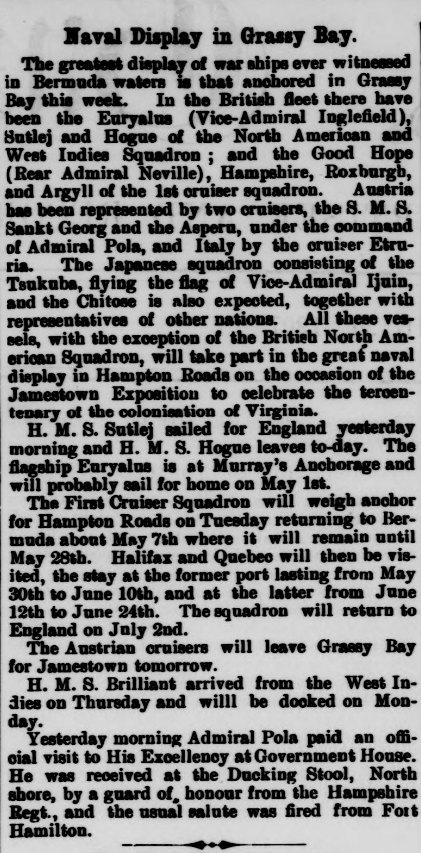
Royal Gazette, Naval Display in Grassy Bay: The greatest display of war ships ever witnessed in Bermuda waters is that anchored in Grassy Bay this week. In the British fleet there have been the Euryalus (Vice-Admiral Inglefield), Sutlej and Hogue of the North American and West Indies Squadron; and the Good Hope, Hampshire, Roxburgh and Argyll of the 1st cruiser squadron. Austria has been represented by two cruisers, the S.M.S. Sankt Georg and the Aspern, under the command of Admiral Pola, and Italy by the cruiser Etruria. The Japanese squadron consisting of the Tsukuba and the Chitose is also expected. All these vessels will take part in the great naval display in Hampton Roads for the Jamestown Exposition. The flagship Euryalus is at Murray's Anchorage and will probably sail for home on May 1st
Royal Gazette, 20 April 1907: “the greatest display of war ships ever witnessed in Bermuda waters”

Euryalus came to the station in the summer of 1906. The Fourth Cruiser Squadron, also called the North America and West Indies and Particular Service Squadron, swapped its older cruisers Royal Arthur, St George, Edgar and Hawke for three new armoured cruisers: Euryalus, Hogue and Sutlej. Euryalus hoisted the flag of Admiral Sir Day Bosanquet. That August the squadron visited Christiania, where King Oscar entertained the officers to lunch on board his yacht.

Rear-Admiral F. S. Inglefield took over in February 1907 and brought the squadron out to “show the flag” in the West Indies, with cadets on board as usual. Euryalus, under Flag Captain E. M. Phillpotts, came into Grassy Bay on Wednesday 6 March 1907. The next afternoon Inglefield landed at Hamilton from a steam pinnace, to a guard of honour from the 2nd Hampshires, and drove to Government House in the Governor’s carriage. Then she was off to the West Indies.

She was back in mid-April for what the Gazette called “the greatest display of war ships ever witnessed in Bermuda waters”. Along with Euryalus, Hogue and Sutlej were four cruisers of the 1st Cruiser Squadron, two Austrian cruisers under Admiral Pola and an Italian cruiser, and a Japanese squadron was expected. Most of them were on their way to the naval review at Hampton Roads for the Jamestown Exposition, marking three hundred years since the founding of Virginia. Euryalus went alongside the Camber and sailed for England on 1 May 1907.

IV

Ashore and afloat

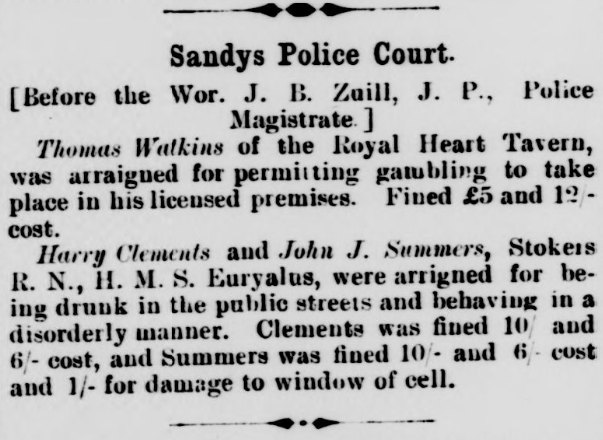
Royal Gazette, Sandys Police Court, before the Wor. J. B. Zuill, J.P., Police Magistrate: Thomas Walkins of the Royal Heart Tavern was arraigned for permitting gambling to take place in his licensed premises, fined five pounds and 12 shillings cost. Harry Clements and John J. Summers, Stokers R.N., H.M.S. Euryalus, were arraigned for being drunk in the public streets and behaving in a disorderly manner. Clements was fined 10 shillings and 6 shillings cost, and Summers was fined 10 shillings and 6 shillings cost and 1 shilling for damage to window of cell
Royal Gazette, 24 March 1908: two stokers at Sandys Police Court
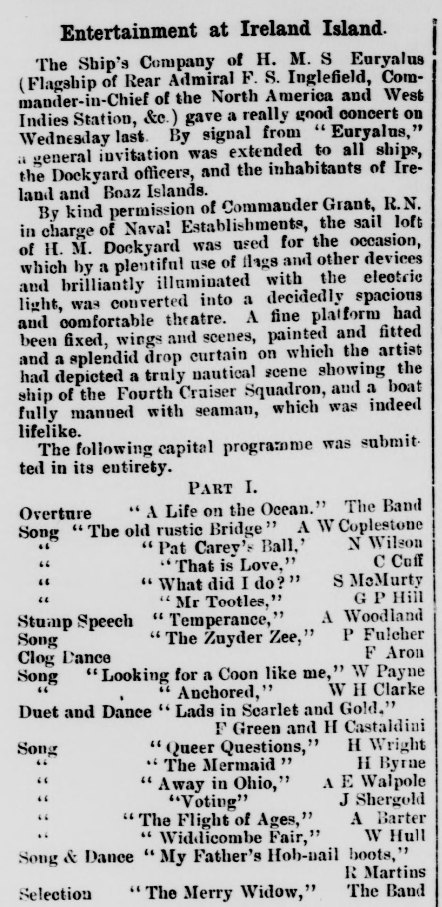
Royal Gazette, Entertainment at Ireland Island: The Ship's Company of H.M.S. Euryalus, flagship of Rear Admiral F. S. Inglefield, Commander-in-Chief of the North America and West Indies Station, gave a really good concert on Wednesday last. By signal from Euryalus a general invitation was extended to all ships, the Dockyard officers, and the inhabitants of Ireland and Boaz Islands. The sail loft of H.M. Dockyard was converted into a spacious and comfortable theatre, with a drop curtain showing the ship of the Fourth Cruiser Squadron. The programme follows: overture A Life on the Ocean by the Band, songs, a stump speech on Temperance, a clog dance, a duet and dance Lads in Scarlet and Gold, and a selection from The Merry Widow
Royal Gazette, 31 March 1908: the ship’s company concert in the sail loft
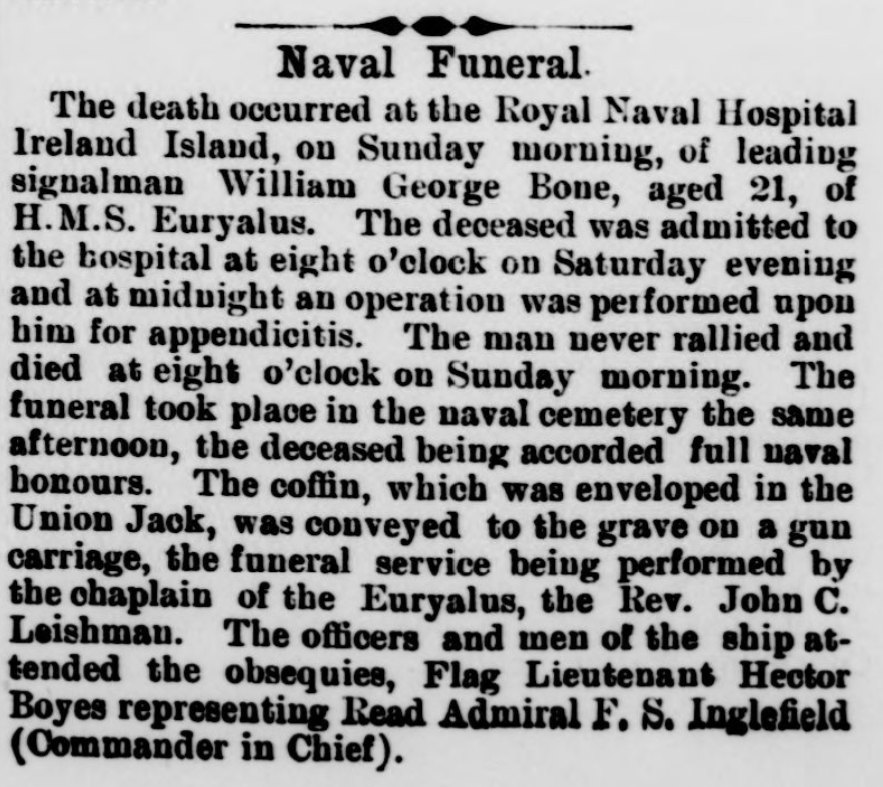
Royal Gazette, Naval Funeral: The death occurred at the Royal Naval Hospital, Ireland Island, on Sunday morning, of leading signalman William George Bone, aged 21, of H.M.S. Euryalus. The deceased was admitted to the hospital at eight o'clock on Saturday evening and at midnight an operation was performed upon him for appendicitis. The man never rallied and died at eight o'clock on Sunday morning. The funeral took place in the naval cemetery the same afternoon, the deceased being accorded full naval honours. The coffin, enveloped in the Union Jack, was conveyed to the grave on a gun carriage, the service performed by the chaplain of the Euryalus, the Rev. John C. Leishman. Flag Lieutenant Hector Boyes represented Rear Admiral F. S. Inglefield
Royal Gazette, 18 April 1908: Leading Signalman William George Bone
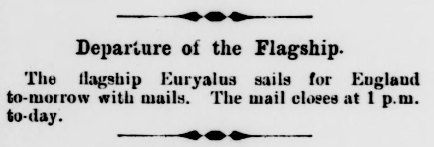
Royal Gazette, Departure of the Flagship: The flagship Euryalus sails for England to-morrow with mails. The mail closes at 1 p.m. to-day
Royal Gazette, 28 April 1908: “with mails”

She was back at Bermuda by March 1908, and this time the Gazette gives a real picture of the ship’s company.

Not everyone behaved. On 24 March the paper reported that two of her stokers, Harry Clements and John J. Summers, had been up before the magistrate at Sandys for being drunk in the public streets and behaving in a disorderly manner. Each was fined ten shillings with six shillings costs, and Summers paid an extra shilling for the damage he did to the window of his cell.

The next evening, Wednesday 25 March, the ship’s company put on a concert in the sail loft at the Dockyard, hung with flags and lit by electric light, and invited every ship, the Dockyard officers and the people of Ireland and Boaz Islands. There were songs, a clog dance, a stump speech on the “burning question of Temperance” (a burlesque, the Gazette assures us), and a sketch called “In Possession” that “created roars of laughter”. The band finished with a selection from The Merry Widow. Given what had happened at Sandys, I can’t help wondering how the Temperance speech went down.

Then a sad one. On Saturday 11 April Leading Signalman William George Bone, aged 21, was taken into the Royal Naval Hospital at Ireland Island and operated on at midnight for appendicitis. He died at eight the next morning and was buried in the naval cemetery that same afternoon with full naval honours, his coffin carried on a gun carriage under the Union Jack. The ship’s chaplain, the Rev. John C. Leishman, took the service, and the officers and men of Euryalus followed him to the grave.

On 25 April the Gazette announced that the flagship would sail “on Wednesday next for Portsmouth”, and on Wednesday 29 April 1908 she left “with mails”, the mail closing at one o’clock the day before. Mrs Inglefield went home in her. Our sailor had been told the 26th, so the date slipped three days, and I’d like to know whether he still made Portsmouth by 9 May. Perhaps both cards went home in that mail, tucked into a letter, but I can’t prove it.

The Ship

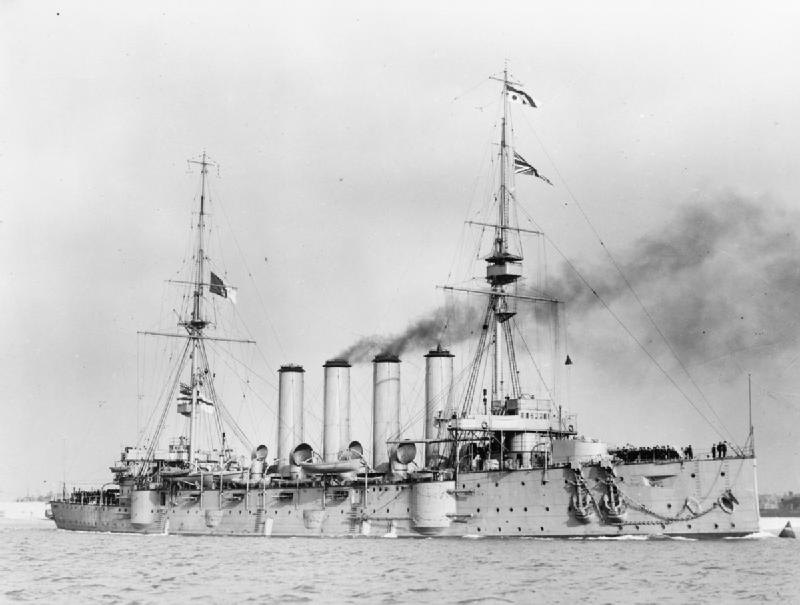
Black and white photograph of the armoured cruiser HMS Euryalus at anchor, seen broadside on from the starboard side: a long grey hull with rows of gun casemates, four tall funnels amidships and two masts with fighting tops, a white ensign at the stern

H.M.S. Euryalus

Euryalus was a Cressy-class armoured cruiser built by Vickers, Sons & Maxim at Barrow and launched on 20 May 1901. A fire at the dock and an accident in drydock held her up, and she wasn’t completed until January 1904, nearly two years after her sisters. She went straight out as flagship of the Australia Station.

From mid-1906 to March 1909 she was flagship of the North America and West Indies Station, the Fourth Cruiser Squadron, under Admiral Sir Day Bosanquet and then Rear-Admiral Inglefield. Most accounts call her a boys’ training ship in these years. She did carry cadets, but the Royal Gazette is clear that she was the flagship. In the first days of 1909 her men landed food and dug the wounded out of the ruins after the Messina earthquake, and that March the flag moved to Leviathan.

In 1914 she was back in the North Sea. She had gone in to coal when her sisters Aboukir, Cressy and Hogue were sunk by U-9 on 22 September. In April 1915 she was Admiral Wemyss’s flagship for the Gallipoli landings, and later flagship of the East Indies Station. Her conversion into a minelayer was never finished, and she was sold for scrap on 1 July 1920.

She isn’t the same ship as the frigate H.M.S. Euryalus of 1803, which has a page of its own.

BuiltVickers, Barrow; launched 20 May 1901
TypeCressy-class armoured cruiser
Guns2 × 9.2-in, 12 × 6-in; 12,000 tons
StationFlagship, North America and West Indies, 1906–09
FateSold for scrap, 1 July 1920

Euryalus, Symonds & Co., Imperial War Museums Q 21233A, via Wikimedia Commons.

Still to find out

If you can help with either of these, I’d be very pleased to hear from you.

References

Two cards, a dozen lines and no name, but between them a sailor from the flagship complaining about Front Street prices and nursing a toothache while he counts the days to Portsmouth. I’m grateful to have them both.