Postal History · Royal Navy · First Cruiser Squadron

H.M.S. Good Hope, Argyll, Hampshire and Roxburgh

Bermuda · April–May 1907

Two postcards home from Bermuda, one written as the squadron arrived and one after it came back from the Jamestown naval review.

◆

In April 1907 Grassy Bay held the biggest gathering of warships Bermuda had seen. Most of them were on their way to Hampton Roads, Virginia, for the naval review at the Jamestown Ter-Centennial Exposition, held 300 years after the English settled at Jamestown. Britain sent the First Cruiser Squadron: Good Hope, Argyll, Hampshire and Roxburgh. These two postcards were written a month apart, one just after the squadron arrived from England and one after it came back from America. Neither names a ship, so the page is partly about working out where they came from.

I

“Arrived yesterday”

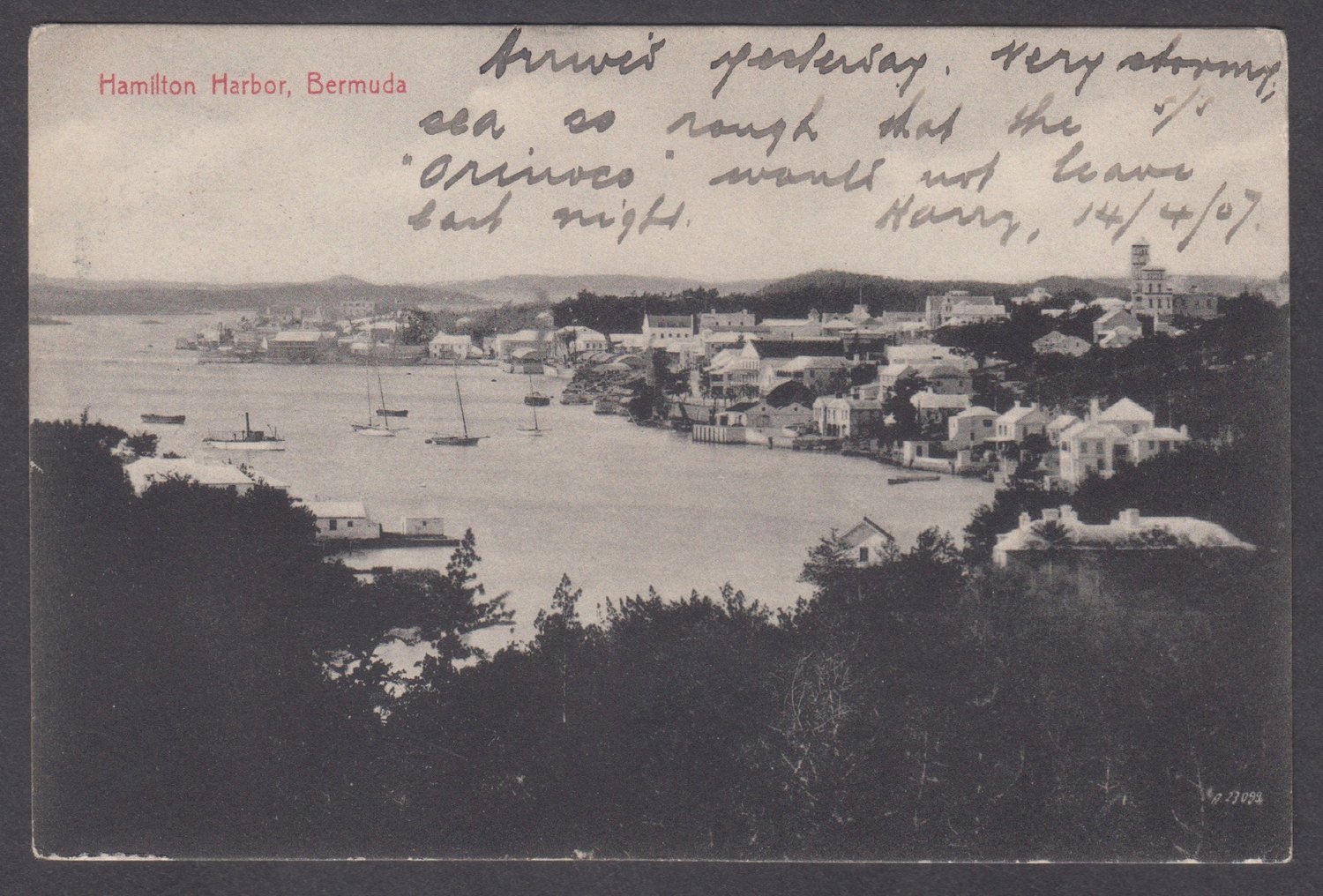
Black and white picture postcard titled Hamilton Harbor, Bermuda in red: a view down over trees to the harbour, with sailing boats and a small steamer at anchor and the town of Hamilton along the shore; written in ink across the sky: Arrived yesterday. Very stormy; sea so rough that the s/s Orinoco would not leave last night. Harry, 14/4/07
“Hamilton Harbor, Bermuda”, with Harry’s message across the sky
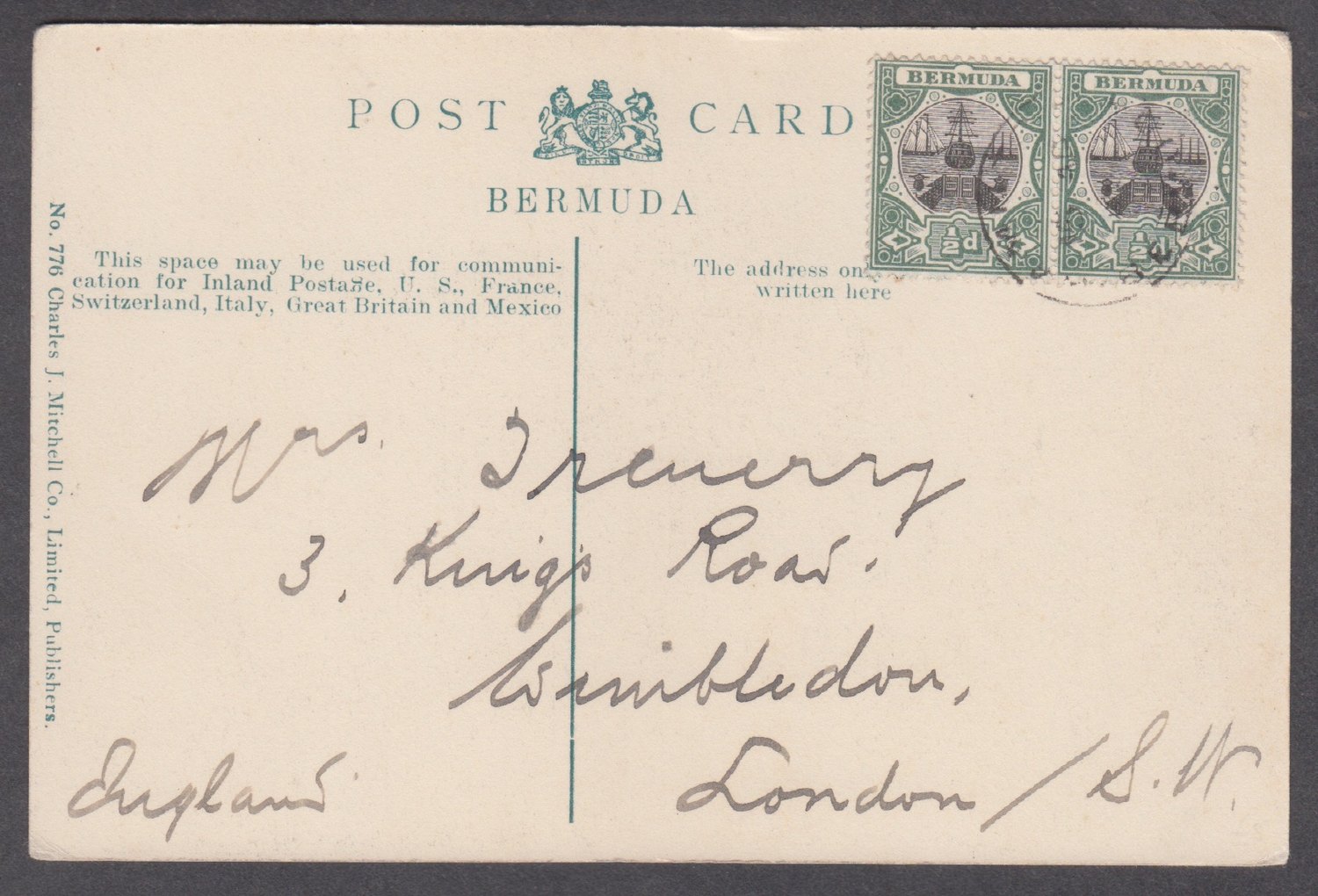
Address side of a Bermuda postcard published by Charles J. Mitchell Co., Limited, No. 776: a pair of ½d green and black Dock stamps tied by a Hamilton datestamp, addressed in ink to Mrs Trenery, 3 King's Road, Wimbledon, London S.W., with England written at lower left; the message space is blank
Pair of ½d Dock, Hamilton 15 April 1907, to Mrs Trenery, Wimbledon
  • Dated “14/4/07” by the writer
  • Card “Hamilton Harbor, Bermuda”, Charles J. Mitchell Co., Limited, No. 776
  • From “Harry”, ship not stated
  • Addressed to Mrs Trenery, 3 King’s Road, Wimbledon, London S.W., England
  • Stamps Pair of ½d Dock
  • Postmark Hamilton, Bermuda, 15 April 1907
  • Rate 1d, the postcard rate to England

Harry squeezed his few lines into the sky above Hamilton Harbour and left the message space on the address side empty:

“Arrived yesterday. Very stormy; sea so rough that the s/s ‘Orinoco’ would not leave last night. Harry, 14/4/07.”

Bermuda, 14 April 1907

The Gazette’s shipping column bears him out. The steamer Orinoco, Captain Bale, was cleared on 13 April for Halifax, Nova Scotia, but by Harry’s account the sea was too rough for her to get away that night. It was a rough night to arrive at Bermuda. The card went into the post at Hamilton the next day, Monday the 15th, with a pair of ½d Dock stamps making up the penny postcard rate to England.

The First Cruiser Squadron had been reported by wireless 220 miles out the day before, and on Saturday morning, 13 April, Good Hope, Hampshire, Argyll and Roxburgh came into Grassy Bay. The only other warships there, Sutlej and Hogue, had been in for some time, and Euryalus wasn’t expected until the 15th. So when Harry wrote “Arrived yesterday” on the 14th, the obvious arrivals were the squadron. He doesn’t name a ship, and I can’t rule out that he came another way, but I’d be surprised.
II

“Come back from America”

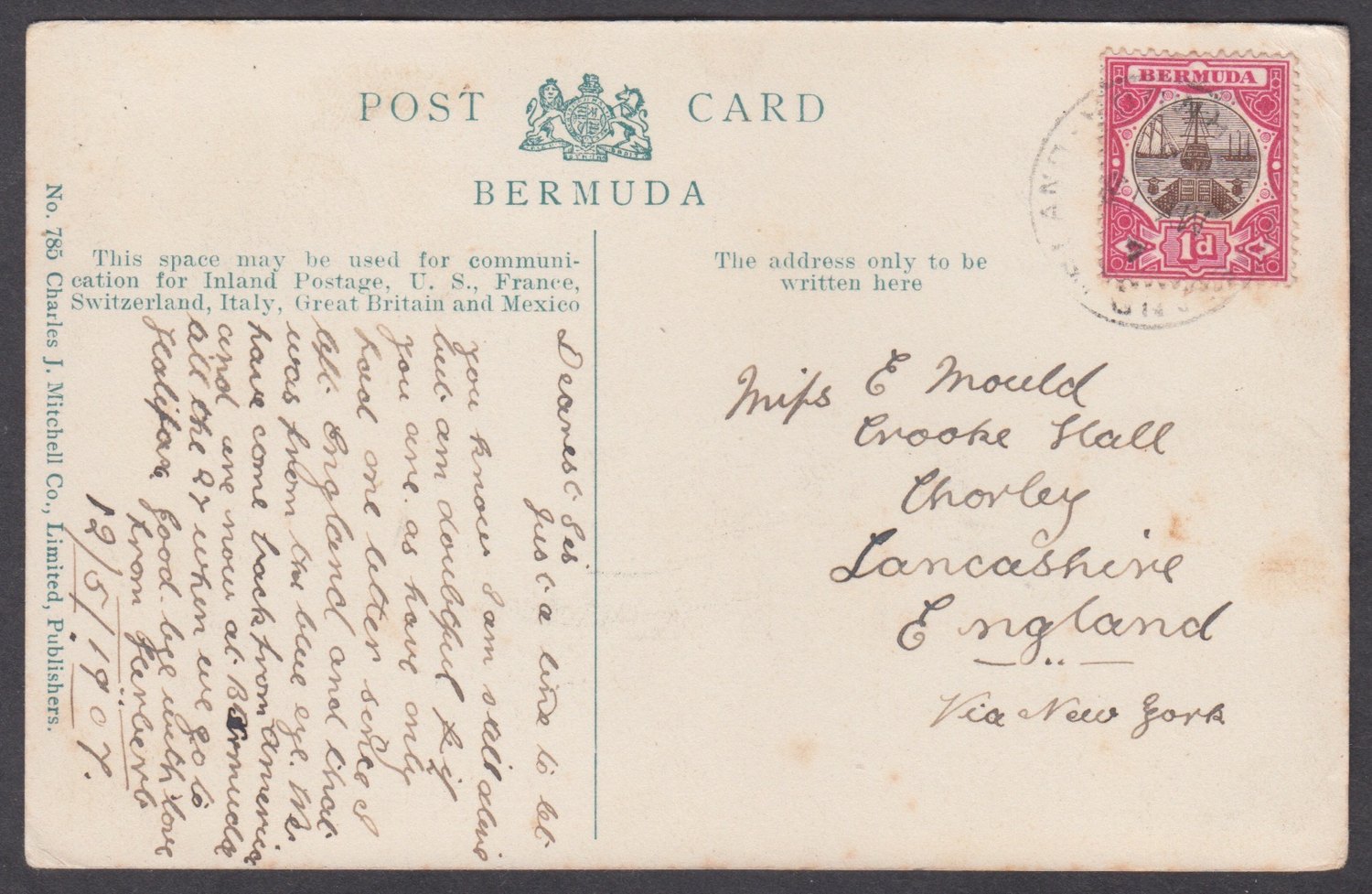
Address side of a Bermuda picture postcard published by Charles J. Mitchell Co., Limited, No. 785: a 1d carmine and brown Dock stamp tied by an Ireland Island datestamp, addressed in ink to Miss E. Mould, Crooke Hall, Chorley, Lancashire, England, Via New York; the message on the left, written sideways, begins Dearest Bes, Just a line to let you know I am still alive, and is signed from Herbert, 12/5/1907
1d Dock, Ireland Island 13 May 1907, to Miss E. Mould, Chorley
  • Dated “12/5/1907” by the writer, a day before the postmark
  • Card “Rubber Tree, Bermuda”, Charles J. Mitchell Co., Limited, No. 785
  • From “Herbert”, ship not stated
  • Addressed to Miss E. Mould, Crooke Hall, Chorley, Lancashire, England. “Bes” is probably Bess, short for Elizabeth
  • Endorsed “Via New York”
  • Stamp 1d Dock
  • Postmark Ireland Island, Bermuda, 13 May 1907
  • Rate 1d, the postcard rate to England

The picture side of this one is a rubber tree, with nothing written on it. Herbert used the message space on the address side, turning the card on its end to fit everything in:

“Dearest Bes, Just a line to let you know I am still alive but am doubtful if you are. as have only had one letter since I left England and that was from the blue eye. We have come back from America and are now at Bermuda till the 27 when we go to Halifax. Good-bye with love from Herbert.”

Bermuda, 12 May 1907

I like this one for the gentle telling-off about letters, and I’ve no idea who “the blue eye” was. But it’s also the card that ties the pair to the squadron. “Come back from America” and “till the 27 when we go to Halifax” fit only the First Cruiser Squadron’s movements, which the Royal Gazette had printed in advance in April. Herbert wrote on Sunday the 12th, and the card was posted at Ireland Island, the Dockyard post office, the next day, endorsed to go by way of New York.

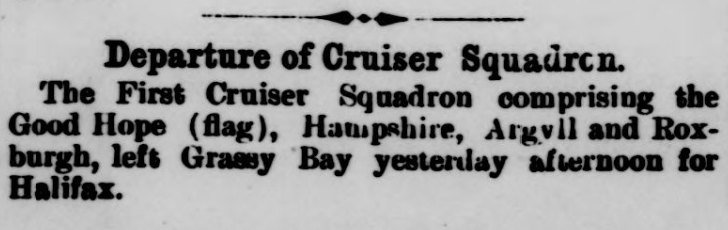
The squadron did sail on the 27th, as he said. The Gazette of the 28th reported that it “left Grassy Bay yesterday afternoon for Halifax”.

III

Grassy Bay and Hampton Roads

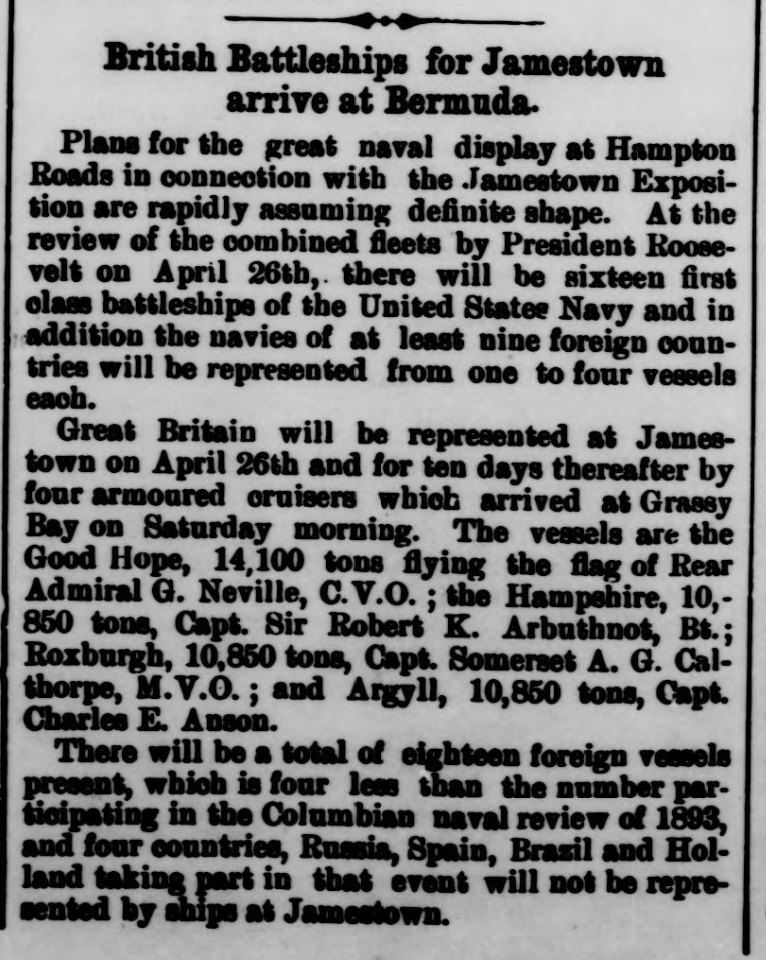
Royal Gazette article headed British Battleships for Jamestown arrive at Bermuda: plans for the naval display at Hampton Roads; Great Britain will be represented at Jamestown on April 26th by four armoured cruisers which arrived at Grassy Bay on Saturday morning: the Good Hope, 14,100 tons, flying the flag of Rear Admiral G. Neville, C.V.O.; the Hampshire, Capt. Sir Robert K. Arbuthnot, Bt.; Roxburgh, Capt. Somerset A. G. Calthorpe, M.V.O.; and Argyll, Capt. Charles E. Anson
Royal Gazette, 16 April 1907: the squadron arrives
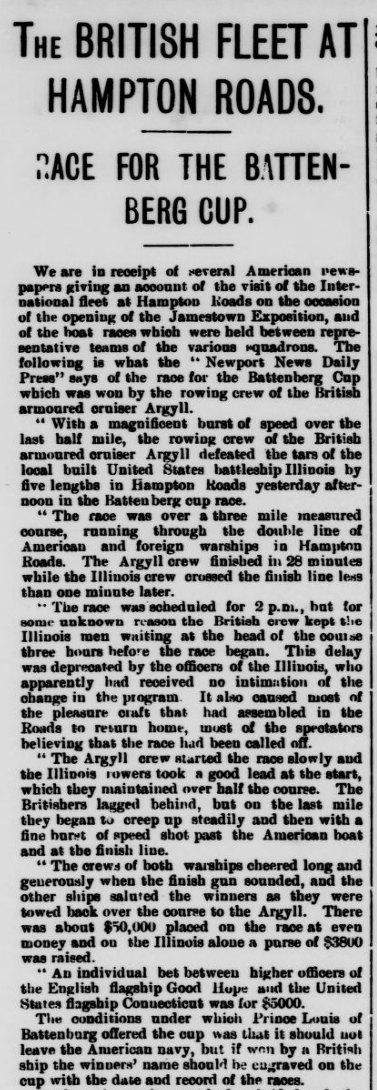
Royal Gazette article headed The British Fleet at Hampton Roads, Race for the Battenberg Cup, quoting the Newport News Daily Press: the rowing crew of the British armoured cruiser Argyll defeated the crew of the United States battleship Illinois by five lengths over a three mile course in Hampton Roads, finishing in 28 minutes
Royal Gazette, 14 May 1907: the race for the Battenberg Cup

The Royal Gazette called it “the greatest display of war ships ever witnessed in Bermuda waters”. As well as the four cruisers of the squadron, Grassy Bay held the station’s own Euryalus, Sutlej and Hogue, two Austrian cruisers and an Italian one, with a Japanese squadron expected. The Gazette of 16 April gave the squadron’s officers: Good Hope flying the flag of Rear-Admiral George Neville, Hampshire under Captain Sir Robert Arbuthnot, Roxburgh under Captain Somerset Calthorpe and Argyll under Captain Charles Anson.

The squadron sailed on Tuesday 23 April and was at Hampton Roads for President Roosevelt’s review on the 26th. The Gazette reported that Roxburgh was the first British ship he passed, then Hampshire and Argyll, and that he exchanged salutes with Admiral Neville on Good Hope’s bridge.

The sailors’ great day came in early May. Argyll’s crew took the Battenberg Cup from the battleship Illinois by five lengths over a three-mile course, in a cutter reportedly borrowed from USS Indiana. It was the only time a British crew ever won it. Admiral Neville accepted the cup for the British sailors. Under Prince Louis of Battenberg’s rules it couldn’t leave the American navy, so Argyll’s name was engraved on it and it went back to the Illinois.

“The Battenberg Cup Race was, of course, the event of the week.”

Royal Gazette, 14 May 1907

The Gazette said that, quoting American papers, and the New York Herald was describing the review on 5 May. The race itself isn’t dated, but it was in the first days of May.

IV

Jack ashore

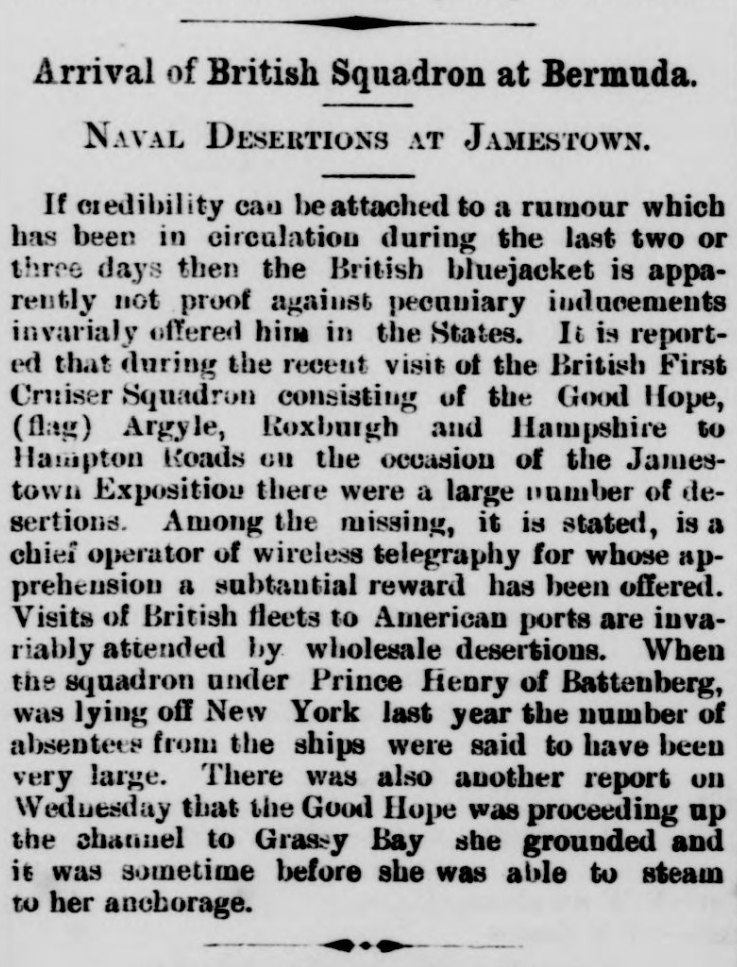
Royal Gazette article headed Arrival of British Squadron at Bermuda, Naval Desertions at Jamestown: a rumour that during the First Cruiser Squadron's visit to Hampton Roads there were a large number of desertions, among them a chief operator of wireless telegraphy; also a report that the Good Hope grounded on her way up the channel to Grassy Bay and was some time before she could steam to her anchorage
Royal Gazette, 11 May 1907: desertions, and Good Hope aground
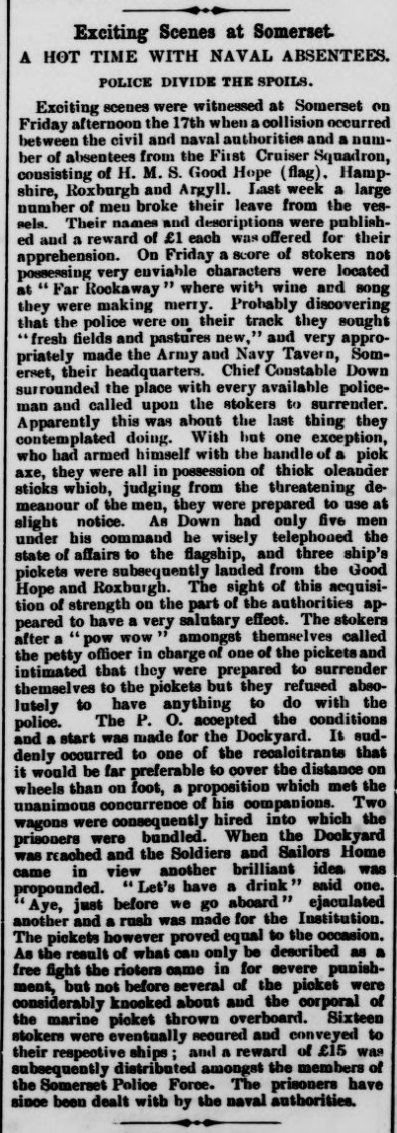
Royal Gazette article headed Exciting Scenes at Somerset, A Hot Time with Naval Absentees, Police Divide the Spoils: on Friday 17 May police found a score of stokers from the First Cruiser Squadron at Far Rockaway and then at the Army and Navy Tavern, Somerset; they surrendered to pickets from the Good Hope and Roxburgh, made a rush for the Soldiers and Sailors Home on the way to the Dockyard, and in the fight the corporal of the marine picket was thrown overboard; sixteen stokers were taken back to their ships
Royal Gazette, 25 May 1907: “A hot time with naval absentees”

The visit to America cost the squadron men. The Gazette passed on a rumour of “a large number of desertions” at Hampton Roads, among them the chief wireless operator. Good Hope then grounded on her way up the channel to Grassy Bay, and it was some time before she reached her anchorage.

Things were livelier still at Bermuda. On Thursday 16 May the names of 19 absentees from Good Hope and Roxburgh, most of them stokers, were circulated with £1 reward for each. The next afternoon the police cornered a group of them at the Army and Navy Tavern in Somerset. They refused to give themselves up to the police and surrendered only to pickets sent from their own ships. On the way back to the Dockyard by wagon they made a rush for a last drink at the Soldiers and Sailors Home, and in the fight that followed the marine corporal was thrown overboard. Sixteen were taken back aboard.

Herbert wrote his card in the middle of all this. I’d like to think he wasn’t among them.

V

Which ship?

Royal Gazette notice headed Departure of Cruiser Squadron: The First Cruiser Squadron comprising the Good Hope (flag), Hampshire, Argyll and Roxburgh, left Grassy Bay yesterday afternoon for Halifax
Royal Gazette, 28 May 1907: off to Halifax

I’d love to know which ship Herbert and Harry were on. Neither names one. They’re ordinary picture postcards home to England at the standard rate, Herbert’s to Lancashire and Harry’s to Wimbledon. For now, all I can say is that Herbert’s card is certainly from the First Cruiser Squadron and Harry’s very probably is.

April to June 1907

The squadron on one side, the cards on the other.

The squadron
The cards
Thu 4 Apr
The squadronLeaves Plymouth for America.
Sat 13 Apr
The squadronArrives in Grassy Bay in the morning.
Sun 14 Apr
The cardsHarry writes: “Arrived yesterday.”
Mon 15 Apr
The cardsHarry’s card posted at Hamilton.
Tue 23 Apr
The squadronSails for Hampton Roads.
Fri 26 Apr
The squadronPresident Roosevelt’s review opens the Exposition.
Early May
The squadronArgyll wins the Battenberg Cup.
About 8 May
The squadronBack at Bermuda; Good Hope grounds in the channel.
Sun 12 May
The cardsHerbert writes: “We have come back from America.”
Mon 13 May
The cardsHerbert’s card posted at Ireland Island.
16–17 May
The squadronNineteen absentees posted; the stand-off at Somerset.
Mon 27 May
The squadronLeaves Grassy Bay for Halifax in the afternoon.
Thu 30 May
The squadronArrives at Halifax.
Sun 9 Jun
The squadronSails from Halifax for Quebec.

The Ships

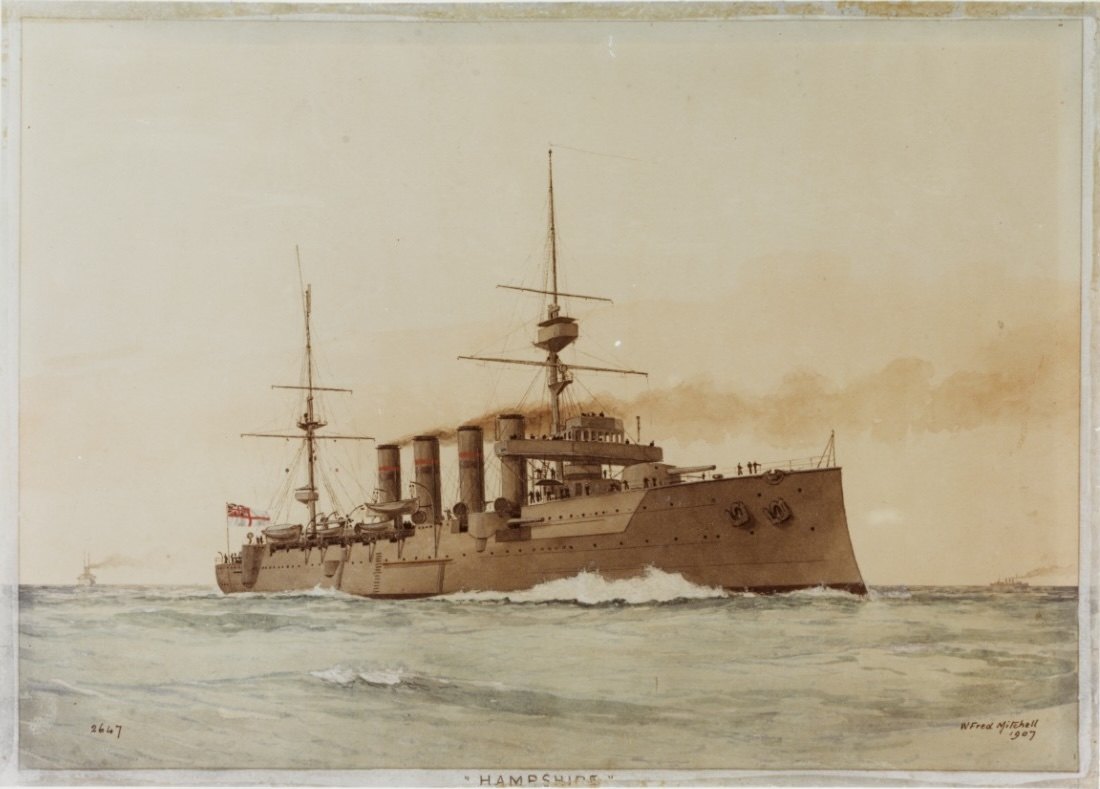
Watercolour in sepia tones of the armoured cruiser Hampshire steaming at speed, bow wave curling, smoke from four funnels, two masts, a red ensign flying at the stern and another warship faint in the distance; signed W. Fred Mitchell 1907 and titled Hampshire beneath

The four ships of April 1907

Good Hope was a Drake-class armoured cruiser, launched at Govan on 21 February 1901. In 1907 she was Rear-Admiral George Neville’s flagship, under Captain George Hope. Argyll, Hampshire and Roxburgh were Devonshire-class armoured cruisers, all completed in 1905 and sent to the First Cruiser Squadron of the Channel Fleet.

All but Roxburgh came to a hard end. Good Hope was sunk with all hands at Coronel on 1 November 1914. Argyll was wrecked on the Bell Rock on 28 October 1915. Hampshire was mined off Orkney on 5 June 1916 with Lord Kitchener on board. Roxburgh survived the war and was sold in November 1921.

Two of the 1907 captains are remembered for later events. Sir Robert Arbuthnot of Hampshire was killed at Jutland on 31 May 1916, a rear-admiral by then and commanding the First Cruiser Squadron itself, flying his flag in Defence. Somerset Calthorpe of Roxburgh rose to admiral and, as Commander-in-Chief in the Mediterranean, signed the armistice with Turkey at Mudros on 30 October 1918.

The watercolour of Hampshire was painted in 1907, and her officers gave it to the wardroom of USS Maine at Hampton Roads that year.

Good HopeLaunched 1901 · Drake class · 14,100 tons · Flag of Rear-Admiral Neville · Sunk at Coronel 1914
ArgyllLaunched 1904 · Devonshire class · 10,850 tons · Capt. Charles Anson · Wrecked 1915
HampshireLaunched 1903 · Devonshire class · 10,850 tons · Capt. Sir Robert Arbuthnot · Mined 1916
RoxburghLaunched 1904 · Devonshire class · 10,850 tons · Capt. Somerset Calthorpe · Sold 1921

H.M.S. Hampshire, watercolour by W. Fred Mitchell, 1907. Naval History and Heritage Command, NH 93042-KN.

The other three ships

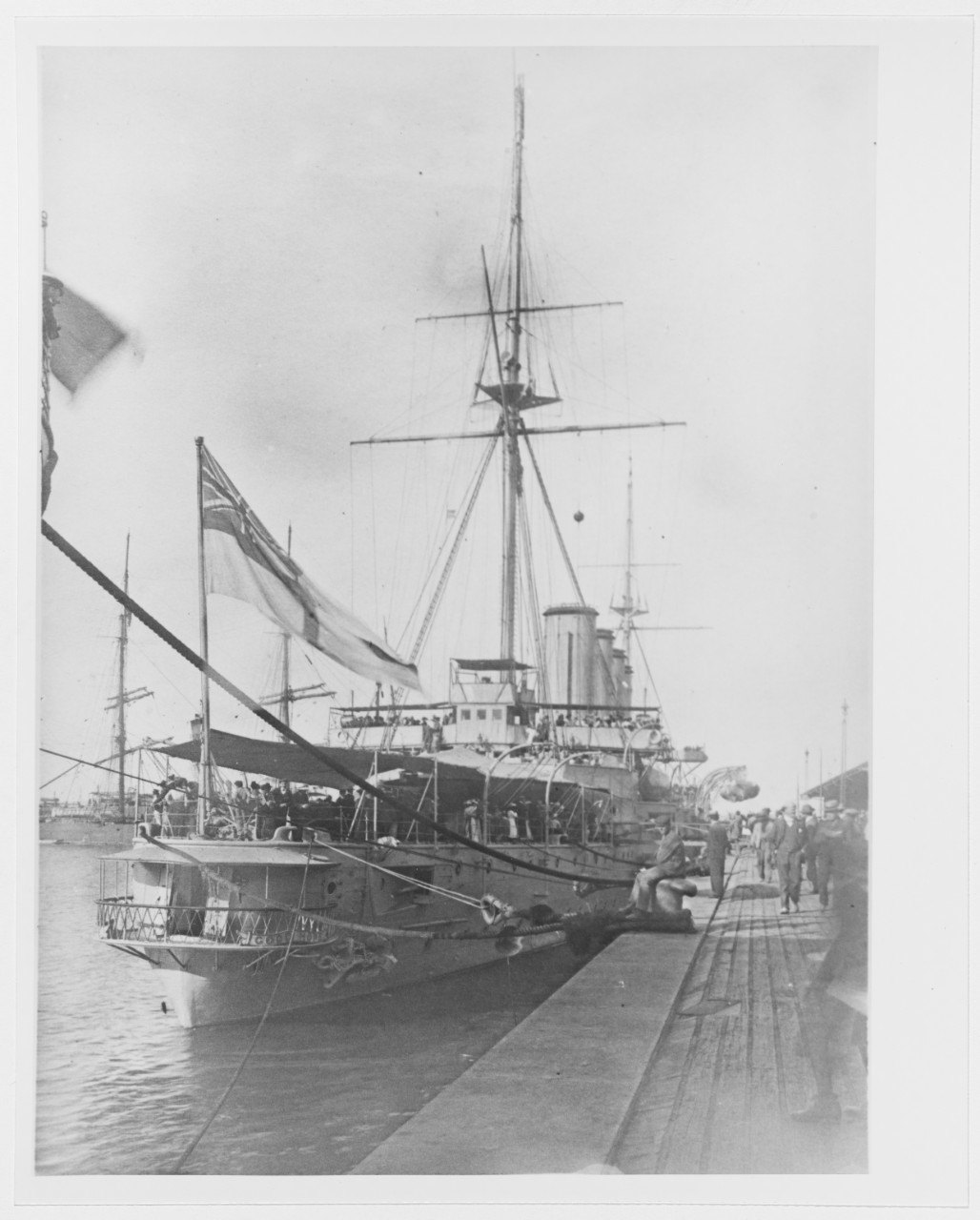
Black and white photograph of the cruiser Good Hope alongside a wooden wharf, seen from the bow, with her tall foremast and yards, a white ensign flying from a staff, awnings rigged over the forecastle and people on the wharf beside her
Good Hope alongside, before 1914. Naval History and Heritage Command, NH 93844
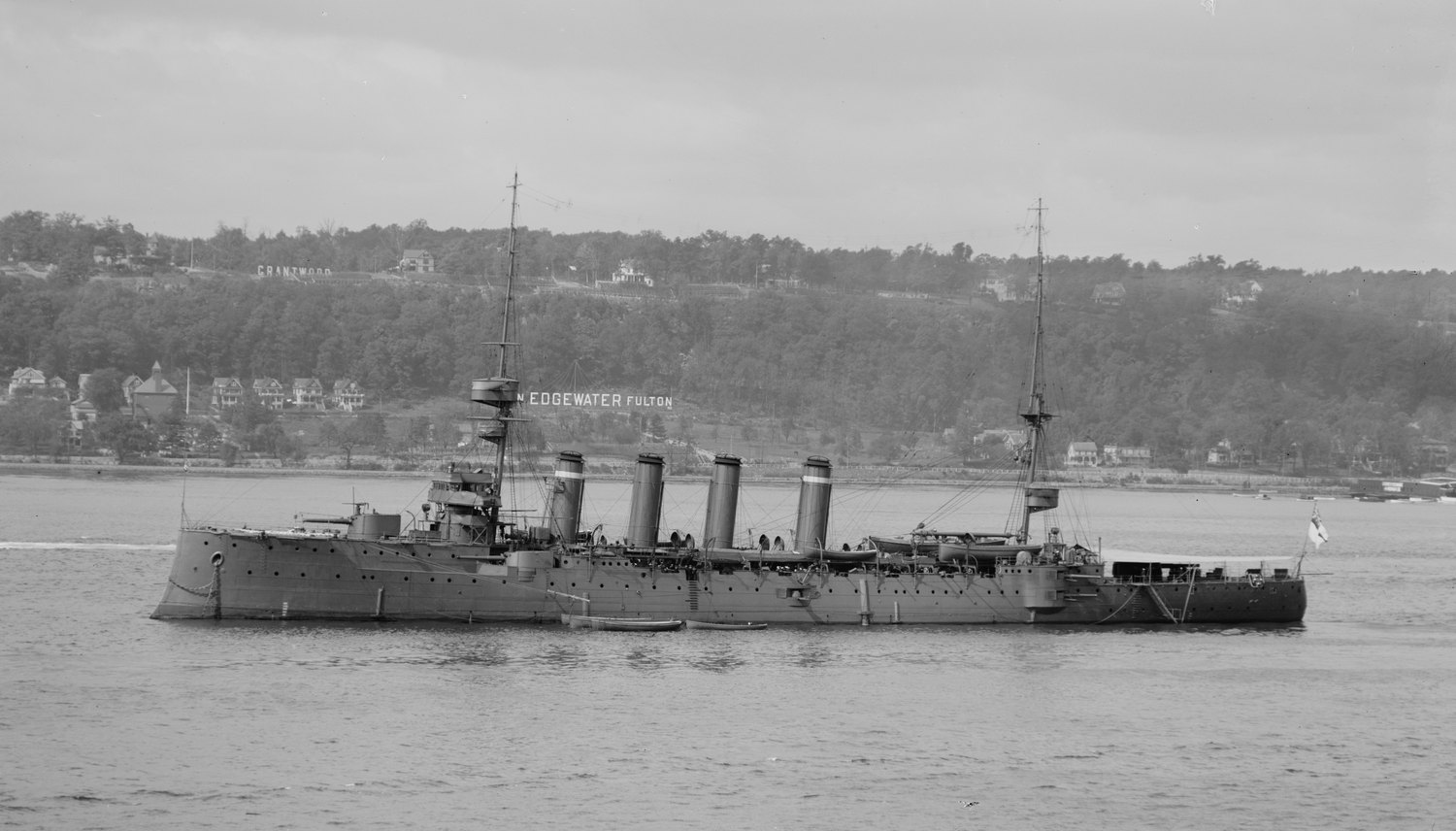
Black and white photograph of the cruiser Argyll at anchor in a river, broadside, with four funnels and two masts, and a wooded shore behind with houses and the words Edgewater Fulton painted on the bank
Argyll at New York, about 1909. Detroit Publishing Co., Library of Congress, via Wikimedia Commons
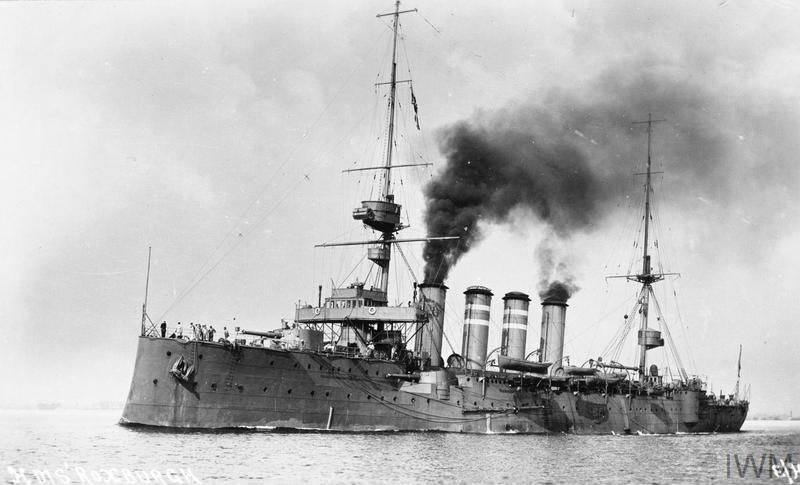
Black and white photograph of the cruiser Roxburgh under way, with thick black smoke from the forward of her four funnels, which carry painted bands
Roxburgh, a later photograph. Imperial War Museums (Q 75299), via Wikimedia Commons

Still to find out

If you can help with any of these, I’d be very pleased to hear from you.

References

Two men, a month apart, each sent a Bermuda view home to England. One had just arrived after a stormy crossing; the other had been to America, had heard from almost nobody, and knew he’d be off to Halifax on the 27th. Neither tells us his ship, but the Gazette fills in nearly everything else, down to the marine corporal in the water at the Dockyard.