Postal History · Royal Navy · North America and West Indies Station

H.M.S. Cressy

Ireland Island · 13 March 1908

“I will write again as soon as we get to Jamaica”: a sailor’s card, days before his ship was sent to Haiti.

◆

I like this card because it’s written by a sailor who has no idea what’s coming. Lionel, of Mess 40 in H.M.S. Cressy, wrote it on a Thursday in March 1908 and it was posted at Ireland Island the next day. He’d been swimming, he hoped Ethel would like the cards, and he promised to write again “as soon as we get to Jamaica.” Four days later the Admiralty turned his ship round and sent her to Haiti instead.

I

“We went swimming yesterday”

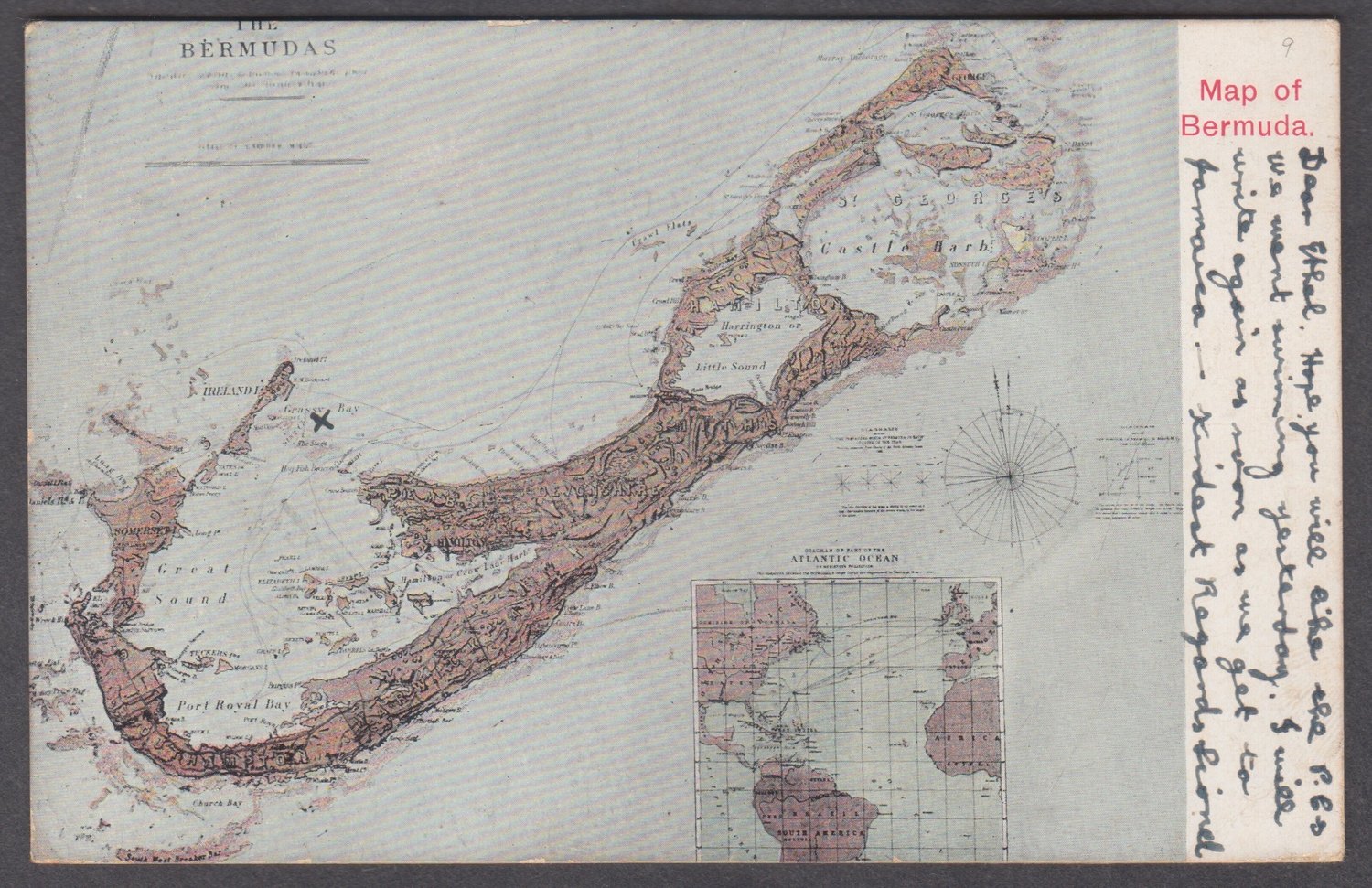
Coloured picture postcard titled in red Map of Bermuda: a relief map of the islands in pink and brown on a pale blue sea, with St George's, Castle Harbour, Hamilton, Harrington Sound, Great Sound, Port Royal Bay, Somerset and Ireland Island marked, an inset diagram of part of the Atlantic Ocean and a compass rose; a small cross in ink has been drawn in Grassy Bay beside Ireland Island, and a message is written in ink up the right-hand edge
“Map of Bermuda”, with Lionel’s X in Grassy Bay
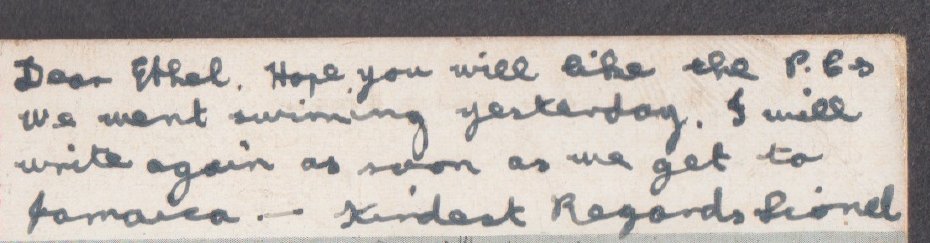
Close-up of the message, turned to read across: Dear Ethel. Hope you will like the P.C.s. We went swimming yesterday. I will write again as soon as we get to Jamaica. Kindest Regards Lionel
The message, turned to read across
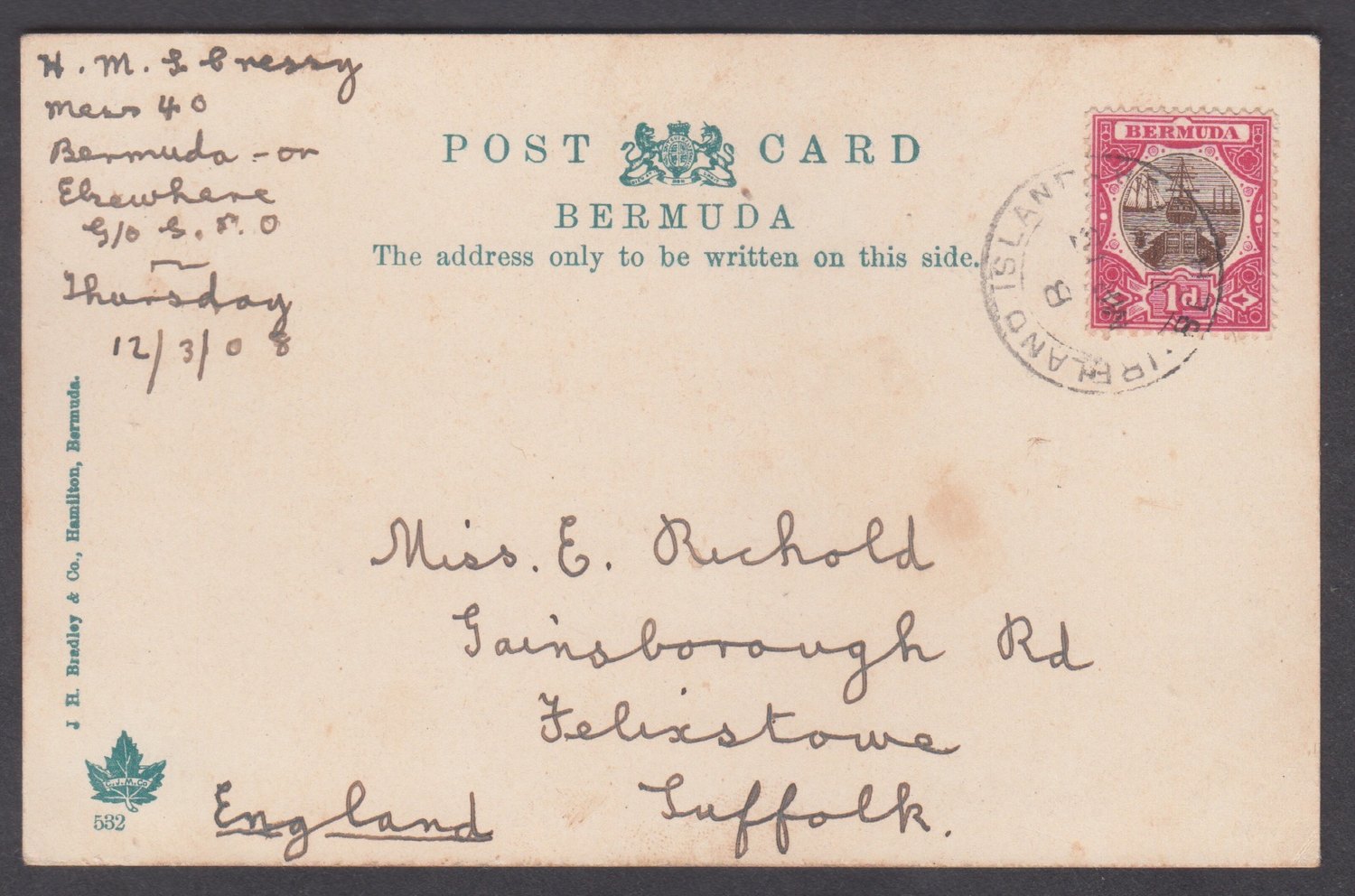
Address side of the postcard, printed POST CARD with the royal arms, BERMUDA, The address only to be written on this side, and up the left edge J. H. Bradley & Co., Hamilton, Bermuda, with a maple leaf device lettered C.J.M.Co. and the number 532. In the top left corner in ink: H.M.S. Cressy, Mess 40, Bermuda or Elsewhere, C/o G.P.O., Thursday 12/3/08. Addressed to Miss E. Richold, Gainsborough Rd, Felixstowe, Suffolk, England. Franked with a 1d Dockyard stamp in carmine and brown, tied by an IRELAND ISLAND circular datestamp, code B
To Miss E. Richold, Felixstowe; 1d Dockyard, IRELAND ISLAND, code B
  • From Lionel, Mess 40, H.M.S. Cressy
  • To Miss E. Richold, Gainsborough Rd, Felixstowe, Suffolk
  • Card “Map of Bermuda”; J. H. Bradley & Co., Hamilton, no. 532
  • Postage 1d Dockyard, the postcard rate to England
  • Marking IRELAND ISLAND, code B, 13 March 1908
  • Written Thursday 12 March 1908

The card is one of J. H. Bradley & Co.’s, a coloured “Map of Bermuda”, number 532. In Grassy Bay, just off Ireland Island, there’s a small X in ink. That’s where the warships anchored, and I’m sure it’s Lionel showing Ethel where Cressy was lying.

The message runs up the right-hand edge:

“Dear Ethel. Hope you will like the P.C.s. We went swimming yesterday. I will write again as soon as we get to Jamaica. — Kindest Regards Lionel”

H.M.S. Cressy, Bermuda

“P.C.s” tells us he sent her more than one card, so somewhere there may be others from the same set.

On the address side he wrote his return address in the top corner, “H.M.S. Cressy, Mess 40, Bermuda – or Elsewhere, C/o G.P.O.”, and dated it “Thursday 12/3/08”. I like “or Elsewhere”. A sailor never knew where he’d be when the reply came, and in Lionel’s case he was more right than he knew.

The card went to Miss E. Richold of Gainsborough Road, Felixstowe. It’s franked with a 1d Dockyard stamp, the postcard rate to England, and tied by the IRELAND ISLAND datestamp, code B, of Friday 13 March 1908, the day after he wrote it.
II

Not Jamaica, but Haiti

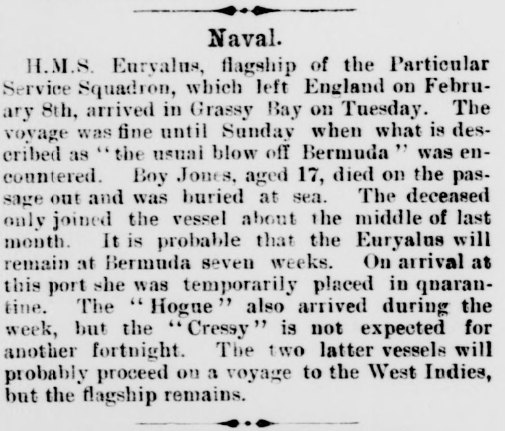
Royal Gazette, Naval: H.M.S. Euryalus, flagship of the Particular Service Squadron, which left England on February 8th, arrived in Grassy Bay on Tuesday. The voyage was fine until Sunday when what is described as the usual blow off Bermuda was encountered. A boy, Jones, aged 17, died on the passage out and was buried at sea. It is probable that the Euryalus will remain at Bermuda seven weeks. On arrival she was temporarily placed in quarantine. The Hogue also arrived during the week, but the Cressy is not expected for another fortnight. The two latter vessels will probably proceed on a voyage to the West Indies, but the flagship remains
Royal Gazette, 29 February 1908: “the ‘Cressy’ is not expected for another fortnight”
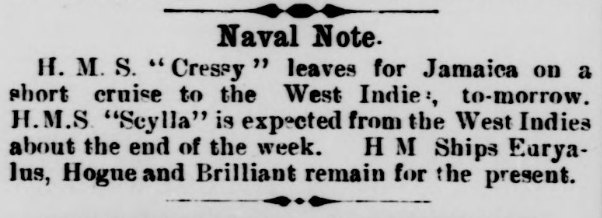
Royal Gazette, Naval Note: H.M.S. Cressy leaves for Jamaica on a short cruise to the West Indies, to-morrow. H.M.S. Scylla is expected from the West Indies about the end of the week. H.M. Ships Euryalus, Hogue and Brilliant remain for the present
Royal Gazette, 10 March 1908: “leaves for Jamaica … to-morrow”
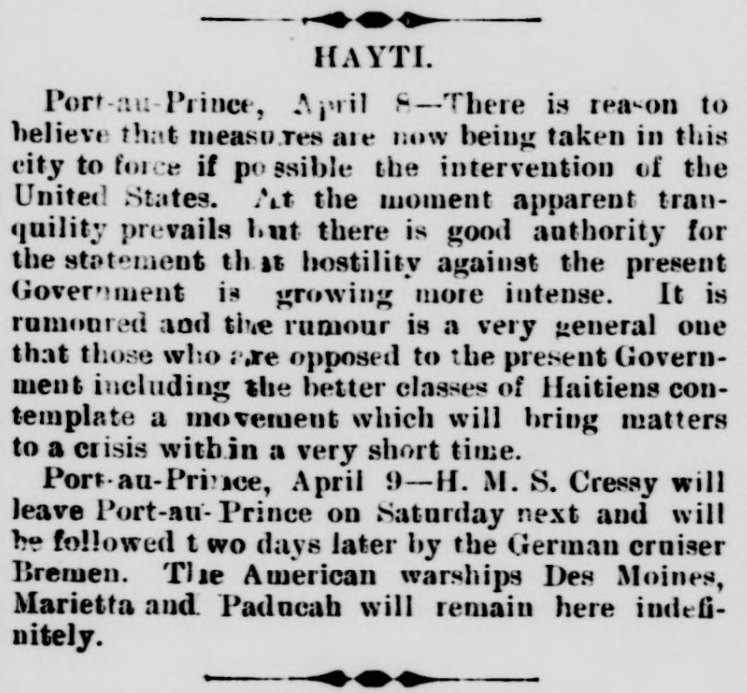
Royal Gazette, Hayti: Port-au-Prince, April 8. There is reason to believe that measures are now being taken in this city to force if possible the intervention of the United States. At the moment apparent tranquility prevails but there is good authority for the statement that hostility against the present Government is growing more intense. Port-au-Prince, April 9. H.M.S. Cressy will leave Port-au-Prince on Saturday next and will be followed two days later by the German cruiser Bremen. The American warships Des Moines, Marietta and Paducah will remain here indefinitely
Royal Gazette, 14 April 1908: “H.M.S. Cressy will leave Port-au-Prince on Saturday next”

Rear-Admiral Inglefield brought the Fourth Cruiser Squadron out from England in February 1908. The flagship Euryalus came into Grassy Bay first, then Hogue, and the Royal Gazette of 29 February said Cressy was “not expected for another fortnight.” She must have come in early, because on 10 March the paper reported that she was leaving for Jamaica “on a short cruise to the West Indies, to-morrow.”

Lionel’s card shows she hadn’t gone on the 11th. He was still writing “as soon as we get to Jamaica” on Thursday the 12th, and the card was in the post at Ireland Island on the 13th. I think she sailed a day or two late, and it may well have been one of the last things he did before she left.

Haiti had been unsettled all winter, with a revolt against President Nord Alexis. Before dawn on Sunday 15 March, men accused of plotting against the government were taken from their homes in Port-au-Prince and shot. The next day, Monday 16 March, the Prime Minister, Asquith, told the House of Commons that orders had gone out that morning to send Cressy and the cruiser Indefatigable to Haiti. Indefatigable was at Jamaica and reached Port-au-Prince that evening. Cressy was already at sea on her way from Bermuda to Jamaica. The Admiralty told the House she was expected to pass within about 120 miles of Port-au-Prince on the Monday night, and she was turned in there instead.

She stayed for nearly four weeks, with the German cruiser Bremen and three American warships in the harbour too. On 10 April her captain telegraphed that all was quiet, and the Gazette carried a report from Port-au-Prince that she would “leave Port-au-Prince on Saturday next”, 11 April, leaving Indefatigable behind. So Lionel did get to Jamaica in the end, about a month later than he’d told Ethel.

III

Back at Grassy Bay

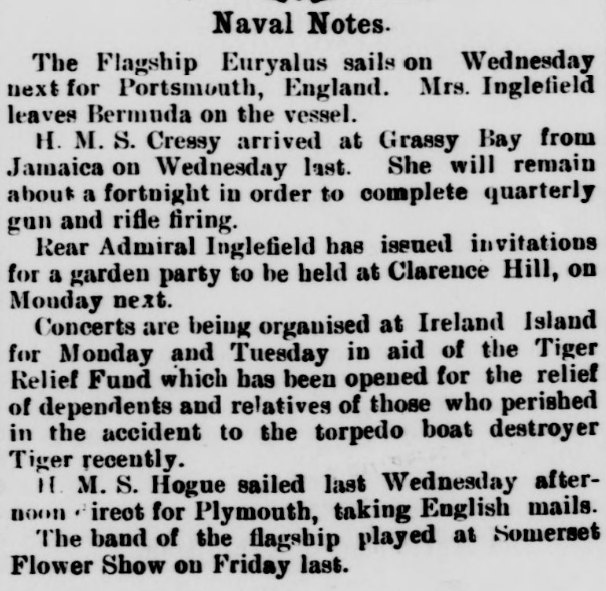
Royal Gazette, Naval Notes: The Flagship Euryalus sails on Wednesday next for Portsmouth, England. Mrs. Inglefield leaves Bermuda on the vessel. H.M.S. Cressy arrived at Grassy Bay from Jamaica on Wednesday last. She will remain about a fortnight in order to complete quarterly gun and rifle firing. Rear Admiral Inglefield has issued invitations for a garden party to be held at Clarence Hill, on Monday next. Concerts are being organised at Ireland Island for Monday and Tuesday in aid of the Tiger Relief Fund. H.M.S. Hogue sailed last Wednesday afternoon direct for Plymouth, taking English mails. The band of the flagship played at Somerset Flower Show on Friday last
Royal Gazette, 25 April 1908: “arrived at Grassy Bay from Jamaica on Wednesday last”

The Gazette of 25 April has her home again: “H.M.S. Cressy arrived at Grassy Bay from Jamaica on Wednesday last. She will remain about a fortnight in order to complete quarterly gun and rifle firing.” That was Wednesday 22 April.

The squadron was breaking up for the season. Hogue had sailed for Plymouth the same afternoon Cressy came in, and the flagship Euryalus was getting ready to go home. That week the men of Euryalus, Cressy, Brilliant and Terror had a concert in the Sail Loft at Ireland Island, so Lionel may well have been in the audience.

A captain who saw Tsushima

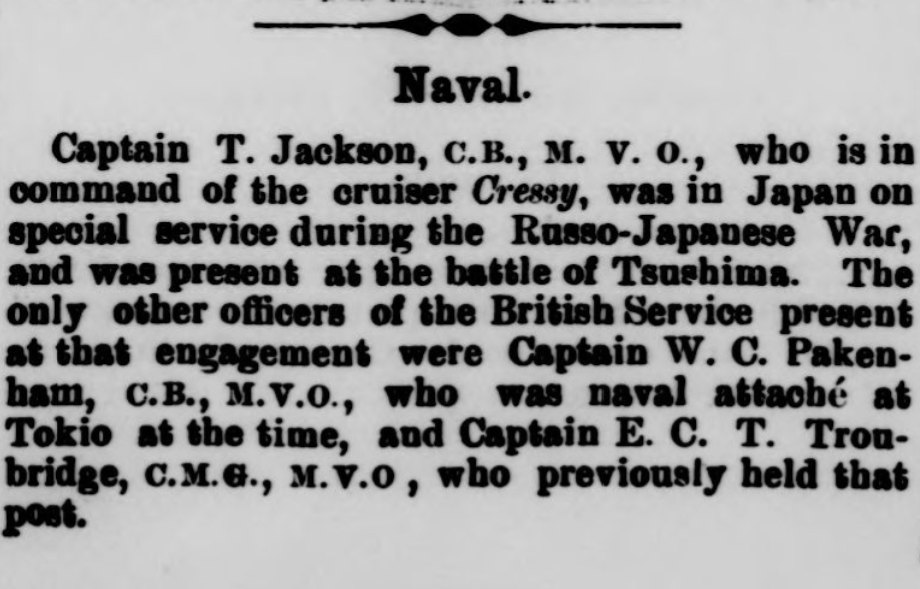
Royal Gazette, Naval: Captain T. Jackson, C.B., M.V.O., who is in command of the cruiser Cressy, was in Japan on special service during the Russo-Japanese War, and was present at the battle of Tsushima. The only other officers of the British Service present at that engagement were Captain W. C. Pakenham, C.B., M.V.O., who was naval attaché at Tokio at the time, and Captain E. C. T. Troubridge, C.M.G., M.V.O., who previously held that post
Royal Gazette, 7 April 1908: Captain T. Jackson

While Cressy was at Port-au-Prince the Gazette told its readers a little about her captain. Captain Thomas Jackson had been in Japan on special service during the Russo-Japanese War and, the paper said, was present at the Battle of Tsushima in May 1905, one of only three British officers there. He later went to the Admiralty as Director of the Intelligence Division in 1913 and finished his career as an admiral.

Five weeks late for Jamaica

The ship on one side, the card on the other.

The Cressy
The card
Feb 1908
The CressyThe Fourth Cruiser Squadron comes out from England under Rear-Admiral Inglefield.
Early Mar
The CressyIn Grassy Bay, earlier than the Gazette expected.
10 Mar
The Gazette“Leaves for Jamaica … to-morrow.”
11 Mar
Lionel“We went swimming yesterday.”
Thu 12 Mar
The cardWritten: “as soon as we get to Jamaica.”
Fri 13 Mar
The cardPosted at Ireland Island, code B.
Sun 15 Mar
HaitiExecutions in Port-au-Prince before dawn.
Mon 16 Mar
The CressyOrdered to Haiti while on passage to Jamaica.
Sat 11 Apr
The CressyLeaves Port-au-Prince for Jamaica.
Wed 22 Apr
The CressyBack in Grassy Bay from Jamaica.

The Ship

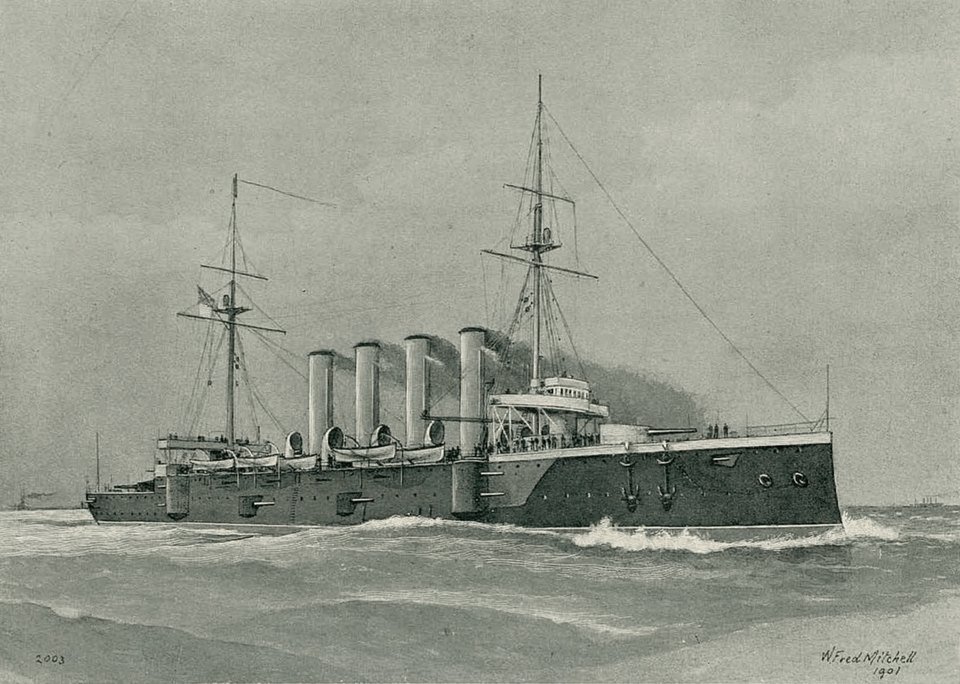
Monochrome painting of the armoured cruiser HMS Cressy under way at speed, seen from the starboard bow: a long dark hull with a ram bow, four tall funnels trailing black smoke, two masts with fighting tops, and rows of gun casemates along the side, signed W. Fred Mitchell 1901

H.M.S. Cressy

Cressy was the first of six Cressy-class armoured cruisers, built by Fairfield at Govan and launched on 4 December 1899. She was completed in May 1901 and went out to the China Station. In 1907 she joined the North America and West Indies squadron, and the Royal Gazette has her coming out from England with Rear-Admiral Inglefield in February 1908. In 1909 she was replaced by Berwick and went into reserve at home.

When war came in 1914 she was brought forward again, and on 22 September she was patrolling the Broad Fourteens off the Dutch coast with her sisters Aboukir and Hogue. The German submarine U-9 sank all three in a single morning. Cressy had stopped to pick up survivors from the others and was hit twice. 560 of her men were lost, and about 1,459 from the three ships together. I often wonder whether Lionel was still aboard.

BuiltFairfield, Govan; launched 4 December 1899
TypeCressy-class armoured cruiser
Guns2 × 9.2-in, 12 × 6-in; 12,000 tons
CaptainThomas Jackson (1908)
FateSunk by U-9, North Sea, 22 September 1914
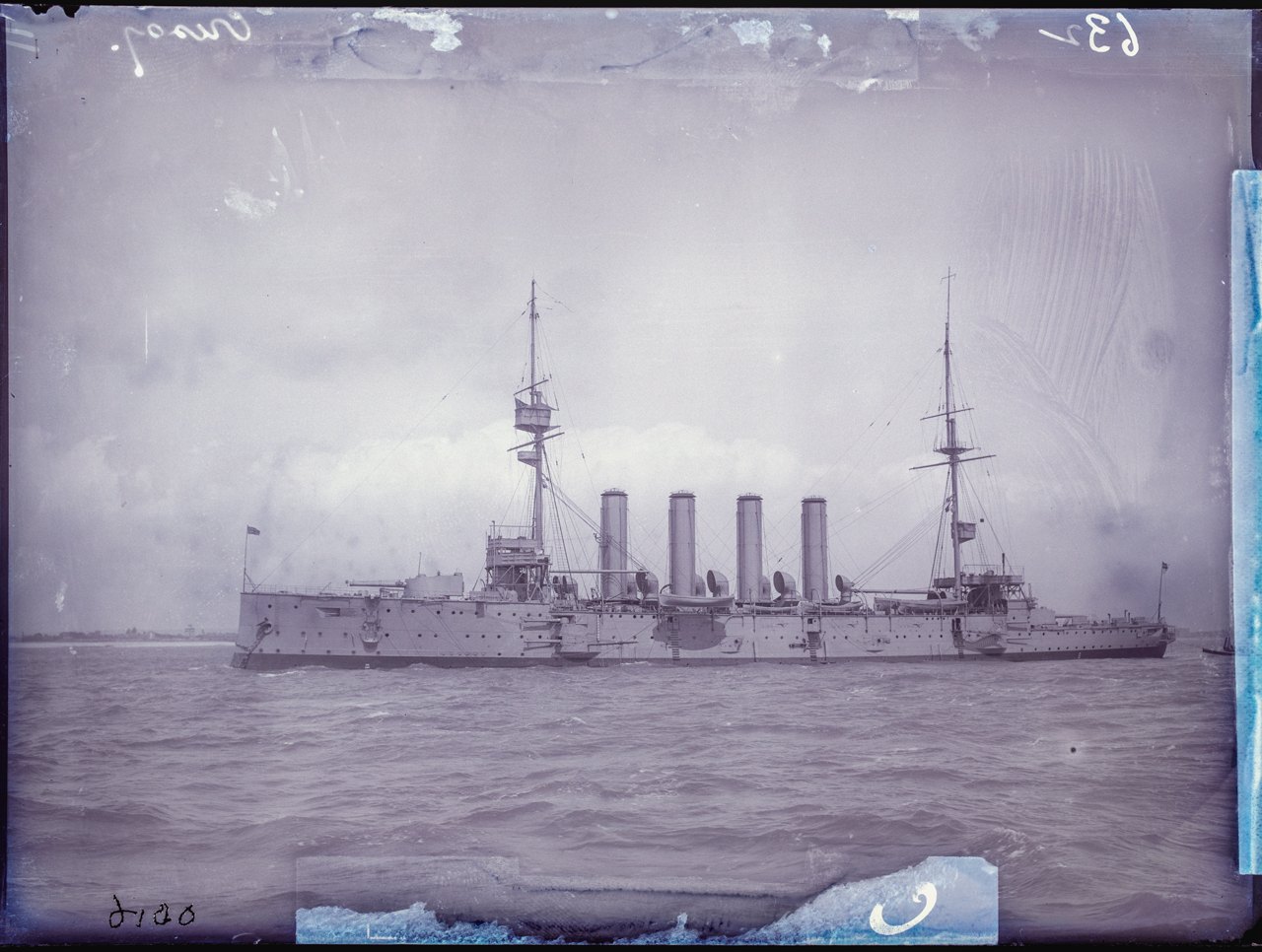
Glass plate negative of HMS Cressy at anchor, seen broadside on from the port side in a choppy sea: four tall funnels, two masts with fighting tops and the forward 9.2-inch gun turret, with a low shoreline behind; the plate is chipped and worn at the edges
At anchor in 1907, the year she joined the West Indies squadron

Painting by W. F. Mitchell, frontispiece of Brassey’s Naval Annual, 1901, via Wikimedia Commons. Photograph: Royal Museums Greenwich, negative N1090.

Still to find out

If you can help with any of these, I’d be very pleased to hear from you.

References

A map, an X in Grassy Bay and four lines about swimming. Lionel thought his next letter would come from Jamaica. Instead his ship spent the next month off Port-au-Prince, and this card is the last word from him that I know of.