Postal History · Royal Navy · North America and West Indies Station

H.M.S. Scylla

Chatham, Kent · 22 or 23 May 1911

A Bermuda postcard, sent home to Essex as the cruiser paid off.

◆

This is a Bermuda picture postcard that never went near a Bermuda post office. It was written aboard the cruiser Scylla after she had come home from two years on the North America and West Indies Station, and posted at Chatham with an ordinary British halfpenny stamp. I like it because it’s so ordinary: a sailor just back from Bermuda, using up a card that was probably bought in Hamilton, to tell his family when he’d be home.

I

“I expect to be home Wedensday night”

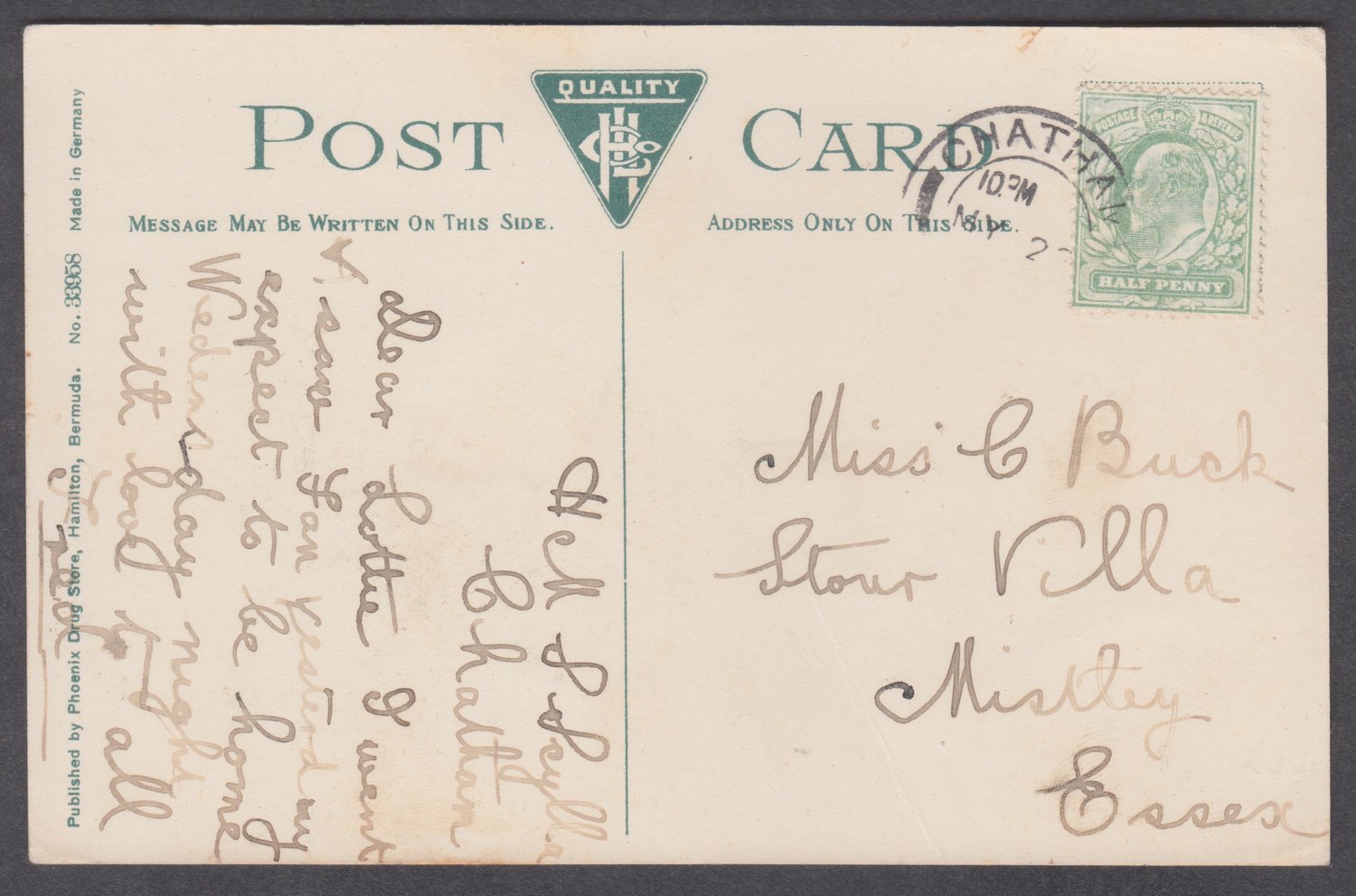
Address side of a divided-back postcard headed Post Card with a green Quality triangle trademark, the imprint Published by Phoenix Drug Store, Hamilton, Bermuda, No. 33958, Made in Germany up the left edge. A green halfpenny King Edward VII stamp is cancelled by a Chatham circular datestamp, 10 PM, May. Addressed in ink to Miss C Buck, Stour Villa, Mistley, Essex. The message runs up the left-hand side: H M S Scylla, Chatham, Dear Lottie I went and saw Fan yesterday I expect to be home Wedensday night with love to all Fred
To Miss C. Buck, Mistley, Essex
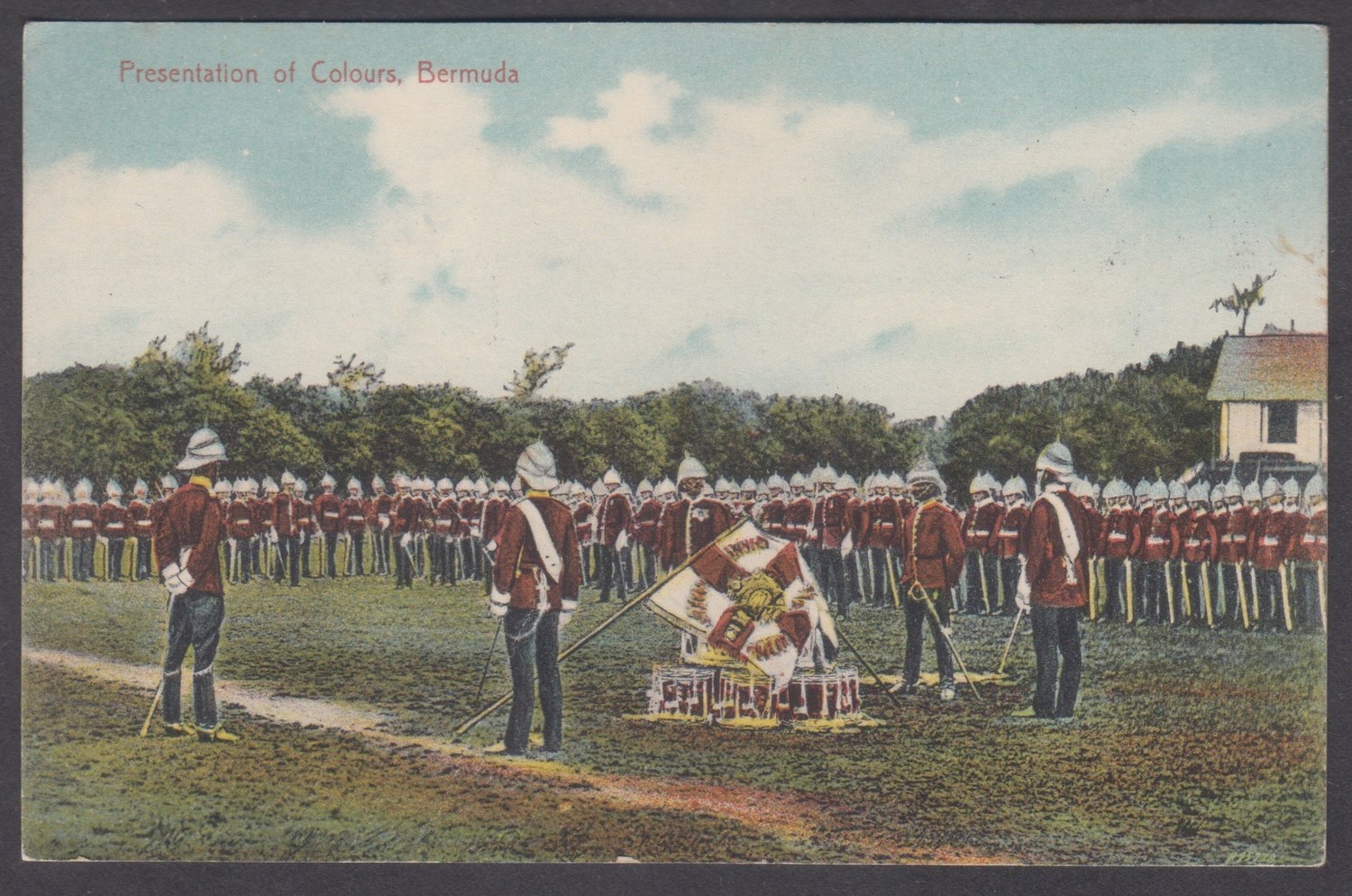
Coloured picture postcard captioned Presentation of Colours, Bermuda: a regiment in scarlet tunics and white helmets drawn up on a grass parade ground in a hollow square, with officers in the foreground and the Colours laid against a pile of drums in the centre; trees and a white building behind
“Presentation of Colours, Bermuda”
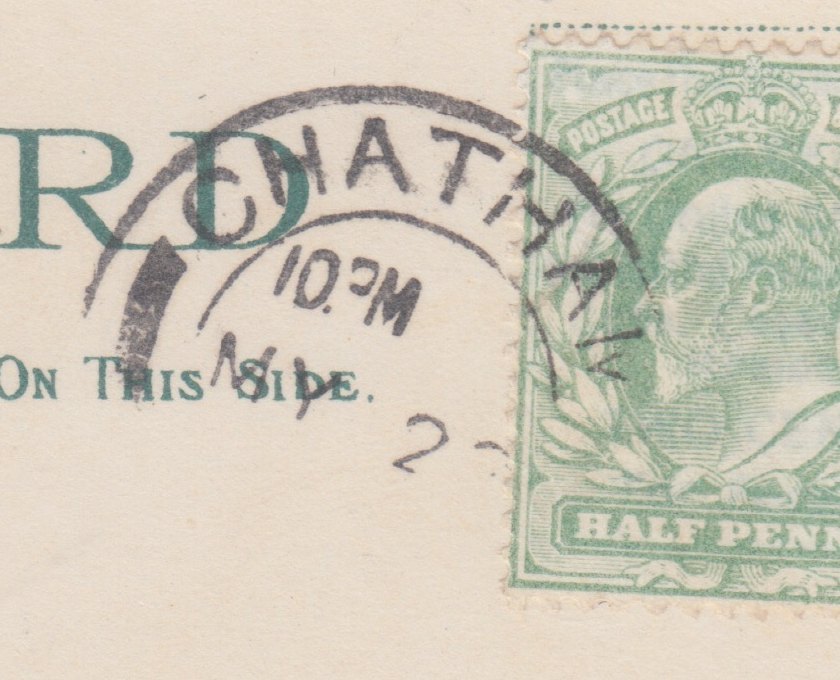
Close-up of the Chatham circular datestamp: CHATHAM around the top, 10 PM, MY, and the figure 2 with the top of a second figure beside it; the year is not struck. A green halfpenny King Edward VII stamp is on the right
CHATHAM, 10 PM, “MY 2?”; the year didn’t strike
  • From Signed “Fred”, H.M.S. Scylla, Chatham
  • To Miss C. Buck, Stour Villa, Mistley, Essex
  • Card “Presentation of Colours, Bermuda”, divided back
  • Publisher Phoenix Drug Store, Hamilton; no. 33958, made in Germany
  • Postage GB ½d green King Edward VII, the inland postcard rate
  • Postmark Chatham, 10 PM, 22 or 23 May (year not struck; 1911 from the Gazette)

The picture side shows “Presentation of Colours, Bermuda”: a regiment in scarlet and white helmets drawn up in a square, with the Colours laid against a pile of drums. It was published by the Phoenix Drug Store in Hamilton as their no. 33958 and printed in Germany.

The message is short:

“H M S Scylla, Chatham. Dear Lottie I went & saw Fan yesterday I expect to be home Wedensday night with love to all Fred”

Chatham, May 1911

It’s addressed to Miss C. Buck, Stour Villa, Mistley, Essex. Mistley is a small port on the Stour estuary, next to Manningtree, and an easy train ride from Chatham by way of London. “Lottie” and “Miss C. Buck” are surely the same person, a Charlotte, perhaps Fred’s sister. I don’t know who Fan was.

The halfpenny green King Edward stamp paid the British inland postcard rate, and it’s cancelled at Chatham at 10 at night. The postmark gives the month and the first figure of the day, a 2. Only the top of the second figure shows, but it has the same curve as the first, so it’s a 2 or a 3. The year didn’t strike at all. For that we need the Royal Gazette.
II

Home to pay off

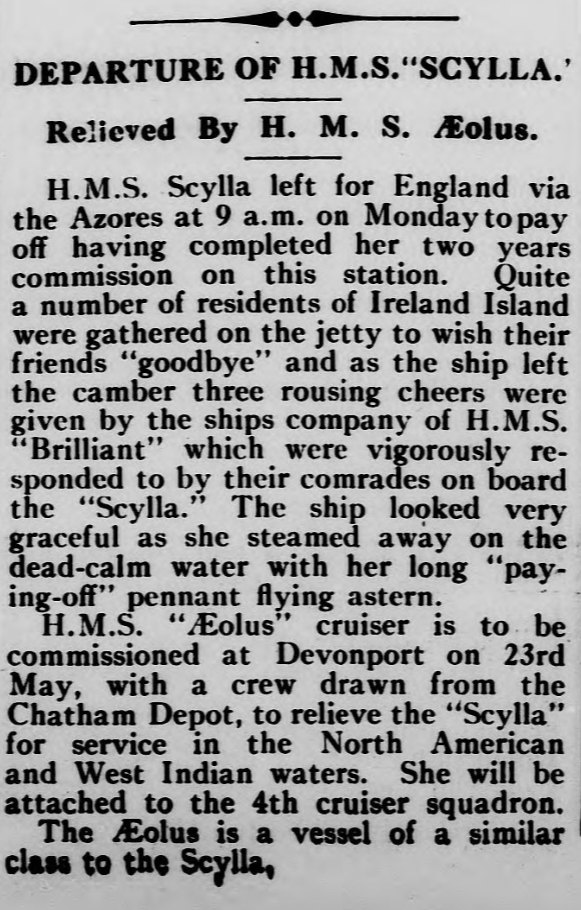
Royal Gazette report headed Departure of H.M.S. Scylla. Relieved by H.M.S. Aeolus: H.M.S. Scylla left for England via the Azores at 9 a.m. on Monday to pay off having completed her two years commission on this station. Quite a number of residents of Ireland Island were gathered on the jetty to wish their friends goodbye and as the ship left the camber three rousing cheers were given by the ships company of H.M.S. Brilliant which were vigorously responded to by their comrades on board the Scylla. The ship looked very graceful as she steamed away on the dead-calm water with her long paying-off pennant flying astern. H.M.S. Aeolus cruiser is to be commissioned at Devonport on 23rd May, with a crew drawn from the Chatham Depot, to relieve the Scylla for service in the North American and West Indian waters. She will be attached to the 4th cruiser squadron. The Aeolus is a vessel of a similar class to the Scylla
Royal Gazette, 4 May 1911: “Departure of H.M.S. Scylla”

Fred gives the ship and Chatham but no date, so the question is when Scylla’s men were at Chatham in late May. The Gazette answers it. In April 1911 she left Kingston, Jamaica, after nearly a month there, and came up to Bermuda, “whence she will proceed to England” to be paid off. On 27 April the Gazette said she would leave for England “on Monday next”, and on 4 May it reported that she had gone:

“H.M.S. Scylla left for England via the Azores at 9 a.m. on Monday to pay off having completed her two years commission on this station.”

Royal Gazette, 4 May 1911

That was Monday 1 May. Residents of Ireland Island gathered on the jetty to see their friends off, and as she left the camber Brilliant’s ship’s company gave her three cheers. “The ship looked very graceful as she steamed away on the dead-calm water with her long ‘paying-off’ pennant flying astern.”

Her two-year commission had begun at Chatham in May 1909. Her captain, Commander Bertram Thesiger, gave up command on Wednesday 24 May 1911, which is presumably the day she paid off. In 1911 the 22nd was a Monday and the 23rd a Tuesday, so Fred wrote this a day or two before. “I expect to be home Wedensday night” fits very neatly: paying-off day, and then the train for Mistley. Her relief, her sister Aeolus, was commissioning at Devonport on the 23rd with a crew from the Chatham depot.

III

Scylla at Bermuda

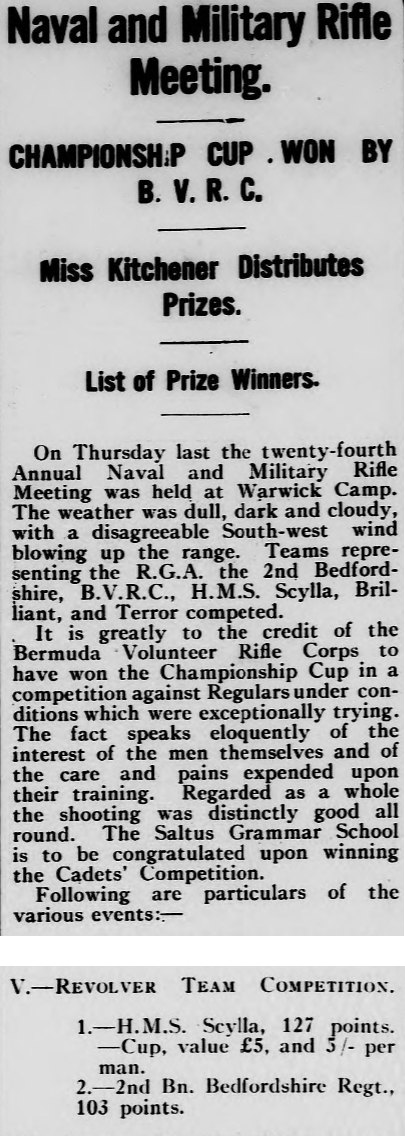
Royal Gazette report headed Naval and Military Rifle Meeting. Championship Cup won by B.V.R.C. Miss Kitchener distributes prizes. List of prize winners: On Thursday last the twenty-fourth Annual Naval and Military Rifle Meeting was held at Warwick Camp. Teams representing the R.G.A., the 2nd Bedfordshire, B.V.R.C., H.M.S. Scylla, Brilliant, and Terror competed. Below, from the list of events: V. Revolver Team Competition. 1. H.M.S. Scylla, 127 points. Cup, value 5 pounds, and 5 shillings per man. 2. 2nd Bn. Bedfordshire Regt., 103 points
Royal Gazette, 27 April 1911: Scylla wins the revolver cup
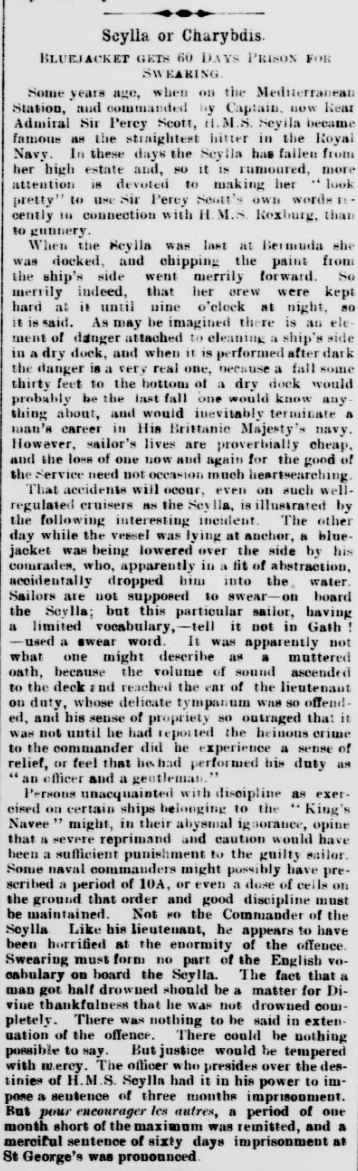
Royal Gazette article headed Scylla or Charybdis. Bluejacket gets 60 days prison for swearing. It recalls that the Scylla under Captain, now Rear Admiral Sir Percy Scott was famous as the straightest hitter in the Royal Navy, describes her crew chipping paint in the dry dock at Bermuda until nine at night, and tells how a bluejacket being lowered over the side was dropped into the water by his comrades, swore, was reported by the lieutenant on duty, and was given sixty days imprisonment at St George's
Royal Gazette, 4 July 1908: “Scylla or Charybdis”

Scylla turns up in the Gazette well before Fred’s card. In July 1902 she brought out a fresh ship’s company for Tribune and took Tribune’s old crew home under Captain Galloway. From 1906 or 1907 she was one of the station’s own cruisers, working the West Indies in winter and coming back to Bermuda in between.

My favourite piece is from 4 July 1908, headed “Scylla or Charybdis”. On her last visit she had been in the dry dock, with her crew chipping paint until nine at night. Later, lying at anchor, a bluejacket being lowered over the side was dropped into the water by his shipmates, and he swore. The lieutenant on duty reported him, and he was given sixty days in prison at St George’s. The writer was clearly not impressed:

“Swearing must form no part of the English vocabulary on board the Scylla.”

Royal Gazette, 4 July 1908

There’s a happier note just before she left in 1911. At the Naval and Military Rifle Meeting at Warwick Camp, against the Royal Garrison Artillery, the 2nd Bedfordshires, the Bermuda Volunteer Rifle Corps, Brilliant and Terror, Scylla’s team won the revolver competition with 127 points, for a cup worth £5 and five shillings a man. I’d love to know whether Fred was in the team, or the sailor from 1908 for that matter.

The Ship

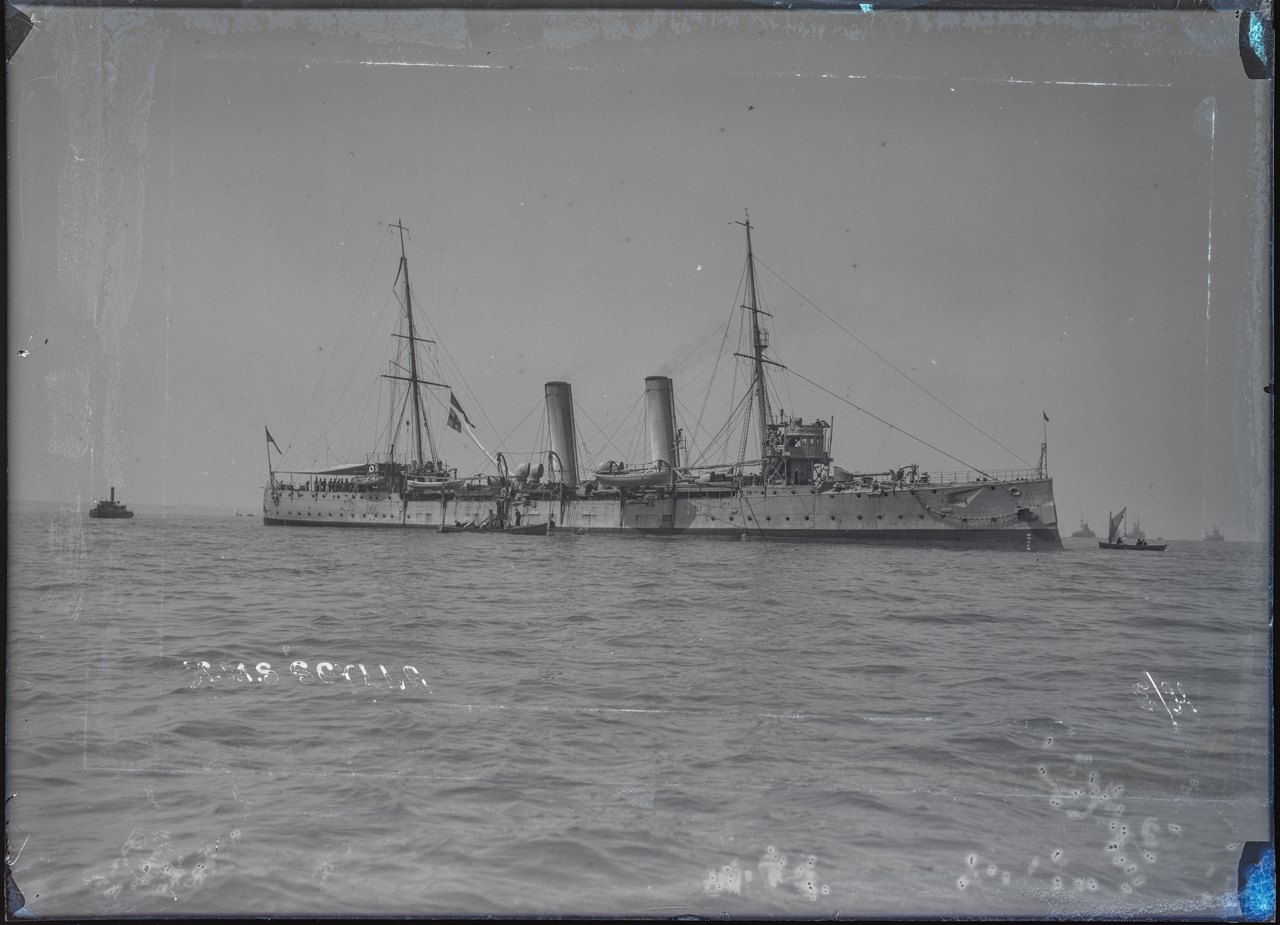
Black and white glass plate photograph of HMS Scylla at anchor, seen broadside on from the starboard side, with two funnels, two masts, boats alongside and other ships and a sailing barge in the distance; HMS Scylla and a small mark are written on the plate

H.M.S. Scylla

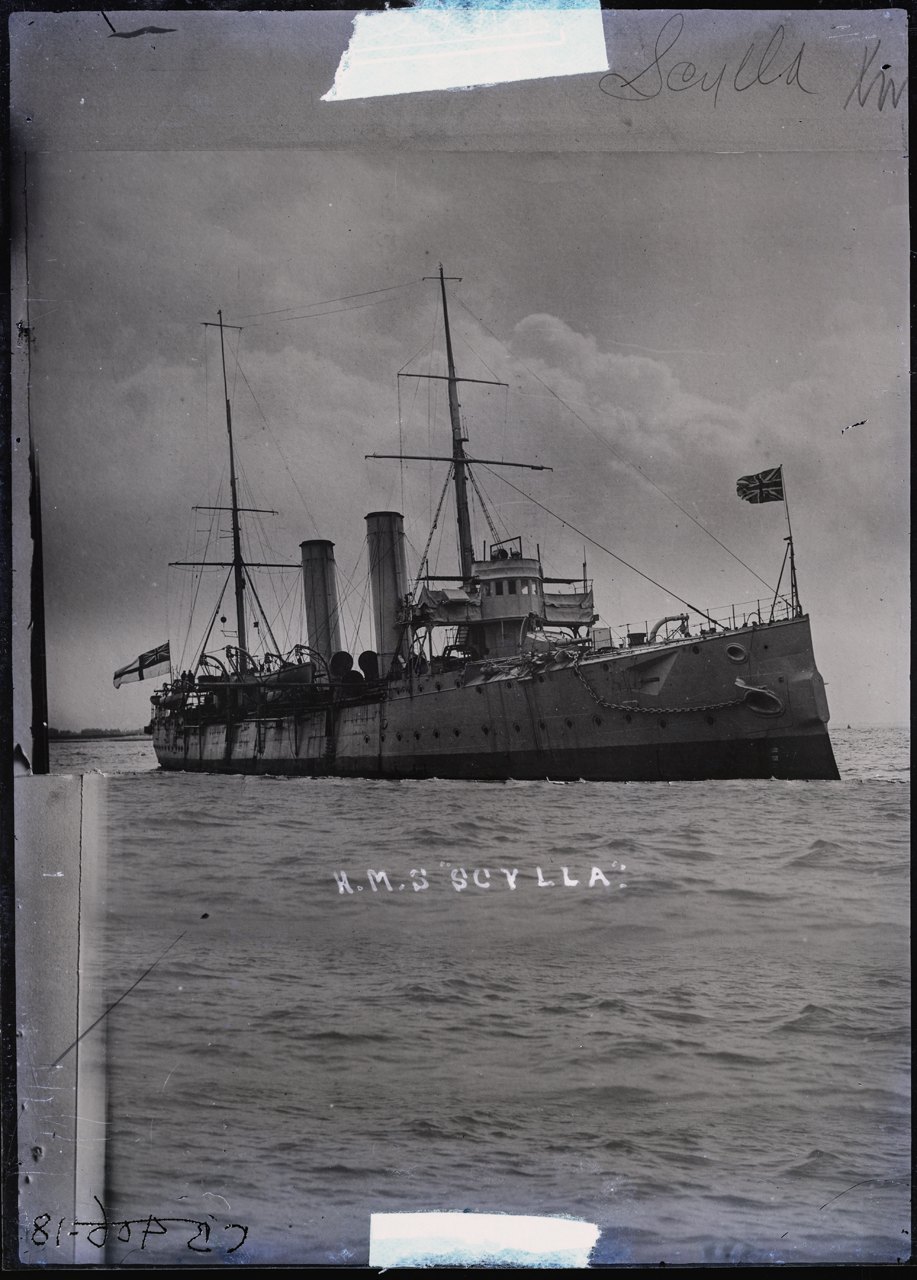
Scylla was one of the 21 Apollo-class second-class cruisers built under the Naval Defence Act of 1889. Samuda Brothers built her at Poplar, alongside her sister Sappho; she was launched on 17 October 1891 and completed in 1893. Her best-known captain was Percy Scott, the gunnery pioneer. In 1896–99 in the Mediterranean he made her the best-shooting ship in the fleet, with scores so high that some doubted them.

From 1905 she was on the Newfoundland fisheries station, and then with the 4th Cruiser Squadron on the North America and West Indies Station, based on Bermuda, until she came home to pay off in May 1911. After a spell in the reserve she was sold in 1914 and broken up.

Black and white glass plate photograph of the cruiser HMS Scylla under way, seen from the starboard bow: a grey hull with a ram bow, an anchor at the hawse, a bridge and foremast forward, two tall funnels amidships and the mainmast aft, a Union flag at the bow and the white ensign at the stern; H.M.S. Scylla is written on the plate
Scylla under way, from the starboard bow
BuiltSamuda Bros, Poplar; launched 17 October 1891
TypeApollo-class second-class cruiser, 3,400 tons
Guns2 × 6-in, 6 × 4.7-in
CaptainCommander B. S. Thesiger, 1909–11
FateSold 1914

Photographs: National Maritime Museum, Greenwich, London (negatives N1352 and N7824).

Still to find out

If you can help with any of these, I’d be very pleased to hear from you.

References

It’s a small card with very little on it, but with the Gazette beside it you can follow Fred all the way home: the month in Jamaica, the revolver cup at Warwick Camp, the cheers from Brilliant and the paying-off pennant, and then a train from Chatham to Essex on a Wednesday night in May 1911.