Postal History · Royal Navy · North America and West Indies Station

H.M.S. Charybdis

Bermuda · c.1901 – 1915

A South Shore view from The Tower, with the ship’s name written across the front.

◆

This page started with one of the simplest things in the naval collection: an unused Bermuda postcard of the South Shore, published by S. Nelmes of The Tower, with “H.M.S Charybdis” and “Bermuda” written across the front. No message, no stamp, no postmark. While I was pulling her story together, I found she also turns up on a 1915 photo card sitting with my Australian material. Charybdis was in and out of Bermuda for four winters in the early 1900s, then came back in the war to end her days here. This is what I know so far.

I

The South Shore card

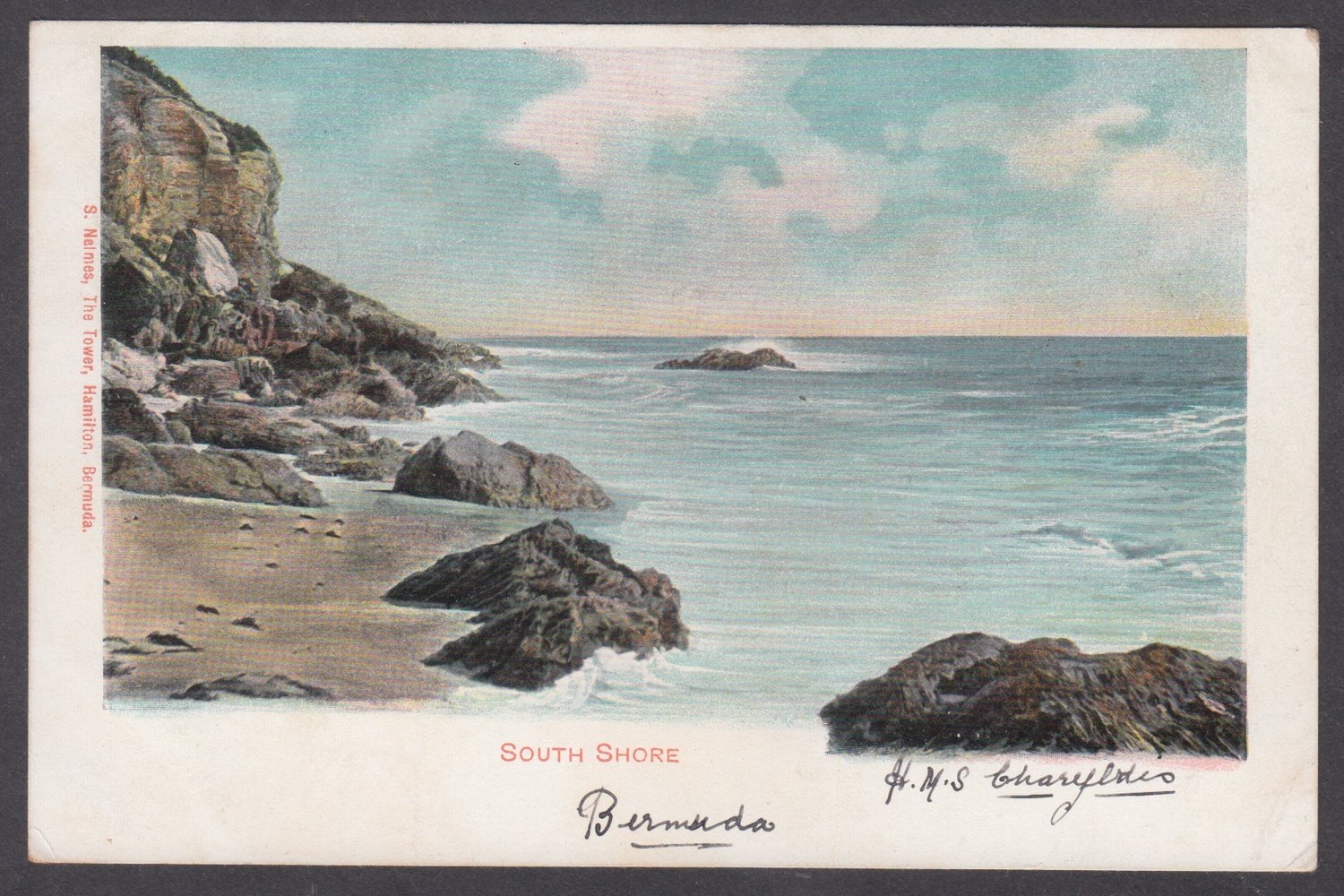
Coloured Bermuda picture postcard titled South Shore, showing a sandy cove with dark rocks, a cliff on the left and a rocky outcrop offshore; the imprint S. Nelmes, The Tower, Hamilton, Bermuda runs up the left side in red, and below the picture is written in ink Bermuda and H.M.S Charybdis, the ship's name underlined
“South Shore”, published by S. Nelmes, The Tower, Hamilton
Close-up of the ink writing below the picture: Bermuda, and H.M.S Charybdis with the ship's name underlined
The writing: “Bermuda” and “H.M.S Charybdis”
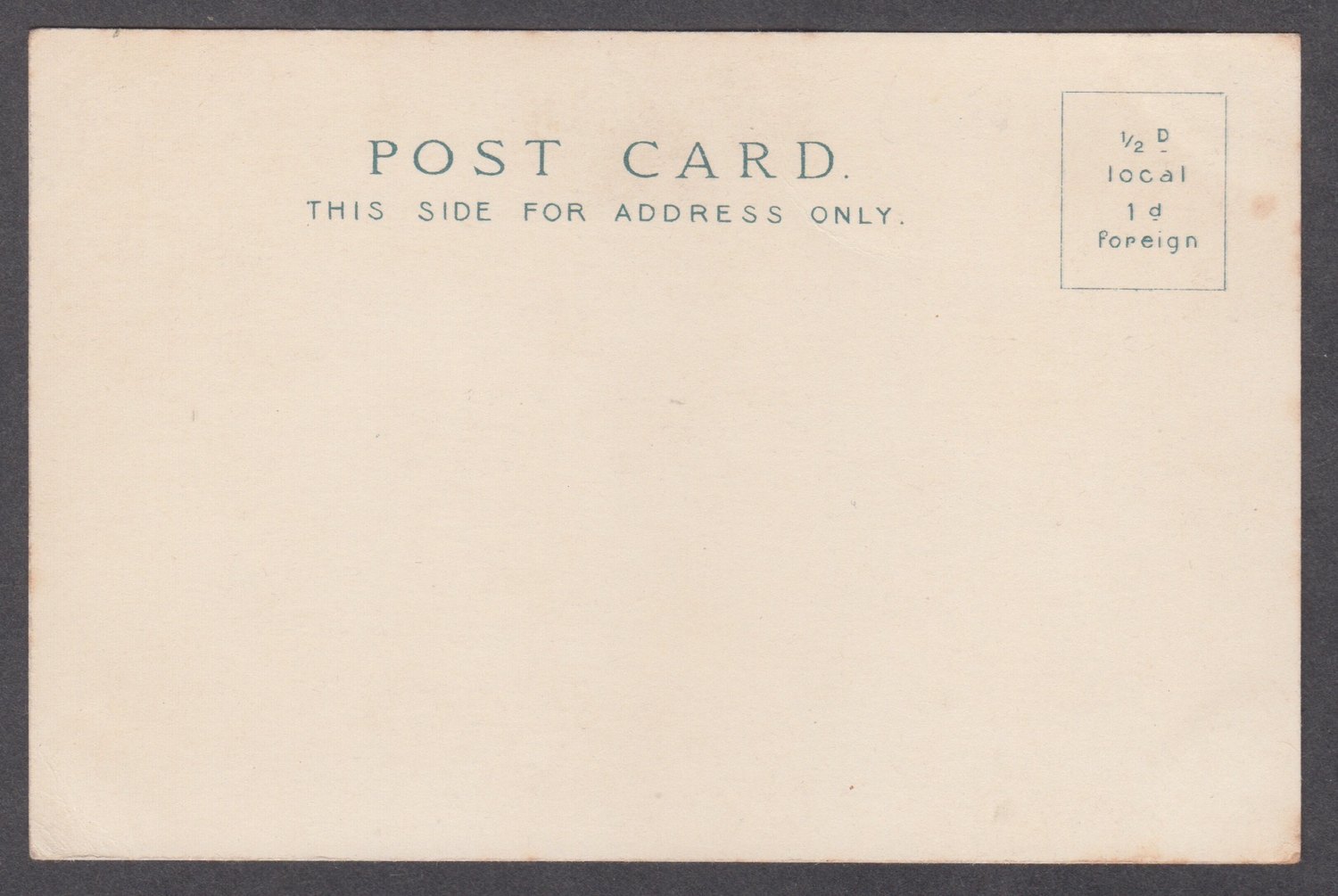
Reverse of the postcard, printed in green POST CARD, THIS SIDE FOR ADDRESS ONLY, with a stamp box at top right reading half penny local, one penny foreign; otherwise blank
The undivided back: “This side for address only”
  • Publisher S. Nelmes, The Tower, Hamilton, Bermuda
  • View South Shore
  • Back Undivided, stamp box “½D local, 1d Foreign”
  • Condition Unused
  • Manuscript “H.M.S Charybdis” and “Bermuda” on the front
  • Date Probably 1901–1905 (not proven)

The card is a coloured view titled “South Shore”: a sandy cove with rocks, a cliff on the left and an outcrop offshore. The publisher’s imprint runs up the left side in red, “S. Nelmes, The Tower, Hamilton, Bermuda.” I’ve written about The Tower before, on the H.M.S. Active page. It was one of Hamilton’s best-known shops, and by the 1890s the Nelmes family were selling stamps and postcards to the ships’ companies.

Below the picture, in the space left for a message, someone has written “Bermuda” and “H.M.S Charybdis”, with the ship’s name underlined. The hand isn’t the tidiest, but I don’t think there’s any doubt about the name.

“H.M.S Charybdis” · “Bermuda”

Written on the front

The back has the old printed instruction “THIS SIDE FOR ADDRESS ONLY”, with a stamp box marked “½D local, 1d Foreign”. That’s why the writer put the ship’s name on the picture side: there was nowhere else to write. Undivided backs like this generally belong to the years before about 1907, which fits Charybdis’s time on the station.

Because the card was never posted, I can’t date it from a postmark. The best I can say is that it fits the years Charybdis was on the North America and West Indies station, 1901 to early 1905. That’s a guess for now, and I’d like to tighten it.
II

Charybdis at Bermuda

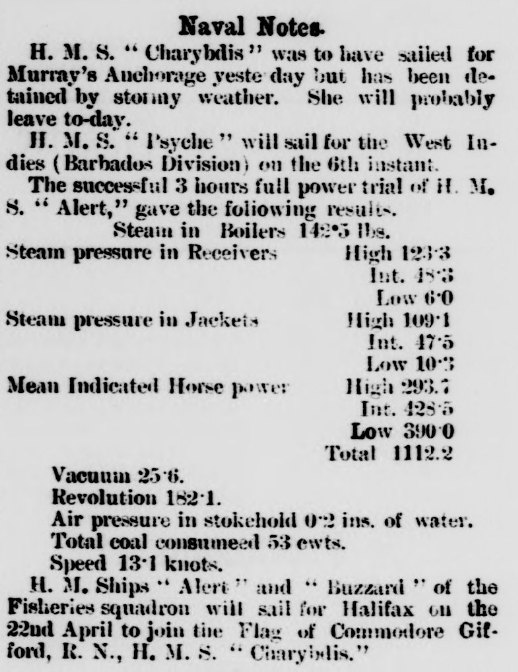
Royal Gazette Naval Notes: H.M.S. Charybdis was to have sailed for Murray's Anchorage yesterday but has been detained by stormy weather; results of H.M.S. Alert's full power trial; H.M. Ships Alert and Buzzard of the Fisheries squadron will sail for Halifax on the 22nd April to join the Flag of Commodore Gifford, R.N., H.M.S. Charybdis
Royal Gazette, 2 April 1901: flagship of the fisheries squadron
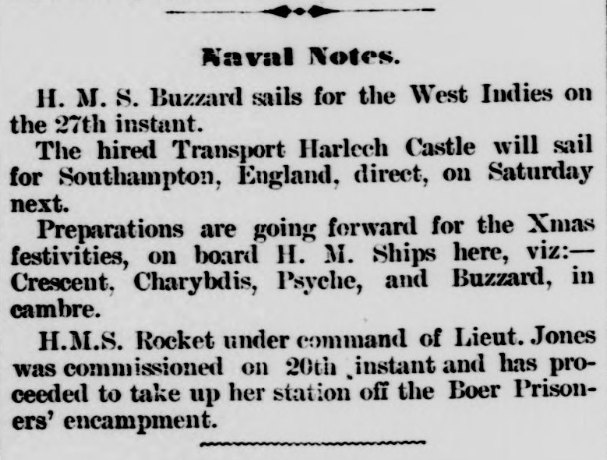
Royal Gazette Naval Notes: Buzzard sails for the West Indies; preparations are going forward for the Xmas festivities on board H.M. Ships Crescent, Charybdis, Psyche and Buzzard, in cambre; H.M.S. Rocket has proceeded to take up her station off the Boer Prisoners' encampment
Royal Gazette, 24 December 1901: Christmas in the Cambre
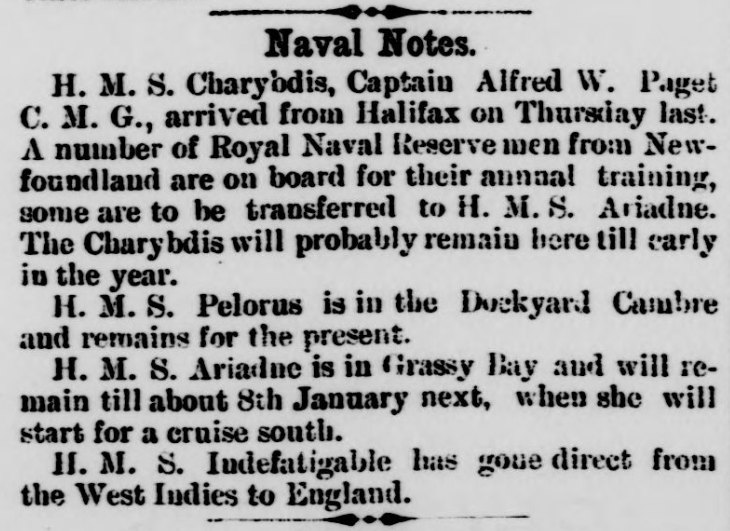
Royal Gazette Naval Notes: H.M.S. Charybdis, Captain Alfred W. Paget C.M.G., arrived from Halifax on Thursday last with Royal Naval Reserve men from Newfoundland on board for their annual training; the Charybdis will probably remain here till early in the year
Royal Gazette, 29 November 1904: Newfoundland reservists on board

The Royal Gazette’s “Naval Notes” let you follow her around. In April 1901 she was flagship of the fisheries squadron. The Gazette of 2 April has her “detained by stormy weather” on her way to Murray’s Anchorage, and Alert and Buzzard about to sail for Halifax “to join the Flag of Commodore Gifford, R.N., H.M.S. ‘Charybdis.’” The fisheries squadron spent its summers looking after the Newfoundland fishery, then came south to Bermuda for the winter.

That’s the pattern year after year. On 30 November 1901 she “arrived from Halifax yesterday morning and anchored in Grassy Bay”, under Captain George A. Gifford (the Gazette spells it “Giffard” this time). By Christmas she was in the Dockyard Cambre with Crescent, Psyche and Buzzard. The Gazette of 24 December says “preparations are going forward for the Xmas festivities” on board, and in the same few lines notes H.M.S. Rocket taking up her station off the Boer prisoners’ camp. It’s a nice reminder of what else Bermuda was dealing with that winter.

She was back in the Cambre in March 1903, preparing to go into the floating dock, and in June 1903 ran a steam trial before leaving for the Newfoundland fisheries again. Her last full winter was 1904–05. On 29 November 1904 the Gazette reported her arrival from Halifax under Captain Alfred W. Paget, C.M.G., with Newfoundland Royal Naval Reserve men on board for their annual training. In January 1905 she sailed for the West Indies with the flagship Ariadne, due back at Bermuda “about 10th February, on her way to England.”

III

Venezuela

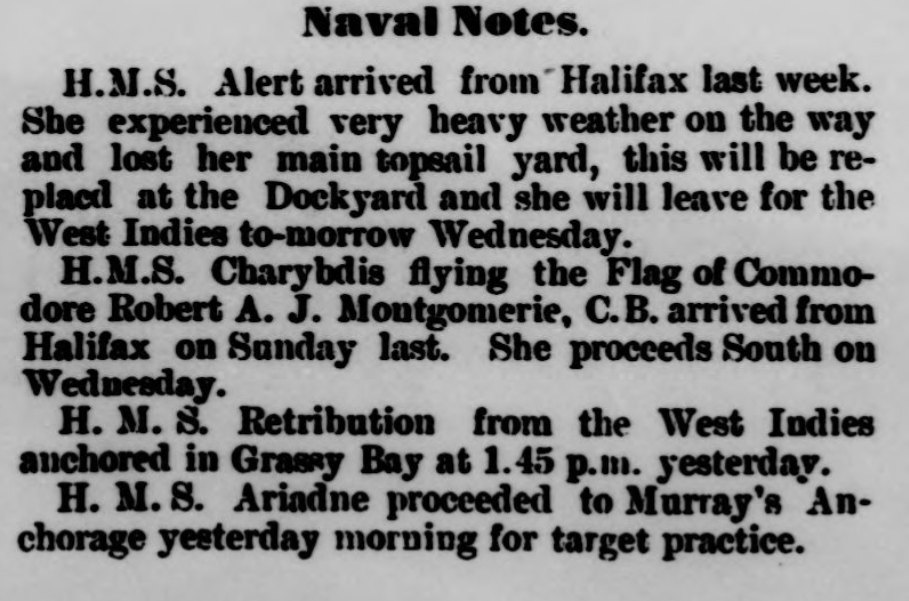
Royal Gazette Naval Notes: H.M.S. Alert arrived from Halifax having lost her main topsail yard in heavy weather; H.M.S. Charybdis flying the Flag of Commodore Robert A. J. Montgomerie, C.B. arrived from Halifax on Sunday last and proceeds South on Wednesday; Retribution anchored in Grassy Bay; Ariadne proceeded to Murray's Anchorage for target practice
Royal Gazette, 2 December 1902: in from Halifax with Commodore Montgomerie’s flag
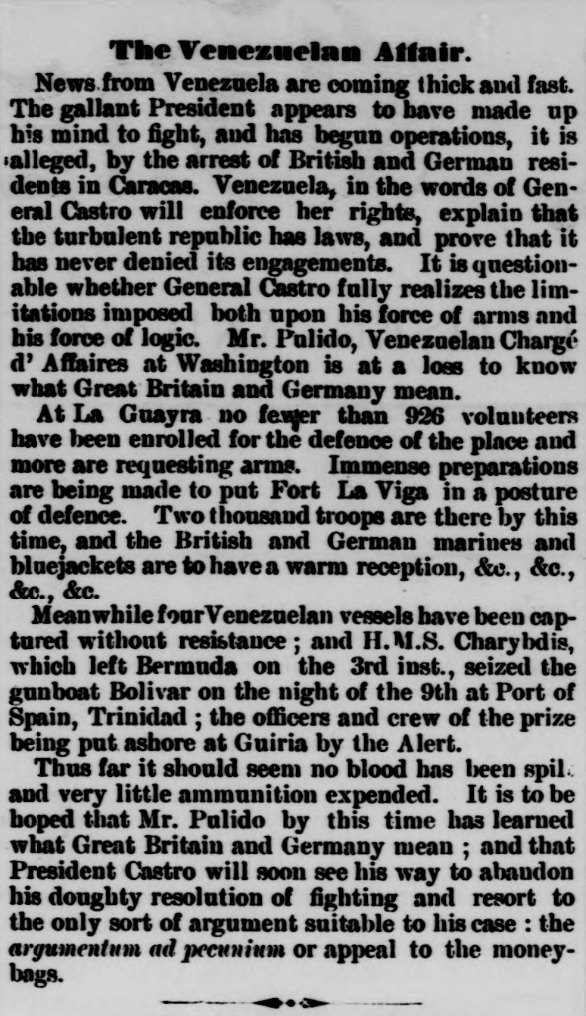
Royal Gazette article The Venezuelan Affair: news from Venezuela, President Castro's preparations at La Guayra; four Venezuelan vessels captured without resistance, and H.M.S. Charybdis, which left Bermuda on the 3rd inst., seized the gunboat Bolivar on the night of the 9th at Port of Spain, Trinidad, the officers and crew being put ashore at Guiria by the Alert
Royal Gazette, 13 December 1902: the gunboat Bolivar seized at Port of Spain
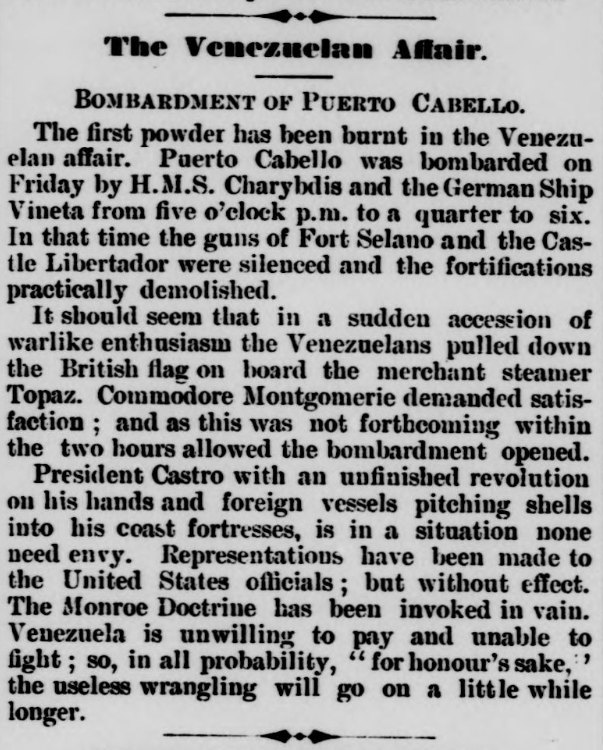
Royal Gazette article The Venezuelan Affair, Bombardment of Puerto Cabello: Puerto Cabello was bombarded by H.M.S. Charybdis and the German ship Vineta from five o'clock to a quarter to six, silencing Fort Selano and the Castle Libertador, after the Venezuelans pulled down the British flag on the merchant steamer Topaz and Commodore Montgomerie's demand for satisfaction went unanswered
Royal Gazette, 16 December 1902: “Bombardment of Puerto Cabello”

The Gazette lets you follow this one almost day by day. On Sunday 30 November 1902 Charybdis came in from Halifax “flying the Flag of Commodore Robert A. J. Montgomerie, C.B.”, and the Naval Notes said she would proceed south on the Wednesday. By 6 December the paper was reporting “great activity” in the Dockyard getting the squadron ready “for immediate departure presumably to Venezuela”, and Charybdis, Alert and Quail had already gone.

Britain and Germany were trying to force President Castro to settle debts and claims. The Gazette of 13 December reports that Charybdis, “which left Bermuda on the 3rd inst.”, had seized the Venezuelan gunboat Bolivar at Port of Spain, Trinidad, on the night of the 9th, with the Alert putting her officers and crew ashore at Guiria.

Then came Puerto Cabello. A mob boarded the British steamer Topaz and pulled down her flag. Commodore Montgomerie demanded satisfaction, and when none came within the two hours allowed, Charybdis and the German cruiser Vineta opened fire on the forts on 13 December.

“Puerto Cabello was bombarded … by H.M.S. Charybdis and the German Ship Vineta from five o’clock p.m. to a quarter to six.”

Royal Gazette, 16 December 1902

The Gazette says Friday, but 13 December 1902 was a Saturday, and the American papers have it right. They also report that marines from Charybdis occupied the castle afterwards.

What I like is how close to home this was. Within a few months the German ships were docking at Bermuda. The Gazette of 14 March 1903 has the German cruiser Falke in Grassy Bay, “to be docked here instead of the Vineta or Panther”, and in June the Vineta herself anchored in Grassy Bay, the same week Charybdis was running her steam trial.

IV

Bermuda, 1915

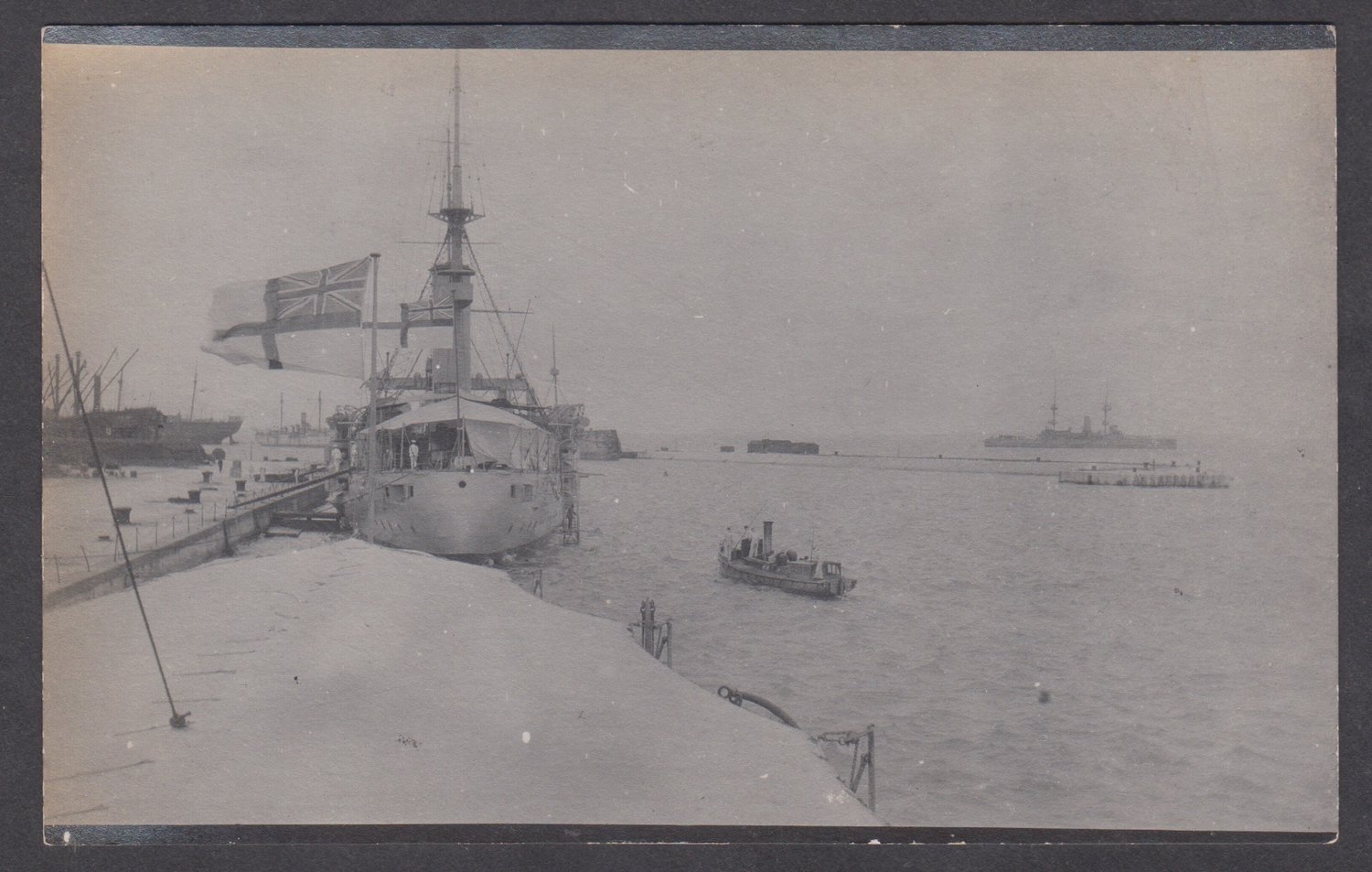
Real photo postcard: HMAS Melbourne moored stern-on to the Dockyard wall at Bermuda with awnings spread and a White Ensign flying from the staff, a steam pinnace crossing in front, merchant ships at the left and a two-masted warship lying further out
HMAS Melbourne at the Dockyard, 20 June 1915
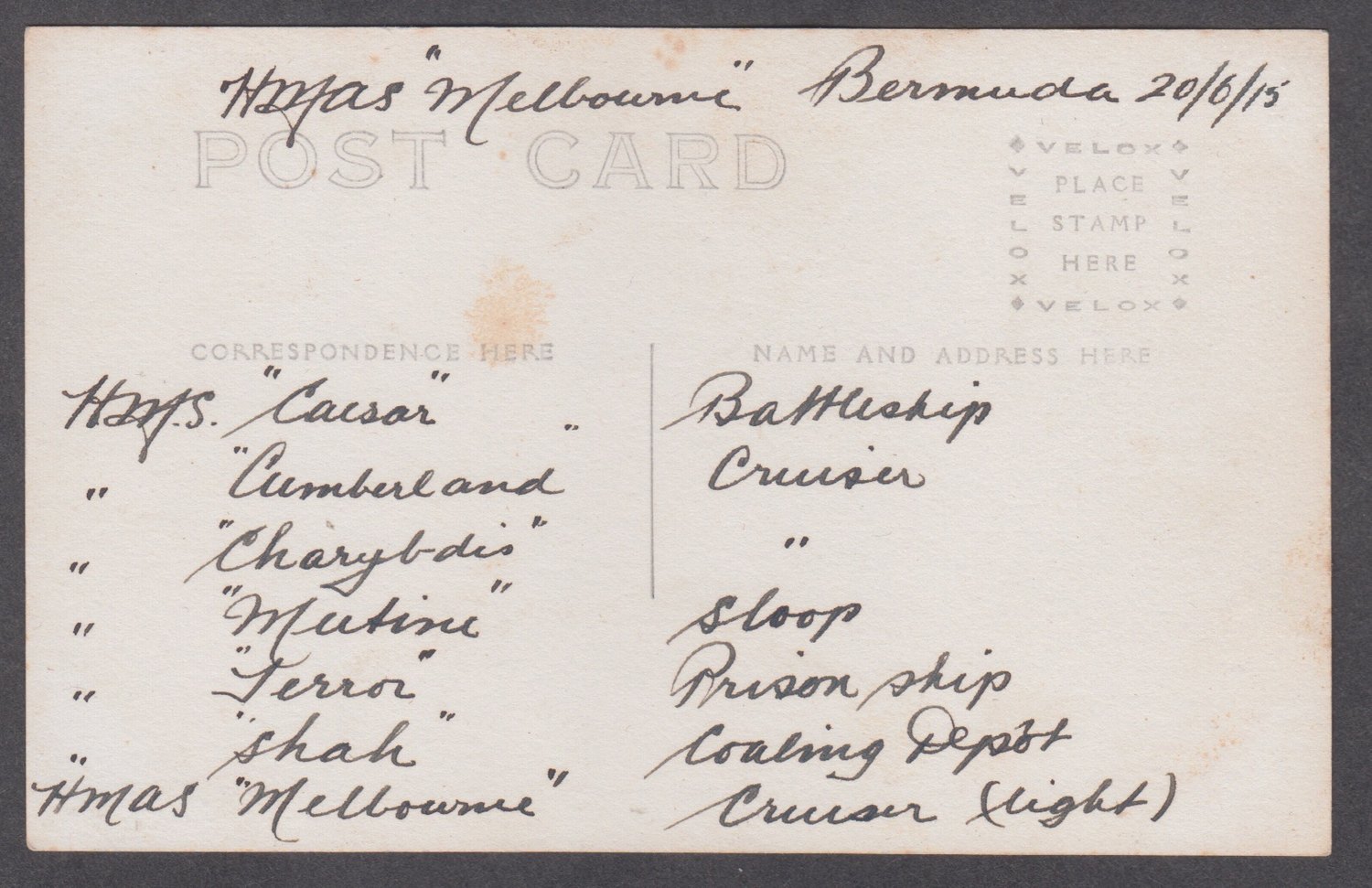
Reverse of the Velox real photo postcard, written in ink: H.M.A.S. Melbourne, Bermuda 20/6/15, and a list of ships with their types: H.M.S. Caesar, battleship; Cumberland, cruiser; Charybdis, cruiser; Mutine, sloop; Terror, prison ship; Shah, coaling depot; H.M.A.S. Melbourne, cruiser (light)
The reverse: the ships in port, Charybdis third on the list
  • Card Real photo postcard, Velox paper
  • Condition Unused
  • Manuscript “H.M.A.S. ‘Melbourne’ Bermuda 20/6/15” and a list of ships
  • Kept With my Australian material

This one is a real photo postcard on Velox paper. It shows HMAS Melbourne moored stern-on to the Dockyard wall with her awnings spread and the White Ensign flying, a steam pinnace crossing in front, and a two-masted ship lying further out. On the back, in ink, is “H.M.A.S. ‘Melbourne’ Bermuda 20/6/15”, and below that a list of the ships in port, each with what it was:

“Caesar, Battleship · Cumberland, Cruiser · Charybdis, Cruiser · Mutine, Sloop · Terror, Prison ship · Shah, Coaling Depot · H.M.A.S. Melbourne, Cruiser (light)”

The reverse

It reads as if someone from the Melbourne was showing the folks at home who was who: their own ship in the picture, and the others in port with her. Melbourne was based at Bermuda from January 1915 until August 1916. Charybdis isn’t in the photo, but she’s third on the list. By June 1915 she had been damaged in a collision and was laid up at the Dockyard, and this card is my evidence that she was there.

I also like seeing Terror listed as a “prison ship”, and the old Shah still serving as a coaling hulk.

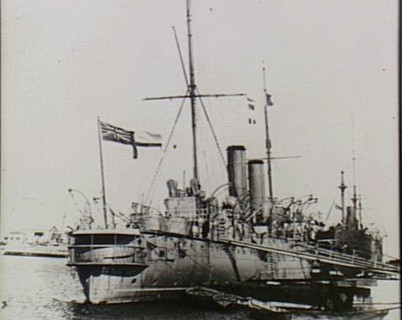
The Ship

Black and white photograph of the cruiser HMS Charybdis from the starboard quarter, moored alongside at Bermuda, with two funnels, a tall mainmast and the ensign flying at the stern

H.M.S. Charybdis

Charybdis was one of the eight Astraea-class second-class protected cruisers built under the Naval Defence Act of 1889. She was launched at Sheerness Dockyard on 15 June 1893 and completed in January 1896. She came to the North America and West Indies station in 1901 and went home in early 1905. In August 1914 she was flagship of the 12th Cruiser Squadron in the Channel. She was damaged in a collision in 1915 and laid up at Bermuda, where she appears on my June 1915 card. She was used as a depot ship in 1917, and in 1918 she was converted into a cargo carrier. That July, Governor Willcocks telegraphed London that war-risk insurance “for the Charybdis” was prohibitive. She was returned to the Navy in 1920, sold in 1922 and broken up the following year.

BuiltSheerness, launched 15 June 1893
TypeAstraea-class protected cruiser, 4,360 tons
GunsTwo 6-inch, eight 4.7-inch
CaptainsG. A. Gifford (1901); A. W. Paget (1904)
FateSold 1922, broken up 1923

Photograph: HMS Charybdis at Bermuda. Australian War Memorial, P02243.006 (dated c.1906 by the AWM; possibly 1915).

Still to find out

If you can help with any of these, I’d be very pleased to hear from you.

References

Two cards, fourteen years apart: one with only the ship’s name written on a South Shore view, the other with her name on a list of ships at the Dockyard in wartime. Between them, the Gazette fills in the rest. When something with a postmark turns up, this page will grow.