Postal History · Royal Navy · North America and West Indies Station

H.M.S. Ariadne

Bermuda · 20 December 1904

A Christmas card home from the Admiral’s French cook.

◆

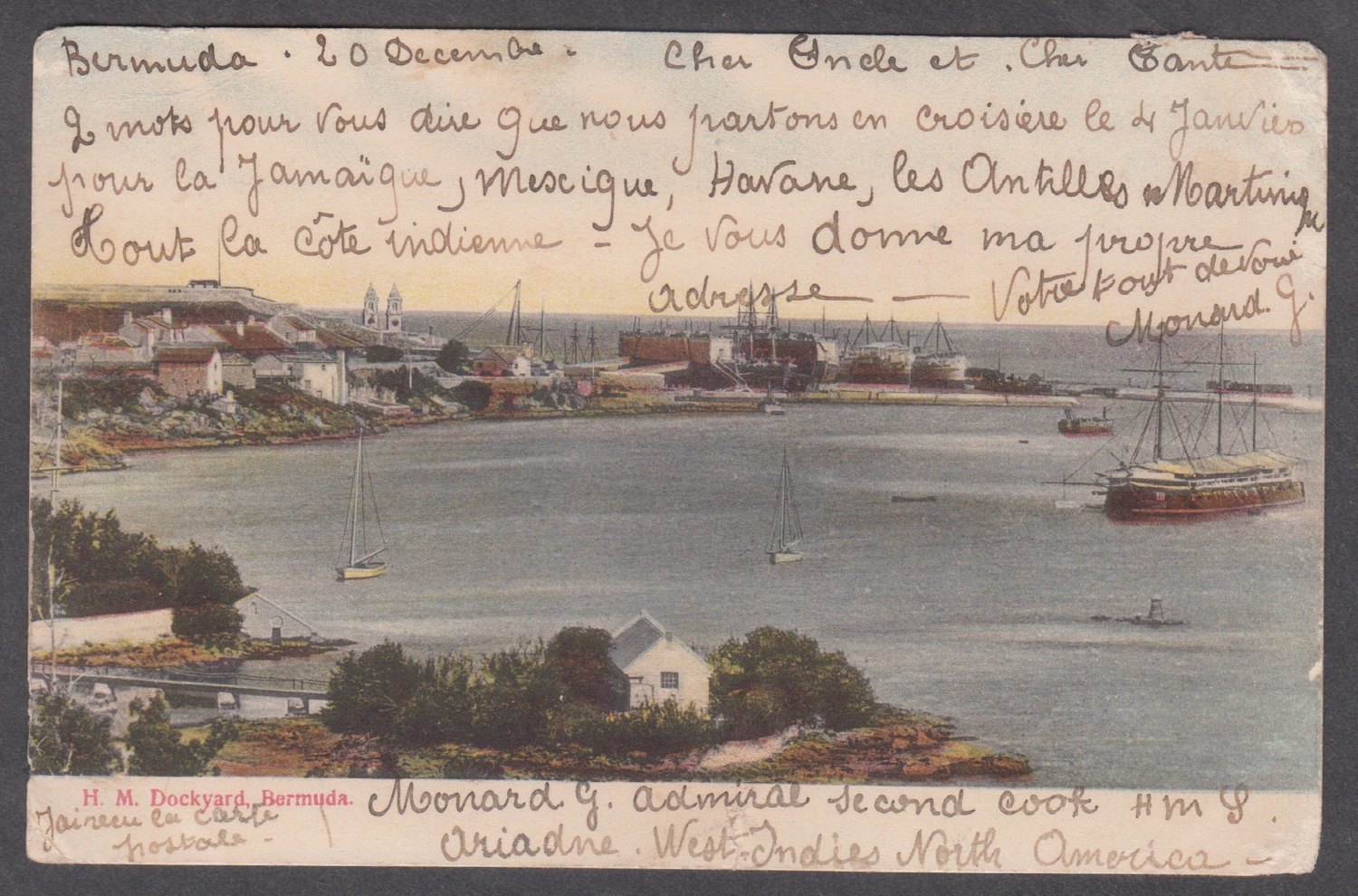
I couldn’t pass this card up. It was written in French by G. Monard, who signs himself “admiral second cook HMS Ariadne”, to his aunt and uncle at Blère, a small town in the Loire Valley, five days before Christmas 1904. Ariadne was the flagship of Vice-Admiral Day H. Bosanquet, lying in Grassy Bay and waiting to set off on the winter cruise south.

I

The Admiral’s second cook

Coloured picture postcard titled H. M. Dockyard, Bermuda: a view across the water to the Dockyard buildings, the twin towers of the Dockyard church, ships alongside and a hulk at anchor, with small sailing boats in the foreground; the sky and lower margin are covered with a handwritten message in French, dated Bermuda 20 December and signed Monard G., with an address line in English along the bottom reading Monard G. admiral second cook HMS Ariadne, West Indies North America
“H. M. Dockyard, Bermuda”, written by Monard on 20 December 1904
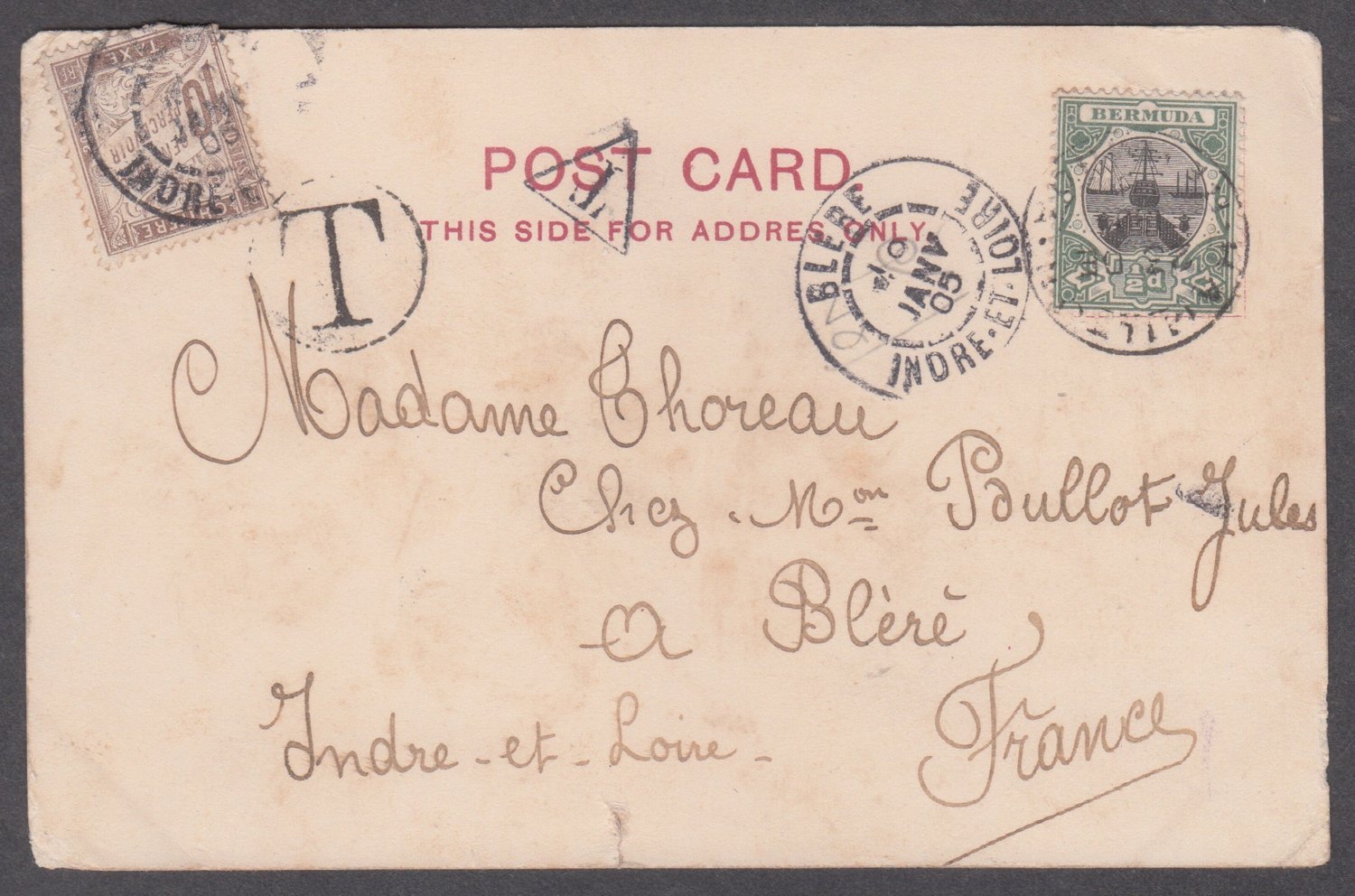
Address side of the postcard, printed POST CARD, This side for address only: a Bermuda halfpenny Dock stamp in green and black tied by a Hamilton datestamp; a large T in circle and a T in triangle; a French 10 centimes Chiffre Taxe postage due stamp at top left cancelled at Blère; a Blère Indre-et-Loire datestamp of January 1905; addressed in ink to Madame Choreau, chez Mon. Poullot Jules, à Blère, Indre-et-Loire, France
½d Dock, Hamilton 23 December 1904; 10c to pay at Blère
  • Written Bermuda, 20 December 1904
  • Card “H. M. Dockyard, Bermuda”, coloured picture postcard
  • From G. Monard, Admiral’s second cook, H.M.S. Ariadne
  • Addressed to Madame Choreau, chez M. Poullot Jules, Blère, Indre-et-Loire, France
  • Stamp ½d Dock
  • Postmark Hamilton, 23 December 1904
  • Markings “T” in circle (Bermuda); “T” in triangle (France); French 10c postage due cancelled at Blère, JANV 05

The card is a coloured view of H. M. Dockyard, Bermuda. Monard wrote right across the sky, in French:

“2 mots pour vous dire que nous partons en croisière le 4 Janvier pour la Jamaïque, Mescique, Havane, les Antilles et Martinique, tout la côte indienne – Je vous donne ma propre adresse – Votre tout dévoué, Monard G.”

Bermuda, 20 December 1904

In English: “A quick line to tell you that we leave on a cruise on 4 January for Jamaica, Mexico, Havana, the Antilles and Martinique, the whole of the West Indies coast. I’m giving you my own address. Your devoted Monard G.”

The address he mentions is the line written in English along the bottom of the picture: “Monard G. admiral second cook HMS Ariadne. West Indies North America”, so that a reply would find him. Down the left-hand side he added “J’ai reçu la carte postale”, “I received the postcard”, so his aunt and uncle had written first. His spelling suggests he wrote the way he spoke, “Mescique” for Mexique and “Cher Tante” for Chère Tante, and I’ve left it just as he wrote it.

Monard describes himself as the Admiral’s second cook. Admirals were allowed their own cooks and stewards, known as Domestics, and I suspect he was one of Vice-Admiral Bosanquet’s. Whether a Frenchman was entered on the ship’s books like the others, or was paid privately by the Admiral, I don’t yet know. Ariadne’s ledger at Kew should tell us.
II

Ten centimes to pay at Blère

  • Paid ½d
  • Rate 1d, the overseas postcard rate
  • Short ½d
  • Charged 10 centimes, twice the shortfall

Monard put a ½d Dock stamp on the card, but a postcard to France needed 1d. It was posted at Hamilton on 23 December, and the Bermuda post office struck the “T” in circle to show it was underpaid. In France it got the “T” in triangle, and at Blère a 10 centime postage due stamp was added and cancelled with the January 1905 datestamp. That was twice the halfpenny shortfall, as the rules then required.

So Madame Choreau paid 10 centimes to read her nephew’s news. If the cruise went to plan, by the time she had it he was already somewhere in the Caribbean.

III

The flagship at Bermuda

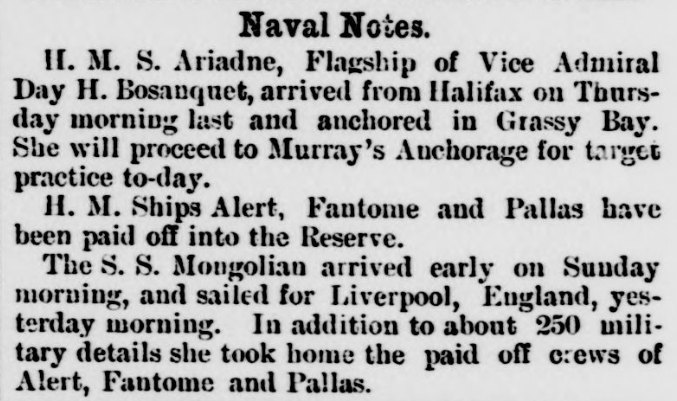
Royal Gazette Naval Notes: H.M.S. Ariadne, Flagship of Vice Admiral Day H. Bosanquet, arrived from Halifax on Thursday morning last and anchored in Grassy Bay, and will proceed to Murray's Anchorage for target practice to-day; H.M. Ships Alert, Fantome and Pallas have been paid off into the Reserve; the S.S. Mongolian sailed for Liverpool with about 250 military details and the paid-off crews
Royal Gazette, 15 November 1904: arrived from Halifax
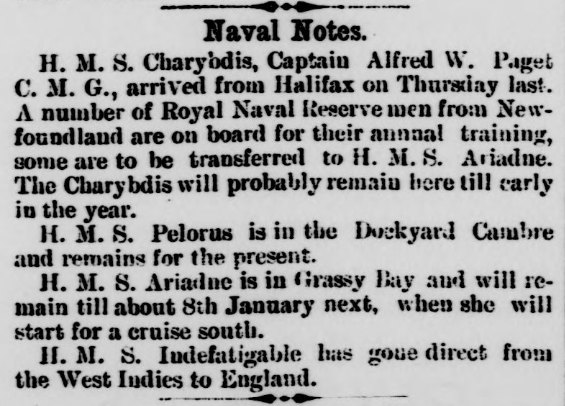
Royal Gazette Naval Notes: H.M.S. Charybdis arrived from Halifax with Royal Naval Reserve men from Newfoundland, some to be transferred to H.M.S. Ariadne; H.M.S. Pelorus in the Dockyard Cambre; H.M.S. Ariadne is in Grassy Bay and will remain till about 8th January next, when she will start for a cruise south; H.M.S. Indefatigable has gone direct from the West Indies to England
Royal Gazette, 29 November 1904: “a cruise south”
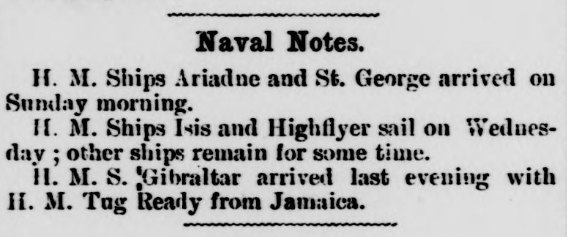
Royal Gazette Naval Notes: H.M. Ships Ariadne and St. George arrived on Sunday morning; H.M. Ships Isis and Highflyer sail on Wednesday, other ships remain for some time; H.M.S. Gibraltar arrived last evening with H.M. Tug Ready from Jamaica
Royal Gazette, 7 March 1905: back at Bermuda
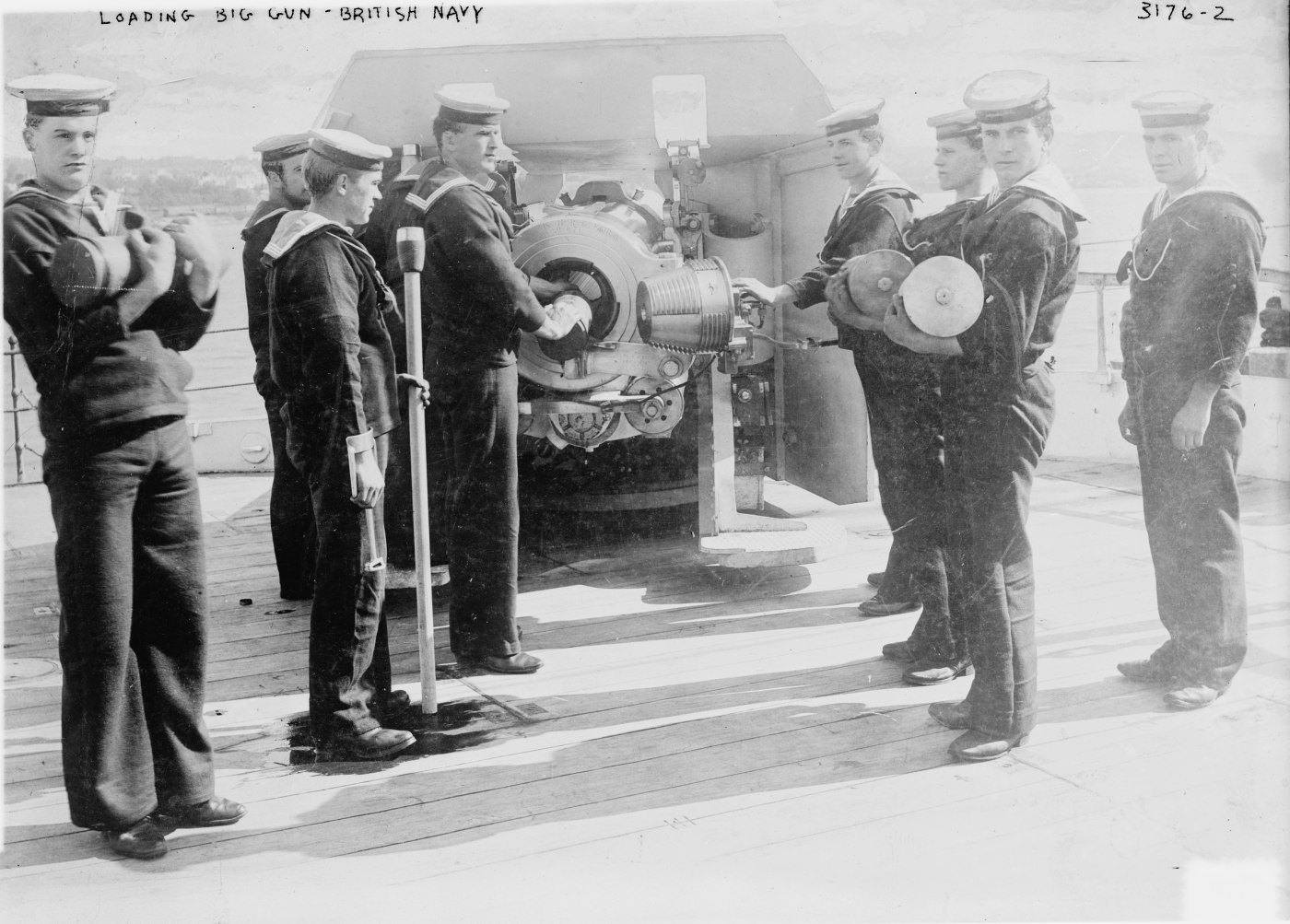
Black and white photograph of eight sailors posed around a 6-inch gun on a wooden deck, the breech open; one holds the rammer, others hold a projectile and brass propellant cases; the plate is captioned Loading big gun, British Navy
Loading a 6-inch gun aboard Ariadne, c.1903

Ariadne sailed from Halifax on 8 November 1904, arrived in Grassy Bay on the morning of Thursday the 10th, and went on to Murray’s Anchorage for target practice. On 29 November the Royal Gazette reported:

“H.M.S. Ariadne is in Grassy Bay and will remain till about 8th January next, when she will start for a cruise south.”

Royal Gazette, 29 November 1904

Monard had the 4th, so either plans changed or the cook knew something the paper didn’t.

The cruise is easy enough to follow. In early February she joined the new Particular Service Squadron at Dominica, a training squadron of St George, Hawke, Gibraltar, Isis and Highflyer, and on 21 February she was at Kingston, Jamaica. I haven’t found Mexico or Havana in the clippings yet. She and St George were back at Bermuda on Sunday morning, 5 March 1905.

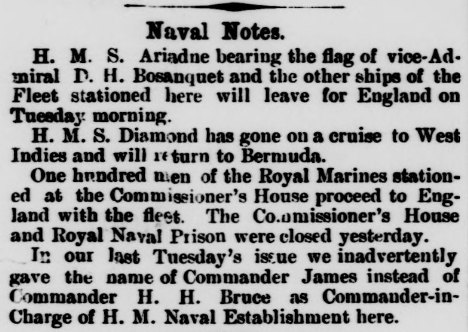
By then her time on the station was nearly over. The Army and Navy Gazette expected her to go home to be paid off, though as it turned out that came later. By 14 March the only ships left were Ariadne, Diamond, Hawke, Gibraltar and St George, and Diamond was to stay on the station permanently. The Dockyard was being wound down too. Captain Leah handed over the Naval Establishment to a Commander, and on Friday 31 March the Commissioner’s House and the Royal Naval Prison were closed. The Gazette of 1 April reported that Ariadne, “bearing the flag of vice-Admiral D. H. Bosanquet”, and the other ships of the fleet would leave for England on Tuesday morning, 4 April, with one hundred Royal Marines from the Commissioner’s House.

She came into Plymouth from Portland on the afternoon of Tuesday 18 April, bringing home a number of supernumeraries who were discharged to the shore the next evening. She wasn’t paid off after all. The Naval & Military Record reported that in May she would lead the Particular Service Squadron on a coasting cruise and through the summer manoeuvres, and only then return to Devonport to be replaced as flagship by Royal Arthur.

Ashore

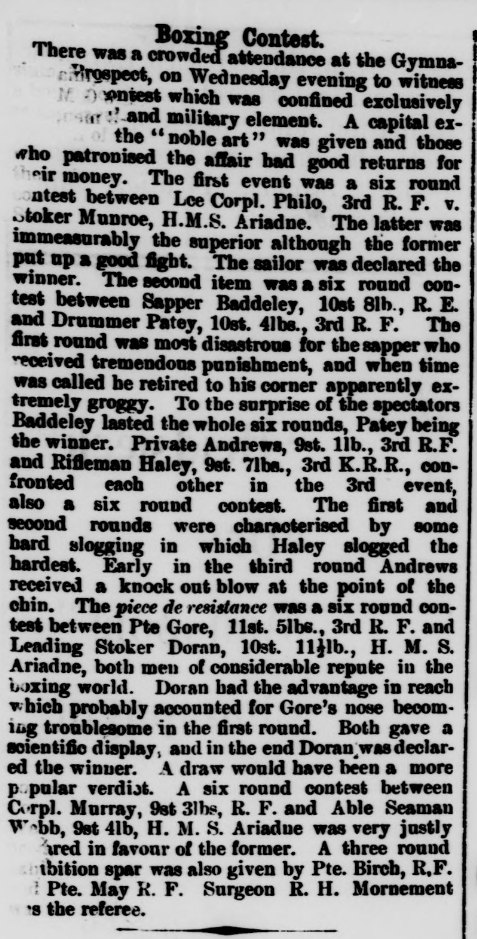
Royal Gazette report of a Boxing Contest at the Gymnasium, Prospect, on Wednesday evening, confined to the naval and military element: Stoker Munroe of H.M.S. Ariadne beat Lance Corporal Philo, 3rd R.F.; Sapper Baddeley, R.E. and Drummer Patey, 3rd R.F.; Private Andrews, 3rd R.F. and Rifleman Haley, 3rd K.R.R.; Leading Stoker Doran of H.M.S. Ariadne was declared the winner against Private Gore, 3rd R.F., though a draw would have been a more popular verdict; Corporal Murray, R.F. beat Able Seaman Webb of H.M.S. Ariadne; Surgeon R. H. Mornement was the referee
Royal Gazette, 1 April 1905: Army against Navy at Prospect
Royal Gazette Naval Notes: H.M.S. Ariadne bearing the flag of vice-Admiral D. H. Bosanquet and the other ships of the Fleet stationed here will leave for England on Tuesday morning; H.M.S. Diamond has gone on a cruise to the West Indies and will return to Bermuda; one hundred men of the Royal Marines stationed at the Commissioner's House proceed to England with the fleet, and the Commissioner's House and Royal Naval Prison were closed yesterday
Royal Gazette, 1 April 1905: leaving for England

The papers also give a glimpse of the ship’s company ashore in that last month. On 6 March, at the Windsor Hotel, the wife of Lieut. T. E. Wardle, R.N., of Ariadne gave birth to a son. Wardle later commanded the armed merchant cruiser Alcantara in her fight with the German raider Greif in 1916.

Ariadne’s bandmaster, Mr Chesterman, had sung at Wesley Church at Christmas, and on 27 March he sang bass there in the cantata Naaman. Three weeks later, as Ariadne passed the flagship Impregnable on her way into Devonport, his band played “Home sweet home”.

Two nights later the Gymnasium at Prospect was packed for a boxing contest between the Army and the Navy. Stoker Munroe of Ariadne beat Lance Corporal Philo of the 3rd Royal Fusiliers, and in the main event Leading Stoker Doran was given the decision over Private Gore, though the Gazette thought “a draw would have been a more popular verdict”. Able Seaman Webb lost his bout to Corporal Murray. I like to think the Admiral’s cook was in the crowd.

November 1904 to April 1905

The ship on one side, the card on the other.

The ship
The card
8 Nov 1904
The shipSails from Halifax for Bermuda.
Thu 10 Nov
The shipAnchors in Grassy Bay.
29 Nov
The shipGazette: cruise south “about 8th January”.
20 Dec
The cardMonard writes: “nous partons en croisière le 4 Janvier”.
23 Dec
The cardPosted at Hamilton, ½d short.
Jan 1905
The shipLeaves on the winter cruise.
The cardReaches Blère, 10 centimes to pay.
2 Feb
The shipJoins the training squadron at Dominica.
21 Feb
The shipAt Kingston, Jamaica.
Sun 5 Mar
The shipBack at Bermuda with St George.
Tue 4 Apr
The shipSails for England.
Tue 18 Apr
The shipArrives at Plymouth from Portland.

The Ship

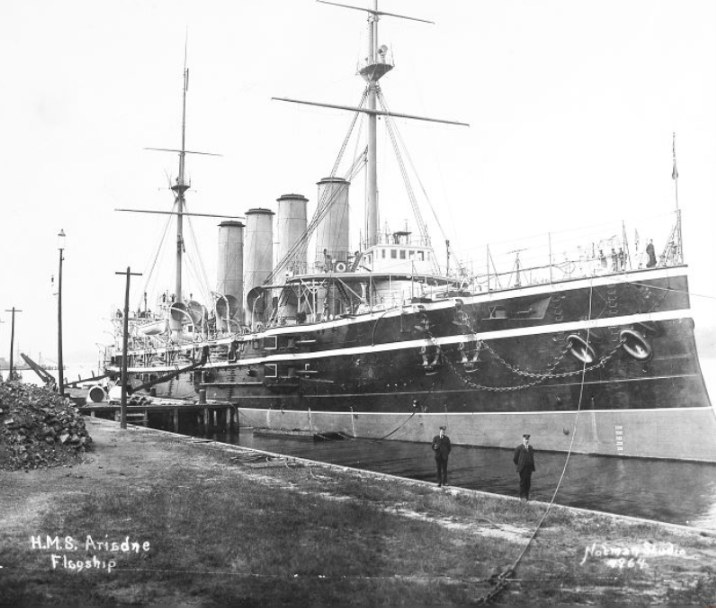
Black and white photograph of the cruiser Ariadne alongside a wharf at Halifax, seen from the bow, with four tall funnels and two masts, a heap of coal on the quay at left and two men standing at the water’s edge; lettered “H.M.S. Ariadne Flagship” and “Notman Studio 9964”

H.M.S. Ariadne (1898)

Ariadne was a Diadem-class protected cruiser, built by J. & G. Thomson at Clydebank and launched on 22 April 1898. In July 1902 she took over from H.M.S. Crescent at Halifax as flagship of the North America and West Indies Station, and she took part in the blockade of Venezuela in 1902–03.

In early 1905 she was flagship of the Particular Service Squadron, and that April she came home to Devonport, staying on as the squadron’s flagship through the summer manoeuvres until Royal Arthur relieved her. In 1913 she became a stokers’ training ship, and in 1917 she was converted to a minelayer. She was torpedoed and sunk off Beachy Head by the German submarine UC-65 on 26 July 1917.

BuiltJ. & G. Thomson, Clydebank, launched 22 April 1898
TypeDiadem-class protected cruiser
Displacement11,000 tons
FlagVice-Admiral Day H. Bosanquet, 1904–05
FateSunk by UC-65, 26 July 1917

Flagship H.M.S. Ariadne, docked and ready for coaling, Halifax, Nova Scotia, c.1902–04. Notman Studio, Halifax, N.S., courtesy of Nova Scotia Archives (1983-310 no. 9964). Gun photograph: Bain News Service, Library of Congress, via Wikimedia Commons.

Still to find out

If you can help with either of these, I’d be very pleased to hear from you.

References

It’s an ordinary little card in many ways, but I love that a French cook in a British flagship sat down in Bermuda, five days before Christmas, to tell his aunt and uncle where he was going. And they had to pay to read it.