Postal History · Royal Navy · North America and West Indies Station

H.M.S. Ariadne, St George, Gibraltar or Hawke

Ireland Island · 29 March 1905

A card from the Dockyard to a pub in Brighton, and a ship to work out.

◆

One of the things I love about postal history is that you rarely get all the answers. You piece together what you can from the item, the newspapers and the records, and sometimes you end up making a best guess. This card is one of those. It was posted at the Dockyard on 29 March 1905 by someone who signs himself “Al”, to a publican in Brighton, and he doesn’t say which ship he was in. But he does say when he expected to be in England, and with the Royal Gazette that narrows it down to four ships: Ariadne, St George, Gibraltar and Hawke. My guess is Ariadne. I could be completely wrong.

I

“Dear Jack”

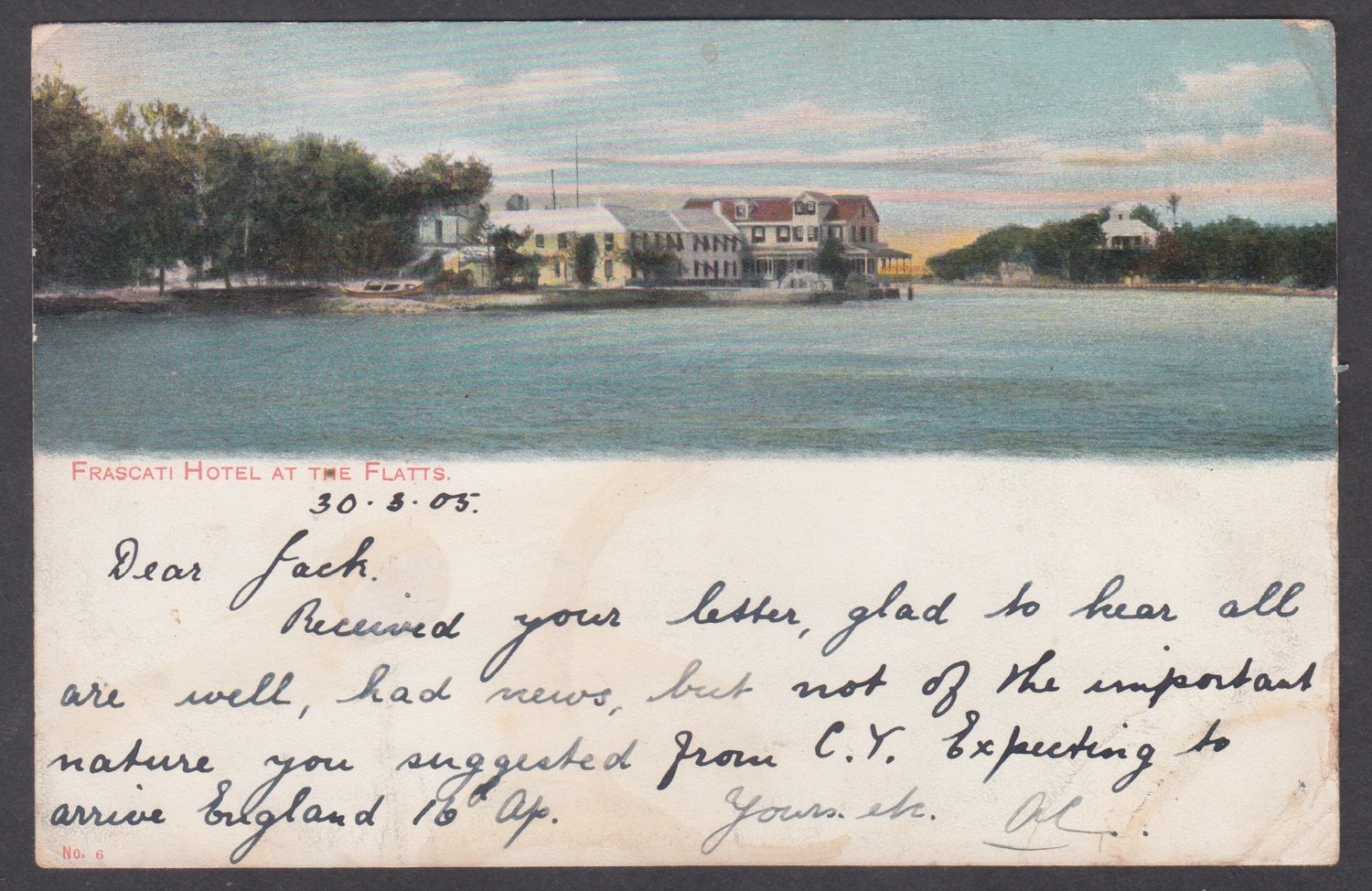
Coloured picture postcard titled Frascati Hotel at the Flatts: a view across blue water to a long white hotel with red roofs and verandahs among trees, with a boat drawn up on the shore; below the picture a message in ink dated 30.3.05 reads Dear Jack. Received your letter, glad to hear all are well, had news, but not of the important nature you suggested from C.Y. Expecting to arrive England 16th Ap. Yours etc. Al; the card is numbered No. 6 at bottom left
“Frascati Hotel at the Flatts”, 30 March 1905
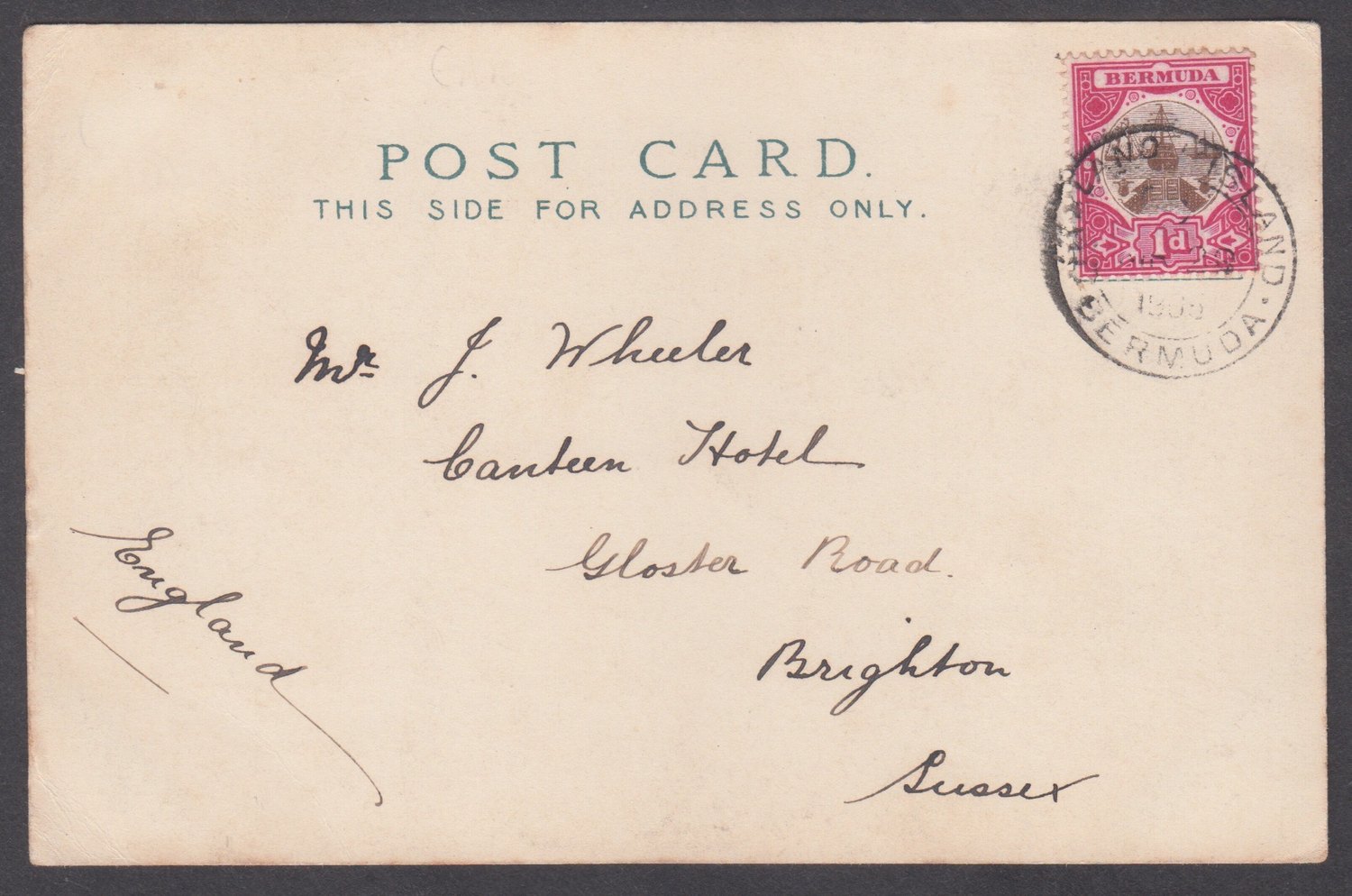
Address side of the postcard, printed POST CARD, This side for address only: a Bermuda 1d Dock stamp in carmine and brown tied by an Ireland Island Bermuda datestamp of 29 March 1905; addressed in ink to Mr J. Wheeler, Canteen Hotel, Gloster Road, Brighton, Sussex, with England written diagonally at the left
1d Dock, Ireland Island 29 March 1905, to Mr J. Wheeler, Canteen Hotel, Brighton
  • Dated “30.3.05” by the writer, a day after the postmark
  • Card “Frascati Hotel at the Flatts”, coloured picture postcard, No. 6
  • From “Al”, ship not stated
  • Addressed to Mr J. Wheeler, Canteen Hotel, Gloster Road, Brighton, Sussex, England
  • Stamp 1d Dock
  • Postmark Ireland Island, Bermuda, type H7, 29 March 1905
  • Rate 1d, the postcard rate to England

The picture is a coloured view of the Frascati Hotel at Flatts, and Al wrote his message underneath it:

“Dear Jack. Received your letter, glad to hear all are well, had news, but not of the important nature you suggested from C.Y. Expecting to arrive England 16th Ap. Yours etc. Al..”

Bermuda, 30 March 1905

It’s a short note, and I like it for what it leaves out. Jack had written suggesting there might be some important news from “C.Y.” Al had news, just not that news. I’ve no idea who or what C.Y. was: a person, a place, perhaps a ship. Chatham Yard crossed my mind, but that’s a guess and nothing more.

The card was posted at Ireland Island, the Dockyard post office, with a 1d Dock stamp, the right rate for a postcard to England. The datestamp is the Ireland Island type H7, and it reads 29 March 1905, the day before the date Al put on the card. Either Al got his date wrong or the Ireland Island clerk hadn’t changed his datestamp that morning; I suspect Al. The signature might be “Al” or it might be initials, “A.L.” Either way, that’s all he gives us.
II

The Canteen Hotel

  • Jack John Lovell Wheeler, licensee from 1890
  • Pub The Royal Artillery Canteen, 20 Gloucester Road, Brighton
  • Opposite Headquarters of the 1st Sussex Volunteer Artillery
  • Family Wife Ann; daughters Alice and Ann; son Lovell John, licensee by 1930

Mr J. Wheeler was John Lovell Wheeler, who kept the Royal Artillery Canteen at 20 Gloucester Road, Brighton, from 1890 until at least 1915. Al calls it the Canteen Hotel and spells the street “Gloster”, the way it’s said. The pub took its name from the headquarters of the 1st Sussex Volunteer Artillery across the road, and it was still the Canteen Inn when James Gray photographed it in 1963.

His wife Ann and their daughters Alice and Ann worked in the pub, and his son, Lovell John Wheeler, had taken it over by 1930.

“Dear Jack” isn’t how a son writes to his father, so I don’t think Al was family in that sense. A friend, a brother-in-law or an old regular seems more likely, and with the Volunteer Artillery across the road Jack must have known a good many men in uniform.

I do like that a card of a Bermuda hotel went to a hotel in Brighton. Whether Al chose it for that, or it was just the card he had to hand, I’ll never know.

III

Which ship?

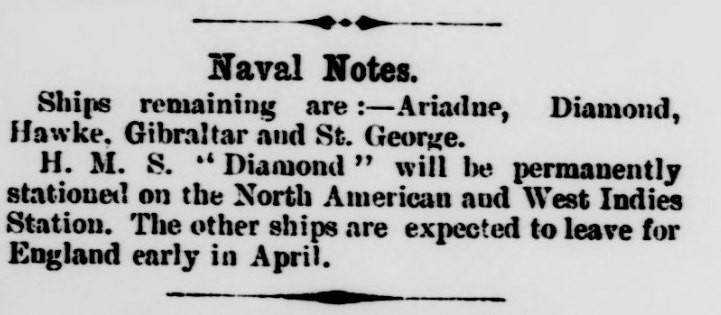
Royal Gazette Naval Notes: Ships remaining are Ariadne, Diamond, Hawke, Gibraltar and St. George. H.M.S. Diamond will be permanently stationed on the North American and West Indies Station. The other ships are expected to leave for England early in April
Royal Gazette, 14 March 1905: the ships remaining
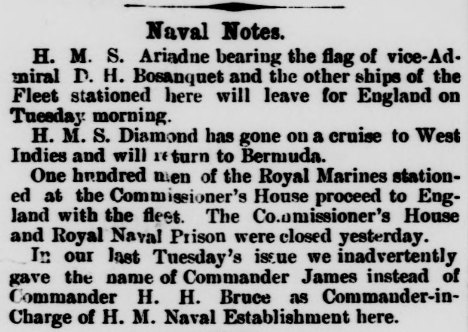
Royal Gazette Naval Notes: H.M.S. Ariadne bearing the flag of vice-Admiral D. H. Bosanquet and the other ships of the Fleet stationed here will leave for England on Tuesday morning; H.M.S. Diamond has gone on a cruise to West Indies and will return to Bermuda; one hundred men of the Royal Marines stationed at the Commissioner's House proceed to England with the fleet; the Commissioner's House and Royal Naval Prison were closed yesterday; a correction naming Commander H. H. Bruce as Commander-in-Charge of H.M. Naval Establishment
Royal Gazette, 1 April 1905: leaving for England

Al gives the date he expected to reach England, the 16th of April, and the Royal Gazette does the rest. By the middle of March 1905 most of the squadron had gone home. Charybdis sailed for England at the beginning of the month, and Isis and Highflyer followed on 8 March. On 14 March the paper listed the ships remaining as Ariadne, Diamond, Hawke, Gibraltar and St George. Diamond was to stay on the station permanently, and the others were expected to leave for England early in April.

On 1 April the Gazette reported that Ariadne, “bearing the flag of vice-Admiral D. H. Bosanquet”, and the other ships would leave for England on Tuesday morning, 4 April, and that one hundred Royal Marines from the Commissioner’s House would go with them. The Commissioner’s House and the Royal Naval Prison had closed on 31 March, two days after Al posted his card, and Diamond had gone off to the West Indies. So whoever Al was, he was almost certainly going home in one of the four ships that sailed that Tuesday.

They seem to have crossed together. Ariadne came into Plymouth from Portland on the afternoon of Tuesday 18 April, and Portland was where a squadron coming home usually anchored first. Sunday the 16th, Al’s date, fits a passage from Bermuda straight to Portland. After that they went their own ways: Ariadne into Devonport, her band playing “Home sweet home” as she passed the flagship, and Gibraltar to Portsmouth.

Why do I lean towards Ariadne? Mostly because of one line in the Naval & Military Record of 20 April:

“The Ariadne has brought home a number of supernumeraries”

Naval & Military Record, 20 April 1905

Supernumeraries were men carried as passengers rather than as part of the crew, which is just what the Marines from the Commissioner’s House, or a Dockyard man going home, would have been. If Al was one of them, Ariadne is the likeliest ship. But the other three had big crews of their own, and Al could just as easily have been a stoker in Hawke. I can’t prove it either way, so the page carries all four names until something better turns up.

March to April 1905

The ships on one side, the card on the other.

The ships
The card
Sun 5 Mar
The shipsAriadne and St George back at Bermuda from the West Indies.
14 Mar
The shipsGazette: Ariadne, Diamond, Hawke, Gibraltar and St George remain.
Wed 29 Mar
The cardPosted at Ireland Island: “Expecting to arrive England 16th Ap.”
Fri 31 Mar
The shipsCommissioner’s House and Royal Naval Prison closed.
Tue 4 Apr
The shipsAriadne, St George, Gibraltar and Hawke sail for England.
Sun 16 Apr
The cardThe day Al expected to arrive.
Tue 18 Apr
The shipsAriadne arrives at Plymouth from Portland.

The Ships

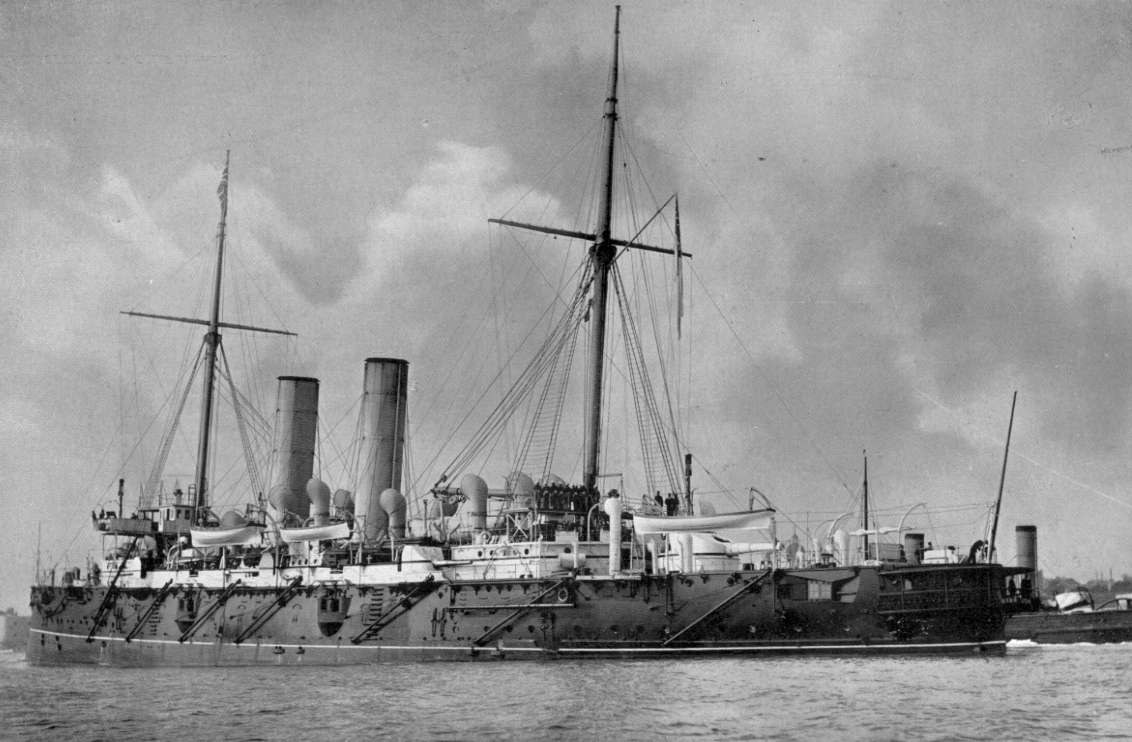
Black and white photograph of the cruiser Gibraltar at anchor, seen broadside from the port side: dark hull with a white line, white upperworks, two tall funnels between two masts with yards, ventilator cowls along the deck, boats slung in davits and men gathered amidships, under a cloudy sky

The four ships of April 1905

Ariadne was a Diadem-class protected cruiser, launched at Clydebank in 1898 and flagship of the North America and West Indies Station from 1902. Her own page tells more of her story. St George, Gibraltar and Hawke were Edgar-class protected cruisers, sister ships launched in 1891–92, and in 1905 they were seagoing training ships for boys in the Particular Service Squadron, which Ariadne led as flagship until Royal Arthur relieved her after the summer manoeuvres.

Hawke is best remembered for colliding with the liner Olympic in 1911. She was torpedoed by U-9 in the North Sea on 15 October 1914. Ariadne was sunk by UC-65 off Beachy Head in 1917, and St George and Gibraltar survived the war and were sold for breaking up in the early 1920s.

The photograph is of Gibraltar, which shows well what the three Edgar-class sisters looked like. There’s a photograph of Ariadne on her own page, and a painting of St George on hers.

SailedBermuda, Tuesday 4 April 1905
ShipsAriadne, St George, Gibraltar, Hawke
FlagVice-Admiral Day H. Bosanquet, in Ariadne
ArrivedPortland, mid-April; Ariadne at Plymouth 18 April

H.M.S. Gibraltar. Photographer and date not recorded. Via Wikimedia Commons.

Still to find out

If you can help with any of these, I’d be very pleased to hear from you.

References

I may be wrong about the ship, and I may never know who Al was. But someone sat down at Ireland Island, six days before the last of the squadron sailed for home, and sent a picture of a Bermuda hotel to a pub in Brighton to say he’d be back on the 16th. That’s enough for me, for now.