Ephemera · Royal Navy · Cadet Training Cruiser

H.M.S. Eclipse

Bermuda · Saturday 18 November 1905

A ship’s concert programme, drawn by hand and run off on board, from a cadet training cruiser wintering at Bermuda.

◆

This one isn’t a cover or a postcard. It’s the programme for a ship’s concert held on board H.M.S. Eclipse at Bermuda on Saturday 18 November 1905, and it’s the only thing I’ve ever seen relating to this ship. Someone on board drew it all by hand: the ship, the lettering, a little pile of cannonballs, a joke about the ship’s name. It was then run off in that purple ink, almost certainly on a hectograph or jelly copier, for the audience. I think it’s quite lovely, and I like that it was made for one evening and was never meant to last.

I

The programme

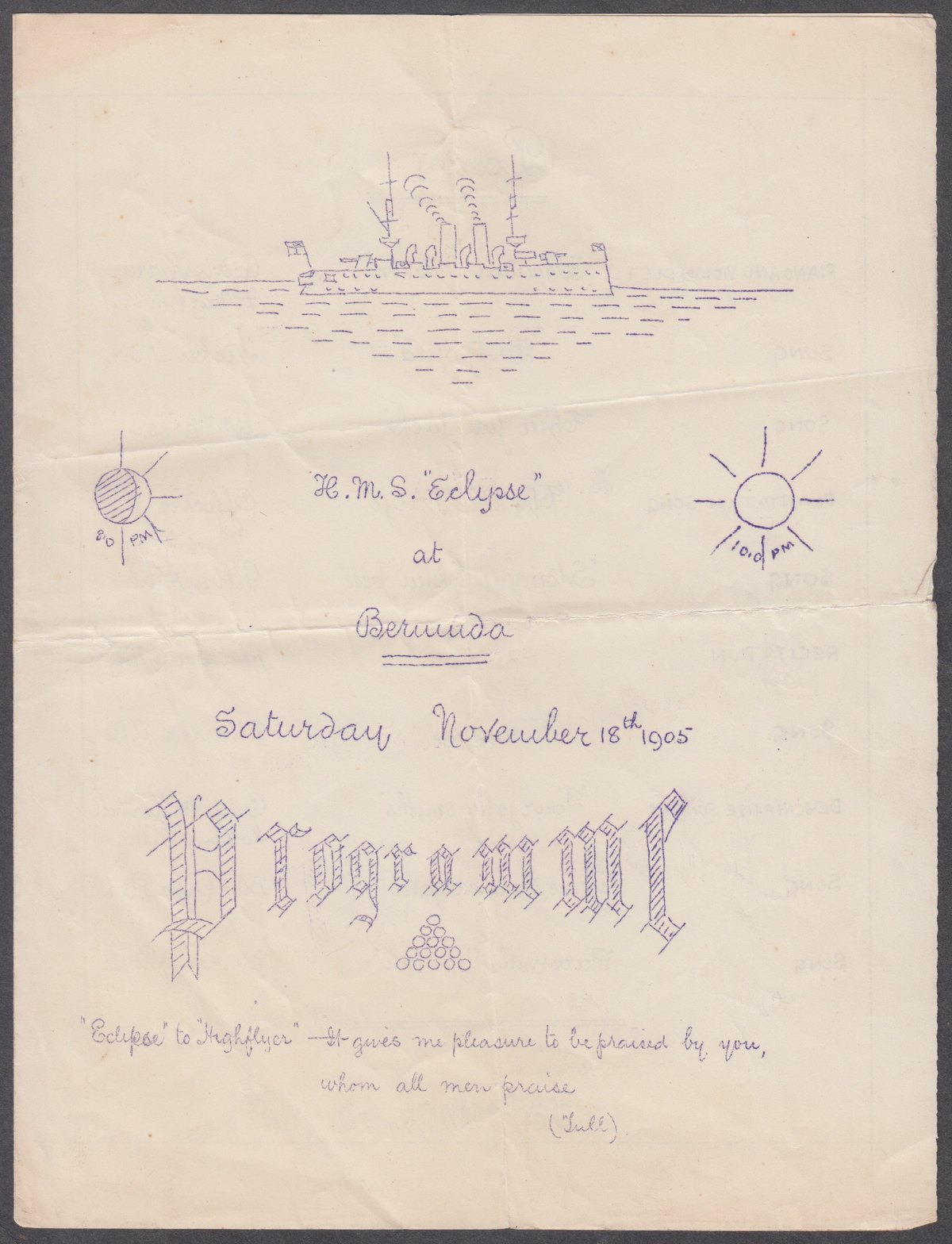
Front of the programme in purple hectograph ink: a drawing of the two-funnelled cruiser Eclipse under way above the words H.M.S. Eclipse at Bermuda, Saturday November 18th 1905, flanked by a half-shaded disc marked 8.0 PM and a rayed sun marked 10.0 PM, with a large Gothic Programme above a pyramid of cannonballs, and at the foot the line Eclipse to Highflyer, It gives me pleasure to be praised by you, whom all men praise (Tull)
The front
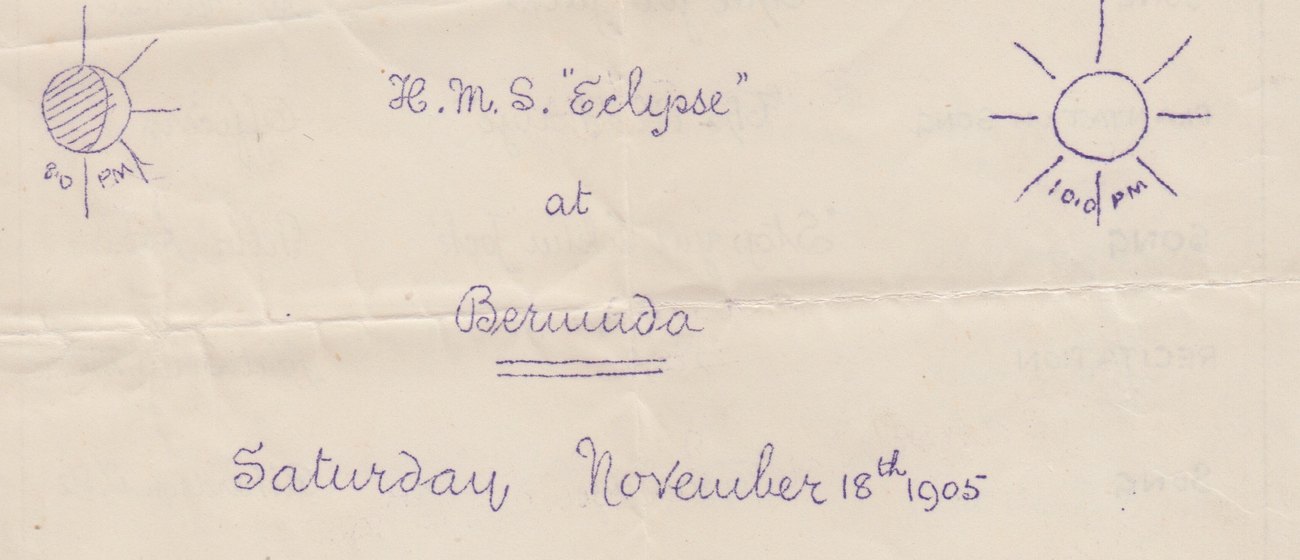
Close-up of the title: a half-shaded disc marked 8.0 PM on the left, H.M.S. Eclipse at Bermuda, Saturday November 18th 1905 in the centre, and a full sun with rays marked 10.0 PM on the right
In eclipse at 8 p.m., sunshine by 10
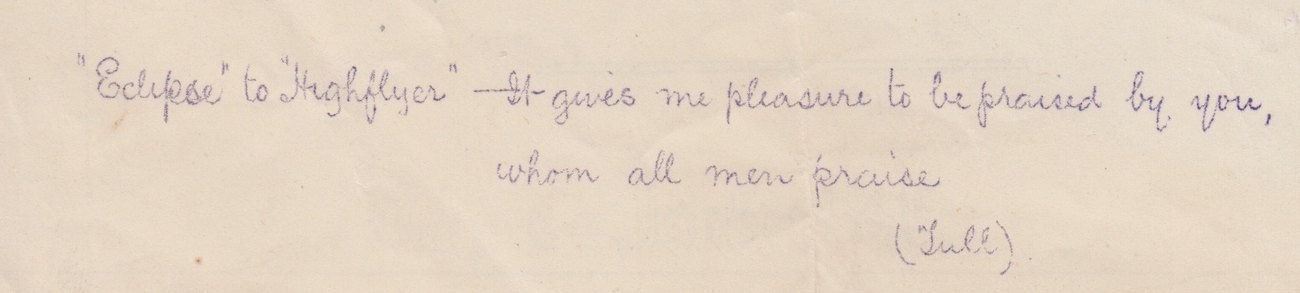
Close-up of the handwritten line: Eclipse to Highflyer, It gives me pleasure to be praised by you, whom all men praise (Tull)
“Eclipse” to “Highflyer”
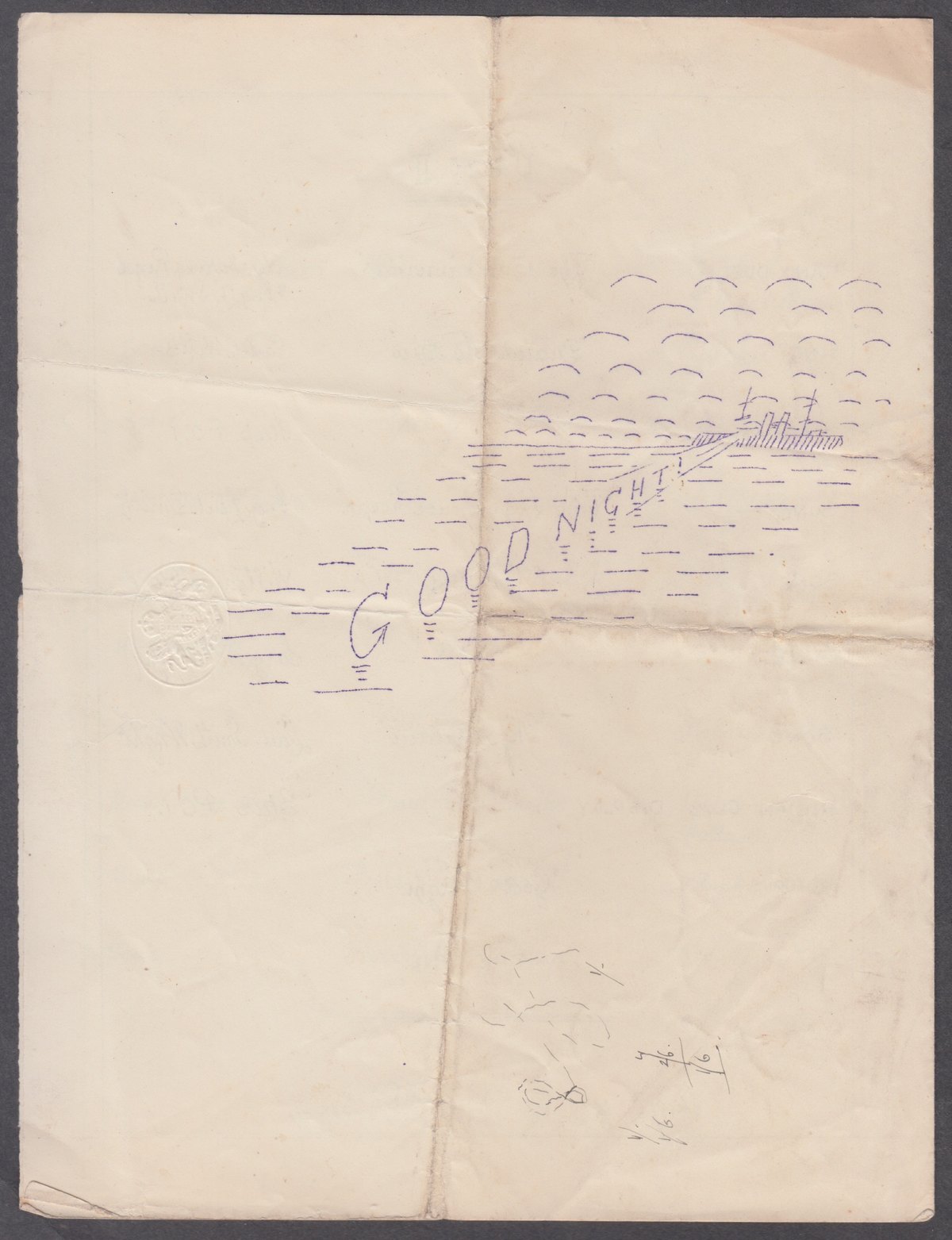
Back of the programme: the ship drawn small on the horizon under a sky of arcs, with GOOD NIGHT written in large letters on the water in her wake; an embossed oval of the Royal Arms at left
The back: “Good Night”
  • Item Concert programme, a single folded sheet of four pages
  • Printing Hand-drawn and lettered, reproduced in purple aniline ink, probably by hectograph
  • Date Saturday 18 November 1905, 8 to 10 p.m.
  • Place On board H.M.S. Eclipse, Bermuda
  • Paper Embossed with the Royal Arms in an oval

The front shows Eclipse under way, smoke trailing from her two funnels, above “H.M.S. ‘Eclipse’ at Bermuda, Saturday November 18th 1905” and a big Gothic “Programme” with a pile of cannonballs beneath. The artist got his own ship right: Eclipse had two funnels, where her consort Highflyer had three.

Either side of the title is the joke. On the left is a disc half in shadow, marked “8.0 PM”; on the right a full sun with its rays out, marked “10.0 PM”. The show starts in eclipse and ends in sunshine, and it also tells us the concert ran for two hours.

At the foot is a line headed “Eclipse” to “Highflyer”:

“It gives me pleasure to be praised by you, whom all men praise”(Tull.)

“Tull.” is Tully, the old English name for Cicero. In a letter to Cato he quoted Hector’s line from the poet Naevius, glad to be praised by a man who was himself praised. Highflyer was the senior of the two cadet cruisers at Bermuda that winter, so it looks as if she had paid Eclipse a compliment, and Eclipse answered in kind. I’d love to know what it was for. A month earlier Eclipse’s cadets had beaten Highflyer’s in their rowing race at the Trafalgar Centenary sports (see below), but that’s only a guess.

On the back the ship sails off into the night, small on the horizon, with “GOOD NIGHT” written on the water in her wake. The paper itself is embossed with the Royal Arms, the lion, unicorn and crown, in a small oval, probably the paper maker’s or stationer’s mark.
II

The concert

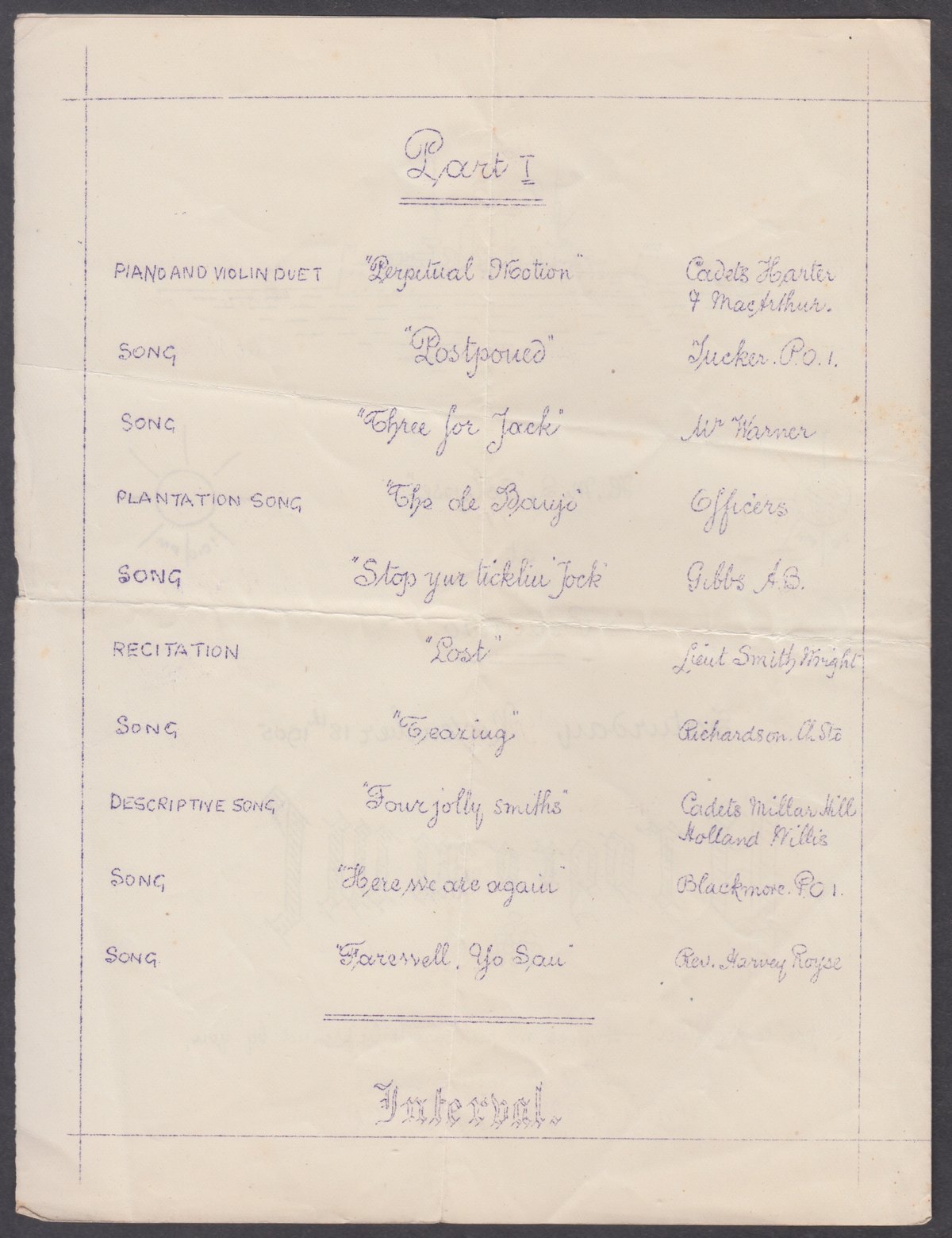
Inside left page headed Part I, listing ten turns with the type of turn, the title and the performer, ending with Interval in Gothic lettering
Part I
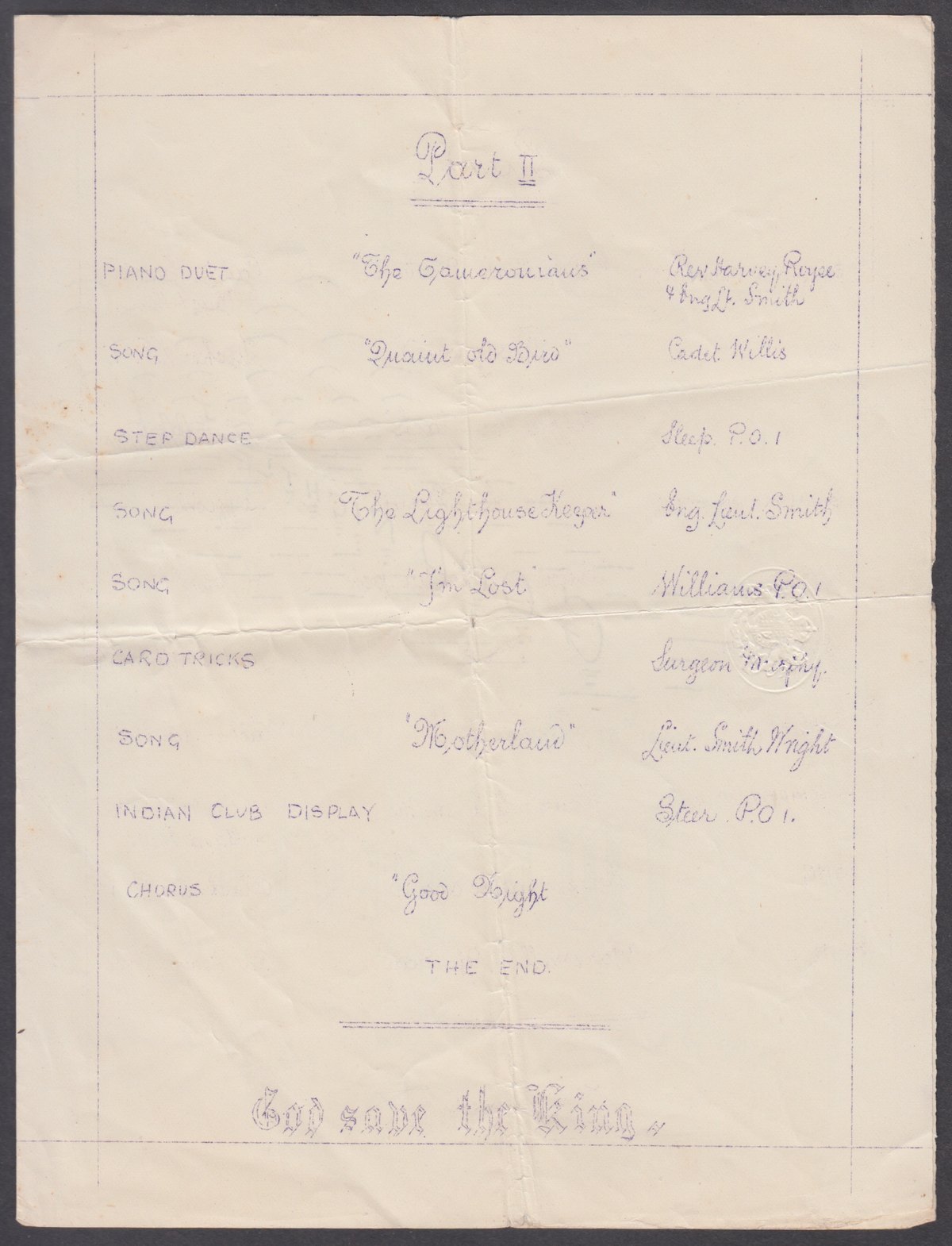
Inside right page headed Part II, listing nine turns ending with a chorus of Good Night, The End, and God save the King in Gothic lettering; the embossed Royal Arms overlaps Surgeon Murphy's name
Part II
  • Part I
  • Piano & violin “Perpetual Motion”: Cadets Harter & MacArthur
  • Song “Postponed”: Tucker, P.O.1
  • Song “Three for Jack”: Mr Warner
  • Plantation song “The ole Banjo”: Officers
  • Song “Stop yer ticklin’ Jock”: Gibbs, A.B.
  • Recitation “Lost”: Lieut. Smith-Wright
  • Song “Teasing”: Richardson, Ch. Sto.
  • Descriptive song “Four jolly smiths”: Cadets Millar, Hill, Holland & Willis
  • Song “Here we are again”: Blackmore, P.O.1
  • Song “Farewell, Yo San”: Rev. Harvey Royse
  • Interval
  • Part II
  • Piano duet “The Cameronians”: Rev. Harvey Royse & Eng. Lt. Smith
  • Song “Quaint old Bird”: Cadet Willis
  • Step dance Sleep, P.O.1
  • Song “The Lighthouse Keeper”: Eng. Lieut. Smith
  • Song “I’m Lost”: Williams, P.O.1
  • Card tricks Surgeon Murphy
  • Song “Motherland”: Lieut. Smith-Wright
  • Indian clubs Steer, P.O.1
  • Chorus “Good Night”. The End. God save the King

Inside are nineteen turns in two parts, with an interval, and the whole ship took part: cadets, petty officers, a chief stoker, an able seaman, the officers, the chaplain and the surgeon. The songs are the music-hall and drawing-room favourites of the day. “Stop yer ticklin’, Jock” was one of Harry Lauder’s hits of the time. There’s a plantation song from “Officers”, a step dance, card tricks from the surgeon, an Indian club display, and a chorus of “Good Night” before “God save the King”.

I like the mix of people. Cadet Willis sings “Quaint old Bird” on his own, after joining three other cadets for “Four jolly smiths”. The chaplain and the engineer lieutenant sit down together at the piano for “The Cameronians”. Chief Stoker Richardson sings “Teasing”, and Lieutenant Smith-Wright gives a recitation in the first half and a song in the second.

The chaplain’s turn wasn’t a hymn. “Farewell, Yo San” must be “Farewell, my little Yo-San”, a sentimental song that was brand new that winter; Henry Burr recorded it in New York around the turn of 1905–06. Yo-San was the princess heroine of The Darling of the Gods, Belasco and Long’s Japanese drama, a hit on Broadway in 1902 and in London the following year. Japan was very much in fashion after the war with Russia, and it’s nice to see the craze reached a cruiser’s concert at Bermuda.

The names are read from the programme as they’re written. The one I’m least sure of is Surgeon Murphy, as the embossed crest sits right on top of his name.

I’ve looked through the Royal Gazette for November 1905 and found no report of the concert. It was most likely held on board, for the ship’s company and their guests, and the paper didn’t always notice those.

III

Cadets at Bermuda

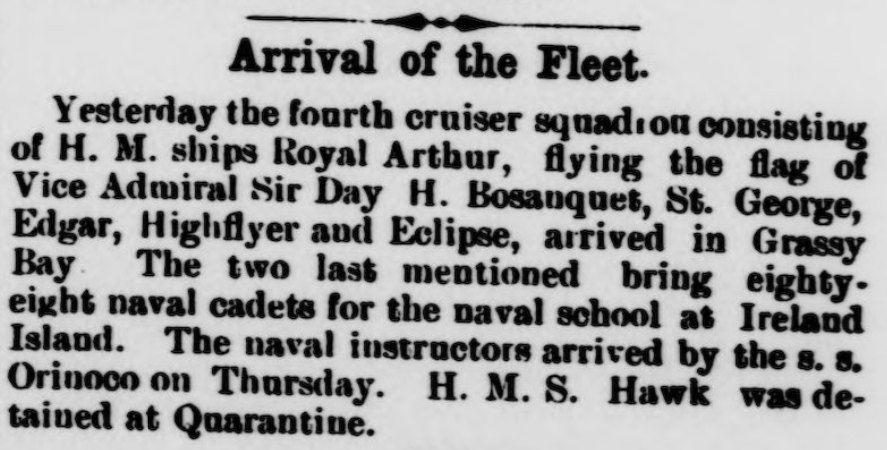
Royal Gazette report headed Arrival of the Fleet: yesterday the fourth cruiser squadron, consisting of H.M. ships Royal Arthur, flying the flag of Vice Admiral Sir Day H. Bosanquet, St. George, Edgar, Highflyer and Eclipse, arrived in Grassy Bay. The two last mentioned bring eighty-eight naval cadets for the naval school at Ireland Island. The naval instructors arrived by the s.s. Orinoco on Thursday. H.M.S. Hawk was detained at Quarantine.
Royal Gazette, 7 October 1905: eighty-eight cadets arrive
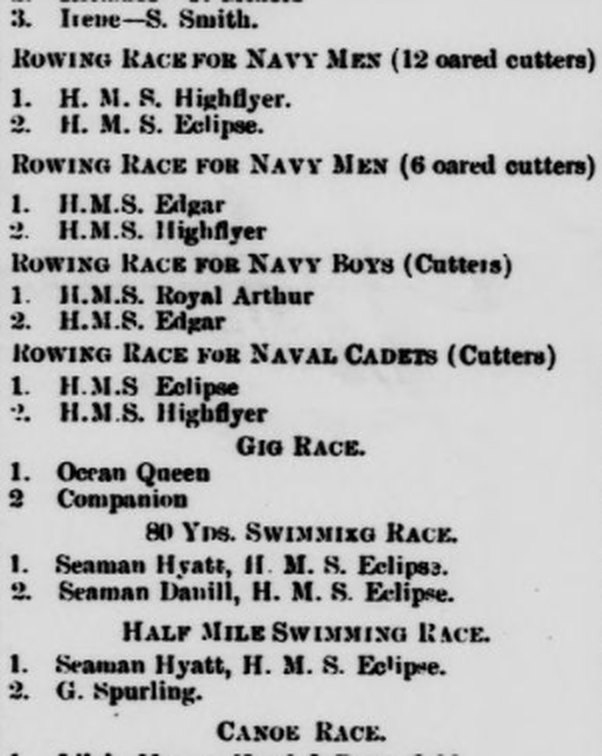
Part of the Trafalgar Centenary prize list: rowing race for navy men, 12 oared cutters, 1 HMS Highflyer, 2 HMS Eclipse; rowing race for naval cadets, cutters, 1 HMS Eclipse, 2 HMS Highflyer; 80 yards swimming race, 1 Seaman Hyatt, HMS Eclipse, 2 Seaman Danill, HMS Eclipse; half mile swimming race, 1 Seaman Hyatt, HMS Eclipse, 2 G. Spurling
Royal Gazette, 24 October 1905: the Trafalgar Centenary prize list
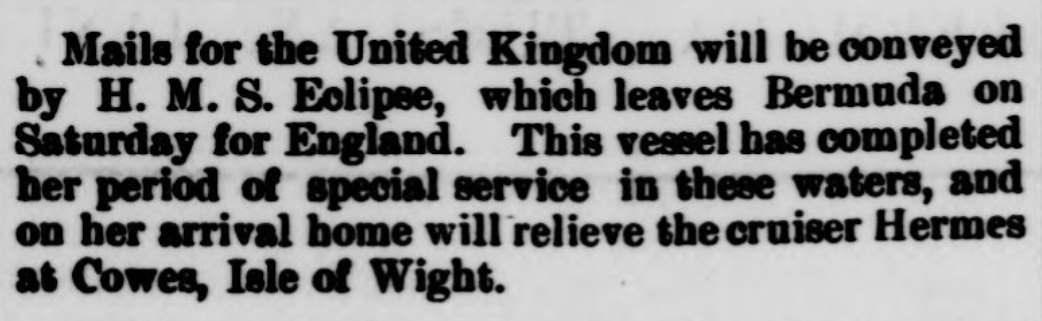
Royal Gazette: Mails for the United Kingdom will be conveyed by H.M.S. Eclipse, which leaves Bermuda on Saturday for England. This vessel has completed her period of special service in these waters, and on her arrival home will relieve the cruiser Hermes at Cowes, Isle of Wight.
Royal Gazette, 2 January 1906: home with the mails

In 1903 the Navy opened its new college for cadets at Osborne, and by 1905 the first of the Osborne boys were ready to move on to the new college at Dartmouth. That left the last of the cadets trained under the old system in the Britannia needing somewhere to go. On 17 April 1905 the Admiralty told the House of Commons that the remaining Britannia cadets would go to sea in two training cruisers to winter at Bermuda, one party for three months and the other for six. The two ships were Highflyer, already a cadet cruiser, and the newly assigned Eclipse, and Eclipse had the three-month party.

She arrived in Grassy Bay on Friday 6 October 1905 with the 4th Cruiser Squadron, Royal Arthur flying the flag of Vice-Admiral Sir Day Bosanquet, with St George, Edgar and Highflyer. The Gazette reported that Highflyer and Eclipse brought “eighty-eight naval cadets for the naval school at Ireland Island”, and that their instructors had come out on the Orinoco the day before. The Admiralty had been careful to say it wasn’t setting up a school at Bermuda, so I don’t know how much of the teaching was done ashore and how much on board.

They soon joined in island life. On Saturday 21 October Bermuda celebrated the centenary of Trafalgar with sports at Hamilton, and Lieutenant Lyon of the Highflyer sat on the committee for both ships. Eclipse did well. Her seamen came second to Highflyer’s in the twelve-oared cutters, but her cadets beat Highflyer’s in the rowing race for naval cadets, and Seaman Hyatt of Eclipse won both the 80 yards and the half-mile swimming races.

The concert came four weeks later. On Saturday 6 January 1906 Eclipse sailed for England, her “period of special service in these waters” complete, and she took the mails for the United Kingdom with her; they closed at the Post Office in Hamilton at 2 p.m. the day before. I’d love to find a cover that went home in her. Highflyer stayed on with her own cadets until the spring.

One of Eclipse’s cadets, Lewis John Pitcairn-Jones, kept a log on board from September to December 1905, and it’s now at the National Maritime Museum. It must cover the night of the concert. On this site the cadet frigate Bristol was at Bermuda in 1869 and the cadet cruiser Cornwall in 1912, and Eclipse sits neatly between them.

Three months at Bermuda

The ship on one side, the cadets and the concert on the other.

The ship
The cadets
17 Apr 1905
The planThe Admiralty tells the Commons the last Britannia cadets will winter at Bermuda in two cruisers.
6 Oct
EclipseArrives in Grassy Bay with the 4th Cruiser Squadron and Highflyer.
The cadetsEighty-eight cadets between the two ships.
21 Oct
Trafalgar CentenaryEclipse’s cadets win their rowing race; Seaman Hyatt wins both swims.
18 Nov
The concertOn board Eclipse, 8 to 10 p.m.
5 Jan 1906
The mailsMails for the United Kingdom by Eclipse close at Hamilton at 2 p.m.
6 Jan
EclipseSails for England with Fantome, to relieve Hermes at Cowes.
The cadetsHome after three months.

The Ship

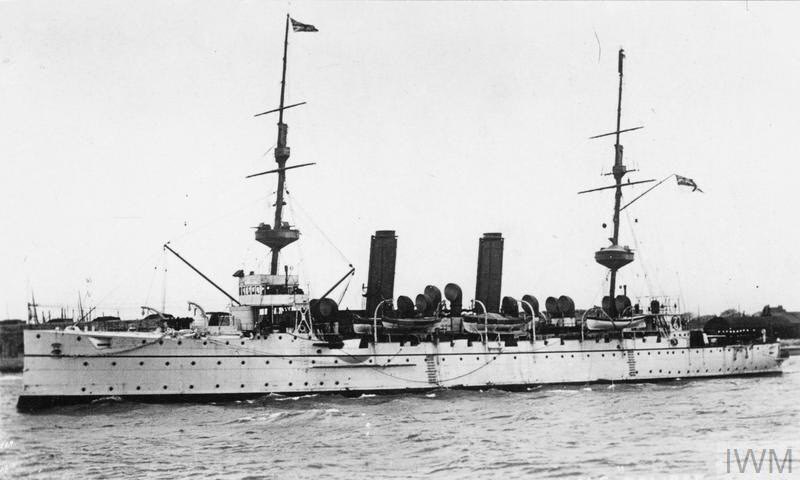
Photograph of the cruiser HMS Eclipse from the port side, painted grey, with two tall funnels, two masts with fighting tops, and a row of ventilator cowls and boats amidships

H.M.S. Eclipse

Eclipse was the name ship of a class of nine second-class protected cruisers. She was laid down at Portsmouth Dockyard in December 1893, launched on 19 July 1894 and completed in March 1897. She was flagship of the East Indies Squadron in 1899, and in 1901 went out to the China Station to relieve Hermione. In the autumn of 1905 she became a cadet training cruiser and spent three months at Bermuda.

In the First World War she served with the 12th Cruiser Squadron in the western Channel, stopping suspicious ships and guarding the cross-Channel traffic, and in 1916 she became a submarine depot ship. She was sold for scrap in August 1921.

The photograph isn’t dated, but she’s in grey, so it was probably taken after 1902, when the Victorian black hulls went out of use. That’s much as the cadets would have known her.

BuiltPortsmouth Dockyard, launched 19 July 1894
TypeSecond-class protected cruiser, Eclipse class
Displacement5,600 tons
Crew450
At Bermuda6 October 1905 – 6 January 1906
FateSold for scrap, August 1921

Imperial War Museums (Q 75393). Photographer and date not recorded.

Still to find out

If you can help with any of these, I’d be very pleased to hear from you.

References

It’s a single sheet, folded once, made for one evening. But it caught a cruiser full of cadets at Bermuda having a good time, and it’s the only thing of hers I’ve ever found.