Postal History · Training Cruise & Cruiser Squadron · Bermuda Station

H.M.S. Cornwall

Bermuda · Halifax · Gibraltar · 1912–1913

A letter, a run of postcards and one very busy card that between them follow one cruiser from Bermuda to Halifax and Gibraltar, and back to Bermuda again.

◆

I have always enjoyed correspondence that lets you follow the movements of a particular ship, especially when several pieces survive together and start to tell a story. In this case I had built up a small group of Bermuda material relating to HMS Cornwall without really appreciating how well it all fitted together. It was only when I started researching a rather interesting postcard from October 1913 that I went back through my notes, rediscovered the earlier material and realised there was a much bigger story to tell.

I

“We are having a very enjoyable time here”

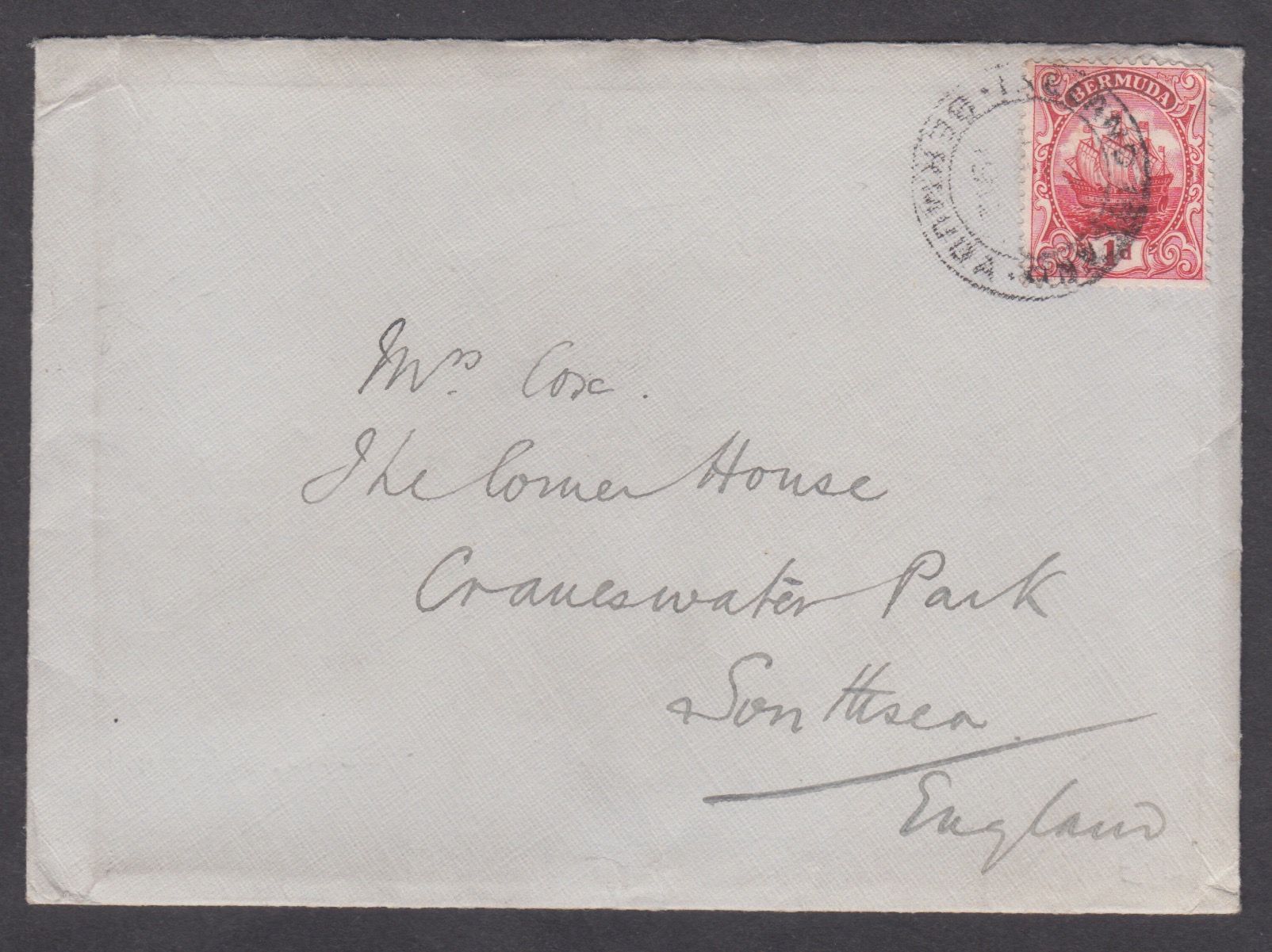
Cover addressed to Mrs Cox, The Corner House, Craneswater Park, Southsea, England, franked with a Bermuda 1d caravel stamp
Ralph Cox to his mother at Southsea
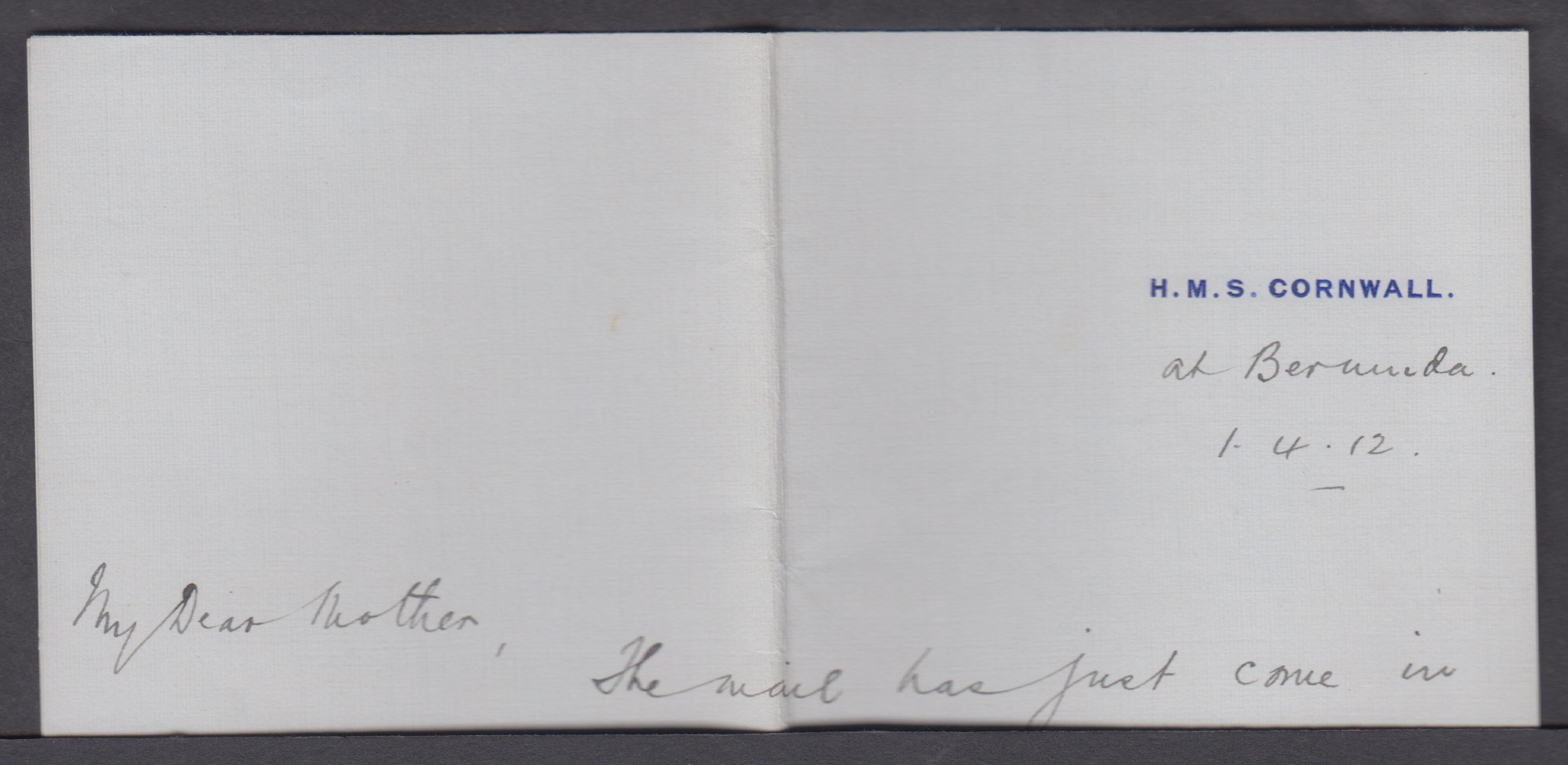
Letter on embossed H.M.S. Cornwall stationery, headed at Bermuda, 1.4.12, beginning My Dear Mother, The mail has just come in
H.M.S. Cornwall stationery, headed “at Bermuda, 1.4.12”
  • Written aboard H.M.S. Cornwall, at Bermuda
  • Dated 1 April 1912
  • Writer Ralph Cox, to his mother
  • Addressed to Mrs Cox, The Corner House, Craneswater Park, Southsea

Cornwall arrived at Bermuda on 22 March 1912, described by the Royal Gazette as a “cadet training ship”. She went to Grassy Bay and tied up alongside the old coal hulk Shah. It wasn’t a brief call. She stayed several weeks, and her cadets and crew became involved in local sporting and social life.

The earliest item in my group is a cover and letter dated 1 April 1912, written on embossed HMS Cornwall stationery and headed “at Bermuda”. Ralph Cox wrote it to his mother, Mrs Cox, at The Corner House, Craneswater Park, Southsea. I was later able to confirm the address in a contemporary Hampshire directory.

The letter gives a first-hand glimpse of life aboard during the training cruise:

“We are having a very enjoyable time here, plenty of golf, hockey, tennis and cricket. Quite handy, but we are feeling the cold after the tropics.”

“The tropics” fits nicely with Cornwall having come up through the West Indies. Ralph also comments on how much easier the mail had become, “only five days mail” from Halifax, and mentions that “one of our cadets was operated on for appendicitis on Saturday night”. That “our cadets”, together with the stationery and his later return to Devonport, leaves little doubt he was serving aboard.

Then it becomes personal. He asks his mother not to worry about Kathleen, who is “coming across with friends” and will join him at Devonport when he returns. He also asks her to have some money she’d promised him in connection with his marriage paid into his account at the Chatham branch of the London County & Westminster Bank.

“Ernest is remaining on the Renown another year” points to a possible brother, Staff-Paymaster James Ernest Courtney Cox, R.N., who was promoted Fleet Paymaster a month later. Ralph himself may be the Ralph D. Cox, R.N., of contemporary naval records. I haven’t found the final piece of evidence for either, so both remain probable rather than certain.

My favourite passage comes near the end:

“Have you got all the postcards I have sent you from the various places? And will you please ask Granny if she has got hers, as I have sent from every place…”

When I first read that I smiled, because the next group in my collection is exactly that: a run of Bermuda picture postcards carried aboard Cornwall and posted as she went from port to port.
II

Following Cornwall to Halifax and Gibraltar

  • Correspondence eight Bermuda picture postcards, 1912–1913
  • Written by a member of Cornwall’s ship’s company, signing “Dad” or “Uncle”
  • Addressed to 89 Somerset Road, Knowle, Bristol: his son Horace Rea (“Holl”) and his niece Ida Wheeler
  • Sent from Bermuda (2), Halifax (3), Gibraltar (3)
  • Franking Bermuda 1d ship type; Canada 1c pair; Gibraltar 1d

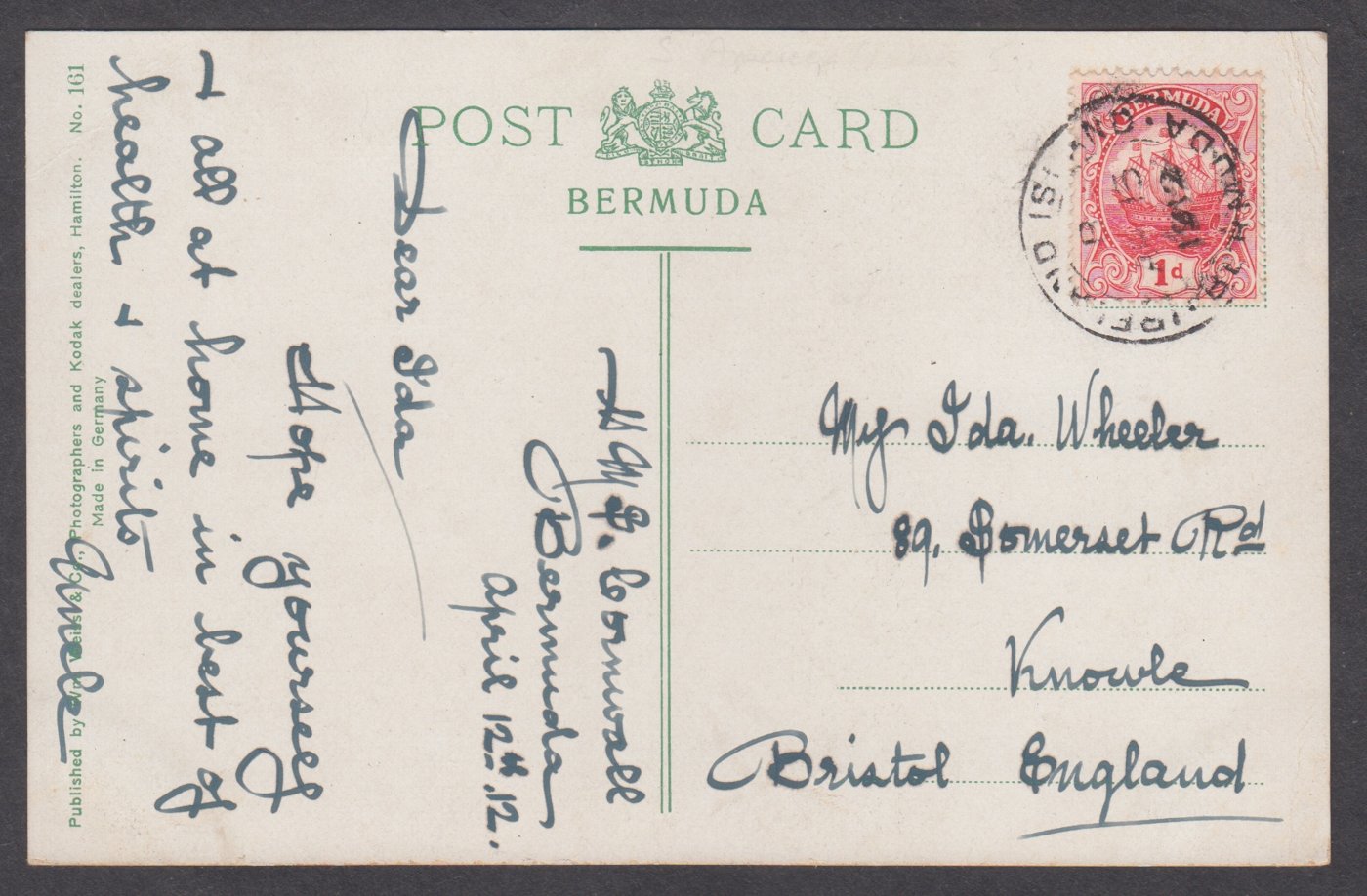
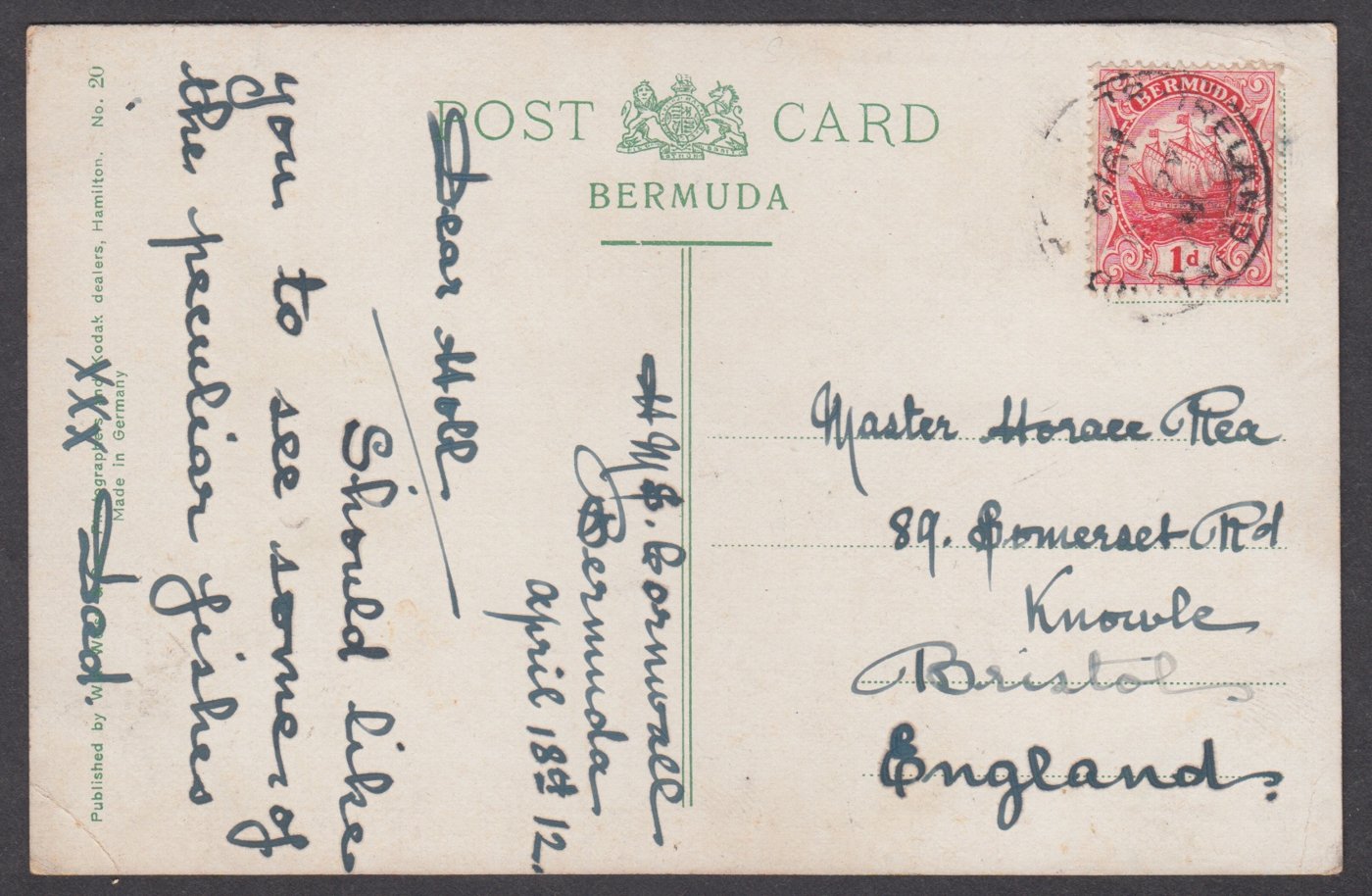
This is a correspondence of eight Bermuda picture postcards, written by a member of Cornwall’s ship’s company in 1912 and 1913. All eight went to 89 Somerset Road, Knowle, Bristol: two to his niece Ida Wheeler and six to his son Horace Rea, whom he calls “Holl”. He signs himself simply “Dad” or “Uncle”, and I have yet to identify him.

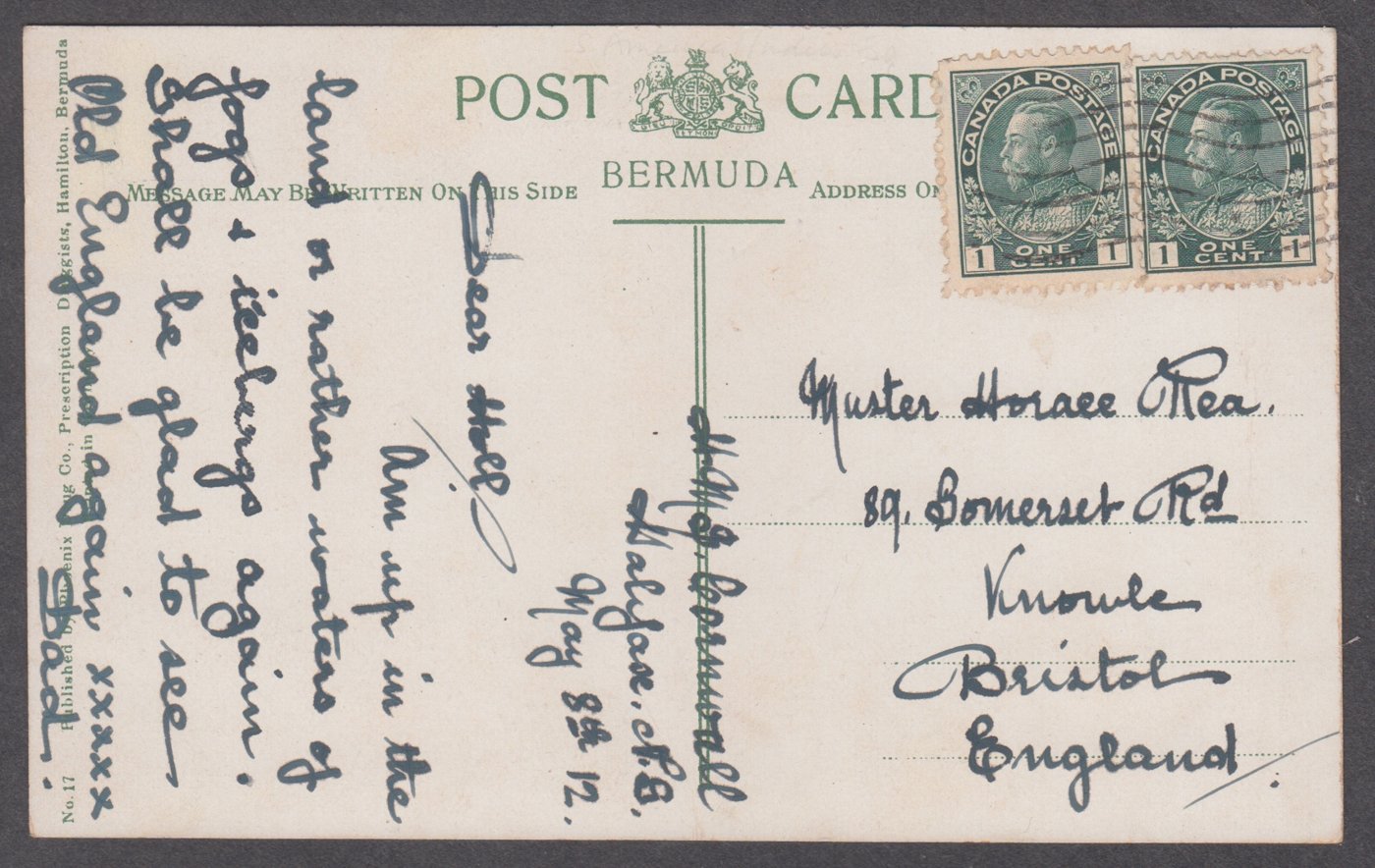
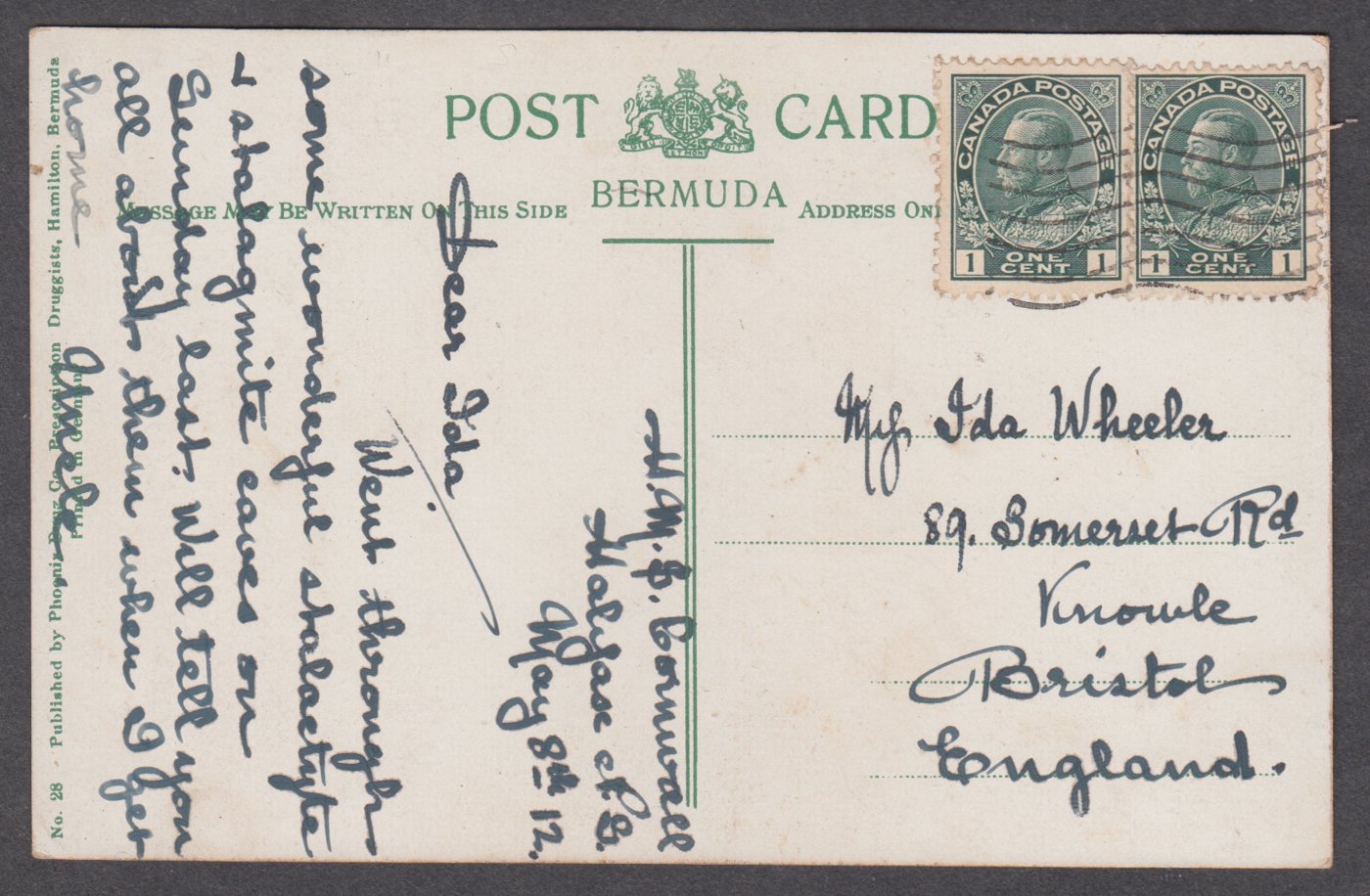
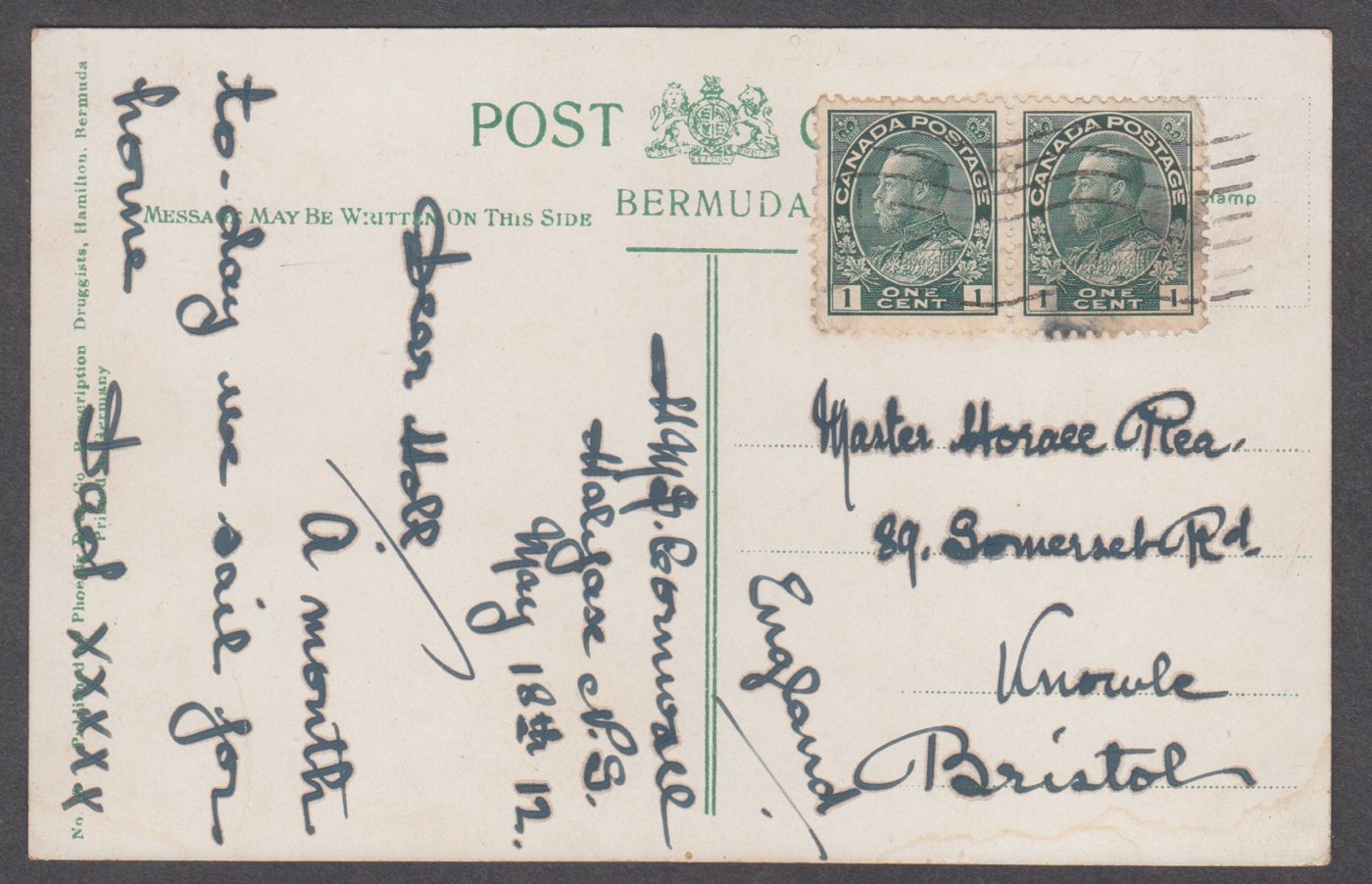
Every card is a Bermuda view, but only the first two were posted in Bermuda. He took the rest with him and wrote them at Halifax and Gibraltar, and you can follow him by the stamps. The two Bermuda cards carry the 1d ship type, cancelled at Ireland Island. The three from Halifax each have a pair of Canadian 1 cent stamps. The last three have the Gibraltar 1d. Each card paid the postcard rate to Britain from wherever he happened to be.

From Halifax on 8 May he told Ida about “wonderful stalagmite and stalactite caves” he had been through the Sunday before. That Sunday was 5 May, three days after Cornwall returned to Grassy Bay, so the caves were almost certainly Bermuda’s, and most likely the recently opened Crystal Cave.

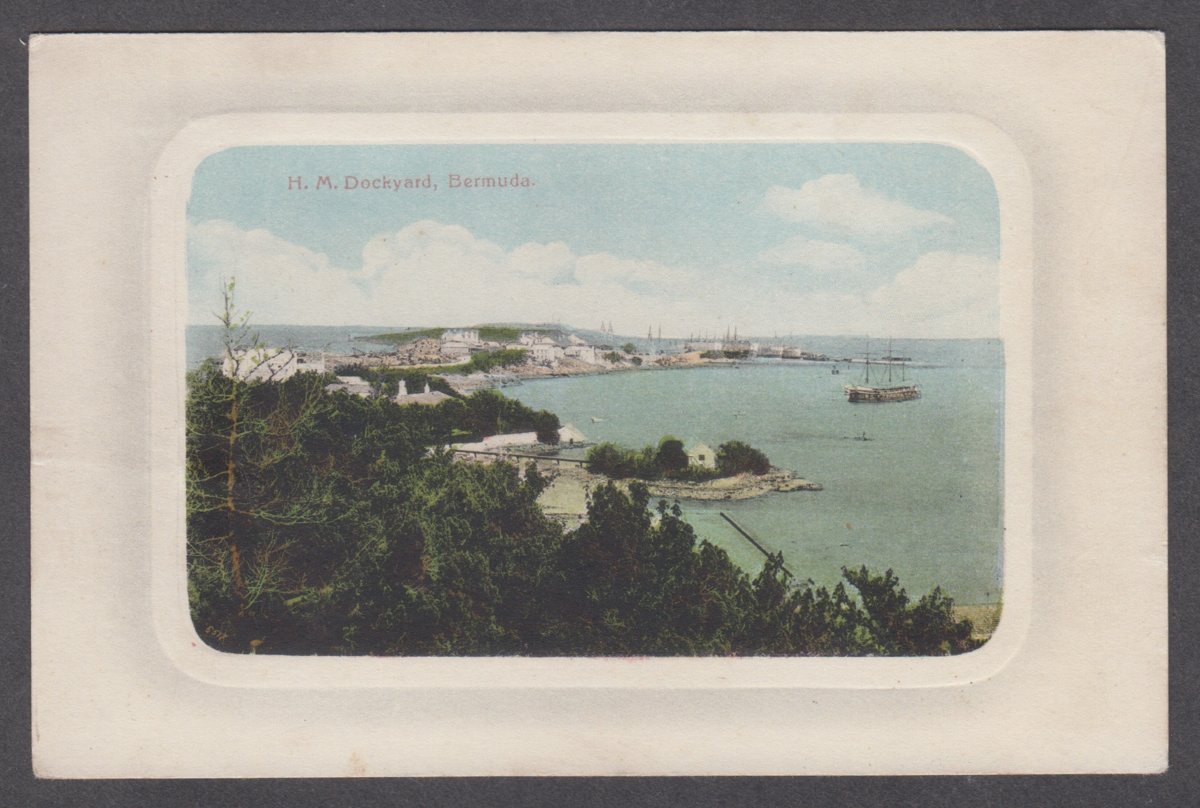
Then nothing for more than eight months, until three more cards turn up at Gibraltar in early 1913, still Bermuda views. The first is the H.M. Dockyard card of 30 January:

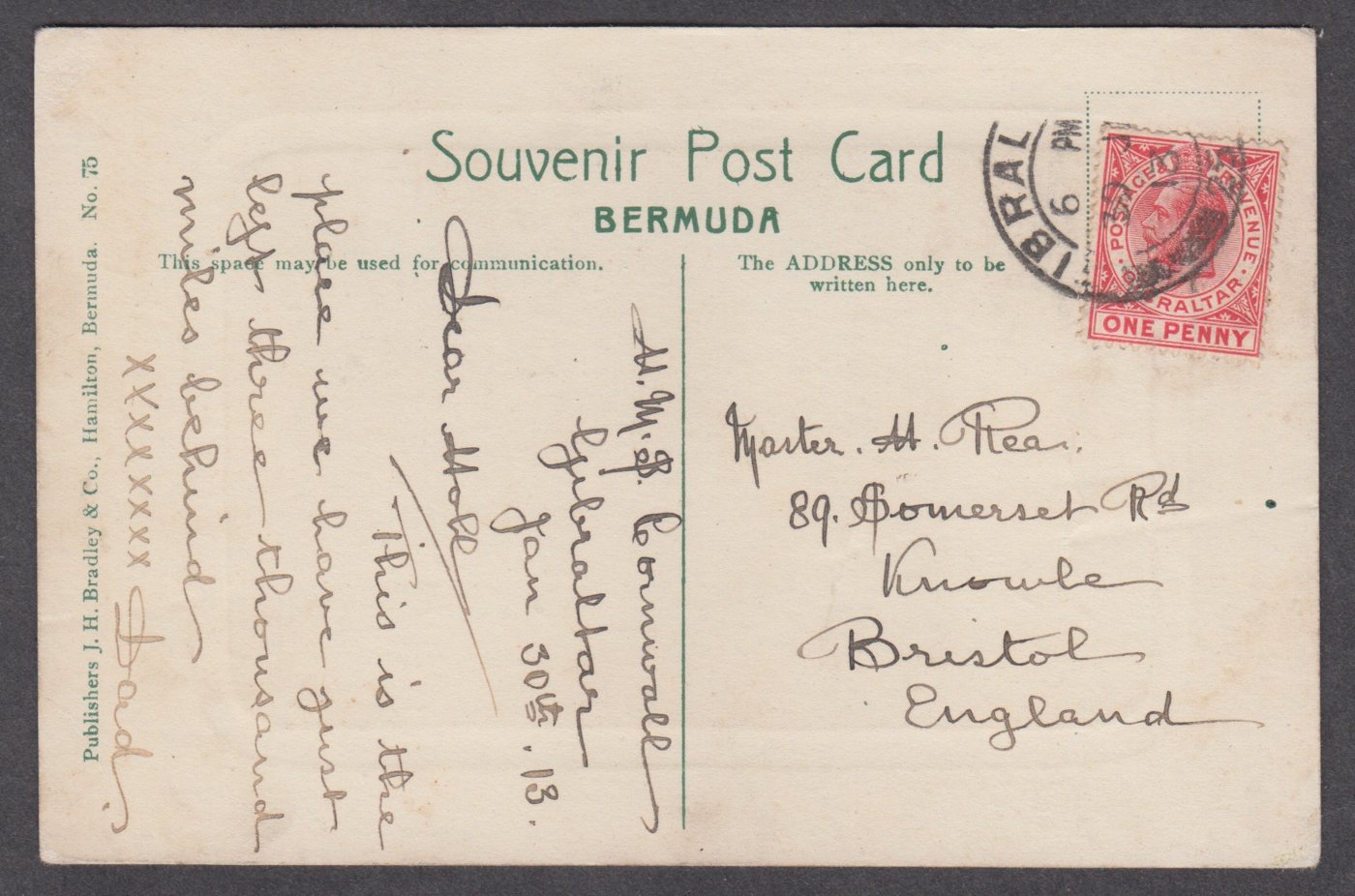
“Dear Holl, this is the place we have just left, three thousand miles behind. Dad.”

That short message is particularly useful. It tells us Cornwall had been at Bermuda again, quite separately from her 1912 stay.

There’s something rather appealing about him carrying his Bermuda cards with him. Almost a year after the first ones were written, the island was still travelling with him.

Message side to Miss Ida Wheeler, written H.M.S. Cornwall, Bermuda, April 12th 12, with a Bermuda 1d ship type stamp and Ireland Island datestamp
1 · Bermuda, 12 April 1912, to Ida. “Hope yourself & all at home in best of health & spirits.”
Message side to Master Horace Rea, written H.M.S. Cornwall, Bermuda, April 18th 12, with a Bermuda 1d ship type stamp and Ireland Island datestamp
2 · Bermuda, 18 April 1912, to Holl. “Should like you to see some of the peculiar fishes.”
Message side to Master Horace Rea, written H.M.S. Cornwall, Halifax N.S., May 8th 12, franked with a pair of Canada 1 cent stamps
3 · Halifax, 8 May 1912, to Holl. “Am up in the land, or rather waters, of fogs & icebergs again. Shall be glad to see Old England again.”
Message side to Miss Ida Wheeler, written H.M.S. Cornwall, Halifax N.S., May 8th 12, franked with a pair of Canada 1 cent stamps
4 · Halifax, 8 May 1912, to Ida. “Went through some wonderful stalagmite & stalactite caves on Sunday last.”
Message side to Master Horace Rea, written H.M.S. Cornwall, Halifax N.S., May 18th 12, franked with a pair of Canada 1 cent stamps
5 · Halifax, 18 May 1912, to Holl. “A month to-day we sail for home.”
Message side to Master H. Rea, written H.M.S. Cornwall, Gibraltar, Jan 30th 13, franked with a Gibraltar one penny stamp
6 · Gibraltar, 30 January 1913, to Holl. “This is the place we have just left…”
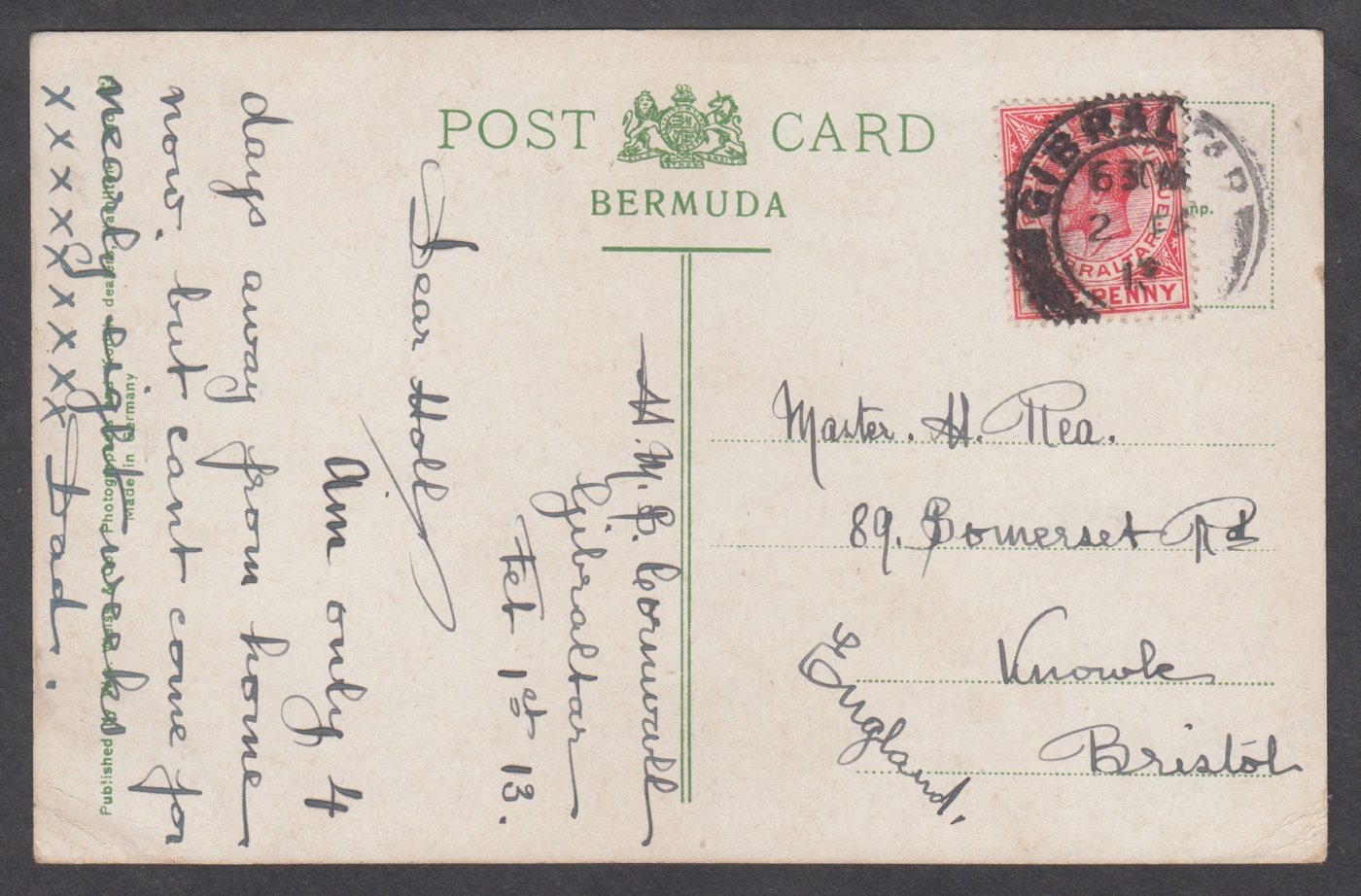
Message side to Master H. Rea, written H.M.S. Cornwall, Gibraltar, Feb 1st 13, franked with a Gibraltar one penny stamp
7 · Gibraltar, 1 February 1913, to Holl. “Am only 4 days away from home now, but can’t come for nearly eight weeks.”
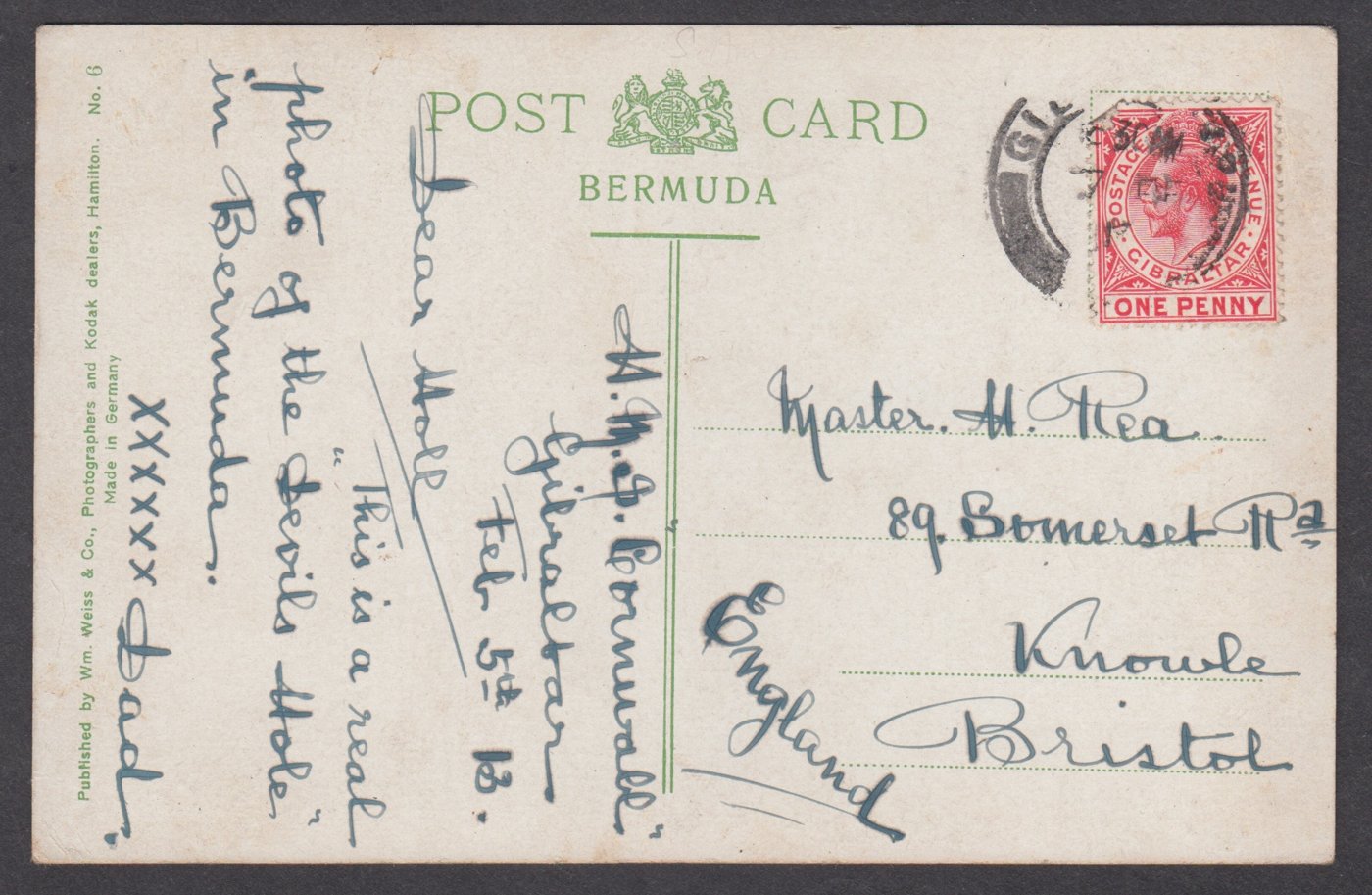
Message side to Master H. Rea, written H.M.S. Cornwall, Gibraltar, Feb 5th 13, franked with a Gibraltar one penny stamp
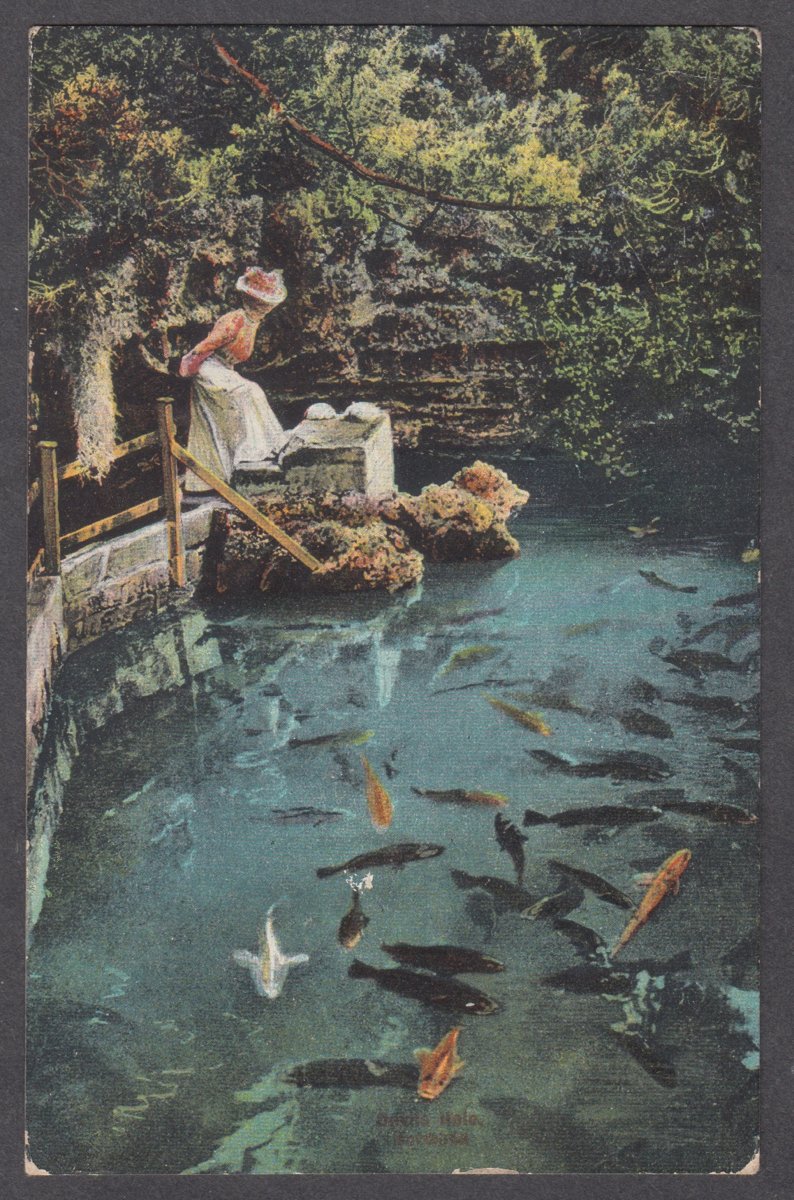
8 · Gibraltar, 5 February 1913, to Holl. “This is a real photo of the Devils Hole in Bermuda.”

The picture sides

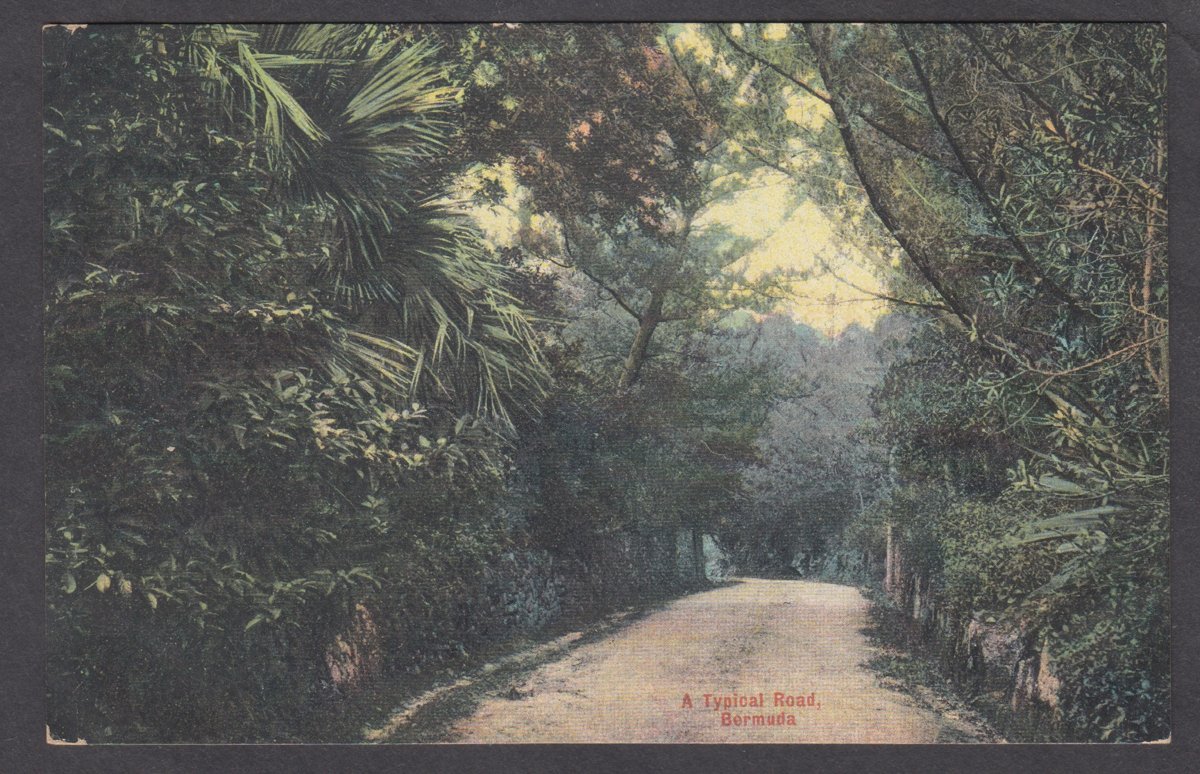
Bermuda picture postcard: A Typical Road
1 · A Typical Road
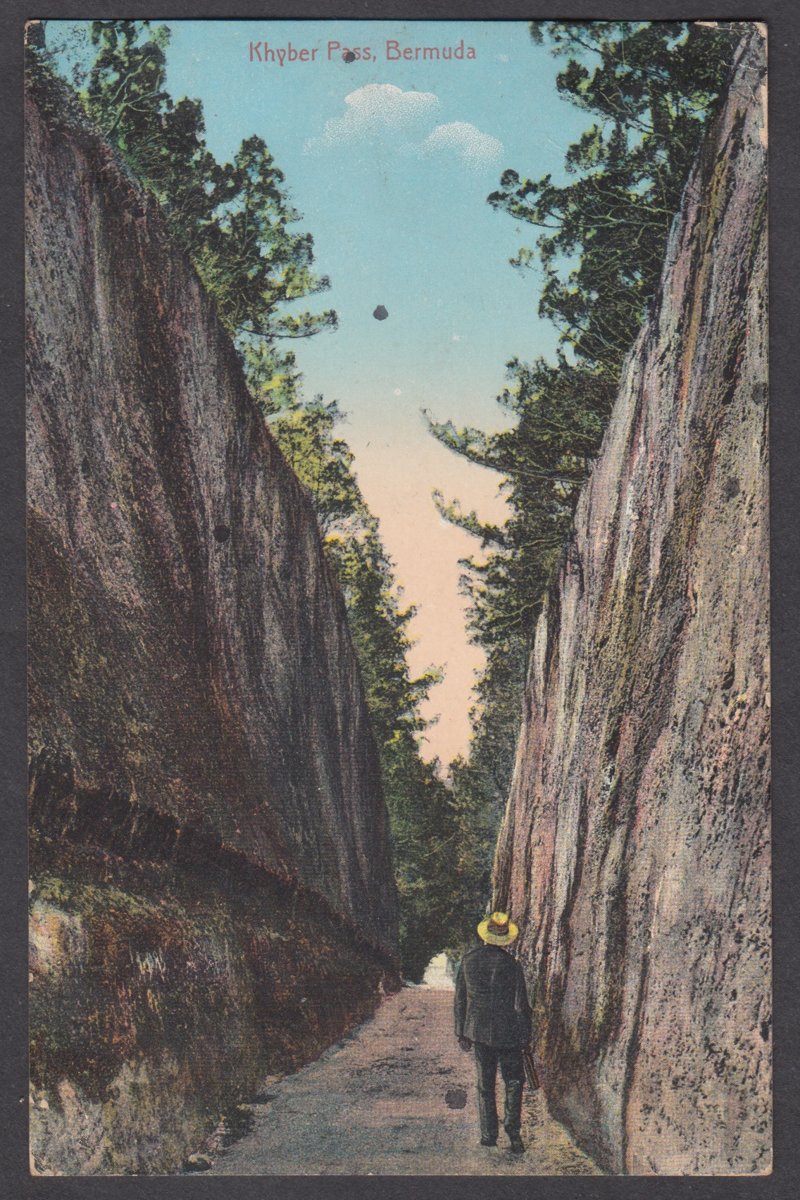
Bermuda picture postcard: Khyber Pass
2 · Khyber Pass
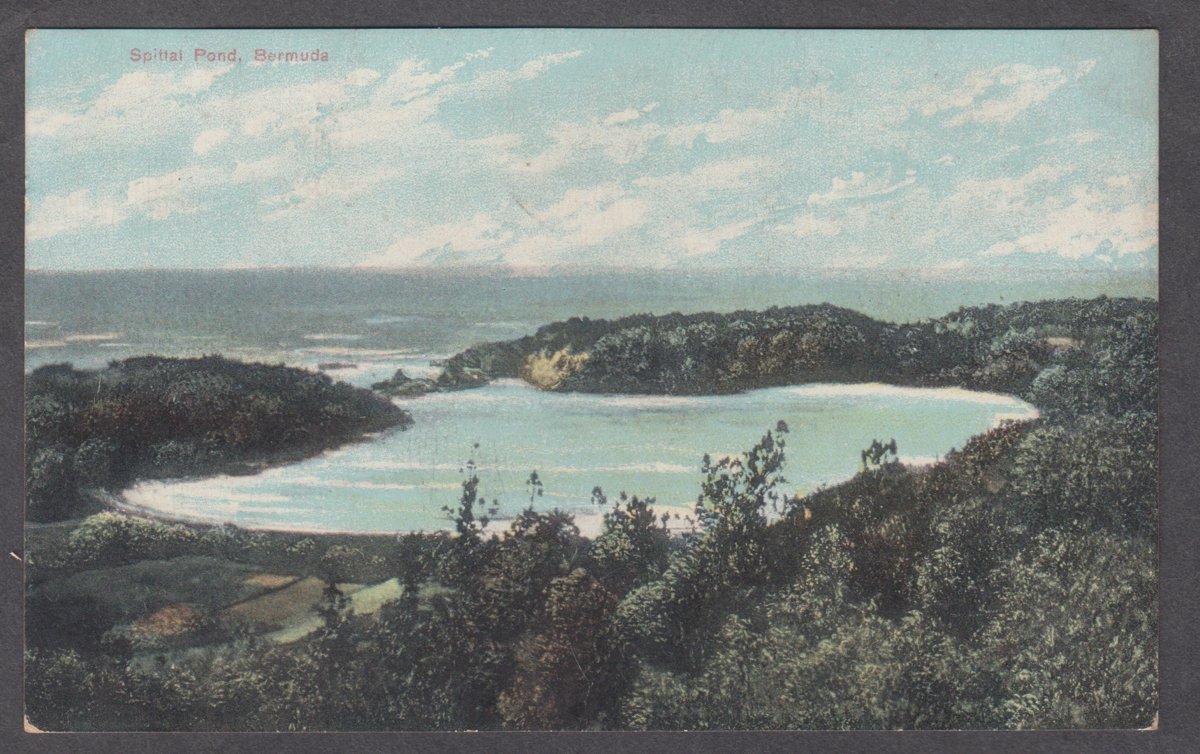
Bermuda picture postcard: Spittal Pond
3 · Spittal Pond
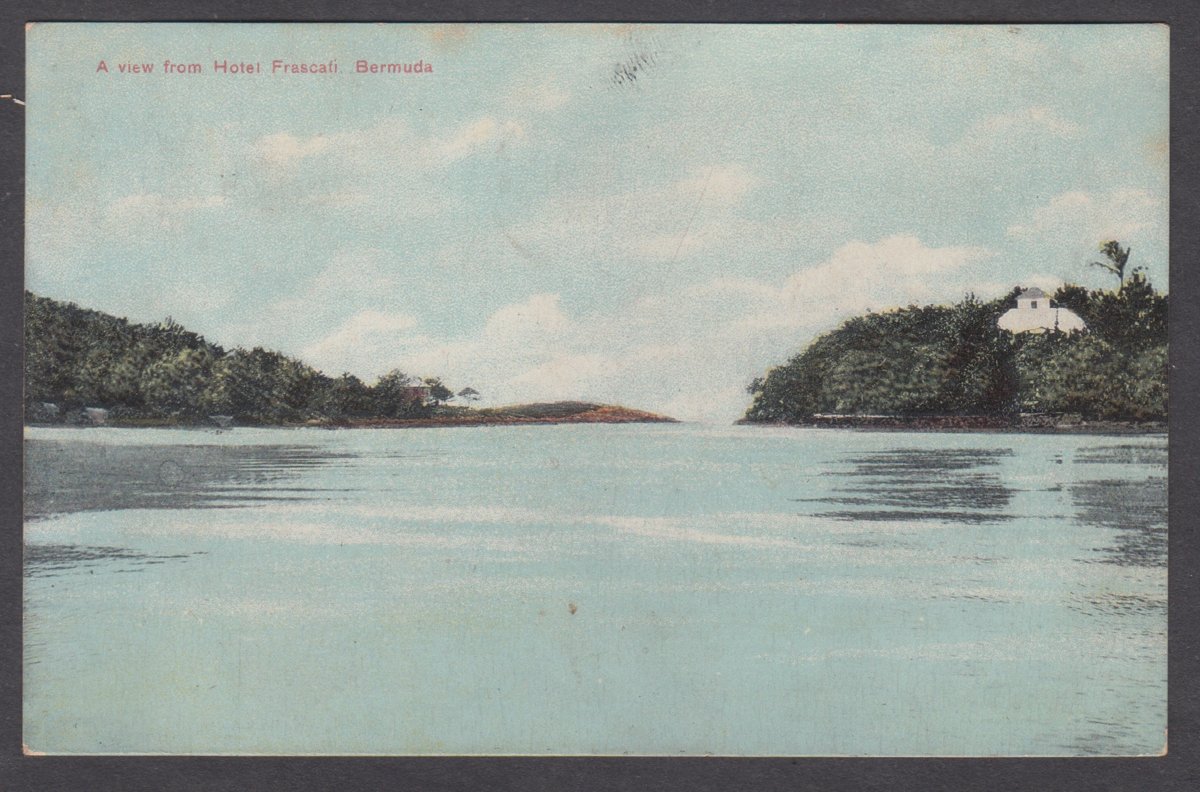
Bermuda picture postcard: A View from Hotel Frascati
4 · A View from Hotel Frascati
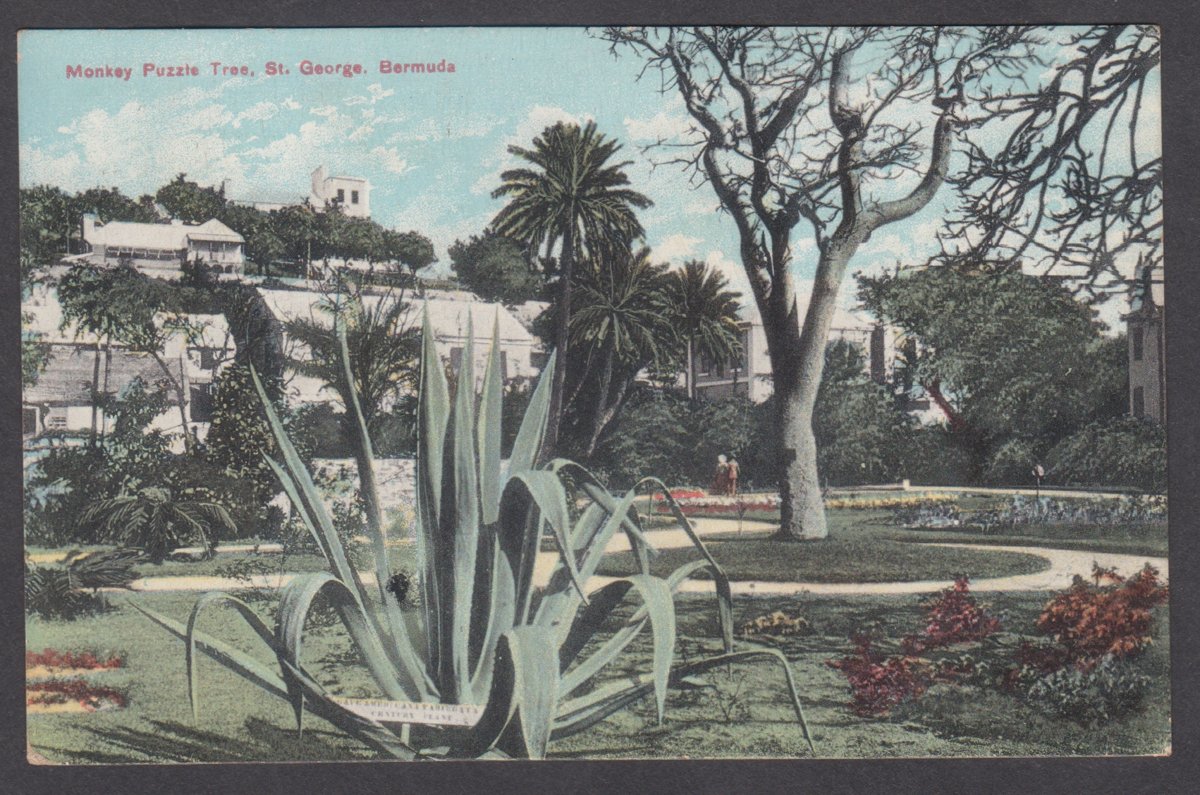
Bermuda picture postcard: Monkey Puzzle Tree, St George's
5 · Monkey Puzzle Tree, St George’s
Bermuda picture postcard: H.M. Dockyard
6 · H.M. Dockyard
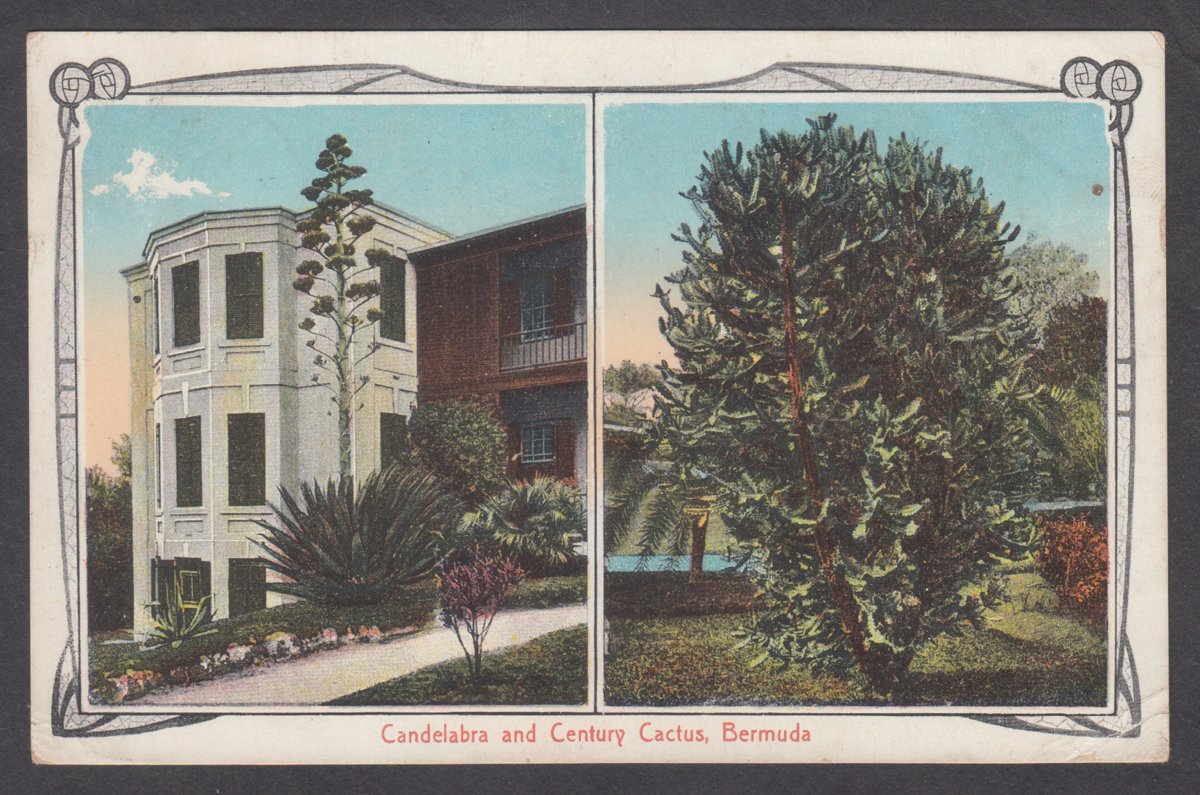
Bermuda picture postcard: Candelabra and Century Cactus
7 · Candelabra and Century Cactus
Bermuda picture postcard: Devil's Hole
8 · Devil’s Hole
III

“The Cornwall is in again”

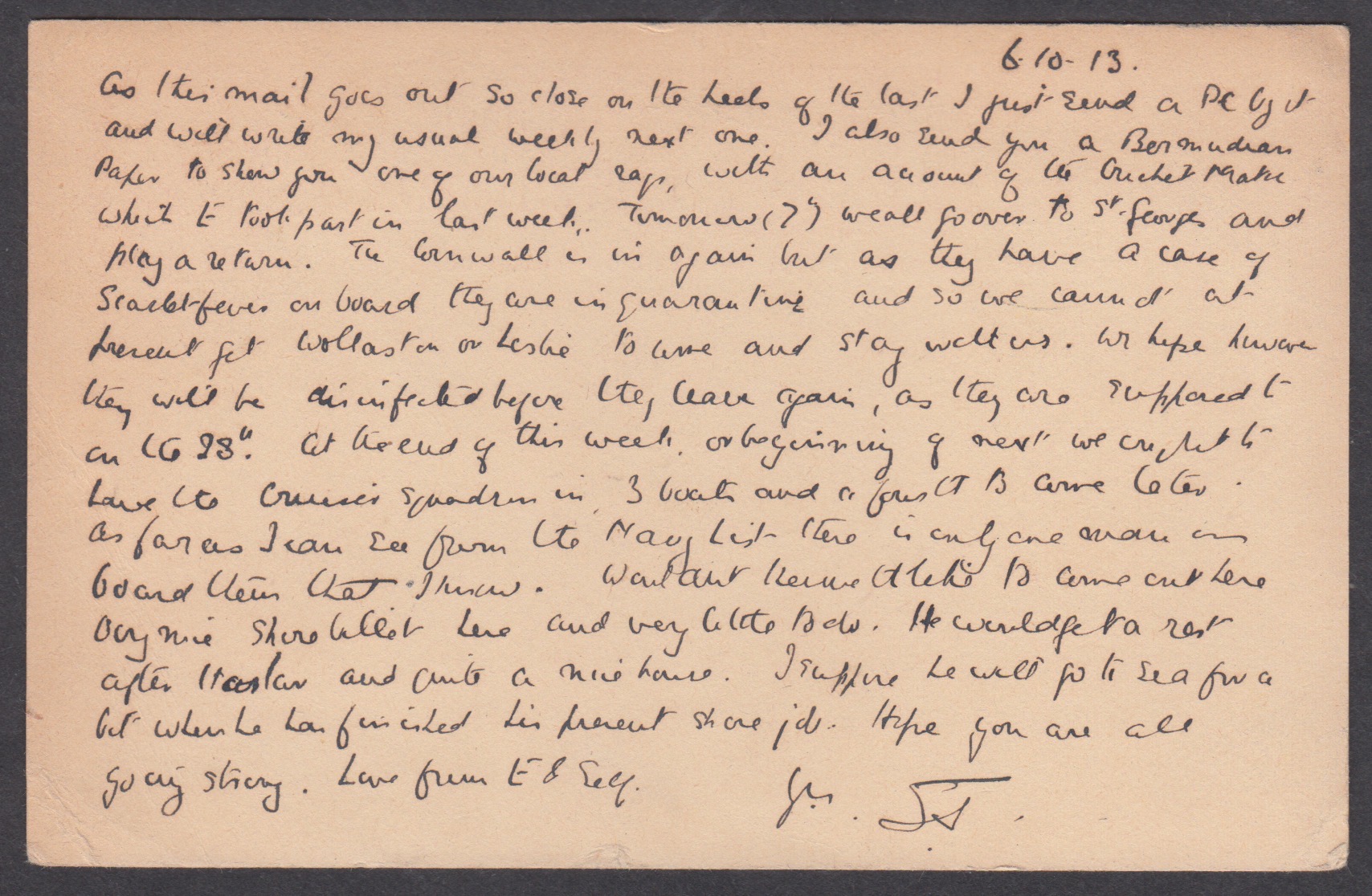
Message side of the Jervis postcard dated 6-10-13, mentioning the cricket match, Cornwall in quarantine with scarlet fever and the Cruiser Squadron
6 October 1913: cricket, scarlet fever and the Cruiser Squadron
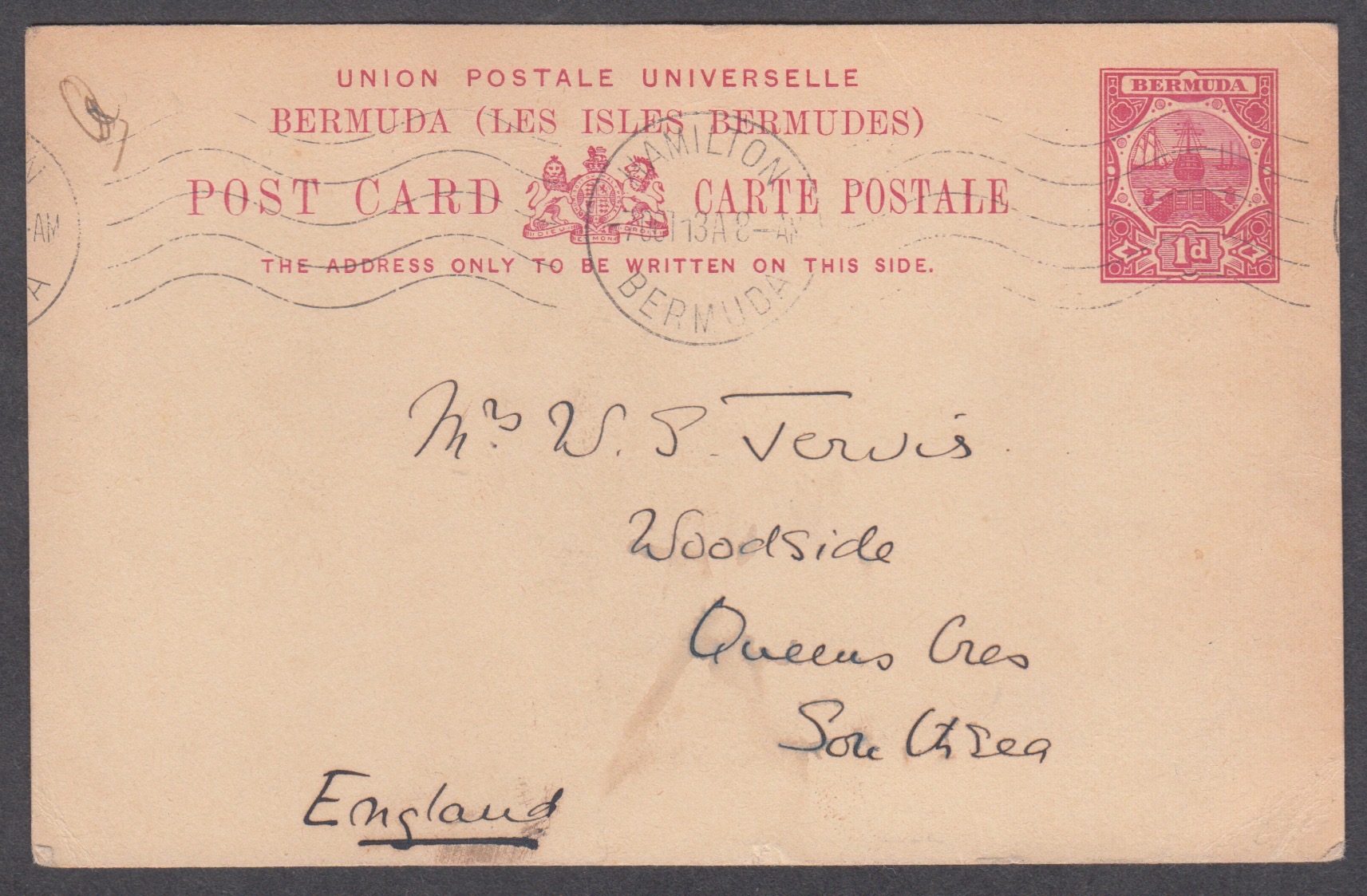
Bermuda 1d postal stationery card addressed to Mrs W. S. Jervis, Woodside, Queens Crescent, Southsea, England, cancelled at Hamilton
Bermuda 1d postal stationery card to Mrs W. S. Jervis, Southsea
  • Written Bermuda, 6 October 1913
  • Card Bermuda 1d postal stationery
  • Writer very probably Major Swynfen John Jervis
  • Addressed to Mrs W. S. Jervis, Woodside, Queen’s Crescent, Southsea
  • Subjects a ladies’ cricket match, Cornwall in quarantine, the 4th Cruiser Squadron

This is the card that started me looking properly at everything else. I spotted it listed by a UK dealer who had managed to decipher the word “quarantine” amongst some fairly dreadful handwriting, and understandably got rather excited about it. It wasn’t until it arrived with me in New Zealand that I could sit down and work slowly through the message, and almost every few lines produced another avenue to investigate.

It’s a Bermuda 1d postal stationery card dated 6 October 1913, addressed to Mrs W. S. Jervis at Woodside, Queen’s Crescent, Southsea. The first breakthrough came from an innocuous-looking passage:

“I also send you a Bermudian Paper to show you one of our local rags, with an account of the Cricket Match which E took part in last week. Tomorrow (7th) we all go over to St Georges and play a return.”

A search of the newspapers showed this wasn’t just a cricket match but a ladies’ cricket match, with a Mrs Jervis among the players. She was Edith Freeman Jervis, wife of Major Swynfen John Jervis, then serving in Bermuda as a General Staff Officer.

When I first worked through the card I took Edith to be the writer. Going back over it for this page, I now think it was Swynfen. The “E” who played is Edith, the card closes “Love from E & Self”, it’s signed with what look like his initials, and he mentions writing “my usual weekly”. That fits a son writing home to his mother, which Mrs W. S. Jervis may well have been, though I haven’t yet confirmed the relationship.

Then the line that caught the dealer’s eye:

“The Cornwall is in again but as they have a case of Scarlet-fever on board they are in quarantine…”

For me the important words turned out not to be “scarlet fever” or “quarantine”, but “The Cornwall is in again”. Here was Cornwall back at Bermuda eighteen months after Ralph Cox wrote his letter, and after the Rea postcards had followed her to Halifax and Gibraltar.

The quarantine meant two men from Cornwall, Wollaston and Leslie, couldn’t come and stay. The Jervises hoped the ship would be disinfected before she left, as she was due to on the 23rd. The Royal Gazette of 9 October confirms it: Cornwall was in quarantine owing to “a case of sickness which is under observation”. Her men could land on Ireland Island and visit the Royal Sailors’ Home, but couldn’t enter private houses or cross Gray’s Bridge.

And still the card keeps giving:

“At the end of this week or beginning of next we ought to have the Cruiser Squadron in, 3 boats and a fourth to come later.”

He’d even checked the Navy List and found only one man aboard that he knew. The three ships were HMS Suffolk, Berwick and Lancaster of the 4th Cruiser Squadron, with Suffolk flying the flag of Rear-Admiral Sir Christopher Cradock. They were already crossing the Atlantic as he wrote. Lancaster’s log records St David’s Head sighted just after six on the morning of 11 October, so the prediction was remarkably accurate. The squadron stayed eleven days and left on 22 October for the West Indies.

IV

Coronel and the Falklands

There’s considerable hindsight attached to the name Cradock. Little more than a year later he commanded the British squadron that met Admiral von Spee’s German East Asia Squadron off Coronel, Chile, on 1 November 1914. It was a disastrous defeat, and Cradock was killed along with more than 1,500 officers and men.

And this is where the story comes almost full circle. Von Spee rounded Cape Horn and on 8 December 1914 met a much stronger British force at the Battle of the Falkland Islands. Among the British ships was HMS Cornwall, which with HMS Glasgow pursued and sank the German light cruiser Leipzig.

So in October 1913 the Jervises were in Bermuda, writing casually about Cornwall in quarantine while they waited for Cradock’s squadron to arrive. A year later Cradock was dead at Coronel, and Cornwall, the ship sitting at Bermuda that week, helped destroy the squadron responsible.

Coaling at Bermuda

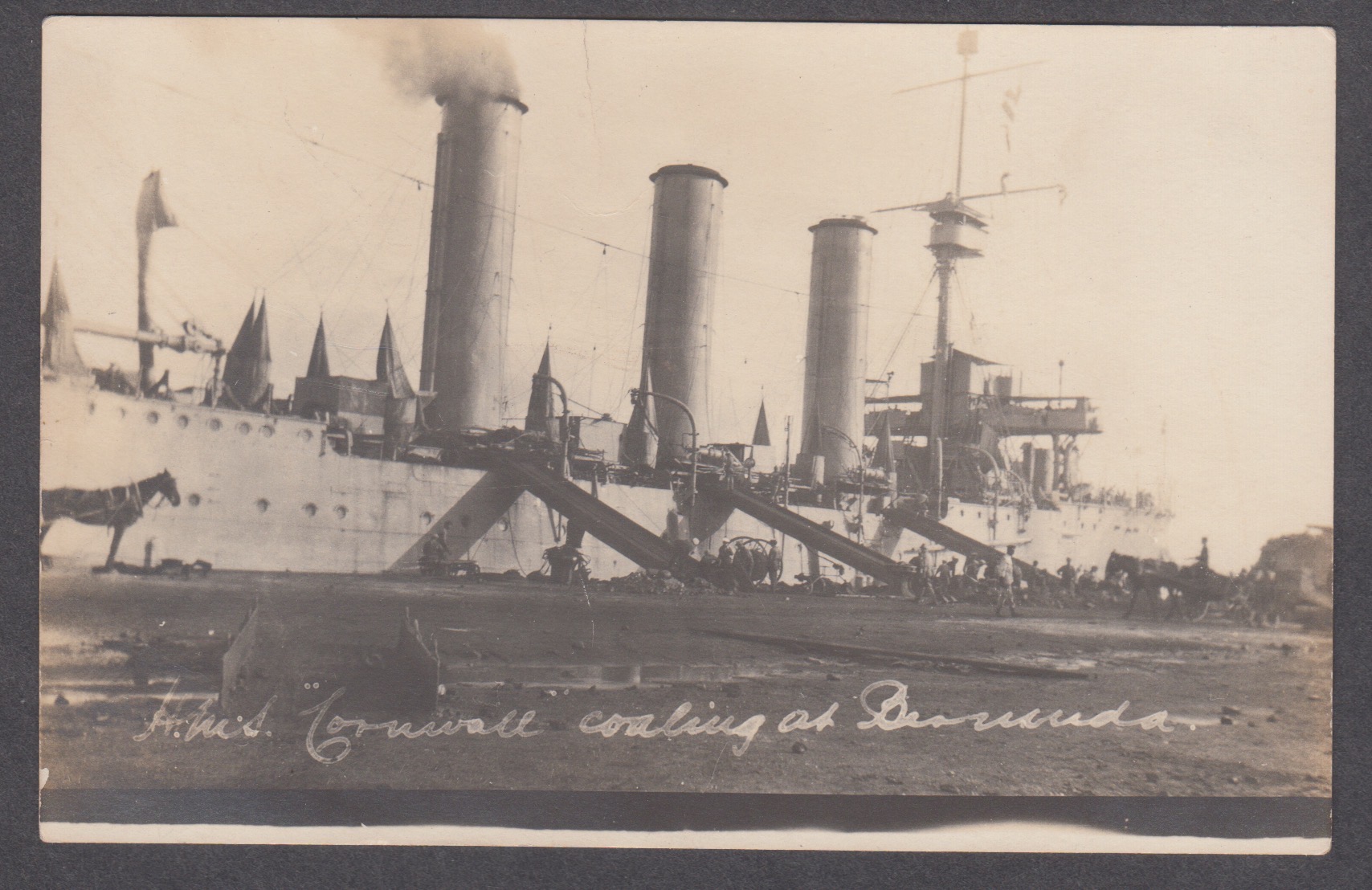
Real photograph postcard captioned H.M.S. Cornwall coaling at Bermuda: the cruiser alongside a wharf with ramps running up to her deck, horses and carts on the wharf, men at work along her side and smoke from her forward funnel
“H.M.S. Cornwall coaling at Bermuda”

This real photograph postcard is captioned “H.M.S. Cornwall coaling at Bermuda”. Coaling was the dirtiest job in the Navy, and everyone aboard turned to for it. Here Cornwall lies against a wharf with ramps running up to her deck, horses and carts bringing the coal alongside, and men at work all along her side. Smoke is drifting from her forward funnel.

I haven’t been able to date it, and the card is unused. It doesn’t match the Royal Gazette’s account of March 1912, when she tied up alongside the old coal hulk Shah in Grassy Bay, because here she is clearly at a wharf ashore. So it may be from another visit, perhaps her return in early 1913, but that’s a guess for now.

The Ship

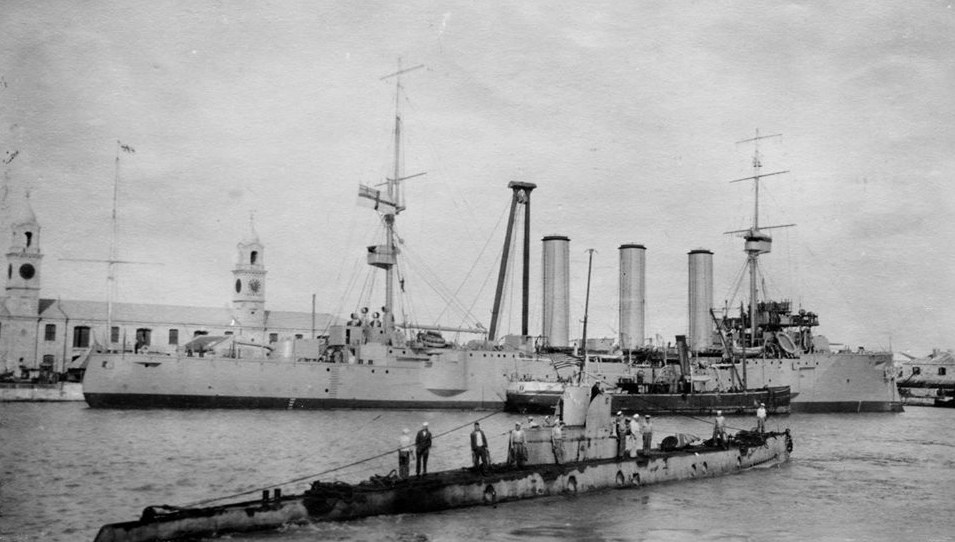
HMS Cornwall lying at the Royal Naval Dockyard, Bermuda, about 1918, in front of the twin clock towers, with a submarine and its crew in the foreground

H.M.S. Cornwall

A Monmouth-class armoured cruiser, launched in 1902 and commissioned in 1904. Before the First World War she was used extensively as a training ship for naval cadets, making long cruises to Canada, Bermuda, the West Indies and the Mediterranean. She remained a fully operational cruiser throughout, as the Falklands would show.

After the Falklands she went home to refit, then out to East Africa in the spring of 1915 to help blockade the German cruiser Königsberg in the Rufiji River, before being sent on to the Dardanelles. She spent 1916 in the East Indies and on the China Station. From September 1917 she escorted convoys between North America and Britain. Her last convoy ended at Bermuda on 18 October 1918, and she stayed until 14 December.

In 1919 she went back to training cadets, and was at Bermuda again that May. She was paid off at Devonport in August 1919 and sold for scrap in 1920.

The photograph shows her at the Royal Naval Dockyard about 1918, lying in front of the twin clock towers, with a submarine and her crew in the foreground. Bermuda saw Cornwall at the start of this story, and again close to the end of her career.

ClassMonmouth-class armoured cruiser
Launched1902
Commissioned1904
Role, 1912–13Cadet training cruises
War serviceFalklands, East Africa, Dardanelles, China, convoy escort
FatePaid off 1919; sold for scrap 1920

HMS Cornwall at the Royal Naval Dockyard, Bermuda, about 1918. Photographer not identified. Via Wikimedia Commons.

Still to find out

If you can help with any of these, I’d be very pleased to hear from you.

See also

That’s what makes the Jervis card so satisfying. I bought it because somebody in England had deciphered the word “quarantine”. By the time I’d finished with it, it had given me a ladies’ cricket match, the Jervises, scarlet fever aboard Cornwall, and the imminent arrival of Cradock’s squadron. Best of all, three rather innocent words, “The Cornwall is in again”, provided the link back to a group of material that had been sitting in my collection all along.