Postal History · Royal Navy · Carried by Warship

H.M.S. Bristol

Hamilton · Bermuda · 10 December 1869

A merchant’s letter that went home in the Navy’s cadet training frigate instead of waiting for the packet.

◆

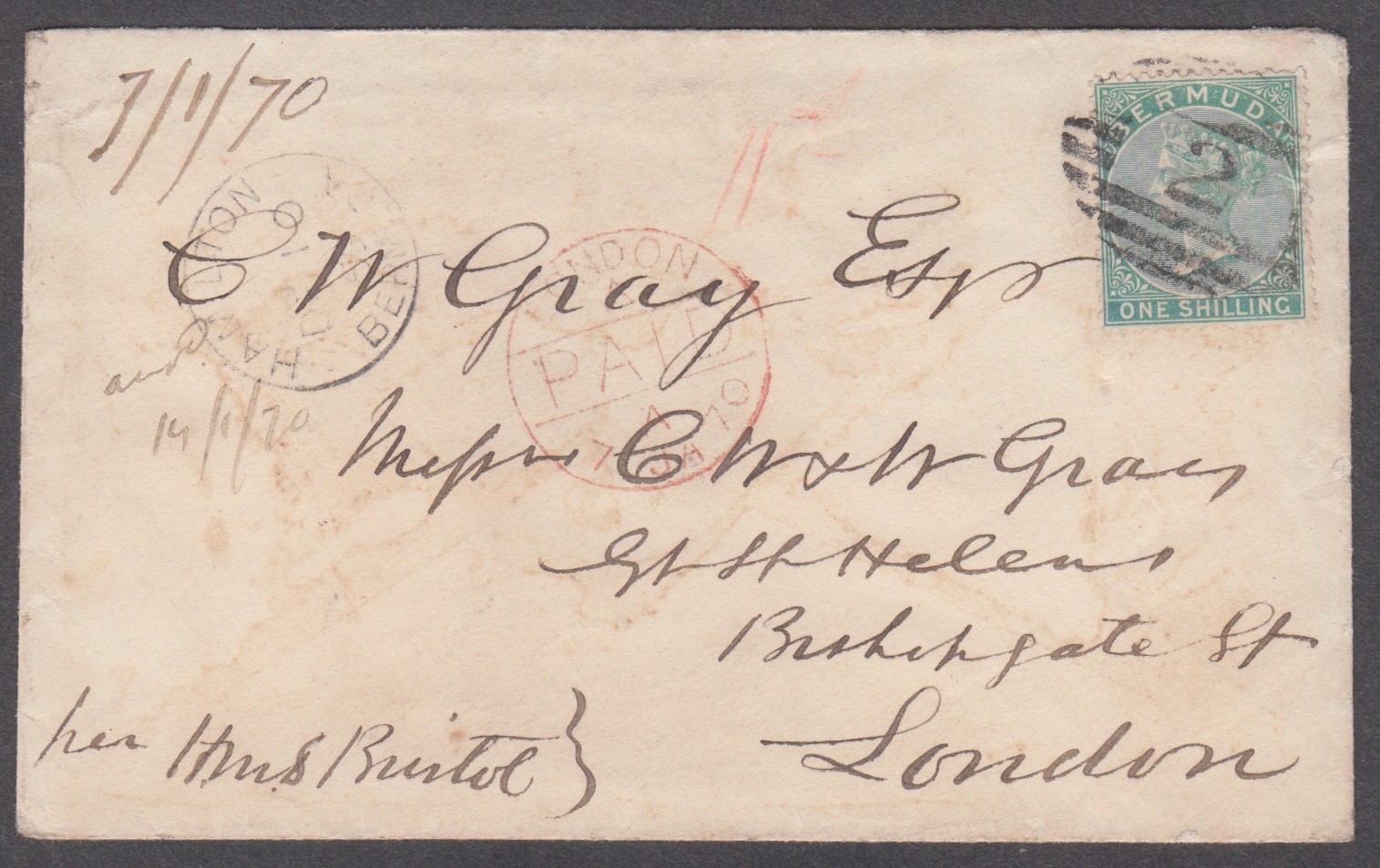
This envelope was posted at Hamilton on 10 December 1869, addressed to C.W. Gray Esq., of Messrs C.W. & W. Gray, Great St Helen’s, Bishopsgate Street, London. At lower left the writer has added “per H.M.S. Bristol”. It isn’t a naval cover in the strict sense. The writer was a civilian, and nothing suggests the letter came from anyone on board. But it was carried home in a warship, and that is what makes it interesting to me.

I

The cover

Envelope addressed to C. W. Gray Esq., Messrs C. W. and W. Gray, Great St Helens, Bishopsgate Street, London, franked with a Bermuda one shilling green cancelled by a barred numeral 2, with a Hamilton Bermuda datestamp at left, a red London PAID datestamp, manuscript dockets 7/1/70 and 14/1/70, and endorsed per H.M.S. Bristol at lower left
Front: the 1/- green and the endorsement “per H.M.S. Bristol”
  • Posted Hamilton, Bermuda, 10 December 1869
  • Endorsed “per H.M.S. Bristol”
  • Franking First Government Issue 1/- green, the correct rate to the United Kingdom
  • Obliterator barred numeral “2” (type K1), used at Hamilton
  • Datestamp small HAMILTON/BERMUDA (type H1), DE 10 69
  • Arrival red London PAID, 7 January 1870
  • Addressed to C.W. Gray Esq., Messrs C.W. & W. Gray, Great St Helen’s, Bishopsgate Street, London

The 1/- green of the First Government Issue pays the correct rate to the United Kingdom. It is cancelled by the barred numeral “2” (type K1), used here at Hamilton. At left is the small HAMILTON/BERMUDA datestamp (type H1), dated DE 10 69.

The red London PAID datestamp was struck on arrival on 7 January 1870. Someone in the Grays’ office wrote the same date, “7/1/70”, at top left when it came in. A second note, “14/1/70”, below the Hamilton datestamp is probably the date it was answered.

The endorsement at lower left is the reason the cover is here. “Per H.M.S. Bristol” is the writer telling the Post Office how they wanted the letter to go.
II

Why a warship?

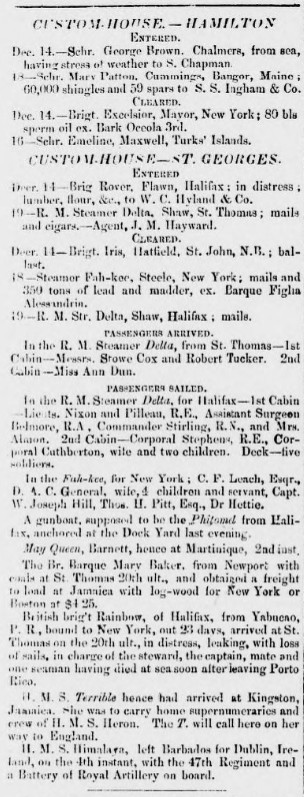
Royal Gazette custom-house lists for Hamilton and St George's, showing the R. M. Steamer Delta, Shaw, entered at St George's on the 19th from St Thomas with mails and cigars, and cleared the same day for Halifax with mails, with lists of passengers arrived and sailed
Royal Gazette, 21 December 1869: the Delta in and out of St George’s on the 19th

It was perfectly normal for HM ships to carry mail, usually as ship letters. What I wanted to know was why this one went by the Bristol at all, when Bermuda had a regular packet service.

Graham Booth looked at this cover and left a note with it. He thought it travelled as a packet letter. That was normally done only when the regular packet had broken down, sunk or been captured. Here, nothing had gone wrong. The Royal Mail Steam Packet Company ships on either side of it, the Seine and the Tasmanian, were both on schedule, though Graham doubted much Bermuda mail went west to join them anyway.

The real problem was timing. The Halifax packet Delta had left Bermuda for St Thomas on 6 December and Graham had her due back on the 16th. The Royal Gazette of 21 December shows her entering St George’s from St Thomas on the 19th with mails and cigars, and clearing for Halifax with the mails the same day. Anyone posting a letter for London on 10 December faced a wait of more than a week just for the packet to arrive, then the long way round through Halifax.

Graham’s view was that it was a simple decision. If the Bristol was going straight home, the letter would get there much sooner.

He also pointed out that it was a fortunate one. Had the letter gone by Halifax, he thought it would have been put aboard the Inman liner City of Boston. She sailed from Halifax for Liverpool on 28 January 1870 with 191 people on board and was never seen again.

Bermuda to London

The warship on one side, the packet route on the other.

The Bristol and the letter
The packet route
6 Dec
The BristolArrives at Bermuda, twelve days from Trinidad.
The DeltaLeaves Bermuda for St Thomas.
7 Dec
The BristolLies in Grassy Bay.
10 Dec
The letterPosted at Hamilton, endorsed “per H.M.S. Bristol”.
11 Dec
The BristolSails from Grassy Bay under steam and grounds on a coral reef before 11.30am; another ship assists.
19 Dec
The DeltaEnters St George’s from St Thomas and clears for Halifax with the mails.
7 Jan
The letterLondon PAID. Received by the Grays the same day.
28 Jan
City of BostonSails from Halifax for Liverpool and is never heard of again.
III

The cadet ship’s cruise

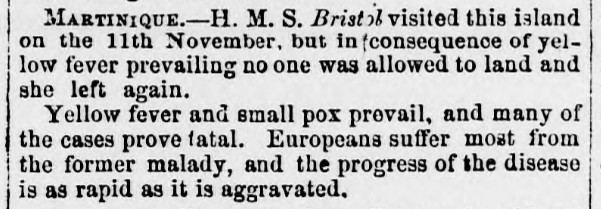
Newspaper paragraph headed Martinique: H. M. S. Bristol visited this island on the 11th November, but in consequence of yellow fever prevailing no one was allowed to land and she left again; yellow fever and small pox prevail, and many of the cases prove fatal
Royal Gazette, 21 December 1869: Martinique
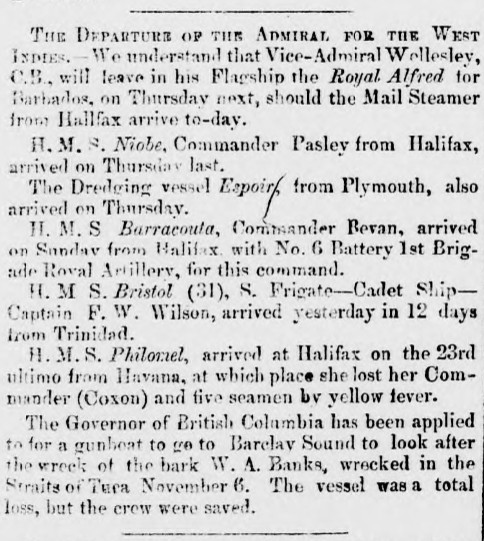
Royal Gazette shipping paragraphs, including: H. M. S. Bristol (31), S. Frigate, Cadet Ship, Captain F. W. Wilson, arrived yesterday in 12 days from Trinidad
Royal Gazette, 7 December 1869: “arrived yesterday in 12 days from Trinidad”

In 1869 the Bristol was the Royal Navy’s sea-going training ship for naval cadets. Boys came to her from the Britannia for a year of practical seamanship and gunnery, with their schooling carried on at sea. Her captain was Frederick William Wilson.

That summer she had sailed with the Flying Squadron as far as Bahia, leaving it there in August and returning to England. Her second cruise of the year took her to the West Indies: Barbados, Trinidad, Martinique, St Lucia and finally Bermuda.

Martinique was not a happy call. The Gazette reported that she visited the island on 11 November, but yellow fever was so bad that no one was allowed to land and she left again.

The Royal Gazette of 7 December recorded her arrival at Bermuda: “H.M.S. Bristol (31), S. Frigate, Cadet Ship, Captain F.W. Wilson, arrived yesterday in 12 days from Trinidad.” That puts her here from 6 December, and Greet’s log has her lying in Grassy Bay from the 7th to the 11th. Four days after she arrived, this letter was postmarked at Hamilton.

One of the cadets aboard was Thomas Young Greet, then about fifteen, who went on to become an admiral. His logs survive at the National Maritime Museum, Greenwich. They cover his time in the Bristol under Captain Wilson from 25 April 1869 to 10 January 1870, so they span this whole cruise, Bermuda included. The volume also has track charts and drawings tucked inside. The library staff at the Museum kindly checked it for me, and it turned out to hold the answer to what happened next.

IV

11 December 1869

The day after this letter was postmarked, the Bristol left Bermuda, and Greet’s log records what happened. Her fires were lit at 3.15 in the morning, and at 8.30 she proceeded under steam. Then, before 11.30, comes the entry “ship grounded on a coral reef”. The log notes another ship coming to assist and gives her latitude and longitude. I have ordered copies of the pages, and when they arrive I will add the exact position.

She was refloated. The repairs later cost £2,197, and her pilot was found to blame and lost his licence to pilot men-of-war. As she had sailed from Grassy Bay that morning, I think he must have been a Bermuda pilot taking her out through the reefs. This letter would already have been in her mail.

She got home all the same. The London PAID of 7 January 1870 shows the letter came with her, well ahead of anything sent by the Halifax packet. There are no Halifax markings on the cover, and a letter that waited for the Delta could not have reached London by that date.

V

The Grays of Great St Helen’s

The firm was founded by Benjamin Charles Thomas Gray, who was in business in London as a West Indies merchant from about 1832 and later traded with North America as well. He took his son Charles William Gray into partnership. By the time of this letter the firm was Charles William and Wentworth Gray, the “C.W. & W. Gray” of the address.

Charles William Gray, the C.W. Gray of this envelope, remained a partner until his death in 1880. The firm traded from several addresses in the City over the years, Great St Helen’s among them, and lasted until about 1910. Its papers survive at the London Metropolitan Archives.

A London house trading with the West Indies and North America is exactly the sort of correspondent who would care about a few weeks saved on the post.

The Ship

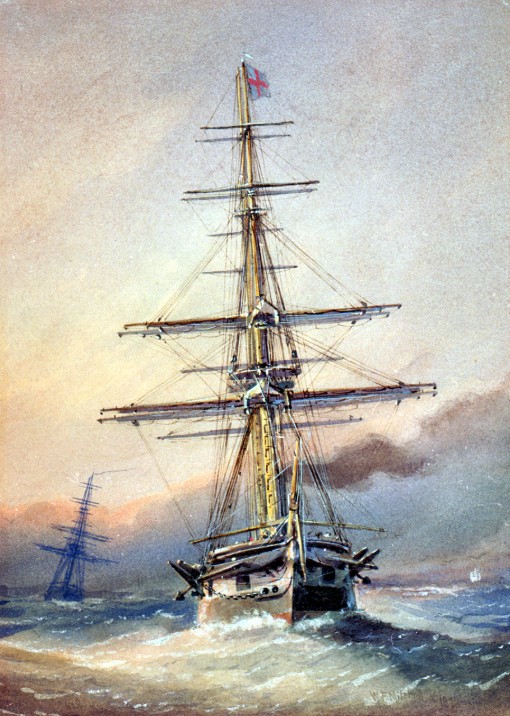
Watercolour of the three-masted frigate HMS Bristol seen bow-on in a heavy sea, flying a red-cross flag at the masthead, with another ship under sail in the distance

H.M.S. Bristol

HMS Bristol was a wooden screw frigate and the name ship of her class. She was laid down at Woolwich Dockyard in 1859 and launched on 12 February 1861, but not commissioned until October 1865. She was one of the last generation of wooden fighting ships, built to carry 51 guns, and her propeller could be hoisted into the hull so she sailed more cleanly. Her first commission was as flagship of Commodore Hornby on the west coast of Africa. In February 1868 she recommissioned as the cadet training ship, and the Gazette of 1869 lists her with 31 guns.

She served as the cadet ship until 1871 and was sold in July 1883 to Castle’s, who broke her up at Charlton. Her figurehead, a white-painted female head, was one of the few carvings at Castle’s yard to survive the bombing of 1941. It is now at the National Maritime Museum, Greenwich.

BuiltWoolwich Dockyard, launched 12 February 1861
TypeWooden screw frigate, Bristol class
Guns51 as built; 31 in 1869
Tonnage3,027 tons burthen
Captain, 1869Frederick William Wilson
FateSold for breaking up, 1883

“HMS Bristol, No.618”, watercolour by William Frederick Mitchell, c.1870. National Maritime Museum, Greenwich (PAD9498).

Provenance and references