Postal History · Royal Navy · Carried by Warship

H.M.S. Renown

St George’s · Bermuda · 19 April 1899

A letter posted the day before the flagship sailed, which went home with the Admiral on a record passage.

◆

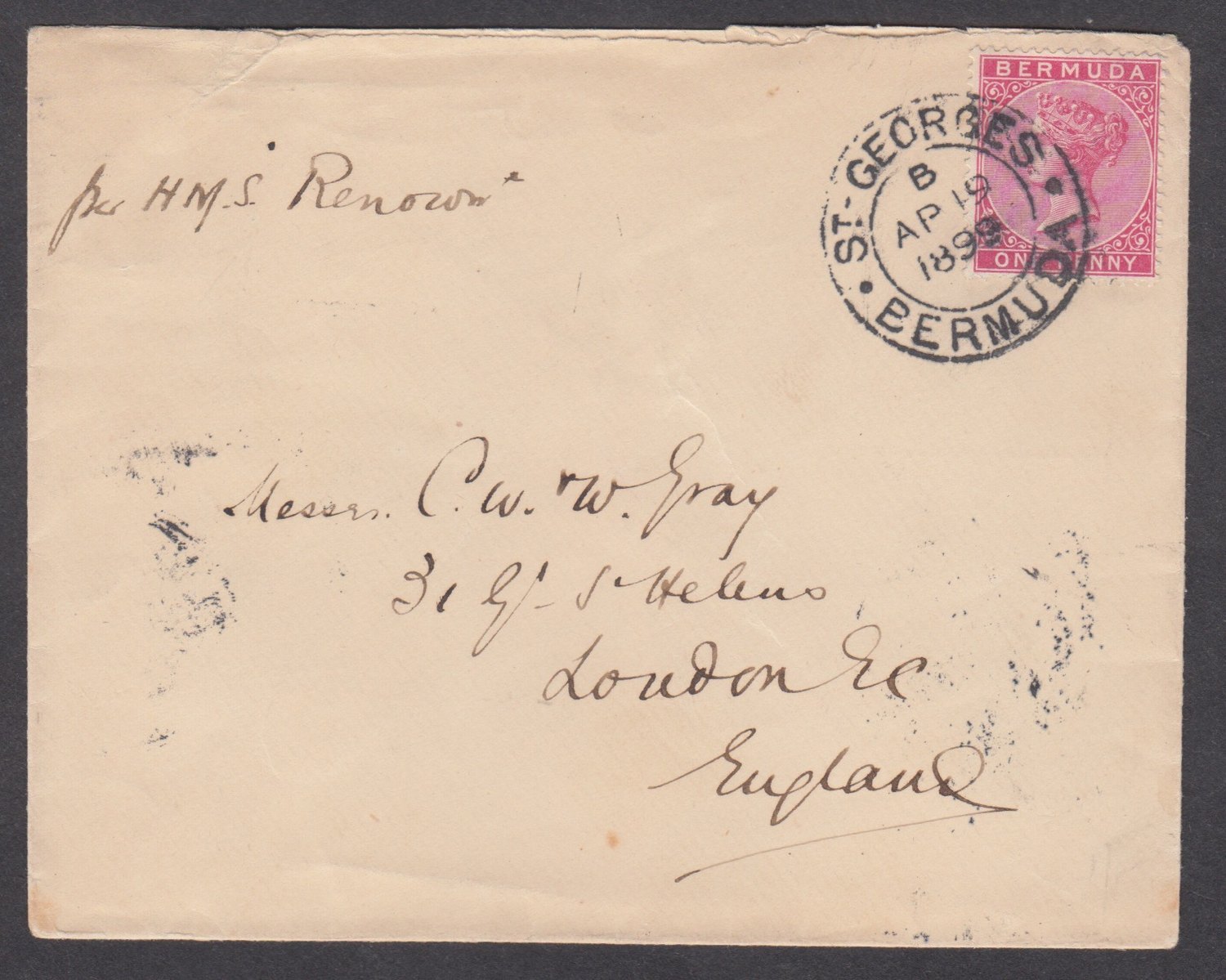
This envelope was posted at St George’s on 19 April 1899, addressed to Messrs C.W. & W. Gray, 31 Great St Helen’s, London. At top left the writer has added “per H.M.S. ‘Renown’”. The next afternoon Renown, flagship of the North America and West Indies Station, sailed for England with Vice-Admiral Sir John Fisher on board. She made the fastest passage yet recorded by a British battleship, and the letter went with her. I’m fond of it for another reason too. It’s addressed to the same London firm as my HMS Bristol cover, posted thirty years earlier.

I

The cover

Envelope addressed to Messrs C. W. and W. Gray, 31 Great St Helens, London E.C., England, franked with a Bermuda one penny rose-red Queen Victoria stamp tied by a St George's Bermuda double-circle datestamp, collection letter B, AP 19 1899, and endorsed per H.M.S. Renown at top left
Posted at St George’s, 19 April 1899, endorsed “per H.M.S. ‘Renown’”
  • Posted St George’s, Bermuda, 19 April 1899
  • Endorsed “per H.M.S. ‘Renown’”
  • Franking 1d rose-red Queen Victoria, the Imperial penny rate to the United Kingdom
  • Datestamp ST. GEORGE’S / BERMUDA (type H5), B, AP 19 1899
  • Arrival Portsmouth and London E.C., 29 April 1899
  • Addressed to Messrs C.W. & W. Gray, 31 Great St Helen’s, London E.C.

The single 1d stamp pays the new Imperial penny rate. Bermuda was one of the colonies that adopted it on the first day, 25 December 1898. Until then a letter to England had cost 2½d. The St George’s datestamp (type H5) carries the letter B, the noon or early afternoon collection, on 19 April 1899. On the back are Portsmouth and London E.C. datestamps, both 29 April.

The endorsement is the reason the cover is here. “Per H.M.S. ‘Renown’” is the writer asking the Post Office to send the letter by the flagship instead of the usual route through New York or Halifax.

When this cover was sold in 2022, the description called it “the only recorded privately posted cover carried on a Royal Navy ship”. I don’t think that’s right. My HMS Bristol cover of 1869 is just that, and it’s addressed to the same firm. The note that came with the cover also says it was posted at Hamilton, but the datestamp is clearly St George’s. I don’t know why the writer used St George’s. I’d love to find out.
II

The monster arrives

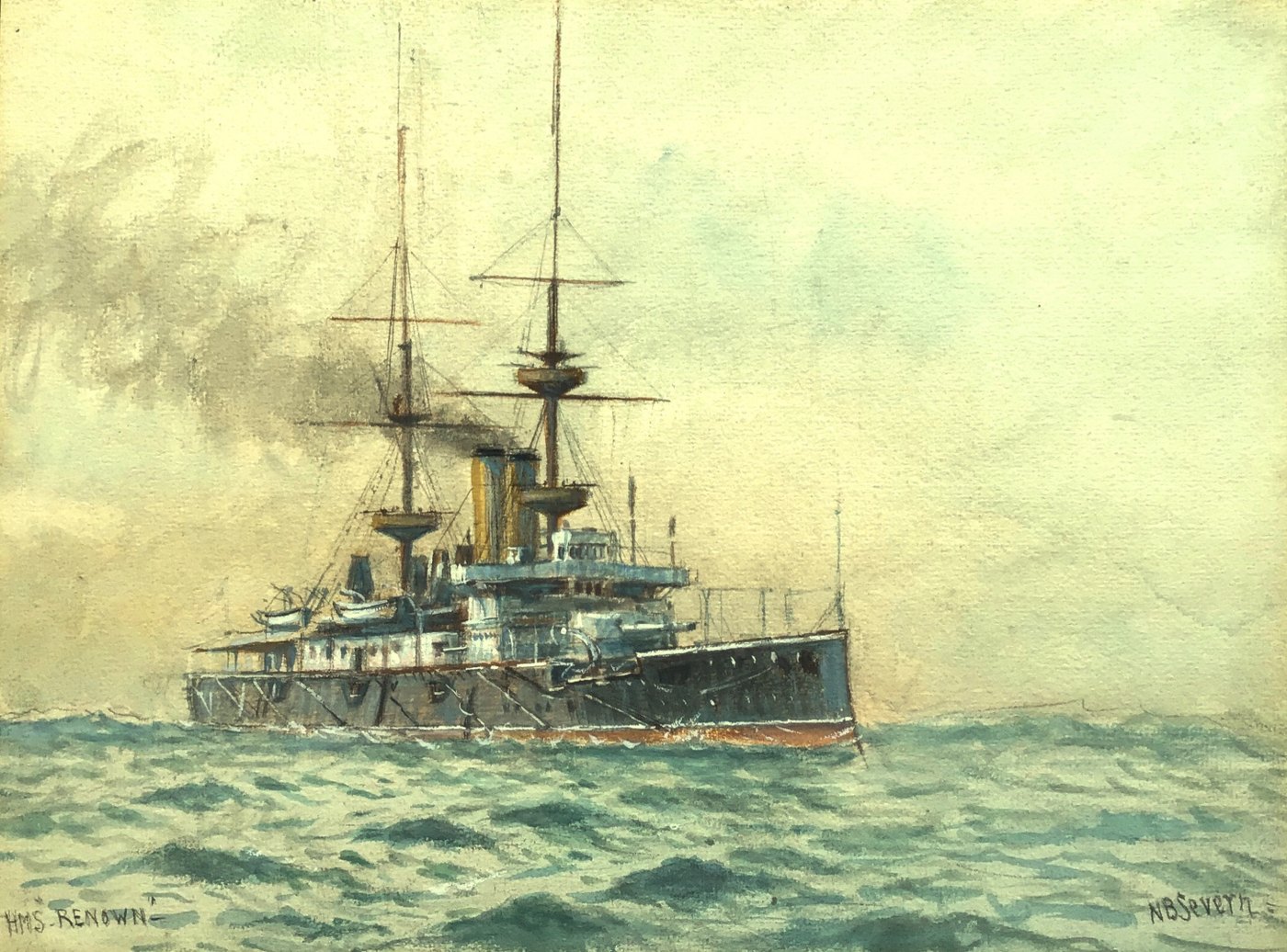
Watercolour of the battleship HMS Renown steaming through a green sea, black hull with white upperworks, two buff funnels side by side between two masts with fighting tops, smoke trailing astern, lettered HMS Renown at lower left and signed N B Severn at lower right
Renown in watercolour by N.B. Severn. Courtesy of Maritime Originals
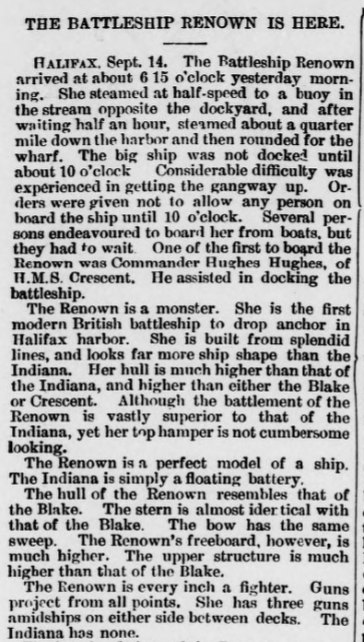
Royal Gazette report headed The Battleship Renown is Here, dated Halifax September 14, describing her arrival and docking at Halifax and beginning: The Renown is a monster. She is the first modern British battleship to drop anchor in Halifax harbor
Royal Gazette, 21 September 1897: “The Renown is a monster”
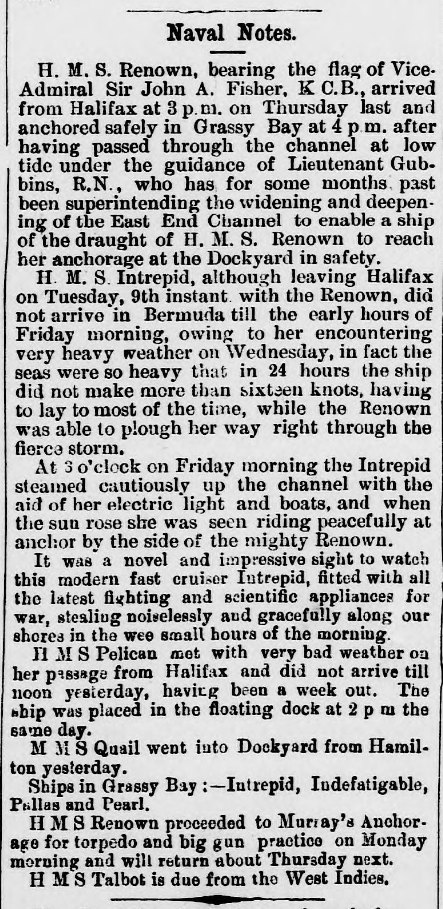
Royal Gazette Naval Notes: H.M.S. Renown, bearing the flag of Vice-Admiral Sir John A. Fisher, arrived from Halifax at 3 p.m. on Thursday last and anchored safely in Grassy Bay at 4 p.m. after passing through the channel at low tide under the guidance of Lieutenant Gubbins, R.N., with notes on the Intrepid and Pelican
Royal Gazette, 16 November 1897: through the East End Channel at low tide

Renown commissioned at Devonport in June 1897 to replace the cruiser Crescent as flagship of the station. She took part in the Diamond Jubilee review at Spithead and left Portsmouth on 28 August. She met head seas all the way across and reached Halifax on 13 September.

The Halifax Mail sent a reporter on board, and the Gazette reprinted his piece. It begins “The Renown is a monster”. He wrote that she was the first modern British battleship to anchor at Halifax, and he compared her favourably with the American battleship Indiana. He also toured Fisher’s apartments, finished in white and gold, carved oak and red silk, with sideboards costing 100 guineas each. Lady Fisher and their two grown-up daughters came out with him.

Bermuda had needed some work to take her. The East End Channel had been widened and deepened for months under Lieutenant Gubbins, R.N., so that a ship of her draught could reach the Dockyard. The dredger St Albin had moved about 100,000 tons of material.

Renown arrived from Halifax on Thursday 11 November 1897 and came in through the channel at low tide with Gubbins guiding her. She anchored safely in Grassy Bay at 4 pm. The Gazette noted that she ploughed through a storm that held back the cruiser Intrepid. The next morning Fisher, Lady Fisher and their daughters moved into Admiralty House on Clarence Hill.

She was a sight for Bermuda. Within a month S. Nelmes of The Tower, Hamilton, was advertising “Splendid Pictures of the Battleship Renown”.

Her captain had a fright in his first weeks here. On 30 November 1897 Captain Daniel McNab Riddel, who couldn’t swim, somehow ended up in Grassy Bay and was drowning. Ordinary Seaman James Glasson Williams went in and saved him. Captain and Mrs Riddel gave Williams an engraved gold watch, and sent him a gift of money every Christmas for the rest of his life. Edward Harris told the story in the Royal Gazette.

III

Going home

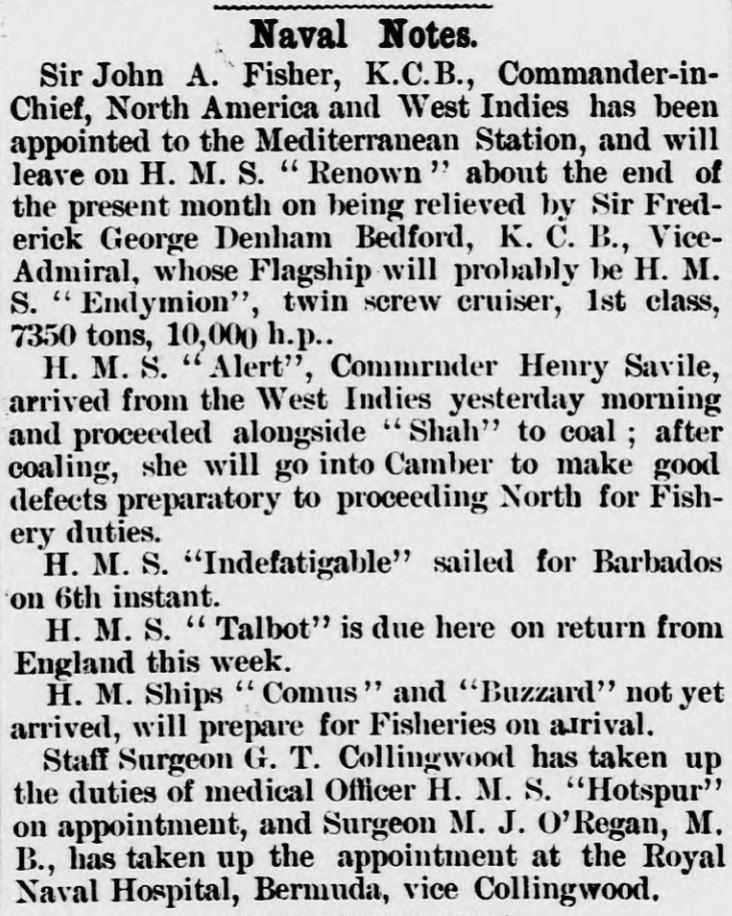
Royal Gazette Naval Notes: Sir John A. Fisher, K.C.B., Commander-in-Chief, North America and West Indies, has been appointed to the Mediterranean Station and will leave on H.M.S. Renown about the end of the present month on being relieved by Sir Frederick George Denham Bedford, with notes on the Alert, Indefatigable, Talbot, Comus and Buzzard
Royal Gazette, 11 April 1899: Fisher to leave in Renown
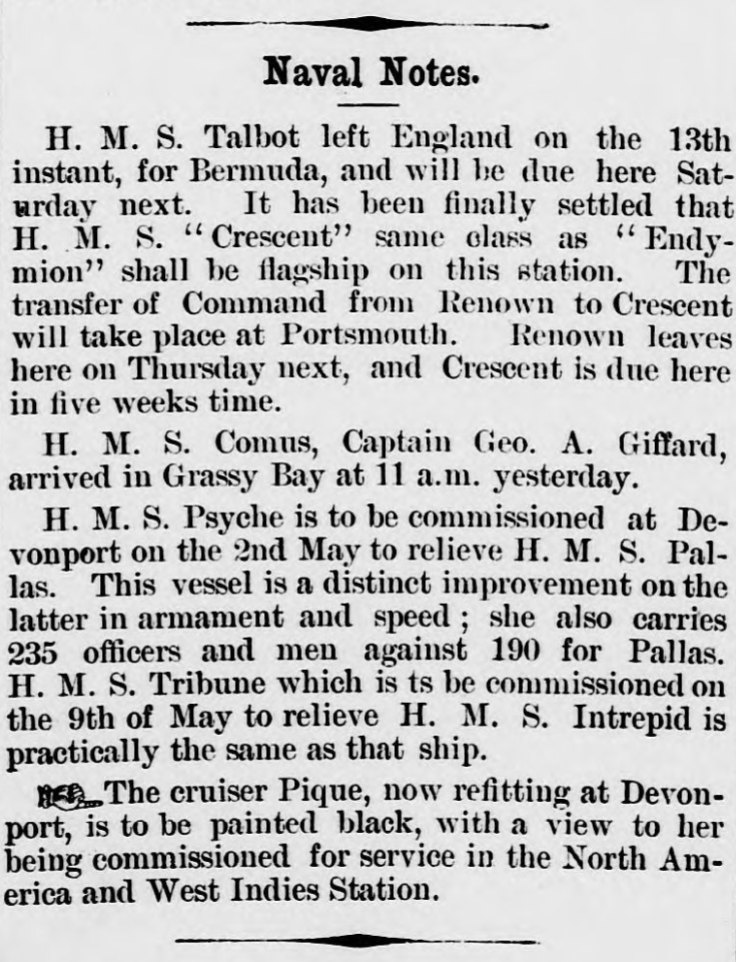
Royal Gazette Naval Notes: Crescent shall be flagship on this station; the transfer of command from Renown to Crescent will take place at Portsmouth; Renown leaves here on Thursday next, and Crescent is due here in five weeks time; with notes on the Talbot, Comus, Psyche, Tribune and Pique
Royal Gazette, 18 April 1899: “Renown leaves here on Thursday next”
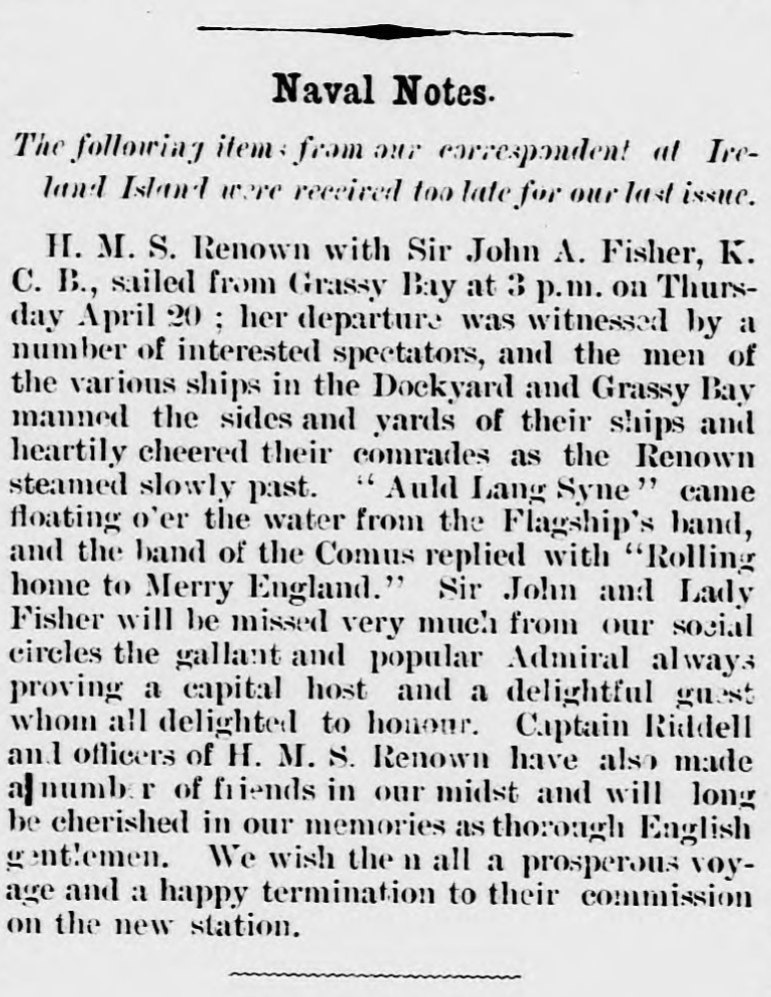
Royal Gazette Naval Notes from the correspondent at Ireland Island: H.M.S. Renown with Sir John A. Fisher sailed from Grassy Bay at 3 p.m. on Thursday April 20; the men of the ships in the Dockyard and Grassy Bay manned the sides and yards and cheered; Auld Lang Syne came from the flagship's band and the band of the Comus replied with Rolling home to Merry England
Royal Gazette, 2 May 1899: the flagship sails, 20 April

On 11 April 1899 the Gazette reported that Fisher had been appointed to the Mediterranean and would leave in Renown at the end of the month. A week later it had the date: “Renown leaves here on Thursday next”. The Crescent, the ship Renown had replaced, would be flagship again, and the change of command would take place at Portsmouth.

This letter was posted at St George’s on the Wednesday, the day before she sailed.

The Gazette’s correspondent at Ireland Island described the departure. Renown sailed from Grassy Bay at 3 pm on Thursday 20 April with Sir John Fisher on board. The men of the ships in the Dockyard and Grassy Bay manned the sides and yards and cheered as she steamed slowly past. Her band played “Auld Lang Syne”, and the band of the Comus answered with “Rolling home to Merry England”.

“Sir John and Lady Fisher will be missed very much from our social circles…”

Royal Gazette, 2 May 1899
IV

A record run

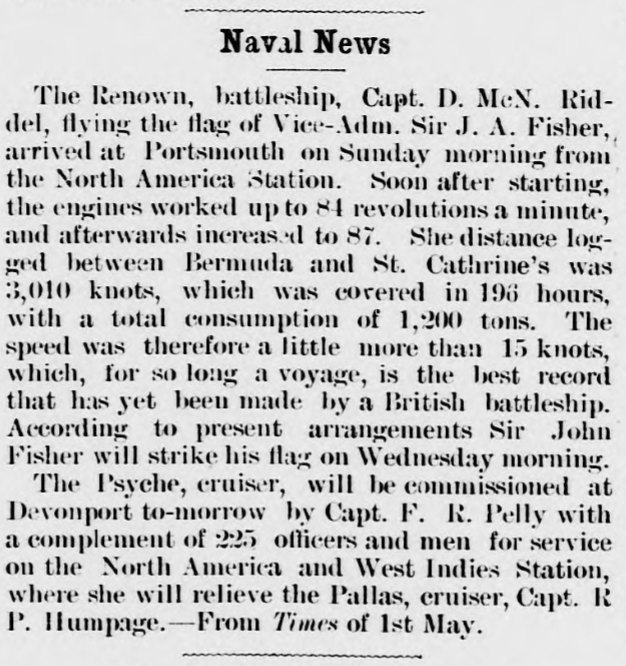
Royal Gazette Naval News from the Times of 1st May: the Renown, battleship, Capt. D. McN. Riddel, flying the flag of Vice-Adm. Sir J. A. Fisher, arrived at Portsmouth on Sunday morning from the North America Station; the distance logged between Bermuda and St Cathrine's was 3,010 knots, covered in 196 hours, the best record that has yet been made by a British battleship
Royal Gazette, 30 May 1899: “the best record that has yet been made by a British battleship”
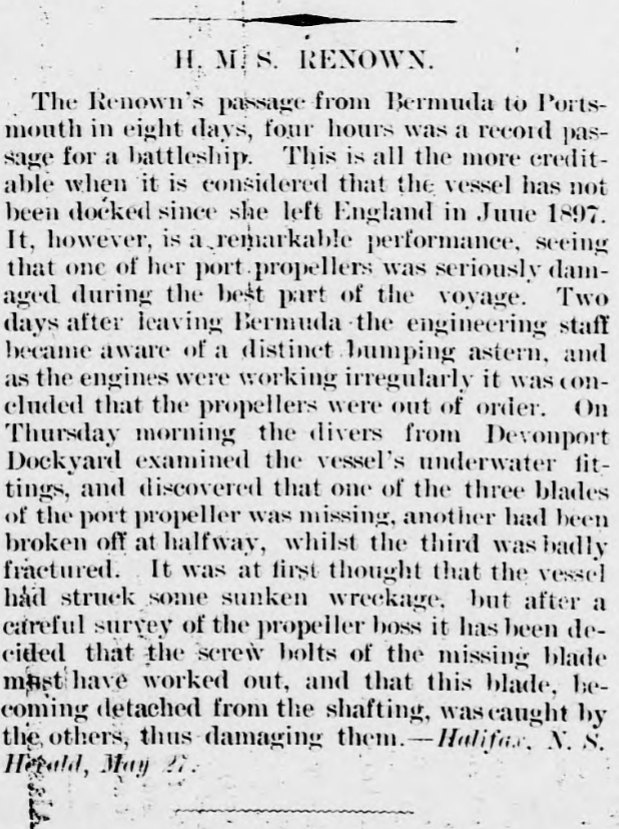
Royal Gazette report headed H.M.S. Renown, from the Halifax Herald of May 27: the passage from Bermuda to Portsmouth in eight days four hours was a record for a battleship, although one of the three blades of the port propeller was missing, another broken off at halfway and the third badly fractured
Royal Gazette, 20 June 1899: eight days, four hours, on a broken propeller

She logged 3,010 knots between Bermuda and St Catherine’s in 196 hours, a little over 15 knots. The Times called it “the best record that has yet been made by a British battleship”.

She did it on a damaged propeller. Two days out, her engineers noticed a bumping astern. When divers examined her in England they found one blade of the port propeller missing, another broken off halfway and the third badly fractured. She hadn’t been docked since leaving England in June 1897.

The Times has her arriving at Portsmouth on Sunday morning, 30 April. The letter is backstamped Portsmouth and London on the 29th, so the mails must have been landed on the Saturday, before the ship came into harbour. It reached London ten days after it was posted.

Fisher struck his flag on 3 May. A fortnight later he was at The Hague as the British naval delegate to the Peace Conference.

Bermuda to London

The flagship on one side, the letter on the other.

The Renown
The letter
19 Apr
The letterPosted at St George’s, B collection.
20 Apr
The RenownSails from Grassy Bay at 3 pm with Fisher on board.
22 Apr
The RenownEngineers notice a bumping astern.
28 Apr
The RenownPasses St Catherine’s after 196 hours.
29 Apr
The letterPortsmouth and London E.C.
30 Apr
The RenownArrives at Portsmouth, Sunday morning.
3 May
The RenownFisher strikes his flag.
V

The Grays again

C.W. & W. Gray were London merchants trading with the West Indies and North America. I told their story on the Bristol page. In 1869 one of their correspondents sent a letter home in the cadet frigate Bristol. Thirty years later another sent this one in Renown.

I don’t think they were the same writer. Covers to the Grays are a known correspondence, and plenty of people in Bermuda wrote to them. It seems to have been a firm whose correspondents knew a faster way home when they saw one.

The Ship

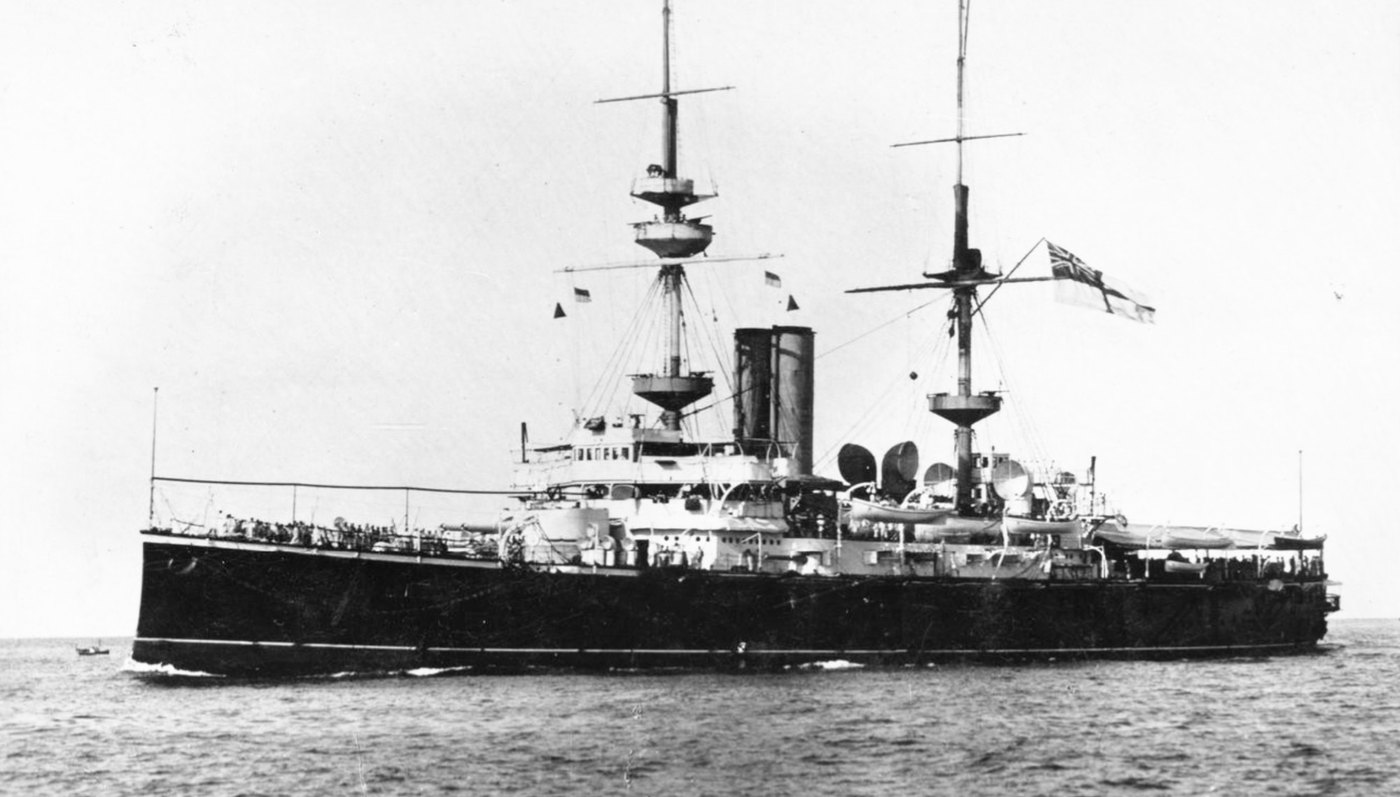
Photograph of the battleship HMS Renown under way, black hull with white upperworks, two funnels side by side between two masts with fighting tops and searchlights, a white ensign flying from the main mast

H.M.S. Renown

Renown was laid down at Pembroke Dockyard on 1 February 1893 and launched on 8 May 1895. She was a one-off, a fast second-class battleship meant to lead cruiser squadrons on foreign stations. Fisher had been closely involved in her design as Controller, and she was his flagship twice. The first time was here, from August 1897 to May 1899, with Captain Daniel McNab Riddel as flag captain. The second was in the Mediterranean from 1899 to 1902.

In 1905–06 she was refitted as a royal yacht and took the Prince and Princess of Wales to India. She was sold in April 1914 and broken up at Blyth.

BuiltPembroke Dockyard, launched 8 May 1895
TypeSecond-class battleship
GunsFour 10-inch, ten 6-inch
Flag captainDaniel McNab Riddel
FateSold 1914, broken up at Blyth

Photograph: photographer not identified. Via Wikimedia Commons.

Still to find out

If you can help with any of these, I’d be very pleased to hear from you.

Provenance and references

Most letters home from Bermuda went the long way round, through New York or Halifax. This one went in the flagship, with the Admiral and his band, and with a propeller coming apart under it. The writer couldn’t have known it would be a record run, but I think they’d have been pleased.