Postal History · Royal Navy · Bermuda Station

H.M.S. Intrepid

Halifax to Bermuda · 1–5 March 1898

A Halifax tent salesman drums up business with the officers of a Bermuda cruiser.

◆

This is one of my favourite kinds of item: an ordinary piece of business mail. In March 1898 a Halifax agent called D. McDonald sent a postcard to Bermuda, addressed to “the Paymaster or any of the Officers” of the cruiser Intrepid, offering to sell them camping tents. He had no name to write to, so he simply addressed it to whoever on board might be buying. It’s a lovely glimpse of how the Halifax trade followed the North America and West Indies squadron, and it reached Bermuda just four days after it was written.

I

A postcard from Halifax

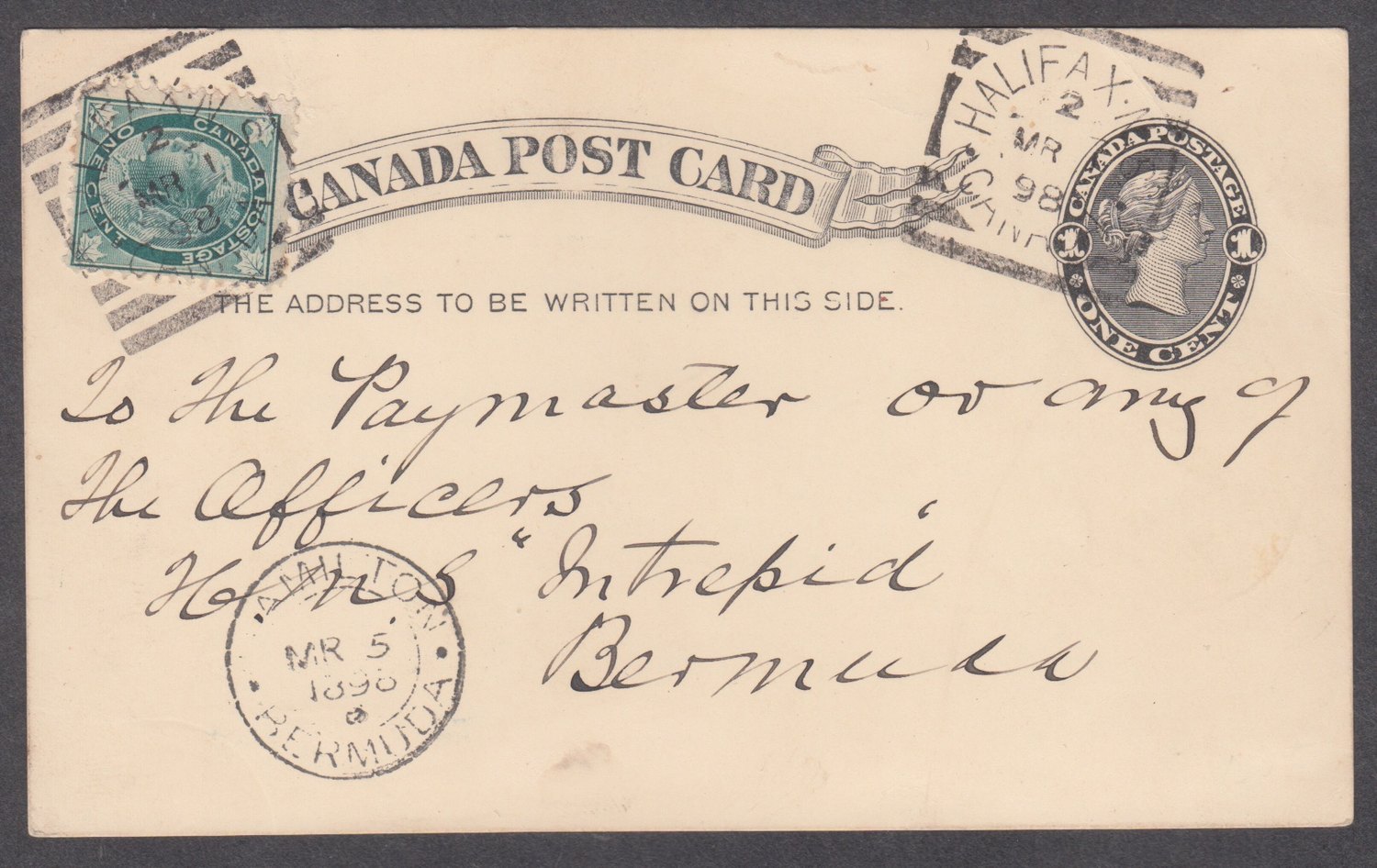
Canada Post Card, one cent black Queen Victoria, uprated with a one cent green Maple Leaf stamp, both cancelled with Halifax N.S. squared circle datestamps, addressed in ink To the Paymaster or any of the Officers, H.M.S. Intrepid, Bermuda, with a Hamilton Bermuda MR 5 1898 circular datestamp at lower left
The address side: uprated to 2 cents, with the Hamilton receiver of 5 March 1898
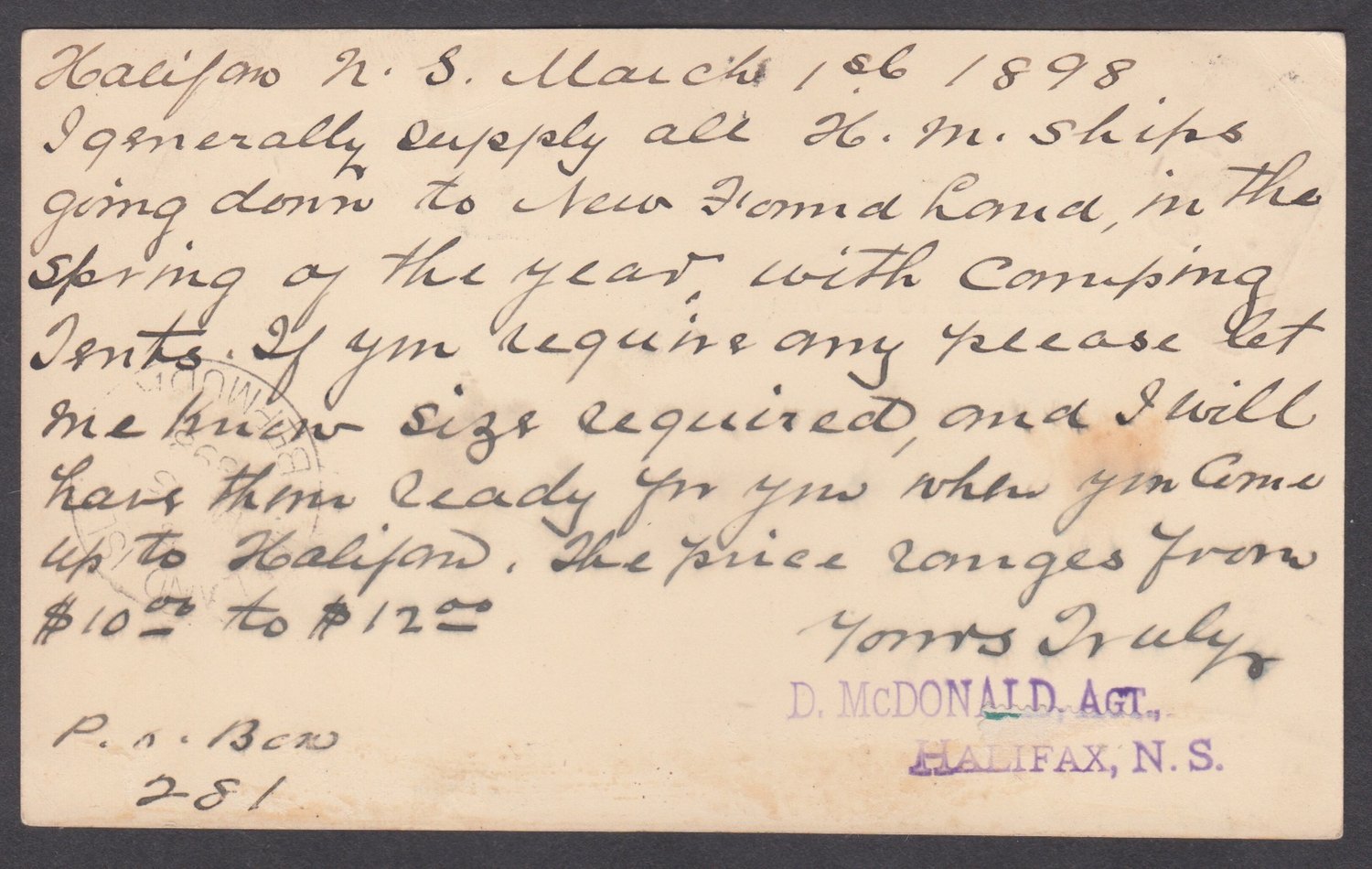
Message side of the postcard, handwritten: Halifax N.S. March 1st 1898. I generally supply all H.M. ships going down to New Found Land, in the spring of the year, with Camping Tents. If you require any please let me know size required, and I will have them ready for you when you come up to Halifax. The price ranges from $10.00 to $12.00. Yours Truly. Signed with a violet handstamp D. McDonald, Agt., Halifax, N.S., and P.O. Box 281 at lower left. An Ireland Island Bermuda datestamp is struck across the middle of the message
The message side, with McDonald’s violet handstamp and the Ireland Island receiver
  • Written Halifax, Nova Scotia, Tuesday 1 March 1898
  • Card Canada one cent Queen Victoria postcard
  • Uprated one cent green Maple Leaf, making the 2 cent foreign postcard rate
  • Postmarks Halifax N.S. squared circles, 1 March 1898
  • Receivers Hamilton type H5, MR 5 1898, on the front; Ireland Island type H5, the same day, on the message
  • Addressed to “The Paymaster or any of the Officers, H.M.S. ‘Intrepid’, Bermuda”
  • Sender D. McDonald, Agt., Halifax, N.S., P.O. Box 281
  • Provenance ex R. Maresch & Son

The card is a Canadian one cent Queen Victoria postcard. One cent paid for a card inside Canada, but a card to Bermuda needed the two cent foreign rate, so McDonald added a one cent green Maple Leaf stamp. Both were cancelled at Halifax with squared circle datestamps.

The message is in his own hand, written across the back of the card:

“I generally supply all H.M. ships going down to New Found Land, in the spring of the year, with Camping Tents. If you require any please let me know size required, and I will have them ready for you when you come up to Halifax. The price ranges from $10.00 to $12.00”

He signed off “Yours Truly”, added his violet “D. McDONALD, AGT., HALIFAX, N.S.” handstamp, and wrote his post office box number at the foot. I like that he calls himself an agent. He wasn’t making the tents himself, he was selling someone else’s, and I haven’t been able to find out whose.

The dealer’s description that came with the card spells the ship “Interprid” and says the tents were “for the troops”. The card itself is clear: they were offered to the officers.
II

“Going down to New Found Land”

Each year the squadron spent the winter at Bermuda and in the West Indies, then went north for the summer, with Halifax as its base. Some ships went on from there to patrol the Newfoundland fisheries, keeping the peace between British and French fishermen on the French Shore. The Pelican had done exactly that in 1897, and in November that year she and Intrepid came south from Halifax to Bermuda in the same stormy week.

For the officers, a Newfoundland summer meant salmon rivers and time ashore, and a good tent made all the difference. McDonald knew the ships would be back in Halifax within a few months, so he got his offer in early: tell him the size, and he’d have them “ready for you when you come up to Halifax”, at ten to twelve dollars each.

III

Halifax to Bermuda in four days

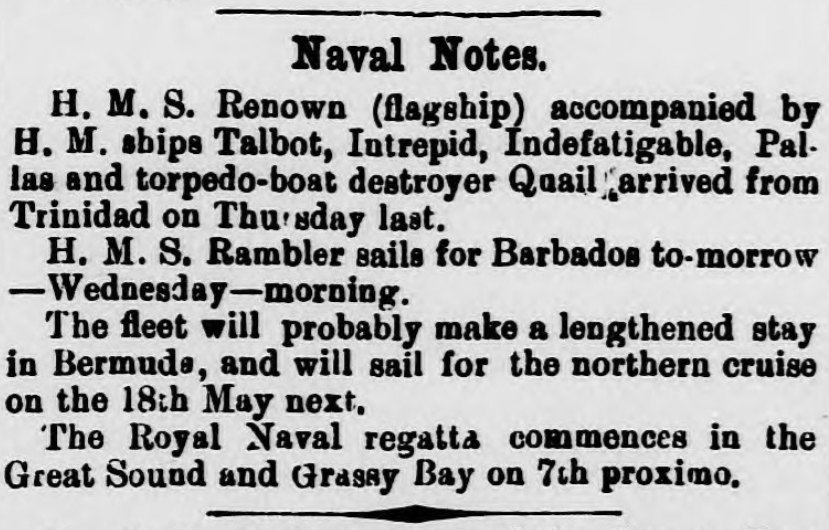
Royal Gazette Naval Notes: H.M.S. Renown (flagship) accompanied by H.M. ships Talbot, Intrepid, Indefatigable, Pallas and torpedo-boat destroyer Quail arrived from Trinidad on Thursday last. H.M.S. Rambler sails for Barbados to-morrow, Wednesday, morning. The fleet will probably make a lengthened stay in Bermuda, and will sail for the northern cruise on the 18th May next. The Royal Naval regatta commences in the Great Sound and Grassy Bay on 7th proximo
Royal Gazette, 22 February 1898: back from Trinidad, with the northern cruise set for 18 May
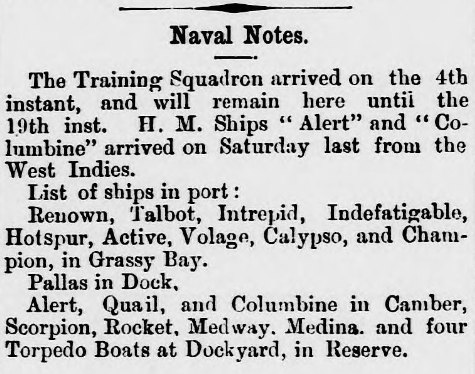
Royal Gazette Naval Notes: The Training Squadron arrived on the 4th instant and will remain here until the 19th instant. H.M. Ships Alert and Columbine arrived on Saturday last from the West Indies. List of ships in port: Renown, Talbot, Intrepid, Indefatigable, Hotspur, Active, Volage, Calypso and Champion, in Grassy Bay. Pallas in Dock. Alert, Quail and Columbine in Camber. Scorpion, Rocket, Medway, Medina and four Torpedo Boats at Dockyard, in Reserve
Royal Gazette, 8 March 1898: Intrepid at anchor in Grassy Bay

McDonald wrote and posted his card on Tuesday 1 March 1898. It was landed at Hamilton on Saturday 5 March, where the type H5 receiver went on the front. From there it was sent out to the Dockyard, and Ireland Island struck its own type H5 receiver the same day, right across the message.

The card found Intrepid at home. She had come back from the West Indies with Admiral Fisher’s flagship Renown and the rest of the squadron in mid-February, and the Naval Notes of 8 March list her at anchor in Grassy Bay with Renown, Talbot, Indefatigable and the visiting Training Squadron, which had arrived on the 4th.

McDonald had his timing right, too. In February the Gazette expected the fleet to make “a lengthened stay in Bermuda” and sail for the northern cruise on 18 May, which would have brought them up to Halifax just as he said.

IV

“When you come up to Halifax”

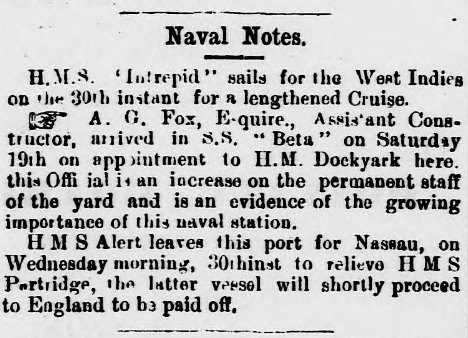
Royal Gazette Naval Notes: H.M.S. Intrepid sails for the West Indies on the 30th instant for a lengthened Cruise. A. G. Fox, Esquire, Assistant Constructor, arrived in S.S. Beta on Saturday 19th on appointment to H.M. Dockyard here. H.M.S. Alert leaves this port for Nassau on Wednesday morning, 30th instant, to relieve H.M.S. Partridge
Royal Gazette, 29 March 1898: Intrepid sails south “for a lengthened Cruise”
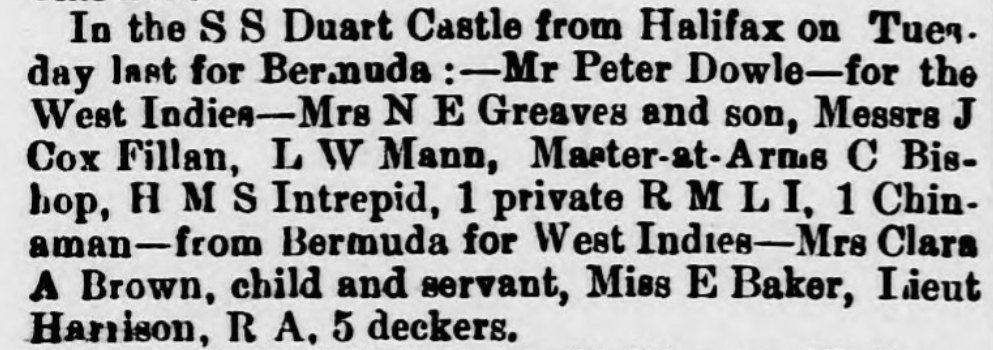
Royal Gazette passenger list: In the S.S. Duart Castle from Halifax on Tuesday last for Bermuda, Mr Peter Dowle; for the West Indies, Mrs N. E. Greaves and son, Messrs J. Cox Fillan, L. W. Mann, Master-at-Arms C. Bishop, H.M.S. Intrepid, 1 private R.M.L.I., and others; from Bermuda for West Indies, Mrs Clara A. Brown, child and servant, Miss E. Baker, Lieut. Harrison, R.A., 5 deckers
Royal Gazette, 28 June 1898: Intrepid’s Master-at-Arms on his way south to rejoin her

Intrepid had other plans. On 29 March the Gazette reported that she would sail “for the West Indies on the 30th instant for a lengthened Cruise”.

That spring the United States and Spain were heading for war over Cuba, and the Americans declared war in April. I suspect that’s why a British cruiser was wanted in the Caribbean, but I can’t prove it.

She was still down there in midsummer. At the end of June her Master-at-Arms, C. Bishop, came through Bermuda as a passenger in the steamer Duart Castle, which had left Halifax on 21 June bound for the West Indies.

So I doubt anyone in the Intrepid’s wardroom ever got to Halifax that year to order a tent. McDonald may well have spent his two cents for nothing.

Spring 1898

The ship on one side, the card on the other.

The ship
The card
17 Feb 1898
IntrepidBack at Bermuda from Trinidad with Renown and the squadron.
1 Mar
McDonaldWritten and posted at Halifax, uprated to 2 cents.
4 Mar
BermudaThe Training Squadron arrives.
5 Mar
BermudaHamilton and Ireland Island receivers, both type H5.
8 Mar
IntrepidAt anchor in Grassy Bay.
30 Mar
IntrepidSails for the West Indies “for a lengthened Cruise”.
18 May
FleetThe date set in February for the northern cruise.
21 Jun
IntrepidHer Master-at-Arms leaves Halifax in Duart Castle to rejoin her in the West Indies.

The Ship

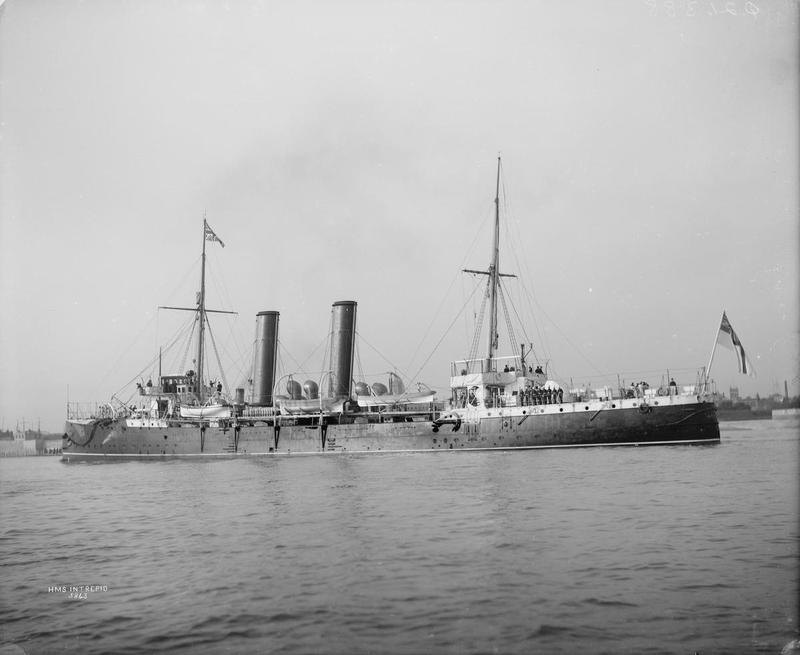
Photograph of HMS Intrepid in 1896 in her original configuration as an Apollo-class protected cruiser, with two funnels and two masts

H.M.S. Intrepid

Intrepid was an Apollo-class second-class protected cruiser, one of the many ordered under the Naval Defence Act of 1889. She was laid down by the London and Glasgow Shipbuilding Company at Govan in September 1889, launched on 20 June 1891 and completed in November 1892. She served on the North America and West Indies Station from 1896 to 1899, then went to the Mediterranean in 1902.

Before the First World War she was converted to a minelayer, and she laid mines with the Dover Patrol in 1914. In 1915–17 she was a depot ship in North Russia.

Her end is the famous part. In the Zeebrugge Raid of 23 April 1918, she was one of three old cruisers filled with concrete and scuttled as blockships in the entrance to the Bruges canal.

BuiltGovan, launched 1891
TypeApollo-class protected cruiser
Displacement3,600 tons
StationNorth America & West Indies, 1896–99
FateBlockship, Zeebrugge, 23 April 1918

HMS Intrepid in 1896. Imperial War Museum, IWM Q 21388, via Wikimedia Commons.

Still to find out

If you can help with any of these, I’d be very pleased to hear from you.

Provenance and references

It’s only a sales pitch on a penny postcard, but it shows how far the squadron’s trade reached, from a post office box in Halifax to a cruiser lying in Grassy Bay. I like to think McDonald sold a few tents that summer, even if none of them went to the Intrepid.