Postal History · Naval Concessionary Rate · Bermuda Station

H.M.S. Rambler

Ireland Island, Bermuda · 9 November 1898

A sailor’s penny letter home from Bermuda, posted six weeks before Imperial Penny Postage made the naval concession unnecessary.

◆

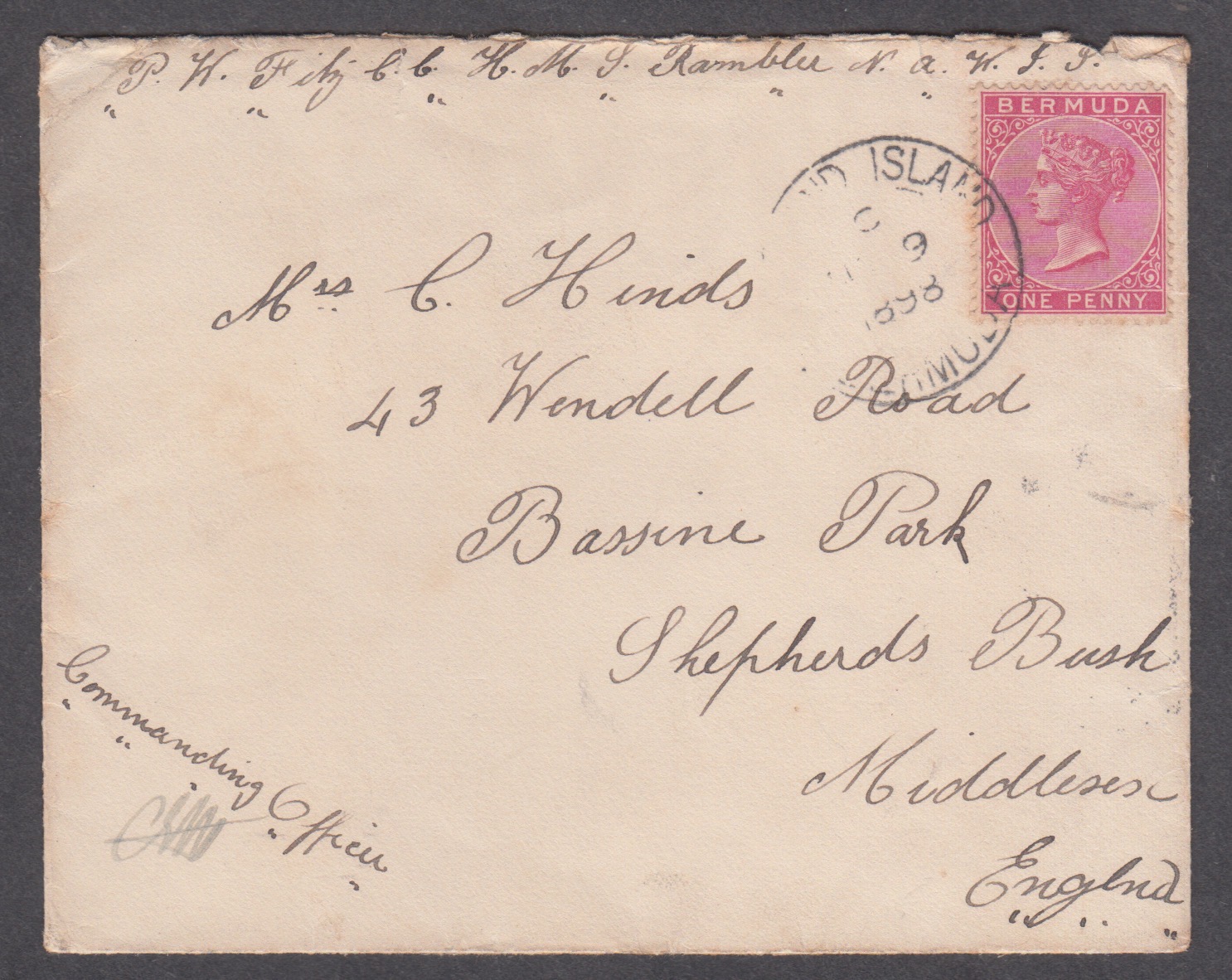
This is a naval concessionary rate cover, posted at Ireland Island, Bermuda, on 9 November 1898 and franked with a single 1d stamp. Along the top the sender has written his name and ship, “P. W. Fitz C.C. H.M.S. Rambler N.A. W.I.S.”, and at the lower left it has been endorsed “Commanding Officer” and initialled. Those two endorsements are what allowed a sailor to send a letter home for a penny. What makes this one special is the date: it was posted just six weeks before Imperial Penny Postage made the concession unnecessary, and only days before Rambler left Bermuda for West Africa.

I

A penny to send a letter home

1898 cover endorsed P. W. Fitz C.C. H.M.S. Rambler N.A. W.I.S., franked with a Bermuda one penny stamp with an Ireland Island datestamp alongside, addressed to Mrs C. Hinds, 43 Wendell Road, Bassine Park, Shepherd's Bush, Middlesex, England, and endorsed Commanding Officer with pencil initials at lower left
Endorsed by the sender, countersigned for the commanding officer, franked 1d
  • Posted Ireland Island, Bermuda, 9 November 1898
  • Received Shepherd’s Bush, 22 November 1898 (backstamp)
  • Rate 1d, naval concessionary rate
  • Sender Percy W. Fitz, Carpenter’s Crew, H.M.S. Rambler
  • Addressed to Mrs C. Hinds, 43 Wendell Road, Bassine Park, Shepherd’s Bush, Middlesex, England
  • Endorsed “P. W. Fitz C.C. H.M.S. Rambler N.A. W.I.S.”
  • Countersigned “Commanding Officer”, lower left, with pencil initials
  • Provenance ex George Ulrich, lot 51

The concession let serving sailors send letters home for a penny. The letter had to be endorsed with the sender’s name, rating and ship, and countersigned by his commanding officer, and this cover has both. “N.A. W.I.S.” is the North America and West Indies Station, where Bermuda was one of the principal bases.

What makes it worth a second look is the timing. Imperial Penny Postage came in on 25 December 1898, and Bermuda was part of it from the first day. From then on a letter could go to Britain for a penny, sailor or not, and the naval concession largely lost its point overnight. Covers using it this late aren’t common.

The month in the Ireland Island datestamp is faint, but the Shepherd’s Bush backstamp of 22 November settles it.
II

The Ramblers at Ireland Island

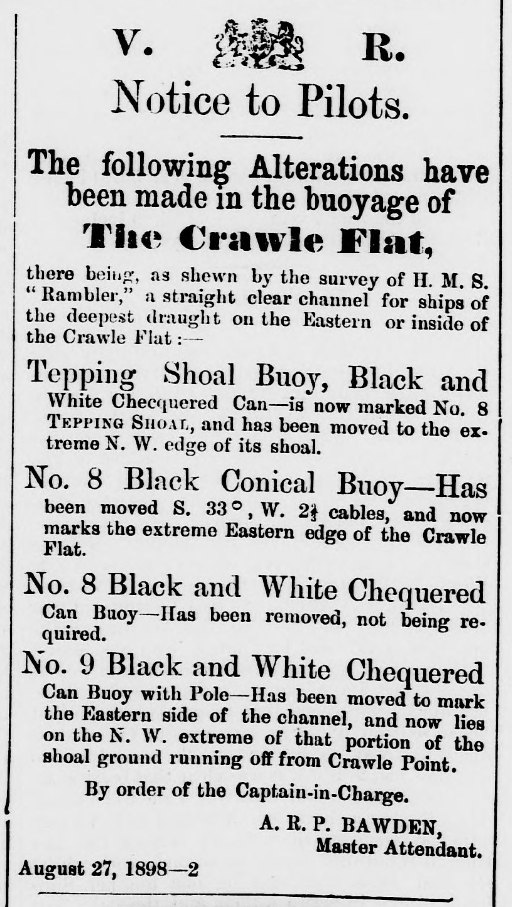
Royal Gazette Notice to Pilots dated August 27, 1898: alterations have been made in the buoyage of the Crawle Flat, there being, as shewn by the survey of H.M.S. Rambler, a straight clear channel for ships of the deepest draught on the Eastern or inside of the Crawle Flat; Tepping Shoal buoy, No. 8 black conical buoy and No. 9 chequered can buoy moved, No. 8 chequered can buoy removed; by order of the Captain-in-Charge, A. R. P. Bawden, Master Attendant
Royal Gazette, 6 September 1898: the Crawle Flat buoys moved after Rambler’s survey
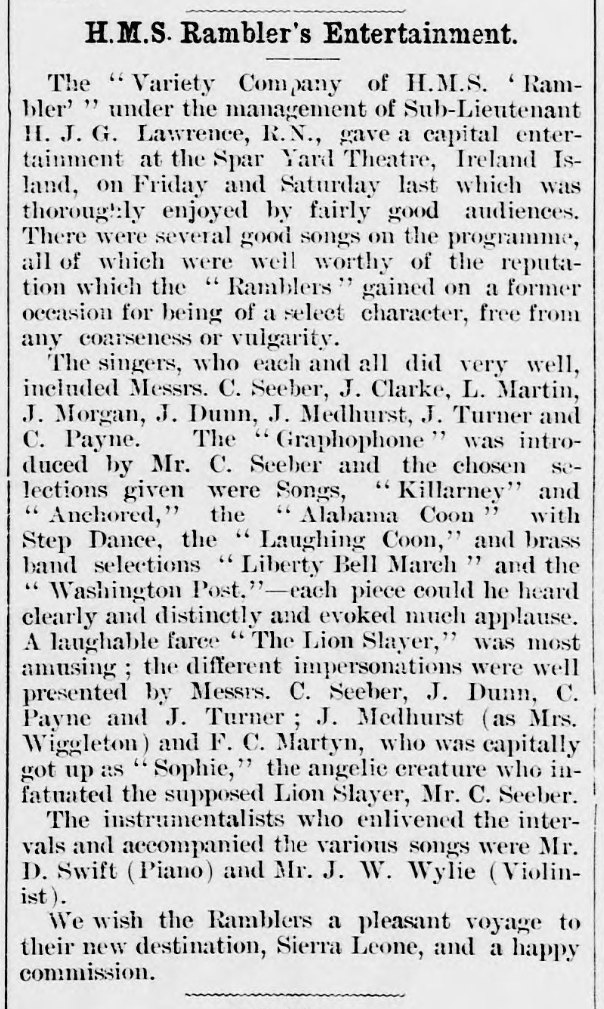
Royal Gazette report headed H.M.S. Rambler's Entertainment: the Variety Company of H.M.S. Rambler under Sub-Lieutenant H. J. G. Lawrence, R.N., gave a capital entertainment at the Spar Yard Theatre, Ireland Island, on Friday and Saturday last; songs, a Graphophone, a farce called The Lion Slayer, piano and violin; we wish the Ramblers a pleasant voyage to their new destination, Sierra Leone, and a happy commission
Royal Gazette, 15 November 1898: the Ramblers’ farewell concert

Rambler wasn’t just passing through Bermuda. In the summer of 1898 she had been surveying the island’s own waters, and on the strength of her survey the Master Attendant at the Dockyard moved the buoys around the Crawle Flat to mark “a straight clear channel for ships of the deepest draught” on the inside of the flat. The notice to pilots is dated 27 August and was still running in the Gazette on 6 September.

Then, on 15 November, the Gazette reported that the “Variety Company of H.M.S. Rambler”, under Sub-Lieutenant H. J. G. Lawrence, had put on two nights of entertainment at the Spar Yard Theatre at Ireland Island the previous Friday and Saturday, 11 and 12 November. There were songs, a farce called “The Lion Slayer”, and a Graphophone playing “The Washington Post” and the “Liberty Bell March”. The paper ended:

“We wish the Ramblers a pleasant voyage to their new destination, Sierra Leone, and a happy commission.”

So Percy Fitz posted his letter on Wednesday 9 November, two days before the concert. His name isn’t among the performers. He wrote to Mrs Hinds again on 21 November, so Rambler was still at Ireland Island then, and she must have sailed for West Africa a few days later.

III

Who was P. W. Fitz?

I read the “C.C.” after his name as Carpenter’s Crew. This was a recognised Royal Navy rating for the men working under the ship’s carpenter on maintenance and repair of the vessel.

He was a regular letter writer. David Cordon’s Bermuda cover census records five covers from Percy Fitz in 1898, all sent from Rambler at Bermuda at the penny rate. Two are dated 23 January, one of them to Mr Colton Hinds at 20 Cathnor Road, Shepherd’s Bush, only a few streets from Wendell Road. The other three went to Mrs C. Hinds at 43 Wendell Road in October and November, mine among them. The last, posted on 21 November, is believed to be the latest recorded naval concessionary cover from Bermuda.

The 1908 Navy List records a Percy Fitz serving as Carpenter aboard HMS Perseus. I can’t yet prove it’s the same man, but the name and the career fit well. If it is him, the young man in Rambler’s carpenter’s crew had risen to the warrant rank of Carpenter within ten years.

I haven’t yet worked out who Mrs C. Hinds was, or how she and Colton Hinds were connected to Percy. The obvious guess is that she was Colton Hinds’s wife, but I can’t prove it.

The Ship

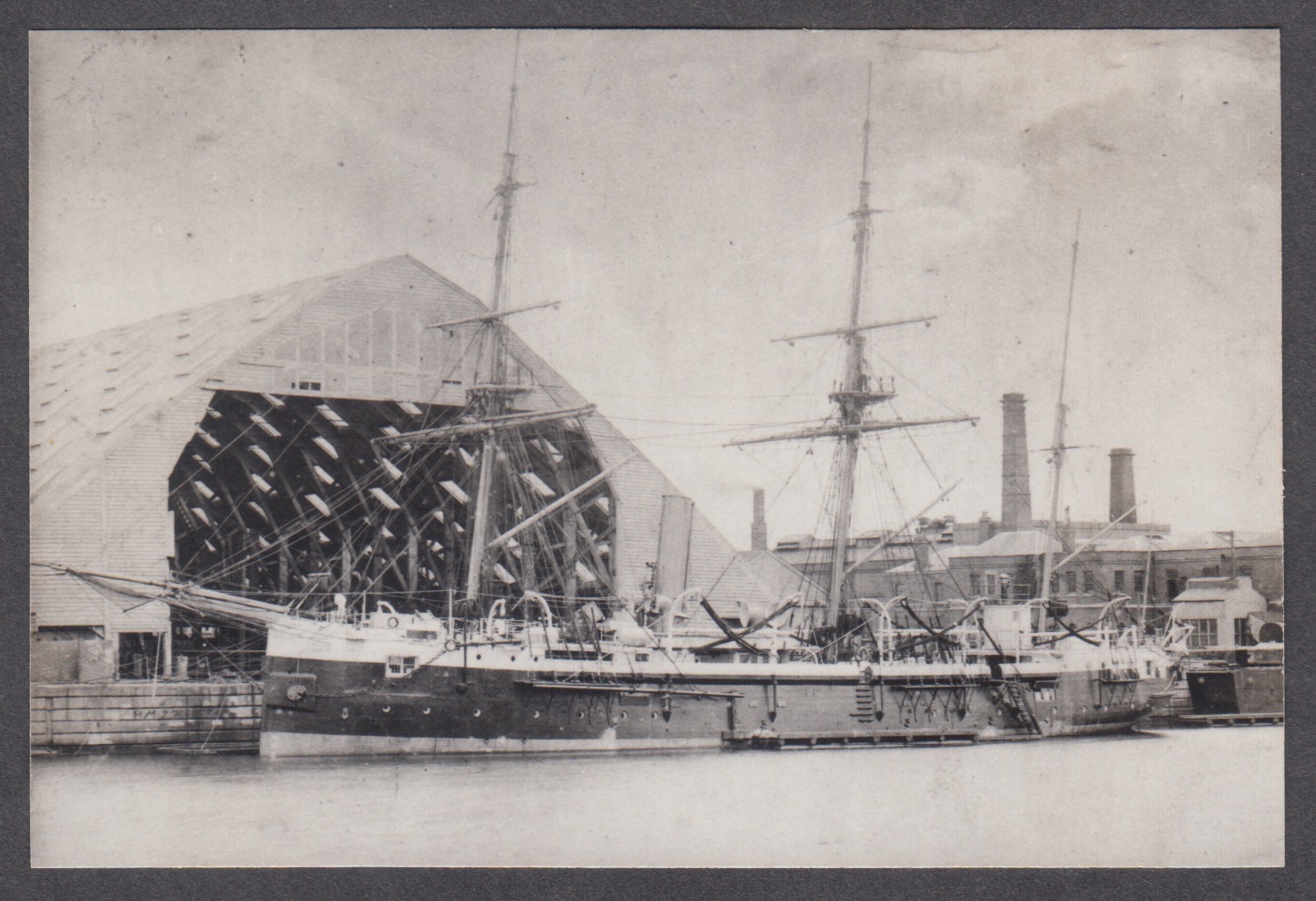
Photograph of HMS Rambler alongside in a dockyard, a three-masted gunvessel with a single funnel, with a large covered slipway behind her and dockyard chimneys to the right

H.M.S. Rambler

Rambler was built by John Elder & Co. at Glasgow and launched on 26 January 1880, one of three Algerine-class composite gunvessels. She was completed as a survey ship instead and commissioned in 1884, and she spent the rest of her career surveying, in the Red Sea, on the China coast and in Western Australia.

Commander Herbert Edward Purey-Cust, an experienced hydrographic surveyor who went on to become Hydrographer of the Navy, took command at the end of 1897. Under him she surveyed on the North America and West Indies Station: Bermuda’s own waters, and the Serpent’s Mouth off Trinidad, charted in 1898. In late November 1898 she left Bermuda for Sierra Leone and the West African coast. In 1899–1900 she was at the Cape during the Boer War, where some of her men served ashore in the naval brigade at Graspan and Magersfontein. She was sold on 23 January 1907.

BuiltJohn Elder & Co., Glasgow, launched 1880
TypeAlgerine-class composite gunvessel, completed as a survey ship
Guns / DisplacementFour 20-pdr BL; 835 tons
CommanderH. E. Purey-Cust, from late 1897
FateSold 23 January 1907

Photographer not identified.

Still to find out

If you can help with any of these, I’d be very pleased to hear from you.

Provenance and references

It’s a small cover, but it sits right at the end of a postal privilege that sailors had relied on for generations, and it catches Rambler’s men in their last days at Bermuda before they sailed for Sierra Leone. There’s still more to find out about Percy Fitz and the Hinds family, and my research continues.