Postal History · Royal Navy · Concessionary Rate

H.M.S. Northampton

Bermuda · 1880 – 1883

A letter in, a letter out, and a bandsman’s twopence.

◆

HMS Northampton was the flagship of the North America and West Indies Station from 1879 to 1886, summering at Halifax and wintering at Bermuda. I have two covers from her. One came out from London in March 1880 to a young lieutenant just back from the Arctic. The other went home from Ireland Island in November 1881, written by one of the ship’s bandsmen and paid at a rate that had only been in place since 1880.

I

To Lieutenant Egerton

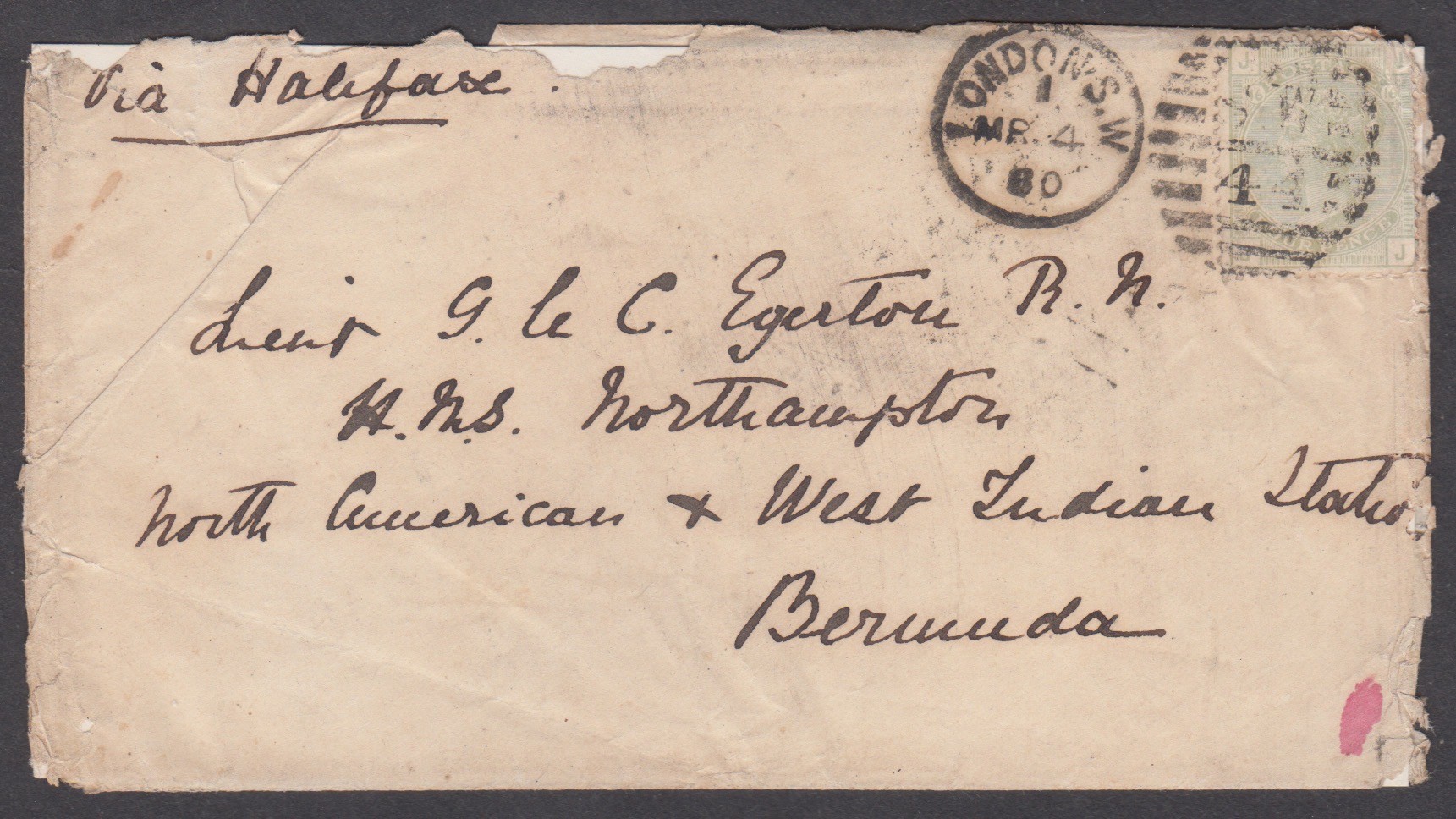
Worn envelope addressed to Lieut. G. le C. Egerton R.N., H.M.S. Northampton, North American and West Indian Station, Bermuda, endorsed Via Halifax at top left, with a Great Britain 4d sage-green stamp cancelled by a London S.W. duplex dated MR 4 80
Posted in London S.W., 4 March 1880, endorsed “Via Halifax”
  • Posted London S.W., 4 March 1880
  • Franking Great Britain 4d sage-green, the ordinary letter rate to Bermuda
  • Postmark LONDON S.W. duplex, MR 4 80
  • Route endorsed “Via Halifax”
  • Addressed to Lieut. G. le C. Egerton R.N., H.M.S. Northampton, North American & West Indian Station, Bermuda

This envelope was posted in London S.W. on 4 March 1880, paid 4d (the ordinary letter rate to Bermuda at the time) and endorsed “Via Halifax”. It is addressed to “Lieut. G. le C. Egerton R.N., H.M.S. Northampton, North American & West Indian Station, Bermuda”.

George Le Clerc Egerton had gone north as a sub-lieutenant in the Alert on Nares’s Arctic Expedition of 1875–76, and was promoted lieutenant while the expedition was away. By 1880 he was serving in the flagship of another Arctic man: Vice-Admiral Sir Leopold McClintock, who had found the first firm evidence of the fate of the Franklin expedition. His captain was John Fisher, the “Jacky” Fisher who would later rebuild the Royal Navy. Egerton went on to become Second Sea Lord, and Commander-in-Chief at Plymouth during the First World War.

The cover is worn and opened out, but it has made it through 146 years. As an officer’s letter it paid the full 4d. The men had cheaper rates, as the next cover shows.
II

From G. Wicks, Band

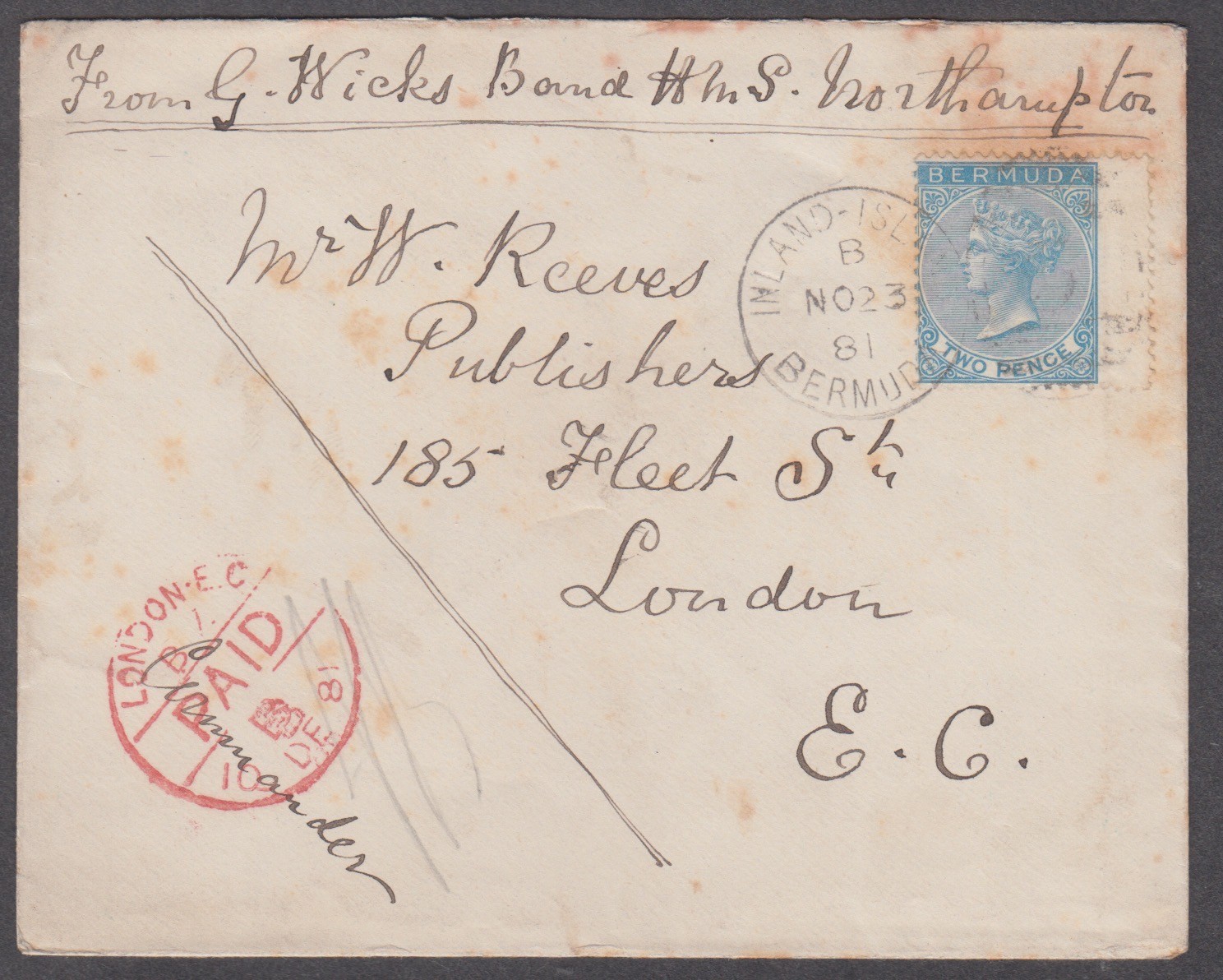
Envelope headed From G. Wicks Band H.M.S. Northampton, addressed to Mr W. Reeves, Publishers, 185 Fleet St., London E.C., with a wing-margin Bermuda 2d bright blue cancelled by an INLAND-ISL B NO 23 81 Bermuda datestamp, a red London E.C. Paid datestamp of 10 December 1881 at lower left, and the countersignature Commander
Ireland Island to London, 23 November 1881
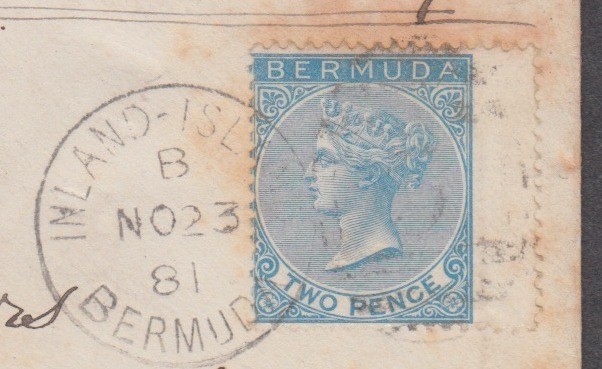
Close-up of the datestamp lettered INLAND-ISL, B, NO 23, 81, BERMUDA, beside the 1877 2d bright blue with its wing margin at right
The INLAND-ISL datestamp and the wing-margin 2d
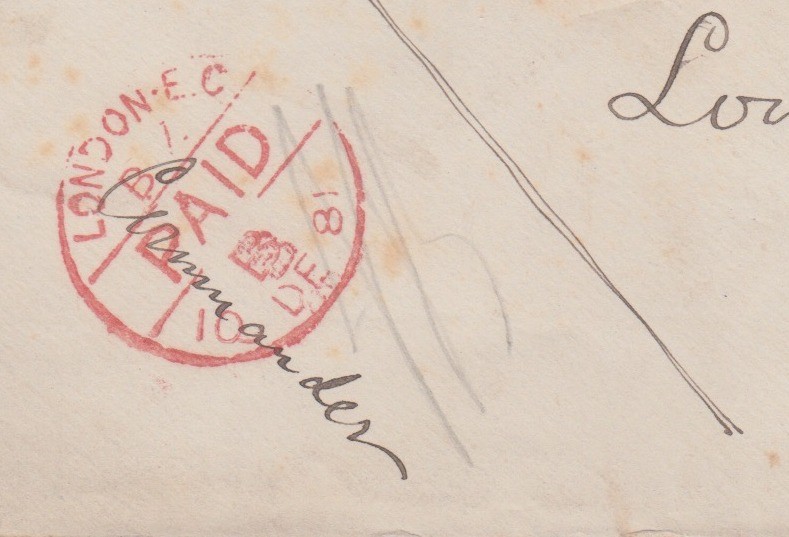
Close-up of the countersignature Commander in ink, with the red London E.C. Paid datestamp of 10 December 1881 struck over it
“Commander”, with the London Paid struck over it
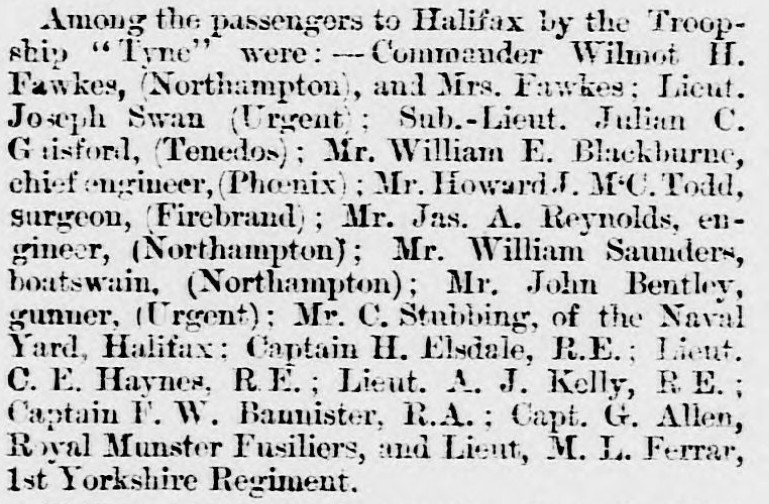
Royal Gazette list of passengers to Halifax by the troopship Tyne, beginning Commander Wilmot H. Fawkes, (Northampton), and Mrs. Fawkes, and including Mr Jas. A. Reynolds, engineer, and Mr William Saunders, boatswain, both of the Northampton
Royal Gazette, 18 July 1882: “Commander Wilmot H. Fawkes, (Northampton)”
  • Posted Ireland Island, Bermuda, 23 November 1881
  • Rate 2d privilege rate via New York: 1d sailor’s rate plus 1d United States transfer charge
  • Franking 1877 wing-margin 2d bright blue
  • Datestamp INLAND-ISL / B / NO 23 / 81 / BERMUDA
  • Endorsement “From G. Wicks Band H.M.S. Northampton”
  • Countersigned “Commander”
  • Arrival red LONDON E.C. PAID, 10 December 1881
  • Addressed to Mr W. Reeves, Publishers, 185 Fleet St., London E.C.

This is the rarer of the two, and one of the more unusual naval covers in my collection. It is headed “From G. Wicks Band H.M.S. Northampton”, countersigned “Commander” in the lower left, and franked with an 1877 wing-margin 2d bright blue. It was datestamped at Ireland Island on 23 November 1881, and the red London Paid arrival is dated 10 December.

The 2d is the point. It is the sailors’ privilege rate by the New York route, made up of two parts: the 1d sailor’s rate, plus a further 1d United States transfer charge for carrying the letter through New York (Ludington, p. 121). By packet via Halifax or St. Thomas the same letter would have cost just the 1d. Covers paid at this 2d rate are very seldom seen. Seventeen days from Ireland Island to London fits the New York route.

The countersignature reads simply “Commander”: the ship’s commander, her second-in-command, rather than the captain. In November 1881 that was Wilmot H. Fawkes. The Royal Gazette has him arriving from New York in April 1880, travelling to Halifax in July 1882 as “Commander Wilmot H. Fawkes, (Northampton)”, and still listed as the flagship’s commander that October, when Sir John Commerell’s staff was announced. He later rose to Admiral Sir Wilmot Fawkes.

Beside the countersignature are some light pencil strokes. I wonder whether they are his initials, W.H.F., added quickly in the way an officer signing many such letters might, but I can’t be sure.

The endorsement tells us who wrote it: G. Wicks, of the ship’s band. His letter went to Mr W. Reeves, Publisher, at 185 Fleet Street. William Reeves had opened his shop there in 1875 and built a business largely around music, eventually publishing more than 300 books on the subject; the same address was home to The Musical Standard. What a bandsman in the flagship wanted from a London music publisher we will never know, but it is easy to imagine. A ship’s band at Ireland Island in 1881 would have been hungry for new music.

The datestamp reads INLAND-ISL, not Ireland Island. Horst Augustinovic records that the G.P.O. supplied a handstamp inscribed “Inland Island” in 1879, and that it was replaced about ten years later with a new IRELAND ISLAND handstamp. This is a clear, complete strike on cover.

III

The twopenny rate

Sailors’ and soldiers’ letters to England, countersigned by the commanding officer, went by British packet via Halifax or St. Thomas at the 1d concessionary rate. There was also a fortnightly service via New York, which was faster. A G.P.O. letter of 8 January 1880, referred to the Executive Council in Bermuda on 23 April, held that letters by the New York route had to be prepaid at the full 4d per half ounce.

Admiral Sir Edward Inglefield, McClintock’s predecessor as Commander-in-Chief, had already objected on the men’s behalf. As a result, the rate via New York was reduced to 2d, in line with the rate in the other direction and with other routes where soldiers’ and sailors’ mail passed through a foreign country. The rate existed because of Inglefield, but the first sailors to use it were McClintock’s, and the Wicks cover is one of them.

The Egerton letter, as it happens, was posted in London while the G.P.O. letter was still working its way through the Bermuda system.

The flagship and her letters

The ship on one side, the letters on the other.

The ship
The letters
25 Sep 1879
NorthamptonJohn Fisher becomes flag captain to McClintock.
8 Jan 1880
G.P.O.Letter to Bermuda: 4d by the New York route.
4 Mar 1880
EgertonPosted in London S.W., via Halifax.
23 Apr 1880
BermudaThe G.P.O. letter goes before the Executive Council.
5 Nov 1881
NorthamptonAnchors in Grassy Bay from Halifax.
23 Nov 1881
WicksDatestamped INLAND-ISL, paid 2d.
8 Dec 1881
NorthamptonHer search party takes two men off the Orinoco.
10 Dec 1881
WicksLondon Paid, on its way to Fleet Street.
27 Dec 1881
NorthamptonSails for the West Indies with McClintock.
30 Nov 1883
NorthamptonDrags her anchor and grounds at Stagg’s Channel.
3 Dec 1883
CanadaTows her off, “no material damage”.
IV

Northampton in Bermuda

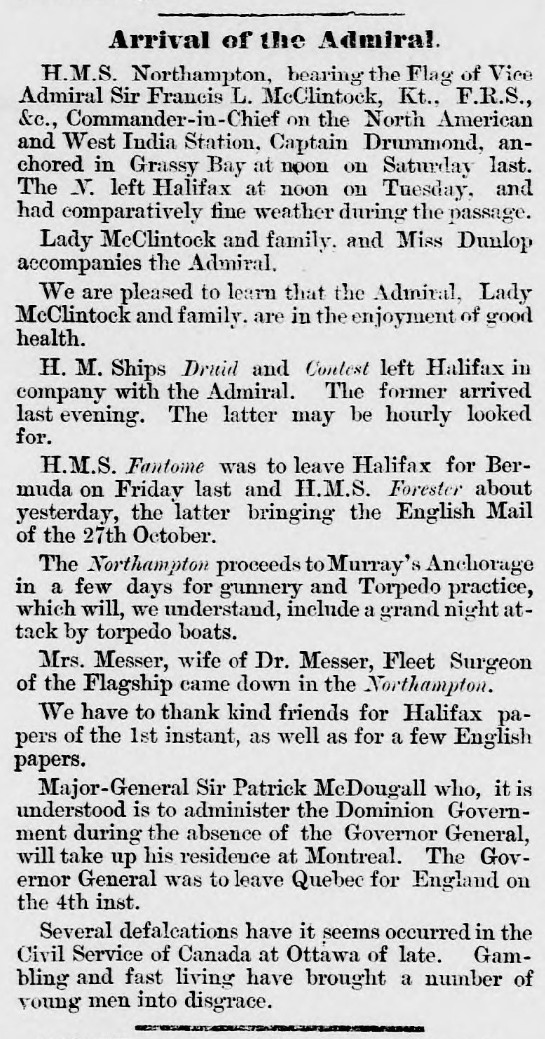
Royal Gazette report headed Arrival of the Admiral: H.M.S. Northampton, bearing the flag of Vice Admiral Sir Francis L. McClintock, Captain Drummond, anchored in Grassy Bay at noon on Saturday last, with Lady McClintock and family, and will proceed to Murray's Anchorage for gunnery and torpedo practice including a grand night attack by torpedo boats
Royal Gazette, 8 November 1881: “Arrival of the Admiral”
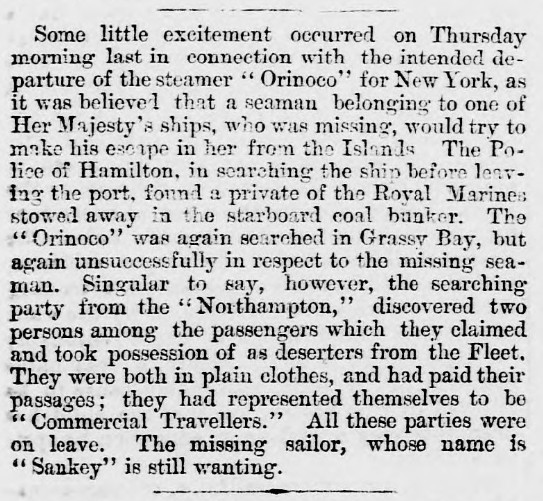
Royal Gazette paragraph: excitement over the departure of the steamer Orinoco for New York; a Royal Marine found stowed away in the coal bunker; the searching party from the Northampton found two men among the passengers in plain clothes, claimed as deserters from the Fleet; the missing sailor Sankey still wanting
Royal Gazette, 13 December 1881: the search of the Orinoco
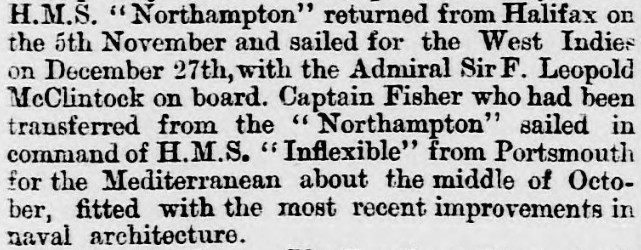
Royal Gazette paragraph: H.M.S. Northampton returned from Halifax on the 5th November and sailed for the West Indies on December 27th with Admiral Sir F. Leopold McClintock; Captain Fisher, transferred from the Northampton, sailed in command of H.M.S. Inflexible from Portsmouth for the Mediterranean
Royal Gazette, 10 January 1882: sailing, and Captain Fisher
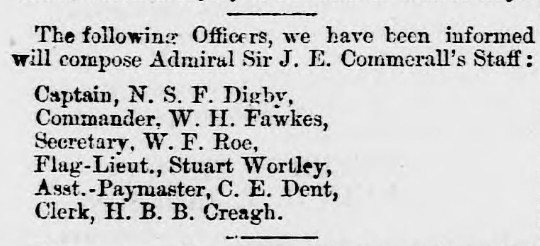
Royal Gazette list of the officers who will compose Admiral Sir J. E. Commerell's staff: Captain N. S. F. Digby; Commander W. H. Fawkes; Secretary W. F. Roe; Flag-Lieutenant Stuart Wortley; Assistant Paymaster C. E. Dent; Clerk H. B. B. Creagh
Royal Gazette, 31 October 1882: Admiral Commerell’s staff
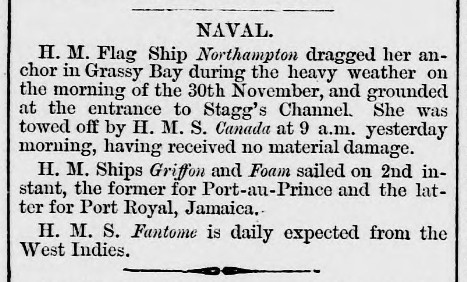
Royal Gazette naval notes: H.M. Flag Ship Northampton dragged her anchor in Grassy Bay during the heavy weather on the morning of the 30th November and grounded at the entrance to Stagg's Channel; she was towed off by H.M.S. Canada at 9 a.m. yesterday morning, having received no material damage
Royal Gazette, 4 December 1883: aground at Stagg’s Channel

The Royal Gazette followed the flagship closely. Five reports give a feel for her time at Bermuda.

8 November 1881. “Arrival of the Admiral”. Northampton, flying McClintock’s flag, Captain Drummond, anchored in Grassy Bay at noon on Saturday 5 November after a fair passage from Halifax. Lady McClintock and the family came with him. The ship was soon to go to Murray’s Anchorage for gunnery and torpedo practice, including “a grand night attack by torpedo boats”. Wicks posted his letter eighteen days later.

13 December 1881. When the steamer Orinoco was about to sail for New York, a sailor called Sankey was missing and thought to be trying to get away in her. The Hamilton police searched her and found a Royal Marine stowed away in the coal bunker instead. She was searched again in Grassy Bay. Northampton’s search party did not find Sankey either, but took off two men among the passengers whom they claimed as deserters from the Fleet: in plain clothes, passages paid, and passing themselves off as “Commercial Travellers”. All of them were on leave. Sankey was “still wanting”.

10 January 1882. The flagship sailed for the West Indies on 27 December with McClintock aboard. The same report notes that Captain Fisher, “transferred from the Northampton”, had taken the new Inflexible out to the Mediterranean.

31 October 1882. The Gazette reported that McClintock would take the flagship from Halifax in the middle of November straight to Antigua, where she would be recommissioned and handed over to the new Commander-in-Chief, Sir John Commerell, coming out from England in the mail steamer Nepaul. The paper was plainly put out: “The change of winter rendezvous of the fleet will be a serious injury to Bermuda in various ways.” Commerell’s staff was listed underneath: Captain N. S. F. Digby, and as Commander, W. H. Fawkes, staying on in the flagship.

4 December 1883. By now flying the flag of Vice-Admiral Sir John Commerell VC, Northampton dragged her anchor in Grassy Bay in heavy weather on the morning of 30 November and grounded at the entrance to Stagg’s Channel. She stayed there until the morning of 3 December, when HMS Canada towed her off, “having received no material damage”.

The Ship

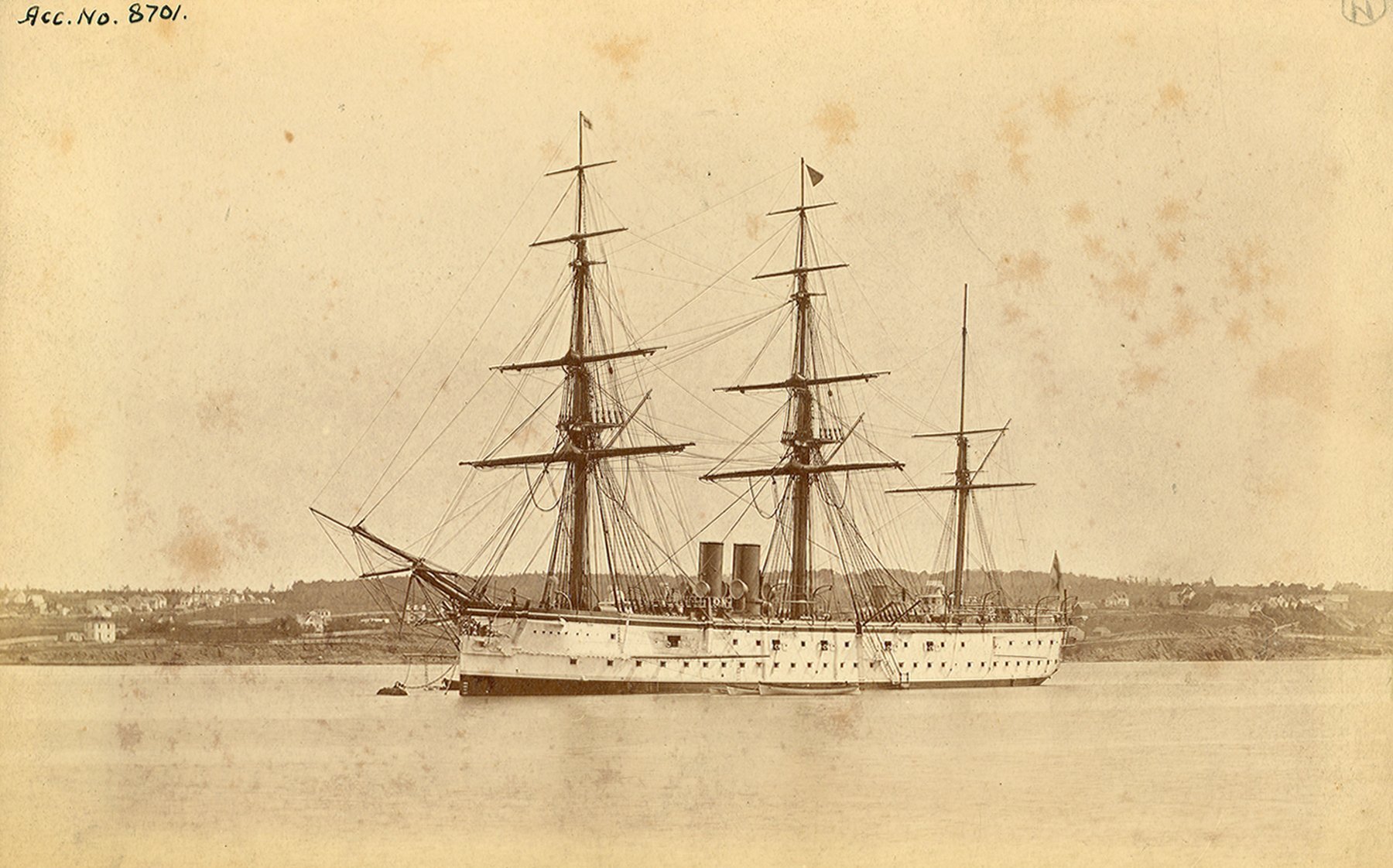
Photograph of HMS Northampton, painted white with a black boot-topping, three masts with yards crossed and two funnels, moored off the Dockyard at Halifax, Nova Scotia, about May 1880

H.M.S. Northampton

HMS Northampton was a Nelson-class armoured cruiser, built by Robert Napier & Sons at Govan and launched on 18 November 1876. She went out to the North America and West Indies Station as flagship in 1879 and stayed until 1886, summering at Halifax and wintering at Bermuda. She later became a boys’ training ship, and was sold for breaking up in 1905.

BuiltRobert Napier & Sons, Govan; launched 18 November 1876
TypeArmoured cruiser, Nelson class
DisplacementAbout 7,600 tons
Complement560
FlagshipNorth America and West Indies, 1879–1886
FateTraining ship, 1894; sold 1905

Northampton, flagship of Vice-Admiral Sir F. Leopold McClintock, moored off the Dockyard at Halifax, about May 1880. Notman Studio, Nova Scotia Archives.

Provenance and references