Postal History · Royal Navy · Naval Stationery

H.M.S. Emerald

Ireland Island · Bermuda · 5 May 1887

A cover on the ship’s own crested stationery, datestamped at Ireland Island on the day Emerald sailed for Halifax.

◆

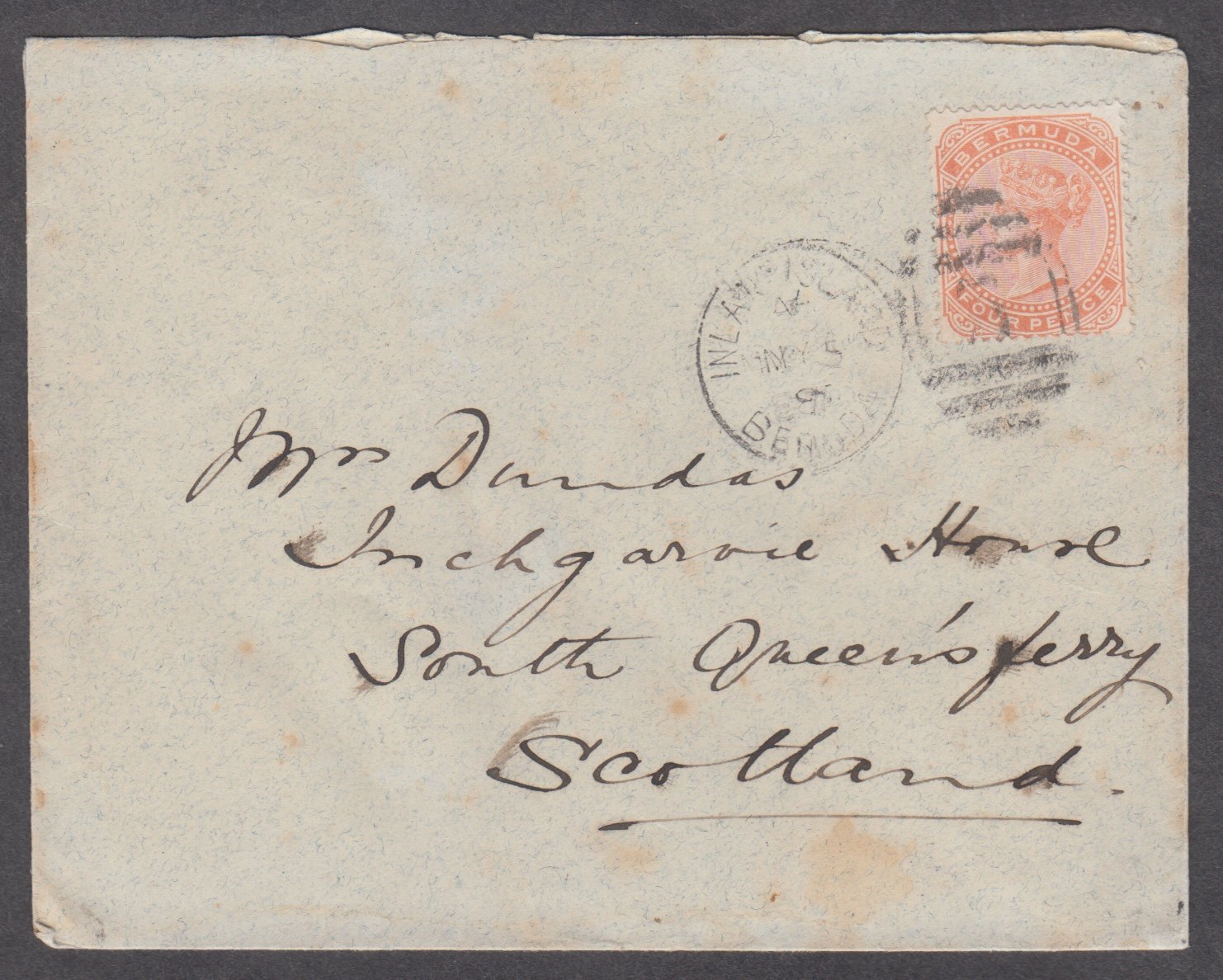
This envelope was posted at Ireland Island on 5 May 1887, addressed to Mrs Dundas at Inchgarvie House, South Queensferry, Scotland. On the back is the printed crest of HMS Emerald: a crown above a winged harp, a fitting device for a ship named after the Emerald Isle. The datestamp reads INLAND ISLAND rather than Ireland Island, which alone makes it a cover worth having. But the date turned out to be the more interesting part. The Royal Gazette shows that Emerald left Bermuda for Halifax and Newfoundland that same day.

I

The cover

Envelope addressed to Mrs Dundas, Inchgarvie House, South Queensferry, Scotland, franked with a Bermuda 4d orange cancelled by a barred numeral, with an INLAND ISLAND BERMUDA datestamp of 5 May 1887 alongside
Front: the 4d orange and the INLAND ISLAND datestamp
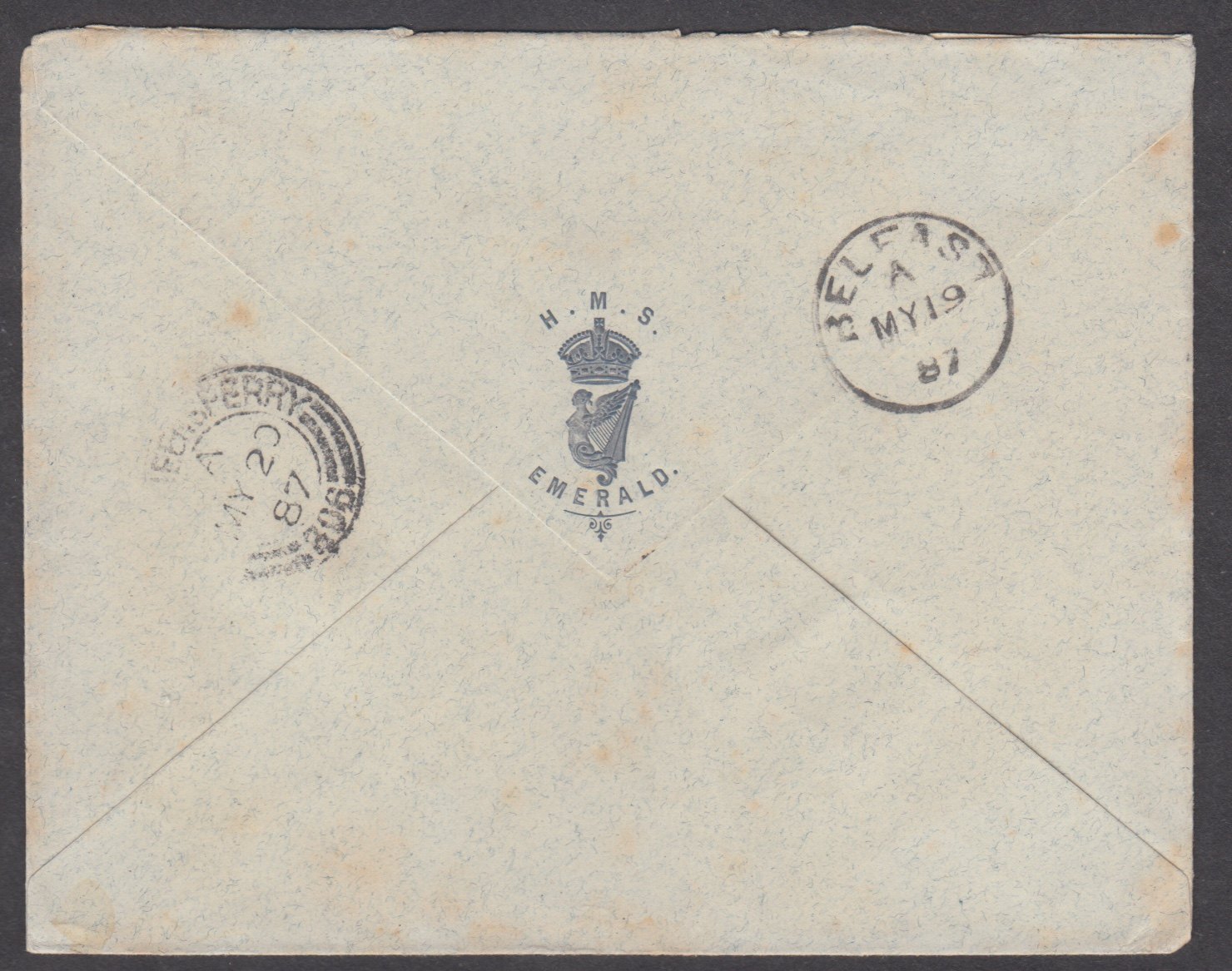
Reverse of the envelope with the printed crest of HMS Emerald in blue on the flap, a South Queensferry datestamp of 20 May 1887 at left and a Belfast datestamp of 19 May 1887 at right
Reverse: the Emerald crest, with Belfast and South Queensferry datestamps
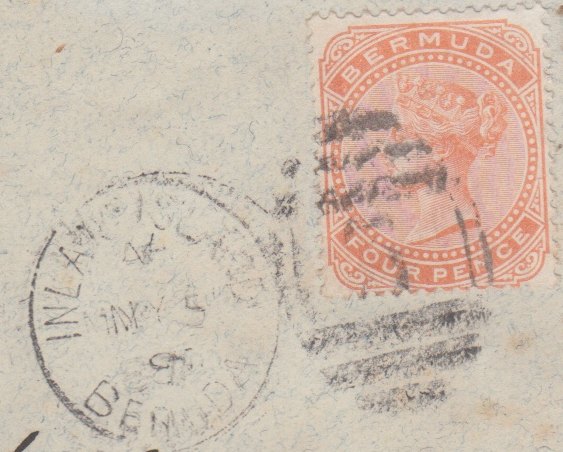
Close-up of the datestamp lettered INLAND ISLAND, MY 5 87, BERMUDA, beside the 4d orange cancelled by a barred numeral
INLAND ISLAND, an island that didn’t exist
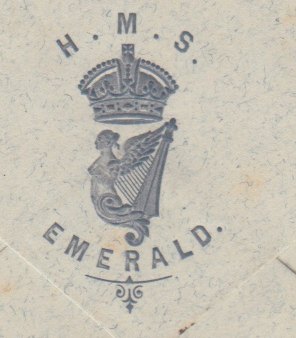
Close-up of the crest: H.M.S. above a crown, a winged harp below, and EMERALD on a curve beneath
The crest of HMS Emerald
  • Posted Ireland Island, Bermuda, 5 May 1887
  • Franking 4d orange, the ordinary letter rate to the United Kingdom
  • Obliterator barred numeral, with the INLAND ISLAND / BERMUDA datestamp, MY 5 87
  • Transit Belfast, 19 May 1887, on the reverse
  • Arrival South Queensferry, 20 May 1887, on the reverse
  • Stationery printed crest of H.M.S. Emerald on the back flap
  • Addressed to Mrs Dundas, Inchgarvie House, South Queensferry, Scotland

The 4d orange is cancelled by a barred numeral, struck alongside a datestamp that reads INLAND ISLAND. It’s the same mistake I wrote about on my HMS Northampton page, where it appears on a bandsman’s cover of 1881. Horst Augustinovic records that the G.P.O. supplied the handstamp in 1879, and that it was replaced about ten years later with a correctly lettered one. So for close to a decade, letters from the Dockyard went out marked for an island that didn’t exist. This strike is from 1887, late in its life.

The 4d paid the full letter rate. Sailors could send letters home at the concessionary rate, but there is no endorsement or countersignature here. Taken with the ship’s crested stationery, that suggests the sender was one of Emerald’s officers, though I can’t yet say which.

On the reverse are a Belfast transit of 19 May and the South Queensferry arrival of 20 May, fifteen days after the cover left Ireland Island.
II

The journey

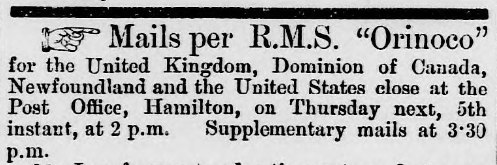
Notice: Mails per R.M.S. Orinoco for the United Kingdom, Dominion of Canada, Newfoundland and the United States close at the Post Office, Hamilton, on Thursday next, 5th instant, at 2 p.m. Supplementary mails at 3.30 p.m.
Royal Gazette, 3 May 1887: the Orinoco mails close on the 5th
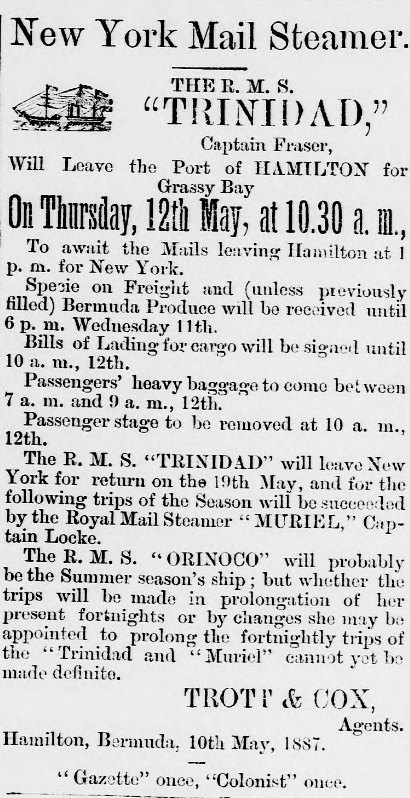
Advertisement by Trott and Cox, agents, for the New York mail steamer R.M.S. Trinidad leaving Hamilton for Grassy Bay on Thursday 12th May, noting that the R.M.S. Orinoco will probably be the summer season's ship
Royal Gazette, 10 May 1887: the Orinoco as “the Summer season’s ship”

On 3 May the Royal Gazette gave notice that mails by R.M.S. Orinoco for the United Kingdom, Canada, Newfoundland and the United States would close at the Post Office in Hamilton on Thursday 5 May at 2 p.m., with supplementary mails at 3.30. This cover was datestamped at Ireland Island that day, so it almost certainly went to New York in the Orinoco.

5 May was also the day Emerald sailed for Halifax and Newfoundland. I think it likely the cover came ashore with the ship’s mail as she left, much like my Woodlark cover of 1873, but I can’t prove it.

The Orinoco was one of the New York mail steamers. A week later the agents, Trott & Cox, were advertising her running mate, the Trinidad, for 12 May. They added that the Orinoco would “probably be the Summer season’s ship”.

From New York the cover crossed the Atlantic by a steamer I haven’t yet identified. It passed through Belfast on 19 May and reached South Queensferry the next day. That’s an unusual way into Scotland. It may have been landed in the north of Ireland by a steamer bound for Glasgow, or come ashore further south and travelled north by rail. Either way, it went the short sea route across to Scotland, and I hope to find out which ship brought it over.

Ireland Island to South Queensferry

The ship on one side, the cover on the other.

The ships
The cover
3 May
BellerophonThe flagship returns to Bermuda from the West Indies.
The mailsThe Gazette gives notice that the Orinoco mails close on Thursday 5 May.
5 May
EmeraldSails for Halifax and Newfoundland with Lily and Bullfrog.
The coverDatestamped INLAND ISLAND. The Orinoco mails close at 2 p.m.
10 May
EmeraldReaches Halifax.
19 May
The coverPasses through Belfast.
20 May
The coverArrives at South Queensferry.
22 May
EmeraldArrives at St John’s, Newfoundland, under Captain Hammond.
III

Emerald at Bermuda

Royal Gazette: Vice Admiral Lyons leaves Halifax for Bermuda on the 26th in the Bellerophon, accompanied by the Tourmaline, Emerald, Lilly and Mallard
Royal Gazette, 19 October 1886
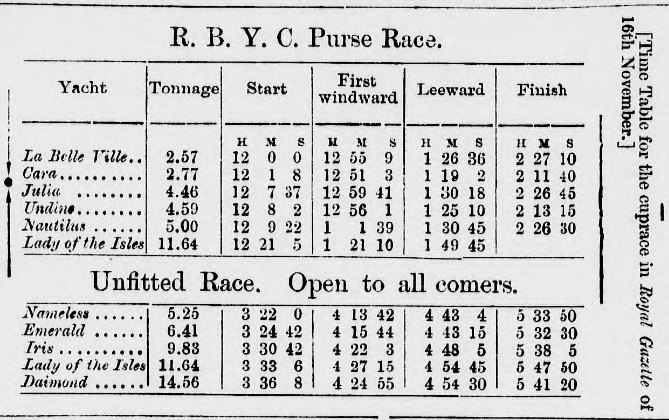
Time table for the R.B.Y.C. Purse Race and the Unfitted Race open to all comers, listing Nameless, Emerald, Iris, Lady of the Isles and Diamond with their tonnage and times
Royal Gazette, 30 November 1886: the race times
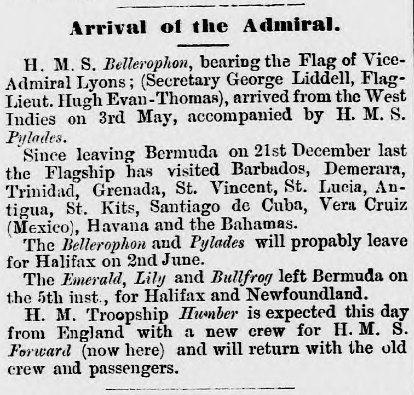
Royal Gazette report headed Arrival of the Admiral: HMS Bellerophon arrived from the West Indies on 3rd May; the Emerald, Lily and Bullfrog left Bermuda on the 5th instant for Halifax and Newfoundland
Royal Gazette, 10 May 1887: Emerald sails on the 5th

The Royal Gazette followed the squadron’s movements closely, and Emerald turns up regularly.

October 1886. The Gazette reported that Vice-Admiral Lyons would leave Halifax for Bermuda on the 26th in his flagship Bellerophon, with Tourmaline, Emerald, Lily and Mallard in company.

November 1886. On Wednesday 17 November the regatta included an “unfitted” race, open to all comers and meant for the ordinary sailing craft of the colony. Entries were disappointingly few, and a correspondent signing himself “North Side” wrote that the Government boats came to the rescue. Hamilton favoured the Nameless, but the Dockyard was confident the Emerald would win, and it was right. Captain Short’s boat gained on Nameless steadily from start to finish and passed her about halfway up the final beat. The result, as he put it: “Emerald first, Nameless a good second, the rest—somewhere!” The published times show Emerald crossing the line eighty seconds ahead, having started nearly three minutes behind her. I can’t be sure whether this Emerald was one of the ship’s own boats or a Dockyard boat that shared her name, but I like to think the ship had a hand in it.

December 1886. On 21 December the squadron sailed for Barbados: Bellerophon, Comus, Emerald, Tourmaline, Pylades, Canada and Lily. The flagship’s cruise took her to Demerara, Trinidad, Grenada, St Vincent, St Lucia, Antigua, St Kitts, Santiago de Cuba, Vera Cruz, Havana and the Bahamas before she returned to Bermuda on 3 May 1887.

May 1887. Two days later, on 5 May, Emerald sailed for Halifax and Newfoundland with Lily and Bullfrog. She was at Halifax by the 10th and reached St John’s on 22 May under Captain Hammond.

October to December 1887. At the end of the summer the Gazette expected Emerald to leave Halifax with the flagship on 29 October. In the event Bellerophon left without her. Emerald stayed on at Halifax until 12 November, and when she did arrive she brought the latest news. The Gazette of 22 November thanked her, and the tug Britannia from New York, for papers dated to the previous Tuesday. On 29 December 1887 she sailed for the West Indies again with Bellerophon and Tourmaline.

IV

Lieutenant Claude Lindsay

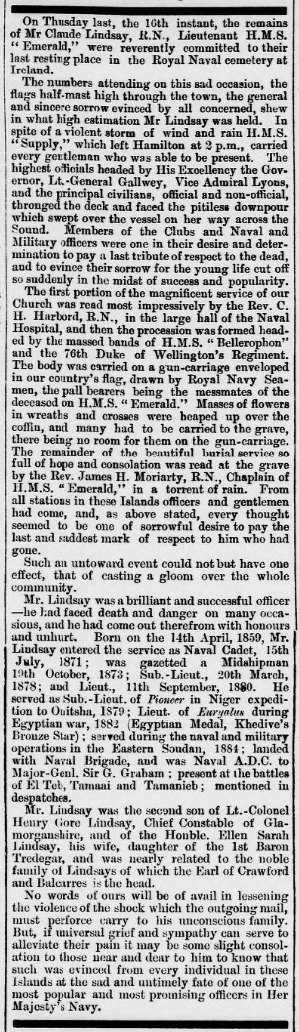
Royal Gazette report of the funeral of Mr Claude Lindsay, R.N., Lieutenant H.M.S. Emerald, in the Royal Naval cemetery at Ireland Island on Thursday 16th December, with an account of his career
Royal Gazette, 21 December 1886

The saddest of the notices is from December 1886. On Thursday 16 December, Lieutenant Claude Lindsay of Emerald was buried in the Royal Naval Cemetery at Ireland Island.

A violent storm of wind and rain blew that afternoon. Even so, HMS Supply carried as many people as she could from Hamilton, including the Governor, Lieutenant-General Gallwey, and Vice-Admiral Lyons. The service began in the hall of the Naval Hospital. The coffin was then taken to the cemetery on a gun-carriage drawn by seamen, with his Emerald messmates as pall bearers and the massed bands of Bellerophon and the 76th Regiment leading the way. Emerald’s chaplain, the Rev. James H. Moriarty, read the service at the grave in pouring rain.

Lindsay was 27. He had served in the Niger expedition of 1879, in Euryalus in the Egyptian war of 1882, and with the Naval Brigade in the Eastern Soudan in 1884. He had been aide-de-camp to Major-General Sir Gerald Graham at El Teb and Tamai, and was mentioned in despatches. The Gazette remarked that he had come through all of that unhurt. It doesn’t say how he died, and I haven’t yet found out.

The Ship

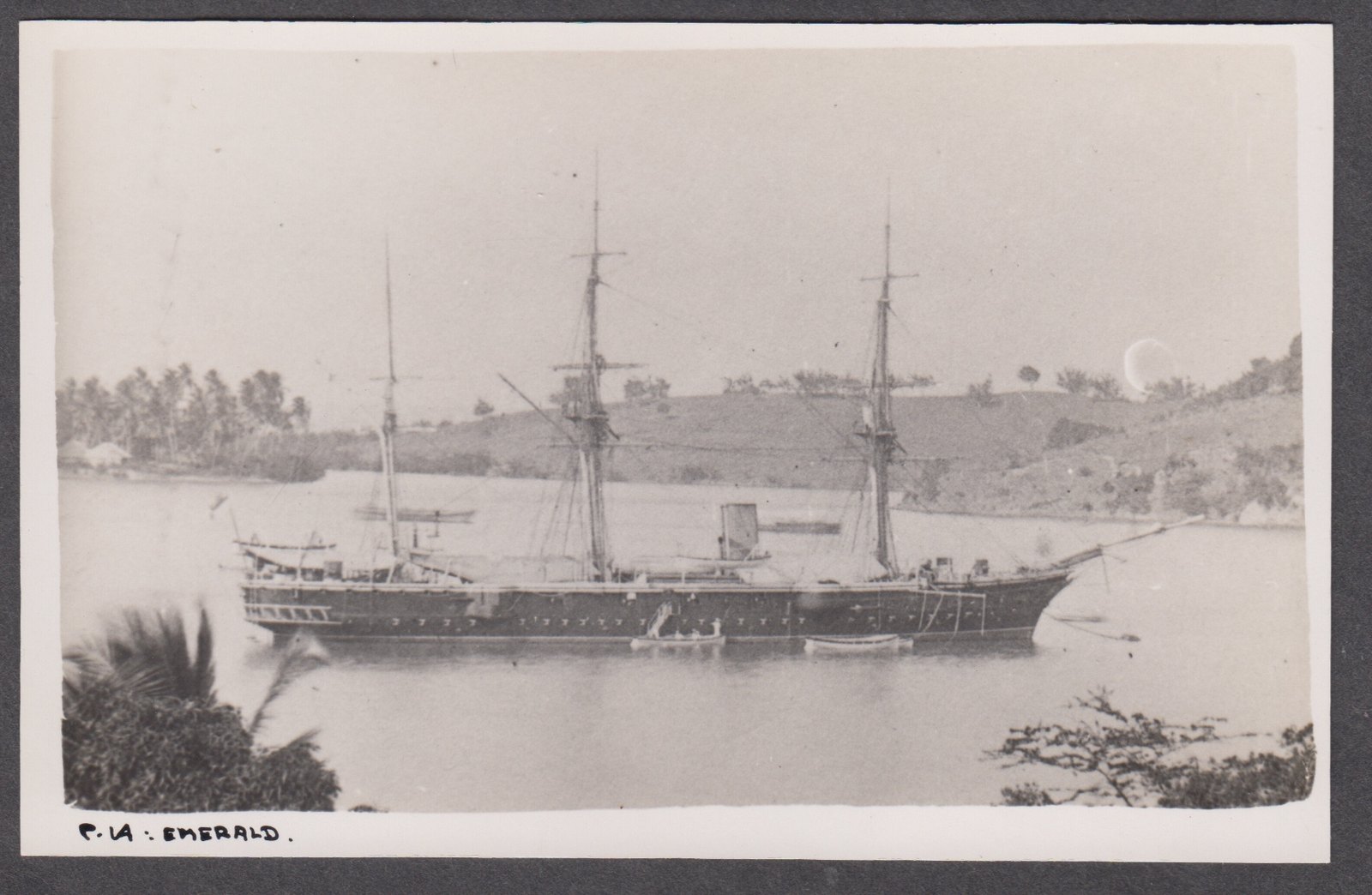
Photograph of the barque-rigged screw corvette HMS Emerald at anchor in a sheltered tropical harbour, with palm trees and low hills behind and two boats alongside

H.M.S. Emerald

HMS Emerald was a composite screw corvette, launched at Pembroke Dockyard on 18 August 1876. Her first commission was on the Australia Station, where she took part in the punitive expedition to the Solomon Islands after the killing of the commander and three of the crew of HMS Sandfly. She left Australia in 1881, and in England was refitted, re-armed with breech-loading guns and placed in reserve. She commissioned for the North America and West Indies Station in 1886 and stayed until 1892. She became a powder hulk at Portsmouth in 1895: an old hull stripped of masts, engines and guns, moored in the harbour and used to store gunpowder and ammunition well away from the dockyard.

The photograph shows her at anchor somewhere tropical, barque-rigged and with a high bridge. On the back is the stamp of Richard Perkins, the naval photograph collector whose identification albums are now at the National Maritime Museum. His pencil note reads: “Evidently taken in West Indies during 1886–1892. Barque rig. B.L. armament. Date of photo after March 1887 when high bridge was added during re-fit at Bermuda.” So she is pictured as she was in the months after this cover.

BuiltPembroke Dockyard, launched 18 August 1876
TypeComposite screw corvette, Emerald class
Displacement2,120 tons
Captain, 1887Hammond
StationNorth America and West Indies, 1886–1892
FatePowder hulk, Portsmouth, 1895; sold 1906

Photographer not identified. Identified and dated by Richard Perkins.

Still to find out

If you can help with any of these, I’d be very pleased to hear from you.

References

It’s a small envelope, but it caught Emerald on the day she left Bermuda for the summer. It’s also a good example of a datestamp that should never have left the engraver’s.