Postal History · Royal Navy · Royal Correspondence

H.M.S. Thrush

Ireland Island · Hamilton · 1890–1891

A young prince in command of a gunboat, collecting stamps around the Caribbean, writes from Bermuda to the Governor of Jamaica.

◆

This is one of my favourite items. In the spring of 1891 the gunboat Thrush was lying at Bermuda under the command of a 25-year-old lieutenant, Prince George of Wales. He was the Prince of Wales’s second son, not expected to be king, and he was collecting stamps. On 27 April he wrote to Sir Henry Blake, Governor of Jamaica, to thank him for some stamps from Turks Island. I have the letter and the envelope it travelled in. Nineteen years later the writer was King George V. With it is a plainer cover from the same ship, posted at Ireland Island a few days after she arrived in Bermuda in November 1890.

I

A letter from Prince George

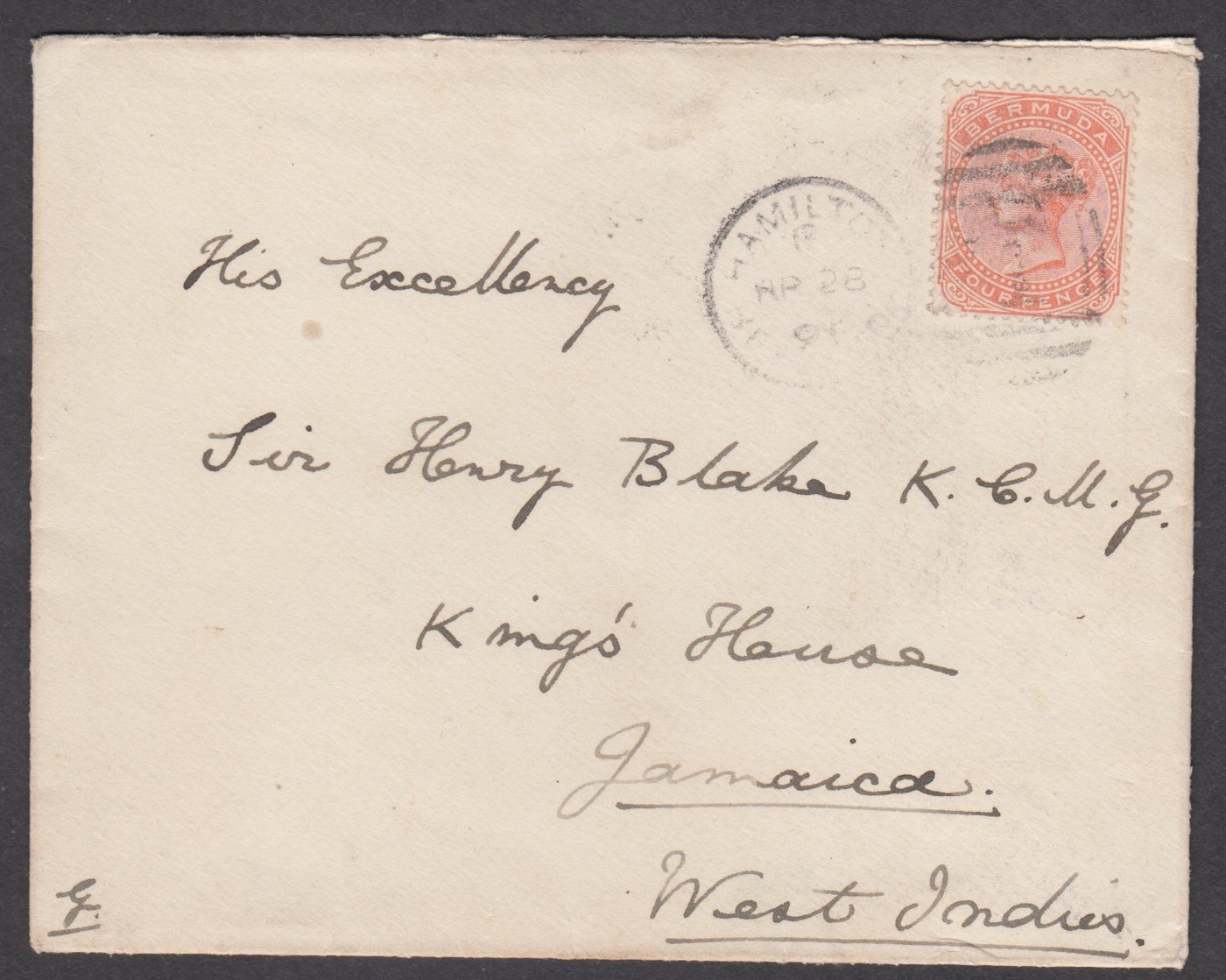
Envelope addressed in Prince George's hand to His Excellency Sir Henry Blake K.C.M.G., King's House, Jamaica, West Indies, franked with a Bermuda 4d orange-red cancelled by the Hamilton duplex numeral 1 with a HAMILTON BERMUDA datestamp of 28 April 1891, and initialled G at lower left
Front: Hamilton, 28 April 1891, to Sir Henry Blake, Jamaica
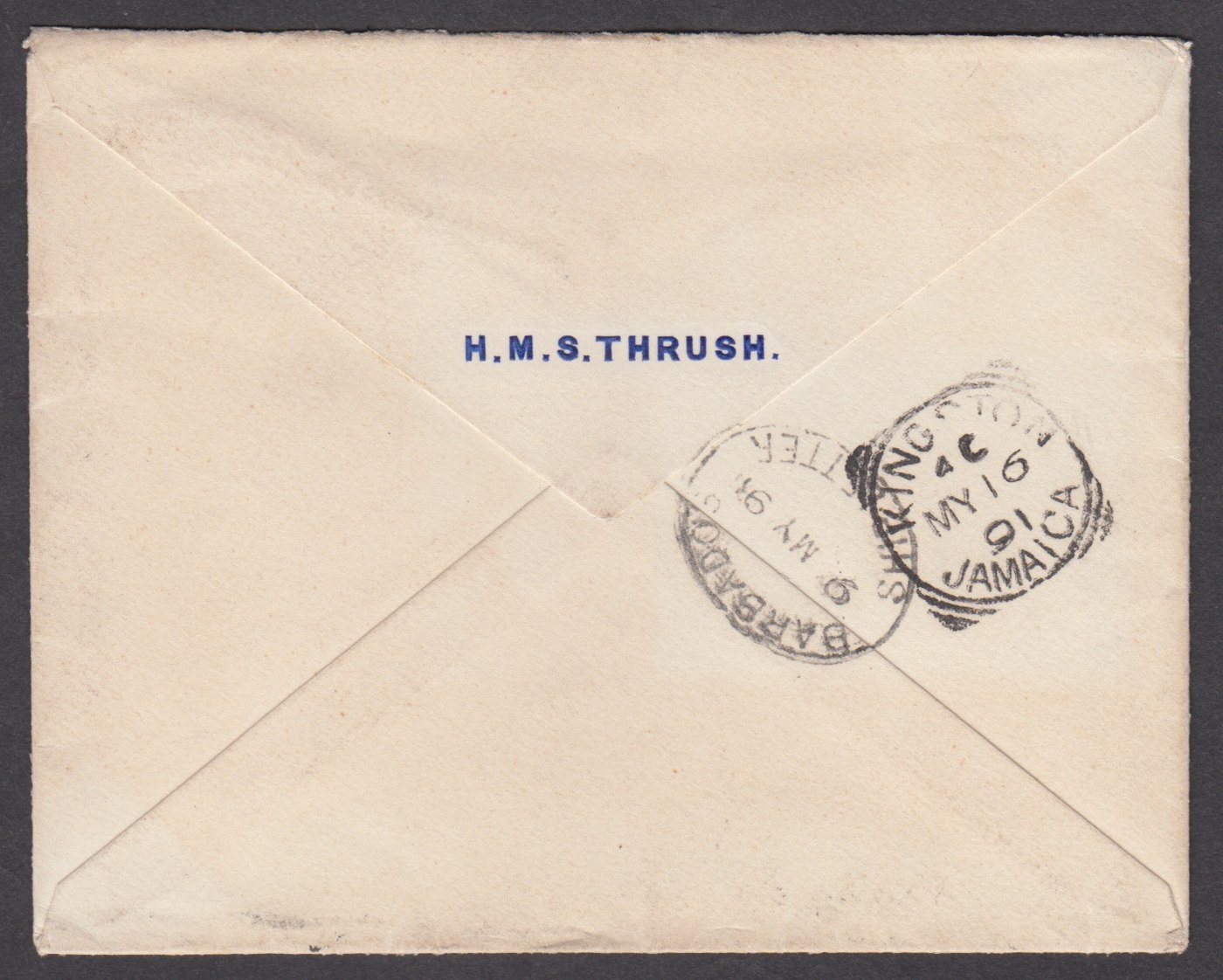
Reverse of the envelope with H.M.S. THRUSH. printed in blue on the flap, an oval BARBADOS SHIP LETTER datestamp of 9 May 1891 and a KINGSTON JAMAICA datestamp of 16 May 1891
Reverse: the ship’s name in blue, Barbados Ship Letter, 9 May, and Kingston, 16 May 1891
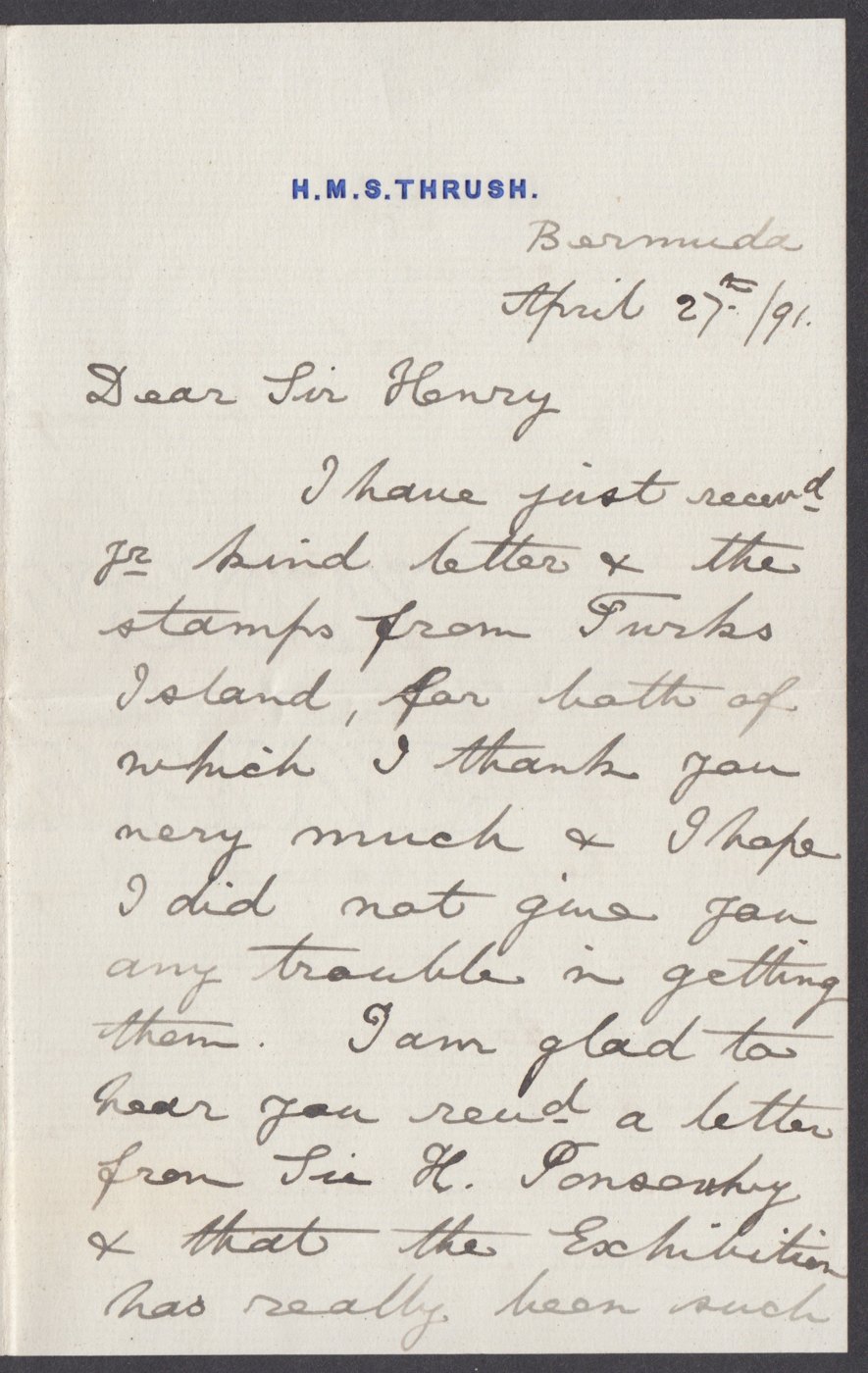
First page of the letter on notepaper headed H.M.S. THRUSH in blue, written Bermuda, April 27th/91, Dear Sir Henry, I have just recevd yr kind letter and the stamps from Turks Island
The letter, first page: “H.M.S. THRUSH. Bermuda, April 27th/91”
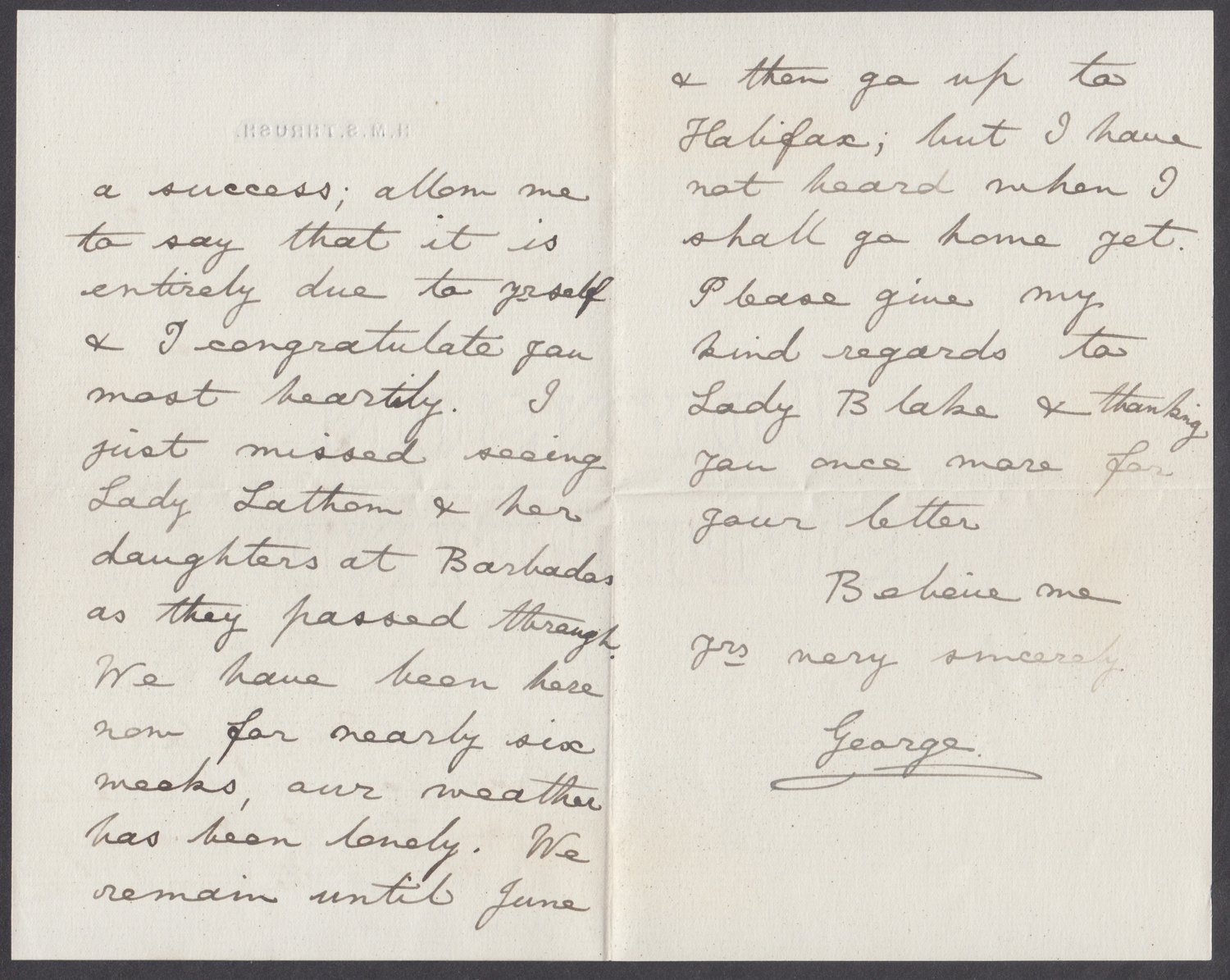
Second and third pages of the letter, ending Believe me yrs very sincerely, George
The letter, inside pages, signed “George”
  • Written H.M.S. Thrush, Bermuda, 27 April 1891
  • Posted Hamilton, Bermuda, 28 April 1891
  • Franking 4d orange-red, watermark Crown CC
  • Obliterator Hamilton duplex “1”, type K4, AP 28 91
  • Carried by S.S. Taymouth Castle, sailed 29 April 1891
  • Transit BARBADOS / SHIP LETTER oval, 9 MY 91, on the reverse
  • Arrival KINGSTON / JAMAICA, MY 16 91, on the reverse
  • Stationery “H.M.S. THRUSH.” printed in blue on the back flap and at the head of the letter
  • Addressed to His Excellency Sir Henry Blake K.C.M.G., King’s House, Jamaica, West Indies
  • Initialled “G” at the lower left

The envelope is addressed in Prince George’s own hand to “His Excellency Sir Henry Blake K.C.M.G., King’s House, Jamaica, West Indies”, with his initial “G” at the lower left. The 4d is cancelled with the Hamilton “1” duplex of 28 April 1891, and it paid the letter rate to Jamaica. On the back flap, “H.M.S. THRUSH.” is printed in blue, and the same heading is printed on the letter inside. The letter has stayed with its envelope, which I’m very glad of.

“Dear Sir Henry, I have just recevd yr kind letter & the stamps from Turks Island, for both of which I thank you very much & I hope I did not give you any trouble in getting them. I am glad to hear you recd a letter from Sir H. Ponsonby & that the Exhibition has really been such a success; allow me to say that it is entirely due to yrself & I congratulate you most heartily. I just missed seeing Lady Latham & her daughters at Barbados as they passed through. We have been here now for nearly six weeks; our weather has been lovely. We remain until June & then go up to Halifax, but I have not heard when I shall go home yet. Please give my kind regards to Lady Blake & thanking you once more for your letter. Believe me yrs very sincerely, George.”

It’s a short, friendly letter, the kind any young officer might write, except for the signature.
II

The road to Jamaica

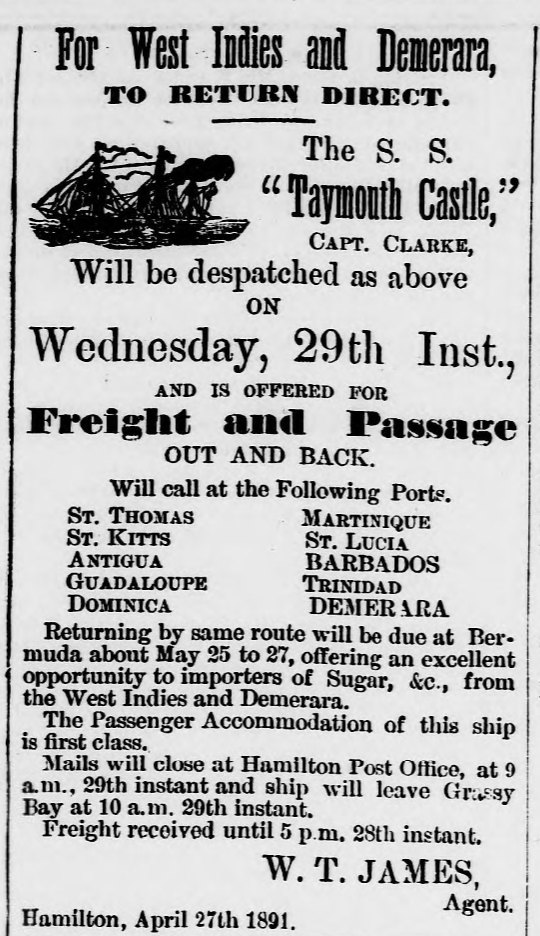
Royal Gazette advertisement: For West Indies and Demerara, to return direct. The S.S. Taymouth Castle, Capt. Clarke, will be despatched on Wednesday 29th inst. Calling at St Thomas, St Kitts, Antigua, Guadaloupe, Dominica, Martinique, St Lucia, Barbados, Trinidad and Demerara. Mails will close at Hamilton Post Office at 9 a.m., 29th instant and ship will leave Grassy Bay at 10 a.m. W. T. James, Agent, Hamilton, April 27th 1891
Royal Gazette, 28 April 1891: the Taymouth Castle sails on the 29th
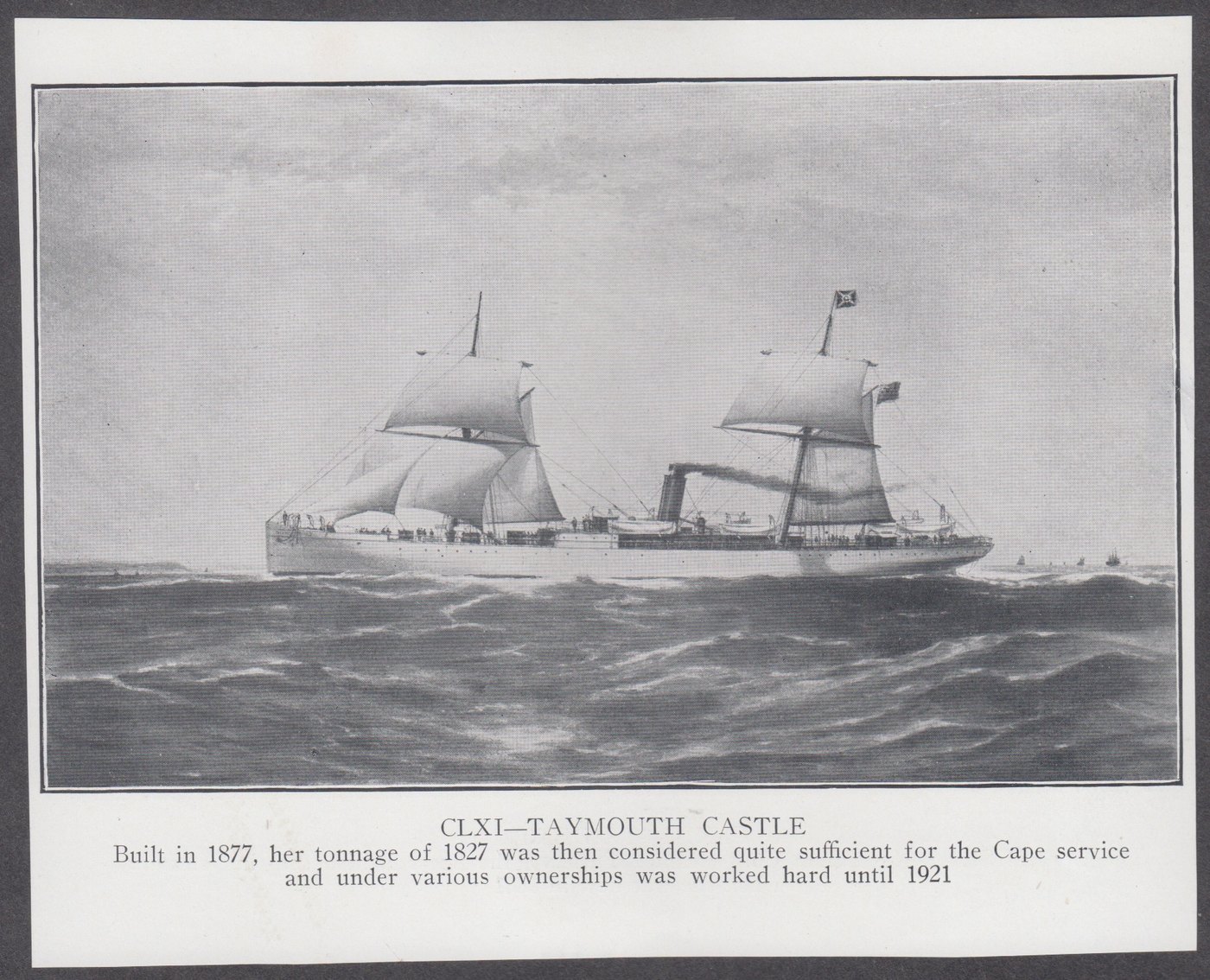
Picture of the Taymouth Castle at sea under steam and sail, a single-funnel iron steamer with two masts, captioned CLXI Taymouth Castle, built in 1877, her tonnage of 1827 was then considered quite sufficient for the Cape service and under various ownerships was worked hard until 1921
The Taymouth Castle

The quickest way to Jamaica had just gone. Ludington’s notes record that the Alpha, which ran direct to Turks Island and Kingston, had sailed on 20 April. The next steamer south was the Taymouth Castle. On 28 April the Royal Gazette carried her notice, dated the day before: “Mails will close at Hamilton Post Office, at 9 a.m., 29th instant and ship will leave Grassy Bay at 10 a.m.” Prince George wrote on the 27th, the letter was postmarked on the 28th, and it went out with that mail.

Jamaica wasn’t on her route. She called at St Thomas, St Kitts, Antigua, Guadeloupe, Dominica, Martinique, St Lucia, Barbados, Trinidad and Demerara. The letter was put ashore at Barbados, where it was struck with the oval SHIP LETTER mark on 9 May. From there it went on by another ship and reached Kingston on 16 May, eighteen days after it was posted.

The Taymouth Castle was a Donald Currie liner, built by Barclay, Curle & Co. and launched in 1877, an iron screw steamer of 1,827 tons. In 1891 she was sold to Sir Christopher Furness and then to Pickford & Black of Halifax, who put her on their service to Bermuda and the West Indies. Ludington’s notes say this was her maiden voyage to the West Indies. She later became the Ocamo (or Ocama; the sources disagree on the spelling and the date) and was broken up in about 1921.

III

Sir Henry, the Exhibition and the stamps

Sir Henry Blake had been an officer in the Irish Constabulary before becoming a colonial governor: the Bahamas, then Newfoundland, then Jamaica from 1889 to 1898. Later he governed Hong Kong and Ceylon. “Lady Blake” was Edith, his second wife.

The Exhibition was the Jamaica International Exhibition at Kingston, and Prince George knew it well, because he had opened it himself in January 1891. The Gazette printed the speeches in a supplement on 10 February. Replying to the Kingston address, he said he was there to represent his father, and he joined “most heartily in congratulating His Excellency Sir Henry Blake on the magnificent success” of the Exhibition. Three months later he was saying the same thing privately in this letter. The Exhibition closed on 2 May, five days after he wrote. Sir Henry Ponsonby was Queen Victoria’s private secretary, so his letter was probably the Queen’s own congratulations, though I can’t prove that.

What makes this letter special for me is that three things come together in it: a prince, a stamp collector, and Bermuda. The Turks Islands were then a dependency of Jamaica, so the Governor was well placed to get them. This wasn’t a one-off. The only other letter of his from the Thrush that I know of was written at Barbados on 9 March 1891 to H. E. W. Grant at Government House, Trinidad, on the same notepaper. It’s about the stamps he had been given in Trinidad: “I am sorry to trouble you again about those blessed stamps…”. He asks for a set of the current postcards, envelopes and wrappers to be sent up to Bermuda “when you send the Tobago stamps”. It too was franked 4d, and it reached Trinidad on 21 April. Two letters six weeks apart, both chasing stamps: he was clearly taking opportunities to build his collection as the ship went around the islands. In 1893 the Philatelic Society, London made him its honorary vice-president, and from 1896 until he became king in 1910 he was its President. As king he built the Royal Philatelic Collection into one of the great stamp collections.

IV

A prince in Bermuda

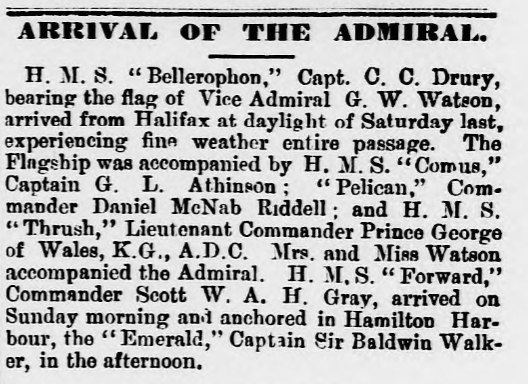
Royal Gazette report headed Arrival of the Admiral: HMS Bellerophon bearing the flag of Vice Admiral G. W. Watson arrived from Halifax at daylight of Saturday last, accompanied by HMS Comus, Pelican and HMS Thrush, Lieutenant Commander Prince George of Wales, K.G., A.D.C.
Royal Gazette, 18 November 1890: “H. M. S. ‘Thrush,’ Lieutenant Commander Prince George of Wales”
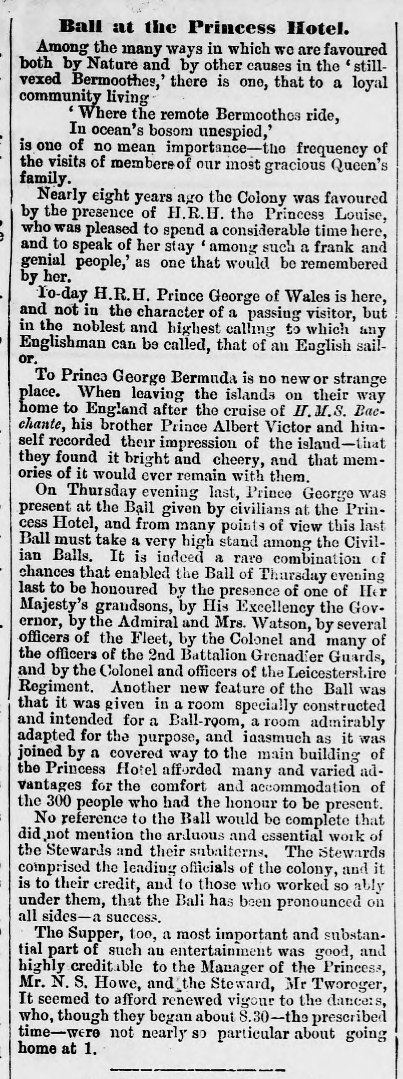
Royal Gazette report headed Ball at the Princess Hotel, describing the civilians' ball given for Prince George of Wales, recalling the visit of Princess Louise and his earlier visit in HMS Bacchante with his brother Prince Albert Victor
Royal Gazette, 6 January 1891: the civilians’ ball for Prince George
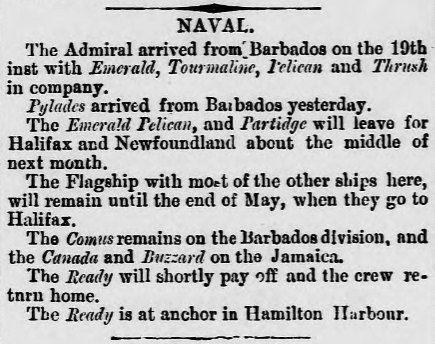
Royal Gazette naval news: The Admiral arrived from Barbados on the 19th inst with Emerald, Tourmaline, Pelican and Thrush in company
Royal Gazette, 24 March 1891: back from Barbados on the 19th

The Thrush came into Bermuda from Halifax at daylight on Saturday 15 November 1890 with the flagship Bellerophon, and the Gazette listed her as “H. M. S. ‘Thrush,’ Lieutenant Commander Prince George of Wales, K.G., A.D.C.” Bermuda wasn’t new to him. He had been there in 1880 as a midshipman in the Bacchante, with his elder brother Prince Albert Victor. When the colony gave a ball for him at the Princess Hotel on New Year’s Day, the Gazette wrote: “To Prince George Bermuda is no new or strange place.”

On Monday 5 January he was at an amateur concert at Prospect Camp in aid of the widows and orphans of HMS Serpent, lost off Spain in November. Two days later the squadron, Thrush with it, sailed for the West Indies. That was the cruise that took him to Kingston for the Exhibition.

They came back to Bermuda on 19 March: “The Admiral arrived from Barbados on the 19th inst with Emerald, Tourmaline, Pelican and Thrush in company.” From then to 27 April is the “nearly six weeks” in his letter. While he was away, the London Times had reported that he would be promoted to commander and given a new cruiser, the Blake. His letter shows that nobody had told him yet: “I have not heard when I shall go home yet.”

The Gazette lets you follow him around that spring. He was at the Hunt Club races on 3 April. On 22 April he came with the Governor’s party to the Grenadier Guards’ ball at the Princess Hotel, five days before he wrote the letter. In May he presented the prizes at the Naval and Military Rifle Meeting at Warwick Camp. At the Governor’s Cup on 29 May he sailed in the yacht Diamond with the Admiral’s daughter, Miss Watson.

V

The first cover

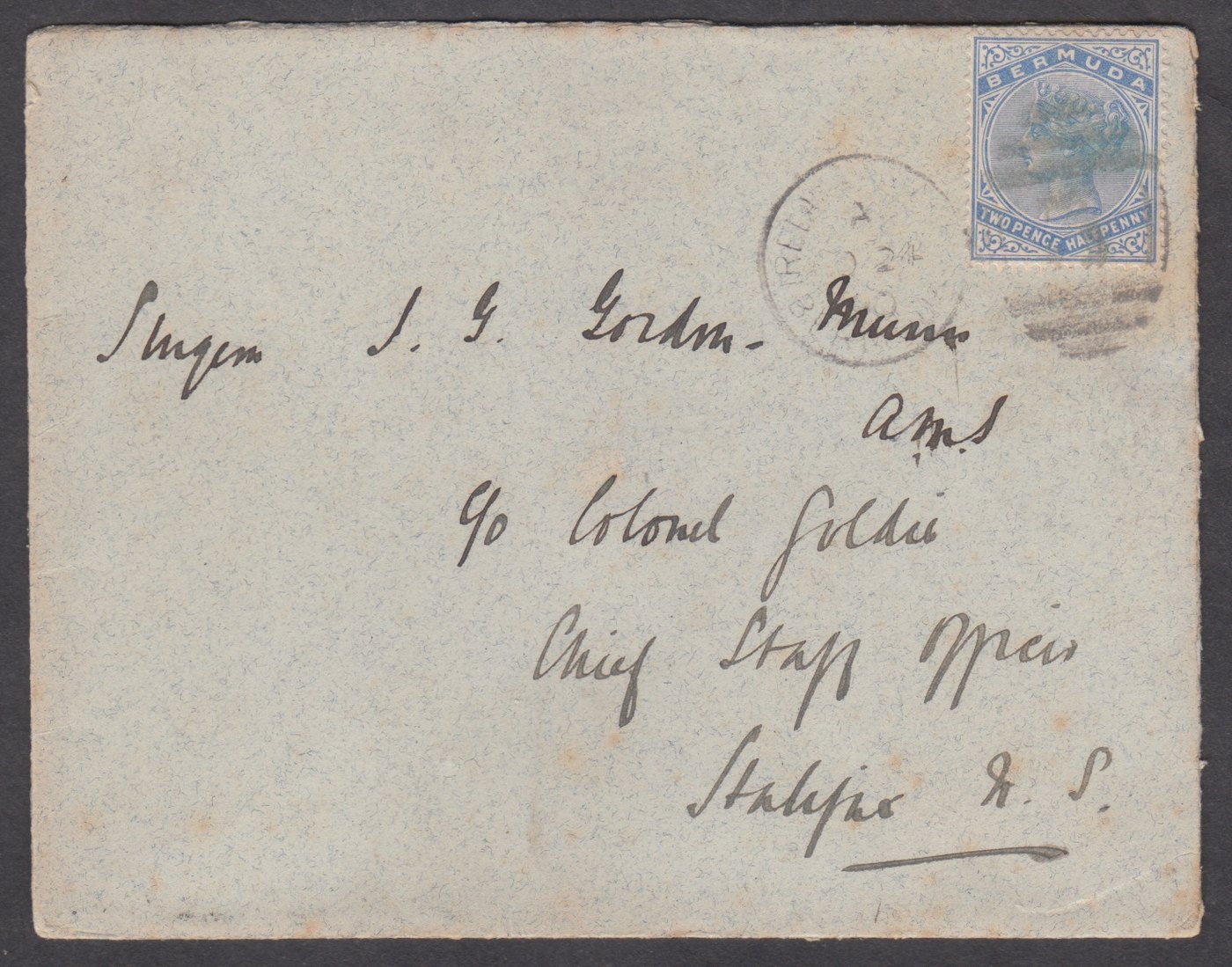
Envelope addressed to Surgn J. G. Gordon-Munn, A.M.S., c/o Colonel Goldie, Chief Staff Officer, Halifax N.S., franked with a Bermuda 2½d blue cancelled by a barred duplex with an IRELAND ISLAND datestamp of 24 November 1890
Front: Ireland Island, 24 November 1890, to Halifax
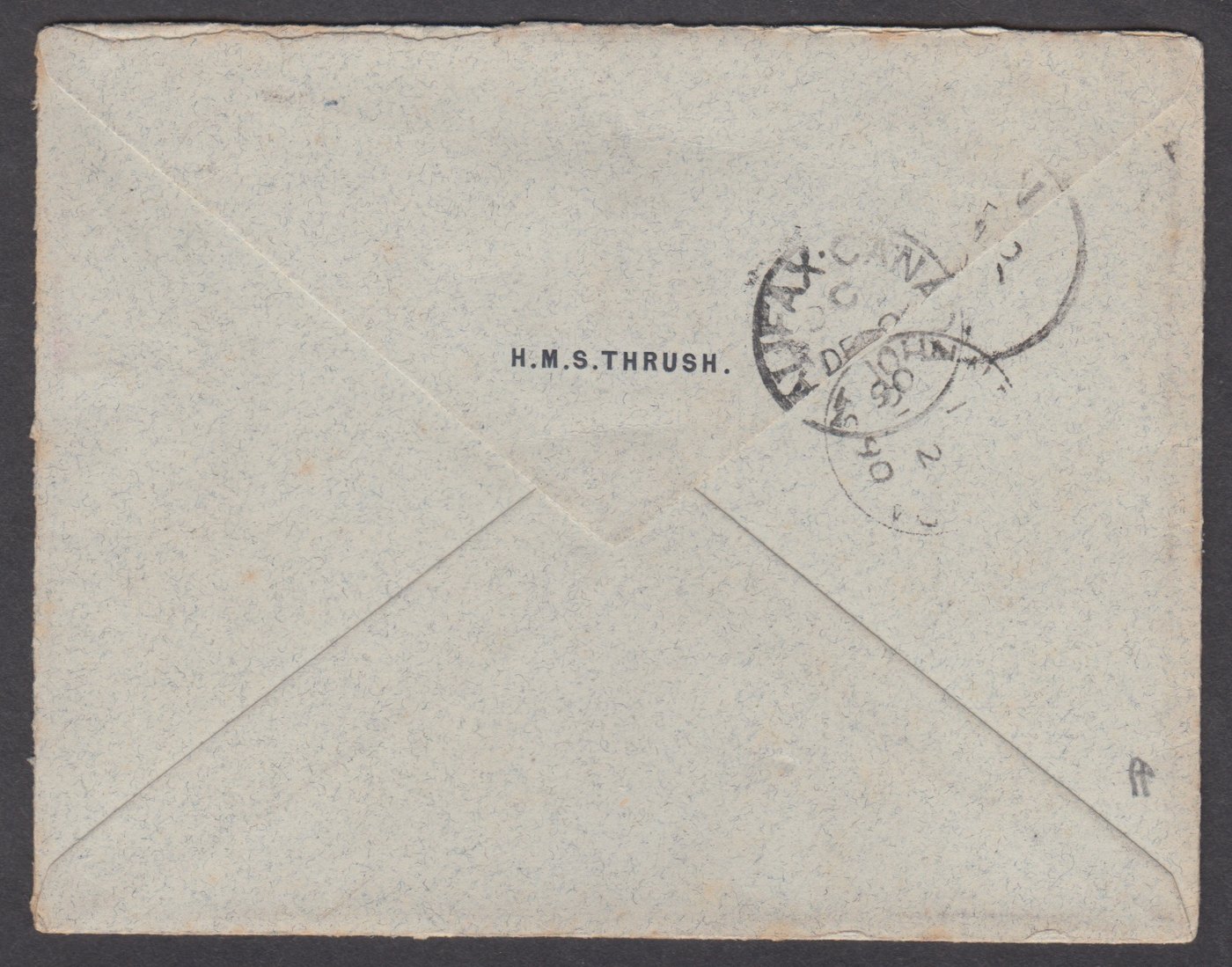
Reverse of the envelope with H.M.S. THRUSH. printed in black on the flap, and HALIFAX CANADA and ST JOHN datestamps of December 1890
Reverse: the ship’s name in black, with Halifax and St John, December 1890
  • Posted Ireland Island, Bermuda, 24 November 1890
  • Franking 2½d blue, the rate to Canada
  • Obliterator IRELAND ISLAND duplex, type K4
  • Backstamps HALIFAX / CANADA, December 1890; ST JOHN, New Brunswick, 1890
  • Stationery “H.M.S. THRUSH.” printed in black on the back flap
  • Addressed to Surgn J. G. Gordon-Munn, A.M.S., c/o Colonel Goldie, Chief Staff Officer, Halifax N.S.

This cover was posted at the Dockyard on 24 November 1890, nine days after the Thrush arrived. It isn’t in Prince George’s hand, so it was written by someone else on board, and I don’t know who. It’s addressed to a surgeon of the Army Medical Staff, care of Colonel Goldie, Chief Staff Officer at Halifax. Colonel Goldie was there in the garrison until March 1892. The surgeon may be John Gordon Gordon-Munn, an Edinburgh doctor who later served with the Grenadier Guards, but I haven’t been able to confirm that. The letter reached Halifax in December and was then sent on to St John, New Brunswick.

What I like is the ship’s name on the flap. Here it is printed in black. On the Prince George envelope five months later it is in blue, the same as the letter heading, so there seem to have been at least two printings of the Thrush’s stationery.

VI

Going home

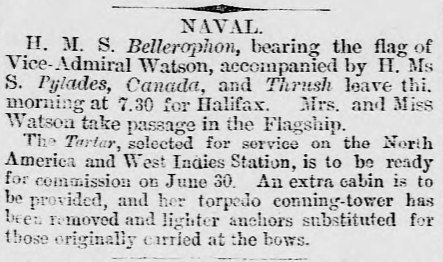
Royal Gazette naval news: HMS Bellerophon, bearing the flag of Vice-Admiral Watson, accompanied by HMs S. Pylades, Canada, and Thrush leave this morning at 7.30 for Halifax. Mrs. and Miss Watson take passage in the Flagship. The Tartar, selected for service on the North America and West Indies Station, is to be ready for commission on June 30
Royal Gazette, 9 June 1891: away to Halifax
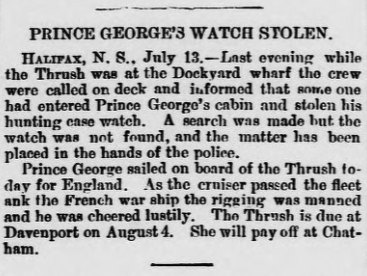
Royal Gazette report headed Prince George's Watch Stolen: Halifax, N.S., July 13. Last evening while the Thrush was at the Dockyard wharf the crew were called on deck and informed that some one had entered Prince George's cabin and stolen his hunting case watch. Prince George sailed on board of the Thrush today for England
Royal Gazette, 21 July 1891: “Prince George’s Watch Stolen”

As he’d said in his letter, they stayed until June. On 9 June the Bellerophon, Pylades, Canada and Thrush left for Halifax, arriving on the 13th. There the Thrush was inspected by the Admiral, and on 13 July she sailed for England. The night before, a thief got into Prince George’s cabin at the Dockyard wharf: “some one had entered Prince George’s cabin and stolen his hunting case watch. A search was made but the watch was not found.” As the Thrush passed out, the French warship in harbour manned her rigging “and he was cheered lustily”.

He was promoted to commander in August 1891. In November the new Tartar arrived at Bermuda to take the Thrush’s place on the station. His life changed completely in January 1892, when his brother Prince Albert Victor died and he became heir to the throne in his turn. He married in 1893 and became king in 1910.

The ship and the post

The ship on one side, the letters on the other.

The ship
The letters
18 Jul 1890
ThrushArrives at Bermuda under Prince George, towing a torpedo boat, then goes on to Halifax.
15 Nov 1890
ThrushBack at Bermuda with the flagship.
24 Nov 1890
CoverPosted at Ireland Island to Halifax.
7 Jan 1891
ThrushSails with the squadron for the West Indies.
Jan 1891
ThrushPrince George opens the Jamaica Exhibition.
19 Mar 1891
ThrushBack at Bermuda from Barbados.
27–29 Apr 1891
LetterWritten on the 27th, posted at Hamilton on the 28th, away in the Taymouth Castle on the 29th.
9 May 1891
LetterLanded at Barbados as a ship letter.
16 May 1891
LetterArrives at Kingston, Jamaica.
9–13 Jun 1891
ThrushBermuda to Halifax.
13 Jul 1891
ThrushSails from Halifax for England.

The Ship

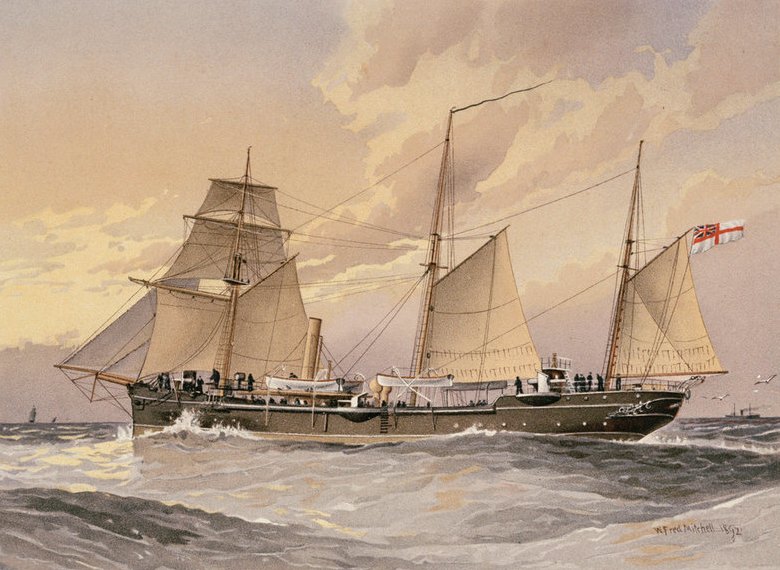
Painting of HMS Thrush at sea under steam and sail by W. Frederick Mitchell, 1892: a black-hulled barquentine-rigged gunboat with square sails on the foremast, fore-and-aft sails on the main and mizzen, a single buff funnel and the white ensign

H.M.S. Thrush

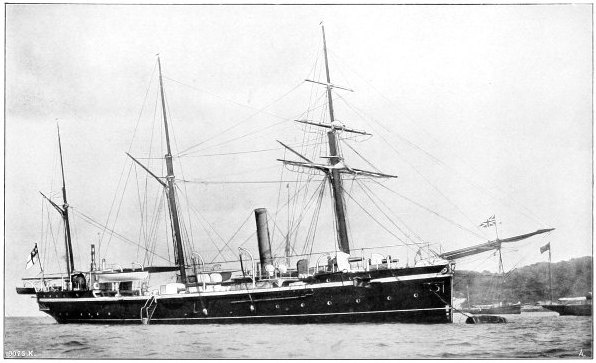
HMS Thrush was a Redbreast-class composite gunboat built by Scotts of Greenock and launched on 22 June 1889. She was barquentine rigged with a single screw and carried six 4-inch guns. Her first station was North America and the West Indies, under Prince George. Afterwards she served in the forty-minute Anglo-Zanzibar war of 1896 and off South Africa during the Boer War. She later became a coastguard ship, then a cable ship and then a salvage ship. In January 1917 she helped rescue survivors from the submarine K13 in the Gareloch, and on 11 April that year she was wrecked off Glenarm, County Antrim, in a snowstorm. Her bell was given to her old commander and is in King George V’s War Museum at Windsor Castle.

BuiltScotts, Greenock, launched 22 June 1889
TypeComposite gunboat, Redbreast class
Displacement805 tons
GunsSix 4-inch
CommanderLieutenant Prince George of Wales, 1890–91
FateWrecked off Glenarm, 11 April 1917
Photograph of HMS Thrush at anchor in 1889, newly built: black hull with a white band, three masts with yards on the foremast, a single funnel, the white ensign at the stern and a jack at the bow
At anchor, 1889, the year she was launched

Painting: W. Frederick Mitchell, 1892. Photograph: H. J. Symonds, Portsmouth, 1889, via Wikimedia Commons.

Still to find out

If you can help with any of these, I’d be very pleased to hear from you.

Provenance and references

Most of my naval covers were written by men whose names I’ll never know. This one was written by a future king, thanking a governor for some stamps.