Postal History · Royal Navy · North America and West Indies Station

H.M.S. Bellerophon

Ireland Island · Bermuda · April 1891

A flagship envelope to a house in Belgravia, sent in the last months of the fourpenny rate.

◆

This small envelope came from the flagship of the North America and West Indies Station. You can tell from the flap, where “H.M.S. BELLEROPHON.” is printed in blue. It was posted at Ireland Island in April 1891 and addressed to “Miss Bromly Davenport” (the writer’s spelling) at 1 Belgrave Place, London. There’s no letter inside, and the Bermuda datestamp is too faint to read. Even so, the envelope, the address and the Royal Gazette together tell a good deal about the ship and the year.

I

The cover

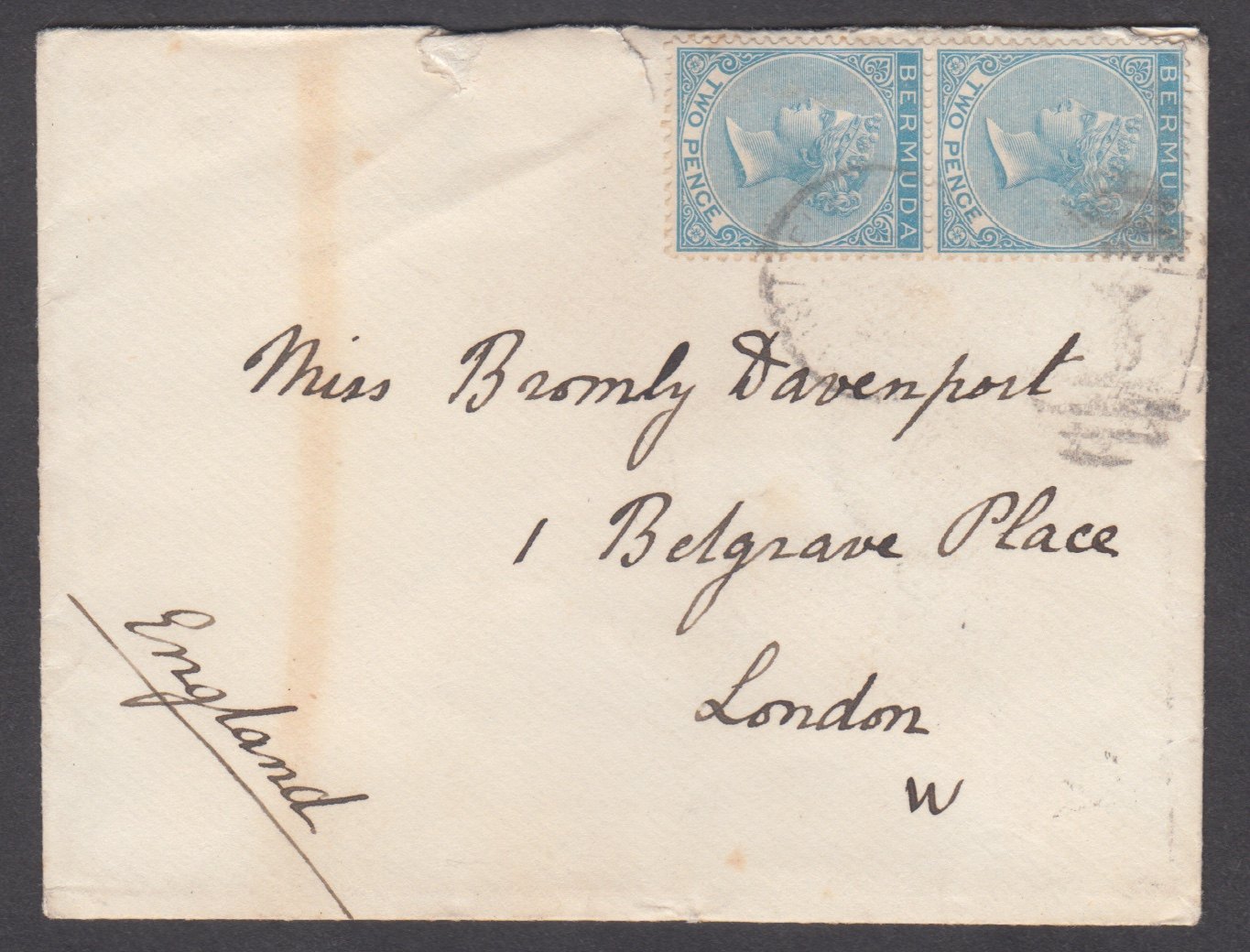
Envelope addressed in ink to Miss Bromly Davenport, 1 Belgrave Place, London W, with England written diagonally at lower left, franked with a pair of Bermuda 2d blue stamps cancelled by a faint duplex
Front: a pair of the 2d blue, paying the 4d rate
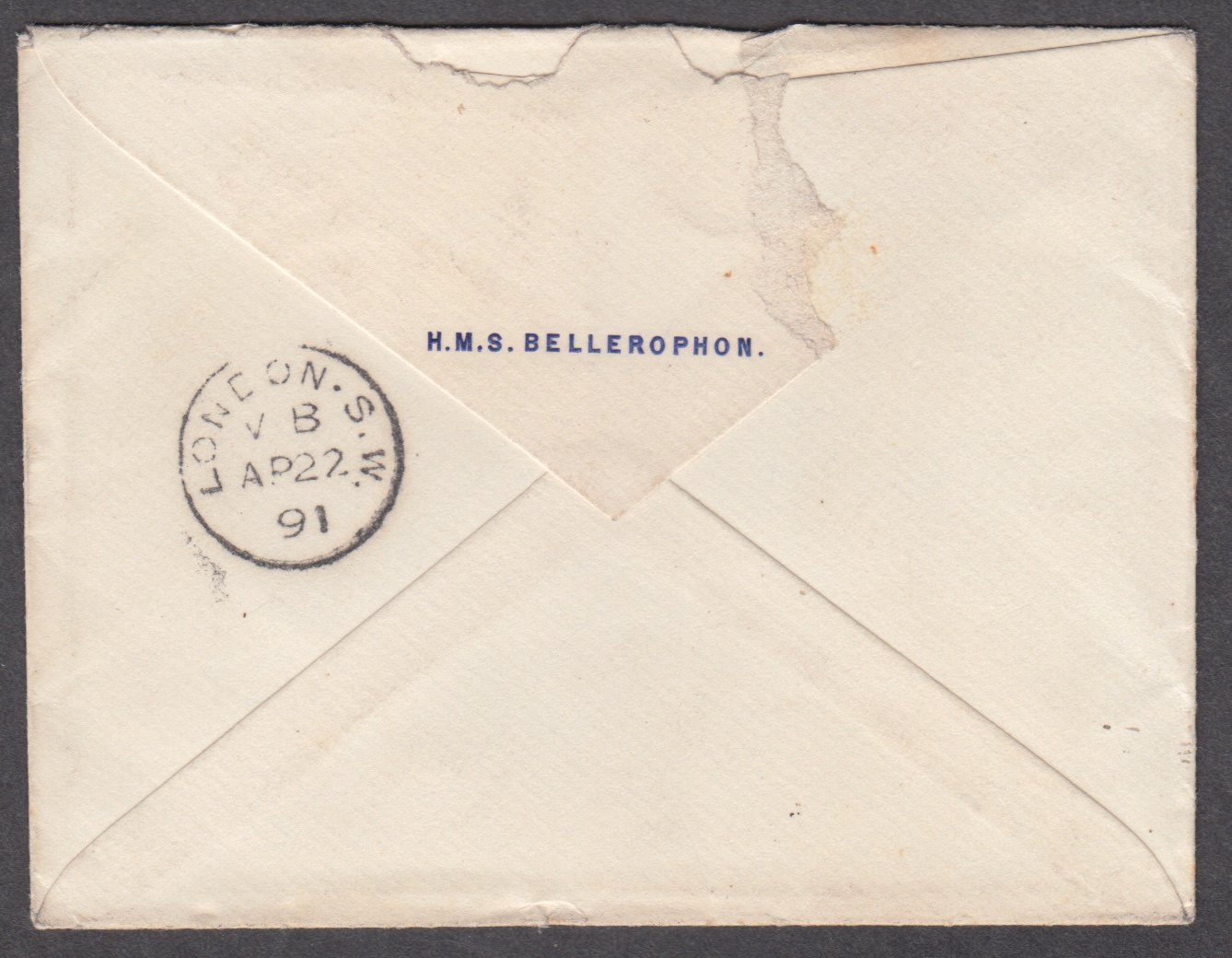
Reverse of the envelope with H.M.S. BELLEROPHON printed in blue on the flap and a LONDON S.W. datestamp, V B, AP 22 91, at left
Reverse: the ship’s name on the flap, and London S.W., 22 April 1891
  • Posted Ireland Island, Bermuda, April 1891
  • Franking 2d blue pair, the 4d letter rate to the United Kingdom
  • Obliterator Ireland Island “3” duplex, date illegible
  • Arrival LONDON S.W. / V B / AP 22 / 91, on the reverse
  • Stationery “H.M.S. BELLEROPHON.” printed in blue on the back flap
  • Addressed to Miss Bromly Davenport, 1 Belgrave Place, London W.

The front carries a pair of the 2d blue, tied by the Ireland Island “3” duplex. The strike is light and I can’t make out the date in it. “England” is written across the lower left. On the back the ship’s name is printed on the flap, and there’s a clear LONDON S.W. receiver for 22 April 1891.

The pair pays the 4d half-ounce letter rate to Britain. That rate didn’t last much longer. A Treasury Warrant cut the rate between Bermuda and the United Kingdom to 2½d from 1 October 1891, so this cover belongs to the last six months of the old rate. No concession was claimed, which fits an officer writing rather than one of the ship’s company.

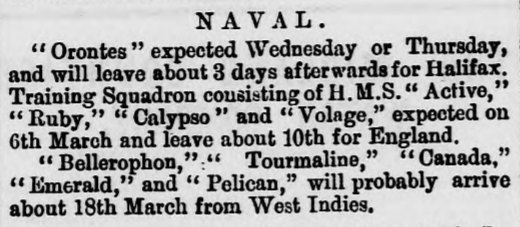
We can’t read the posting date, but the Gazette gets us close. The squadron had gone south to the West Indies in January, and Bellerophon was expected back at Bermuda “about 18th March”. Allowing roughly two weeks for the voyage to London, the letter was probably posted around the second week of April, while the flagship was at the Dockyard.
II

Miss Bromley Davenport of Belgrave Place

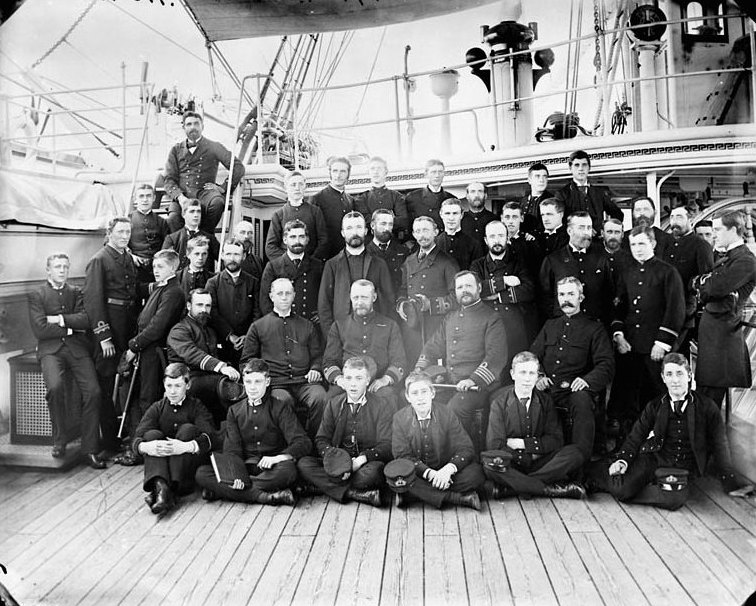
Group photograph of about forty officers of HMS Bellerophon on the ship's deck at Halifax, Nova Scotia: senior officers seated in the centre, young midshipmen sitting cross-legged on the deck in front, and others standing behind against the rails and rigging
Bellerophon’s officers at Halifax, c.1889–1892. Was our writer here?

1 Belgrave Place, off Belgrave Square, was the London house of the Bromley-Davenports of Capesthorne Hall in Cheshire. William Bromley-Davenport, MP for North Warwickshire for twenty years, had died suddenly in 1884. By 1891 his eldest son William, also an MP, headed the household, living there with his mother Augusta and four younger brothers and sisters.

There were three daughters. Evelyn had married in 1880 and Alice in 1882, so the only “Miss Bromley Davenport” at home in April 1891 was Elinor Lucy, then 24. I’m fairly sure she is our addressee, though I can’t prove it. She married David Kinloch, later Sir David Kinloch, Baronet, in 1897.

Who wrote to her from the flagship, I don’t know. There were plenty of young officers on board, and a family with London and Cheshire connections would have known a few naval men. I’d love to find a link. The photograph of the ship’s officers at Halifax was taken during this commission, so the writer may well be one of them.

III

The flagship at Bermuda, 1891

Royal Gazette naval notes: Bellerophon, Tourmaline, Canada, Emerald and Pelican will probably arrive about 18th March from West Indies
Royal Gazette, 24 February 1891: due back about 18 March
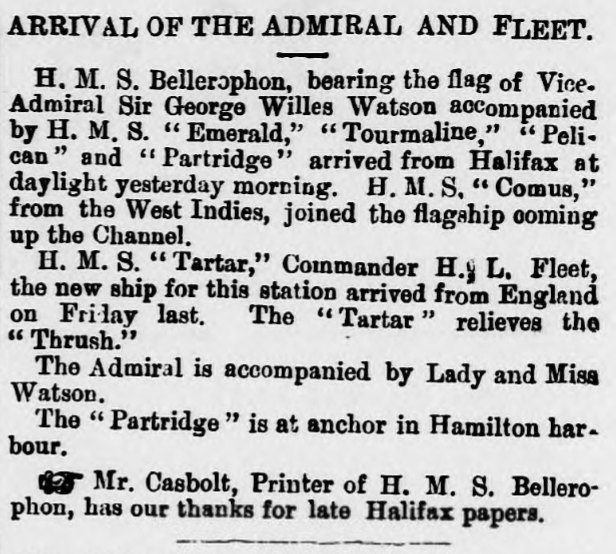
Royal Gazette report headed Arrival of the Admiral and Fleet: HMS Bellerophon, bearing the flag of Vice-Admiral Sir George Willes Watson, arrived from Halifax at daylight yesterday morning with Emerald, Tourmaline, Pelican and Partridge; the Admiral is accompanied by Lady and Miss Watson; Mr Casbolt, Printer of HMS Bellerophon, is thanked for late Halifax papers
Royal Gazette, 17 November 1891: back from Halifax
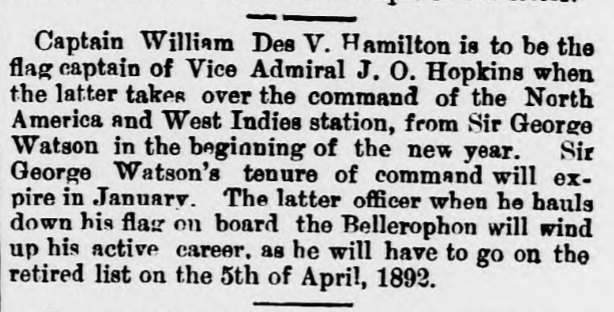
Royal Gazette: Captain William Des V. Hamilton to be flag captain of Vice Admiral J. O. Hopkins; when Sir George Watson hauls down his flag on board the Bellerophon he will go on the retired list on 5th April 1892
Royal Gazette, 8 December 1891: the end of Watson’s command

Through 1891 the Royal Gazette followed Bellerophon’s comings and goings closely. She carried the flag of Vice-Admiral George Willes Watson, who had been Commander-in-Chief since December 1888. In January she led the squadron south to the West Indies, and she was expected back at Bermuda about 18 March.

In June she sailed for Halifax for the summer, with “Mrs. and Miss Watson” taking passage in the flagship. When she came back in November the Gazette called them Lady and Miss Watson. The admiral had been made a K.C.B. on 30 May, while they were away. The same notice thanked “Mr. Casbolt, Printer of H.M.S. Bellerophon”, for the late Halifax papers. I like that the flagship carried her own printer.

It was also her last year as flagship. In December the Gazette reported that Watson’s command would end in the new year, and that when he hauled down his flag in the Bellerophon he would go on the retired list. The new cruiser Blake was coming out with his successor, Vice-Admiral Hopkins, and Watson would go home in the old flagship.

Ashore at Bermuda

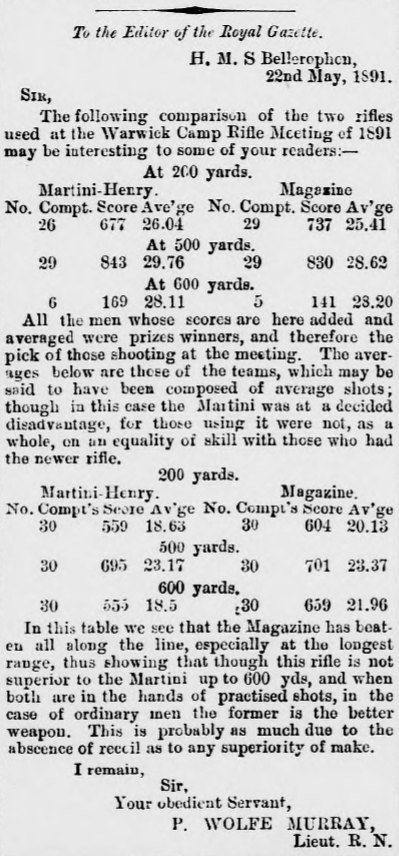
Royal Gazette report of the Fifth Annual Naval and Military Rifle Meeting at Warwick Camp: the 1st team of the Grenadier Guards 415, HMS Bellerophon 410, 2nd team Grenadier Guards 407; P.O. Hill of Bellerophon won a shoot-off; Lieut. Wolfe Murray of Bellerophon made 54 out of a possible 60 in the revolver competition; Prince George of Wales presented the prizes
Royal Gazette, 26 May 1891: the Warwick Camp rifle meeting

Bermuda life in 1891 turns up in the Gazette as much as the ship movements do. In January the ship’s bluejacket glee singers sang at a concert at Prospect Camp, given for the widows and orphans of the crew of HMS Serpent, wrecked off Spain the previous November. Prince George of Wales was there. He was then commanding the gunboat Thrush on the station, and nineteen years later he became King George V.

In May the Bellerophon’s men were in the thick of the annual Naval and Military Rifle Meeting at Warwick Camp. Her first team led the Grenadier Guards going into the last stage of the team competition and lost by just 5 points. Petty Officer Hill tied for first prize at 500 yards and won the shoot-off, and Lieutenant Wolfe Murray scored 54 out of a possible 60 in the revolver competition. Prince George presented the prizes.

Wolfe Murray then wrote to the Gazette from the ship, comparing the old Martini-Henry with the new Magazine rifle. A photograph of him standing beside one of the ship’s quick-firing guns survives in an officer’s album at the National Maritime Museum.

In the floating dock

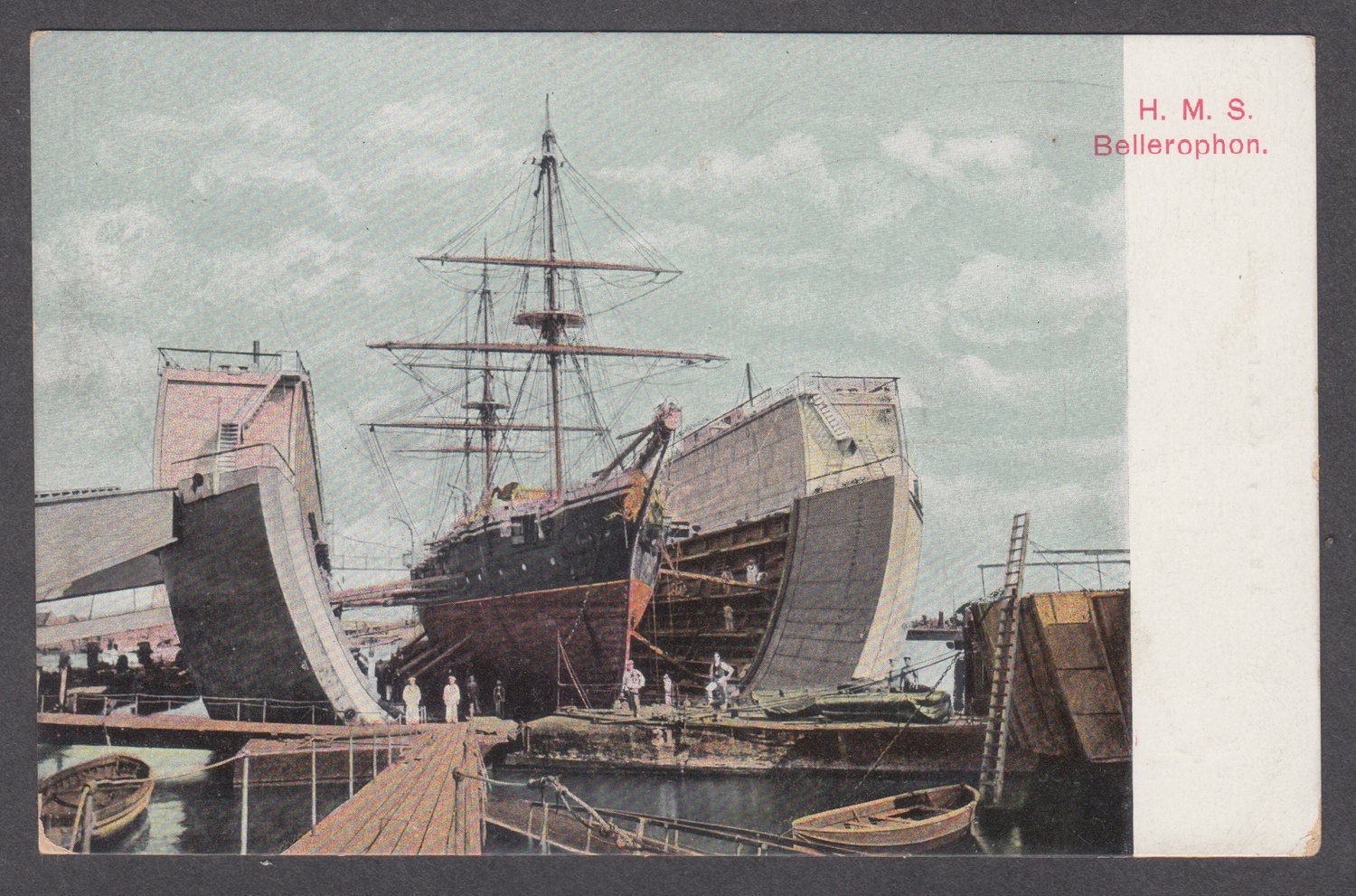
Coloured postcard titled H.M.S. Bellerophon: the three-masted ironclad high and dry inside the iron floating dock at Bermuda, its tall curved side walls either side of her, men standing on the dock floor beneath her bow, and rowing boats and a gangway in the foreground
Bellerophon in the floating dock: J. H. Bradley & Co., Hamilton, No. 500
  • Publisher J. H. Bradley & Co., Hamilton, Bermuda
  • Number 500
  • Back Undivided
  • Condition Unused

This coloured postcard shows Bellerophon high and dry inside a floating dock, with men on the staging around her. It was published in Bermuda by J. H. Bradley & Co. of Hamilton, card number 500, and has the old undivided back.

Bermuda had no rock fit for a conventional dry dock, so in 1869 the Admiralty towed a huge iron floating dock across the Atlantic. It was designed specifically to lift ships of the Bellerophon class, and here is that dock with the ship it was built for sitting in it. The card is later than her time as flagship, so the picture was probably taken from an older photograph.

The other Bellerophon

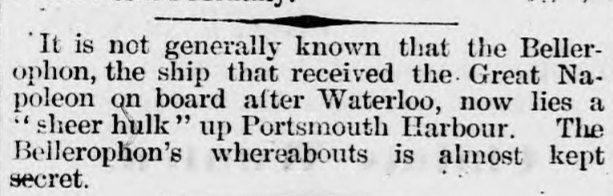
Royal Gazette paragraph: It is not generally known that the Bellerophon, the ship that received the Great Napoleon on board after Waterloo, now lies a sheer hulk up Portsmouth Harbour. The Bellerophon's whereabouts is almost kept secret.
Royal Gazette, 23 June 1891

In June 1891 the Gazette told its readers that the Bellerophon that had received Napoleon after Waterloo “now lies a ‘sheer hulk’ up Portsmouth Harbour”. It was half right.

There was an old Bellerophon hulk at Portsmouth, but she wasn’t Napoleon’s ship. That one, the 74-gun Bellerophon, became a prison ship in 1815, was renamed Captivity in 1824 and was sold in 1836. The Portsmouth hulk was the old 80-gun Waterloo, renamed Bellerophon in 1824, a receiving ship at Portsmouth from 1856 and sold in 1892. So in 1891 there were two Bellerophons afloat: an old wooden hulk at Portsmouth, and the ironclad flagship at Bermuda.

The flagship’s year

The ship on one side, the letter on the other.

The ship
The letter
7 Jan
BellerophonSails for the West Indies with the squadron.
c.18 Mar
BellerophonDue back at Bermuda from the West Indies.
April
The letterPosted at Ireland Island, probably in the second week of the month.
22 Apr
The letterReceived at London S.W.
5 May
BellerophonThe Gazette reports that Hercules has been selected to relieve her as flagship. In the end it was Blake.
15–18 May
BellerophonRifle meeting at Warwick Camp. Her team is second by 5 points.
30 May
WatsonThe admiral is made a K.C.B.
9 Jun
BellerophonSails for Halifax with Pylades, Canada and Thrush.
1 Oct
The rateThe 4d rate to Britain ends; letters now go for 2½d.
16 Nov
BellerophonBack at Bermuda from Halifax at daylight.
1892
BellerophonWatson hauls down his flag and retires in April; the ship pays off at Plymouth.

The Ship

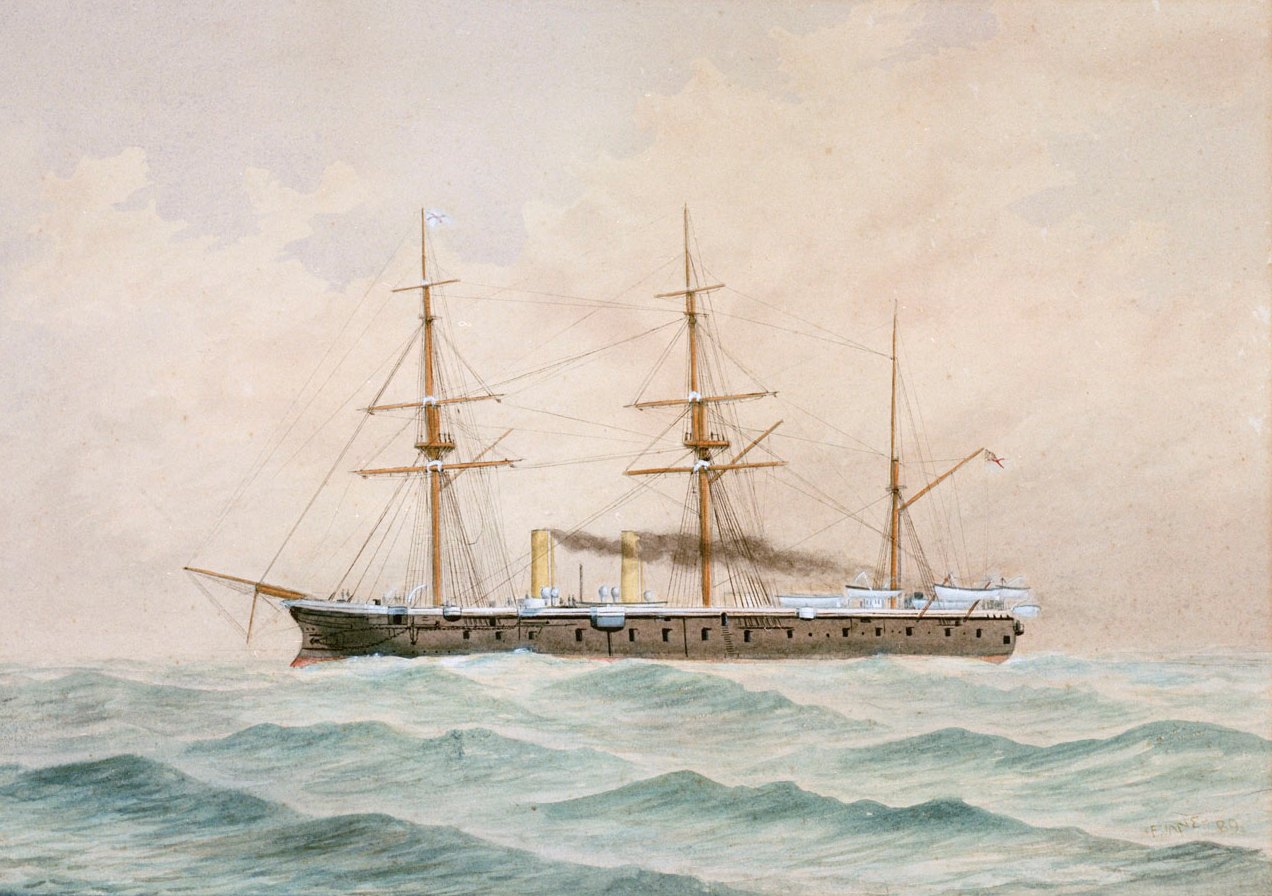
Watercolour of HMS Bellerophon steaming in a green sea, three masts with yards crossed, two buff funnels trailing smoke, a long dark hull with gun ports and white boats on the quarterdeck; signed F. Jane 89 at lower right

H.M.S. Bellerophon

HMS Bellerophon was designed by Edward Reed and built at Chatham Dockyard. She was launched in April 1865 and completed in 1866 as a central battery ironclad, the first British ironclad to carry the 9-inch muzzle-loading gun. She first came to Bermuda as flagship in 1873. After a big refit in 1881–85 she became the only British ironclad to have all her muzzle-loaders replaced by breech-loaders, and she came back to the station as flagship until 1892.

She then served as port guardship at Pembroke. In 1904 she became a stokers’ training ship, renamed Indus III. She was sold in December 1922 and broken up at Bo’ness in 1923. Her sailors seem to have called her “Old Billy”, an echo of “Billy Ruffian”, the lower deck’s name for the earlier Bellerophon that fought at Trafalgar.

A year before my letter, on 25 April 1890, she entertained a famous visitor. After Admiral Watson’s naval review on Moresby’s Plain, the former American President Rutherford B. Hayes was given a formal lunch on board. That evening he wrote in his diary that he had been “shown over the fine ship—old but good and efficient”, and noted “the life of her eight-inch guns two hundred and fifty rounds.” The full story is on my H.M.S. Humber page.

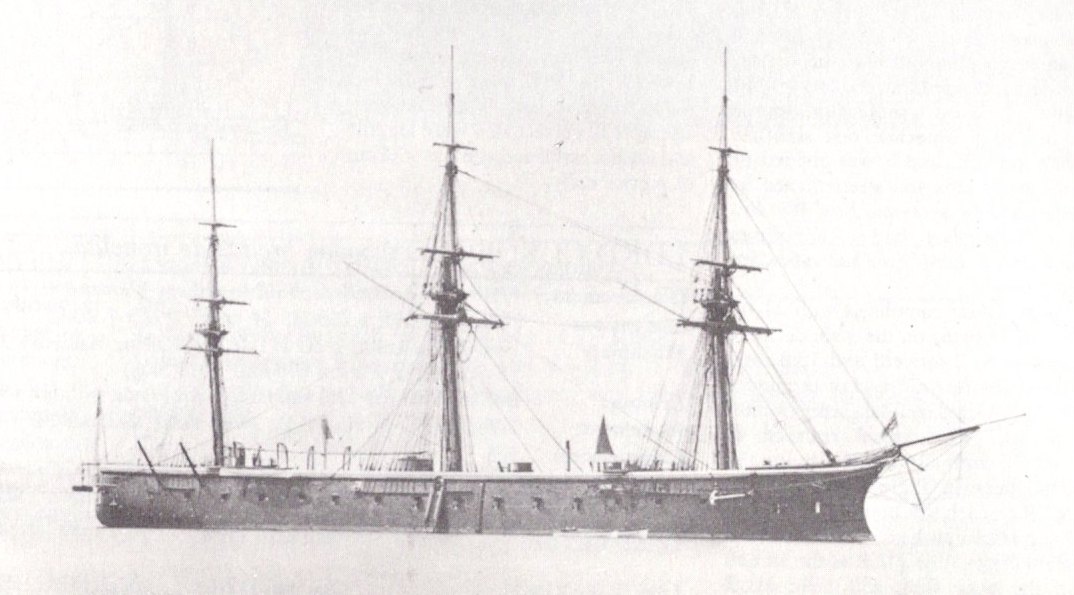
Above, Fred T. Jane’s watercolour of 1889, two years before this letter. Below, a photograph of her as she was when completed in 1866.

BuiltChatham Dockyard, launched April 1865
TypeCentral battery ironclad
Displacement7,551 tons
GunsTen 8-inch breech-loaders (after 1885)
FlagVice-Admiral Sir George Willes Watson, 1888–1892
FateRenamed Indus III 1904; sold 1922
Black and white photograph of HMS Bellerophon at anchor, broadside view, three masts with yards crossed, a long low hull with a line of gun ports and a pronounced ram bow
As she appeared when completed in 1866

Watercolour by Fred T. Jane, 1889: Royal Museums Greenwich. 1866 photograph and officers at Halifax: via Wikimedia Commons.

Still to find out

If you can help with any of these, I’d be very pleased to hear from you.

References

It’s an ordinary envelope, but it carries a whole year of the station with it: the flagship’s last full year, the end of the 4d rate, and a young woman in Belgravia waiting for news from Bermuda.