Photograph · Royal Navy · Bermuda Dockyard

H.M.S. Ready

Bermuda Dockyard · c. 1890

A little gunvessel that came to Bermuda and never left.

◆

Most of the pages on this site show a story a good way down the track, after the covers have been found, the Gazettes read and the pieces fitted together. This one is different. It’s where a story starts. I have one photograph of H.M.S. Ready lying in front of the floating dock at Ireland Island, and one report from the Royal Gazette of the day she ran aground in 1911. That’s all, for now. She was at Bermuda for more than thirty years, so I’m sure more is out there. I’ve put her up anyway, because this is honestly what research looks like at the beginning.

I

“P.17 : Ready”

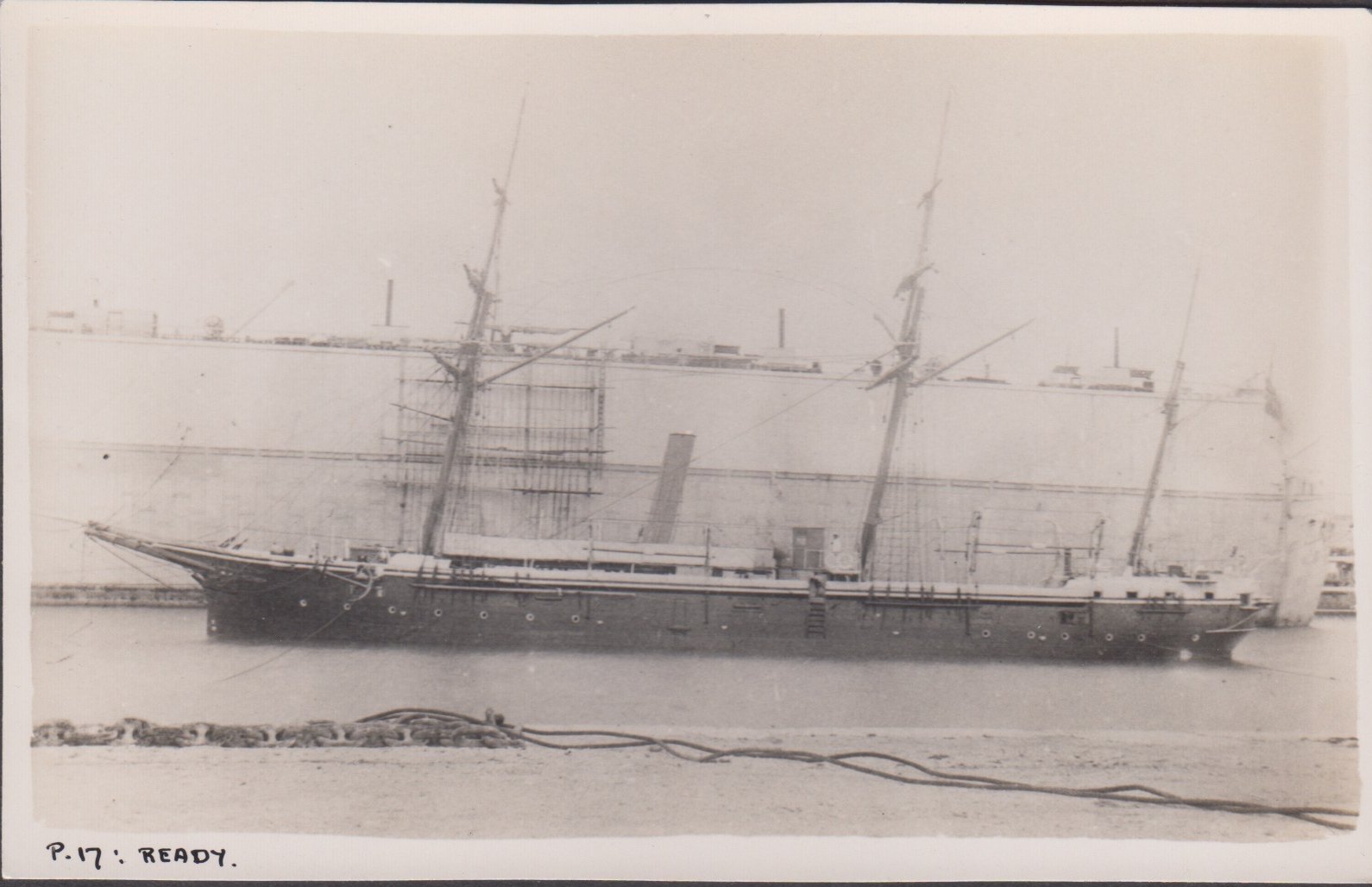
Real photograph of HMS Ready, a three-masted barque-rigged steam gunvessel with a black hull and a single funnel, lying alongside the tall pale wall of the floating dock at Bermuda Dockyard, with a heavy chain and mooring rope on the quay in the foreground; handwritten in ink at lower left: P.17 : READY
Ready alongside the floating dock, about 1890
  • Item Real photograph
  • Stamped on reverse “Copyright, R. Perkins, ‘Downside’ Lydford, Devon”
  • Pencil on reverse “Gun vessel / renamed Drudge / Bermuda”, and “1872”
  • On front “P.17 : READY”
  • Matching negative National Maritime Museum N5406, dated 1890

The ship in the photograph is a three-masted steam gunvessel, painted black, lying in front of an enormous pale wall. That wall is the side of the floating dock at Ireland Island, the same dock you can see holding Bellerophon on another page of this site. So whatever else is uncertain, this was taken at Bermuda.

The print is stamped on the back “Copyright, R. Perkins, ‘Downside’ Lydford, Devon”. That’s Richard Perkins, whose enormous collection of warship photographs went to the National Maritime Museum. In pencil on the back someone has written “Gun vessel, renamed Drudge, Bermuda” and “1872”, her launch year, so there’s no doubt which ship this is. The museum holds a negative of Ready that it describes as a port broadside view at Bermuda, painted black, alongside the floating dock, and dates it to 1890. That’s exactly what I have, so I think my print came from the same negative.

When I first looked at it I wondered whether “P.17 Ready” was meant to be her name. It isn’t. Ships didn’t carry pennant numbers in 1890, so my guess is that P.17 is a reference number from Perkins or a later dealer. That’s only a guess for now.

She’s still fully rigged as a barque here, with her funnel amidships. Four years later she became a water tank vessel, and that’s how she spent the rest of her time at Bermuda.
II

Ashore at Hog Fish Beacon

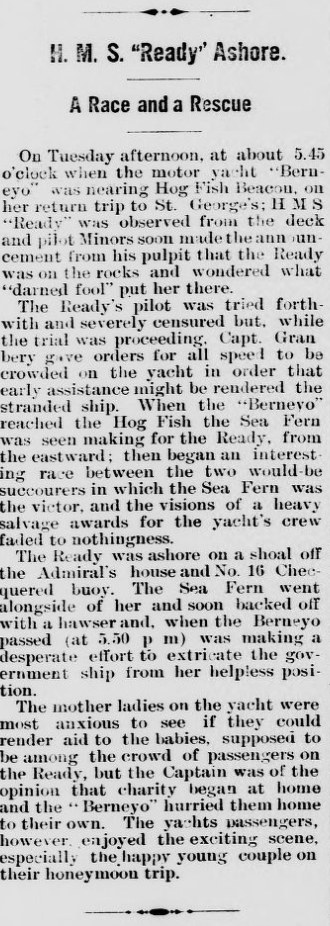
Royal Gazette report headed H.M.S. 'Ready' Ashore, A Race and a Rescue: on Tuesday afternoon the motor yacht Berneyo, nearing Hog Fish Beacon on her return to St. George's, sighted HMS Ready on the rocks; Pilot Minors wondered what darned fool put her there; Captain Granbery ordered full speed, but the Sea Fern reached the Ready first; the Ready was ashore on a shoal off the Admiral's house and No. 16 Chequered buoy; the yacht's passengers enjoyed the exciting scene, especially the happy young couple on their honeymoon trip
Royal Gazette, 16 February 1911

By 1911 Ready was no longer a fighting ship. She had been converted into a water tank vessel in 1894. On a Tuesday afternoon in February the motor yacht Berneyo was nearing Hog Fish Beacon on her way home to St. George’s when Ready was spotted from her deck. Pilot Minors announced from his “pulpit” that the Ready was on the rocks, and wondered what “darned fool” had put her there.

Captain Granbery called for full speed so the yacht could help, but the Sea Fern was already heading for her from the east. The race that followed went to the Sea Fern, and with it went the yacht crew’s visions of a heavy salvage award. Ready was ashore on a shoal off the Admiral’s house and No. 16 Chequered buoy, and when the Berneyo passed at 5.50 p.m. the Sea Fern had a hawser on her and was making “a desperate effort to extricate the government ship from her helpless position.”

I like the last line of the report best:

“The yachts passengers, however, enjoyed the exciting scene, especially the happy young couple on their honeymoon trip.”

The Ship

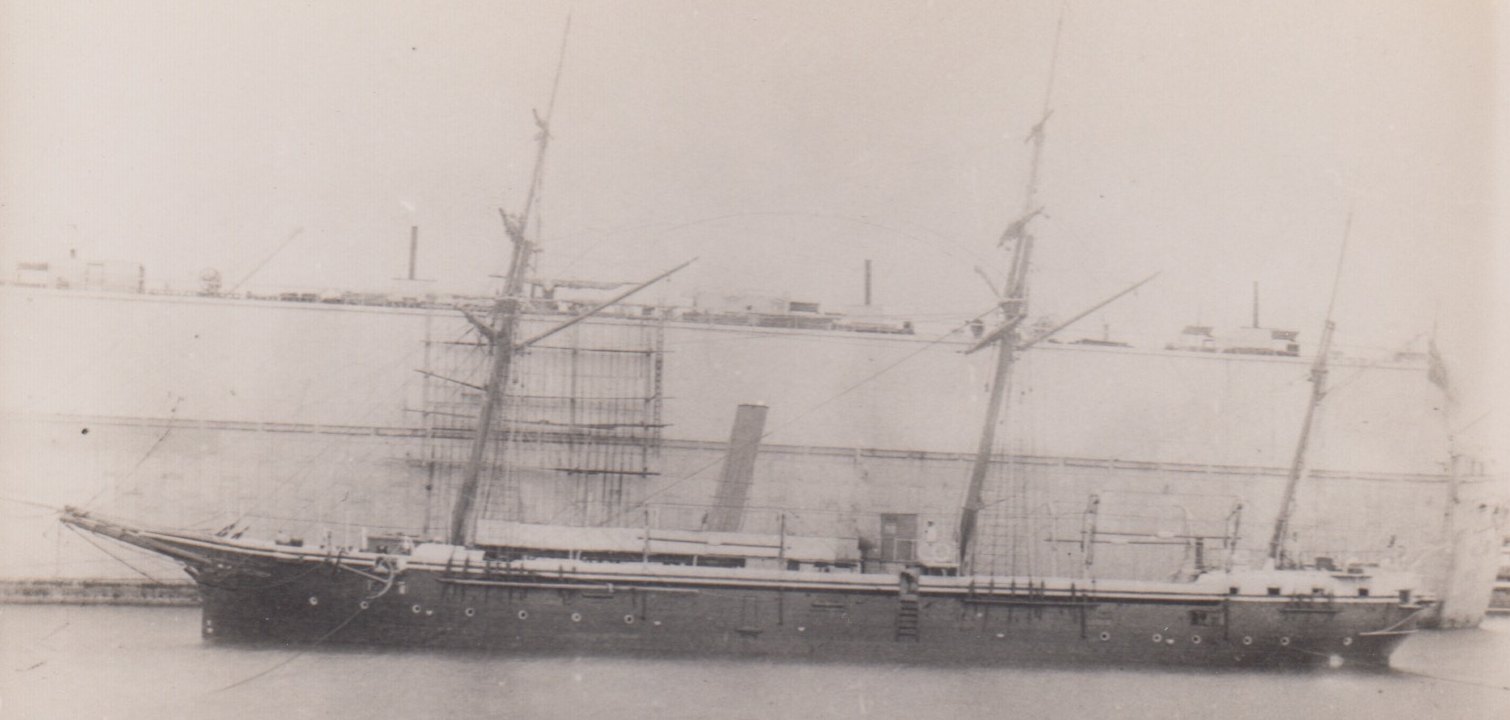
Detail of the photograph of HMS Ready: a black-hulled, three-masted barque-rigged gunvessel with a single funnel amidships, lying alongside the wall of the floating dock at Bermuda

H.M.S. Ready

Ready was one of four Frolic-class composite screw gunvessels built at Chatham, launched on 24 September 1872. She was 155 feet long, displaced 610 tons and was barque-rigged, with a funnel that could be lowered under sail. She served off South America and in the East Indies against the slave trade, and in 1882, at the start of the Anglo-Egyptian War, she seized the Suez Canal Company’s dredgers.

She went into reserve in the mid-1880s and became a tank vessel in 1894. She was renamed Drudge in October 1916 and sold at Bermuda on 25 February 1920, and her new owners turned her into a lighter. As a lighter she carried the winch for William Beebe’s bathysphere dives off Bermuda in 1930. Her remains lie on the north side of St. George’s Harbour, where they were identified in 1998.

BuiltChatham Dockyard, launched 1872
TypeFrolic-class composite screw gunvessel
Displacement610 tons
StationBermuda, tank vessel from 1894
FateSold at Bermuda 1920; wreck in St. George’s Harbour

Detail of the photograph above, Richard Perkins.

Still to find out

If you can help with any of these, I’d be very pleased to hear from you.

References

Not all research is seamless. Some ships arrive with a bundle of letters, Gazette reports and a captain’s name, and the page almost writes itself. Others sit quietly in a folder with one photograph and one clipping, waiting. Ready is one of those. Somewhere there will be a letter from one of her crew, a cover from the Dockyard, or a mention of her in the Beebe years, and when it turns up this page will grow. If you have anything, I’d love to hear from you.