Postal History · Naval Concessionary Rate · Bermuda Station

H.M.S. Pelican

Ireland Island, Bermuda · 8 December 1897

A sailor’s penny letter home to Devon, written at the end of a stormy month at the Dockyard.

◆

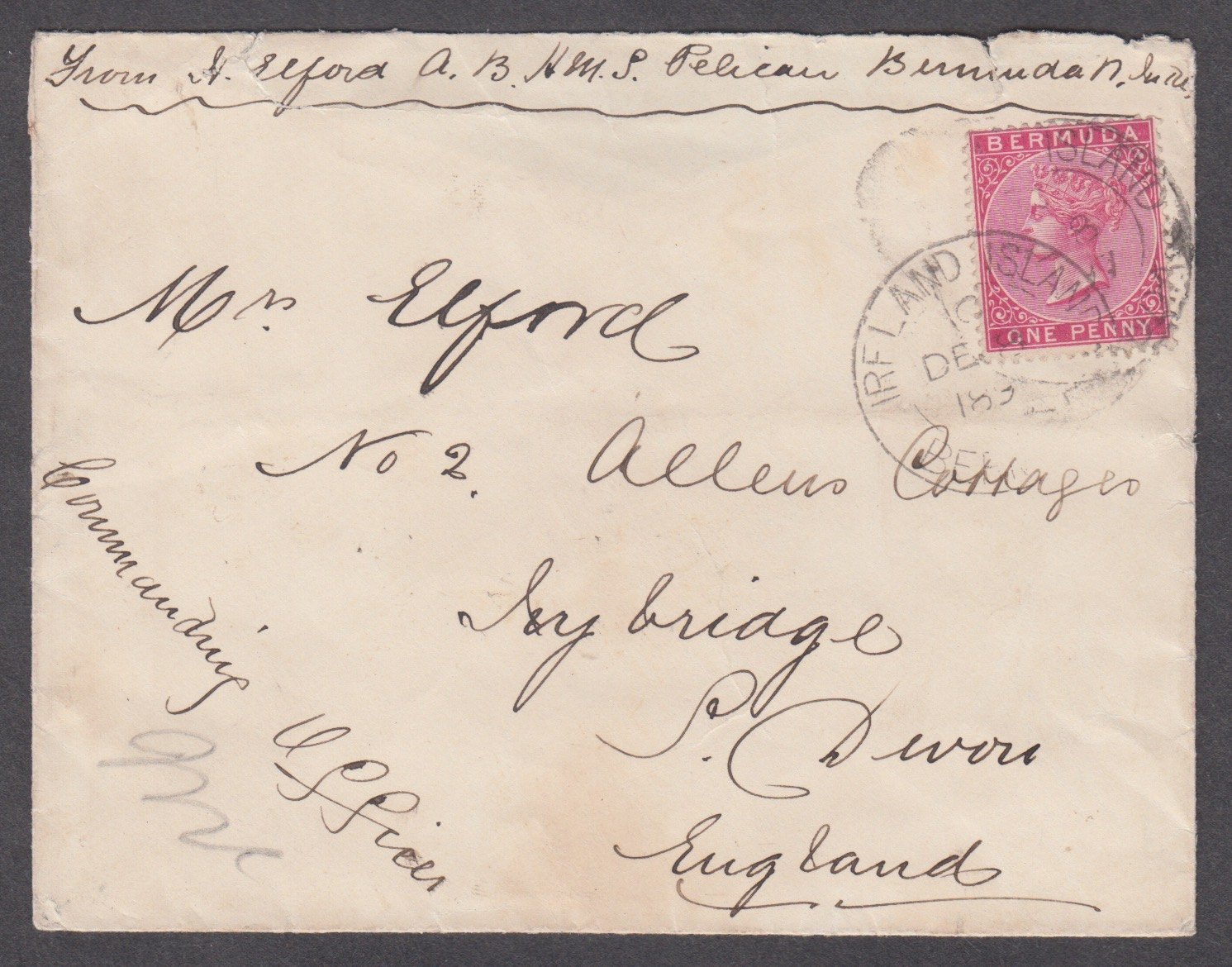
This is a naval concessionary rate cover, posted at Ireland Island, Bermuda, on 8 December 1897 and franked with a single 1d stamp. Along the top the sender has written “From H. Elford A.B. H.M.S. Pelican Bermuda W. Ind.”, and at the lower left it is endorsed “Commanding Officer”. It’s addressed to Mrs Elford at Ivybridge in South Devon. I like it because, with the help of the Royal Gazette, I can follow Elford’s ship almost day by day through the month before he sat down to write home.

I

A penny to send a letter home

1897 cover endorsed along the top From H. Elford A.B. H.M.S. Pelican Bermuda W. Ind., franked with a Bermuda one penny carmine Queen Victoria stamp cancelled by the Ireland Island oval datestamp, addressed to Mrs Elford, No. 2 Allen's Cottages, Ivybridge, S. Devon, England, and endorsed Commanding Officer at lower left with a faint pencilled initial
Endorsed by the sender, countersigned “Commanding Officer”, franked 1d
  • Posted Ireland Island, Bermuda, 8 December 1897
  • Rate 1d, naval concessionary rate
  • Datestamp Ireland Island type H5
  • Sender H. Elford, A.B. (Able Seaman), H.M.S. Pelican
  • Addressed to Mrs Elford, No. 2 Allen’s Cottages, Ivybridge, S. Devon, England
  • Endorsed “From H. Elford A.B. H.M.S. Pelican Bermuda W. Ind.”
  • Countersigned “Commanding Officer”, lower left, with a pencilled initial
  • Provenance Argyll Etkin, November 2025, lot 898

The concession let serving sailors send letters home for a penny. The sender had to give his name, rating and ship, and the letter had to be countersigned by his commanding officer, and this cover has all of that. The words “Commanding Officer” look to be in the same ink as the address, and beside them is a faint pencilled initial or signature that I can’t make out.

“From H. Elford A.B. H.M.S. Pelican Bermuda W. Ind.”

The “A.B.” after his name stands for Able Seaman. It was the rating a sailor reached once he was fully trained and experienced, a step up from Ordinary Seaman: a man who could hand, reef and steer, and was trusted with the everyday work of the ship. Most of the seamen in a ship’s company were A.B.s, and many men never went higher.

Imperial Penny Postage was still a year away, so in 1897 the concession really mattered. An ordinary letter to Britain cost 2½d, and for a sailor writing home regularly the difference added up.

The stamp is cancelled with the Ireland Island datestamp, type H5, which had come into use on 1 January 1896.
II

A rough passage from Halifax

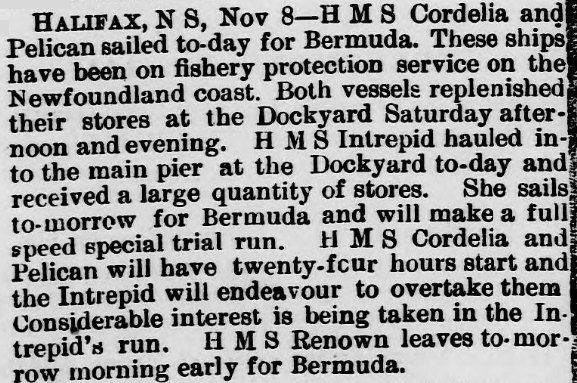
Royal Gazette report from Halifax, N.S., November 8: HMS Cordelia and Pelican sailed today for Bermuda; these ships have been on fishery protection service on the Newfoundland coast; both replenished their stores at the Dockyard on Saturday; HMS Intrepid sails tomorrow for Bermuda on a full speed special trial run and will endeavour to overtake them; HMS Renown leaves tomorrow morning for Bermuda
Royal Gazette, 9 November 1897: Cordelia and Pelican sail from Halifax
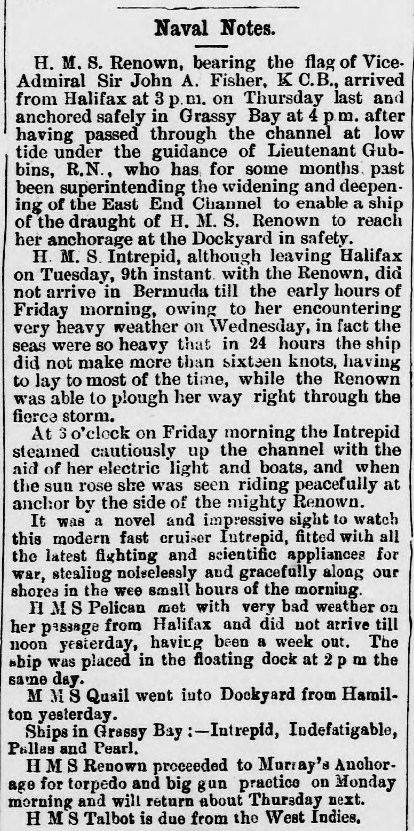
Royal Gazette Naval Notes: HMS Renown, flagship of Vice-Admiral Sir John A. Fisher, arrived from Halifax; HMS Intrepid met very heavy weather on Wednesday and arrived early on Friday morning; HMS Pelican met with very bad weather on her passage from Halifax and did not arrive till noon yesterday, having been a week out, and was placed in the floating dock at 2 p.m. the same day
Royal Gazette, 16 November 1897: “a week out”, and straight into the floating dock
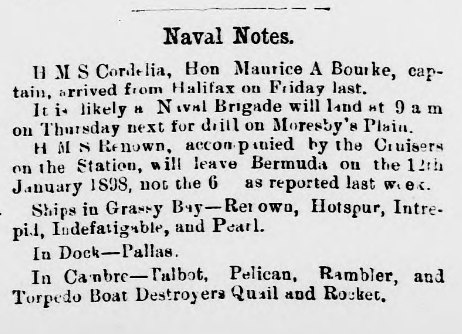
Royal Gazette Naval Notes: HMS Cordelia, Hon. Maurice A. Bourke, captain, arrived from Halifax on Friday last; ships in Grassy Bay, Renown, Hotspur, Intrepid, Indefatigable and Pearl; in dock, Pallas; in Camber, Talbot, Pelican, Rambler and torpedo boat destroyers Quail and Rocket
Royal Gazette, 30 November 1897: Pelican in the Camber
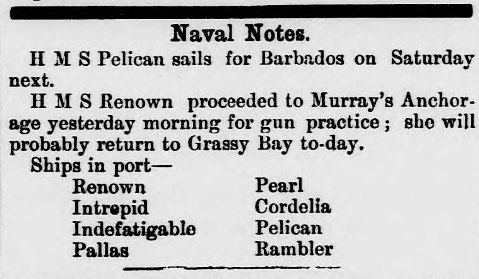
Royal Gazette Naval Notes: HMS Pelican sails for Barbados on Saturday next; ships in port, Renown, Intrepid, Indefatigable, Pallas, Pearl, Cordelia, Pelican and Rambler
Royal Gazette, 7 December 1897: due to sail for Barbados on the Saturday

Pelican and the corvette Cordelia had spent the summer on fishery protection off the Newfoundland coast. On 2 November the Gazette told Bermuda that both were “due from Halifax this week”. After restocking at Halifax Dockyard, they sailed together for Bermuda on Monday 8 November 1897. The new cruiser Intrepid was to leave a day later on a full-speed trial run, and see if she could overtake them.

It turned into a stormy week. Intrepid ran into very heavy seas on the Wednesday, and still got in first, early on the Friday morning. Pelican “met with very bad weather on her passage from Halifax” and came in at noon on Monday 15 November, a week out. At 2 o’clock that afternoon she was taken into the Dockyard’s floating dock. That looks to me like a captain who wanted to see straight away what the crossing had done to his ship’s bottom. Cordelia didn’t arrive until Friday 26 November, eleven days after Pelican, and I don’t yet know why she was so far behind.

By 30 November Pelican was out of dock and lying in the Camber, the basin inside the Dockyard at Ireland Island, with the Talbot, the Rambler and the destroyers Quail and Rocket. On 7 December she was among the ships in port, and the Gazette gave notice that she would sail for Barbados on Saturday the 11th.

Elford’s letter went through the Ireland Island post office on Wednesday 8 December, so he was writing home in the last few days before his ship left for the Caribbean.

A month at Bermuda

The ship on one side, the letter on the other.

The ship
The letter
8 Nov 1897
PelicanSails from Halifax for Bermuda with Cordelia.
12 Nov
IntrepidArrives early in the morning, having overtaken them.
15 Nov
PelicanArrives at noon after very bad weather, a week out; in the floating dock by 2 p.m.
26 Nov
CordeliaArrives from Halifax, eleven days after Pelican.
30 Nov
PelicanIn the Camber at Ireland Island.
7 Dec
PelicanIn port; due to sail for Barbados on Saturday.
8 Dec
ElfordPosted at Ireland Island to Mrs Elford at Ivybridge, 1d.
11 Dec
PelicanDue to sail for Barbados.
III

Who was H. Elford?

I haven’t identified him yet. Elford is a common name around Ivybridge, on the southern edge of Dartmoor, and there are several Ivybridge-born Elford households in the census returns. Mrs Elford could have been his mother or his wife.

Pelican was a Devonport ship, so a Devon man in her company makes good sense. She had recommissioned at Bermuda at the turn of 1896, when a fresh crew came out and the old one went home (the Crescent page has the Gazette noting the Flora leaving for England with “the paid-off crew of Pelican”). Elford was probably one of the new men, but that’s a guess for now. I’d love to find his service record and know which Elford he was.

The Ship

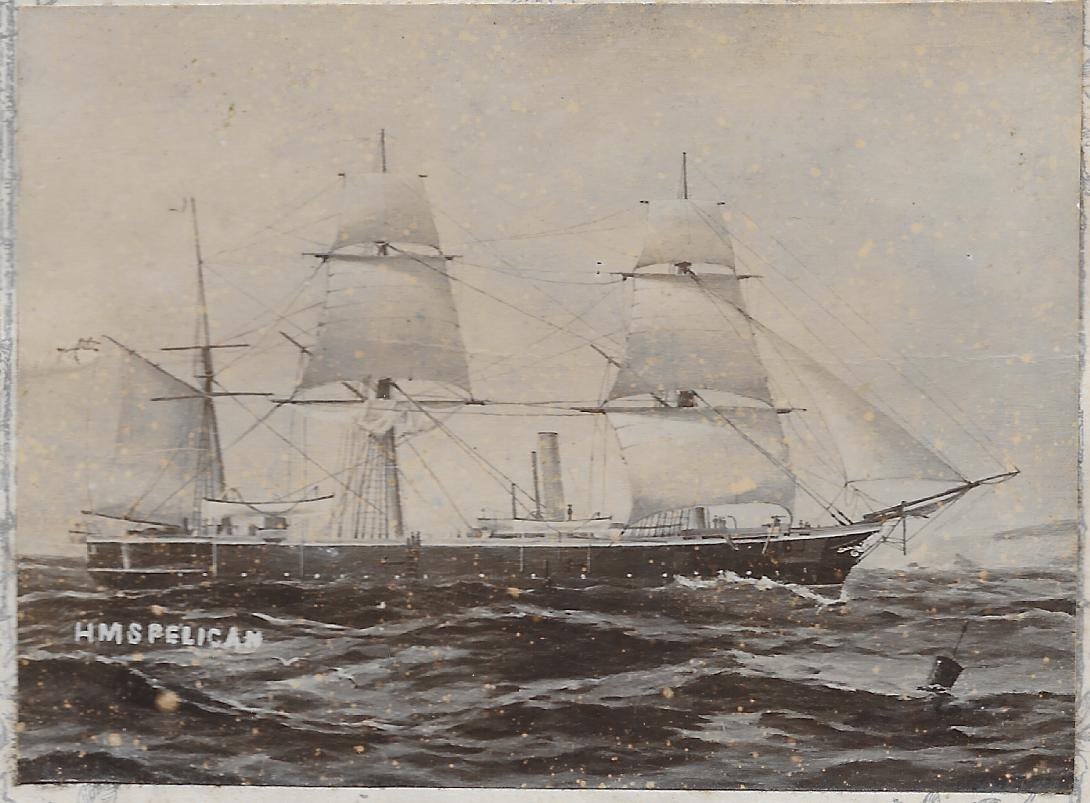
Old photograph of a painting of HMS Pelican under sail and steam in a rough sea, a barque-rigged sloop with a single funnel between the fore and main masts and a clipper bow, with HMS PELICAN lettered at lower left

H.M.S. Pelican

Pelican was an Osprey-class composite screw sloop, built at Devonport Dockyard and launched on 26 April 1877. She had wooden planking on an iron frame, steam engines, and a full barque rig for long spells on foreign stations where coal couldn’t be relied on. She went first to the Pacific Station, and spent the 1890s on the North America and West Indies Station, with summers in northern waters and winters at Bermuda and in the West Indies.

Commander Arthur J. Horsley was her captain from December 1895 to January 1898, so he was in command when Elford wrote this letter. In June 1897 he took her to Sydney, Cape Breton, for Queen Victoria’s Diamond Jubilee celebrations. Commander Herbert Lyon followed him in January 1898.

She paid off at Devonport in 1899 and was sold in January 1901 to the Hudson’s Bay Company, which strengthened her for ice and used her for years to supply its posts in Hudson Bay and Labrador. Her hull ended up at Sydney, Nova Scotia. Accounts differ on her end: the Hudson’s Bay Company records have her sold for breaking up in 1922, while Canadian naval sources say she was scuttled in 1953.

BuiltDevonport Dockyard, launched 1877
TypeOsprey-class composite screw sloop
Displacement1,130 tons
CommanderArthur J. Horsley, Dec 1895–Jan 1898
FateSold to the Hudson’s Bay Company, 1901

Photograph of a painting; artist and photographer not identified. Via Wikimedia Commons.

Still to find out

If you can help with any of these, I’d be very pleased to hear from you.

Provenance and references

It’s a plain little envelope, but it ties one sailor to a month of his ship’s life: a stormy crossing, an afternoon in the floating dock, a few weeks in the Camber, and a letter home before sailing south for Barbados. If I can find out which Elford he was, the story will be complete.