Postal History · Royal Navy · North America and West Indies Station

H.M.S. Pearl

Hamilton & Ireland Island · 1897–1900

Three postcards to a cruiser: a bicycle salesman’s pitch and two summonses from the Malabar.

◆

These are three Queen Victoria postal stationery cards, all sent to men in the cruiser Pearl while she was at Bermuda. None of them is rare, and I like them because they’re so ordinary. The first is a Hamilton shop trying to sell bicycles to her engineer two days after she arrived. The other two, written two and a half years later, are short notes from the same man asking one of her stokers to come and see him. With the help of the Royal Gazette it turned out I could place all three almost to the day, and there was a telephone in the story too.

I

“Our ‘Victor’ Bicycles”

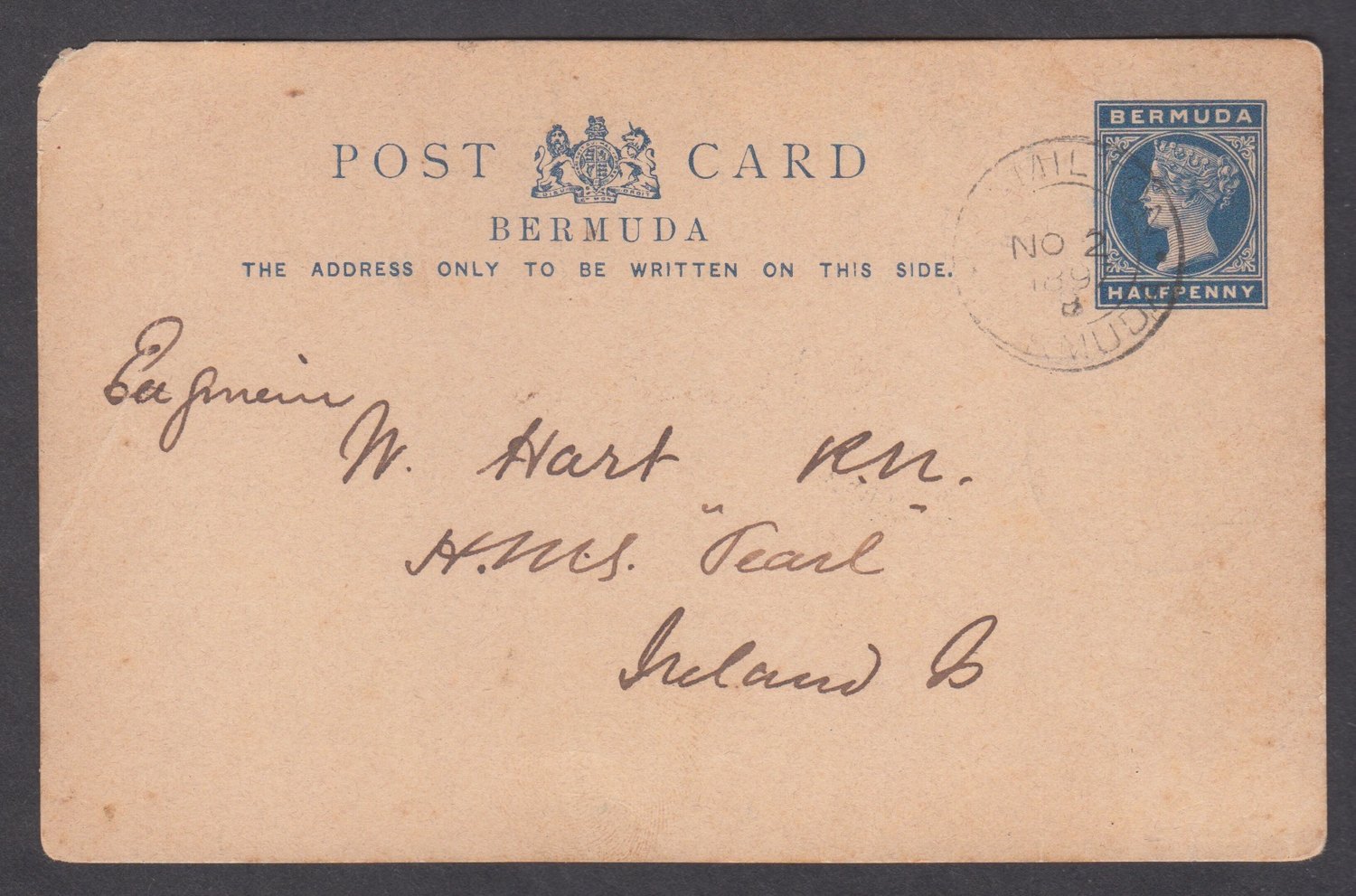
Bermuda halfpenny blue postal stationery card with the Royal Arms and Queen Victoria indicium, addressed in ink to Engineer W. Hart R.N., H.M.S. Pearl, Ireland Is., cancelled with a Hamilton Bermuda datestamp, code B, NO 2 1897
Front: to Engineer W. Hart, Hamilton H6 datestamp, 2 November 1897
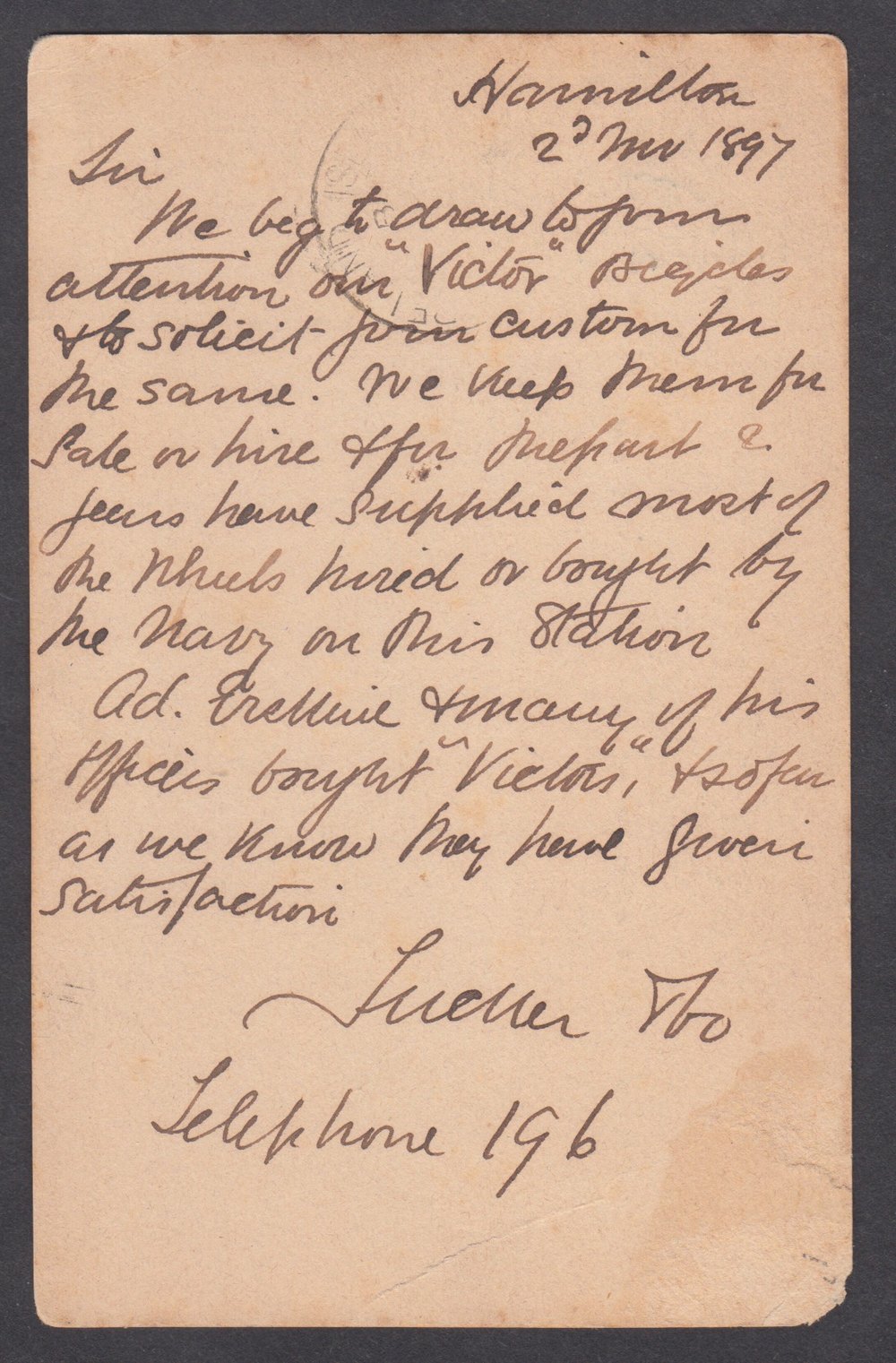
Message side headed Hamilton 2d Nov 1897, offering Victor bicycles for sale or hire, mentioning Admiral Erskine and his officers, signed Tucker & Co., Telephone 196, with a faint Ireland Island receiving datestamp at upper left
Message side, with the faint Ireland Island receiver
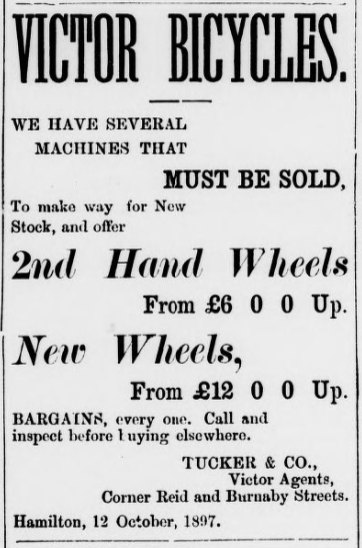
Royal Gazette advertisement: VICTOR BICYCLES. We have several machines that must be sold, to make way for new stock, and offer 2nd hand wheels from £6 0 0 up, new wheels from £12 0 0 up. Bargains, every one. Tucker & Co., Victor Agents, Corner Reid and Burnaby Streets, Hamilton, 12 October 1897
Royal Gazette, 26 October 1897: Tucker & Co.’s advertisement
  • Card ½d blue Queen Victoria postal stationery card
  • Posted Hamilton, datestamp type H6, code B (afternoon), NO 2 1897
  • Received Ireland Island, type H5, code B (afternoon), on the message side (faint)
  • Addressed to Engineer W. Hart R.N., H.M.S. “Pearl”, Ireland Is.
  • Sender Tucker & Co., Victor agents, corner of Reid and Burnaby Streets, Hamilton

The Pearl came into Bermuda on Sunday 31 October 1897, after what the Royal Gazette called “a somewhat stormy passage” from Devonport. On Tuesday 2 November the paper printed a list of her officers, and there among them is Engineer William Hart. That same day Tucker & Co. of Hamilton wrote him this card.

It’s cancelled with the Hamilton H6 datestamp, code B. That’s the afternoon delivery, A, B and C standing for morning, afternoon and evening. If you look closely you can just make out the Ireland Island H5 receiver on the message side, also code B. So it was posted in Hamilton and delivered at the Dockyard the same afternoon.

“Sir, We beg to draw your attention [to] our ‘Victor’ Bicycles & to solicit your custom for the same. We keep them for sale or hire & for the past 2 years have supplied most of the Wheels hired or bought by the Navy on this Station. Ad. Erskine & many of his officers bought ‘Victors’, & so far as we know they have given satisfaction.”

It’s signed “Tucker & Co.”, with “Telephone 196” underneath. It took me a while to read the signature, and in the end the Gazette solved it. A week before, Tucker & Co., “Victor Agents, Corner Reid and Burnaby Streets”, had been advertising that they had several Victors that “must be sold, to make way for New Stock”: second-hand wheels from £6 and new ones from £12, “Bargains, every one.” A new ship with a wardroom full of officers was too good to miss. I like to think somebody at Tucker’s read the officer list over breakfast and wrote straight away, but I can’t prove that.

The admiral they name is Sir James Erskine, Commander-in-Chief since 1895, whose flagship was HMS Crescent (see my Crescent page). Tucker’s were a little behind the times. Erskine and the Crescent had left Halifax for home on 15 September and reached Portsmouth on the 24th to pay off, five weeks before this card was written.

Victors were American bicycles, made by the Overman Wheel Company of Chicopee Falls, Massachusetts, and were reckoned among the best of the day. By December 1897, a month after this card, Overman was heading for bankruptcy. I’d love to know whether Tucker’s ever got their new stock.
The Pearl arrives

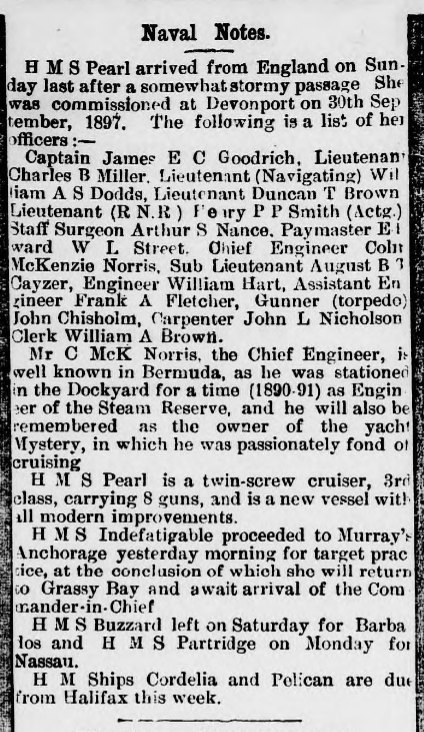
Royal Gazette Naval Notes: H M S Pearl arrived from England on Sunday last after a somewhat stormy passage; she was commissioned at Devonport on 30th September 1897; list of officers including Captain James E C Goodrich, Chief Engineer Colin McKenzie Norris and Engineer William Hart; note that Mr Norris was Engineer of the Steam Reserve in the Dockyard in 1890-91 and owner of the yacht Mystery
Royal Gazette, 2 November 1897: her arrival and officers

The Gazette’s Naval Notes of 2 November give her arrival and every officer by name, from Captain James E. C. Goodrich down to the clerk. She had been commissioned at Devonport on 30 September for the North America and West Indies Station. Her Chief Engineer, Colin McKenzie Norris, was a familiar face. He had been Engineer of the Steam Reserve at the Dockyard in 1890–91, “and he will also be remembered as the owner of the yacht Mystery, in which he was passionately fond of cruising.”

By mid-November she was lying in Grassy Bay with the Intrepid, Indefatigable and Pallas, and on 7 December she was still in port with the flagship Renown, the Cordelia, Pelican and Rambler, among others. After that she drops out of the Naval Notes. She wasn’t with Admiral Fisher’s squadron when it sailed for Antigua in January 1898.

II

“Please come on Board to day”

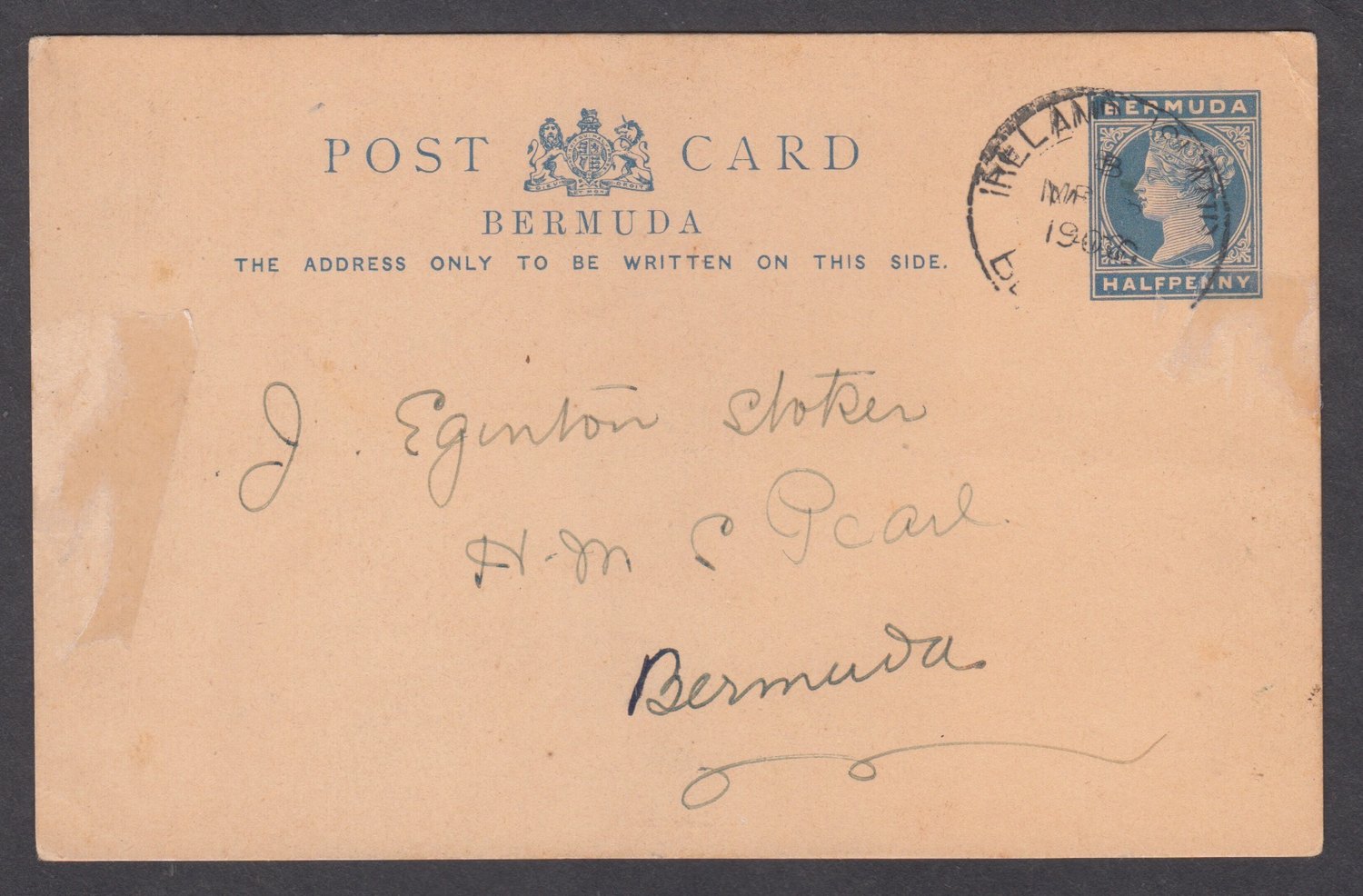
Bermuda halfpenny blue postal stationery card addressed in ink to J. Eginton Stoker, H.M.S. Pearl, Bermuda, cancelled with an Ireland Island Bermuda datestamp, code B, March 1900, with old hinge stains
Card 2: ½d card to J. Eginton, Stoker, Ireland Island H5, 1 March 1900
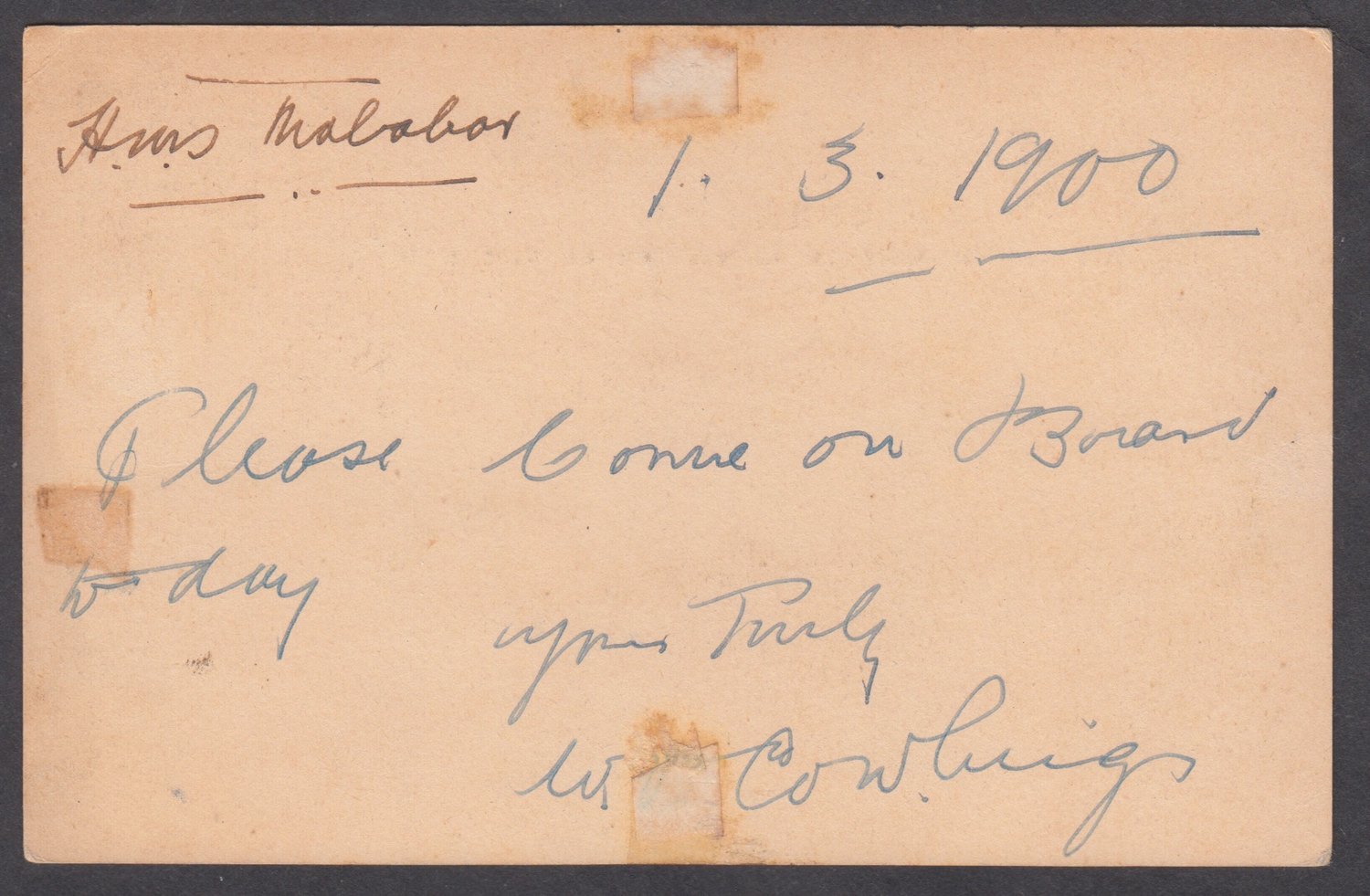
Message side headed H.M.S. Malabar in brown ink, dated 1.3.1900 in blue: Please come on Board to day, yours truly W. Cowlings, with old hinge stains
Card 2, message: “H.M.S. Malabar”, 1 March 1900
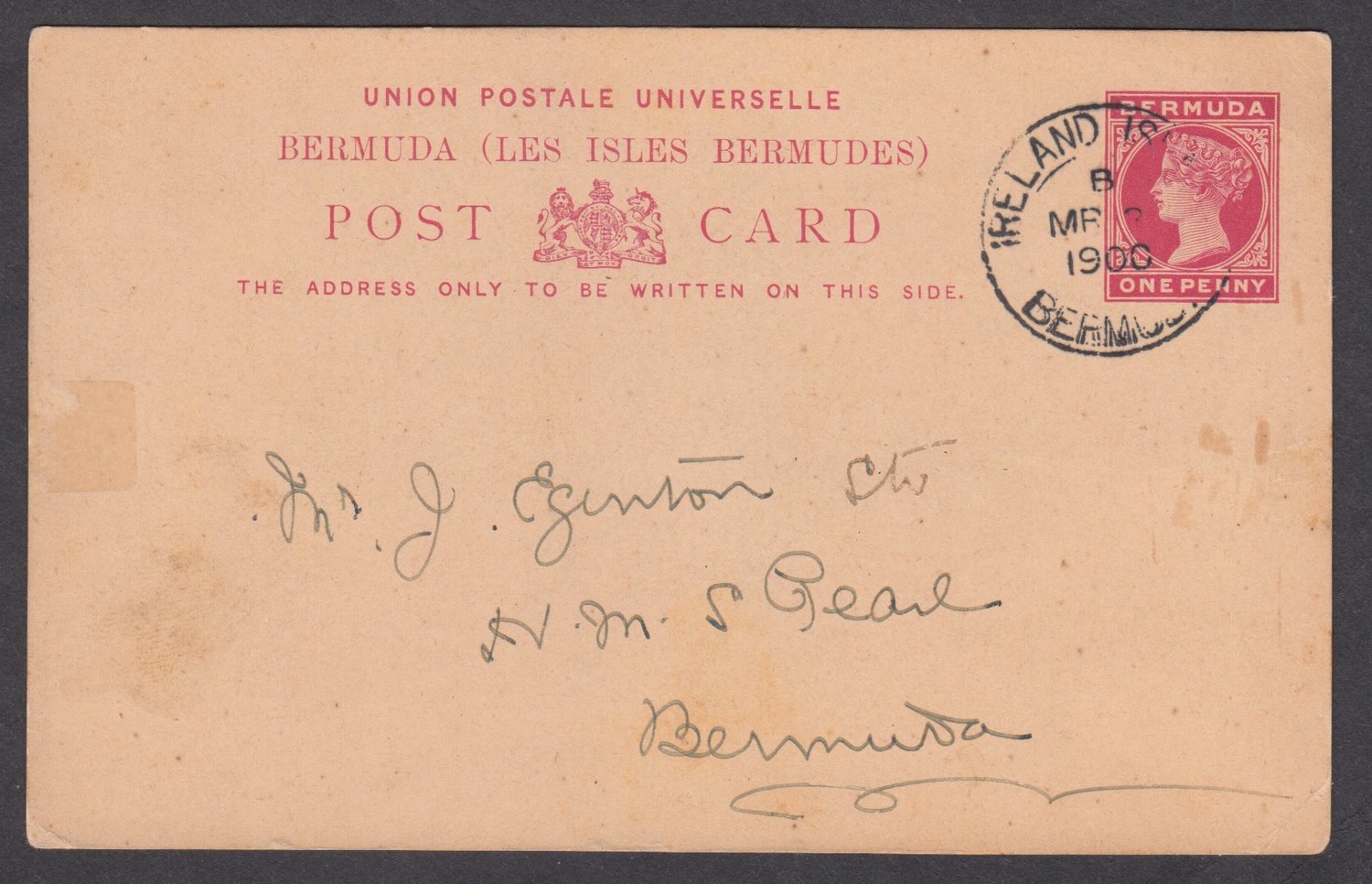
Bermuda one penny carmine Union Postale Universelle postal stationery card addressed to Mr J. Eginton Sto., H.M.S. Pearl, Bermuda, cancelled with an Ireland Island Bermuda datestamp, code B, MR 8 1900
Card 3: 1d UPU card to Mr J. Eginton, Ireland Island H5, 8 March 1900
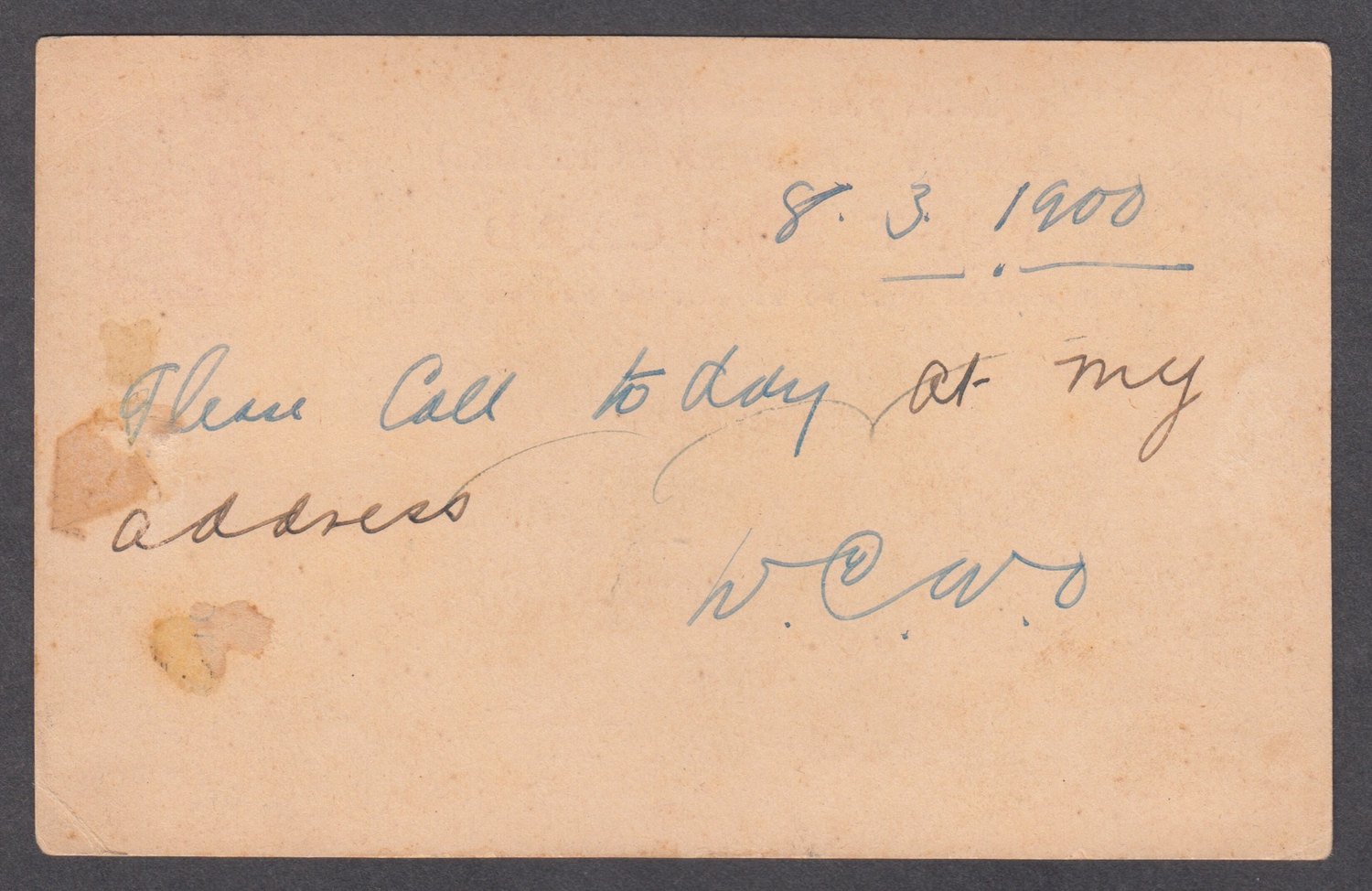
Message side dated 8.3.1900: Please call to day at my address, signed W.Cw., with stains
Card 3, message: 8 March 1900, “W.Cw.”
  • Card 2 ½d blue Queen Victoria postal stationery card
  • Posted Ireland Island, type H5, code B (afternoon), March 1900 (day indistinct, probably the 1st)
  • Card 3 1d carmine Queen Victoria Union Postale Universelle card
  • Posted Ireland Island, type H5, code B (afternoon), MR 8 1900
  • Addressed to J. Eginton, Stoker, H.M.S. Pearl, Bermuda
  • Sender W. Cowlings, H.M.S. Malabar

Two and a half years later, the Pearl was back at Bermuda and these two cards went to the same man, J. Eginton, one of her stokers. Both were posted at Ireland Island and both carry the type H5 datestamp with code B, the afternoon delivery. Both are written in the same blue hand.

The first is dated 1 March 1900 and headed “H.M.S. Malabar”, in a brown ink that doesn’t match the message:

“Please come on Board to day. Yours truly, W. Cowlings”

The second, a week later on 8 March, is shorter still:

“Please Call to day at my address. W.Cw.”

The handwriting is the same, so I’m fairly sure “W.Cw.” is Cowlings again. The Malabar was the old Indian troopship that had become the receiving ship at the Dockyard in 1897. I don’t know who Cowlings was. “Come on board” suggests he was serving in the Malabar, but “my address” sounds like somewhere ashore. A tradesman, a tailor, a creditor? That’s a guess for now.

The second card is a small puzzle of its own. The local rate for a postcard was a halfpenny, as the other two cards show, but this is the penny Union Postale Universelle card meant for overseas, so it’s overpaid. The Queen Victoria halfpenny card had been printed only once, 20,340 of them in 1885, and those had to last until a new halfpenny card arrived in February 1903. I suspect the Ireland Island office simply had none to hand that week, but I haven’t found a record of a shortage, so that’s a guess too.

Both message sides are grubby, with old hinge marks, but they’re what makes these cards worth having, so I’ve shown them.

Back at Bermuda

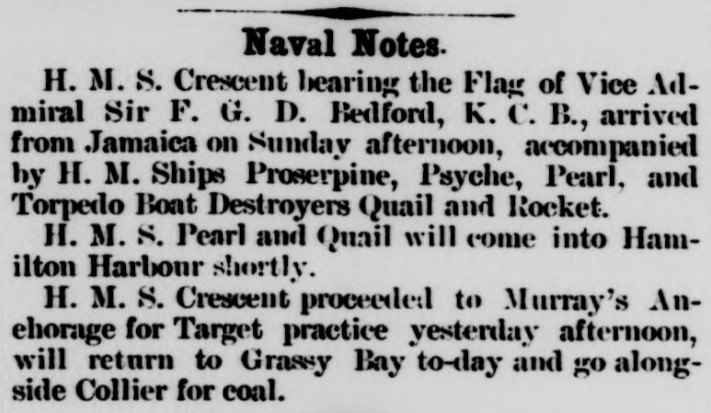
Royal Gazette Naval Notes: H.M.S. Crescent bearing the flag of Vice Admiral Sir F. G. D. Bedford arrived from Jamaica on Sunday afternoon, accompanied by H.M. Ships Proserpine, Psyche, Pearl and torpedo boat destroyers Quail and Rocket; H.M.S. Pearl and Quail will come into Hamilton Harbour shortly
Royal Gazette, 27 February 1900: in from Jamaica with the flagship
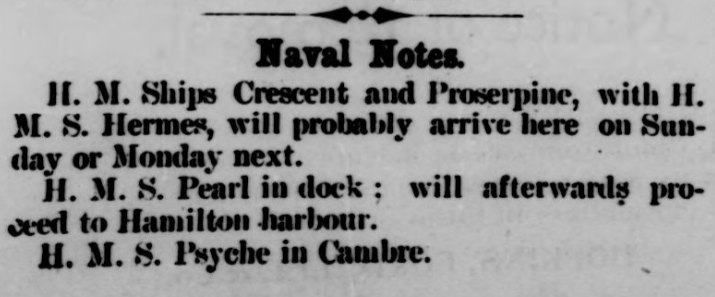
Royal Gazette Naval Notes: H.M.S. Pearl in dock; will afterwards proceed to Hamilton harbour. H.M.S. Psyche in Cambre.
Royal Gazette, 10 March 1900: “H.M.S. Pearl in dock”

The Gazette places both cards neatly. The Pearl had come up from Jamaica with Vice-Admiral Sir Frederick Bedford’s flagship, the Crescent, arriving on the afternoon of Sunday 25 February 1900 with the Proserpine, Psyche and the destroyers Quail and Rocket. Cowlings wrote his first card four days later.

A week after that, on 8 March, he wrote again, and two days later the Gazette reported “H.M.S. Pearl in dock; will afterwards proceed to Hamilton harbour.” So for at least part of that fortnight she was at the Dockyard, not far from the Malabar. Why Cowlings wrote rather than walked over I can only guess. Perhaps some of her men were living elsewhere while she was docked. I’d love to know.

It was a time of change on board. On Saturday 10 March, the day the Gazette reported her in dock, Captain Goodrich sailed for New York in the mail steamer Orinoco, on his way home. He had brought her out from Devonport in 1897. His successor, Captain Frederick Stopford, was no stranger to the station. In 1897, as a commander, he had the cruiser Tartar on the North America station.

III

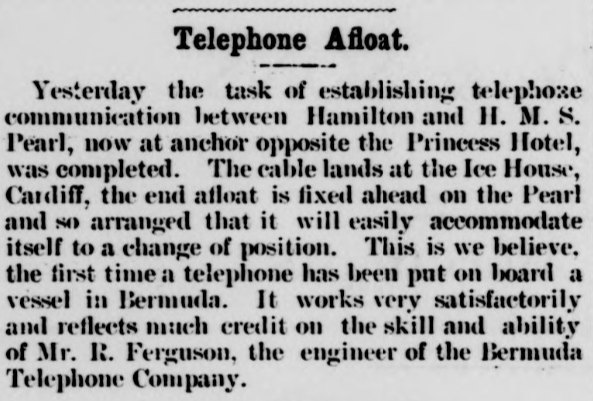
Telephone afloat

Royal Gazette report headed Telephone Afloat: yesterday telephone communication was established between Hamilton and H.M.S. Pearl, at anchor opposite the Princess Hotel; the cable lands at the Ice House, Cardiff, and the end afloat is fixed ahead on the Pearl; believed to be the first time a telephone has been put on board a vessel in Bermuda; credit to Mr R. Ferguson, engineer of the Bermuda Telephone Company
Royal Gazette, 31 March 1900: “Telephone Afloat”

When she came out of dock the Pearl went round to Hamilton, as promised, and anchored opposite the Princess Hotel. On 30 March 1900 the Bermuda Telephone Company ran a line out to her. In the Gazette’s words, “the cable lands at the Ice House, Cardiff, the end afloat is fixed ahead on the Pearl and so arranged that it will easily accommodate itself to a change of position.” The paper believed it was “the first time a telephone has been put on board a vessel in Bermuda”, and gave the credit to Mr R. Ferguson, the company’s engineer.

I like the link with the first card. In 1897 Tucker & Co. proudly signed off with “Telephone 196”. Two and a half years later the Pearl herself was on the telephone.

She stayed until the middle of May. The Gazette of 15 May 1900 reported simply: “H M S Pearl sails to-day for the West Indies.”

The Pearl at Bermuda

The ship on one side, the cards on the other.

The ship
The cards
15 Sep 1897
CrescentAdmiral Erskine leaves Halifax for home in his flagship.
30 Sep
PearlCommissioned at Devonport under Captain Goodrich.
12 Oct
Tucker & Co.Victors “must be sold, to make way for New Stock”.
31 Oct
PearlArrives at Bermuda after a stormy passage.
2 Nov
GazettePrints her list of officers.
Card 1Tucker & Co. write to Engineer Hart.
7 Dec
PearlStill in port; after this she drops out of the Naval Notes.
17 Feb 1900
PearlAt Jamaica with the squadron.
25 Feb
PearlArrives at Bermuda with the flagship Crescent.
1 Mar
Card 2Cowlings: “Please come on Board to day.”
8 Mar
Card 3“Please Call to day at my address.”
10 Mar
PearlIn dock. Captain Goodrich sails for New York in the Orinoco.
30 Mar
PearlAt anchor off the Princess Hotel; the telephone goes on board.
15 May
PearlSails for the West Indies.

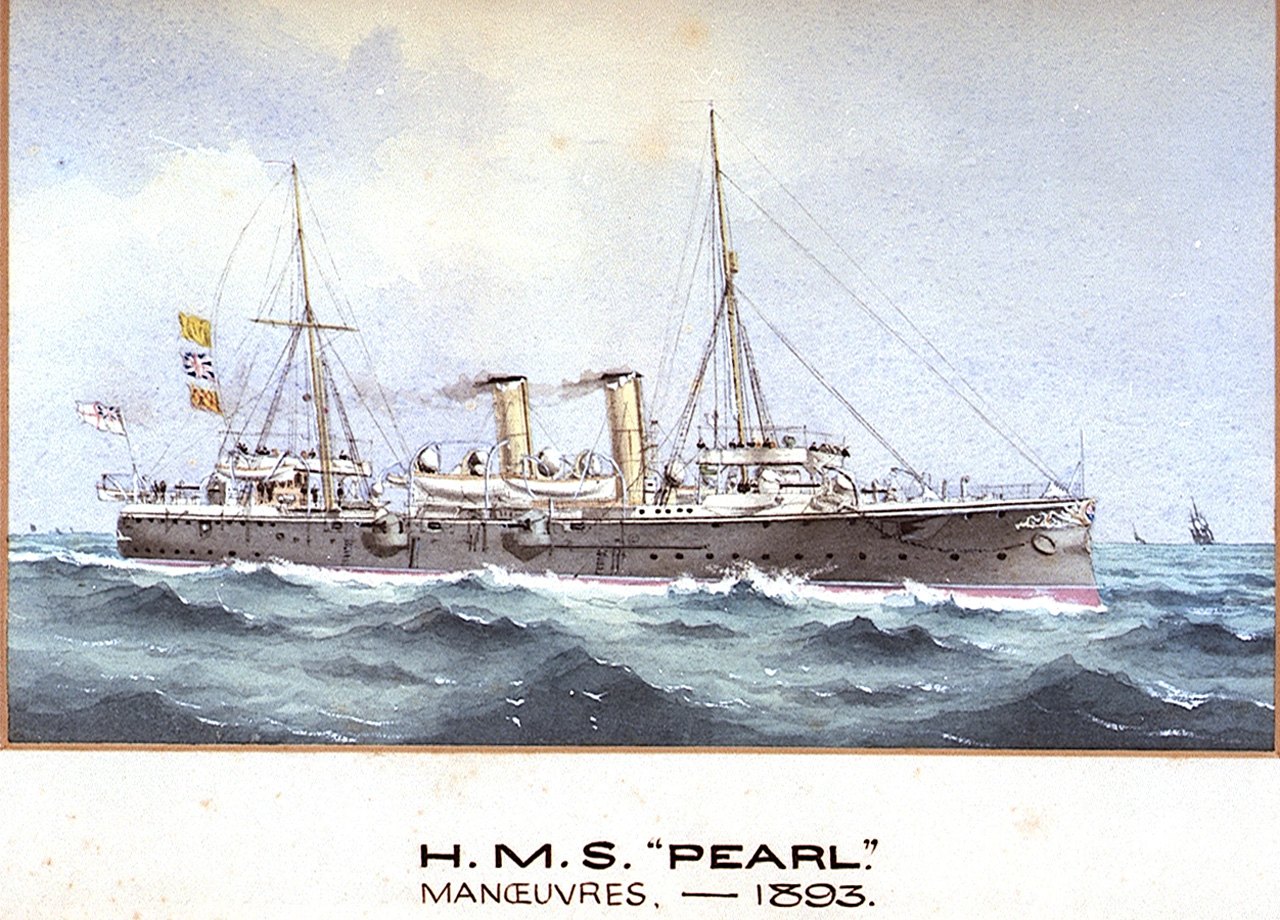
The Ship

Watercolour of HMS Pearl under way in a choppy sea, broadside view with two buff funnels, two masts, signal flags flying and a White Ensign at the stern, captioned H.M.S. Pearl, Manoeuvres, 1893

H.M.S. Pearl

HMS Pearl gave her name to a class of nine third-class protected cruisers designed by Sir William White, five of which were paid for by Australia to serve in Australian waters. She was built at Pembroke Dockyard, launched on 28 July 1890 and completed in 1892. For her first few years she was kept in reserve and commissioned each summer for the annual manoeuvres, which is how the artist of this watercolour saw her in 1893.

On 30 September 1897 she was commissioned at Devonport for the North America and West Indies Station under Captain James Goodrich, and arrived at Bermuda at the end of October. Captain Frederick Stopford succeeded Goodrich in 1900. She was sold for breaking up in 1906.

BuiltPembroke Dockyard, launched 1890
TypeThird-class protected cruiser, Pearl class
Displacement2,575 tons
GunsEight 4.7-inch
CaptainJ. E. C. Goodrich, 1897–1900; F. G. Stopford, 1900
FateSold for breaking up, 1906

“H.M.S. Pearl. Manœuvres, 1893”, watercolour. Royal Museums Greenwich, PU0314, via Wikimedia Commons.

Still to find out

If you can help with any of these, I’d be very pleased to hear from you.

References

Three ordinary cards, and between them a bicycle salesman who read the paper, a stoker someone badly wanted to see, and a ship with a telephone. I’d still like to know who Eginton and Cowlings were.