Postal History · Hired Military Transport · Bermuda 1910

H.M.T. Braemar Castle

Grassy Bay, Bermuda · January 1910

Two postcards from one troopship’s visit: a passenger going on to South Africa, and a Bedfordshire soldier who had just arrived.

◆

Two postcards from the same voyage of the same troopship, written within a few days of each other by two people who, as far as I know, never met. The Braemar Castle came into Grassy Bay from Gibraltar on 18 January 1910 with the 2nd Bedfordshire Regiment on board, and two days later she sailed for South Africa with the Duke of Cornwall’s Light Infantry. One card was written by a passenger who was staying on board and wished she was already in Durban. The other is from a Bedfordshire soldier telling his mother he’d arrived. Both of them say what a rough crossing it was.

I

“I wish it was Durban”

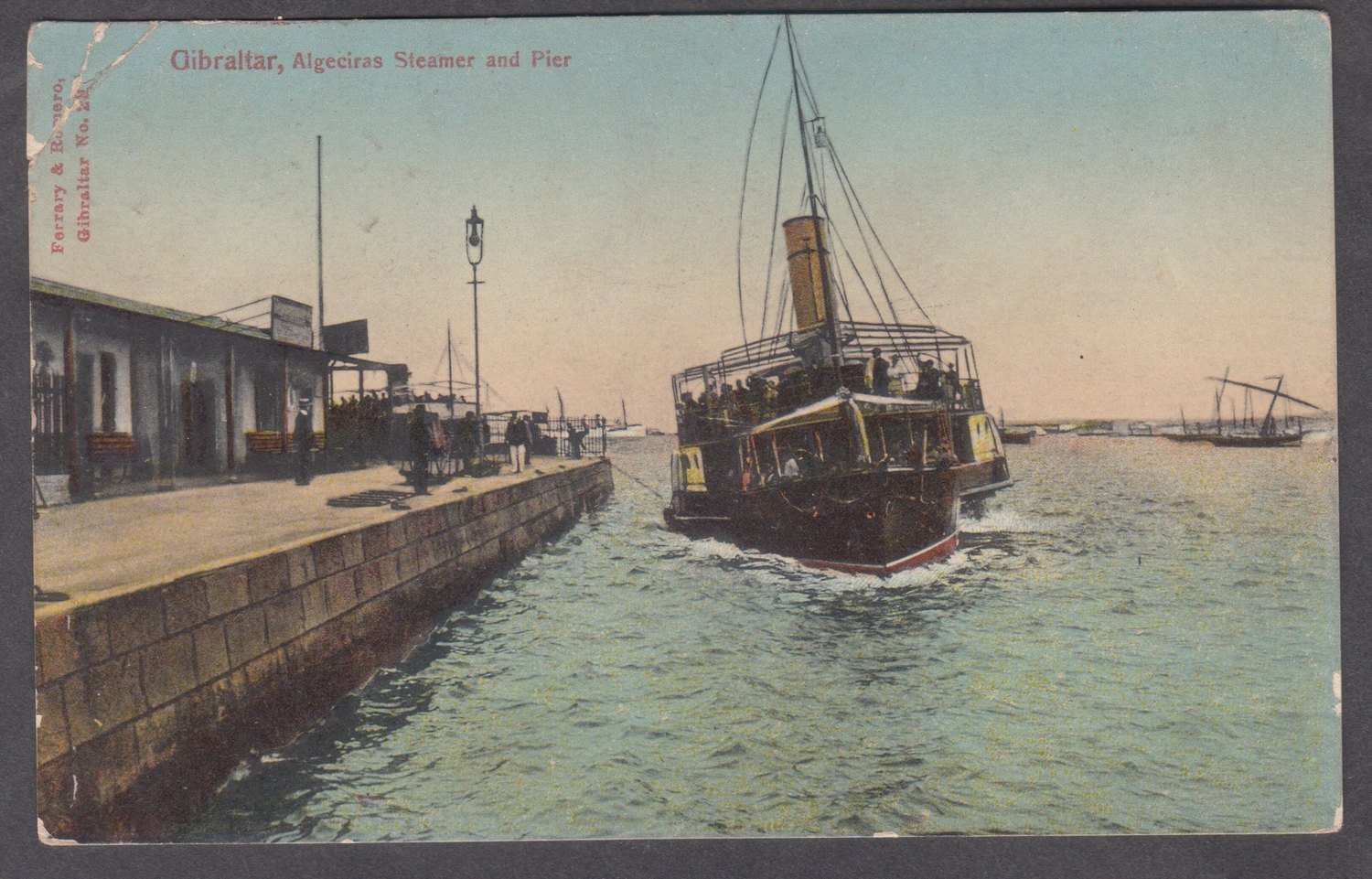
Picture side of a coloured postcard: a paddle-wheel ferry steamer crowded with passengers coming alongside a stone pier with a long low shed, a lamp post and people waiting on the quay; lateen-rigged boats on the water behind; captioned Gibraltar, Algeciras Steamer and Pier, with the publisher's imprint Ferrary and Romero, Gibraltar, up the left edge
“Gibraltar, Algeciras Steamer and Pier”: Ferrary & Romero, Gibraltar
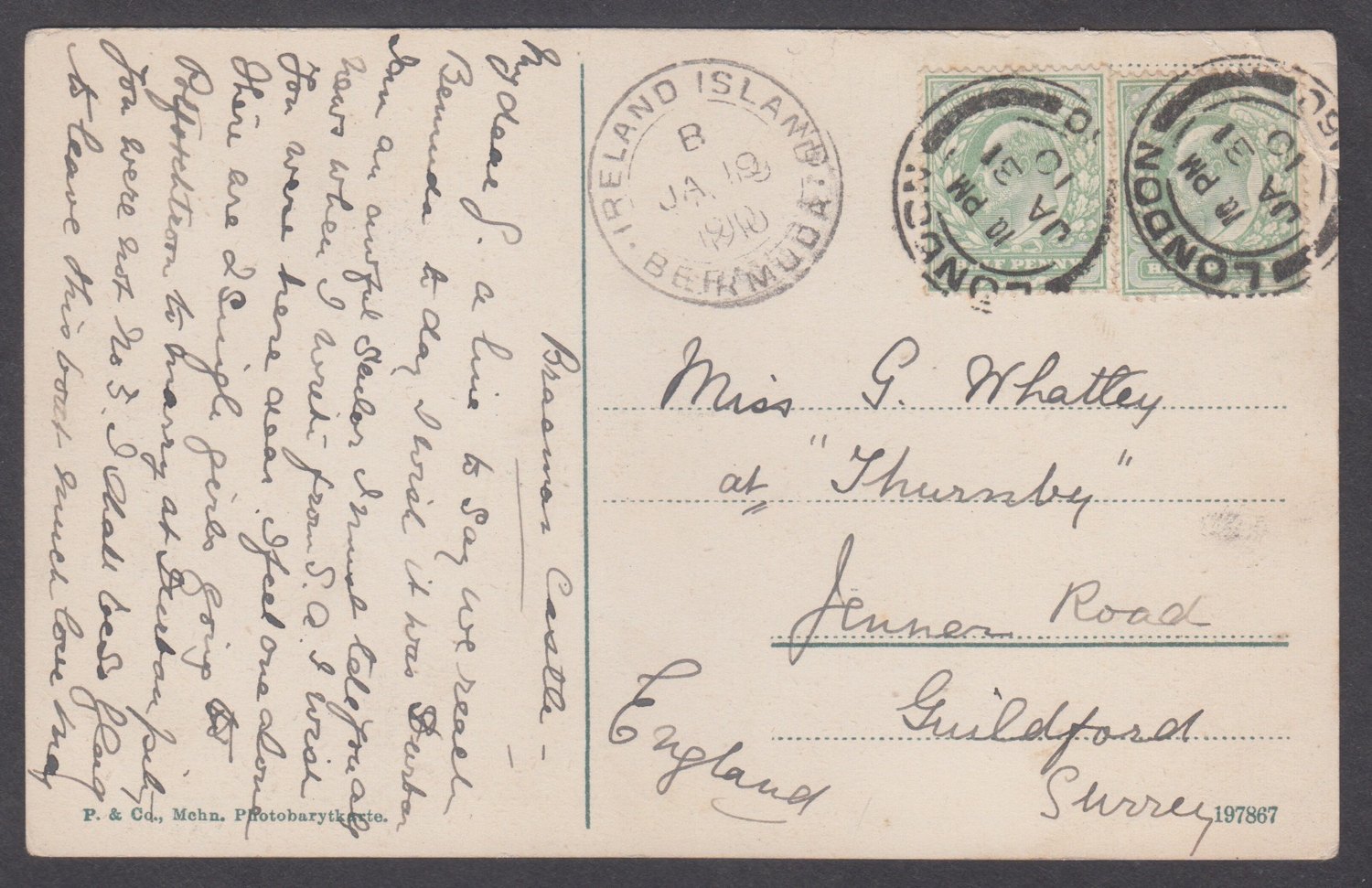
Message and address side of the postcard: a pair of British halfpenny green King Edward VII stamps at top right, each cancelled by a London datestamp of 31 January 1910; to their left a clear Ireland Island B Bermuda datestamp of 19 January 1910 struck on the card; the message written sideways on the left headed Braemar Castle; addressed on the right to Miss G. Whatley, at Thurnby, Jenner Road, Guildford, Surrey, England
Ireland Island B, 19 January 1910, with the British stamps cancelled in London on the 31st
  • Written On board the Braemar Castle, 18 January 1910
  • Card Ferrary & Romero, Gibraltar; printed in Munich (P. & Co., Photobarytkarte 197867)
  • Stamps Two British ½d green, King Edward VII
  • Postmarks Ireland Island B, 19 January 1910; London, 31 January 1910
  • Addressed to Miss G. Whatley, “Thurnby”, Jenner Road, Guildford, Surrey

The picture is a Gibraltar view of the Algeciras ferry coming in to the pier. The Braemar Castle had come to Bermuda from Gibraltar, so I think she bought the card there, wrote it on board as the ship came in, and posted it in Bermuda. She headed it “Braemar Castle” and wrote:

“My dear G. a line to say we reach Bermuda to day I wish it was Durban I am an awful sailor I must tell you all news when I write from S.A. I wish you were here dear. I feel (all) alone There are 2 single girls going to Potchefstroom to marry at Durban pity you were not No 3. I shall be so glad to leave this boat much love May”

The message, 18 January 1910

So she wasn’t getting off at Bermuda. She was going on to South Africa with the ship, and from the sound of it she wasn’t enjoying the trip. Potchefstroom, in the Transvaal, was a big garrison town. I’d love to know whether those two girls were going out to marry soldiers.

The postal side is interesting. She paid with two British ½d stamps, the 1d postcard rate from Britain, and British stamps weren’t valid in Bermuda. The card went into the mail at Ireland Island, the Dockyard office beside Grassy Bay, and was struck IRELAND ISLAND B on 19 January, well clear of the stamps, which were left uncancelled. It probably went out on the 22nd, in either the Bermudian or the Orotava, to New York. From there it crossed on a liner I haven’t yet identified and was cancelled in London on the 31st, as though it had been posted there. I can’t see any sign that it was charged.
II

“Quite safe after the voyage”

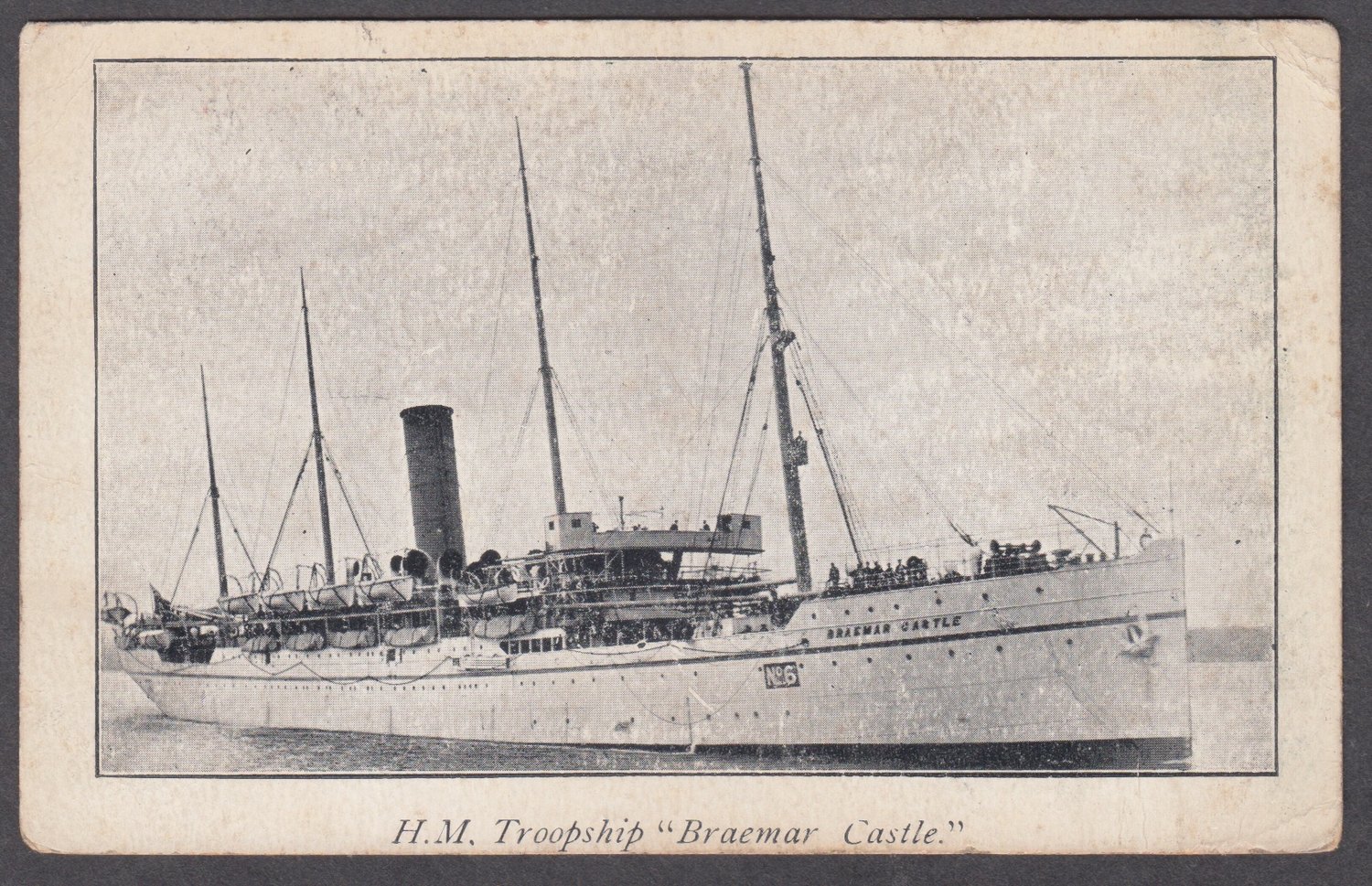
Picture side of a black and white postcard: the troopship Braemar Castle at anchor, a long white-hulled steamer with four masts, a single tall funnel, lifeboats along the upper deck and soldiers lining the rails; her name is painted on the bow and the transport number No 6 on a board on her side; captioned H.M. Troopship Braemar Castle
“H.M. Troopship ‘Braemar Castle’”, with her transport number, No. 6, on her side
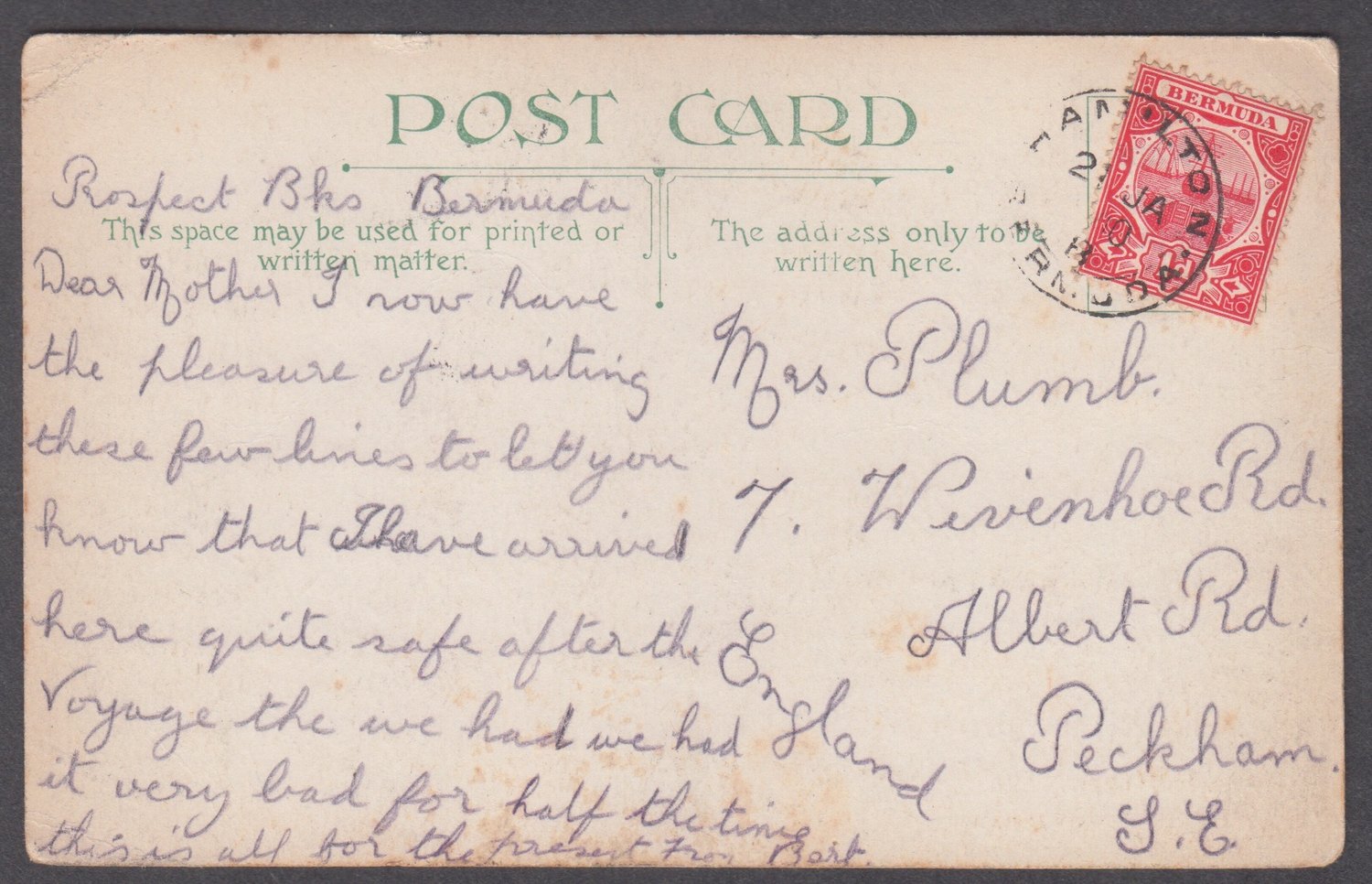
Message and address side of a postcard headed POST CARD: a red 1d Bermuda Dock stamp at top right, tied by a Hamilton Bermuda datestamp of January 1910; the message on the left in pencil headed Prospect Bks Bermuda, beginning Dear Mother I now have the pleasure of writing these few lines and signed Bert; addressed on the right to Mrs Plumb, 7 Wivenhoe Road, Albert Road, Peckham S.E., England
“Dear Mother”: Hamilton to Peckham, January 1910
  • Written Prospect Barracks, Bermuda, January 1910
  • Card “H.M. Troopship ‘Braemar Castle’”
  • Stamp Bermuda 1d Dock, the overseas postcard rate
  • Postmark Hamilton, 21 January 1910 (the day partly under the stamp)
  • Addressed to Mrs Plumb, 7 Wivenhoe Road, Albert Road, Peckham S.E.

The second card shows the ship herself, in the white hull of a peacetime trooper, with her transport number “No 6” on her side and soldiers along her rails. Bert sent it to his mother in Peckham:

“Dear Mother I now have the pleasure of writing these few lines to let you know that I have arrived here quite safe after the voyage we had we had it very bad for half the time this is all for the present from Bert”

The message, January 1910

He headed it “Prospect Bks”. The Bedfords marched up to Prospect on the 19th, so this was written within a couple of days of landing. It was posted at Hamilton with a 1d Dock, the correct rate for a postcard to England. I like that he chose a card of the ship he’d just been so glad to get off. And May and Bert, at opposite ends of the same ship, both thought the crossing from Gibraltar was a bad one.

III

The Beds in, the Dukes out

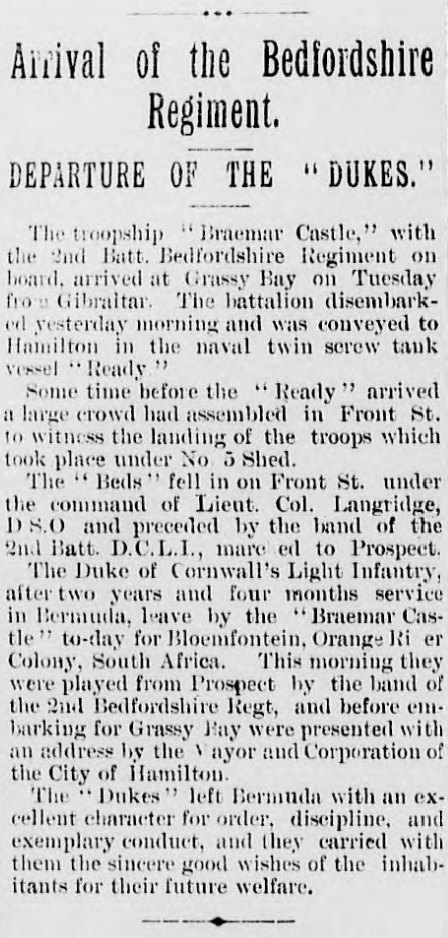
Royal Gazette clipping headed Arrival of the Bedfordshire Regiment, Departure of the Dukes: the troopship Braemar Castle with the 2nd Battalion Bedfordshire Regiment arrived at Grassy Bay on Tuesday from Gibraltar; the battalion disembarked yesterday and was taken to Hamilton in the naval twin screw tank vessel Ready, landed under No 5 Shed and marched to Prospect; the Duke of Cornwall's Light Infantry leave by the Braemar Castle today for Bloemfontein, Orange River Colony
Royal Gazette, 20 January 1910
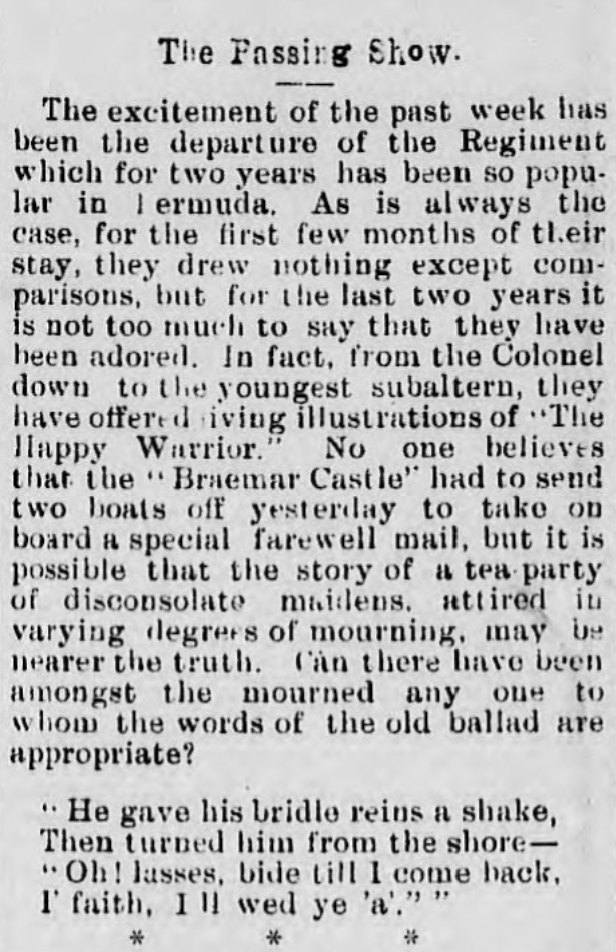
Royal Gazette column headed The Passing Show: the excitement of the past week has been the departure of the regiment which has been so popular in Bermuda; no one believes that the Braemar Castle had to send two boats off to take on board a special farewell mail, but a tea party of disconsolate maidens in varying degrees of mourning may be nearer the truth; ending with lines from an old ballad
“The Passing Show”, Royal Gazette, 22 January 1910
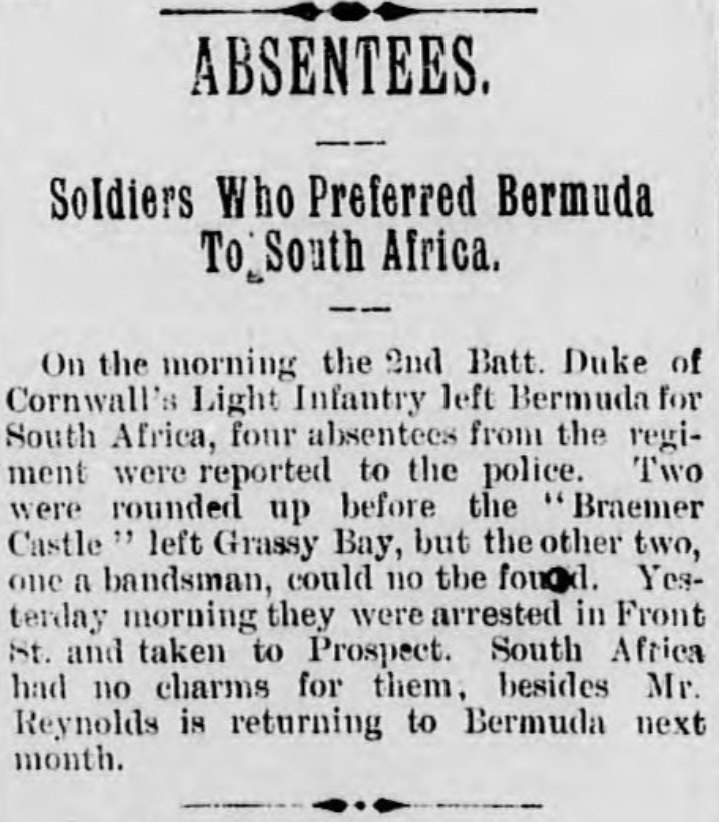
Royal Gazette clipping headed Absentees, Soldiers Who Preferred Bermuda To South Africa: four absentees from the Duke of Cornwall's Light Infantry were reported to the police on the morning the regiment left; two were rounded up before the Braemar Castle left Grassy Bay, but the other two, one a bandsman, were arrested in Front Street afterwards and taken to Prospect
“Absentees”, Royal Gazette, 22 January 1910
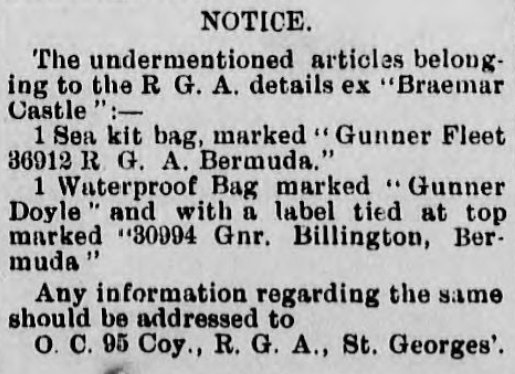
Royal Gazette notice: articles belonging to the R.G.A. details ex Braemar Castle, a sea kit bag marked Gunner Fleet 36912 R.G.A. Bermuda, and a waterproof bag marked Gunner Doyle with a label marked 30994 Gnr. Billington, Bermuda; information to O.C. 95 Coy., R.G.A., St. George's
Lost kit, Royal Gazette, 27 January 1910
  • Arrived Grassy Bay from Gibraltar, Tuesday 18 January 1910 (pilot S. Swan)
  • Brought 2nd Battalion, Bedfordshire Regiment, and R.G.A. drafts
  • Took away 2nd Battalion, Duke of Cornwall’s Light Infantry, for Bloemfontein
  • Sailed Thursday 20 January 1910, about 1.30 pm

The Royal Gazette of 20 January reported that the troopship had arrived at Grassy Bay on the Tuesday from Gibraltar, with the 2nd Bedfordshire Regiment on board. The pilot list for the month shows her coming in on the 18th with S. Swan as pilot. The Bedfords were brought up to Hamilton the next morning in the naval tank vessel Ready, landed at No. 5 Shed in front of a large crowd, and marched to Prospect under Lieut. Col. Langridge, behind the band of the regiment they were replacing.

On the 20th the Duke of Cornwall’s Light Infantry went the other way, after two years and four months in Bermuda. Before they boarded the Ready the Mayor and Corporation of Hamilton presented Colonel Chapman with an address, and as the Ready steamed out of the harbour the Bedfords’ band played “Auld Lang Syne”. The Gazette said embarkation was finished at half past eleven and the ship sailed about two hours later for South Africa. The Dukes were bound for Bloemfontein. She was also carrying May.

The Gazette clearly liked the Dukes. Its “Passing Show” column said no one believed the Braemar Castle had to send two boats in for a special farewell mail, but a tea party of “disconsolate maidens, attired in varying degrees of mourning” might be nearer the truth. Not every Duke wanted to go, either. Four men were missing that morning. Two were rounded up before the ship left Grassy Bay, and the other two, one a bandsman, were arrested in Front Street afterwards. “South Africa had no charms for them.”

The Bedfords weren’t the only ones to land. A week later the Royal Garrison Artillery at St. George’s were advertising for two kit bags belonging to the “R G. A. details ex ‘Braemar Castle’”, one of them Gunner Fleet’s.

January 1910

The ship on one side, the cards on the other.

The ship
The cards
Tue 18 Jan
The shipArrives at Grassy Bay from Gibraltar with the 2nd Bedfords.
The cardsMay writes “we reach Bermuda to day”.
Wed 19 Jan
The shipThe Bedfords land by the Ready and march to Prospect.
The cardsMay’s card struck at Ireland Island.
Thu 20 Jan
The shipThe D.C.L.I. embark. She sails about 1.30 pm for South Africa.
Fri 21 Jan
The cardsBert posts his card at Hamilton.
Sat 22 Jan
The cardsBermudian and Orotava sail for New York, probably with May’s card.
Mon 31 Jan
The cardsMay’s card cancelled in London.

The Ship

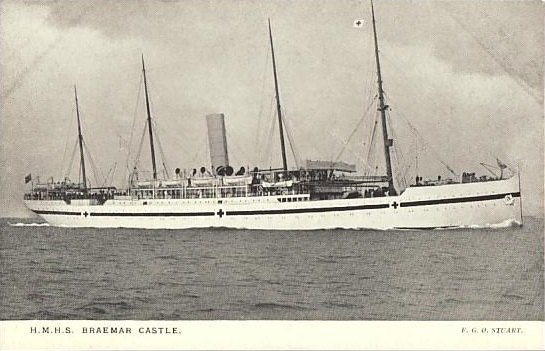
Black and white photograph of the Braemar Castle under way as a hospital ship in the First World War: a long white hull with a dark band and red crosses along it, four masts and a single tall funnel; captioned H.M.H.S. Braemar Castle, with the photographer's name F. G. O. Stuart

H.M.T. Braemar Castle (1898)

The Braemar Castle was a Castle Line intermediate steamer, built by Barclay, Curle & Co. at Glasgow and launched in February 1898 for the run from Southampton to South Africa. She passed to the new Union-Castle Line in 1900. She spent more of her life in government service than with her owners. She carried troops to the Boer War, and in 1909 she was taken up as a hired transport and painted in trooping colours, a white hull with a blue band and a yellow funnel. That’s how she looks on Bert’s card.

In 1914 she carried part of the first British troops to France, and in 1915 she served at Gallipoli. Later that year she became a hospital ship. On 23 November 1916, carrying sick and wounded from Salonika to Malta, she struck a mine in the Mykoni Channel in the Aegean. She was beached and repaired, and in 1918 she went to Murmansk as the base hospital ship for the North Russia expedition. She was sold to Italian shipbreakers and scrapped in 1924.

BuiltBarclay, Curle & Co., Glasgow, 1898
TypePassenger and cargo steamer, hired as a troop transport
TonnageAbout 6,266 gross
OwnerCastle Line, then Union-Castle from 1900
FateScrapped in Italy, 1924

Photograph: F. G. O. Stuart, as the hospital ship Braemar Castle, via Wikimedia Commons.

Still to find out

If you can help with any of these, I’d be very pleased to hear from you.

References

One ship, two cards, one passenger staying on board and one soldier just off. I’d love to find a third from the same week.