Postal History · Hired Military Transport · Bermuda 1904

H.M.T. Dilwara

Warwick Camp, Bermuda · March 1904

A rifleman’s postcard home after a rough crossing on the troopship that brought the King’s Royal Rifles to Bermuda.

◆

Most of the cards on these pages were written by sailors. This one was written by a soldier. In March 1904 “Bob” came out to Bermuda on the hired transport Dilwara with the King’s Royal Rifles, and as soon as he had an address he sent a postcard of the ship home to London. Messages like his must have been posted by the hundred every time a troopship came in. I like it because the two sides tell the same story from opposite ends: the ship on one, and the man who’d just stepped off her on the other.

I

The postcard

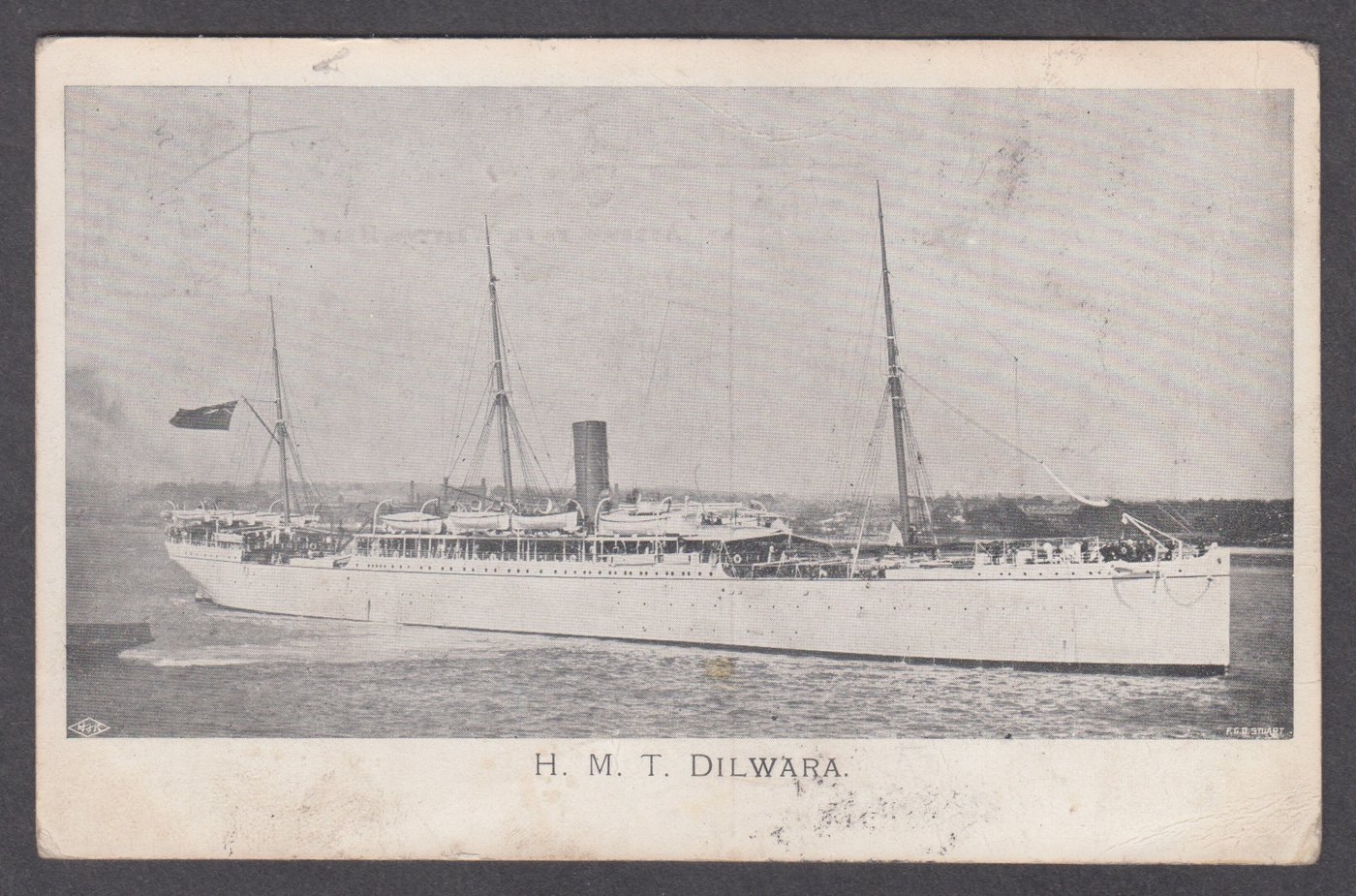
Picture side of a postcard: a black and white photograph of the troopship Dilwara under way, a long white-hulled steamer with three masts, a single dark funnel and lifeboats along her upper deck, flying an ensign at the stern, with a town and harbour behind; captioned H. M. T. DILWARA, with the photographer's credit F. G. O. Stuart in the lower right corner
“H. M. T. Dilwara”: photograph by F. G. O. Stuart of Southampton
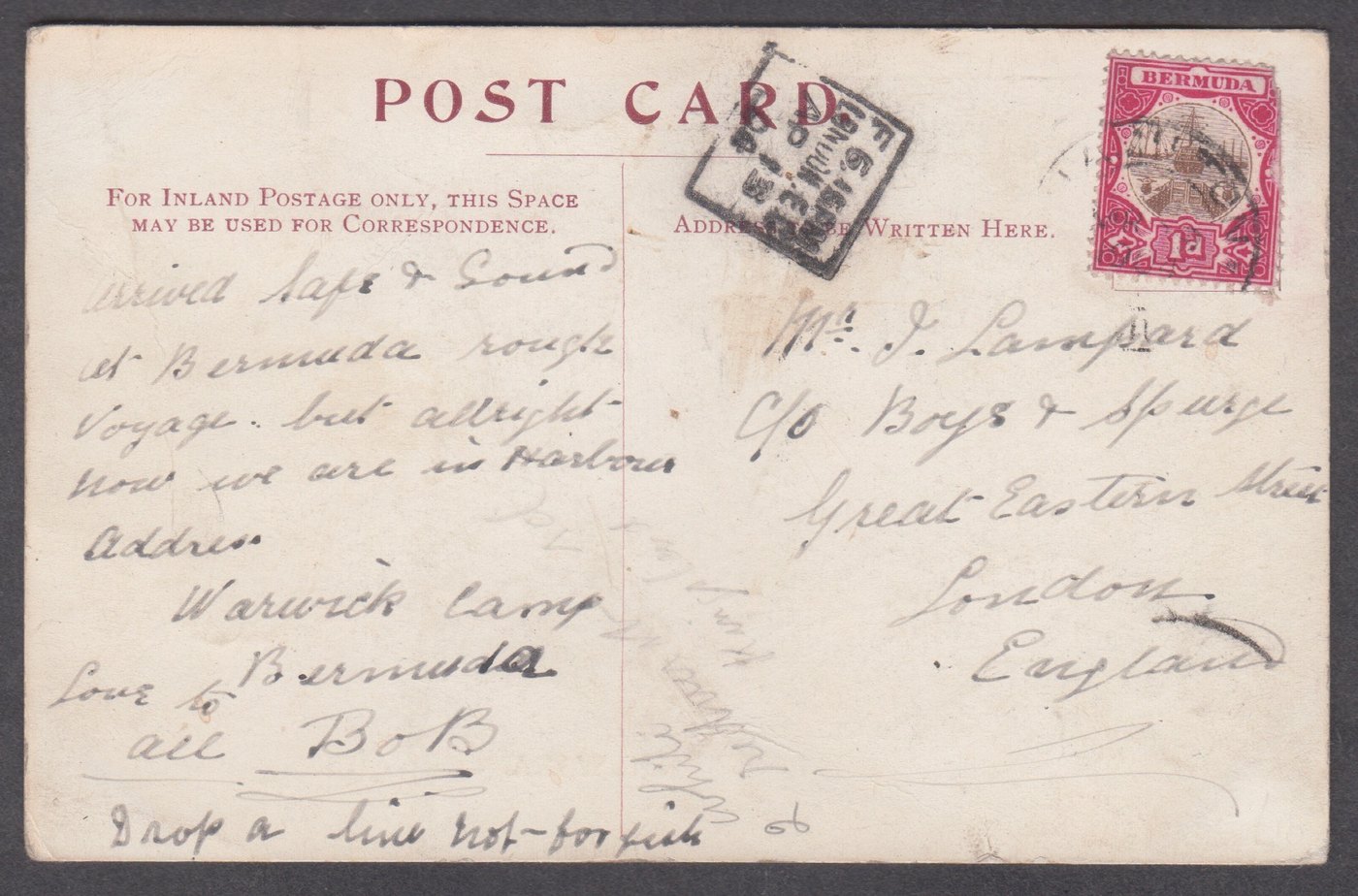
Message and address side of the postcard: a 1d Bermuda Dock stamp in carmine and brown at top right, cancelled by a Hamilton datestamp; an inverted square London E.C. datestamp of 13 April 1904 at the top centre; the message on the left reading arrived safe and sound at Bermuda rough voyage but allright now we are in Harbour, Address Warwick Camp Bermuda, Love to all Bob, Drop a line not for fish; addressed on the right to Mr J. Lampard, c/o Boys and Spurge, Great Eastern Street, London, England
“Arrived safe & sound at Bermuda”: Hamilton to London, received 13 April 1904
  • Written Warwick Camp, Bermuda, late March 1904
  • Card “H. M. T. Dilwara”, photograph by F. G. O. Stuart
  • Stamp Bermuda 1d Dock, the overseas postcard rate
  • Postmarks Hamilton, March 1904; London E.C., 6.15 pm, 13 April 1904
  • Addressed to Mr J. Lampard, c/o Boys & Spurge, Great Eastern Street, London

The picture side is a halftone of the Dilwara under way in her white trooping hull, with three masts and a single funnel, captioned simply “H. M. T. DILWARA.” The photograph is credited in the corner to F. G. O. Stuart, the Southampton marine photographer. Southampton is where the trooping season’s ships embarked most of their men. The card is a British one, so Bob almost certainly brought it with him rather than buying it in Bermuda.

On the back he wrote:

“arrived safe & sound at Bermuda rough voyage but allright now we are in Harbour. Address Warwick Camp Bermuda. Love to all Bob. Drop a line not – for fish”

The message, March 1904

The rough voyage is no surprise: an Atlantic crossing in March in a ship packed with soldiers. The last line took me a while. I think it’s a small joke, “drop a line” meaning write to me, “not for fish”.

Warwick Camp, on the south shore, was the garrison’s rifle ranges and training camp. It takes its name from the parish, not the regiment. Even so, I enjoy the coincidence: Bob was moving into Warwick Camp just as the Royal Warwicks were packing up to leave on the same ship.
II

One regiment in, one out

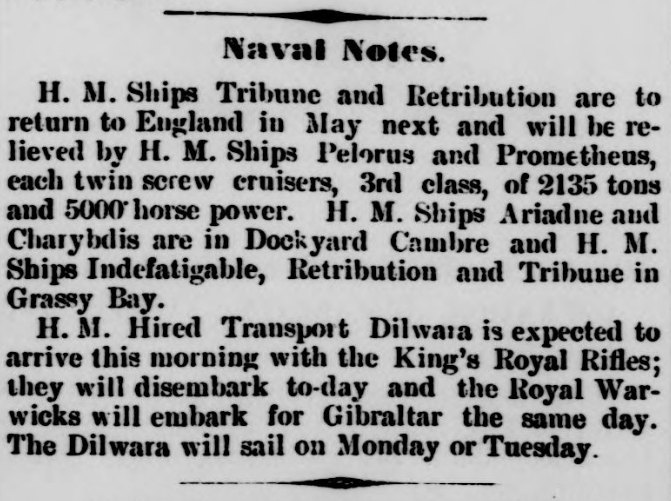
Royal Gazette clipping headed Naval Notes: H.M. Ships Tribune and Retribution to return to England in May, relieved by Pelorus and Prometheus; Ariadne and Charybdis in Dockyard Cambre, Indefatigable, Retribution and Tribune in Grassy Bay; H.M. Hired Transport Dilwara expected this morning with the King's Royal Rifles, who will disembark today while the Royal Warwicks embark for Gibraltar; the Dilwara will sail on Monday or Tuesday
Naval Notes, Royal Gazette, 26 March 1904
  • Arrived Bermuda, Saturday 26 March 1904
  • Brought 3rd Battalion, King’s Royal Rifle Corps
  • Took away 3rd Battalion, Royal Warwickshire Regiment, for Gibraltar
  • Sailing Monday 28 or Tuesday 29 March

The Royal Gazette’s Naval Notes for Saturday 26 March 1904 said that “H. M. Hired Transport Dilwara” was expected that morning with the King’s Royal Rifles. They would land the same day, the Royal Warwicks would embark for Gibraltar, and the Dilwara would sail on the Monday or Tuesday. In the same column Tribune, Retribution and Indefatigable were lying in Grassy Bay. It was a busy week in Bermuda.

The incoming battalion was the 3rd King’s Royal Rifles. Their move had been raised in the House of Commons a month earlier, on 19 February. Only twenty of the married men were to be allowed to bring their wives and families, and the Secretary of State for War replied that the fortress had married quarters for just twenty families. These men had come home from South Africa less than a year before. The outgoing battalion, the 3rd Royal Warwicks, had been in Bermuda since 1902.

That gives a narrow window for Bob’s card. He landed on the 26th, he was “now in Harbour”, and he already knew his address. He probably wrote it within a day or two of coming ashore.

III

The journey home

  • Posted Hamilton, March 1904
  • Postage 1d, the overseas postcard rate
  • Received London E.C., 6.15 pm, 13 April 1904
  • Card printed for British inland post

Bob posted the card at Hamilton with a 1d Dock stamp, the correct rate for a postcard from Bermuda to Britain. It reached London on the evening of 13 April 1904, and the square London E.C. datestamp is struck upside down across the printing. Great Eastern Street is in Shoreditch, in the E.C. district. A fortnight or so in transit is about right for the time.

There’s one small postal point. The card is printed in Britain, and the wording beside the message space says it “may be used for correspondence” only “for inland postage”. That means inland in Britain, not Bermuda. Here it has been used from Bermuda to London instead, with the message written in that space, and paid at the correct overseas postcard rate. Nobody in Hamilton or London seems to have minded.

The Ship

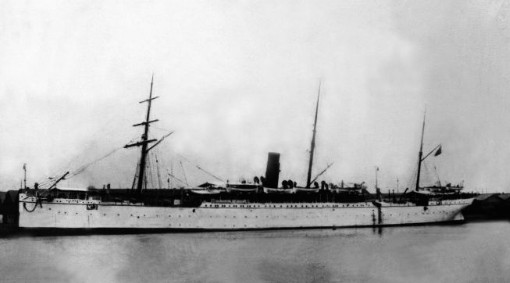
Black and white photograph of the steamer Dilwara lying alongside, seen broadside on from the starboard side: a long white hull with a row of portholes, three masts, a single dark funnel amidships and lifeboats along the upper deck

H.M.T. Dilwara (1891)

The Dilwara was a British India liner, not a naval ship. A. & J. Inglis built her at Pointhouse, Glasgow, for British India Associated Steamers. She was laid down as Dunmora, renamed on the stocks, and completed in December 1891, with her sister Dunera, for the London to Brisbane run. When that service ended in 1895 she went into seasonal trooping to India. During the Boer War she made six voyages to the Cape, and she was still carrying troops for the government in 1904. That’s why the Gazette calls her “H. M. Hired Transport”.

She passed to the British India Steam Navigation Company in July 1903 and was converted to a cargo ship in 1909. She carried Territorials to India in 1914 and served under the Liner Requisition Scheme in 1917–19. She was sold to Chinese shipbreakers in August 1922. Her name went to the well-known 1936 troopship Dilwara, and most pictures online labelled “Dilwara” show that later ship, not this one.

BuiltA. & J. Inglis, Glasgow, 1891
TypePassenger and cargo steamer, hired as a troop transport
TonnageAbout 5,440 gross
OwnerBritish India (BIAS, then BISN from 1903)
FateBroken up in China, 1922

Photograph: P&O Heritage Collection.

Still to find out

If you can help with any of these, I’d be very pleased to hear from you.

References

A troopship, a rough crossing and a quick card home before settling into camp. I’d love to know whether anyone ever dropped a line back to Warwick Camp.