Postal History · Royal Navy · North America and West Indies Station

H.M.S. Tribune

Ireland Island, Bermuda · 13 November 1903

A “Card Only” cover from a Bermuda cruiser, taxed all the way to Sydney.

◆

This small cover came from the cruiser Tribune in November 1903 and went to Sydney the long way round, through New York and San Francisco. Its writer put a single penny stamp on it and wrote “Card only” in the corner, presumably hoping it would go at the cheaper rate. The Bermuda post office didn’t accept that and marked it for postage due. It reached Darling Point on New Year’s Day 1904, just in time for the season if it held a Christmas card. That’s a guess, but the timing fits.

I

The cover

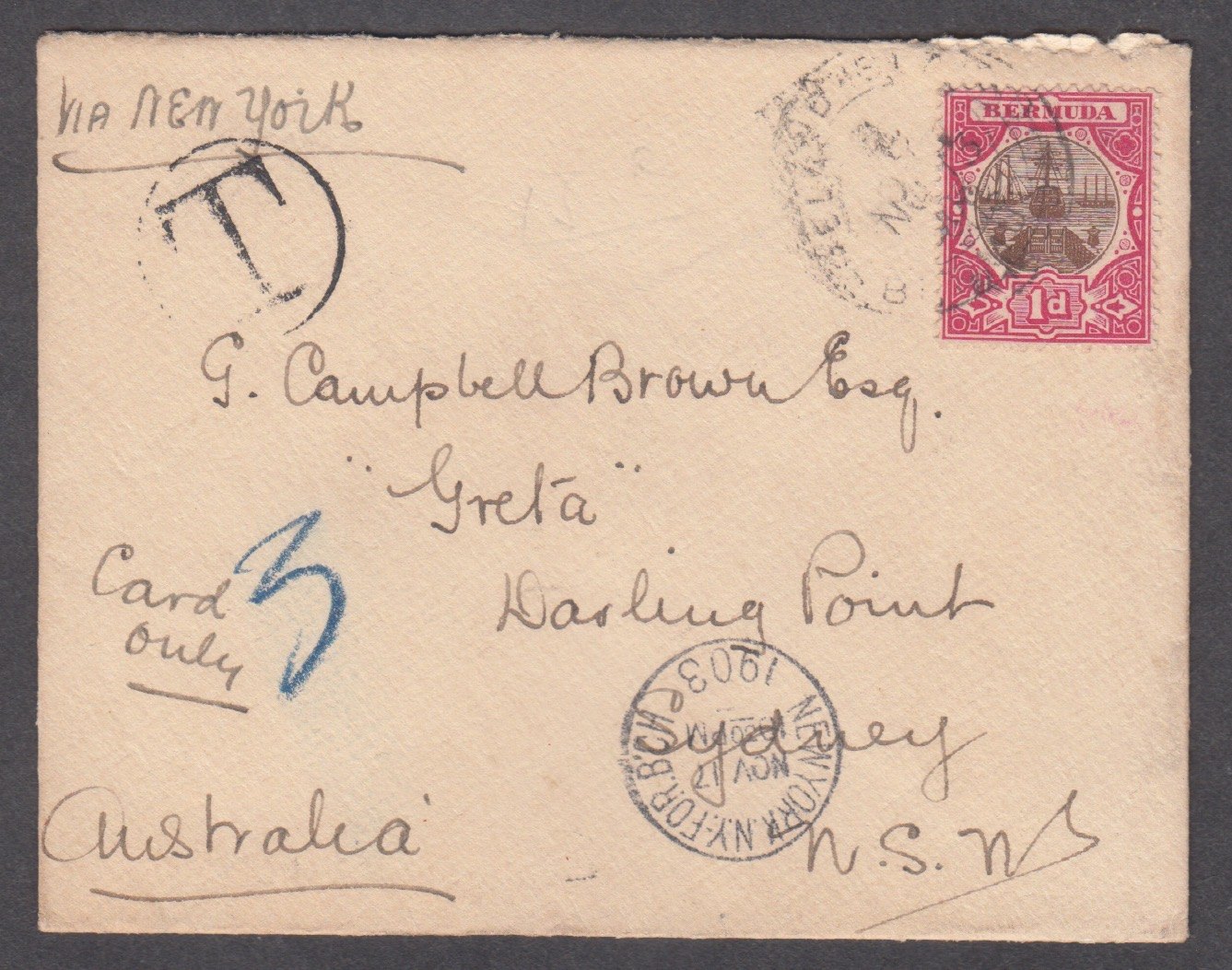
Small cream envelope addressed in ink to G. Campbell Brown Esq., Greta, Darling Point, Sydney, N.S.W., with Australia written large below; endorsed Via New York at top left and Card only at lower left beside a large blue crayon 3; a black T in circle postage due handstamp; a 1d Dock stamp tied by a faint Ireland Island Bermuda datestamp; and a New York N.Y. For'd Nov 17 1903 transit datestamp across the address
Posted at Ireland Island, 13 November 1903, to G. Campbell Brown at Darling Point, Sydney
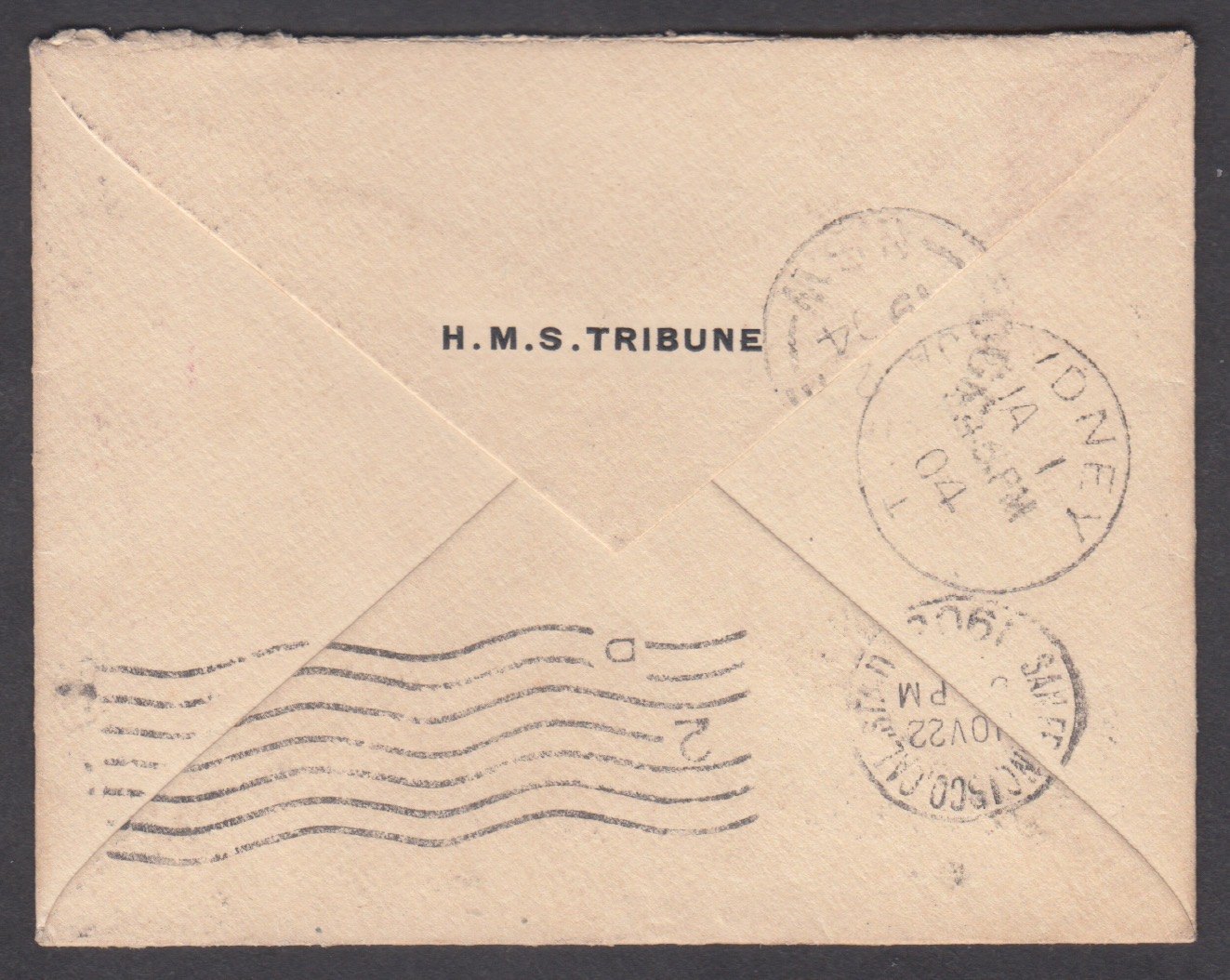
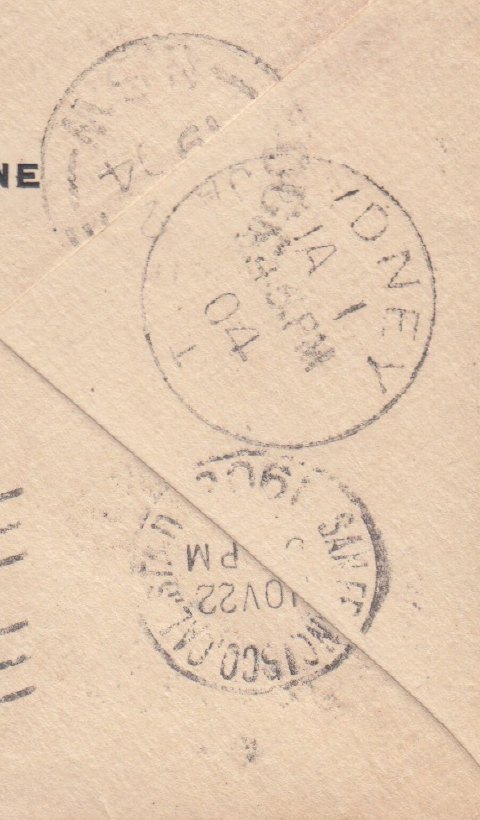
Back of the envelope with the flap printed H.M.S. TRIBUNE in small capitals, a wavy-line machine cancel marked D 2, a San Francisco Cal. Nov 22 1903 transit datestamp, a Sydney JA 1 04 arrival datestamp and a second, fainter Sydney strike
The back: the printed flap, San Francisco and Sydney
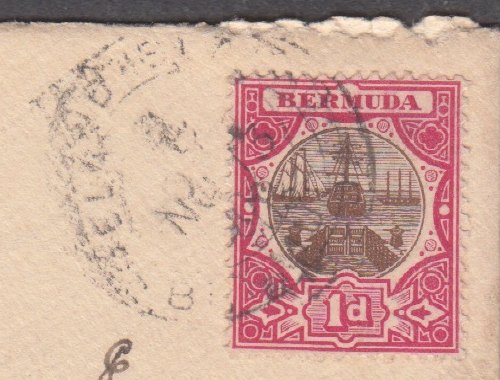
Close-up of the 1d Dock stamp, carmine and brown, tied by a very faint Ireland Island Bermuda double-circle datestamp of 13 November 1903
The 1d Dock stamp and the faint Ireland Island datestamp
  • Addressed to G. Campbell Brown Esq., “Greta”, Darling Point, Sydney, N.S.W., Australia
  • Stationery Envelope with the flap printed H.M.S. TRIBUNE
  • Franking 1d Dock
  • Datestamp Ireland Island, 13 November 1903
  • Endorsements “Via New York”; “Card only”
  • Postage due “T” in circle; blue crayon “3”
  • Transit NEW YORK N.Y. FOR’D, 17 November 1903; SAN FRANCISCO, 22 November 1903
  • Arrival SYDNEY, 1 January 1904, and a second strike of 2 January

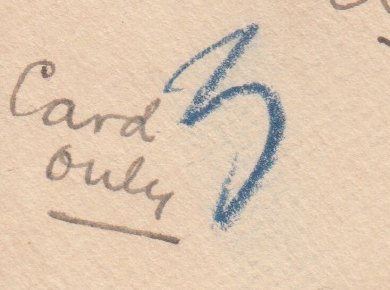
The flap is printed H.M.S. TRIBUNE, so this is ship’s stationery. It’s addressed to “G. Campbell Brown Esq., ‘Greta’, Darling Point, Sydney, N.S.W.” with “Australia” written large underneath. In the top corner the writer added “Via New York”, and on the left is the endorsement:

“Card only”

The endorsement

It carries one 1d Dock stamp, cancelled at Ireland Island on 13 November 1903, a Friday the 13th as it happens. The datestamp is now very faint. Beside it is the Bermuda “T in circle” postage due mark, and further down a large “3” in blue crayon.
II

“Card Only”: why it was taxed

Close-up of the endorsement Card only, underlined, in ink, beside a large 3 in blue crayon
“Card only”, and the blue crayon 3

In 1903 a letter from Bermuda to Australia cost 2½d per half ounce under Universal Postal Union rules. A postcard cost 1d. I think the writer reckoned that a card in an envelope could go for the same penny as a postcard. The post office saw a sealed envelope, which counted as a letter, so it was 1½d short.

The UPU rule was that the receiving country charged double the deficiency, which comes to 3d. I’m fairly sure that is what the blue “3” means: 3d to pay at the door in Sydney. Bermuda’s “T” told every post office along the way that the item was underpaid.

III

Bermuda to Sydney in seven weeks

Close-up of the back flap showing the Sydney JA 1 04 arrival datestamp, a fainter second Sydney strike above it, and the San Francisco Cal. Nov 22 1903 transit datestamp below
San Francisco, 22 November 1903, and Sydney, 1 January 1904

“Via New York” was the obvious route. There was no direct service from Bermuda to Australia, and the fastest way was by steamer to New York, across America by rail, and over the Pacific. The marks show the route. New York handled it on 17 November, four days after posting. San Francisco stamped it on 22 November. Then it waited for the mail steamer.

The Oceanic Steamship Company’s Sierra, Sonoma and Ventura sailed every three weeks from San Francisco to Sydney, calling at Honolulu, Pago Pago and Auckland. This cover almost certainly travelled on one of them. It was in Sydney on 1 January 1904, with another strike the next day. Fifty days from Ireland Island to Darling Point, for a penny and a 3d bill.

IV

The Tribune at Bermuda

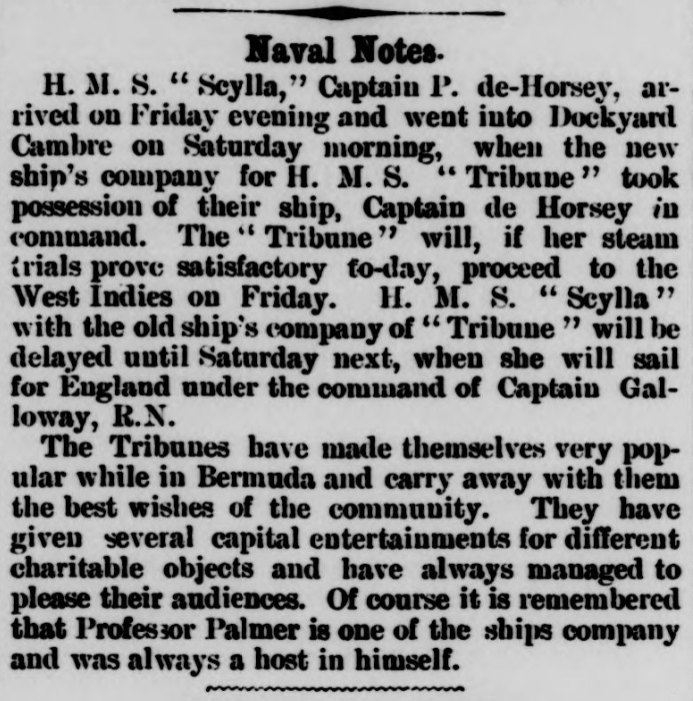
Royal Gazette Naval Notes: H. M. S. Scylla, Captain P. de-Horsey, arrived on Friday evening and went into Dockyard Cambre on Saturday morning, when the new ship's company for H. M. S. Tribune took possession of their ship, Captain de Horsey in command; the Tribune will, if her steam trials prove satisfactory, proceed to the West Indies on Friday; the Scylla with the old ship's company of Tribune will sail for England under the command of Captain Galloway, R.N.; the Tribunes have made themselves very popular while in Bermuda; Professor Palmer was always a host in himself
Royal Gazette, 22 July 1902: the new ship’s company takes over, “Captain de Horsey in command”
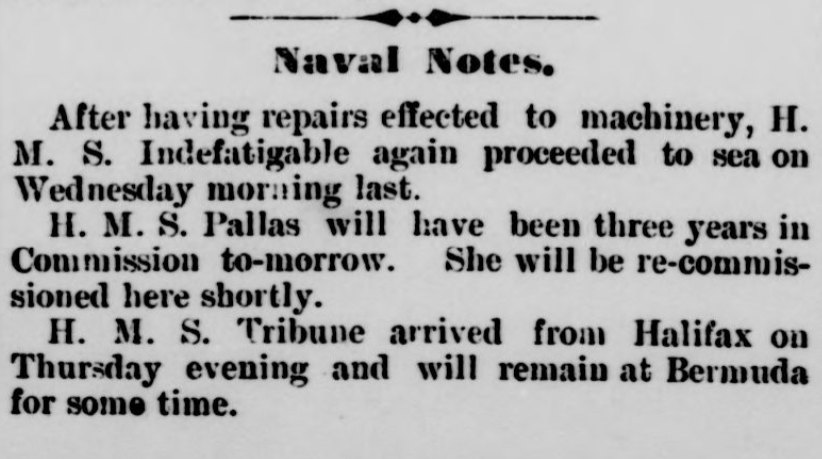
Royal Gazette Naval Notes: after having repairs effected to machinery, H. M. S. Indefatigable again proceeded to sea on Wednesday morning last; H. M. S. Pallas will have been three years in commission to-morrow; H. M. S. Tribune arrived from Halifax on Thursday evening and will remain at Bermuda for some time
Royal Gazette, 10 October 1903: “will remain at Bermuda for some time”
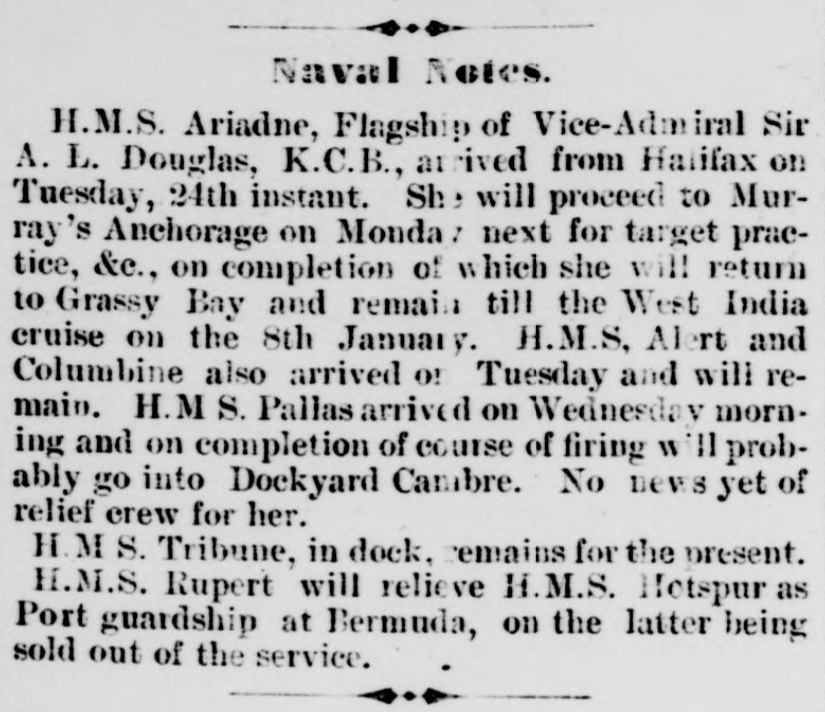
Royal Gazette Naval Notes: H.M.S. Ariadne, flagship of Vice-Admiral Sir A. L. Douglas, K.C.B., arrived from Halifax on Tuesday 24th instant; H.M.S. Alert and Columbine also arrived; H.M.S. Pallas arrived on Wednesday morning; H.M.S. Tribune, in dock, remains for the present; H.M.S. Rupert will relieve H.M.S. Hotspur as port guardship at Bermuda
Royal Gazette, 28 November 1903: “Tribune, in dock, remains for the present”

The Tribune changed crews at Bermuda. On a Friday evening in July 1902 the cruiser Scylla came in from England with a fresh ship’s company, and the next morning in the Dockyard Cambre:

“the new ship’s company for H. M. S. ‘Tribune’ took possession of their ship, Captain de Horsey in command.”

Royal Gazette, 22 July 1902

The Scylla went home with the old crew. So the men who sent this cover had been on the station for about sixteen months by November 1903.

That autumn she was at Bermuda for a long stay. She came in from Halifax on Thursday 8 October, and the Gazette said she would “remain at Bermuda for some time.” On 28 November she was “in dock, remains for the present,” and she was still in dock a fortnight later. That puts her in the Dockyard at Ireland Island when this cover was posted there on 13 November. By 19 December she was out at Murray’s Anchorage with the flagship Ariadne.

V

Bird Island and home

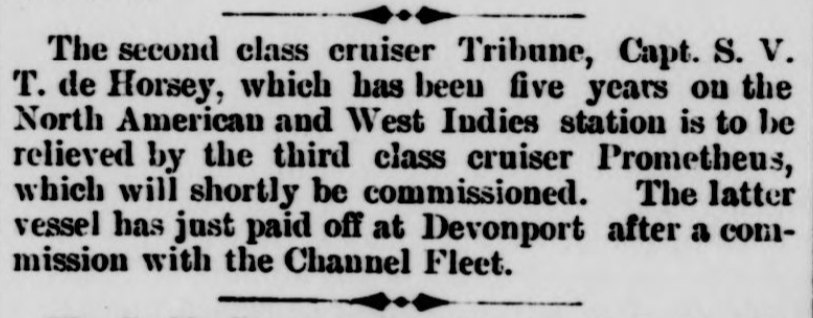
Royal Gazette: the second class cruiser Tribune, Capt. S. V. T. de Horsey, which has been five years on the North American and West Indies station, is to be relieved by the third class cruiser Prometheus, which will shortly be commissioned; the latter vessel has just paid off at Devonport after a commission with the Channel Fleet
Royal Gazette, 17 May 1904: “five years on the North American and West Indies station”
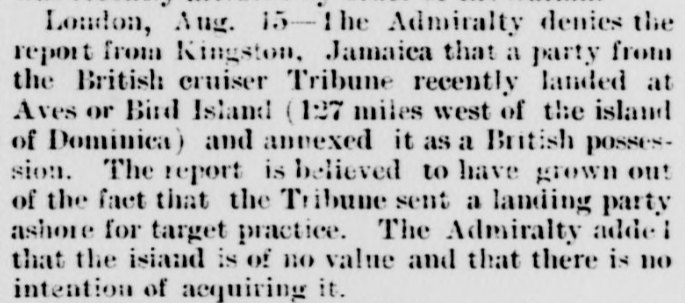
Royal Gazette: London, Aug. 15, the Admiralty denies the report from Kingston, Jamaica that a party from the British cruiser Tribune recently landed at Aves or Bird Island, 127 miles west of the island of Dominica, and annexed it as a British possession; the report is believed to have grown out of the fact that the Tribune sent a landing party ashore for target practice; the Admiralty added that the island is of no value and that there is no intention of acquiring it
Royal Gazette, 20 August 1904: the Admiralty’s denial
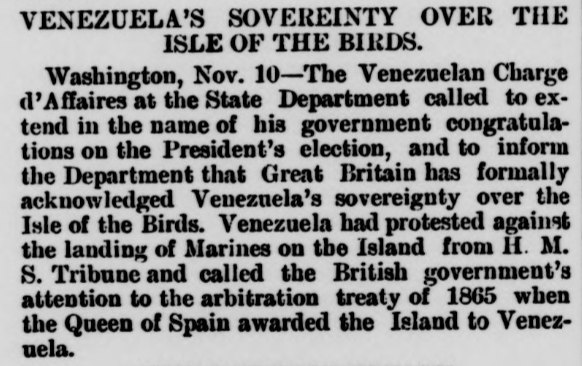
Royal Gazette: Venezuela's Sovereignty over the Isle of the Birds; Washington, Nov. 10, the Venezuelan Charge d'Affaires at the State Department informed the Department that Great Britain has formally acknowledged Venezuela's sovereignty over the Isle of the Birds; Venezuela had protested against the landing of Marines on the island from H. M. S. Tribune and called the British government's attention to the arbitration treaty of 1865 when the Queen of Spain awarded the island to Venezuela
Royal Gazette, 12 November 1904: “Venezuela’s Sovereignty over the Isle of the Birds”

In March 1904 the Gazette announced that the Tribune and Retribution were “to return to England in May next.” In May it said she had been “five years on the North American and West Indies station” and was to be relieved by the Prometheus. Her relief, the Pelorus, reached Grassy Bay in June. Even so, the Tribune was still in the Caribbean in August, and that is when she made the news.

On 11 August she landed a party on Aves, or Bird Island, a sandbank Venezuela claimed, out on its own west of Dominica. Guns were hauled through the surf, and according to the cable reports the flag was hoisted and a royal salute fired. Word spread that Britain had annexed the island. The Admiralty denied it on 15 August:

“The report is believed to have grown out of the fact that the Tribune sent a landing party ashore for target practice.”

Royal Gazette, 20 August 1904

The island, they added, “is of no value.” Venezuela protested all the same. On 10 November its chargé d’affaires in Washington announced that Great Britain “has formally acknowledged Venezuela’s sovereignty over the Isle of the Birds.” Venezuela based its claim on the arbitration award of 1865, made by the Queen of Spain. The Tribune had history with Venezuela: in the blockade of December 1902 she seized schooners off the coast, alongside her old chummy ship the Indefatigable.

By November 1904 the Tribune had gone. Her relief at Bermuda was, fittingly, the Indefatigable. In late September she left Bermuda for Halifax, and on 22 October she “sailed to-day for England” after five years on the station.

The Tribunes’ Variety Company

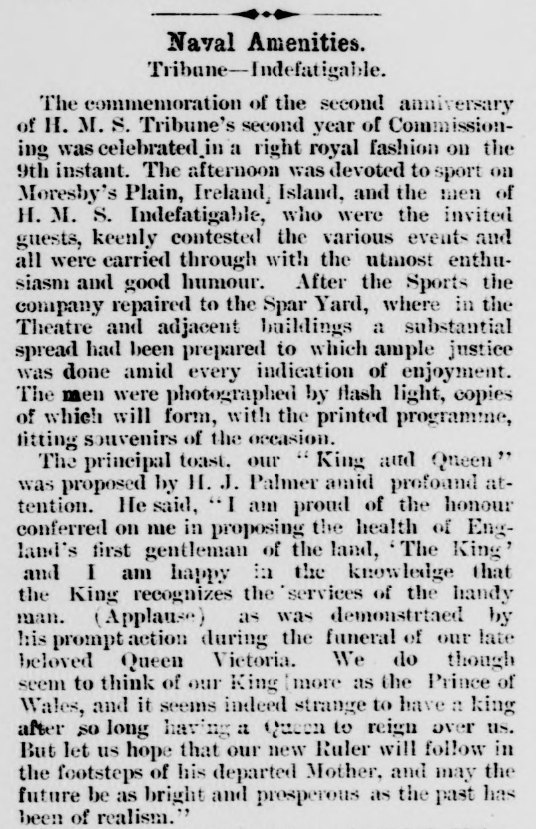
Royal Gazette, Naval Amenities, Tribune and Indefatigable: the commemoration of the second anniversary of H. M. S. Tribune's commissioning was celebrated on the 9th instant; the afternoon was devoted to sport on Moresby's Plain, Ireland Island, with the men of H. M. S. Indefatigable as invited guests; after the sports the company repaired to the Spar Yard, where a substantial spread had been prepared in the theatre; the men were photographed by flash light; the principal toast, the King and Queen, was proposed by H. J. Palmer
Royal Gazette, 21 May 1901: “Naval Amenities. Tribune—Indefatigable.”

The crew before de Horsey’s were great entertainers. In April 1901 the Tribune’s “talented Variety Company” gave shows at the Spar Yard Theatre so that the island’s children could have a matinee, where “each child will receive a present, buns, sweets, &c.”

On 9 May 1901 they celebrated two years in commission. They held sports on Moresby’s Plain with the Indefatigable, their “chummy ship”, followed by dinner and an “operatic farce”, The Illustrious Stranger. “Professor” H. J. Palmer played the court magician and gave selections on his phonograph. When the crew went home in 1902, the Gazette wrote that the Tribunes “carry away with them the best wishes of the community”, adding:

“Of course it is remembered that Professor Palmer is one of the ships company and was always a host in himself.”

Royal Gazette, 22 July 1902

Five years on the station

The ship on one side, the cover on the other.

The Tribune
The cover
9 May 1899
The shipCommissioned.
9 May 1901
The shipSecond anniversary at Bermuda, with the Indefatigable.
19 Jul 1902
The shipCaptain de Horsey and a new ship’s company take over.
Dec 1902
The shipThe Venezuelan blockade.
12 Mar 1903
The shipSails from Kingston for Havana with the squadron.
22 Sep
The shipAt Halifax, in from a cruise.
8 Oct
The shipArrives at Bermuda “for some time”.
13 Nov
The coverPosted at Ireland Island.
17 Nov
The coverNew York.
22 Nov
The coverSan Francisco.
28 Nov – Dec
The shipIn dock at Ireland Island.
1 Jan 1904
The coverArrives at Sydney.
Mar 1904
The shipOrdered home.
Jun
The shipThe Pelorus arrives in relief.
11 Aug
The shipLands a party on Aves, or Bird Island.
15 Aug
LondonThe Admiralty denies any annexation.
29 Sep
The shipArrives at Halifax from Bermuda.
22 Oct
The shipSails from Halifax for England.
10 Nov
WashingtonBritain recognises Venezuela’s claim to the island.
1911
The shipSold.

The Ship

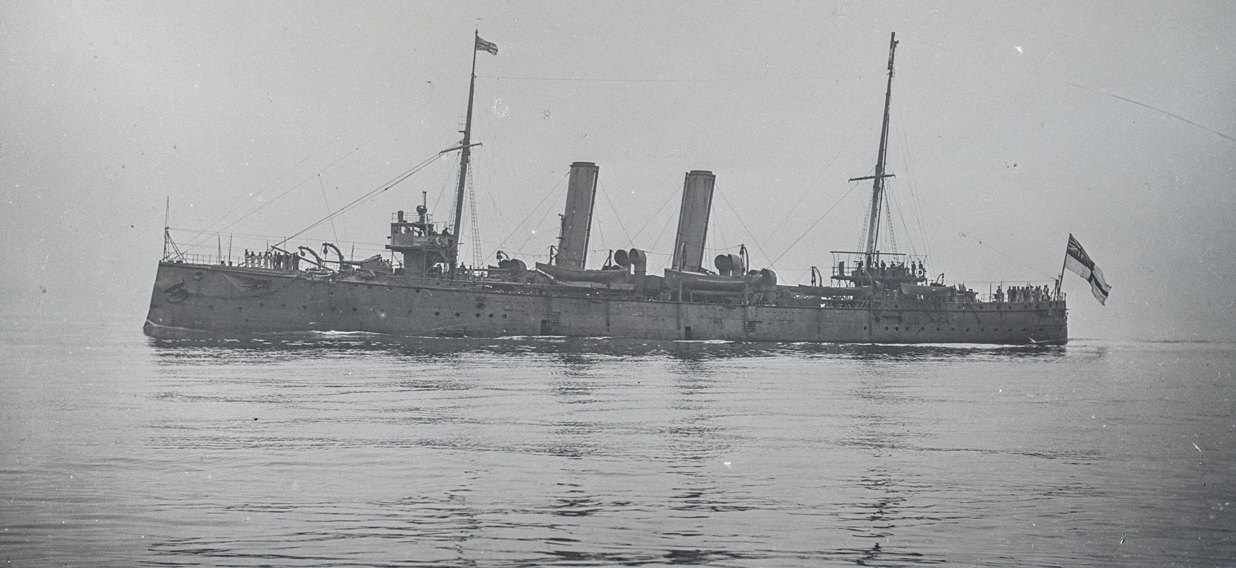
Photograph of the cruiser HMS Tribune under way in calm water in 1904, painted grey, with two tall funnels, two masts, men along her rails and the white ensign at the stern

H.M.S. Tribune

H.M.S. Tribune was an Apollo-class second-class protected cruiser, built by J. & G. Thomson at Clydebank. She was laid down in December 1889, launched on 24 February 1891 and completed in May 1892. She was at the Diamond Jubilee review at Spithead in June 1897, and from 1899 to 1904 she served on the North America and West Indies Station, working from Bermuda and Halifax. Like most of her class she was worn out by the time she was twenty, and she was sold for breaking up in 1911.

Captain Spencer Victor Yorke de Horsey took command at Bermuda in July 1902. He was the son of Admiral Sir Algernon de Horsey. In South Africa he had served with the Naval Brigade from H.M.S. Monarch, been wounded, and been specially promoted to captain in 1900. He later commanded the armoured cruiser Kent and retired as an admiral. The Gazette never quite got his initials right.

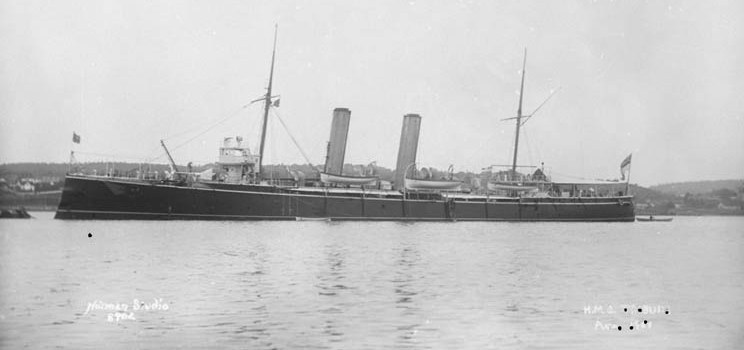
Photograph of HMS Tribune at anchor in Halifax harbour in August 1901, with a black hull, light upperworks, two tall funnels and two masts, the shore behind; inscribed Notman Studio 8702 and H.M.S. Tribune Aug 1901
The Tribune at Halifax, August 1901, in the black hull of her first commission on the station
BuiltJ. & G. Thomson, Clydebank, launched 24 February 1891
TypeApollo-class second-class cruiser, 3,400 tons
CaptainS.V.Y. de Horsey (1902–04)
StationNorth America & West Indies, 1899–1904
FateSold 1911

Photographs: 1904, Royal Museums Greenwich (N1365); 1901, Notman Studio, Halifax, Library and Archives Canada, via Wikimedia Commons.

Still to find out

If you can help with any of these, I’d be very pleased to hear from you.

References

I like this cover because it’s a small gamble that didn’t come off. Someone in the Tribune tried to send a card to Sydney for a penny, and the post office sent the bill along with it.