Postal History · Royal Navy · Storeship

H.M.S. Humber

Ireland Island · Bermuda · 25 April 1890

A postcard from a man who came up from Jamaica in a storeship, went to watch a naval review for an American ex-President, and was gone again within days.

◆

This is one of my favourite kinds of item. The card doesn’t name a ship at all, but the message gives it away. It was written at Ireland Island on 25 April 1890 by “R. Law” to Miss Hewitt at South Hayling, near Portsmouth. He had just come up from Jamaica, was off to watch a review, and expected to be in England by the middle of May. Put that beside the Royal Gazette, and only one ship fits: H.M. Storeship Humber. The review turned out to be in honour of Rutherford B. Hayes, former President of the United States, who wrote about that same morning in his own diary.

I

The postcard

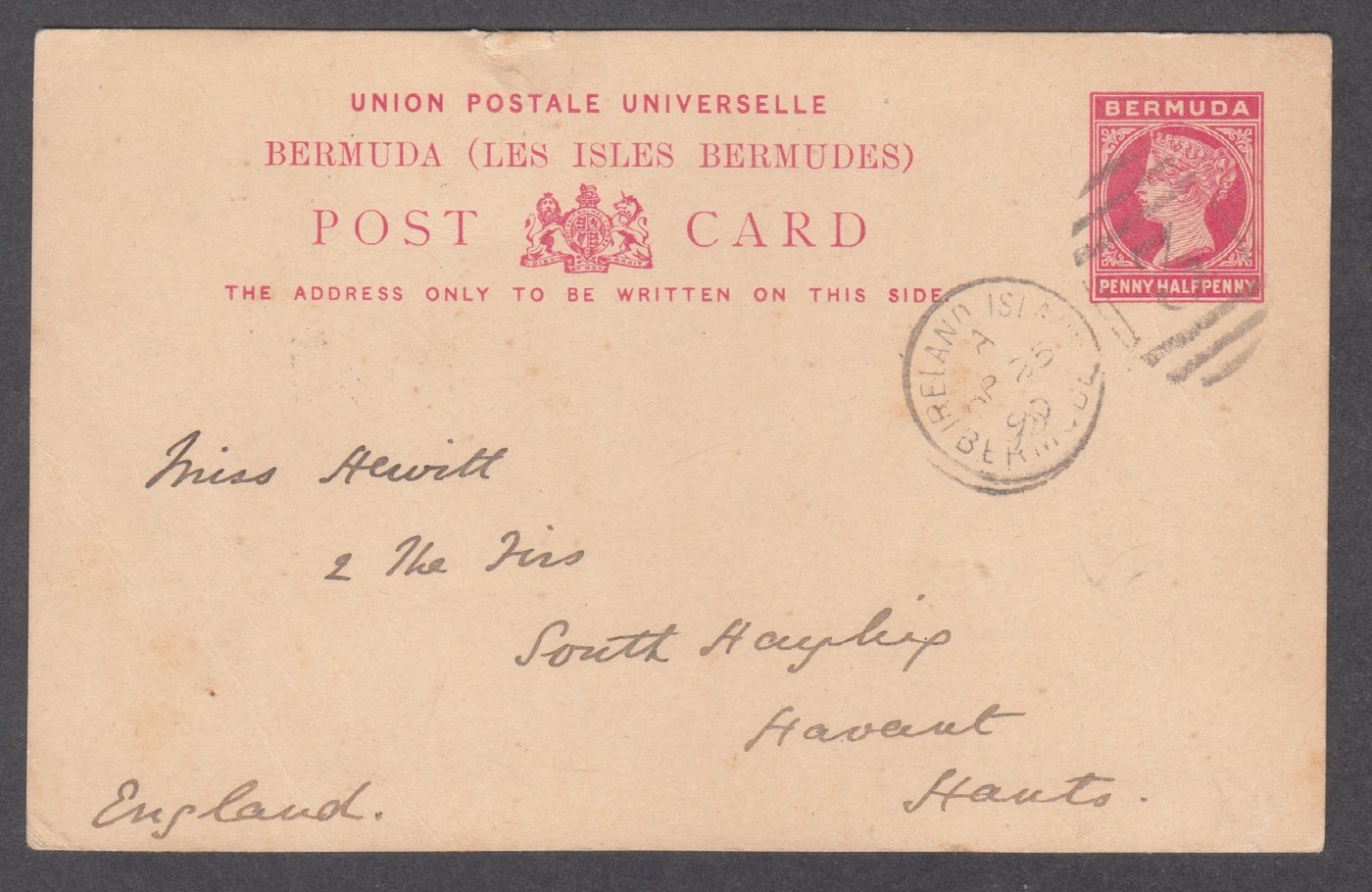
Bermuda penny halfpenny Union Postale Universelle postal card addressed to Miss Hewitt, 2 The Firs, South Hayling, Havant, Hants, England, cancelled by a barred numeral with an IRELAND ISLAND BERMUDA datestamp of 25 April 1890
Address side: Ireland Island, 25 April 1890
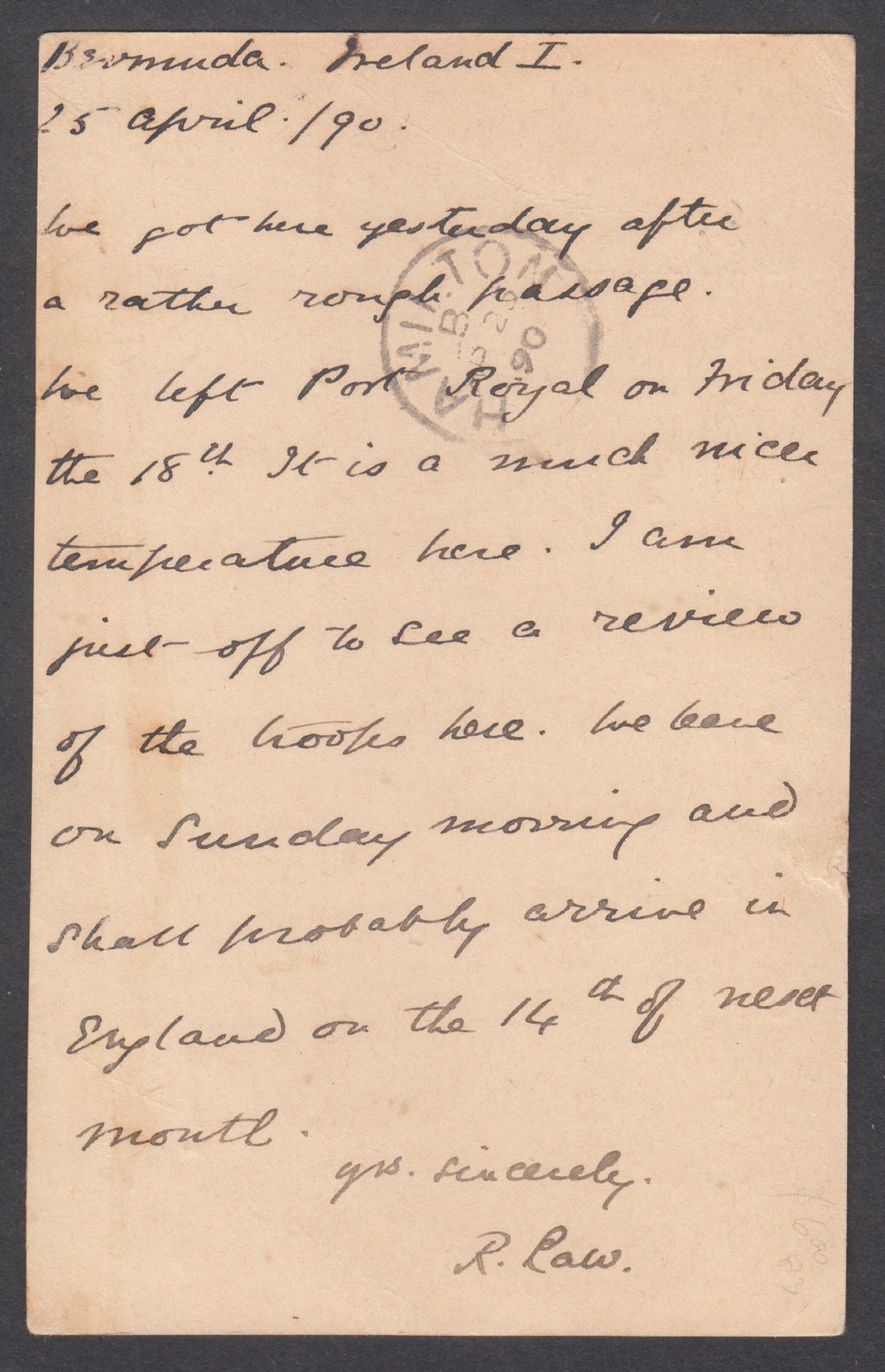
Message side of the postcard, headed Bermuda, Ireland I., 25 April 90, signed R. Law, with a HAMILTON BERMUDA datestamp struck across the writing
Message side, with the Hamilton datestamp
  • Posted Ireland Island, Bermuda, 25 April 1890
  • Card 1½d postal card, Union Postale Universelle
  • Obliterator barred “3”, with the IRELAND ISLAND / BERMUDA datestamp, type K4, AP 25 90
  • Transit HAMILTON / BERMUDA, type H4, 25 April 1890, on the message side
  • Addressed to Miss Hewitt, 2 The Firs, South Hayling, Havant, Hants, England
  • Written by R. Law

This is the Bermuda 1½d postal card for overseas use. It was cancelled at Ireland Island with the barred “3” and the K4 datestamp IRELAND ISLAND, AP 25 90. The Hamilton datestamp of the same day, Ludington’s type H4, is on the message side, showing that it reached the main post office that afternoon.

The message reads:

“Bermuda. Ireland I. 25 April /90. We got here yesterday after a rather rough passage. We left Port Royal on Friday the 18th. It is a much nicer temperature here. I am just off to see a review of the troops here. We leave on Sunday morning and shall probably arrive in England on the 14th of next month. Yrs sincerely, R. Law.”

I like the line about the temperature. After Jamaica in April, Bermuda must have felt like spring.
II

Which ship?

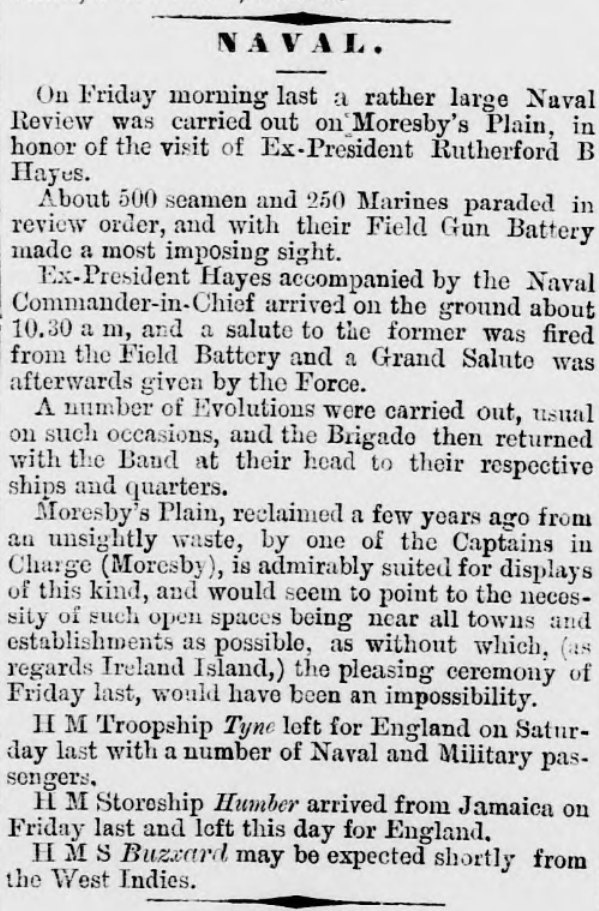
Royal Gazette naval column: a rather large Naval Review carried out on Moresby's Plain on Friday last in honour of the visit of Ex-President Rutherford B Hayes; about 500 seamen and 250 Marines paraded; H M Troopship Tyne left for England on Saturday last; H M Storeship Humber arrived from Jamaica on Friday last and left this day for England; H M S Buzzard may be expected shortly from the West Indies
Royal Gazette, 29 April 1890: the review, and the Humber

Law never names his ship, but he gives enough to find her. He left Port Royal, Jamaica, on Friday 18 April, reached Bermuda on the 24th, and was bound for England, expecting to sail on the Sunday.

The Royal Gazette’s naval column of Tuesday 29 April has exactly one ship that fits: “H M Storeship Humber arrived from Jamaica on Friday last and left this day for England.” The dates are a day or two out. The Gazette has her arriving on the Friday rather than Law’s Thursday, and she sailed on the Tuesday rather than the Sunday he expected. A man on board is the better witness to the day he arrived, and sailing dates slipped all the time. The same column has the troopship Tyne leaving for England on Saturday 26 April, but she hadn’t come from Jamaica. No other ship I can find was making the Jamaica–Bermuda–England passage that week.

III

The review on Moresby’s Plain

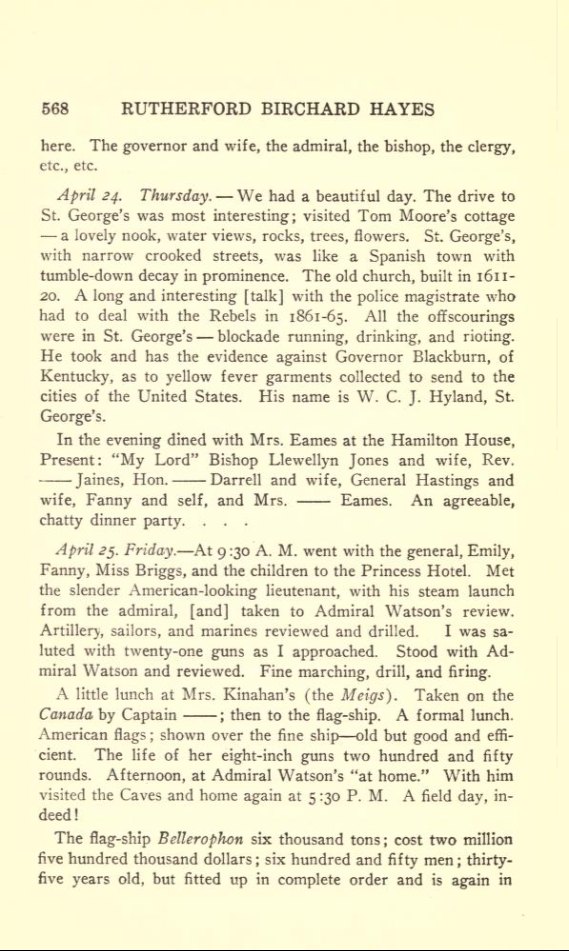
Page 568 of the Diary and Letters of Rutherford Birchard Hayes, with the entries for 24 and 25 April 1890 describing his drive to St George's and Admiral Watson's review of artillery, sailors and marines, his twenty-one gun salute, and his visits to the Canada and the flagship Bellerophon
Hayes’s diary for 25 April 1890, as published in 1926

“I am just off to see a review of the troops here,” Law wrote that Friday morning. The Gazette tells us what he saw: “a rather large Naval Review was carried out on Moresby’s Plain, in honor of the visit of Ex-President Rutherford B Hayes. About 500 seamen and 250 Marines paraded in review order, and with their Field Gun Battery made a most imposing sight.” Hayes arrived with the Commander-in-Chief at about 10.30. A salute was fired from the field battery, the men went through their evolutions, and the brigade marched back to the ships behind the band.

Hayes was the nineteenth President of the United States, from 1877 to 1881. His wife Lucy had died the year before, and he came to Bermuda that April with his daughter Fanny, staying with friends at a house called Soncy. He kept a diary all his life, and that evening he wrote:

“Met the slender American-looking lieutenant, with his steam launch from the admiral, [and] taken to Admiral Watson’s review. Artillery, sailors, and marines reviewed and drilled. I was saluted with twenty-one guns as I approached. Stood with Admiral Watson and reviewed. Fine marching, drill, and firing.”

The rest of his day took in a little lunch at Mrs Kinahan’s, a visit to the Canada, and a formal lunch in the flagship Bellerophon, then the Admiral’s “at home” and the caves. “A field day, indeed!”

So three independent witnesses describe the same morning: a man off a storeship, the colony’s newspaper, and the guest of honour himself.

IV

The card’s journey

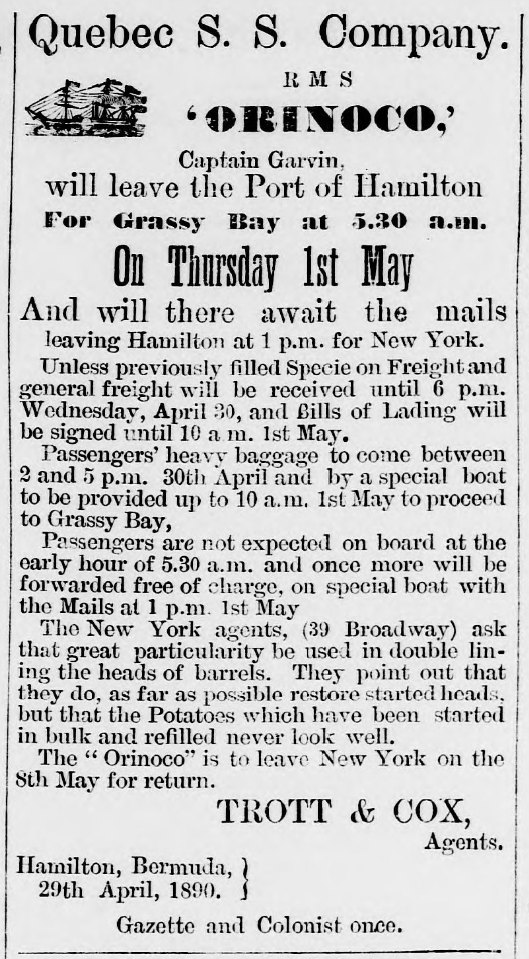
Advertisement by Trott and Cox, agents for the Quebec S.S. Company: R M S Orinoco, Captain Garvin, will leave the Port of Hamilton for Grassy Bay at 5.30 a.m. on Thursday 1st May and will there await the mails leaving Hamilton at 1 p.m. for New York; dated Hamilton, Bermuda, 29th April 1890
Royal Gazette, 29 April 1890: the Orinoco takes the mails on 1 May

Law’s ship sailed straight for England, but his card couldn’t go with her. It had to wait for the mail. The Ireland Island and Hamilton datestamps show it reached the Hamilton post office the day it was written. The next mail for England went by way of New York. On 29 April the agents, Trott & Cox, announced that R.M.S. Orinoco would leave Hamilton for Grassy Bay at 5.30 on the morning of Thursday 1 May “and will there await the mails leaving Hamilton at 1 p.m. for New York”.

The Orinoco had a distinguished passenger that day. Hayes wrote:

“Admiral Watson sent his steam launch to put us on board the Orinoco. Got on board in a heavy rain but comfortably. … Saluted us with flags and music as we passed the fleet.”

So the card very probably crossed to New York with the ex-President whose review its writer had gone to watch. Hayes was at the New York dock by 1 p.m. on 4 May. From there the card would have gone on across the Atlantic, and with luck it reached South Hayling at about the same time as Law reached England.

Ten days in April

The ships on one side, the card on the other.

The ships
The card
18 Apr
HumberLeaves Port Royal, Jamaica.
20 Apr
TrinidadHayes and Fanny arrive from New York.
24 Apr
HumberArrives at Bermuda “after a rather rough passage”.
25 Apr
The reviewNaval review on Moresby’s Plain for Hayes.
The cardWritten and posted at Ireland Island; at Hamilton the same day.
26 Apr
TyneTroopship leaves for England.
29 Apr
HumberLeaves for England.
1 May
OrinocoSails for New York with Hayes on board.
The cardGoes with the New York mails.
4 May
OrinocoDocks at New York.
c.14 May
HumberLaw expects to reach England.
The cardProbably reaches South Hayling about now.

The Ship

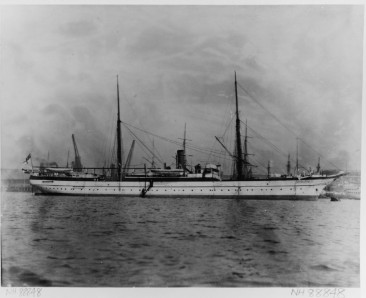
Photograph of the storeship Humber at anchor in a British port in about 1890: a long white-hulled steamer with two masts, a single funnel amidships and a clipper bow

H.M.S. Humber

H.M. Storeship Humber began life as the merchant steamer Harar, an iron screw ship launched in 1876. In 1878, during the war scare with Russia, the Admiralty bought her along with other merchant steamers and renamed her Humber. She stayed in naval service until 1907, when she was sold back into merchant service as Lucia Victoria.

The Navy’s overseas dockyards at Bermuda, Jamaica, Halifax and elsewhere depended on supplies from home, and storeships like the Humber were the Navy’s own cargo ships. They carried stores out from the home dockyards and brought stores and people back. Law’s passage from Port Royal to Bermuda and on to England fits a ship finishing a West Indies run and heading home.

The photograph shows her in a British port in about 1890, the year of this card.

Built1876, as the merchant steamer Harar
TypeIron screw storeship
Purchased1878, during the Russian war scare
In Bermuda24–29 April 1890, from Jamaica, bound for England
FateSold 1907, became Lucia Victoria

Photograph: Naval History and Heritage Command, NH 88848.

Still to find out

If you can help with any of these, I’d be very pleased to hear from you.

References

A card that never names its ship, written on the morning an American ex-President stood on Moresby’s Plain, and probably carried to New York in the same steamer as him.