Postal History · Royal Navy · Registered Mail

H.M.S. Buzzard

Ireland Island · Hamilton · 1889 and 1894

Two registered letters to the same young man in Manchester, posted six weeks apart at two different post offices, and the Gazette tells us why.

◆

I have three items from HMS Buzzard. Two are registered envelopes with the ship’s name printed on the flap, sent in March and April 1889 by the same writer to the same young man in Manchester. The first was posted at Ireland Island, the second at Hamilton, and the Royal Gazette explains the difference: in between, the ship moved. The young man turned out to be Walter Dorning Beckton, one of the great names in British philately. The third item is a postcard of 1894, sent to the Buzzard’s commander in Newfoundland by a lady in Bermuda who had promised to find him a house.

I

Ireland Island, March 1889

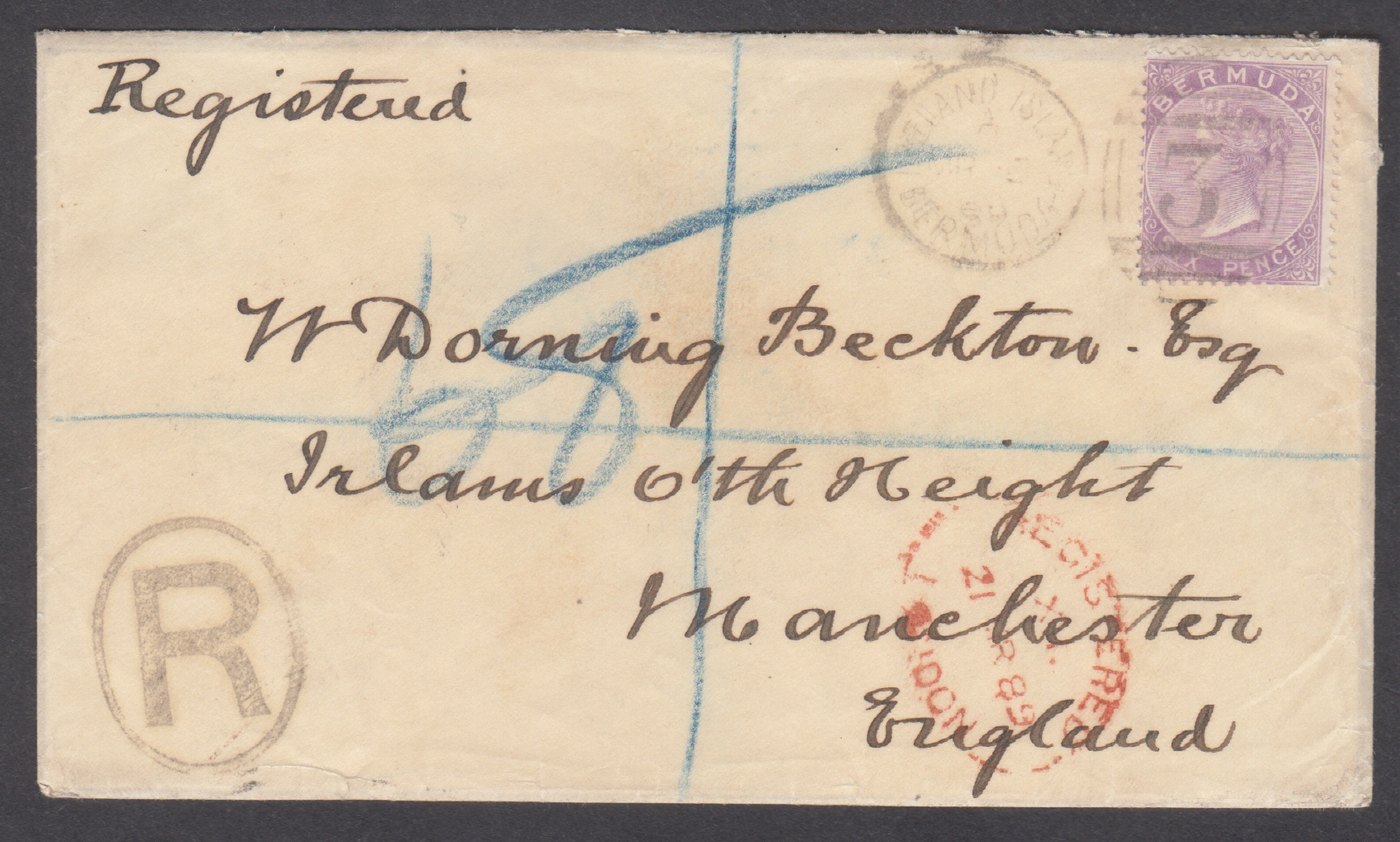
Registered envelope addressed to W Dorning Beckton Esq, Irlams o'th Height, Manchester, England, franked with a Bermuda 6d lilac cancelled by a barred numeral 3, with an IRELAND ISLAND BERMUDA datestamp of March 1889, a large R in an oval at lower left, blue crayon registration crossing and a red REGISTERED LONDON oval of 21 March 1889
Front: Ireland Island, March 1889, to W. Dorning Beckton
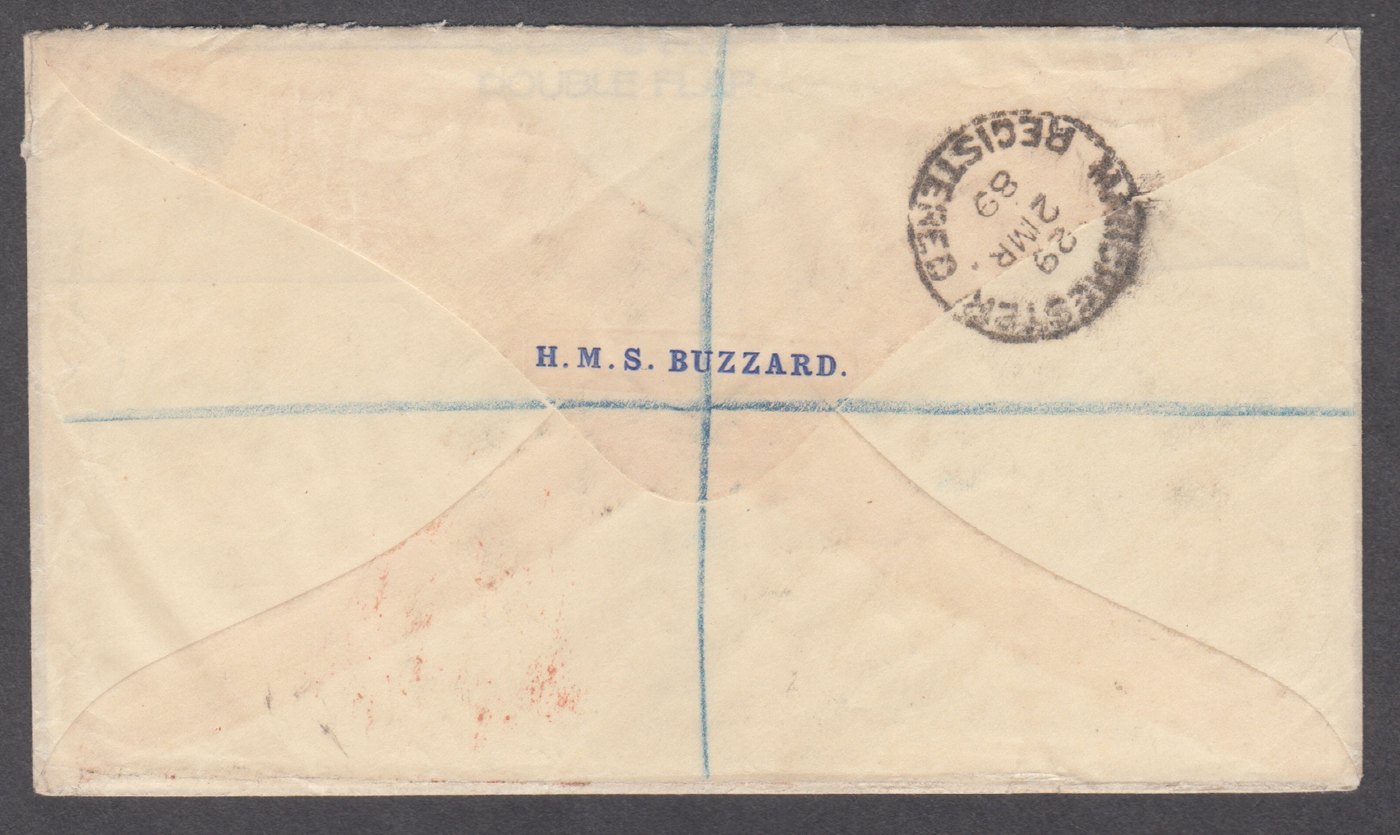
Reverse of the envelope with H.M.S. BUZZARD printed in blue on the flap, blue crayon crossing and a MANCHESTER REGISTERED datestamp of 21 March 1889
Reverse: the ship’s name on the flap, and Manchester, 21 March 1889
  • Posted Ireland Island, Bermuda, March 1889 (day not legible)
  • Franking 6d lilac: 4d letter rate to the United Kingdom and 2d registration
  • Obliterator barred numeral 3, with the IRELAND ISLAND / BERMUDA datestamp, type K4
  • Registration Ireland Island R in oval, Proud type R2
  • Transit red REGISTERED / LONDON oval, 21 MR 89
  • Arrival MANCHESTER REGISTERED, 21 MR 89, on the reverse
  • Stationery “H.M.S. BUZZARD.” printed in blue on the back flap
  • Addressed to W. Dorning Beckton Esq., Irlams o’ th’ Height, Manchester

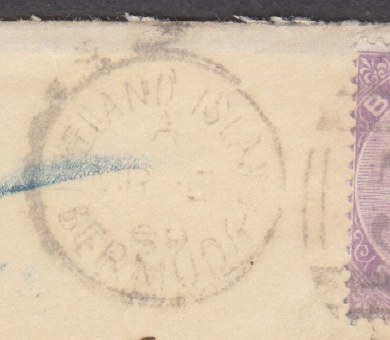
The first envelope was posted at the Dockyard. The 6d lilac is cancelled by the barred “3” of Ireland Island, and beside it is the datestamp IRELAND ISLAND, March 1889. The day is lost under the blue crayon. This is the new K4 datestamp, correctly spelt, which came into use in early March 1889 and replaced the old K3 that read INLAND ISLAND by mistake. So this is an early use of it, and for a while the two seem to have overlapped.

“Registered” is written across the top, there’s a large R in an oval at the lower left, and the blue crayon cross shows it was handled as registered mail. The R in oval is the Ireland Island registration handstamp, Proud’s type R2. Proud gives just one recorded date for it, 7 July 1898, so this strike from March 1889 is more than nine years earlier. The 6d pays the 4d letter rate to Britain and the 2d registration fee. In London it was given the red REGISTERED oval on 21 March, and it reached Manchester the same day. On the back flap, “H.M.S. BUZZARD.” is printed in blue.

The address reads “W Dorning Beckton Esq, Irlams o’th Height, Manchester, England”. The writer’s “o” has a tall loop on it, so at first glance it looks like “6’th”. Irlams o’ th’ Height, “Irlam of the Height”, is a village on the edge of Salford.
II

Hamilton, April 1889

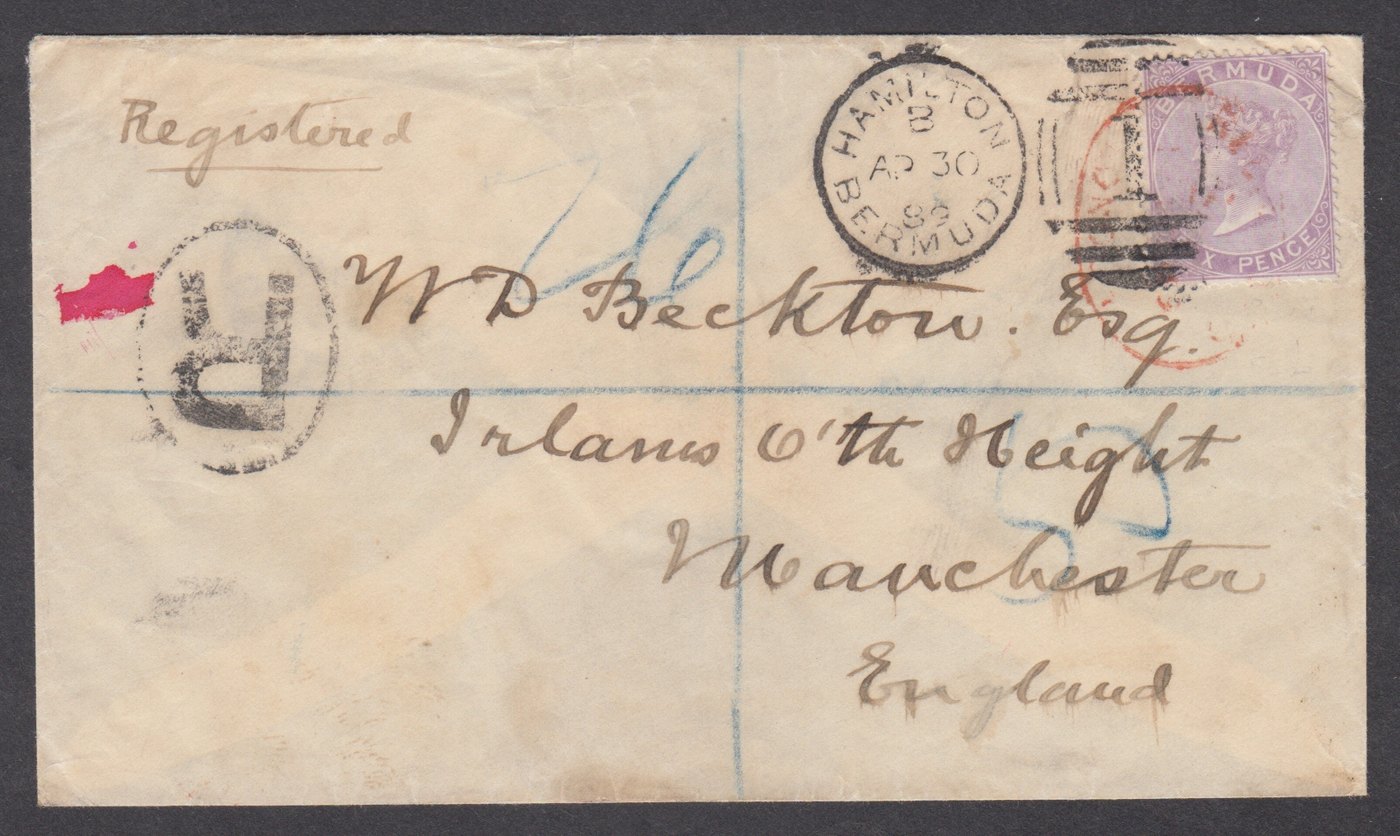
Registered envelope addressed to W D Beckton Esq, Irlams o'th Height, Manchester, England, franked with a Bermuda 6d lilac cancelled by a Hamilton duplex numeral 1 with a HAMILTON BERMUDA datestamp of 30 April 1889, a red London registered oval faint over the stamp, an R in oval at left and blue crayon registration markings
Front: Hamilton, 30 April 1889, to W. D. Beckton
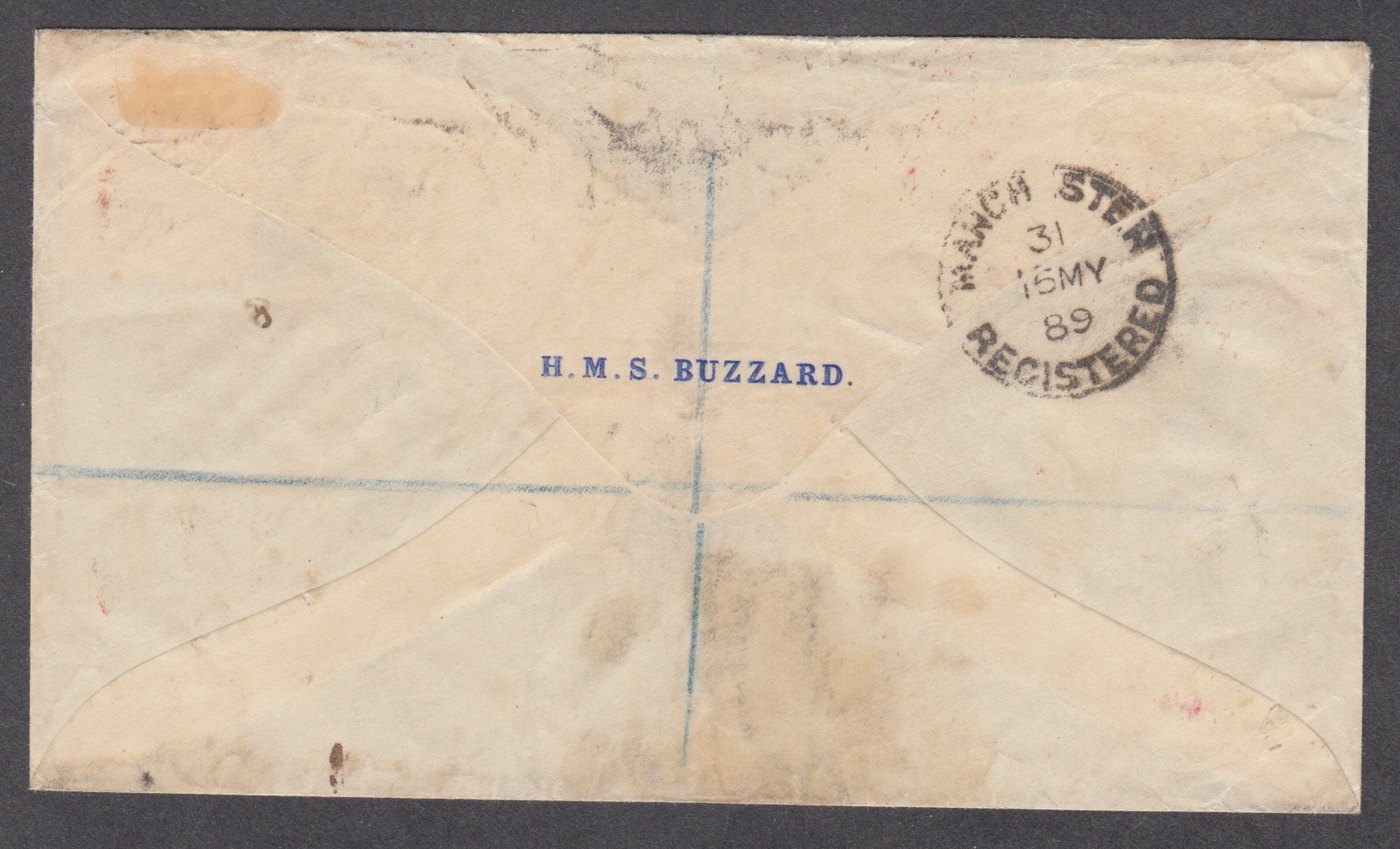
Reverse of the envelope with H.M.S. BUZZARD printed in blue on the flap, blue crayon crossing and a MANCHESTER REGISTERED datestamp of 15 May 1889
Reverse: the same printed flap, and Manchester, 15 May 1889
  • Posted Hamilton, Bermuda, 30 April 1889
  • Franking 6d lilac: 4d letter rate and 2d registration
  • Obliterator Hamilton duplex “1”, type K4, AP 30 89
  • Registration Hamilton R in oval, Proud type R3, struck inverted
  • Transit red REGISTERED / LONDON oval, faint over the stamp
  • Arrival MANCHESTER REGISTERED, 15 MY 89, on the reverse
  • Stationery “H.M.S. BUZZARD.” printed in blue on the back flap
  • Addressed to W. D. Beckton Esq., Irlams o’ th’ Height, Manchester

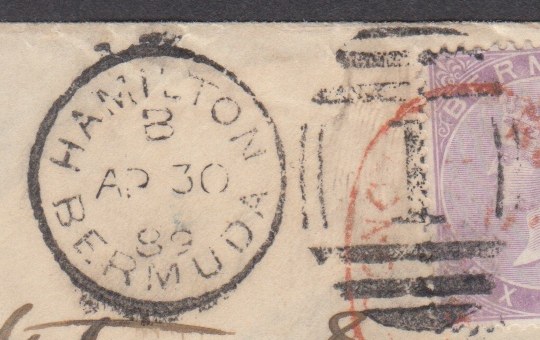
Six weeks later the same writer sent another registered letter to the same address, in the same envelope and with the same 6d. This time it went through Hamilton. The stamp is cancelled by the Hamilton “1” duplex of type K4, used at Hamilton from 1 January 1889 until about 19 December 1895, and the datestamp reads AP 30 89. The R in oval is the Hamilton registration mark, Proud’s type R3, recorded from 31 December 1884 to 16 October 1906, and here it’s struck upside down. It’s the same style of handstamp as the Ireland Island R on the March cover. The red London oval is there again, struck faintly across the stamp. The letter reached Manchester on 15 May, fifteen days after it was posted.

III

Two post offices, one ship

Close-up of the IRELAND ISLAND BERMUDA datestamp of March 1889 beside the barred numeral 3 on the 6d lilac
March: IRELAND ISLAND, the Dockyard
Close-up of the HAMILTON BERMUDA datestamp, B, AP 30 89, beside the duplex numeral 1 on the 6d lilac, with the red London registered oval faint across the stamp
April: HAMILTON, AP 30 89
Royal Gazette: H M S Buzzard, Commander Baker, came into the Harbour of Hamilton on Tuesday last, for the purpose of giving liberty, and acting as guard ship
Royal Gazette, 23 April 1889: guard ship at Hamilton
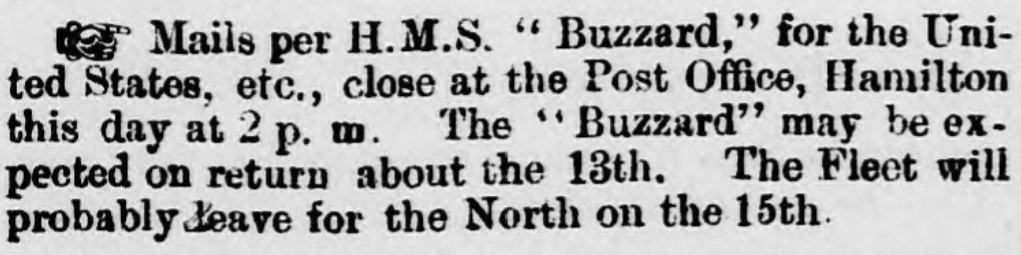
Royal Gazette: Mails per H.M.S. Buzzard for the United States, etc., close at the Post Office, Hamilton this day at 2 p.m. The Buzzard may be expected on return about the 13th
Royal Gazette, 4 June 1889: the mails go by the Buzzard

To me this is the best part of the story. Why would one writer, using the same ship’s envelopes, post one letter at the Dockyard and the next at Hamilton? The Royal Gazette answers it.

The Buzzard was brand new, commissioned in April 1888 for the North America and West Indies Station. She came back to Bermuda from the West Indies in January 1889, and in March she was at the Dockyard, where the first letter was posted. Then, in April, the Gazette reported that “H M S ‘Buzzard,’ Commander Baker, came into the Harbour of Hamilton on Tuesday last, for the purpose of giving liberty, and acting as guard ship.”

“Liberty” was the Navy’s word for shore leave: a set period, often just an afternoon and evening, when men off duty could go ashore and come back aboard by a set time. At Ireland Island that didn’t amount to much, because the Dockyard was at the far end of Bermuda, a long boat trip from town. Bringing the ship into Hamilton Harbour meant her men could step ashore straight into the colony’s capital, with its shops, churches, hotels and taverns.

The ship had moved across the Sound to Hamilton, and the second letter went through the Hamilton post office. Each envelope was posted where the ship was lying.

She was a busy little ship that spring. At the end of May the Gazette expected her back from New York. On 4 June it announced: “Mails per H.M.S. ‘Buzzard,’ for the United States, etc., close at the Post Office, Hamilton this day at 2 p.m.” She was back from New York again on 14 June. For a while she was carrying the colony’s mail to New York, which is an unusual job for a warship. I’d love to know whether my April letter went with her, but the dates don’t settle it.

Her men turned up ashore too. In May, Commander Baker took a prize in the “Running Man” at the Army and Navy rifle meeting. In July, at a band concert at the Soldiers’ and Sailors’ Home in Hamilton, “Mr Ferry, Blue Jacket, H M S ‘Buzzard’” sang “Sweet Forget Me Not” and, after the interval, “Hurrah for the Flag”. In October she left for Port Royal, Jamaica, by way of the Turks Islands.

IV

Walter Dorning Beckton

I recognised the name before I’d finished reading it. The March envelope spells it out in full: W. Dorning Beckton. Walter Dorning Beckton was a Manchester solicitor and one of the best-known philatelists of his generation. He started collecting in 1879, as a boy of about thirteen. He went on to be President of the Manchester Philatelic Society for thirty-five years, and he chaired the first Philatelic Congress of Great Britain, held in Manchester in 1909. He signed the Roll of Distinguished Philatelists in 1921 and was President of the Royal Philatelic Society London from 1929 until his death in 1931.

His medal-winning collections included Greece, Romania, the Straits Settlements, Japan and the British West Indies. His library of more than 900 volumes went to Manchester’s public library and is now the Beckton Philatelic Library.

In 1889 he was 22 or 23 and not yet famous. Someone in the Buzzard was writing to him regularly, by registered post, and two of those letters have stayed together. I don’t know who the writer was. Two registered letters in six weeks, to a young collector who later showed a British West Indies collection, make me wonder whether they held stamps, but that’s a guess and I can’t prove it. I like to think he’d be pleased to know his envelopes ended up with another Bermuda collector.

V

The postcard

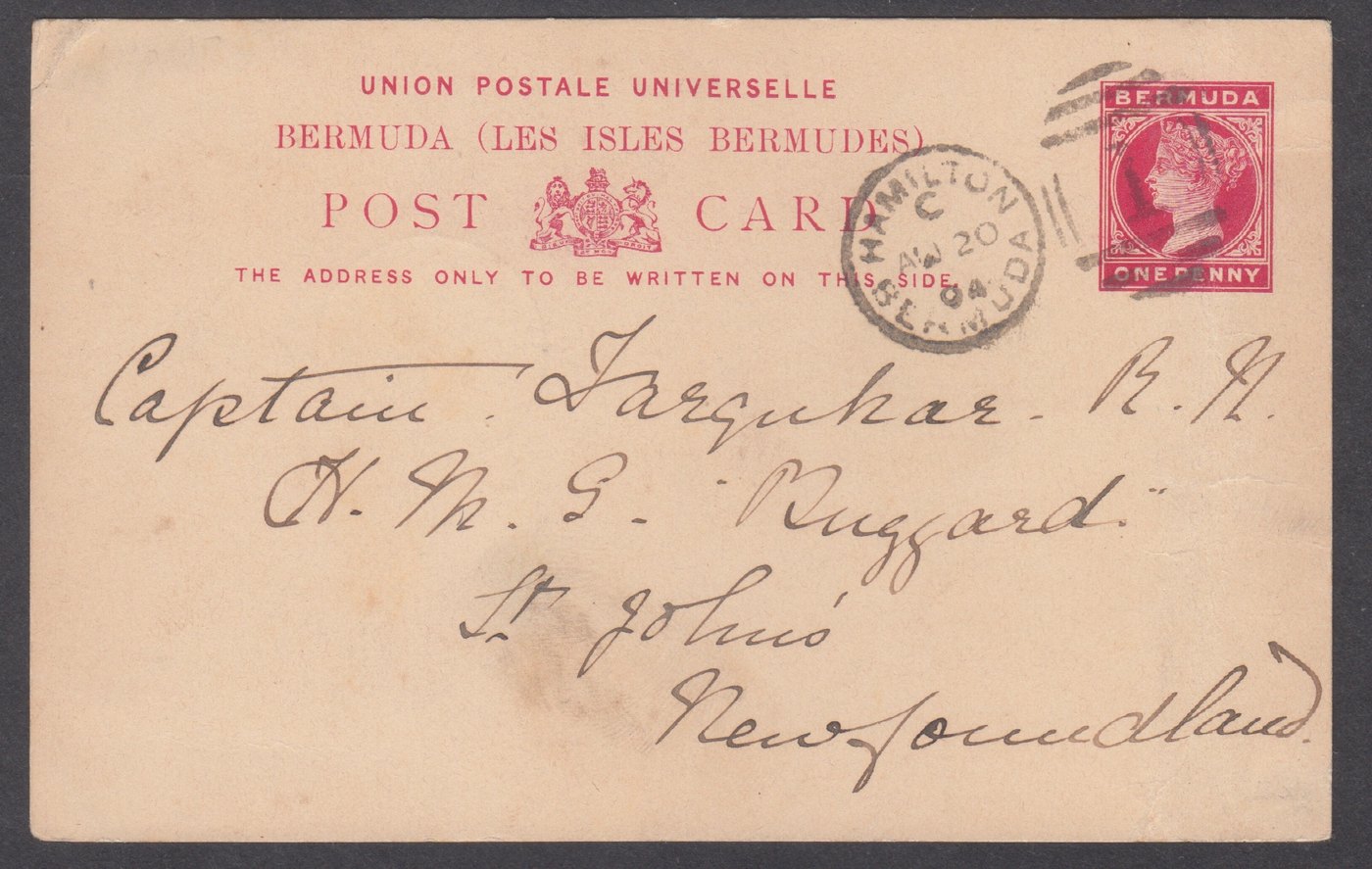
Bermuda one penny Union Postale Universelle postal card addressed to Captain Farquhar R.N., H.M.S. Buzzard, St John's, Newfoundland, cancelled by the Hamilton duplex numeral 1 with a HAMILTON BERMUDA datestamp, C, AU 20 94
Address side: Hamilton, 20 August 1894, to Captain Farquhar at St John’s
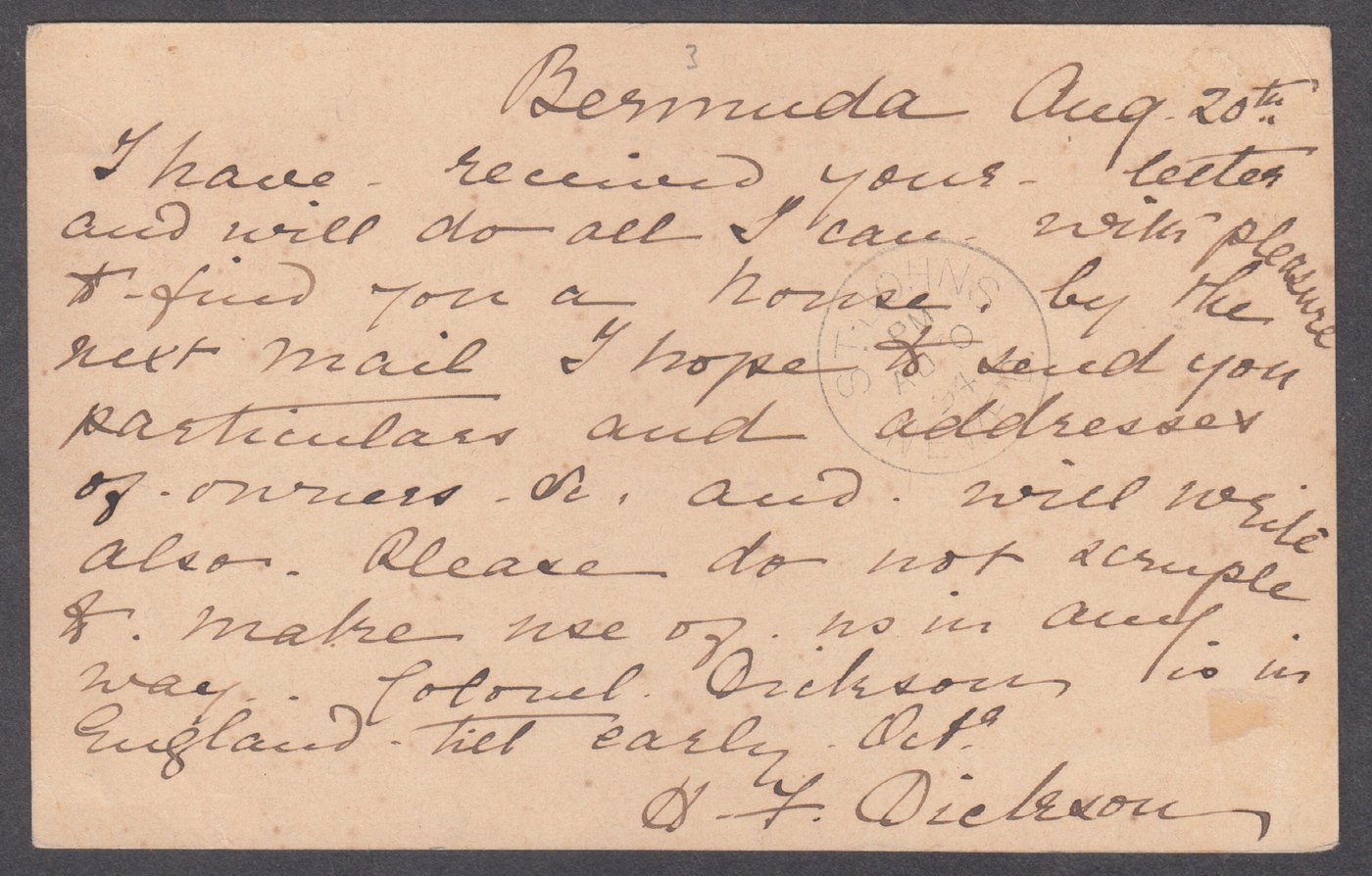
Message side of the postcard written from Bermuda on August 20th about finding a house, signed H. F. Dickson, with a ST JOHN'S NEWFOUNDLAND datestamp of 30 August 1894 struck across the writing
Message side, with St John’s, 30 August 1894
  • Posted Hamilton, Bermuda, 20 August 1894
  • Card 1d postal card, Union Postale Universelle
  • Obliterator Hamilton duplex “1”, type K4, AU 20 94
  • Arrival St John’s, Newfoundland, 30 August 1894, on the message side
  • Addressed to Captain Farquhar R.N., H.M.S. “Buzzard”, St John’s, Newfoundland

Five years on, here is the Buzzard from the other direction: a letter to the ship rather than from it. It’s the 1d Bermuda postal card for overseas use, cancelled with the same Hamilton “1” duplex as my April 1889 cover and datestamped AU 20 94. It’s addressed to “Captain Farquhar R.N., H.M.S. ‘Buzzard’, St John’s, Newfoundland”, and the St John’s receiver of 30 August is struck across the message.

Every summer the squadron went north, and the smaller ships were sent to Newfoundland on fishery protection. In May 1894 the Halifax cable reported the Buzzard leaving for Bay St George on that service. By August she was at St John’s.

VI

A house for the Farquhars

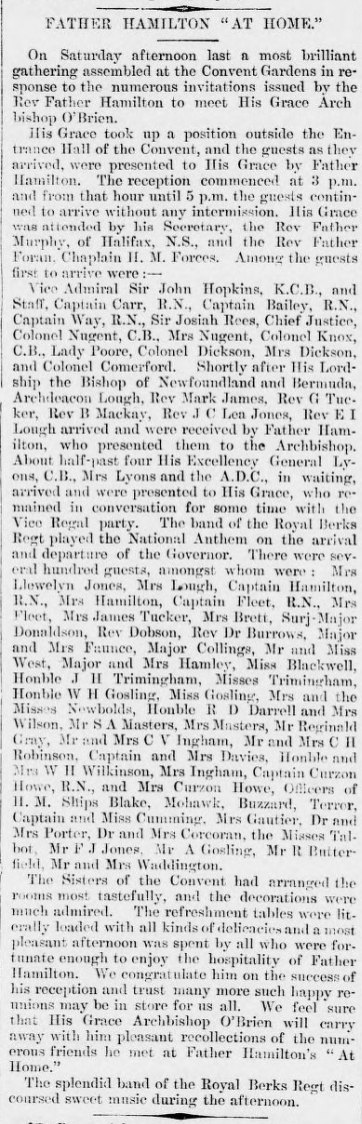
Royal Gazette report headed Father Hamilton At Home: a reception at the Convent Gardens to meet Archbishop O'Brien, with a long list of guests including Vice Admiral Sir John Hopkins, Colonel Dickson, Mrs Dickson, and Officers of H.M. Ships Blake, Mohawk, Buzzard and Terror
Royal Gazette, 24 April 1894: Colonel and Mrs Dickson, and officers of the Buzzard
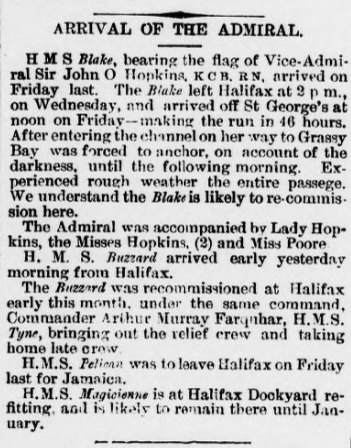
Royal Gazette report headed Arrival of the Admiral: HMS Blake arrived from Halifax; HMS Buzzard arrived early yesterday morning from Halifax; the Buzzard was recommissioned at Halifax early this month under the same command, Commander Arthur Murray Farquhar
Royal Gazette, 13 November 1894: back at Bermuda, “under the same command”

The message reads:

“I have received your letter and will do all I can with pleasure to find you a house. By the next mail I hope to send you particulars and addresses of owners &c, and will write also. Please do not scruple to make use of us in any way. Colonel Dickson is in England till early Octr.”

It’s signed H. F. Dickson. She was Helene Frances Dickson, eldest daughter of Colonel W. F. Harvey and wife of Lieutenant-Colonel Edward Thompson Dickson, who commanded the 1st Battalion of the Royal Berkshire Regiment, then stationed at Bermuda, from 1891 to 1895. He was a veteran of the 1885 Suakin campaign, including the battle of Tofrek, and later became a major-general. With her husband away, she was holding the fort.

She was right about his return, too. On 16 October 1894 the Gazette listed “Lt-Col E Dickson, 1st R Berks” among the passengers who had arrived from New York in the R.M.S. Trinidad on Friday 12 October.

Arthur Murray Farquhar was a commander, not promoted captain until 1896, but as the ship’s captain he was “Captain Farquhar” to everyone. In 1893 he had married Helen Eva Forbes McNeill, daughter of Sir Malcolm McNeill. My guess is that he wanted a house in Bermuda so his wife could join him for the winter, when the squadron came south, but that is a guess. The two families had probably met. In April 1894 the Gazette listed “Colonel Dickson, Mrs Dickson” among the guests at Father Hamilton’s reception for Archbishop O’Brien, along with the “Officers of H.M. Ships Blake, Mohawk, Buzzard”.

The Buzzard came back to Bermuda on 12 November 1894. She had been recommissioned at Halifax with a fresh crew from England, but “under the same command, Commander Arthur Murray Farquhar”. Whether Mrs Dickson found him his house, I don’t know. Farquhar went on to command the cruiser Diana and the battleship Renown, and he was knighted in 1914.

A derelict, and a camera

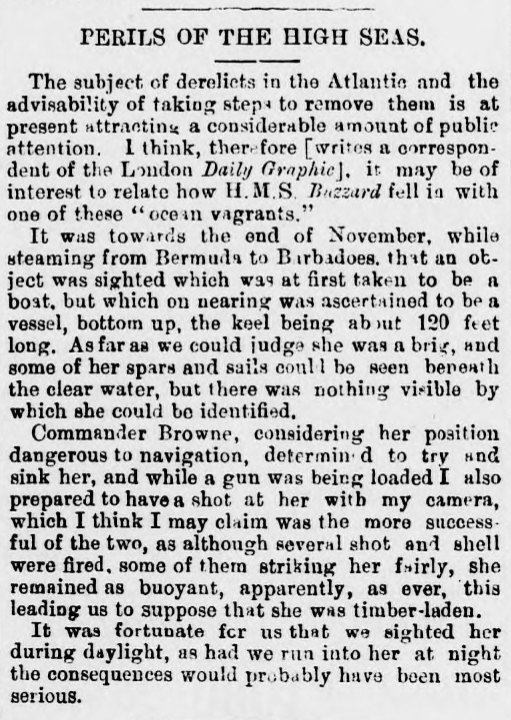
Royal Gazette article headed Perils of the High Seas, reprinting a letter to the London Daily Graphic describing how HMS Buzzard, steaming from Bermuda to Barbados towards the end of November, found a brig floating bottom up and tried to sink her with gunfire
Royal Gazette, 6 February 1894: “Perils of the High Seas”

One more story from the Gazette, from the winter before the postcard. In February 1894 it reprinted a letter that one of the Buzzard’s officers had written to the London Daily Graphic. Towards the end of November 1893, steaming from Bermuda to Barbados, the ship came across a brig floating bottom up, her keel about 120 feet long, with spars and sails visible under the clear water.

Commander Browne, who then had the ship, decided she was a danger to navigation and tried to sink her. “While a gun was being loaded I also prepared to have a shot at her with my camera, which I think I may claim was the more successful of the two, as although several shot and shell were fired, some of them striking her fairly, she remained as buoyant, apparently, as ever.” They thought she was carrying timber. By the following summer Farquhar was in command.

The ship and the post

The ship on one side, the letters on the other.

The ship
The letters
17 Jan 1889
BuzzardArrives at Bermuda from the West Indies.
Mar 1889
BuzzardAt the Dockyard.
Cover 1Registered at Ireland Island. London and Manchester, 21 March.
Apr 1889
BuzzardComes into Hamilton Harbour as guard ship.
30 Apr 1889
Cover 2Registered at Hamilton. Manchester, 15 May.
May–Jun 1889
BuzzardTwo trips to New York, the second carrying the colony’s mails.
Nov 1893
BuzzardFires on a derelict brig on the way to Barbados.
May 1894
BuzzardLeaves Halifax for Newfoundland on fishery protection.
20 Aug 1894
PostcardPosted at Hamilton to Captain Farquhar.
30 Aug 1894
BuzzardAt St John’s, Newfoundland.
PostcardReceived at St John’s.
12 Nov 1894
BuzzardBack at Bermuda, recommissioned under Farquhar.

The Ship

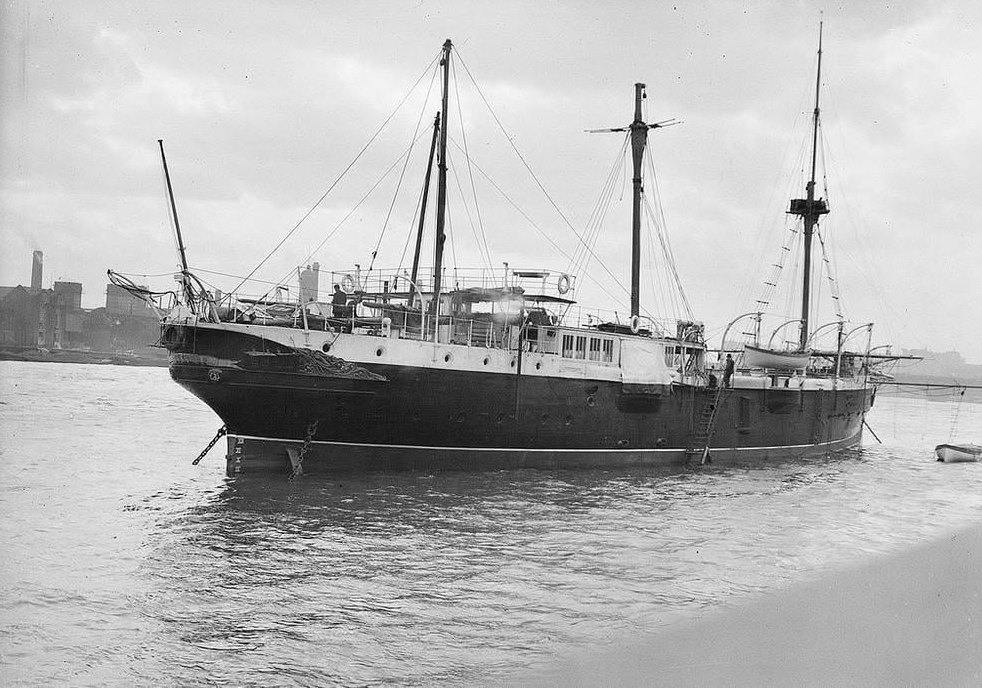
Photograph of HMS Buzzard moored on the Thames as an RNVR training ship: a black-hulled sloop with a white upper works, a deckhouse built over her quarterdeck, three masts with her topmasts mostly struck, and warehouses and a chimney on the far bank

H.M.S. Buzzard

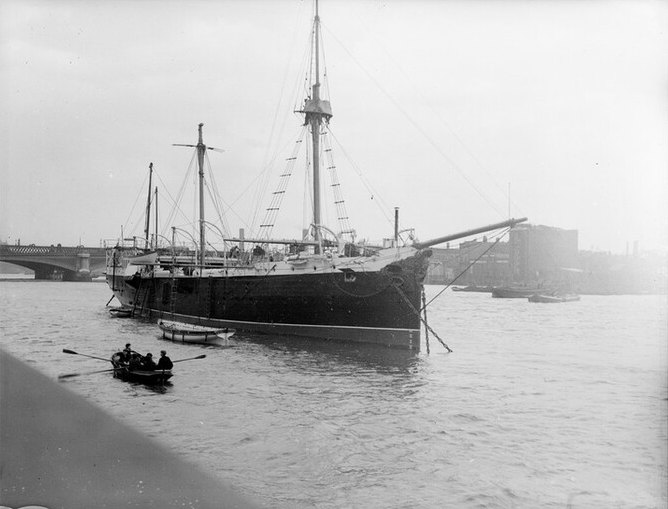
HMS Buzzard was a Nymphe-class composite screw sloop, built at Sheerness Dockyard and launched on 10 May 1887. She was barquentine rigged and carried eight 5-inch breech-loading guns. She spent her whole seagoing life on the North America and West Indies Station, from her commissioning in 1888 until she paid off at Chatham in 1902. In 1904 she arrived on the Thames at Blackfriars as the training ship of the London Royal Naval Volunteer Reserve, and in 1911 she was renamed President. She was sold for breaking up in 1921.

I haven’t yet found a photograph of her from her Bermuda years. Both pictures here show her on the Thames in her later life, with a deckhouse built over the quarterdeck and most of her topmasts struck. She was still recognisably the ship that carried Bermuda’s mails to New York in 1889.

BuiltSheerness Dockyard, launched 10 May 1887
TypeComposite screw sloop, Nymphe class
Displacement1,140 tons
GunsEight 5-inch breech-loaders
CommandersBaker, 1889; Browne, 1893; Farquhar, 1894
FateRNVR drill ship, renamed President 1911; sold 1921
Photograph of HMS Buzzard moored in the Thames off Blackfriars as an RNVR training ship, seen from the bow, with Blackfriars Bridge behind at left and a rowing boat with four men in the foreground
RNVR training ship at Blackfriars, with Blackfriars Bridge behind

Photographers not identified.

Still to find out

If you can help with any of these, I’d be very pleased to hear from you.

References

Three small pieces of postal history, and all three are about people: a young collector in Manchester, a writer who knew exactly where his ship was lying, and a naval officer looking for a home for the winter.