Postal History · Ship Letter · Disinfected Mail

H.M.S. Euryalus

Bermuda · 7 August – 3 October 1819

A ship’s doctor’s letter home to Scotland, written through a yellow fever epidemic and slit and disinfected in quarantine on the way.

◆

This is one of the earliest naval items in my collection, and one of the most moving. It’s an entire, a folded letter sheet with no envelope, written by Dr Robert Riddell of H.M.S. Euryalus while the frigate lay at Bermuda for repairs in the late summer of 1819.

He began it on 7 August and couldn’t finish it until 3 October. By then yellow fever had swept through St. George’s, two of the ship’s midshipmen were dead, and Riddell was writing from his bed in the Naval Hospital. On its way home the letter was slit and disinfected in quarantine. Disinfected mail from Bermuda is very scarce, and I don’t expect to see another like it.

I

An entire to Lauder

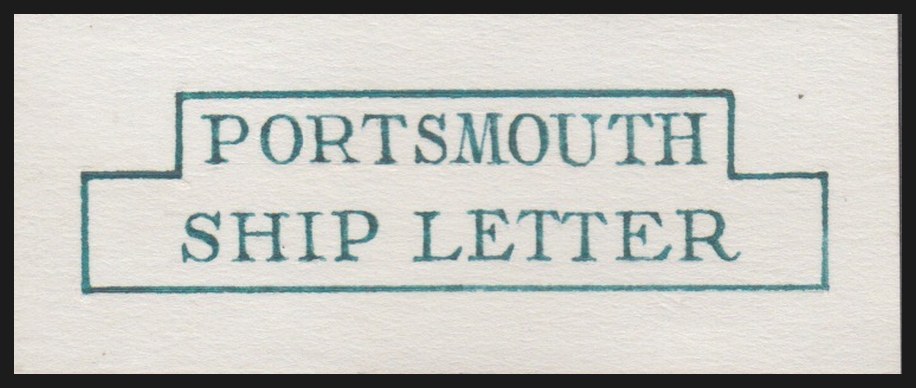
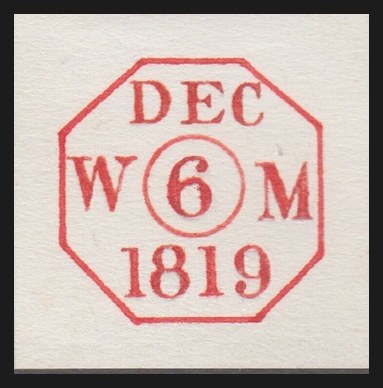
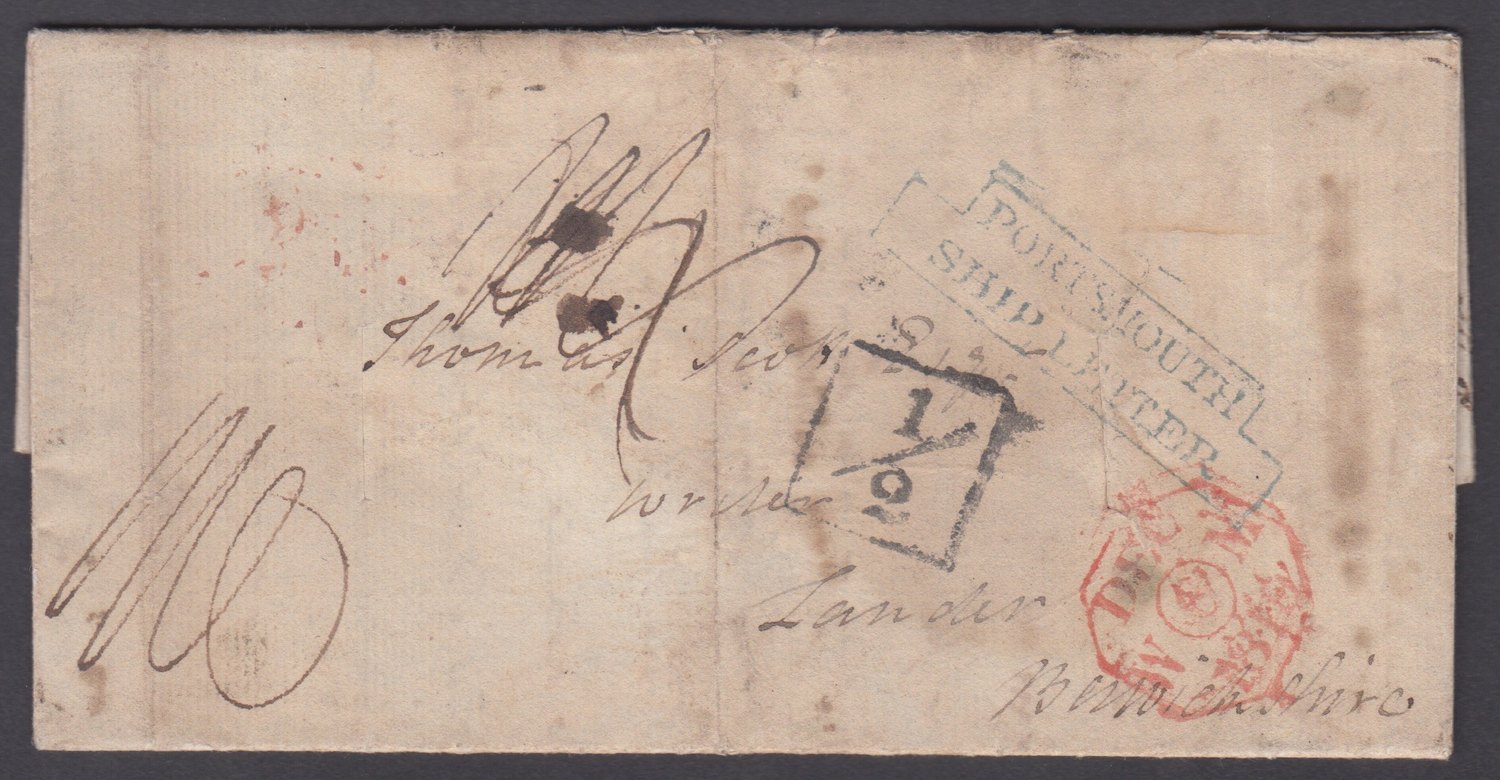
The folded entire, addressed in ink to Thomas Scott Esq., Writer, Lauder, Berwickshire, with a large manuscript 1/10 charge at left, a boxed half in black, a boxed PORTSMOUTH SHIP LETTER handstamp in blue-green and a red octagonal Edinburgh datestamp at lower right
The entire folded, as it went through the post
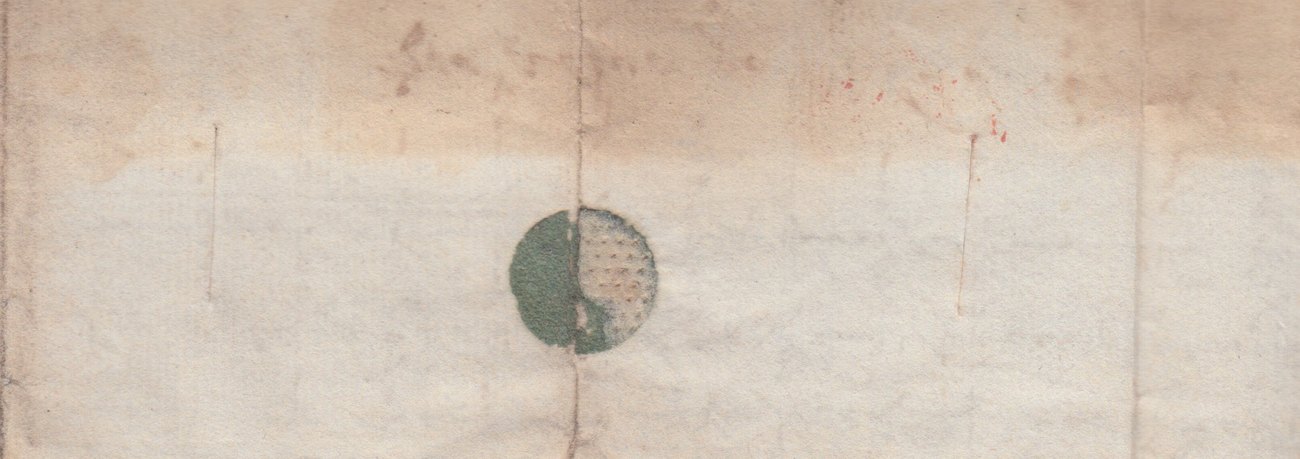
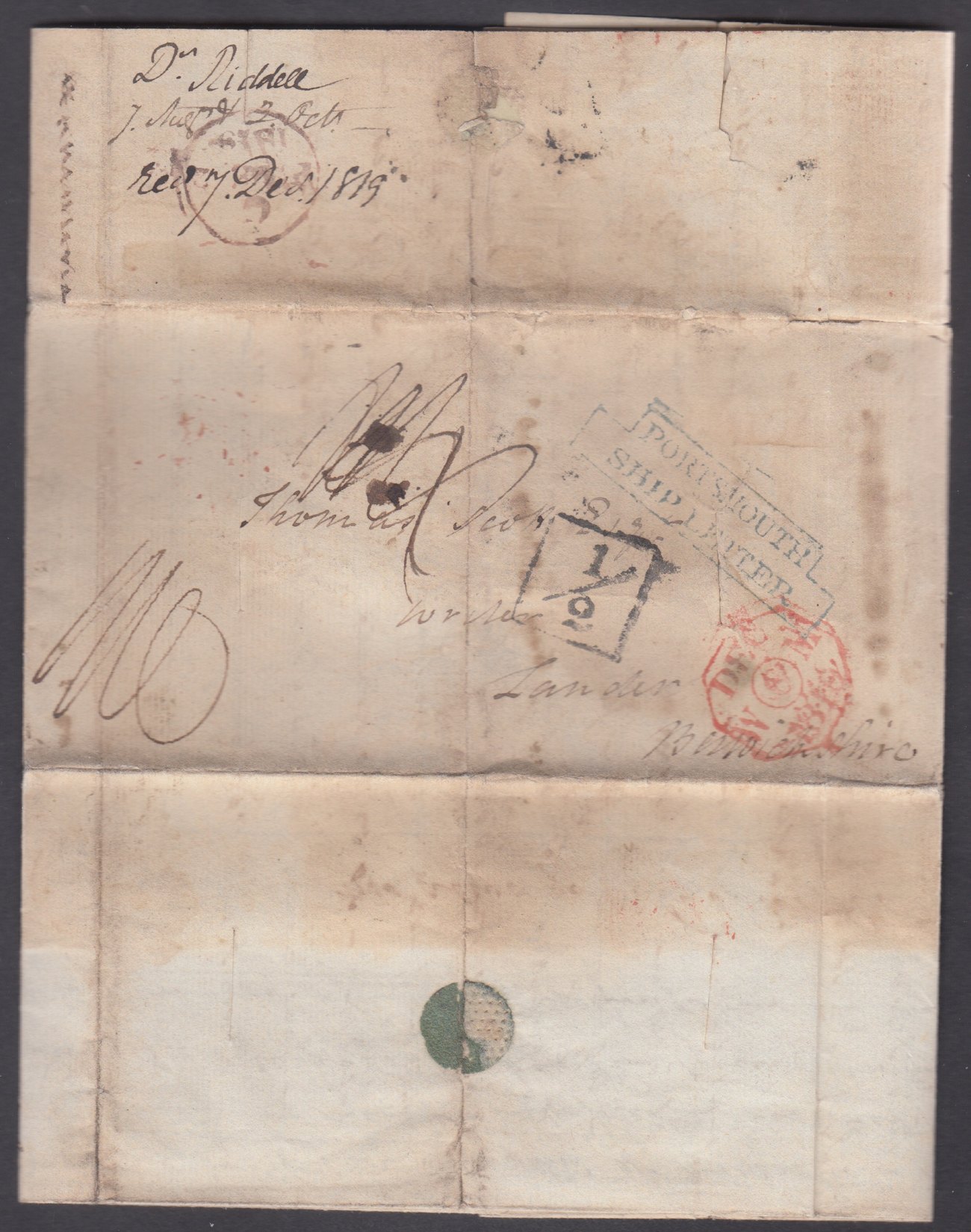
The outer sheet opened out: at top left Thomas Scott’s docket, Dr Riddell 7 Aug & 2 Oct, Recd 7 Dec 1819, written over a faint red circular datestamp; the address panel in the middle; at the foot a green wafer seal between two vertical slits cut through the paper, with brownish staining across the lower panels
Opened out: Scott’s docket, the seal and the two slits
  • Written aboard H.M.S. Euryalus, Bermuda, 7 August to 3 October 1819
  • From Dr Robert Riddell
  • To Thomas Scott Esq., Writer, Lauder, Berwickshire
  • Entry to the post boxed PORTSMOUTH / SHIP LETTER, blue-green
  • Disinfected two chisel slits and vinegar staining; quarantine at the Motherbank, off Ryde
  • On the way London, 2 December 1819 (back); Edinburgh, 6 December 1819 (front)
  • Charge 1/10 (ship letter fee 8d, inland 1s 2d for 474 miles), plus the Scottish additional halfpenny
  • Received Lauder, 7 December 1819

The letter is addressed to “Thomas Scott Esq., Writer, Lauder, Berwickshire”. A writer in Scotland is a solicitor, and Scott was also a friend who had lent Riddell money. A good part of the letter is Riddell settling up. He’d received Scott’s acknowledgement of earlier Navy Bills for £18 8s, enclosed another for £22 2s 3d, and promised the thirty shillings still owing would come by his sister at the end of the year. He thanks Scott for a loan that saved him “from the bitterest of all mortifications — that of asking a favour from a man to whom at that moment I would very unwillingly have been obliged.”

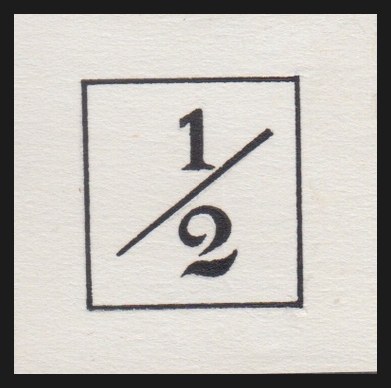
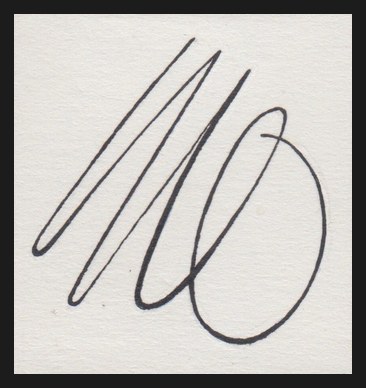
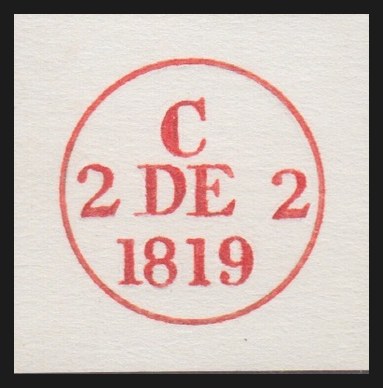
On the front are the marks of the journey home. The boxed PORTSMOUTH / SHIP LETTER in blue-green shows where it entered the British post. The red octagonal is Edinburgh, 6 December 1819. The boxed ½ is the Scottish additional halfpenny, and the big manuscript 1/10 is the charge. On the back, under Scott’s docket, is a red circular London datestamp of 2 December 1819.

Scott paid 1/10½ to receive it. That was the 8d fee for a ship letter landed in Britain, plus 1s 2d inland postage for the 474 miles from Portsmouth to Lauder, which comes to 1/10, and then the Scottish halfpenny on top.

Scott kept a careful note of it on the back: “Dr Riddell, 7 Aug & 2 Oct, Recd 7 Dec 1819.” The last entry in the letter itself is dated 3 October, so one of them is a day out, which hardly matters. The letter took four months from start to finish.

Opened out, you can see the two vertical slits either side of the green wafer seal. They were cut in quarantine so that the vinegar and smoke could get inside. More on that below.

The markings

The markings are faint on the entire, so these are shown as redrawn from the originals.

Redrawn marking: a stepped box in blue-green reading PORTSMOUTH, SHIP LETTER
PORTSMOUTH / SHIP LETTER, blue-green (front)
Redrawn marking: red octagonal datestamp reading DEC, W, 6 in a small circle, M, 1819
Edinburgh, 6 December 1819, red (front)
Redrawn marking: a black box containing the fraction one half
Scottish additional halfpenny (front)
Redrawn marking: the manuscript charge 1/10 in a large flowing hand
Charge 1/10, manuscript (front)
Redrawn marking: red circular datestamp reading C, 2 DE 2, 1819
London, 2 December 1819, red (back)
II

“The hottest place I believe next to hell itself”

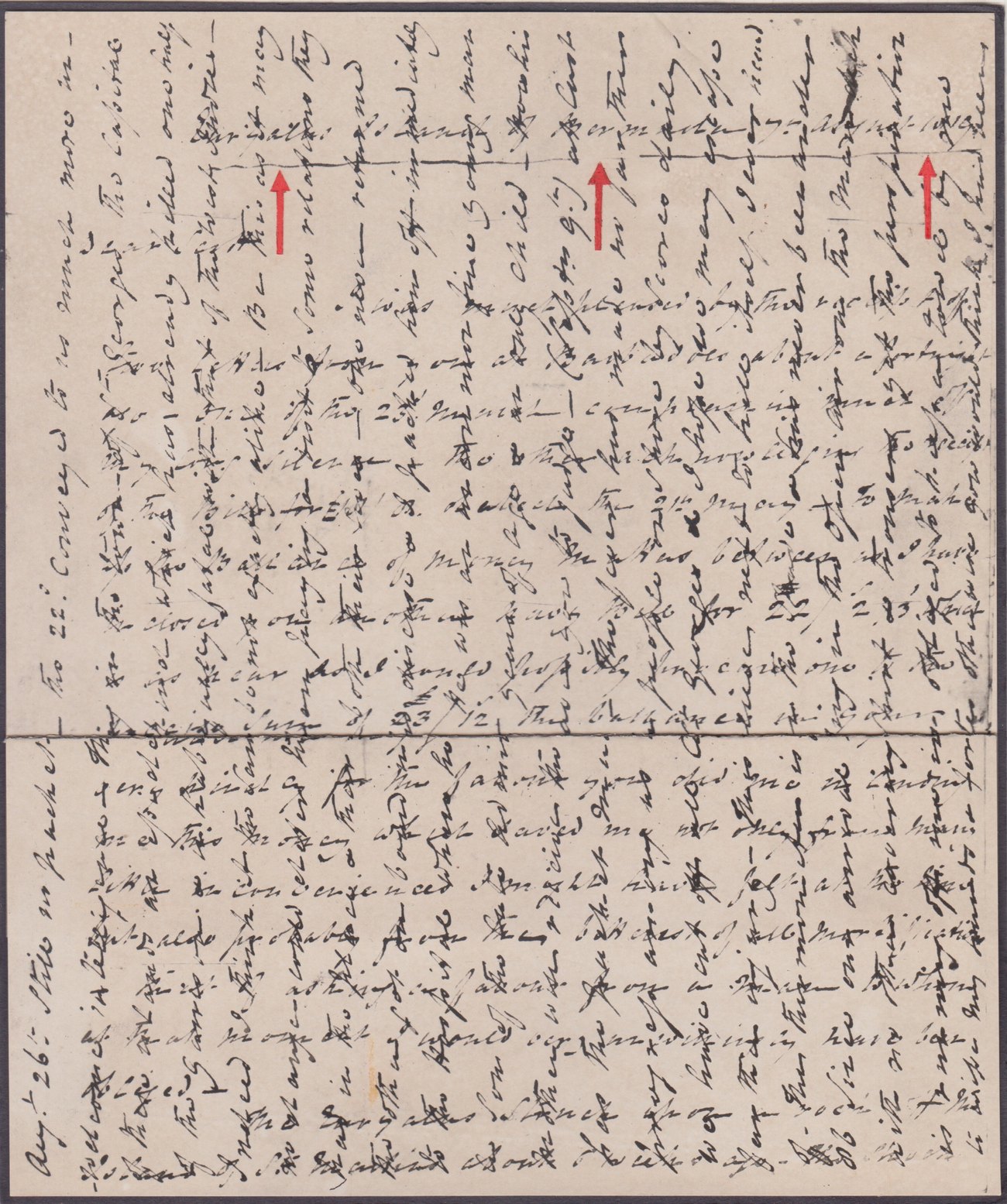
Photograph of the inside page of the letter, closely written in brown ink and then cross-written at right angles over the first lines, with red arrows added along the dateline Euryalus Island of Bermuda 7th August 1819
The inside page, cross-written. Photograph with arrows marking the dateline
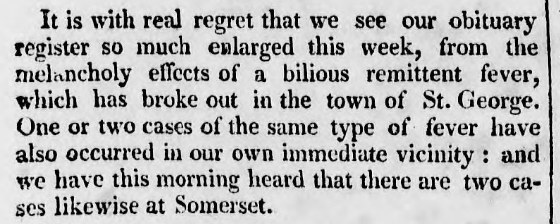
Bermuda Gazette: It is with real regret that we see our obituary register so much enlarged this week, from the melancholy effects of a bilious remittent fever, which has broke out in the town of St. George. One or two cases of the same type of fever have also occurred in our own immediate vicinity: and we have this morning heard that there are two cases likewise at Somerset
Bermuda Gazette, 21 August 1819: the fever breaks out at St. George’s
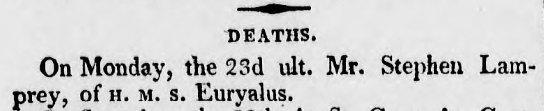
Bermuda Gazette, Deaths: On Monday, the 23d ult. Mr. Stephen Lamprey, of H.M.S. Euryalus
Bermuda Gazette, 4 September 1819: Stephen Lamprey
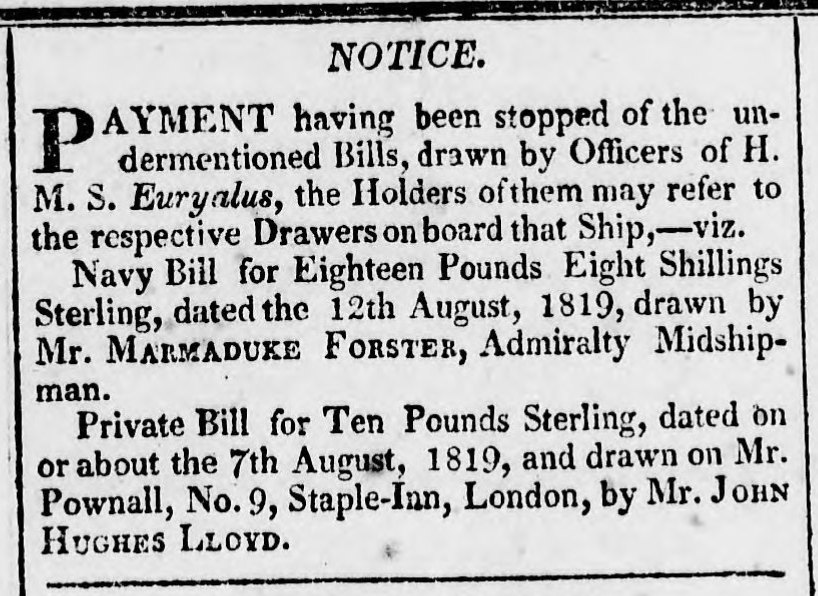
Bermuda Gazette notice: Payment having been stopped of the undermentioned Bills, drawn by Officers of H.M.S. Euryalus, the Holders of them may refer to the respective Drawers on board that Ship, viz. Navy Bill for Eighteen Pounds Eight Shillings Sterling, dated the 12th August, 1819, drawn by Mr. Marmaduke Forster, Admiralty Midshipman. Private Bill for Ten Pounds Sterling, dated on or about the 7th August, 1819, and drawn on Mr. Pownall, No. 9, Staple-Inn, London, by Mr. John Hughes Lloyd
Bermuda Gazette, 25 September 1819: bills stopped
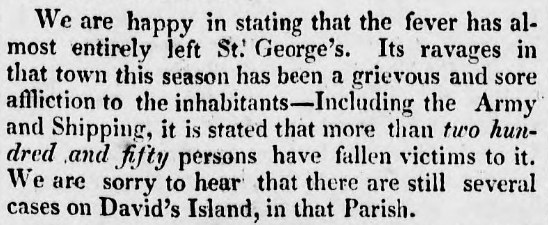
Bermuda Gazette: We are happy in stating that the fever has almost entirely left St. George’s. Its ravages in that town this season has been a grievous and sore affliction to the inhabitants. Including the Army and Shipping, it is stated that more than two hundred and fifty persons have fallen victims to it. We are sorry to hear that there are still several cases on David’s Island, in that Parish
Bermuda Gazette, 2 October 1819: “more than two hundred and fifty”
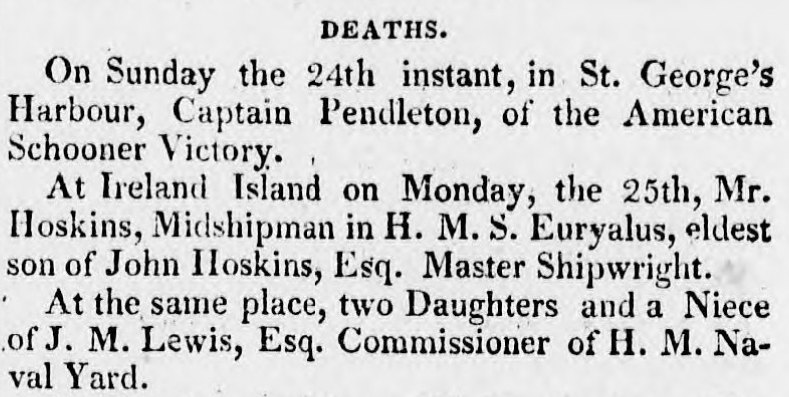
Bermuda Gazette, Deaths: On Sunday the 24th instant, in St. George’s Harbour, Captain Pendleton, of the American Schooner Victory. At Ireland Island on Monday, the 25th, Mr. Hoskins, Midshipman in H.M.S. Euryalus, eldest son of John Hoskins, Esq. Master Shipwright. At the same place, two Daughters and a Niece of J. M. Lewis, Esq. Commissioner of H.M. Naval Yard
Bermuda Gazette, 30 October 1819: Mr Hoskins, and the Commissioner’s family

Riddell wrote the letter in stages over two months, and it reads like a diary. Paper was precious and postage was charged by the sheet, so when he’d filled the page he turned it sideways and carried on across his own lines. Crossed writing like this is very hard to read until you get your eye in.

He starts with the ship’s news. “The Euryalus struck up on a rock off the Island of St. Martins about 6 weeks ago. The shock was not very great but it knocked away our rudder and otherwise damaged the bottom so much that it has been thought necessary to send us here for repairs.” They expected to be at Bermuda about two months, and he wasn’t sorry. Though it was “a miserable place to be at”, it was healthier and safer from hurricanes than the West Indies between July and October.

He was proud of the ship’s record: “Hitherto no ship could have been more healthy than the Euryalus. We have not lost a man either by damage or accident since the ship was commissioned.” Others hadn’t been so lucky. He tells how the Captain, Surgeon and Master of H.M.S. Raleigh spent a day ashore on the Roccas, off the coast of South America, pelting fish with stones and boat-hooks in the sun. The surgeon and two servants were dead within days, and Riddell had sat with the surgeon a few hours before he died.

Talking about his own work, he catches himself: “But I am getting quite in the shop with you — ‘Cackgers will be talking about cart saddles’.” That’s the old Scots saying that cadgers (pedlars) are always talking about cart-saddles, in other words, everyone talks shop.

Then the letter waits for the packet, which never comes. On 22 August there were signals from Government House. On 26 August he learned what they meant:

“There is at present raging in the town of St. Georges, the capital of these islands, an epidemic fever of the worst kind which has already killed one half of the Garrison and inhabitants.”

“One half” is Riddell’s figure, not a count. The Bermuda Gazette had first reported the outbreak on 21 August, as “a bilious remittent fever” in the town of St. George. On 2 October, as it was dying away, the paper put the toll at more than two hundred and fifty, counting the Army and the shipping. That was a terrible number for a small town, if a long way short of half, and there’s no doubting how frightening it was.

Two of the ship’s midshipmen went to visit relations in St. George’s, and “their imprudence cost them both their lives. One never returned, the other got on board in the incipient stage of his disease and I packed him off immediately to the hospital where he lived only 30 hours. He was an uncommon fine young man, a son of the late Admiral Loring, only twenty years of age and an only child. How his mother will receive the news of his death I leave you to judge.”

The Bermuda Gazette of 4 September recorded the death on Monday 23 August of Mr Stephen Lamprey of H.M.S. Euryalus. He was very probably the midshipman who never came back. After that the ship cut off all contact with St. George’s.

On 9 September the packet finally appeared, but on hearing of the fever her captain left without coming to anchor. “Now Lord knows when I shall have an opportunity of sending you this letter.”

By 3 October Riddell was in the Naval Hospital himself: “For a week I was madly delirious, nor is my head yet so clear as to enable me to give you a proper account of my complaints.” Then, almost in passing, comes the strangest part of the letter. While he lay delirious, a shipmate who had cheated him out of a doubloon at cards, thinking him dying, refused to pay the debt, and when Riddell held firm, “drew his Dirk to stab me. Before he could make the blow the First Lieutenant fortunately turned his arm on one side and I escaped — for that time — but the assassin is still in the ship and at large on board.”

Money and debts seem to have been a sore point in the gunroom that summer. On 25 September the Bermuda Gazette gave notice that payment had been stopped on two bills drawn by officers of the Euryalus: a Navy Bill for £18 8s by Marmaduke Forster, Admiralty Midshipman, and a private bill for £10 by John Hughes Lloyd.

Riddell asks Scott to send all his papers to his sister if he never hears from him again, and signs off: “So if ever you see me again in Scotland it will probably be in three months or never. Adieu.”

The fever wasn’t finished with the ship. On 25 October, three weeks after Riddell stopped writing, Mr Hoskins, a midshipman in the Euryalus and eldest son of John Hoskins, Master Shipwright, died at Ireland Island. The same notice records two daughters and a niece of J. M. Lewis, Commissioner of the Naval Yard.

I haven’t scanned the rest of the letter. It’s brittle and cross-written in both directions, and this photograph of the inside page shows well enough what it looks like.
III

Home by way of Portsmouth

Detail of the lower panels of the opened outer sheet, showing two thin vertical slits cut through the paper either side of the green wafer seal, with uneven brownish staining across the panels above
The two disinfection slits either side of the seal
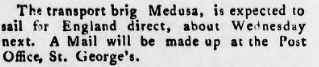
Bermuda Gazette: The transport brig Medusa, is expected to sail for England direct, about Wednesday next. A Mail will be made up at the Post Office, St. George’s
Bermuda Gazette, 9 October 1819
Bermuda Gazette: The Medusa, transport, sailed yesterday, (Oct. 15), for England. She took a Mail
Bermuda Gazette, 16 October 1819
  • Left Bermuda very probably in the transport brig Medusa, St. George’s, 15 October 1819
  • Landed Portsmouth, as a ship letter
  • Quarantine the Motherbank, off Ryde: slit, vinegar and smoke
  • London 2 December 1819
  • Edinburgh 6 December 1819
  • Lauder 7 December 1819

In the ordinary way, Riddell says, the mail from Bermuda “goes round by New York and Hallifax”. This letter didn’t. The packet never arrived, and on 3 October he wrote that “a vessel certainly sails from this place in a day or two for England — and is the first chance we have now.”

She was very probably the transport brig Medusa. The Bermuda Gazette of 2 October reported her arrival from England with Government stores and thirty or forty mechanics for the Dockyard at Ireland Island. A week later it announced that she was “expected to sail for England direct, about Wednesday next. A Mail will be made up at the Post Office, St. George’s.” Riddell’s “day or two” turned into twelve, as it often did with transports, and she sailed on Friday 15 October, taking a mail. None of the other ships clearing from St. George’s that month was bound for England. Nothing on the entire names her, so I can’t prove it, but she fits everything Riddell says.

She landed the letter at Portsmouth, where it entered the post as a ship letter. Coming from an island in the grip of yellow fever, it also had to pass through quarantine. Ships from infected ports were held at the Motherbank, an anchorage off Ryde on the Isle of Wight. Their letters were treated under the quarantine orders of the day, which set out the method: letters were cut so the cleansing could get inside, dipped in vinegar and dried in a smoking box.

This one shows the result: two widely spaced slits either side of the seal, and faint, uneven vinegar staining on the outer panels.

From Portsmouth it went up to London, where it was stamped on 2 December, then north to Edinburgh on the 6th, and Scott had it at Lauder on 7 December.

The Euryalus herself stayed in the West Indies. She was still at Bermuda in late October, when young Hoskins died, and on 18 November Captain Huskisson became senior officer in the Leeward Islands and hoisted his broad pendant in her.

Summer and autumn 1819

The ship on one side, the letter on the other.

The ship
The letter
Late June
The shipEuryalus strikes a rock off St Martin and loses her rudder.
7 Aug
The shipAt Bermuda for about two months’ repairs.
The letterRiddell begins his letter to Scott.
22 Aug
The letterStill no packet. Signals from Government House.
Mon 23 Aug
The shipMr Stephen Lamprey of the Euryalus dies.
26 Aug
The shipAdmiral Loring’s son dies in hospital. All contact with St. George’s cut off.
The letterRiddell writes of the fever raging at St. George’s.
9 Sep
The letterThe packet appears, but leaves without anchoring.
2 Oct
The letterThe transport brig Medusa arrives from England.
3 Oct
The letterRiddell finishes it in the Naval Hospital. A vessel is about to sail for England.
Fri 15 Oct
The letterMedusa sails for England with a mail, very probably carrying the letter.
Mon 25 Oct
The shipMidshipman Hoskins dies at Ireland Island. Euryalus still at Bermuda.
18 Nov
The shipCaptain Huskisson hoists his broad pendant in her in the Leeward Islands.
2 Dec
The letterLondon, after quarantine at the Motherbank.
6 Dec
The letterEdinburgh.
7 Dec
The letterReceived by Thomas Scott at Lauder.

The Ship

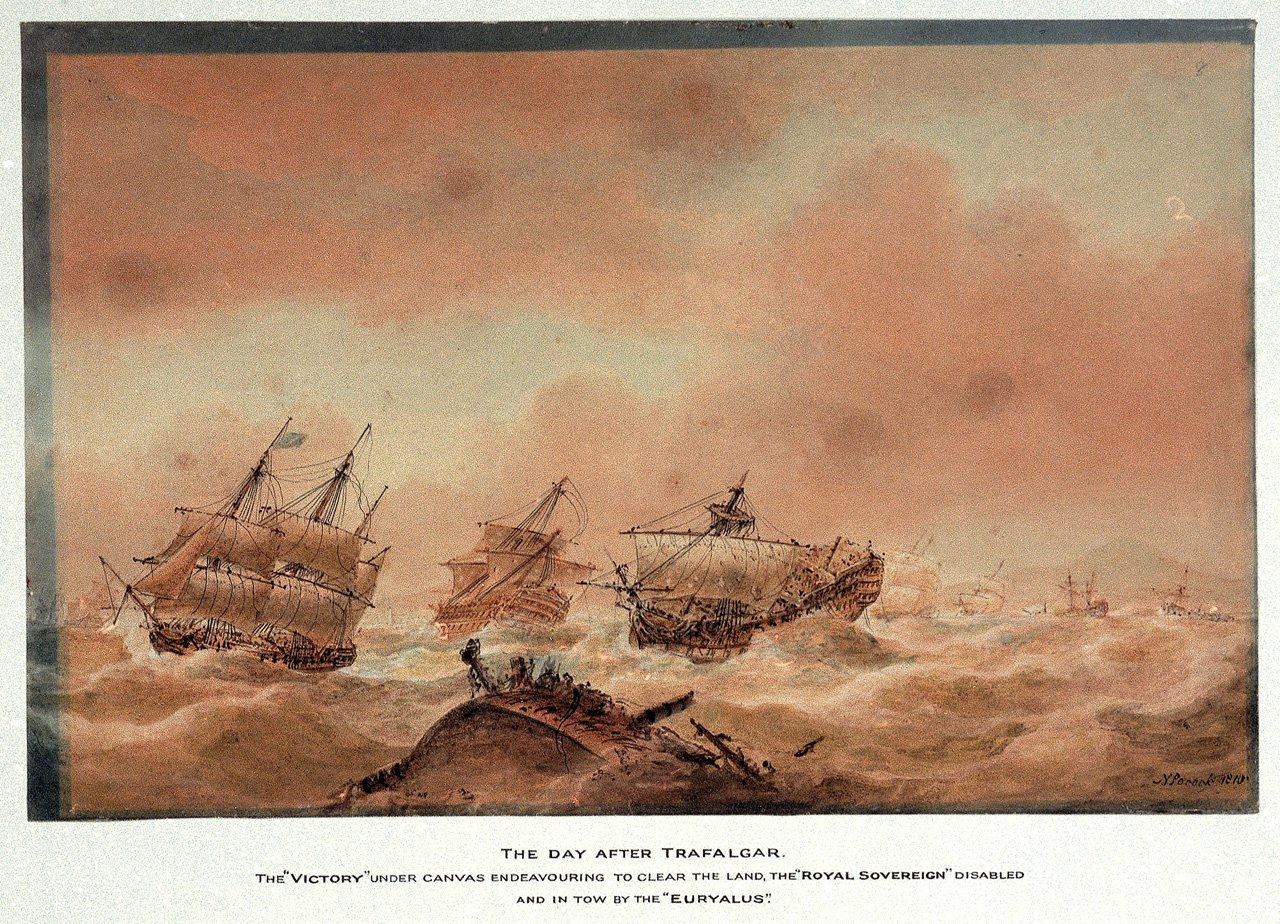
Watercolour by Nicholas Pocock of a storm at sea the day after Trafalgar: the frigate Euryalus towing the dismasted Royal Sovereign on a long line, with Victory under reduced sail beyond, heading towards the Spanish coast

H.M.S. Euryalus

Euryalus was a 36-gun Apollo-class frigate, built by the Adams yard at Buckler’s Hard and launched on 6 June 1803. Under Captain Henry Blackwood she watched the combined French and Spanish fleet out of Cádiz before Trafalgar. After Nelson was killed, Collingwood shifted his flag to her, and she towed the shattered Royal Sovereign clear of the battle. Pocock’s watercolour shows her doing it in the storm the next day. In the War of 1812 she served in the Chesapeake, and she came to Bermuda with a squadron from Gibraltar in June 1814.

Captain Thomas Huskisson took her out to the West Indies in August 1818, and that is where Riddell joined her story. On 18 November 1819, after the death of Rear-Admiral Donald Campbell, Huskisson became senior officer in the Leeward Islands with his broad pendant in Euryalus. In June 1820 he took over the Jamaica squadron as well when Sir Home Popham went home ill (Bermuda Gazette, 22 July 1820).

She paid off in 1825 and spent more than twenty years as a prison hulk at Chatham, at first for boys as young as nine. In 1847 she sailed for Gibraltar as a convict hulk. She was renamed Africa in 1859 and sold at Gibraltar for breaking up in 1860.

She isn’t the same ship as the armoured cruiser H.M.S. Euryalus of 1901, which has a page of its own.

BuiltBuckler’s Hard; launched 6 June 1803
TypeApollo-class fifth-rate frigate
Guns36
Captain, 1819Thomas Huskisson
FatePrison hulk from 1825; broken up at Gibraltar, 1860

“The day after Trafalgar”, Nicholas Pocock, 1810. National Maritime Museum, Greenwich, London (PAF5883).

Still to find out

If you can help with any of these, I’d be very pleased to hear from you.

Read the full transcription

Euryalus, Island of Bermuda 7th August 1819

Dear Scott:

I was most pleased by the receipt of two letters from you at Barbadoes about a fortnight ago — one of the 23 March complaining much of my long silence — the other acknowledging the receipt of the Bills for £18/8 dated the 21st May — to make up the ballance of money matters between us I have enclosed you another Navy Bill for £22/2/3 which is as near as I could possibly procure one to the precise sum of £23/12s the ballance in your favour — If I cannot find any means of sending you the thirty shillings which still remain over the amount of these two Bills, I do not think you will be broke by the want of it until my return to Scotland — but I will pay you if I can — so you may expect to have it remitted about the end of the year by my sister.

And now my good Sir let me thank you very kindly for the favour you did me in lending me this money which saved me not only from many bitter inconveniences I might have felt at the time but also probably from the bitterest of all mortifications — that of asking a favour from a man to whom at that moment I would very unwillingly have been obliged.

The Euryalus struck up on a rock off the Island of St. Martins about 6 weeks ago. The shock was not very great but it knocked away our rudder and otherwise damaged the bottom so much that it has been thought necessary to send us here for repairs. We shall probably be here two months at which I am not sorry for though this be a miserable place to be at, it is much more healthy and secure from hurricanes than the West Indies at this season of the year. From about the middle of July to the middle of October is the period when these visitations of tempest and sickness most frequently come to the West Indies Islands. I have no doubt this season will have elapsed before our return to Barbadoes. Hitherto no ship could have been more healthy than the Euryalus. We have not lost a man either by damage or accident since the ship was commissioned which is an instance of good health I have never before witnessed in this climate. But others have not been equally fortunate. The Captain, Surgeon and Master of the Raleigh attended by two servants went on shore lately at some small uninhabitated islands called the Roccas on the Coast of Spanish America. Finding a small shallow bay swarming with fish, they began pelting them with stones, boat-hooks, and every weapon they could collect fatiguing themselves considerably at this sport in the heat of the sun. The consequence of this imprudence was the death of the Surgeon and the two servants in a few days of the visit. The Master was saved by the breaking out of a rash all over his body as thick as measles which from the violent stinging sensation it creates upon the skin is in this country called the prickly heat and the Captain was afflicted with so violent a headache he was not considered free from danger for three weeks afterwards. I saw the Surgeon, poor fellow, a few hours before he died. He parted from life with great reluctance, after exclaiming to me as I supported him to take a drink “Ah Riddell, could I but recover this I would not remain a day longer in the West Indies”. It is particularly painful to look upon persons in the last stage of yellow fever. The features of this patient are often so terrible distorted the countenance altogether exhibits a picture of such deep distress and agony that few people can bear the sight without the greatest dismay. We have had some very smart attacks on Board the Euryalus but they have always been conquered in the first stage by large repeated bleeding — 50 or 60 ounces at once, and repeated in a few hours if the symptoms should not be overcome. But I am getting quite in the shop with you — “Cackgers will be talking about cart saddles”.

We were two months absent from Barbadoes which was the reason I got both your letters at the same time. Write me thither as soon as possible after you receive this for I shall be there before your letter can be and if I do not get it before we start it may probably be some months before it can catch me. As I said before I think it will be the middle of October before we get back to Barbadoes. But then we shall stay there probably only a day or two; therefore if you wish that I should not be very disappointed you will not fail to write upon receipt of this without delay. A vessel is now in sight which we take to be the Packet but as the mail from this place goes round by New York and Hallifax it will very likely be of an old date before it reaches you — my letter I mean. Remember me most kindly to Mrs. Scott and the young ones — and to my friends Landers. Mrs. L. from Musselburgh I suppose will be with you about this time. Have the goodness to remember me to her also and to all her family particularly my good friend Mary. I shall write no more at present until I see whether this be the Packet or not.

August 22nd. It is not the Packet nor has she yet made her appearance but I observe some signals this morning making from Government House which leads me to believe she is now in the offing.

August 26th: Still no Packet — The signals made on the 22nd conveyed to us much more unwelcome intelligence. There is at present raging in the town of St. Georges, the capital of these islands, an epidemic fever of the worst kind which has already killed one half of the Garrison and inhabitants. It is a fever equally fatal with that of the West Indies. Indeed I think it the same though the symptoms be not exactly alike. Be this as it may no danger could deter two of our Midshipmen from paying a visit to some relations they had in the place and their imprudence cost them both their lives. One never returned, the other got on board in the incipient stage of his disease and I packed him off immediately to the hospital where he lived only 30 hours. He was an uncommon fine young man, a son of the late Admiral Loring, only twenty years of age and an only child. How his mother will receive the news of his death I leave you to judge.

(September 9th) at last has the Packet made her appearance. The fever has made no further progress among us but it is killing the people on shore by scores daily. We have cut off all communication with St. Georges and I hope we may escape further injury. This is the hottest place I believe next to hell itself I ever heard of. The thermometer is frequently above 100 in the shade and has never been under 80. Since our arrival here — I am now sitting in the open air on the main deck with no other covering but a thin linnen shirt and trousers yet the perspiration is running off me in such streams I am obliged to have a towel by me to wipe my hands and forehead every five minutes otherwise you would think I had been blubbering. The night is most intolerable. Disappointed again Scott: No sooner did the Captain of this vessel hear of this terrible fever then he determined to be off without coming to anchor. Now Lord knows when I shall have an opportunity of sending you this letter. However, the vessel I now hear is only going to sea until the mails are ready.

October 3rd — Alas! Scott, this letter has had a very narrow chance of ever being finished by me. I am now in the Naval Hospital here reduced to the very last stage of weakness. For a week I was madly delirious, nor is my head yet so clear as to enable me to give you a proper account of my complaints. Would you think it in human nature that while this delirium still hung about me a wretch who had cheated me out of a doubloon sometime before at cards, thinking me dying reject the payment of his debt with great obstinacy and upon my refusing with equal firmness drew his Dirk to stab me. Before he could make the blow the First Lieutenant fortunately turned his arm on one side and I escaped — for that time — but the assassin is still in the ship and at large on board so that I think it’s a chance that I may sustain another attack being an old hand at this kind of work and a most determined character.

A vessel certainly sails from this place in a day or two for England — and is the first chance we have now. The Packet never arrived. If you never hear from me again have the goodness to send all my papers to my sister. I pray you don’t neglect this. I find it will now be very inconvenient to send you the bill I proposed as it is my only stand by in case I am invalided at Barbadoes and it is my determined purpose to do so in case I do not find my health completely restored. So if ever you see me again in Scotland it will probably be in three months or never. Adieu.

Many kind regards to Mrs. Scott and family not forgetting the Miss Landers.

Yours always Robert Riddell

Provenance and references

One sheet of paper, written over two months, and in it a damaged ship, an epidemic, a dead boy’s mother, a knife and a man who wasn’t sure he’d live to finish writing. I still find it remarkable that it survived the voyage, the quarantine and two hundred years to reach me.