Postal History · War of 1812 · Bermuda Station

H.M.S. Espoir

Halifax · Bermuda · March–June 1814

A father’s letter to his son at the Victualling Office, carried to Bermuda by the brig-sloop Espoir.

◆

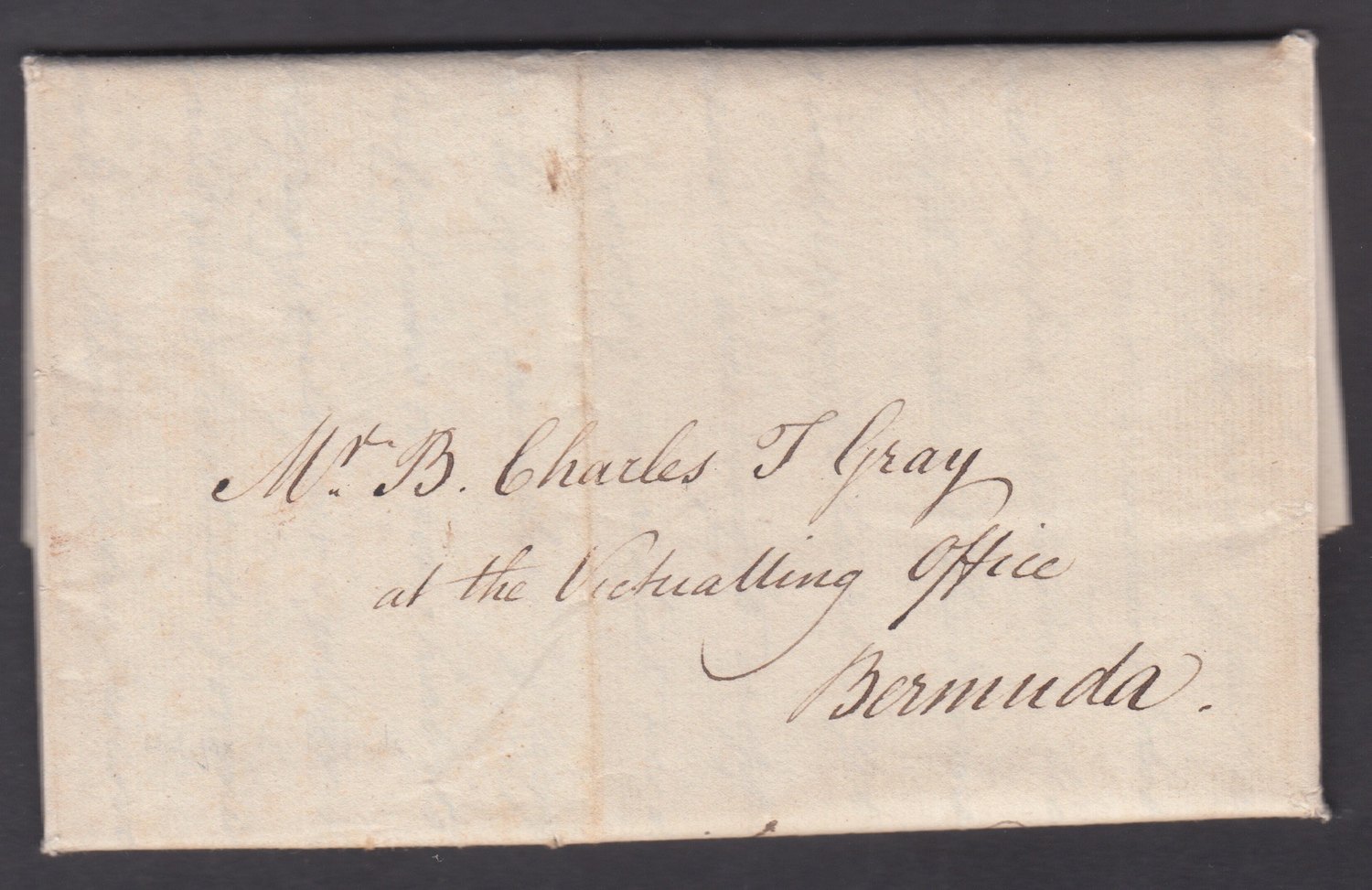
This is the earliest piece in my naval section that came in to Bermuda rather than going out. It’s an entire from Halifax, addressed to “Mr B. Charles J. Gray at the Victualling Office, Bermuda”, and on the back the young man noted when it came and how: “Received p Espoir – 13 June”. Inside are five closely written pages from his father, full of advice about money, religion, books and how to hold his own in company. Squeezed in at the end is the news that “Boney” was at the last gasp.

I

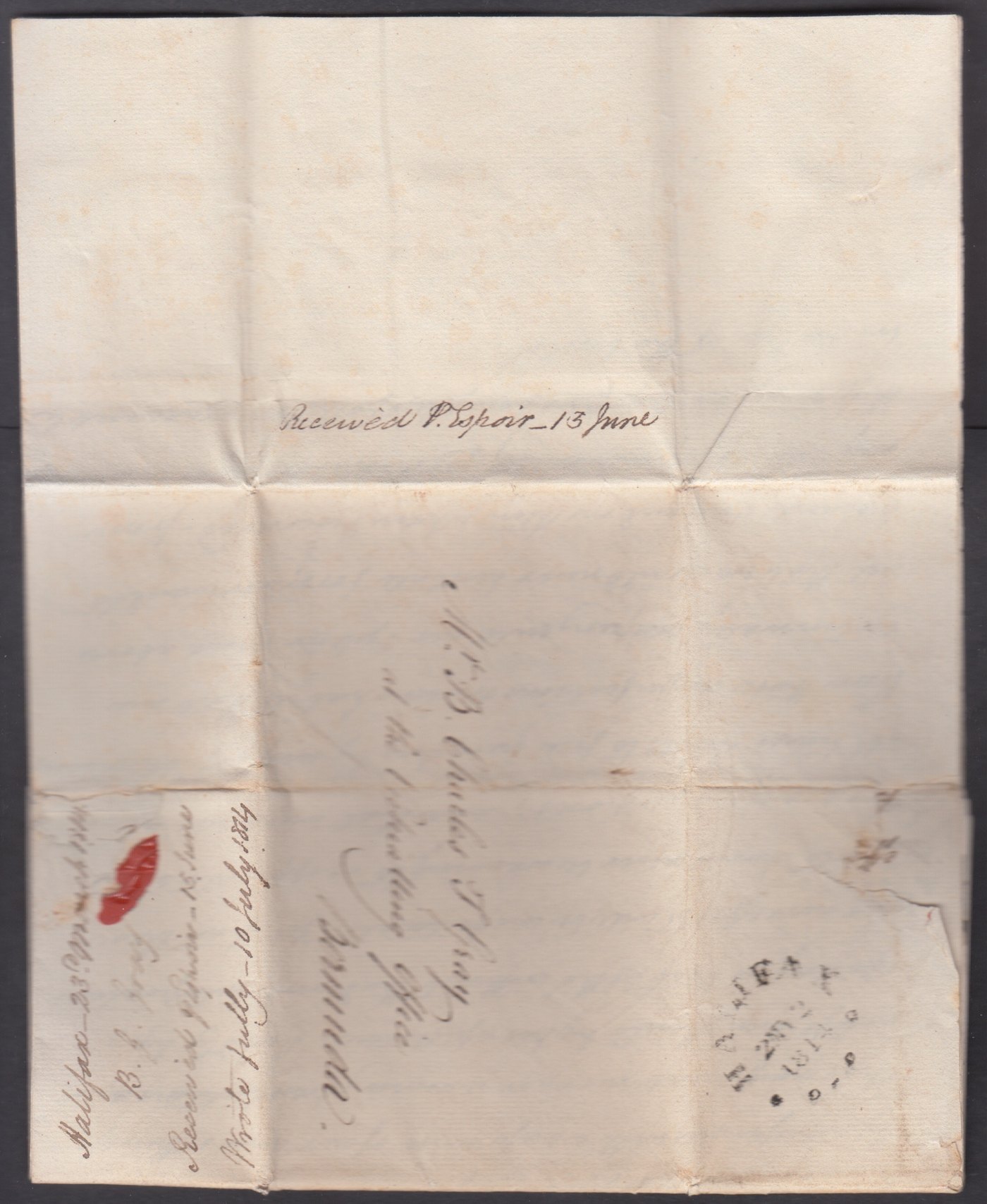
“Received p Espoir – 13 June”

Folded entire addressed in ink to Mr B. Charles J. Gray, at the Victualling Office, Bermuda
The entire folded, addressed to Mr B. Charles J. Gray
The outer sheet opened out, with Received p. Espoir 13 June across the top panel, a docket and red wax seal at lower left, and a black HALIFAX circular datestamp at lower right
The outer sheet opened out: “Received p. Espoir”, the docket, the seal and the HALIFAX datestamp
  • Item Entire: outer address sheet with the letter inside
  • From B. G. Gray, Halifax, Nova Scotia
  • To Mr B. Charles J. Gray, Victualling Office, Bermuda
  • Written 23 March 1814, P.S. 24 March
  • Postmark HALIFAX 2 MY 1814, black
  • Carried by H.M.S. Espoir
  • Received 13 June 1814
  • Answered 10 July 1814

The front is just the address, in a good clear hand. Opened out, the back has a black HALIFAX datestamp of 2 May 1814, a red wax seal and two notes by the recipient. Across the top he wrote “Received p. Espoir – 13 June”, and down the left-hand panel he docketed it the way a clerk files his letters:

“Halifax – 23d March 1814 / B. G. Gray / Received p Espoir – 13 June / Wrote fully – 10 July 1814.”

That gives the whole life of the letter. It was written on Wednesday 23 March, with a postscript the next morning (“Thursday 24th”, and 24 March 1814 was indeed a Thursday). It wasn’t stamped at Halifax until 2 May, nearly six weeks later, and it was in Charles’s hands at Bermuda on 13 June, almost twelve weeks after his father wrote it. He replied, “fully”, on 10 July.

During the war there were no ordinary sailings between Halifax and Bermuda. The mail went by whatever naval vessel was going, so a letter could sit until one was. This one came in the brig-sloop Espoir. I can’t yet say why it waited so long at Halifax before it started.
II

“Your truly affectionate Father”

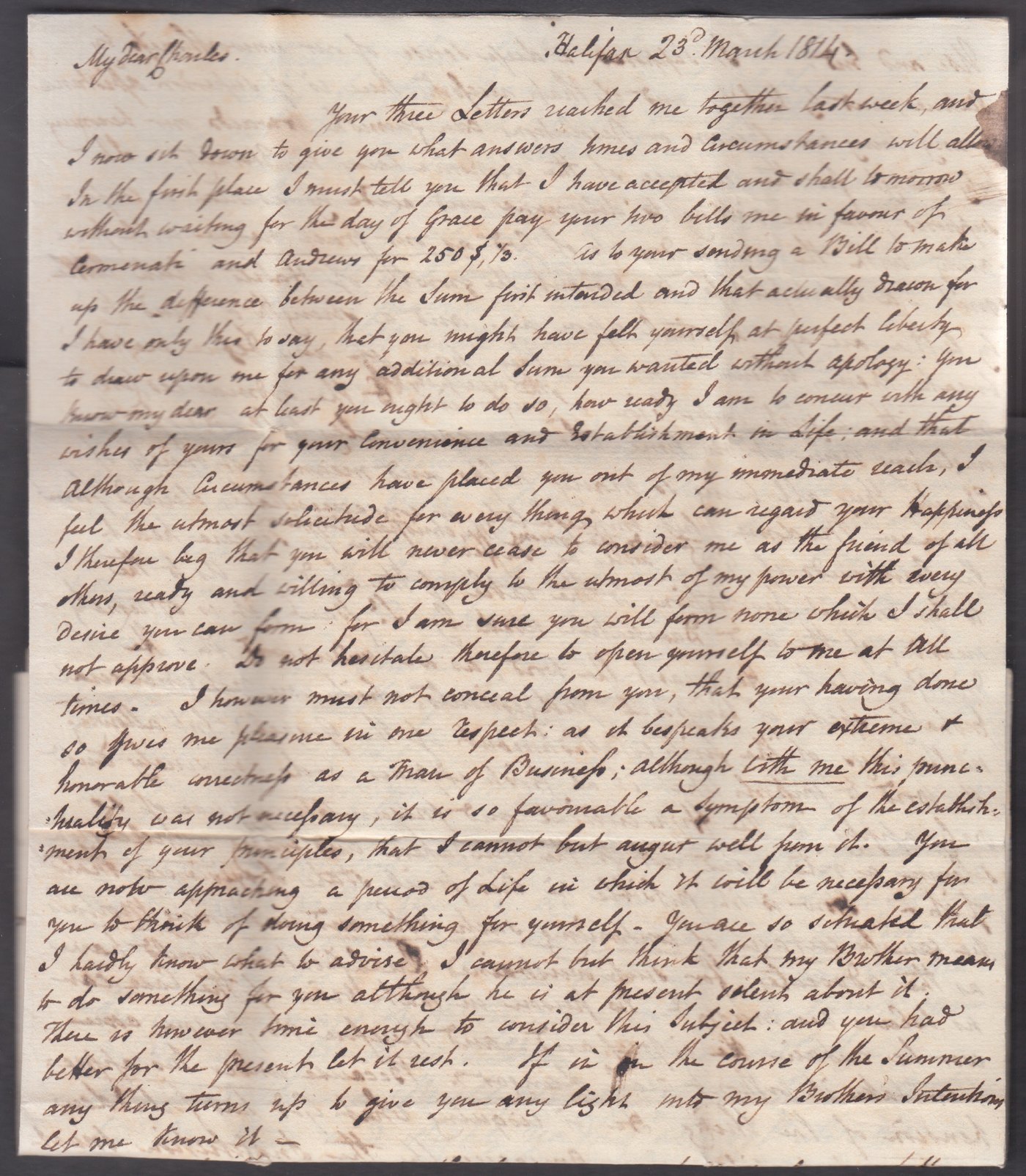
First page of the letter, headed Halifax 23d March 1814 and beginning My Dear Charles, Your three Letters reached me together last week
Page one: “My Dear Charles”, Halifax, 23 March 1814
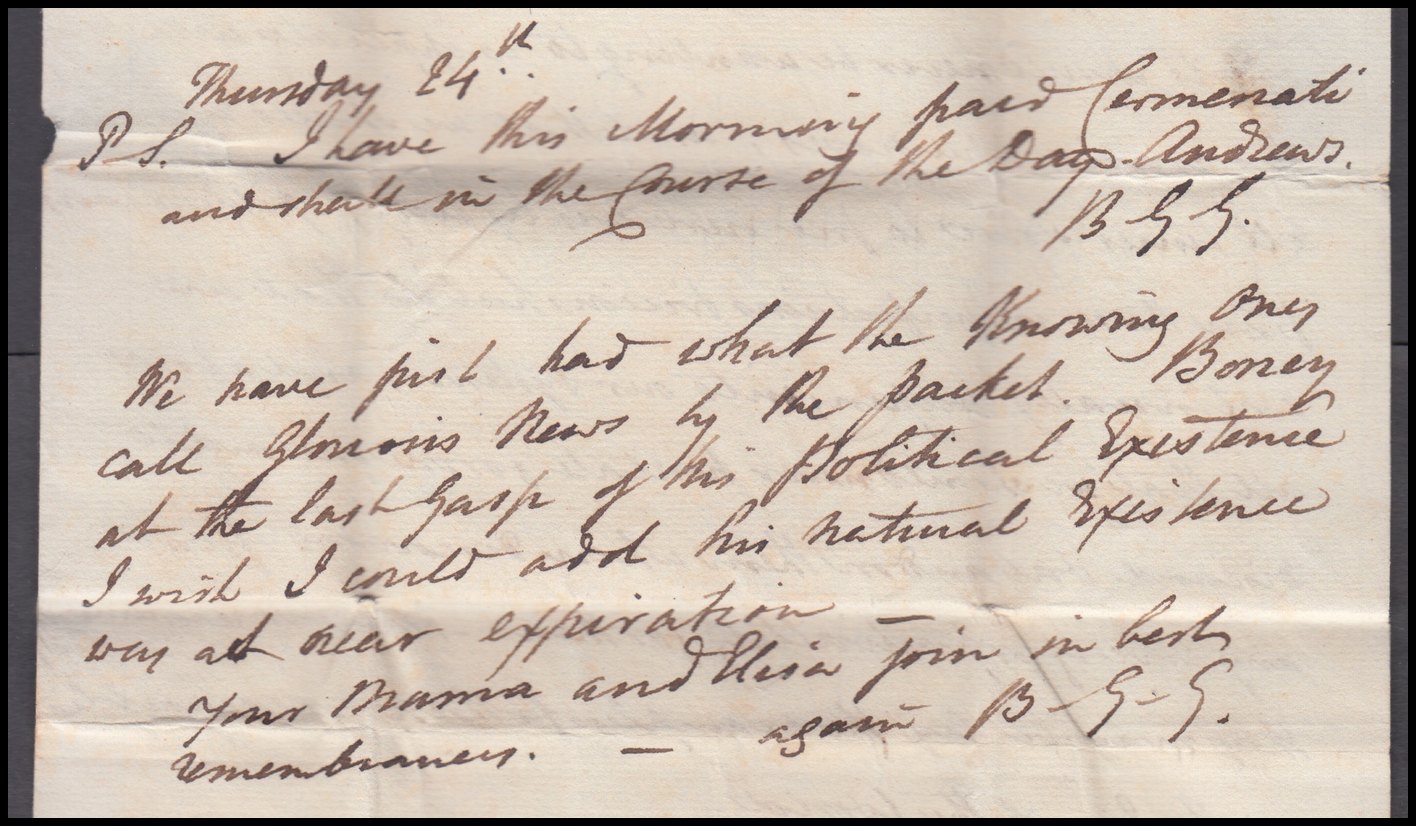
The postscript dated Thursday 24th, reporting payment of Cermenati, the Glorious News by the packet that Boney was at the last gasp of his political existence, and remembrances from Mama and Elisa, initialled B.G.G.
The P.S., Thursday 24 March: “Boney at the last Gasp”
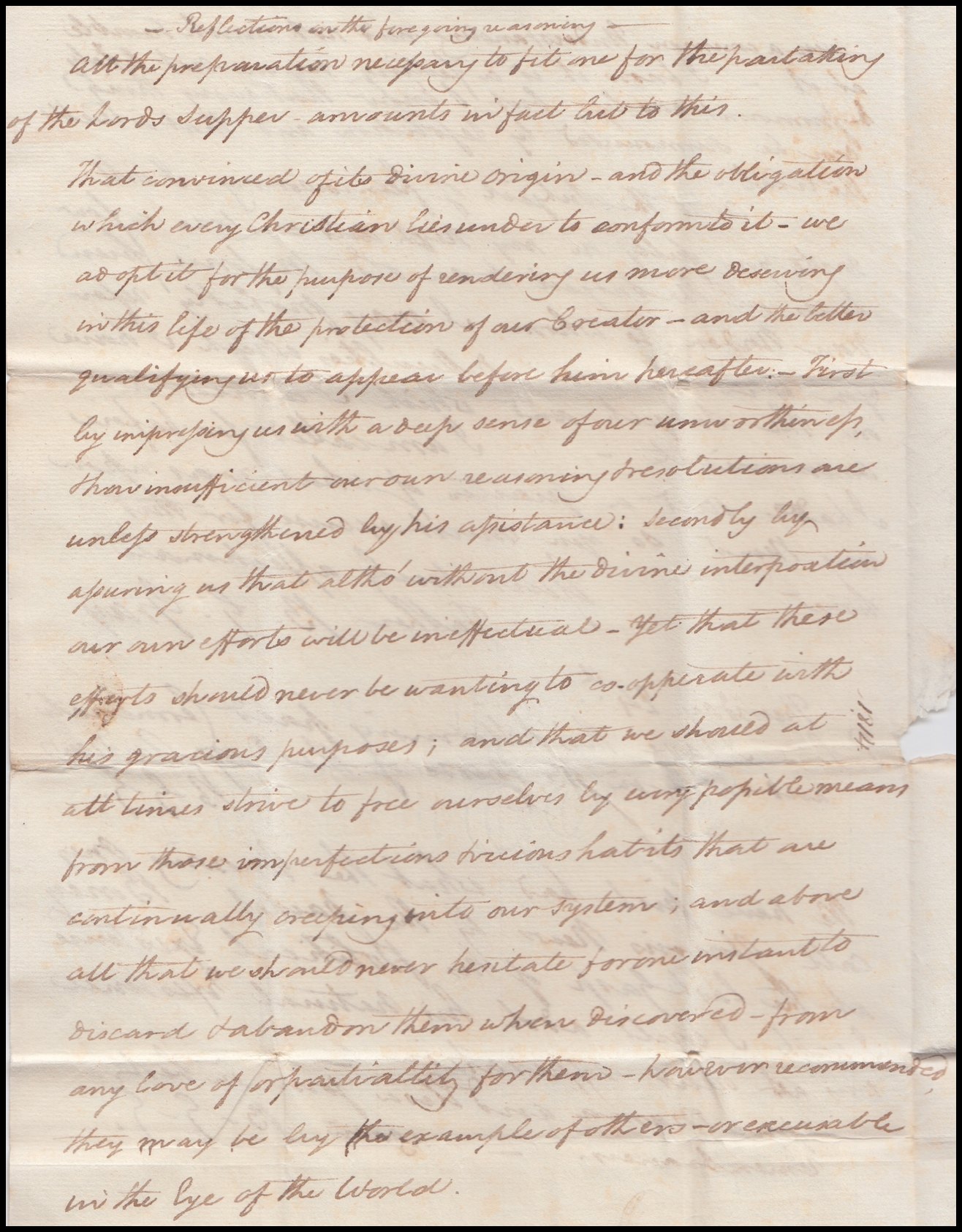
The blank back of the letter’s last page, written over in a different, rounder hand, headed Reflections on the foregoing reasoning, on preparing for the Lord's Supper, with 1814 written in the margin
“Reflections on the foregoing reasoning”, written on the blank back of the letter’s last page, perhaps in Charles’s hand

It opens “My Dear Charles”, and then with business: “Your three Letters reached me together last week”. That alone says something about the wartime mails. His father had accepted two bills Charles had drawn on him, “in favour of Cermenati and Andrews”, and would pay them “without waiting for the day of Grace”. He tells him he needn’t apologise for drawing more, though he’s quietly pleased he did, “as it bespeaks your extreme & honorable correctness as a Man of Business”.

Then the family question: “I cannot but think that my Brother means to do something for you although he is at present silent about it.”

Most of the letter is a careful answer to his son’s worries about taking Holy Communion for the first time, with a promise to send “Dr. Hammonds Catechism”. After that comes a reading list: Grotius on the truth of the Christian religion, the Spectator, Knox, some English essayists, and Euclid, “particularly as you made such real progress in it while with me”. There’s gentle advice for a shy young man too: “Do not let the idea that you are a Cypher in Society cramp your efforts”. He promises to write “fully in my next” about Freemasonry, and to put Charles in touch with “an old Masonic friend Van Norden”.

Then he was interrupted: “I am called for before I have said a quarter of what was upon my Mind”. He signed it “Your truly affectionate Father B. G. Gray”. The next morning he added that he had paid Cermenati and would pay Andrews in the course of the day, and then:

“We have just had what the Knowing Ones call Glorious News by the packet. Boney at the last Gasp of his Political Existence. I wish I could add his natural Existence was at near expiration.”

Within a week the Allies were in Paris, though neither of them could have known that. “Your Mama and Elisa join in best remembrances,” he finished, initialling it “B.G.G.” once more.

On the back of the letter’s last page, left blank by his father, someone has written a short piece in a different, rounder hand, headed “Reflections on the foregoing reasoning”. It’s about preparing for the Lord’s Supper, written in the first person: “all the preparation necessary to fit me for the partaking of the Lords Supper amounts in fact but to this”. It picks up his father’s own words about “our unworthiness” and the habits that creep in, and as it’s written on the letter itself, I think it’s most likely Charles’s own reply to his thoughts.

III

The Grays of Halifax and Bermuda

I think “B. G. Gray” is the Reverend Benjamin Gerrish Gray (1768–1854), a Church of England clergyman at Halifax. He came from a Loyalist Boston family and had been grand chaplain of the Freemasons’ provincial grand lodge in Halifax, which would explain the paragraph about Freemasonry. The whole tone of the letter fits a clergyman. His son John William Dering Gray, born in 1797, also went into the Church, and I suspect he is “your Brother”, the one destined for “that train and course of improvements” that Charles had been separated from. The Dictionary of Canadian Biography gives B. G. Gray only one son, so if I’m right, this letter says otherwise.

And “my Brother”? A William Gray, son of the Loyalist Joseph Gray of Boston and Halifax, was the naval commissary at Bermuda, and later British consul at Norfolk, Virginia, from 1819 to 1845. His own son, John Hamilton Gray, was born at St George’s in 1814. If William was B. G.’s brother, then Charles was working at the Victualling Office under his uncle: “it is perhaps for the best that providence threw you under such excellent protection”. I can’t prove the link yet; that’s a guess for now.

December 1813 to July 1814

The ship on one side, the letter on the other.

The ship
The letter
2 Dec 1813
The shipSchetky sketches Espoir going into Portsmouth harbour.
Wed 23 Mar
The letterB. G. Gray writes to Charles from Halifax.
Thu 24 Mar
The letterThe P.S.: Cermenati paid, and “Boney at the last Gasp”.
2 May
The letterHALIFAX datestamp.
13 Jun
The shipEspoir at Bermuda.
The letter“Received p Espoir”.
10 Jul
The letterCharles “Wrote fully” in reply.
Aug 1814
The shipEspoir in the Chesapeake, in the operations against Washington and Baltimore.

The Ship

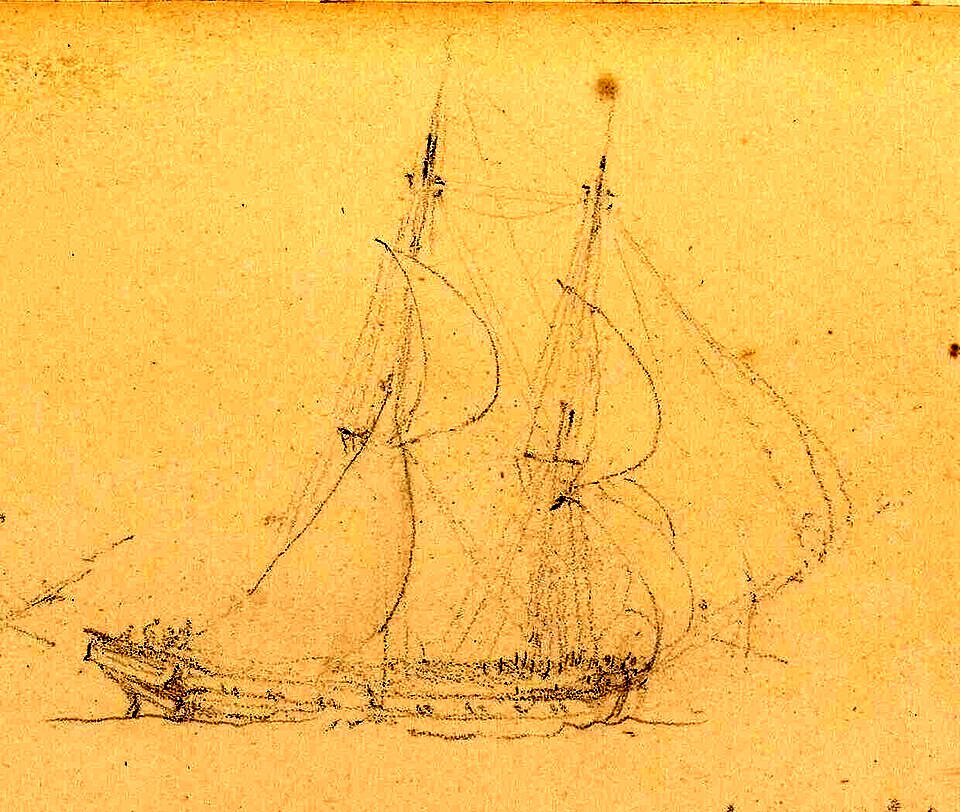
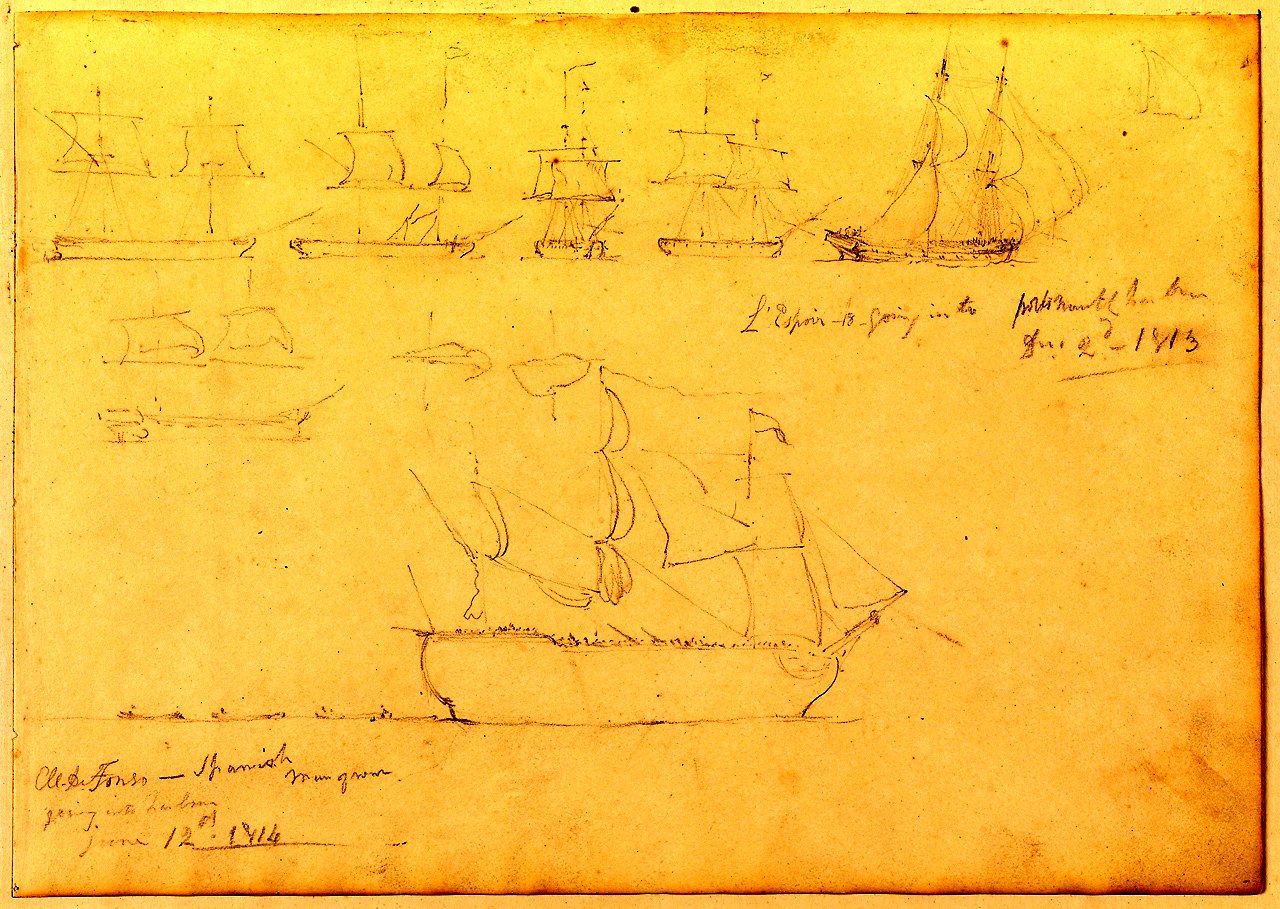
Pencil sketch by John Christian Schetky of the brig-sloop Espoir under sail, going into Portsmouth harbour, 2 December 1813

H.M.S. Espoir

HMS Espoir was a Cruizer-class brig-sloop of 18 guns, built by John King at Dover and launched on 22 September 1804. She spent most of her career in the Mediterranean. In 1814, under Commander Norwich Duff, she came out to the North American station and served in the operations against Washington, Baltimore and New Orleans. In June 1815 she sailed from Bermuda to Halifax with the flagship, and in 1816 she carried Bermuda’s governor, Sir James Cockburn, home to Portsmouth. She was paid off that October and broken up in April 1821.

The marine artist John Christian Schetky sketched her going into Portsmouth harbour on 2 December 1813, just months before she crossed the Atlantic. His note on the sheet reads “L’Espoir – 18 going into Portsmouth harbour / Dr. 2d – 1813”; the 18 is her guns.

BuiltJohn King, Dover, launched 22 September 1804
TypeCruizer-class brig-sloop, 385 tons
Guns16 × 32-pdr carronades, 2 × 6-pdrs
Commander, 1814Norwich Duff
FatePaid off 1816; broken up, April 1821

John Christian Schetky, 1813. National Maritime Museum, Greenwich (PAH3793), via Wikimedia Commons.

Schetky's page of slight sketches of fighting vessels, with Espoir at upper right inscribed L'Espoir 18 going into Portsmouth harbour Dr 2d 1813, and a Spanish man of war, Al de Fonso, lower left dated June 12th 1814
Schetky’s whole sheet, with Espoir at upper right

Still to find out

If you can help with any of these, I’d be very pleased to hear from you.

References

He was a father who worried about a shy son a long way from home, and wrote five pages before he was called away. I like that we also have Charles’s side of it on the back: when it came, which ship brought it, and that he “wrote fully” in reply. I’d love to find that reply.