Postal History · Ship Letter · Bermuda Station

H.M.S. President

Bermuda · 3 February 1836

A letter from the flagship, carried home by the ship’s own surgeon in the brig Serpent.

◆

This is a letter from a flagship. It’s headed “H M Ship President, Bermuda Feby 3rd 1836”, when President was flying the flag of Vice-Admiral Sir George Cockburn, Commander-in-Chief on the North America and West Indies station. It was written by a young man named Cochrane to his sister Mary in Edinburgh.

It didn’t go home in President, and it didn’t go through the Bermuda post office either, even though the post office was advertising for letters by the same ship that very week. He gave it to the ship’s assistant surgeon, Dr Alfred Tucker, who was sailing for England the next morning in the brig Serpent. Tucker handed it in at Portsmouth, and it went on to Edinburgh as a ship letter. I like it because it shows how a letter really got home from Bermuda in the 1830s: you found someone who was going.

I

“H M Ship President, Bermuda”

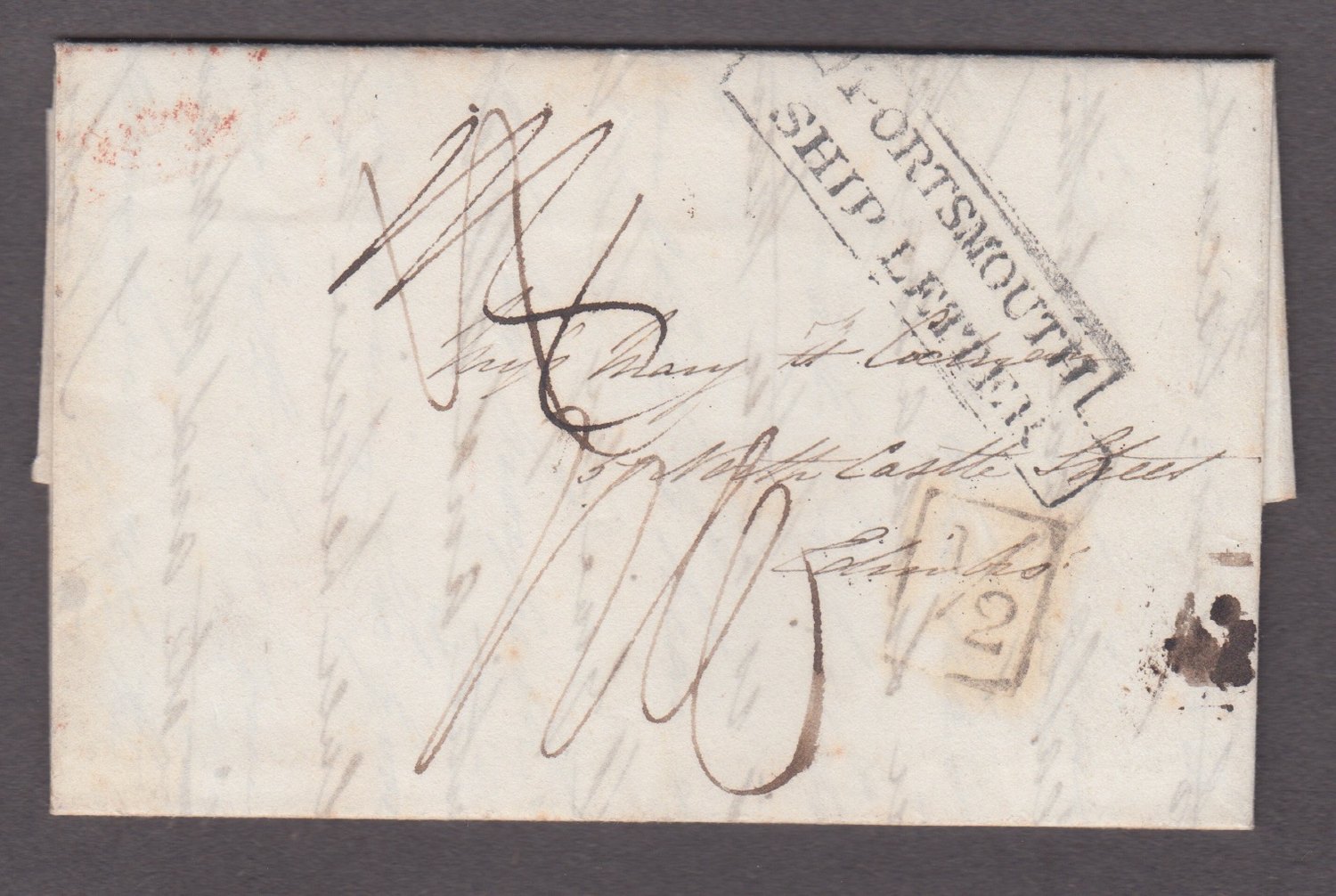
The entire folded, addressed to Miss Mary H. Cochrane, 5 North Castle Street, Edinburgh, with a black boxed PORTSMOUTH SHIP LETTER handstamp, a boxed half for the Scottish additional halfpenny, the manuscript charge 1/10 and an earlier 1/4 struck through
The entire folded: PORTSMOUTH SHIP LETTER, the 1/10 charge and the boxed ½
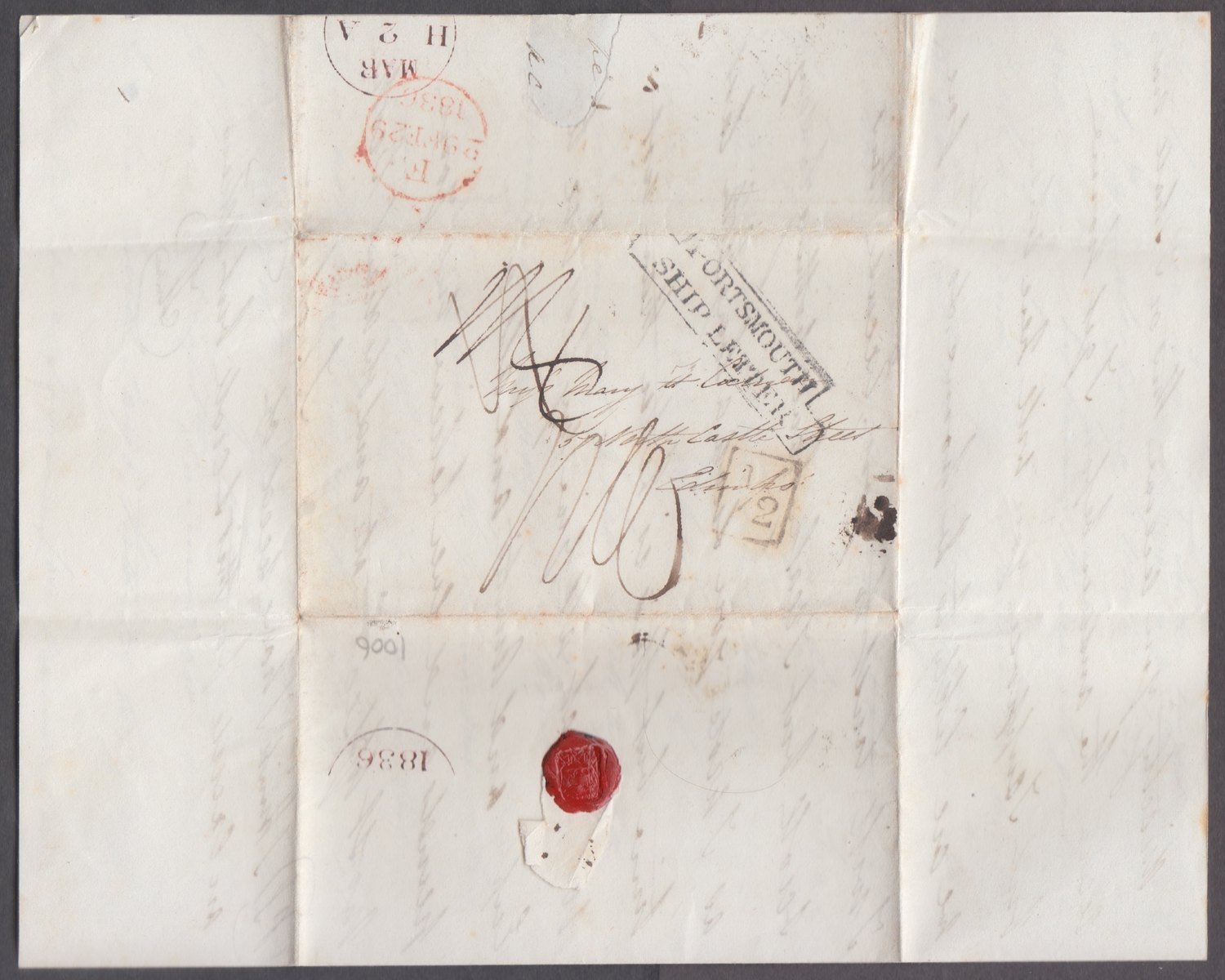
The outer sheet opened out flat, showing the address panel, a red London datestamp of 29 February 1836 and a black arrival datestamp of 2 March 1836, and the red wax seal
The outer sheet opened out, with the backstamps and the red wax seal
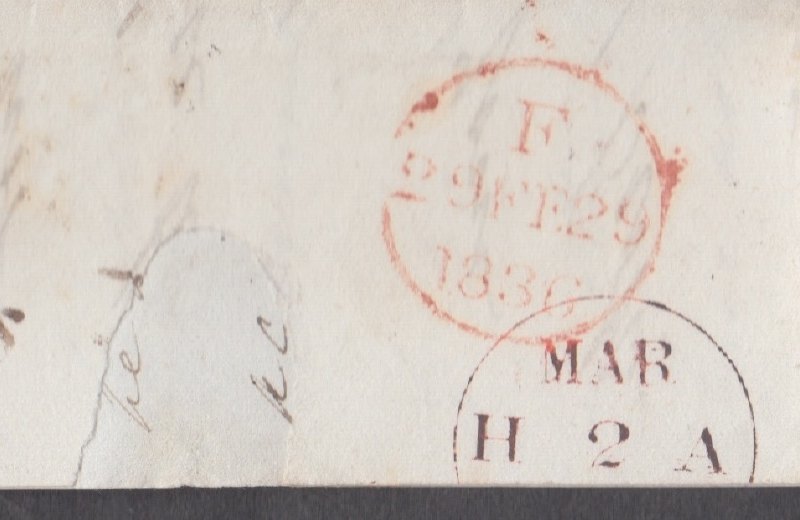
Close-up of the backstamps: a red circular F 29 FE 29 1836 London datestamp and a black MAR H 2 A arrival datestamp
London, 29 February 1836 (a leap day), and the arrival stamp of 2 March
  • Written H M Ship President, Bermuda, 3 February 1836
  • Writer Mary’s brother, who signs himself Cochrane. I can’t read his first initial with confidence.
  • Carried by Assistant Surgeon Alfred Tucker RN, going home in HM Brig Serpent, which sailed on 4 February
  • Bermuda markings none
  • Entry to the post boxed PORTSMOUTH / SHIP LETTER in black
  • Charges 1/4 struck through, then 1/10 (8d ship letter plus 1s 2d inland), with a boxed ½ for the Scottish additional halfpenny: 1s 10½d due
  • Transit red London datestamp, F 29 FE 29 1836
  • Arrival black MAR 2 1836, struck across the fold, probably Edinburgh
  • Addressed to Miss Mary H. Cochrane, 5 North Castle Street, “Edinbro’”

It’s an entire: a single sheet written on three sides, then folded to make its own cover and closed with a red wax seal. It’s addressed to Miss Mary H. Cochrane at 5 North Castle Street, Edinburgh. A big X charge mark runs through her surname, but her brother signs the letter “Cochrane” quite clearly, so there’s no doubt about it.

There’s no Bermuda marking anywhere on it, and that’s the first clue to the story. The first postal marking it received was in England.

One small thing to watch for in the Royal Gazette that January: it also reports the American schooner President, which put into St George’s in distress and was condemned and sold. She has nothing to do with this letter.
II

Home in the Serpent

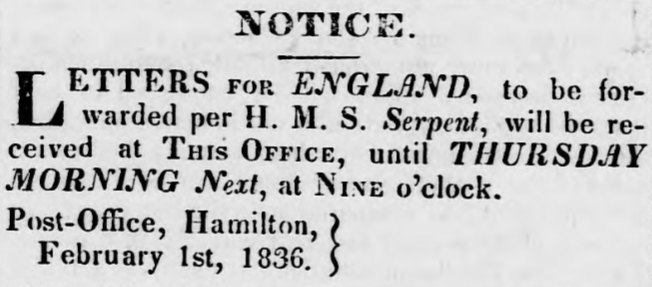
Notice: Letters for England, to be forwarded per H.M.S. Serpent, will be received at this office until Thursday morning next, at nine o'clock. Post-Office, Hamilton, February 1st, 1836
Royal Gazette, 2 February 1836: letters for England per H.M.S. Serpent
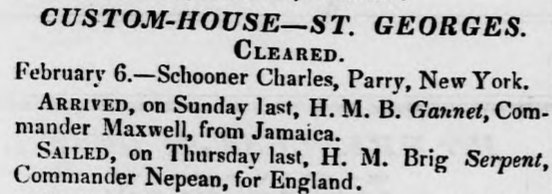
Custom-House, St Georges: arrived on Sunday last H.M.B. Gannet from Jamaica; sailed on Thursday last H.M. Brig Serpent, Commander Nepean, for England
Royal Gazette, 9 February 1836: Serpent sails for England

Serpent was a 16-gun brig-sloop, built at Limehouse in 1832 and commanded by Commander Evan Nepean. She’d had a lively December. On her way from Bermuda to Havana she called at Nassau, and while she was there she helped capture an American brig full of “soldiers of fortune” bound for Texas. She came back to Bermuda from Nassau on Saturday 30 January, under orders for home.

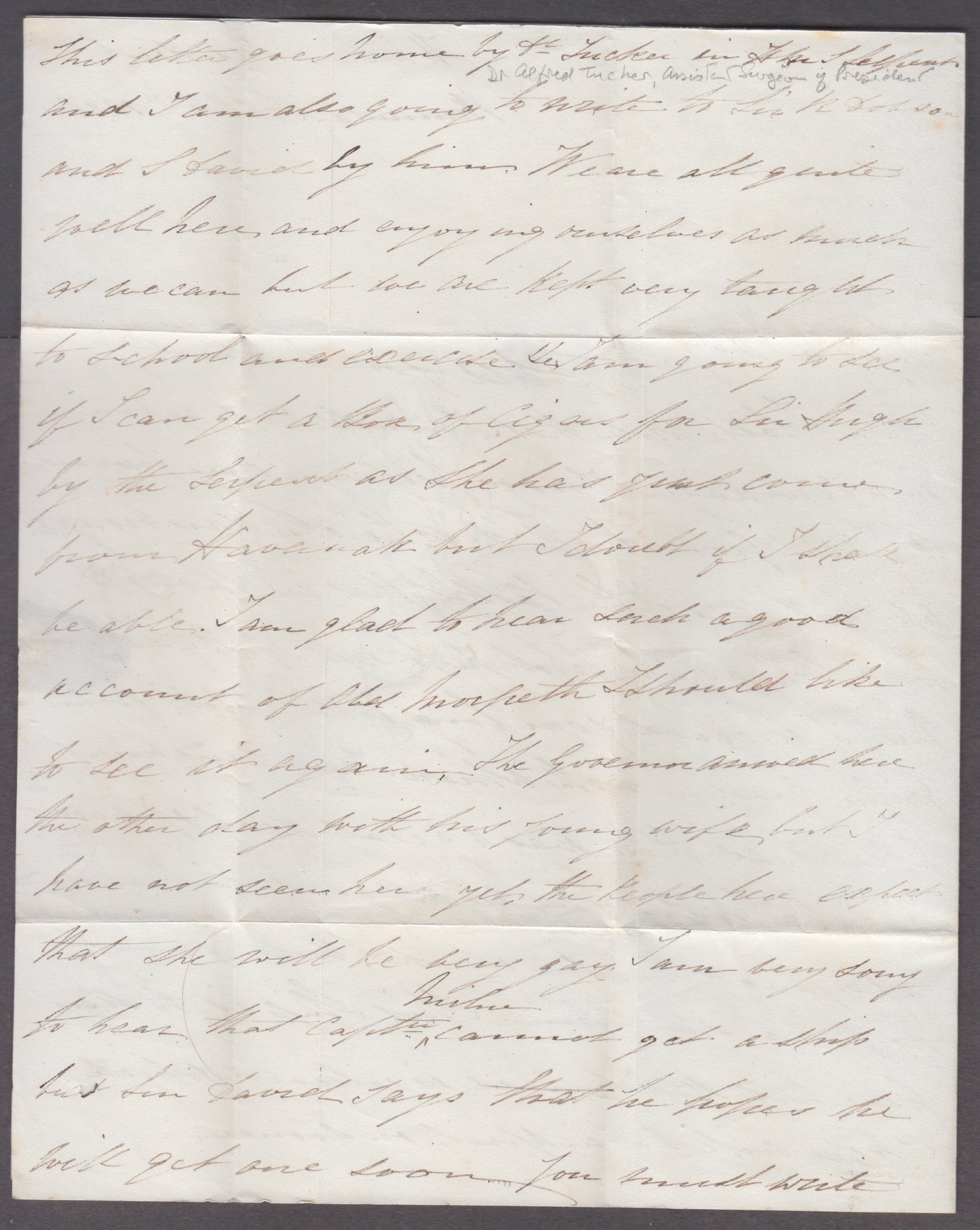
On 1 February the Post Office in Hamilton gave notice that letters for England “per H. M. S. Serpent” would be received until nine o’clock on Thursday morning. Cochrane didn’t use it. He gave his letter to Dr Tucker, who was going home in her: “This letter goes home by Dr Tucker in H M Serpent.”

Serpent sailed on Thursday 4 February and reached Portsmouth on 27 February, a passage of 23 days. Tucker handed the letter in there, and it was struck with the boxed PORTSMOUTH / SHIP LETTER handstamp. It’s the same mark as on my Acorn letter of 1828, which has it in red.

From Portsmouth it went up through London, where it was datestamped in red on 29 February (1836 was a leap year), and it reached Edinburgh on 2 March.

Someone first wrote 1/4 on it, then struck that through. The final charge accounts exactly. There’s 8d for the ship letter and 1s 2d for the inland postage, Portsmouth to Edinburgh by way of London being over 400 and not over 500 miles, which makes the 1/10 written on the front. On top of that is the boxed ½, the extra halfpenny Scotland charged on letters carried by mail coach over its toll roads. Mary paid one shilling and tenpence ha’penny for it. Not cheap for one sheet.

III

“My dear Mary”

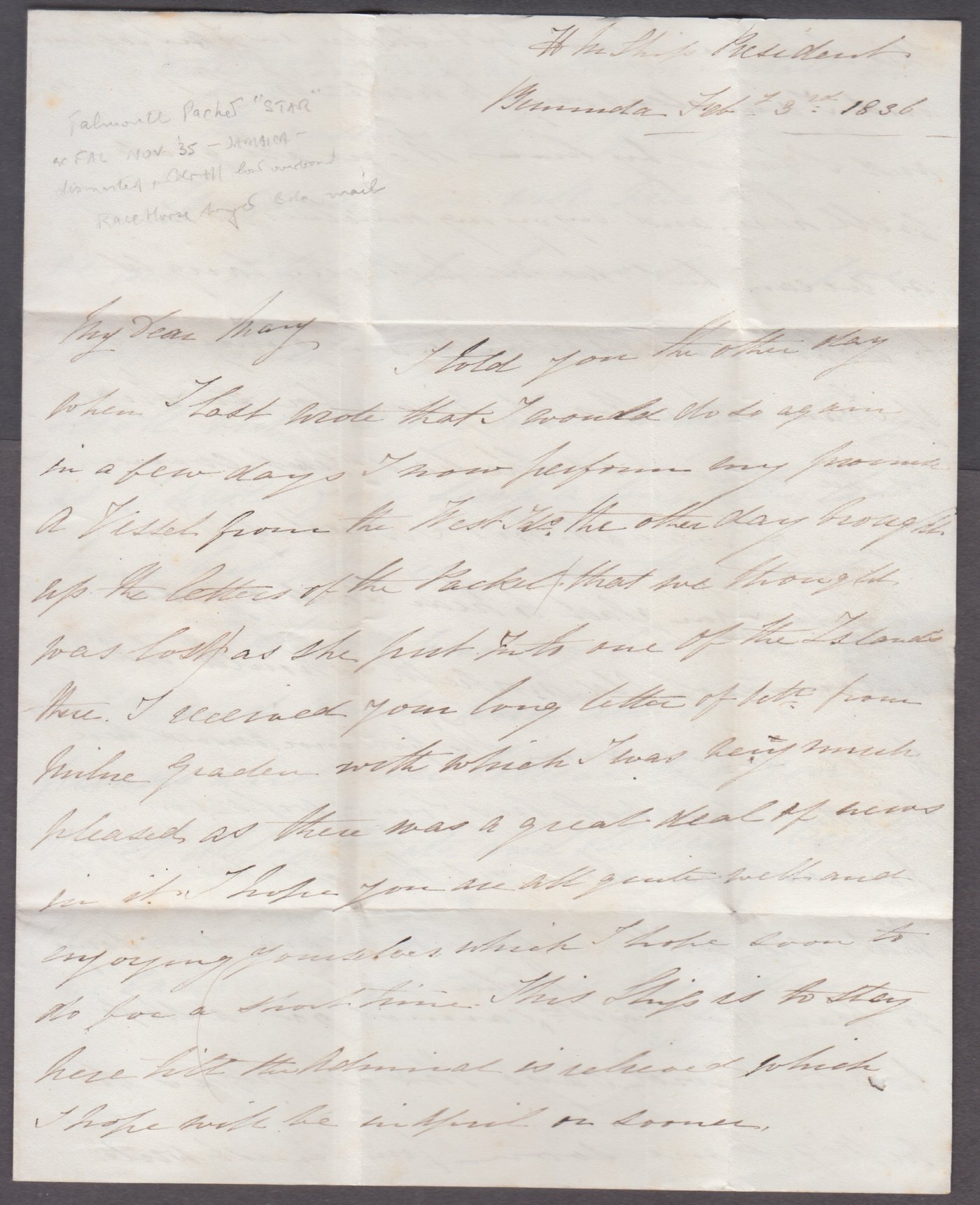
First page of the letter, headed H M Ship President, Bermuda Feby 3rd 1836, My dear Mary, with a later pencil note at top left about the Falmouth packet Star
Page one, with a later pencil note about the packet Star
Second page of the letter, beginning This letter goes home by Dr Tucker in H M Serpent, with a later pencil note identifying Dr Alfred Tucker, Assistant Surgeon of President
Page two: “This letter goes home by Dr Tucker in H M Serpent”
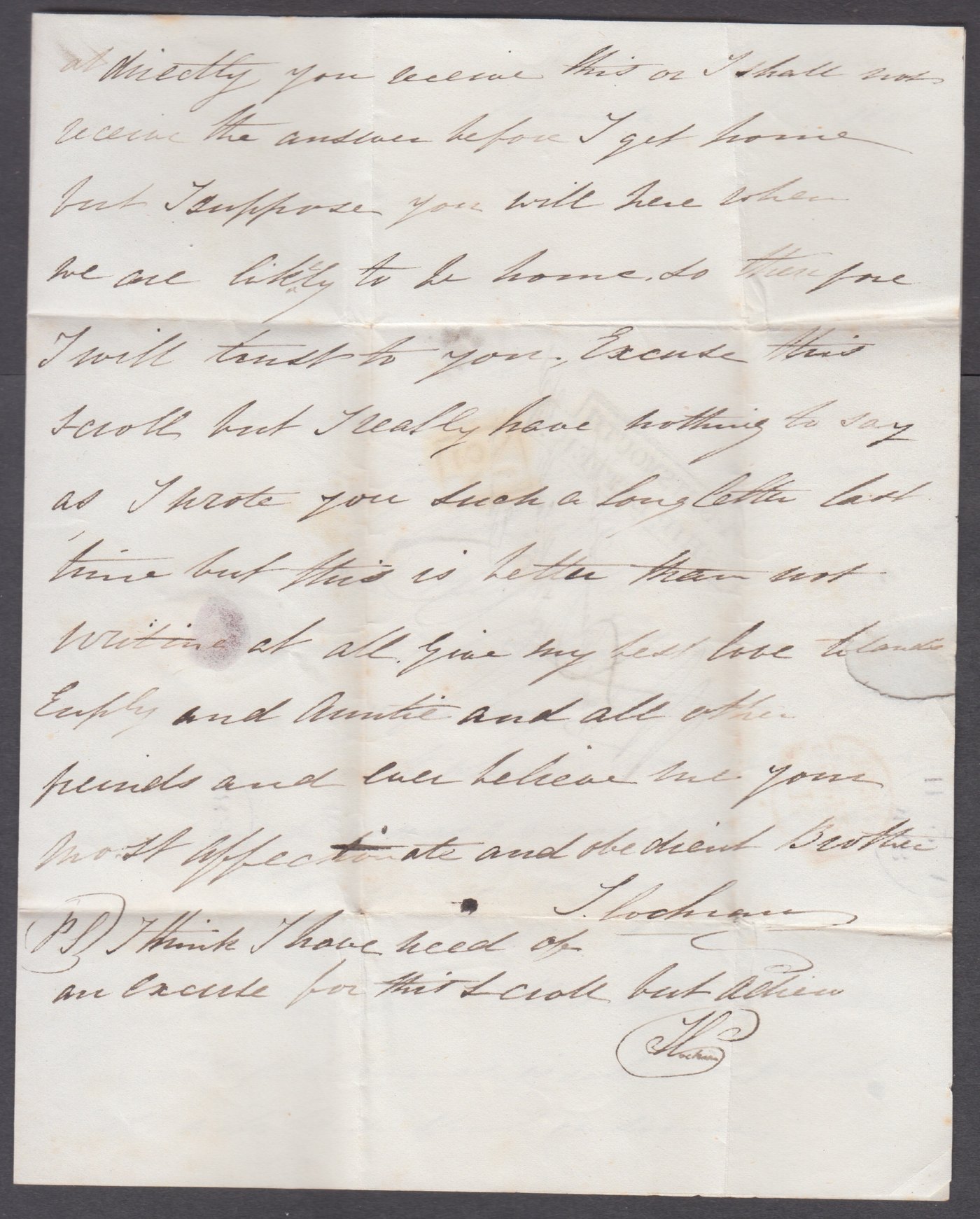
Third page of the letter, signed your most affectionate and obedient Brother, Cochrane, with a postscript and a small Cochrane monogram
Page three, signed “Cochrane”. The paper is torn where the seal was.

He opens by keeping a promise. He’d told Mary he would write again in a few days, and here it is.

Her own long letter of the 6th, written from Milne Graden, the Berwickshire home of Admiral Sir David Milne, had nearly gone astray. It was in the mails of a Falmouth packet “that we thought was lost”, until “a Vessel from the West Indies the other day brought us the letters”. A later pencil note on the letter names her as the packet Star, dismasted on her way to Jamaica. Her Bermuda letters were brought on from the West Indies. HMS Racehorse and the brig Snake both came in from there on 22 January, and one of them carried Mary’s letter.

“This Ship is to stay here till the Admiral is relieved which I hope will be in April or sooner.” Meanwhile “we are kept very taught to School and exercise”, which makes me think he was one of the young gentlemen still having lessons aboard. That’s a guess for now. He hoped to get “a Box of Cigars for Sir Hugh by the Serpent as she has just come from Havannah”, though he doubted he’d manage it.

There’s local news too:

“The Governor arrived here the other day with his young wife but I have not seen her yet, the people here expect that she will be very gay.”

Sir Stephen Chapman had left Bermuda suddenly through illness in the spring of 1835. He and Lady Chapman landed at St George’s on Thursday 21 January 1836, and the Admiral sent his carriage to the ferry for them.

Then a line I enjoyed working out: “I am very sorry to hear that Captn Milne cannot get a Ship but Sir David says that he hopes he will get one soon.” This is Alexander Milne, Sir David’s son, who had been a commander without a ship since November 1830. Sir David was right. At the end of that year Milne was appointed to the Snake, on this same station, and he went on to become Admiral of the Fleet Sir Alexander Milne.

He admits there wasn’t much else to say:

“Excuse this scroll but I really have nothing to say as I wrote you such a long letter last time but this is better than not writing at all.”

That long letter may well survive. David Cordon’s census records another letter from President to Mary at North Castle Street, dated 17 January 1836, and I think it’s the one he means. It went a different way, entering the post at Plymouth with a red framed INDIA LETTER / PLYMOUTH mark, and reached Edinburgh on 24 February, a week ahead of this one. I don’t know which ship carried it.

IV

In the Gazette

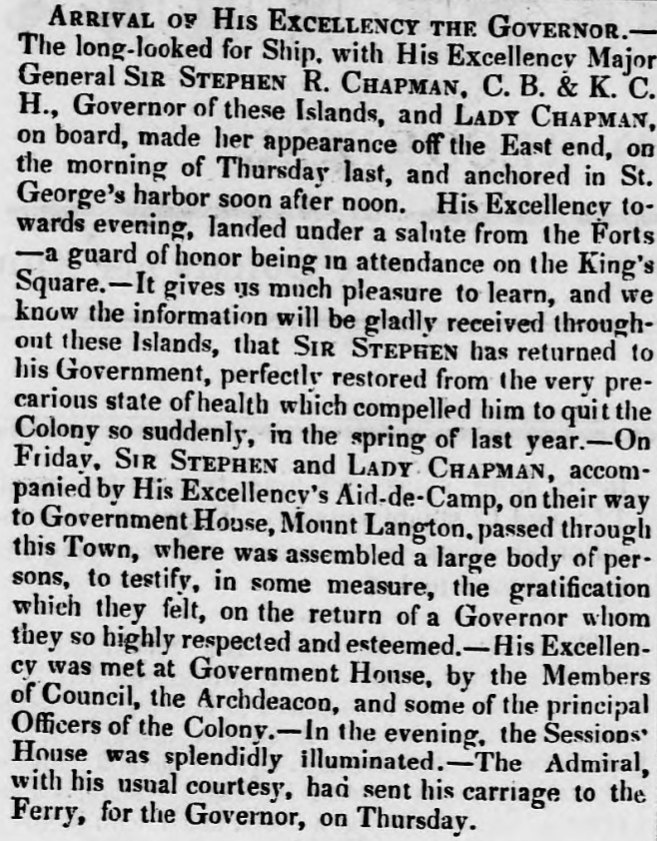
Royal Gazette report headed Arrival of His Excellency the Governor: Sir Stephen R. Chapman and Lady Chapman anchored in St George's harbour on Thursday, restored to health; the Admiral sent his carriage to the ferry for the Governor
Royal Gazette, 26 January 1836: the Governor and Lady Chapman arrive
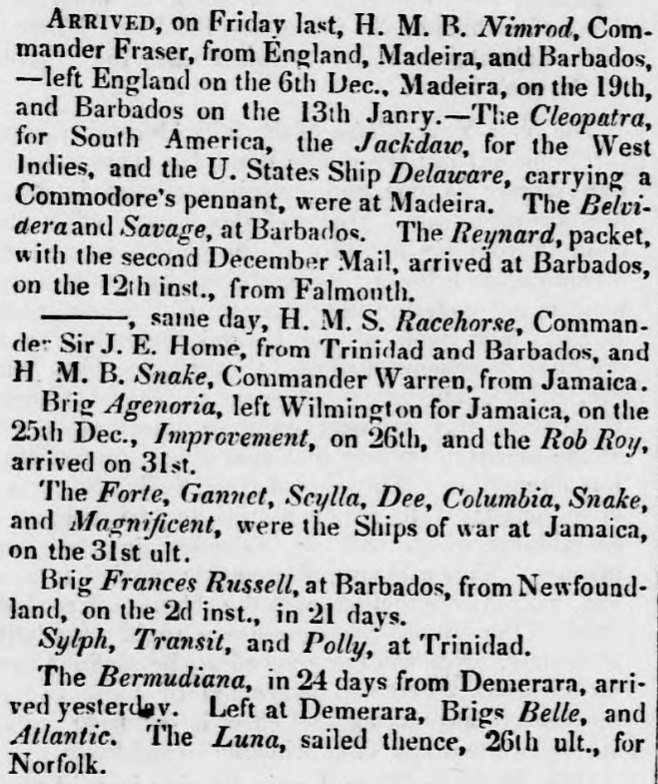
Royal Gazette shipping news: arrived on Friday last H.M.B. Nimrod from England, Madeira and Barbados; same day H.M.S. Racehorse from Trinidad and Barbados and H.M.B. Snake from Jamaica
Royal Gazette, 26 January 1836: Racehorse and Snake in from the West Indies

Two items in the same issue of the Royal Gazette pick up the letter’s news. The first reports Sir Stephen and Lady Chapman’s arrival on the Thursday, to a salute from the forts, a guard of honour, and the Sessions House “splendidly illuminated” that evening.

The second is the shipping news. On Friday 22 January HMS Racehorse, Commander Sir J. E. Home, came in from Trinidad and Barbados, and the brig Snake, Commander Warren, from Jamaica. One record has Snake bringing mail from the Star. The pencil note on the letter says Racehorse. I can’t yet say which is right, but one of these two very probably brought Mary’s letter of the 6th.

V

Dr Alfred Tucker

A dealer’s description of this letter had Tucker as assistant surgeon of the Serpent. He wasn’t. The Navy List shows Alfred Green Gayton Tucker becoming an assistant surgeon in July 1832 and joining President on 16 July 1834. He was the flagship’s own surgeon, going home as a passenger.

He was promoted surgeon in 1841 and went out to the China station in HMS Minden, which served as Hong Kong’s first hospital ship. In 1845 he was a founder and the first President of the China Medico-Chirurgical Society. He died of tuberculosis aboard Minden on 10 October 1845. It’s nice to think of him carrying this letter home nine years earlier.

January to March 1836

The ships on one side, the letters on the other.

The ships
The letters
17 Jan
The lettersCochrane writes to Mary from President: the letter in Cordon’s census.
Thu 21 Jan
The shipsGovernor Sir Stephen Chapman and Lady Chapman land at St George’s.
Fri 22 Jan
The shipsRacehorse and Snake arrive from the West Indies.
The lettersThe Star’s letters reach Bermuda, very probably including Mary’s.
Sat 30 Jan
The shipsSerpent arrives from Nassau, under orders for England.
Mon 1 Feb
The lettersHamilton Post Office takes letters for England “per H. M. S. Serpent”.
Wed 3 Feb
The lettersCochrane writes again and gives the letter to Dr Tucker.
Thu 4 Feb
The shipsSerpent sails for England, with Tucker aboard.
The letter crosses the Atlantic
24 Feb
The lettersThe 17 January letter reaches Edinburgh by way of Plymouth.
Sat 27 Feb
The shipsSerpent reaches Portsmouth.
The lettersEnters the post as a ship letter: PORTSMOUTH / SHIP LETTER.
Mon 29 Feb
The lettersLondon.
2 Mar
The lettersEdinburgh. Mary pays 1s 10½d.
1836
The shipsSir Peter Halkett relieves Cockburn as Commander-in-Chief.

The Ship

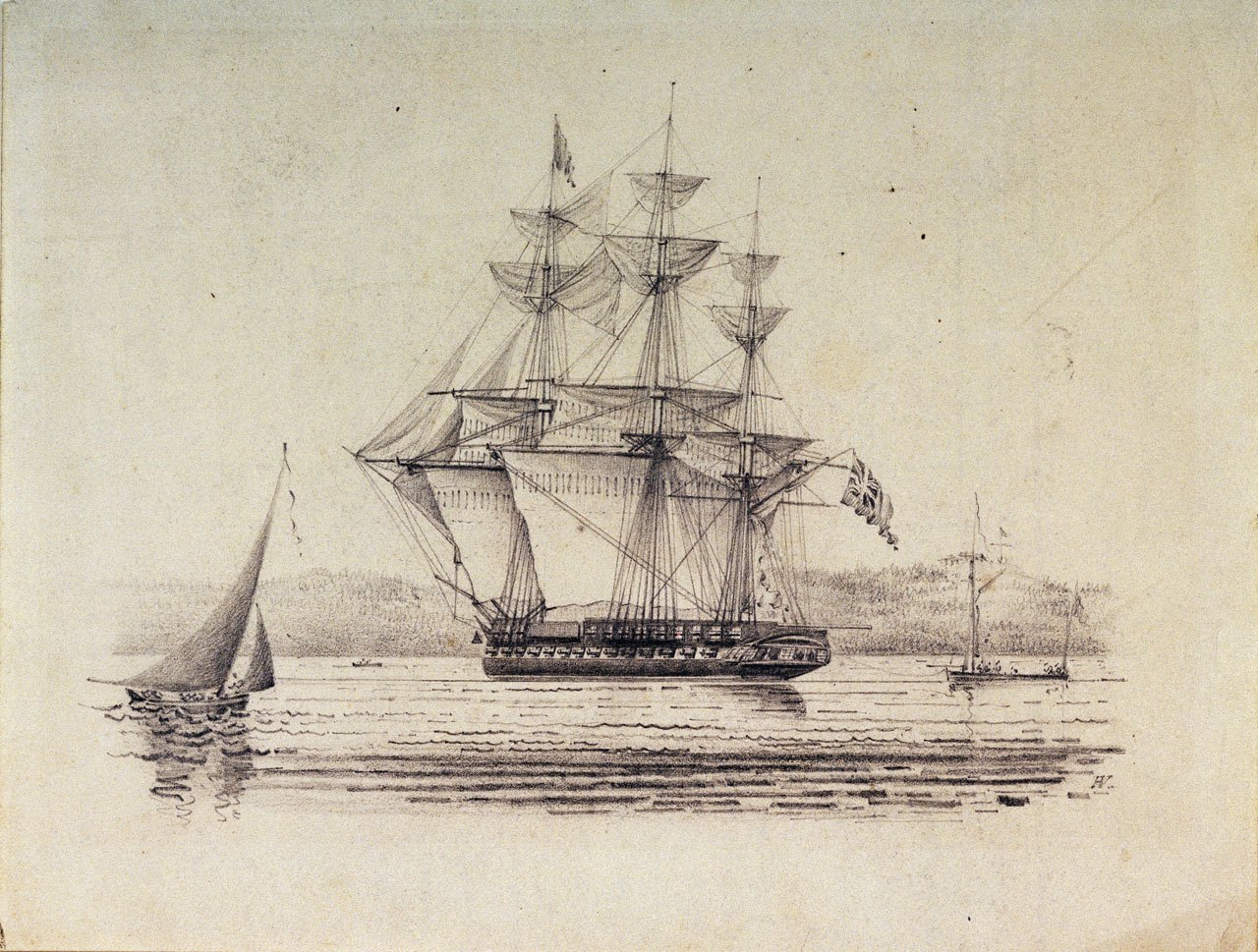
Pencil drawing of HMS President at anchor in calm water with her sails set and guns run out, a small sloop at her stern and a fort on the hill to the right, signed H.V.

H.M.S. President

HMS President was built at Portsmouth Dockyard and launched on 20 April 1829, to the lines of the American frigate USS President, which had been captured in 1815. Rather than copying the American’s armament, she was finished as a 52-gun frigate. Sending her out as flagship of the North America and West Indies station under Cockburn, the admiral who had burned Washington in 1814, was a pointed reminder to the Americans. She served there under Captain James Scott with Cockburn’s flag from June 1834 into 1836. Some accounts put her on the South American station by then, but this letter shows she was at Bermuda with the Admiral in February 1836.

She went on to the Pacific from 1837 to 1842 and saw later service including the Crimean War. In 1862 she became the Royal Naval Reserve drill ship in the West India Docks, London. She was renamed Old President in 1903 and sold for breaking up the same year.

The drawing is signed H.V., and on the back is written “Dimensions of HMS President. Captain Jas Scott, West Indies 1835”, so it shows her in the very commission of this letter.

BuiltPortsmouth Dockyard, launched 20 April 1829
Type52-gun fourth rate, large frigate
Tons1,537 bm
Captain, 1836James Scott, flag of Vice-Admiral Sir George Cockburn
FateRNR drill ship 1862; sold 1903

National Maritime Museum, Greenwich, London (PAD6144), via Wikimedia Commons.

Still to find out

If you can help with any of these, I’d be very pleased to hear from you.

Read the full transcription
Page one

H M Ship President Bermuda Feby 3rd 1836

My dear Mary

I told you the other day when I last wrote that I would do so again in a few days I now perform my promise. A Vessel from the West Ins the other day brought us the letters of the Packet that we thought was lost as she put into one of the Islands there. I received your long letter of 6th from Milne Graden with which I was very much pleased as there was a great deal of news in it. I hope you are all quite well and enjoying yourselves which I hope soon to do for a short time. This Ship is to stay here till the Admiral is relieved which I hope will be in April or sooner.

Page two

This letter goes home by Dr Tucker in H M Serpent and I am also going to write to Sir R Dobson [reading uncertain] and Sir David by him. We are all quite well here and enjoying ourselves as much as we can but we are kept very taught to School and exercise. [?] I am going to see if I can get a Box of Cigars for Sir Hugh by the Serpent as she has just come from Havannah but I doubt if I shall be able. I am glad to hear such a good account of Old Morpeth [reading uncertain] I should like to see it again. The Governor arrived here the other day with his young wife but I have not seen her yet, the people here expect that she will be very gay. I am very sorry to hear that Captn Milne [“Milne” written above the line] cannot get a Ship but Sir David says that he hopes he will get one soon. You must write

Page three

directly you receive this or I shall not receive the answer before I get home but I suppose you will here when we are likely to be home, so therefore I will trust to you. Excuse this scroll but I really have nothing to say as I wrote you such a long letter last time but this is better than not writing at all. Give my best love to [torn at the seal] Euphy and Auntie and all other friends and ever believe me your most affectionate and obedient Brother

Cochrane [first initial uncertain]

PS I think I have need of an excuse for this scroll but Adieu

[small monogram signature: Cochrane]

Address panel

Miss Mary H. Cochrane 5 North Castle Street Edinbro’

Later pencil notes, by an earlier owner

Page one: “Falmouth Packet ‘STAR’ ex FAL Nov 35 – JAMAICA – dismasted … lost overboard. Race Horse brought on mail”

Page two: “Dr Alfred Tucker, Assistant Surgeon of President”

References

It’s a short letter, and he says himself he had nothing much to tell. But between the Gazette and the letter you can watch a whole fortnight at Bermuda: a lost packet turning up, the Governor coming back with his young wife, a brig in from Havana, and the ship’s surgeon going home with this letter in his care.