Postal History · Royal Navy · Entire

H.M.S. Crocodile

Ireland Island, Bermuda · 29–30 October 1840

A captain’s letter home to his father, with a sketch of the dockyard and news of a new ship.

◆

This is a letter from a captain to his father, and his father was an admiral. Alexander Milne was in command of the Crocodile, a small 28-gun ship, and he wrote it in the dockyard at Bermuda on 29 October 1840. He finished it in a hurry the next morning, after he’d been told he was getting a bigger ship. In the middle is his own rough plan of the dockyard, with the Crocodile drawn in, tied up in the Basin. I like it because it’s three things at once: a family letter, a captain fussing over his ship, and an eyewitness view of the dockyard defences being built. Three days later he wrote again from his new ship, and that letter is on the H.M.S. Cleopatra (1840) page. The two went home by different routes, and the comparison is half the fun.

I

“Vice Admiral Sir David Milne G.C.B.”

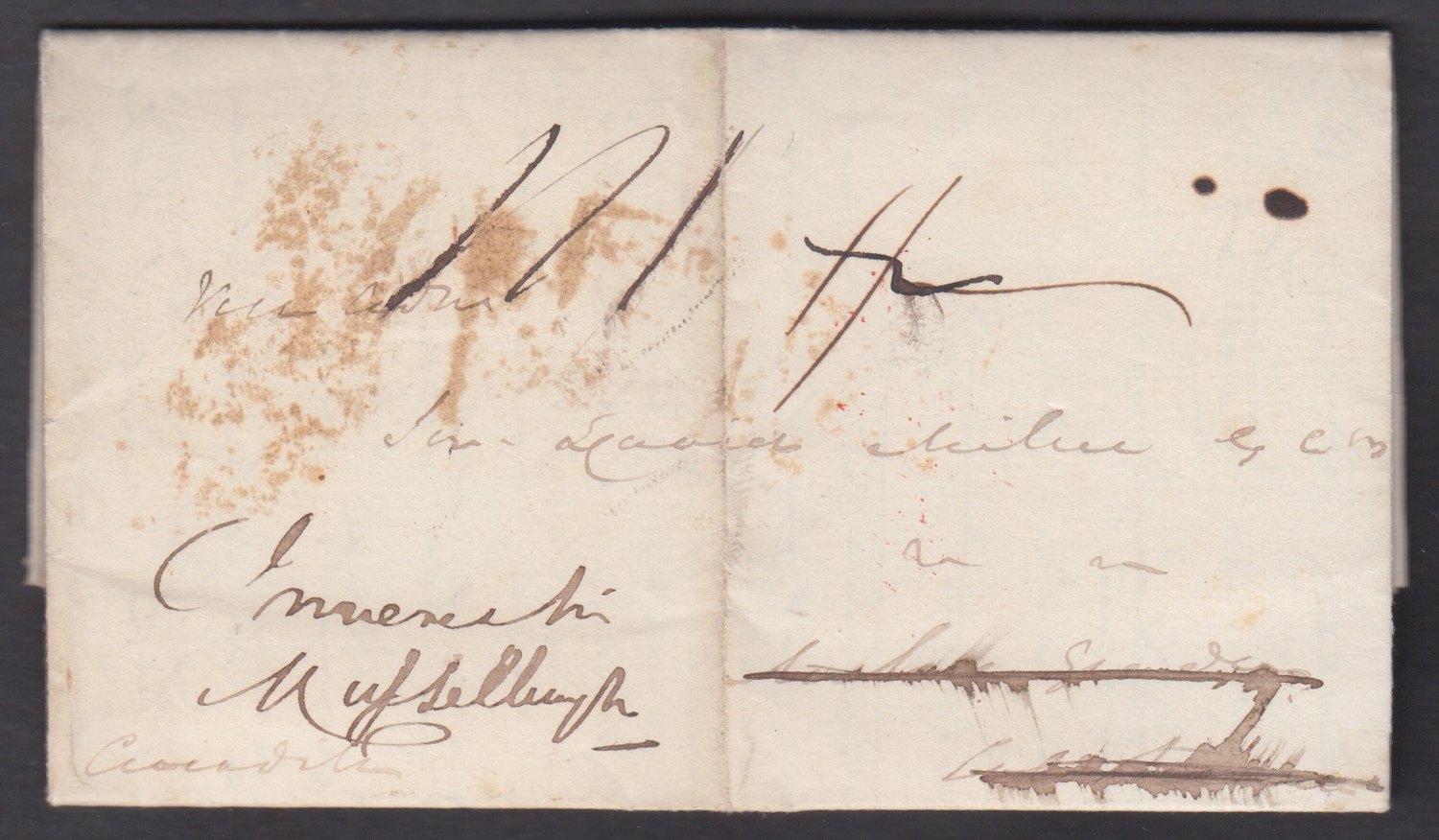
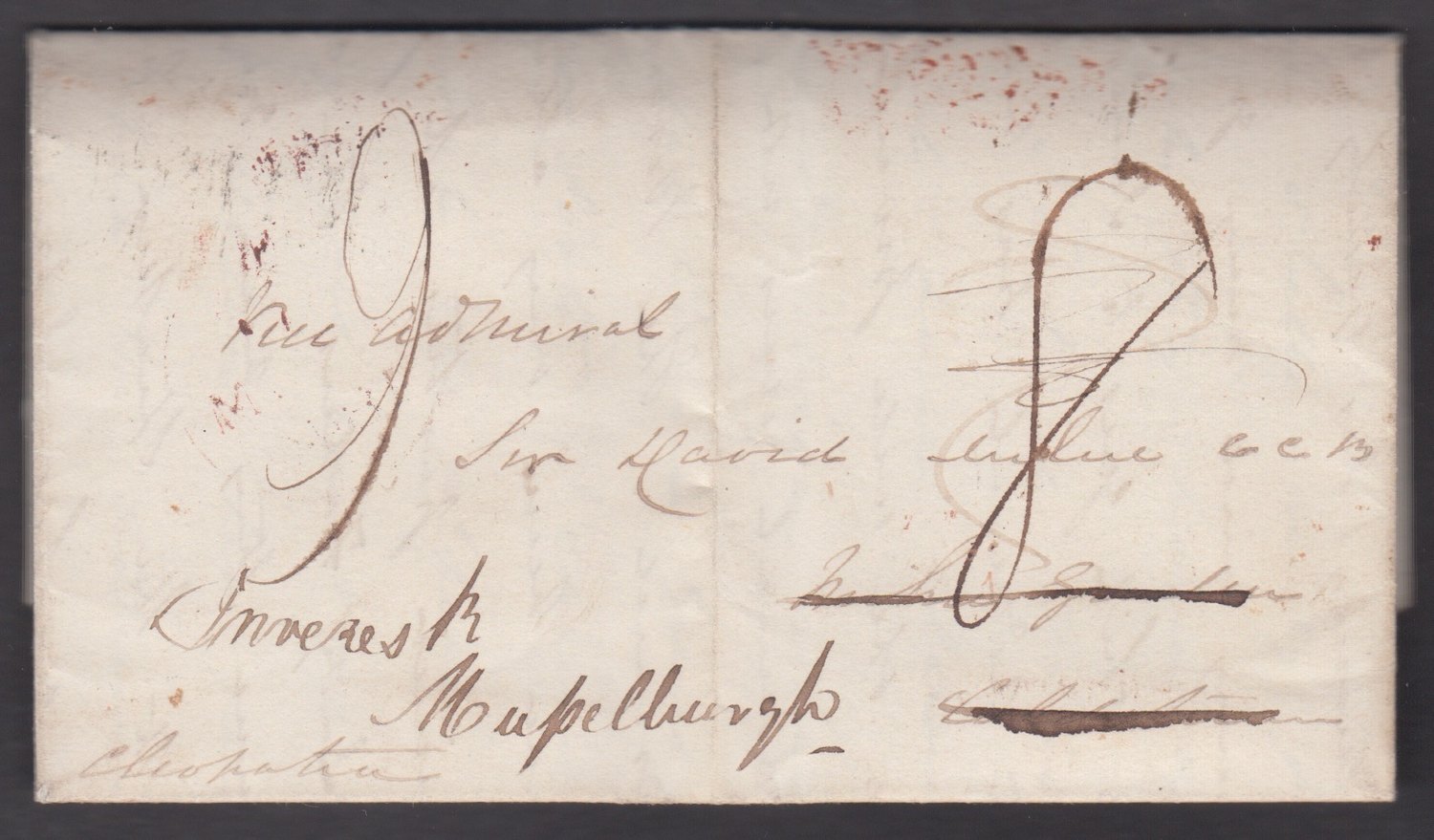
Folded entire addressed Vice Admiral Sir David Milne G.C.B. &c &c &c, the original address Milne Graden, Coldstream struck through in heavy ink and redirected Inveresk, Musselburgh, with the charges 1/- and 1/1 and the word Crocodile written faintly in the lower left corner
The entire folded, redirected from Coldstream to Inveresk, with “Crocodile” faint in the corner
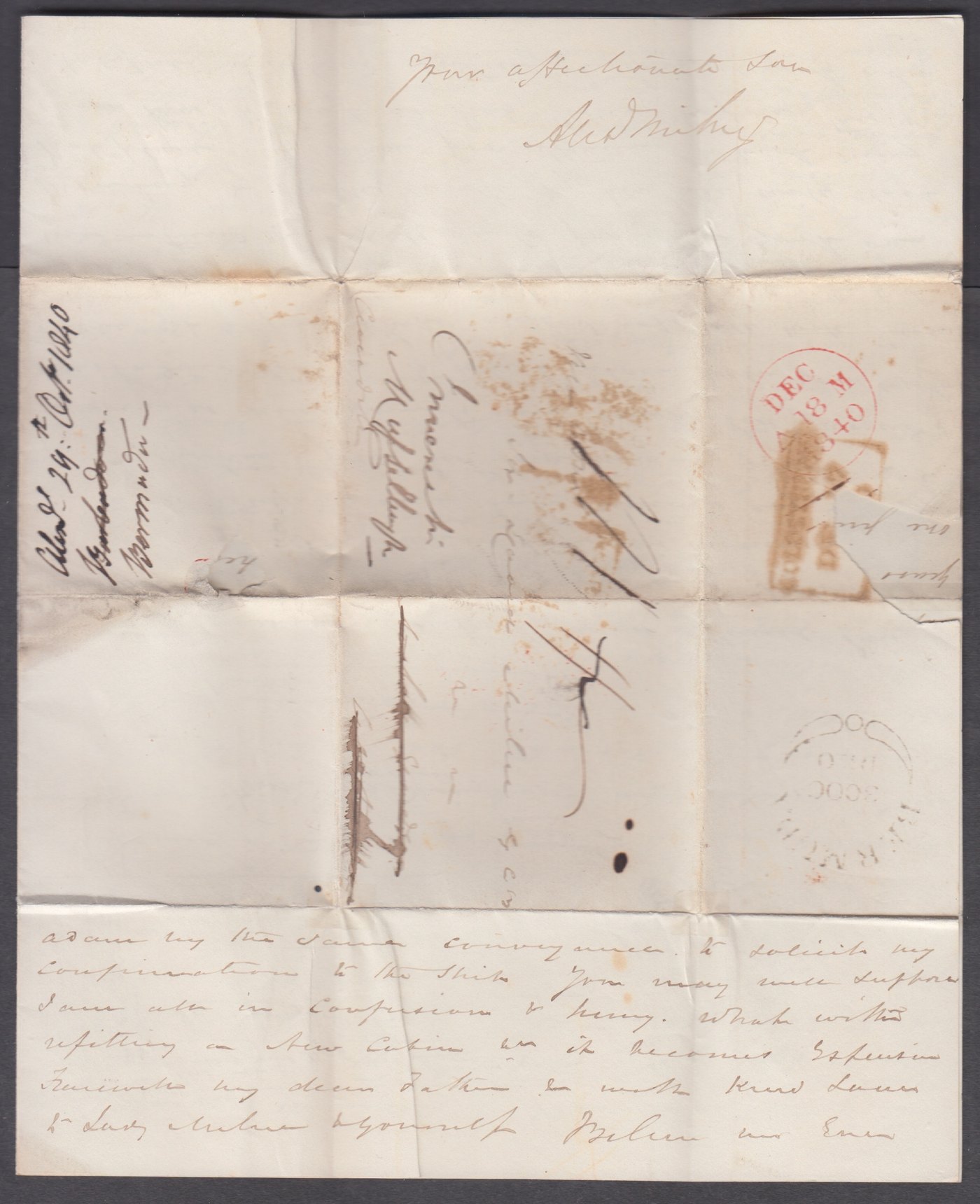
The outer sheet opened out, showing the address panel in the centre, the end of the letter and signature Alexr Milne at the top, the father’s docket Alexr 29th Oct 1840 Bermuda at the left, the red Edinburgh datestamp and a boxed mark under a brown stain at the right, the BERMUDA fleuron below, and the last lines of the letter across the foot
The outer sheet opened out, with the Bermuda, Coldstream and Edinburgh marks
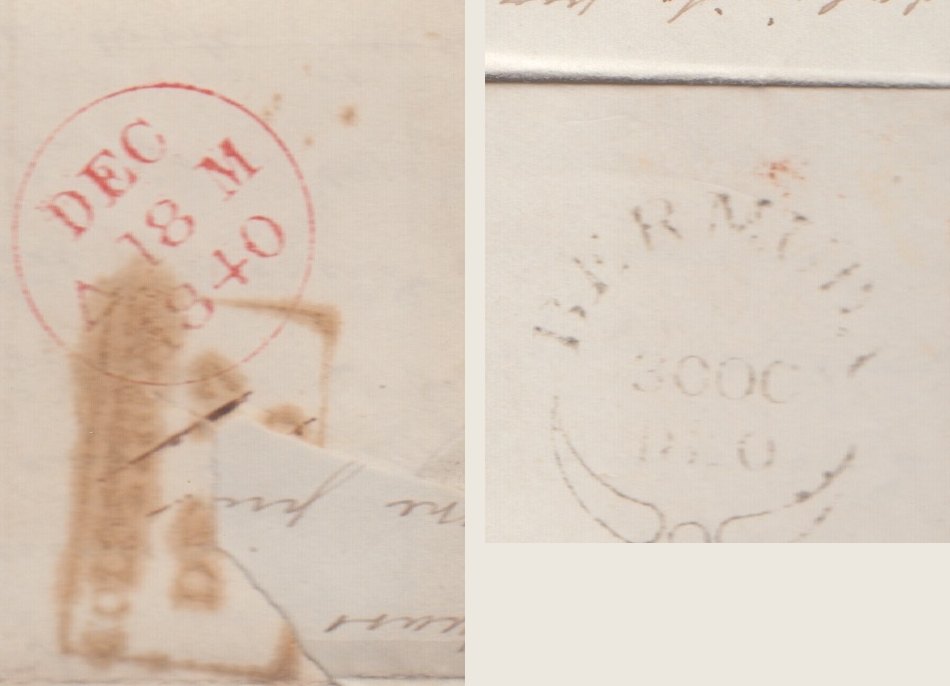
Close-up of two marks: on the left the red circular datestamp DEC 18 M 1840 with a boxed mark partly hidden under a brown stain; on the right the black BERMUDA fleuron dated 30 OC 1840
Edinburgh, 18 December 1840, over the stained Coldstream box (left); the BERMUDA fleuron, 30 October 1840 (right)
  • Item Entire letter, one sheet written on three sides and the outer panel, with a pen sketch
  • From Captain Alexander Milne, H.M.S. Crocodile
  • To Vice-Admiral Sir David Milne, G.C.B., Milne Graden, Coldstream; redirected to Inveresk, Musselburgh
  • Written In the dockyard basin, Bermuda, 29 October 1840; postscript 30 October, 10 am
  • Rate 1/- packet rate, raised to 1/1 when sent on
  • Markings “BERMUDA” fleuron (Ludington PM2), St George’s, 30 October 1840; boxed COLDSTREAM, 17 December; Edinburgh, 18 December 1840, in red
  • Route Mail-boat Roseway to Halifax, then by steamer to Britain

It’s an entire, a single sheet written on three sides and folded to make its own cover. Folded up, the front carries the address: “Vice Admiral / Sir David Milne G.C.B. &c &c &c”. Sir David was a vice-admiral in October 1840; he was made a full admiral a year later. The letter was addressed to Milne Graden, the family’s Berwickshire house near Coldstream. Someone at home struck that through in heavy ink and wrote it on to Inveresk, Musselburgh, the family house outside Edinburgh.

In the bottom left corner, very faint, is the word “Crocodile”. It’s in the same pale brown ink as the letter and the original address, the capital C and the round o’s match the way Milne writes the ship’s name inside, and the dark flourish of the redirection runs over the end of it, so it was there first. I think it’s Milne telling his father at a glance which ship it came from. His next letter, from the Cleopatra, has “Cleopatra” in exactly the same place.

The postage was 1/-, the packet rate for a single letter between Britain and North America that had been fixed in March 1839, and it was raised to 1/1 when the letter was sent on from Coldstream. Proud gives the same 1/- by way of Halifax in his table of rates from 1842.

Opened out, the outer sheet shows the post office’s work. Below the address panel is the “BERMUDA” fleuron, struck at St George’s on 30 October 1840 as the mail was made up for Halifax. Cordon has some 65 strikes of the fleuron, from March 1828 to November 1841. At the top right is a boxed COLDSTREAM mark of 17 December, almost hidden under a brown stain, and the red datestamp of Edinburgh, 18 December, as the letter went on to Musselburgh. I couldn’t read the boxed mark until the Cleopatra letter turned up with a clean strike of the same thing. Sir David docketed it himself: “Alexr 29th Oct 1840 Bermuda”.
II

“Warped into the Basin by four o’clock”

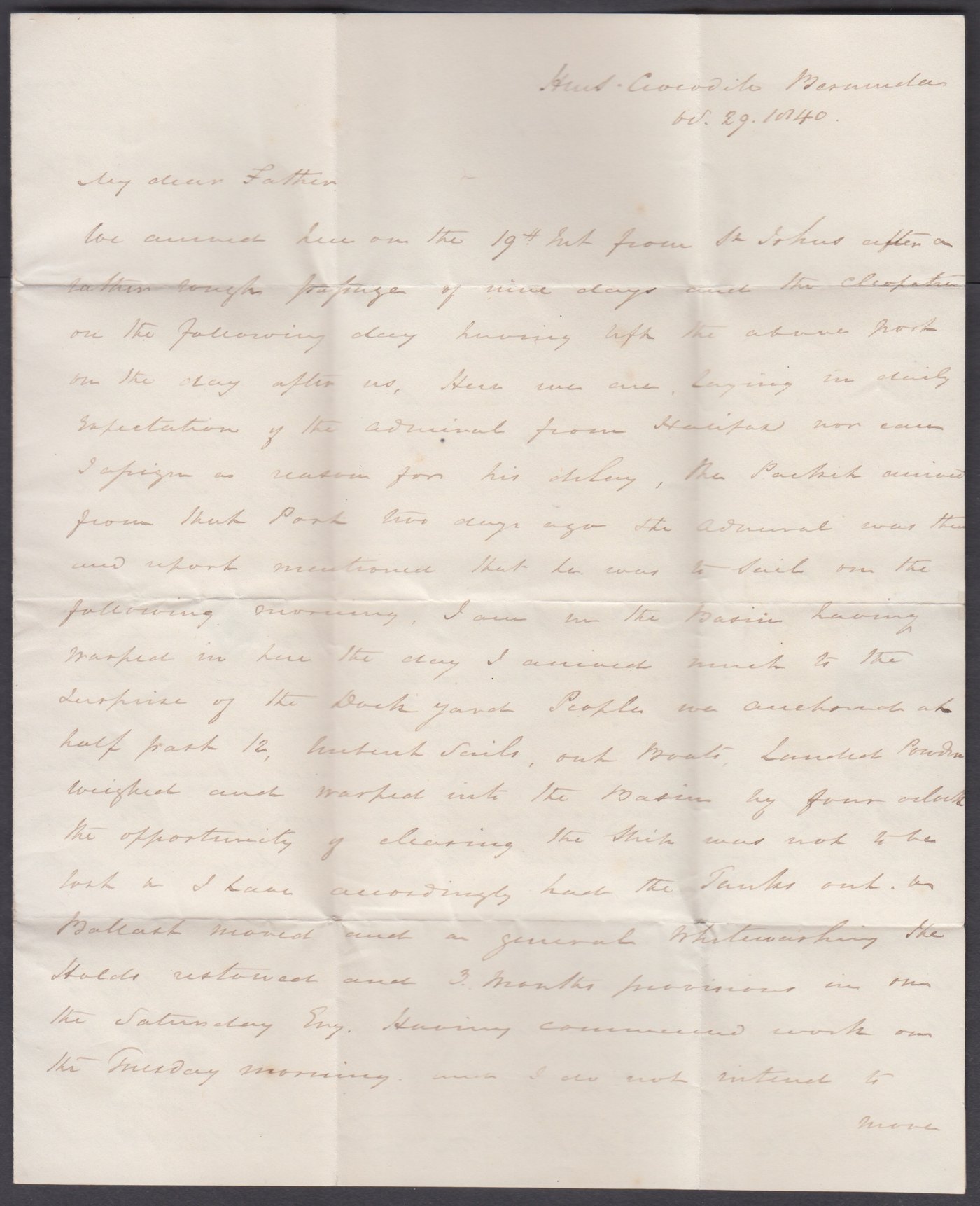
First page of the letter, headed HMS Crocodile Bermuda Oct 29 1840, My dear Father, We arrived here on the 19th Inst from St Johns after a rather rough passage of nine days
“H.M.S. Crocodile Bermuda Oct. 29. 1840”: the first page
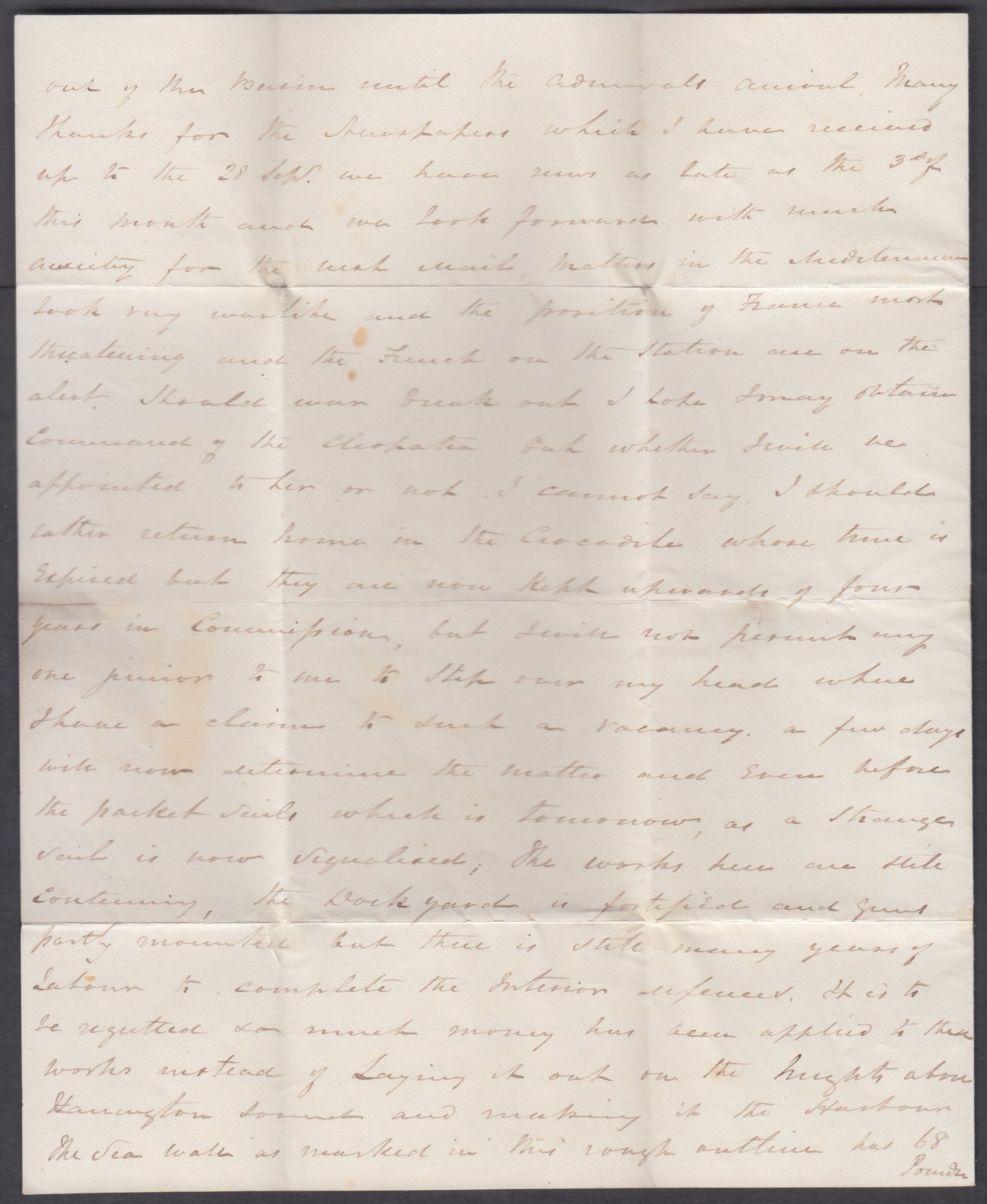
Second page of the letter, about the news from Europe, his hope of command of the Cleopatra, and the dockyard defences
The second page: France, the Cleopatra, and the dockyard works
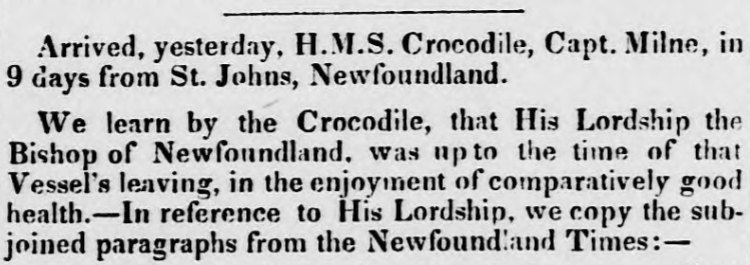
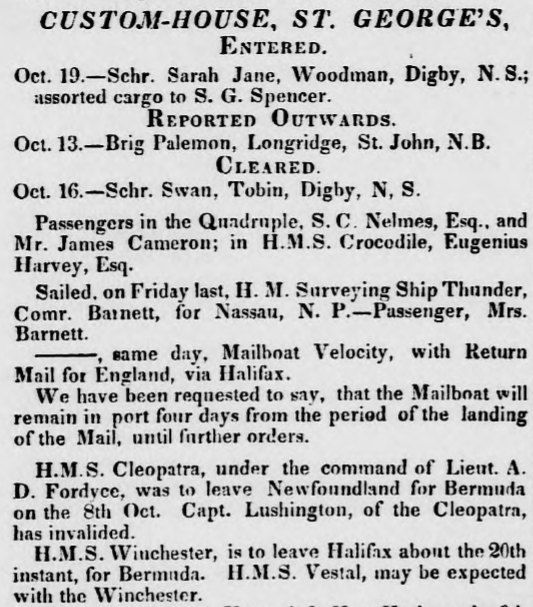
Royal Gazette: Arrived, yesterday, H.M.S. Crocodile, Capt. Milne, in 9 days from St. Johns, Newfoundland. We learn by the Crocodile, that His Lordship the Bishop of Newfoundland was in the enjoyment of comparatively good health
Royal Gazette, 20 October 1840: “in 9 days from St. Johns, Newfoundland”
Royal Gazette shipping column: passengers in H.M.S. Crocodile, Eugenius Harvey, Esq.; the mailboat Velocity sailed with the return mail for England via Halifax; the mailboat will remain in port four days from the landing of the mail; and news that H.M.S. Cleopatra under Lieut. A. D. Fordyce was to leave Newfoundland for Bermuda on the 8th October
Royal Gazette, 20 October 1840: Crocodile’s passenger, the mail-boats, and Cleopatra on her way
Royal Gazette: Arrived, on Tuesday last, H.M.S. Cleopatra, Lieut. Fordyce, from Newfoundland. Passenger, Dept. Asst. Com. Gen. Alexander Edwards.
Royal Gazette, 27 October 1840: Cleopatra in on Tuesday the 20th

He’d come down from Newfoundland, where the Crocodile had spent the season on fishery protection:

“We arrived here on the 19th Inst from St Johns after a rather rough passage of nine days and the Cleopatra on the following day having left the above port on the day after us.”

The Royal Gazette of 20 October has him “in 9 days from St. Johns, Newfoundland”, with a passenger, Eugenius Harvey, Esq. His next letter explains that he was the son of Dr Harvey of Bermuda and a commission merchant at St John’s. The next week’s paper has the Cleopatra in on the Tuesday, the 20th, under her first lieutenant, Fordyce, because her captain had been invalided. Everyone was now waiting for the Commander-in-Chief, Vice-Admiral Sir Thomas Harvey, to come down from Halifax.

Milne didn’t waste the time. He took the Crocodile straight into the dockyard Basin on the day he arrived, “much to the surprise of the Dock yard People”:

“we anchored at half past 12, unbent Sails, out Boats, Landed Powder, weighed and warped into the Basin by four o’clock”

By the Saturday evening the tanks were out, the ballast moved, the holds whitewashed and restowed, and three months’ provisions were on board. He had no intention of moving out of the Basin until the Admiral came.

Then the news. He thanks his father for newspapers up to 28 September, and the news from Europe looked bad: “Matters in the Mediterranean look very warlike and the position of France most threatening and the French on the Station are on the alert.” This was the Eastern crisis of 1840, when Britain and France came close to war over Egypt and Syria. If war came, he wanted a bigger ship:

“Should war break out I hope I may obtain Command of the Cleopatra but whether I will be appointed to her or not I cannot say.”

He’d rather go home in the Crocodile, “whose time is Expired”, but ships were now being kept “upwards of four years in Commission”, and he wasn’t going to let anyone junior to him “Step over my head where I have a claim to such a vacancy.”

III

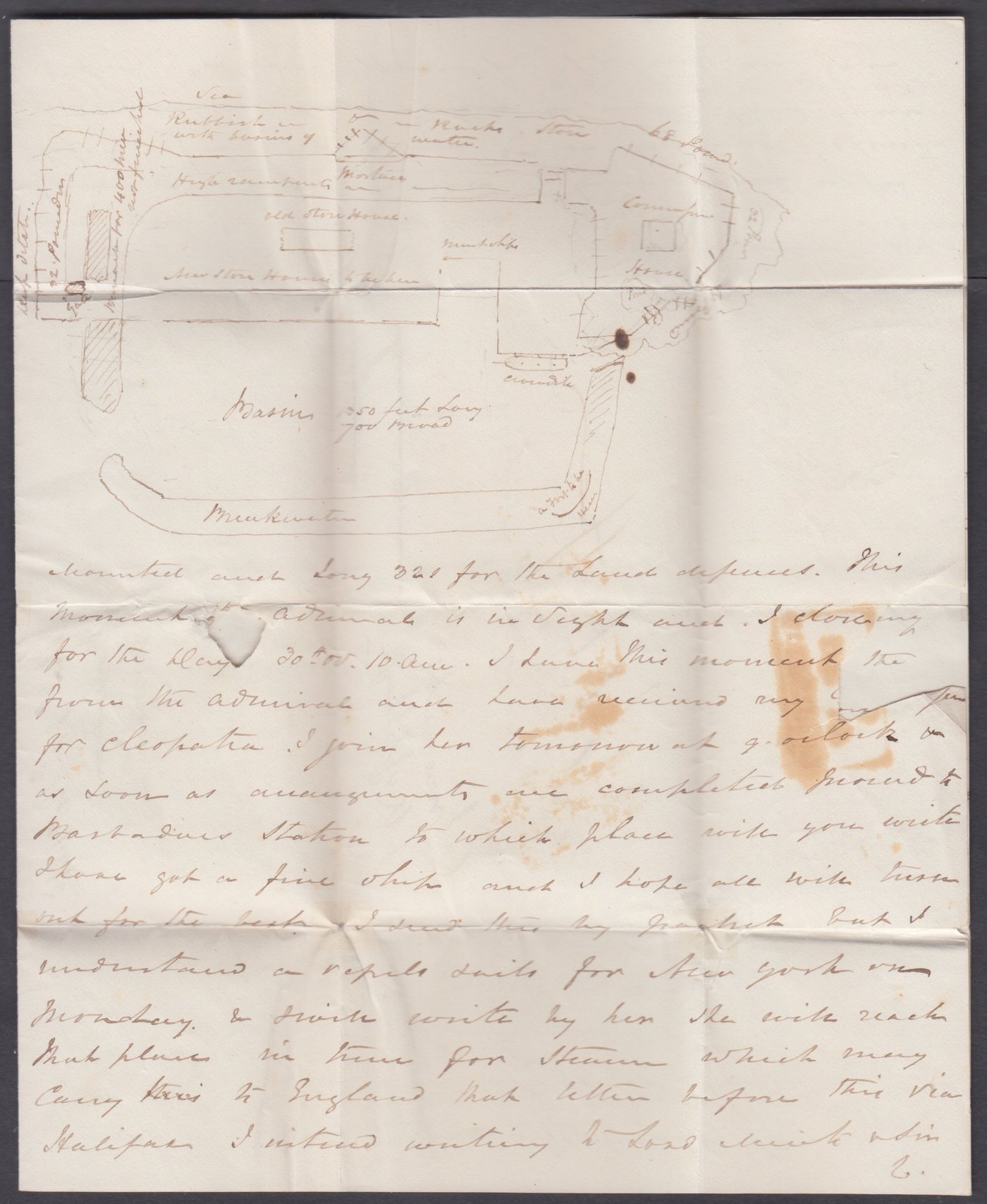
“This rough outline”

Third page of the letter, with the pen sketch of the dockyard at the top and the postscript of 30th Oct 10 am below it
The third page: the sketch, and the postscript of 30 October below it
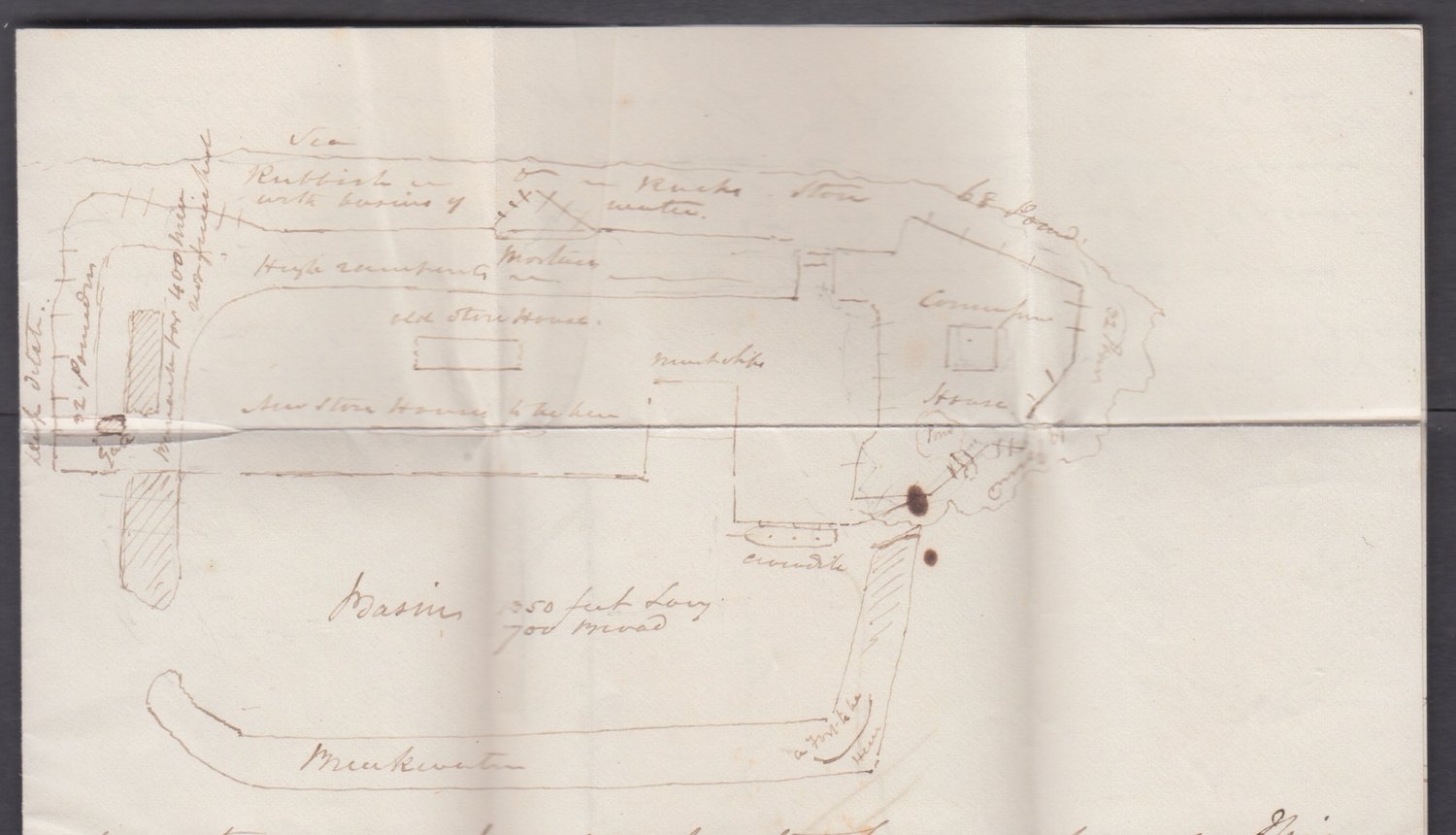
Milne’s pen sketch of the dockyard as it is on the letter, showing the sea, the high ramparts, the old and new store houses, the Commissioner’s House, the Basin 1350 feet long 700 broad, the breakwater, and the Crocodile drawn alongside
The sketch as Milne drew it
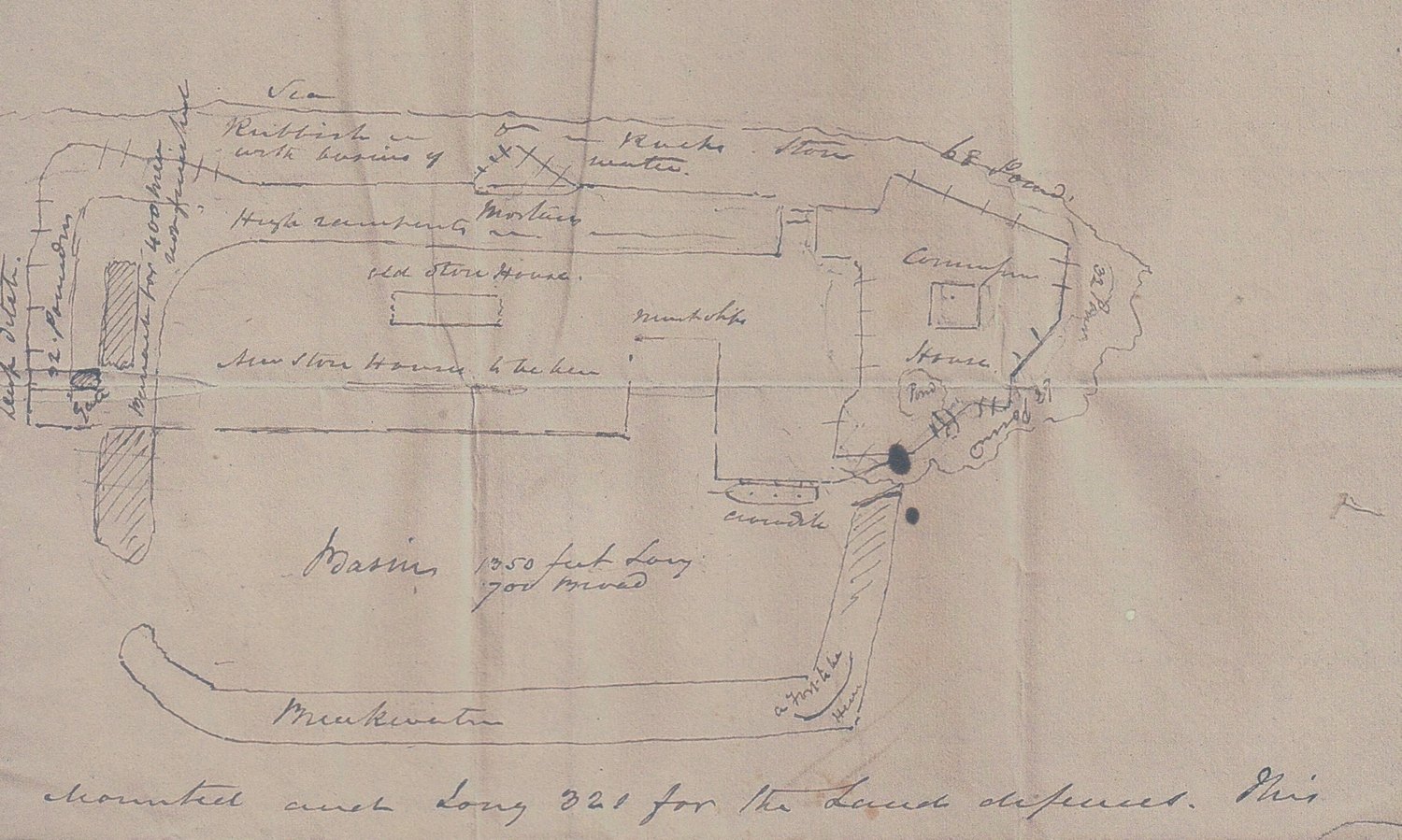
The same sketch, cleaned up and darkened by a previous owner so that the labels can be read more easily
The same sketch, enhanced by a previous owner

He then turns to the dockyard on Ireland Island. “The works here are still continuing, the Dock yard is fortified and guns partly mounted but there is still many years of Labour to complete the Interior defences.” He thought it a pity so much money had gone into this site “instead of Laying it out on the heights above Harrington Sound and making it the Harbour”. He came back to the same idea in his next letter.

To show his father what he meant, he drew it. The plan has the sea along the top, the high ramparts with mortars, the old store house and “New Store House to be here”, the Commissioner’s House, “Barracks for 400 men now finished”, 32-pounders and a “Deep ditch” on the land side, 68-pounders on the point, the breakwater, and “a Fort to be here” at the end of it. In the middle is the Basin, “1350 feet long 700 broad”. And there, tied up alongside, is a little ship labelled “Crocodile”. Under the sketch the letter carries on: the sea wall “has 68 Pounders mounted and Long 32s for the Land defences.”

The previous owner made a cleaned-up copy of the sketch, and I’ve shown it alongside the original because the labels are much easier to read.

IV

“Received my Commission for Cleopatra”

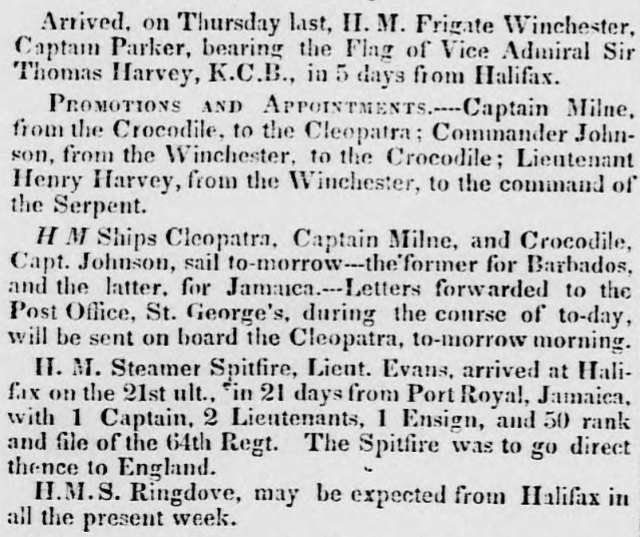
Royal Gazette: Arrived, on Thursday last, H. M. Frigate Winchester, Captain Parker, bearing the Flag of Vice Admiral Sir Thomas Harvey, K.C.B., in 5 days from Halifax. Promotions and Appointments: Captain Milne, from the Crocodile, to the Cleopatra; Commander Johnson, from the Winchester, to the Crocodile; Lieutenant Henry Harvey, from the Winchester, to the command of the Serpent. H M Ships Cleopatra, Captain Milne, and Crocodile, Capt. Johnson, sail to-morrow, the former for Barbados, and the latter for Jamaica
Royal Gazette, 3 November 1840: the Admiral arrives, and the appointments
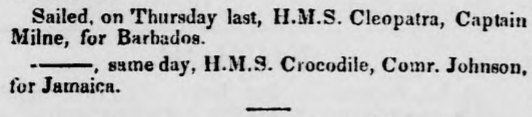
Royal Gazette: Sailed, on Thursday last, H.M.S. Cleopatra, Captain Milne, for Barbados; same day, H.M.S. Crocodile, Comr. Johnson, for Jamaica.
Royal Gazette, 10 November 1840: both ships sail on Thursday the 5th

He breaks off on the evening of the 29th: “This moment the Admiral is in sight and I [am] closing for the day.” The Royal Gazette of 3 November confirms it: the frigate Winchester had arrived on the Thursday, “bearing the Flag of Vice Admiral Sir Thomas Harvey, K.C.B., in 5 days from Halifax.” The next morning he added a postscript, squeezed in below the sketch next to a torn corner:

“30th Oct. 10 am. I have this moment [been] from the Admiral and have received my Commission for Cleopatra. I join her tomorrow at 9 o’clock & as soon as arrangements are completed proceed to Barbadoes Station to which place will you write. I have got a fine ship and I hope all will turn out for the best.”

(The word I’ve given as [been] looks like “the”, and I think it’s a slip of the pen.) The Admiral could appoint him, but only the Admiralty could confirm it, so he meant to write to Lord Minto and Sir Charles Adam, the First Lord and the senior Naval Lord, “to solicit my confirmation to the Ship.” He sounds pleased and a little harassed: “You may well suppose I am all in Confusion & hurry. What with refitting a New Cabin &c it becomes Expensive.” He sends love to “Lady Milne & yourself”. That’s his stepmother, Agnes, daughter of George Stephen of Grenada, whom Sir David had married in 1819; Alexander’s own mother, Grace, had died in 1814, when he was seven.

The same Gazette lists the appointments: “Captain Milne, from the Crocodile, to the Cleopatra; Commander Johnson, from the Winchester, to the Crocodile”. The two ships sailed together on Thursday 5 November, the Cleopatra for Barbados and the Crocodile for Jamaica. What happened to Milne and the Cleopatra after that is on the Cleopatra (1840) page.

V

“I send this by Packet”

The front of Milne’s next entire, of 2 November 1840, addressed in the same way to Vice Admiral Sir David Milne, redirected to Inveresk, Musselburgh, charged 8 and 9, with Cleopatra written faintly in the lower left corner
His next letter, from the Cleopatra on 2 November, sent by New York. See the Cleopatra (1840) page.

The mail-boat Roseway had come in from Halifax on the afternoon of Monday 26 October, ten days out, with the English mail; Milne’s “the Packet arrived from that Port two days ago” is near enough. The Gazette had told its readers that the mail-boat would stay four days after landing the mail, and this letter was struck with the fleuron on 30 October, the day he’d been told the packet would sail. From Halifax the mail went on to Liverpool by Cunard’s new steamers, but in winter they sailed only once a month, which probably explains why the letter didn’t reach Coldstream until 17 December.

He wasn’t sure this was the quickest way:

“I send this by Packet but I understand a vessel sails for New York on Monday & I will write by her. She will reach that place in time for Steamer which may carry that letter before this via Halifax.”

He did write again, from his new ship on Monday 2 November, and sent it by New York. That letter is on the Cleopatra (1840) page. It was cheaper, 8d against 1/-, and it lost: it reached Coldstream on 24 December, a week after this one.

October to December 1840

The ship on one side, the letter on the other.

The ship
The letter
Sat 10 Oct
The shipCrocodile leaves St John’s, Newfoundland, for Bermuda.
Mon 19 Oct
The shipArrives at Bermuda after nine days and warps into the dockyard Basin the same afternoon.
Tue 20 Oct
The shipCleopatra arrives from Newfoundland. Work on Crocodile begins.
Sat 24 Oct
The shipHolds restowed and three months’ provisions on board.
Mon 26 Oct
The letterThe mail-boat Roseway arrives from Halifax with the English mail.
Thu 29 Oct
The shipThe Admiral arrives in the Winchester.
The letterWritten in the Basin, with the sketch.
Fri 30 Oct
The shipMilne receives his commission for Cleopatra.
The letterPostscript at 10 am; BERMUDA fleuron at St George’s; the mail closes for Halifax.
Sat 31 Oct
The shipMilne joins Cleopatra; Commander Johnson takes the Crocodile.
Thu 5 Nov
The shipCrocodile sails for Jamaica, Cleopatra for Barbados.
Thu 17 Dec
The letterBoxed COLDSTREAM; redirected to Inveresk.
Fri 18 Dec
The letterEdinburgh, on its way to Musselburgh.

The Ship

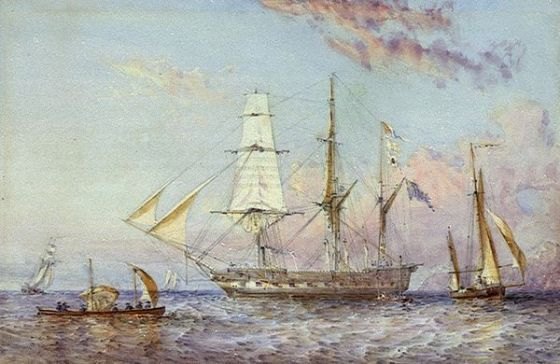
Watercolour by Oswald Brierly of H.M.S. Rattlesnake, a three-masted Atholl-class sixth rate and sister of the Crocodile, under sail

H.M.S. Crocodile

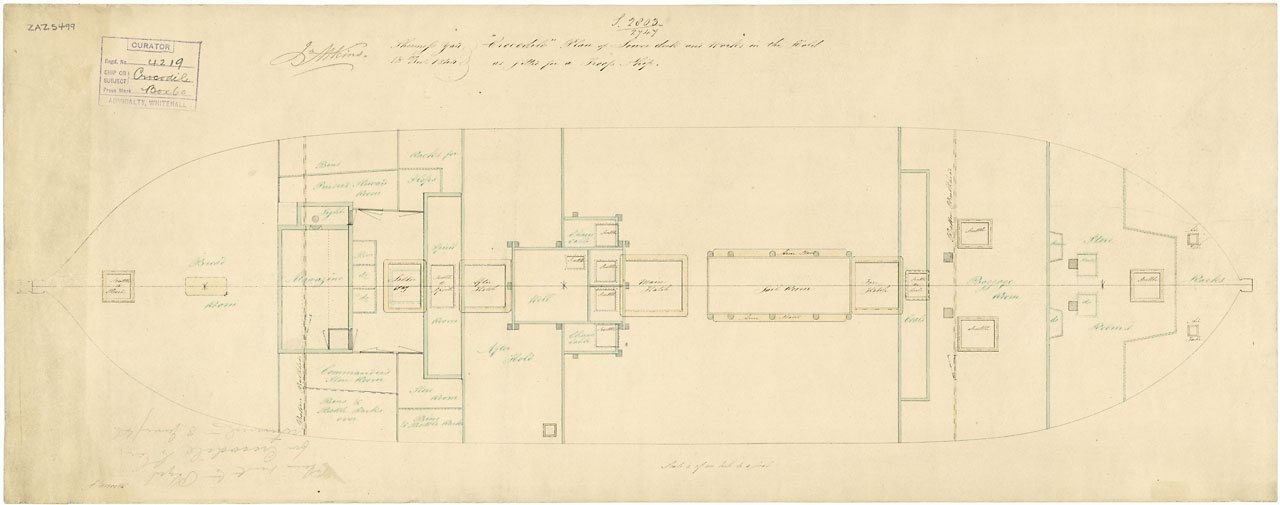
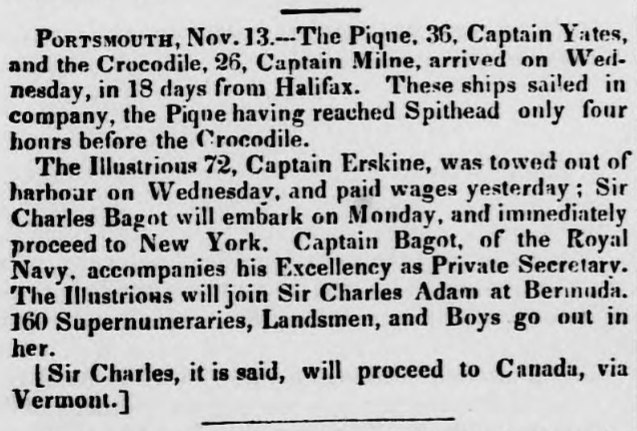
H.M.S. Crocodile was one of the Atholl class of 28-gun sixth rates, small ship-rigged frigates sometimes called “donkey frigates”. She was built at Chatham Dockyard and launched on 28 October 1825. In 1828–32 she served in the East Indies. Alexander Milne took command in April 1839 on the North America and West Indies station, where she spent the summers on fishery protection off Newfoundland and Labrador. Johnson had her from November 1840 to February 1841, when Milne came back to her. The Royal Gazette of 21 December 1841 reports her reaching Portsmouth with the Pique in 18 days from Halifax, “only four hours” behind her, and she paid off. The same report has the Illustrious sailing to join Sir Charles Adam at Bermuda, the same Sir Charles Adam that Milne had written to about the Cleopatra, now Commander-in-Chief on the station. In 1844 she was fitted as a troop ship; the plan below is from then. She went to harbour service in 1850 and was sold for breaking up on 22 November 1861.

There’s no picture of the Crocodile herself that I know of. The watercolour above is her sister ship Rattlesnake, built to the same design.

BuiltChatham, 1825
Type28-gun sixth rate (Atholl class)
TonnageAbout 500 tons
CaptainAlexander Milne, 1839–41
FateHarbour service 1850; sold 1861

H.M.S. Rattlesnake by Oswald Walters Brierly, 1853. National Maritime Museum, Greenwich, London (PAF5620), via Wikimedia Commons. Plan below: © National Maritime Museum, Greenwich, London (ZAZ5499).

Admiralty plan of the lower deck and works in the hold of the Crocodile, as fitted for a troop ship, 1844
The Crocodile’s lower deck and hold, as fitted for a troop ship, 1844. National Maritime Museum, Greenwich, ZAZ5499.
Royal Gazette quoting Portsmouth, Nov. 13: The Pique, 36, Captain Yates, and the Crocodile, 26, Captain Milne, arrived on Wednesday, in 18 days from Halifax, the Pique having reached Spithead only four hours before the Crocodile; and the Illustrious, 72, to join Sir Charles Adam at Bermuda
Royal Gazette, 21 December 1841: home to Portsmouth, and the Illustrious going out to Sir Charles Adam

Still to find out

If you can help with any of these, I’d be very pleased to hear from you.

Provenance and references

What I keep coming back to is the little ship drawn in the Basin. He’d been in harbour ten days, had the whole ship turned out and restowed, and still found time to draw the dockyard for his father, and to put himself in it.