Postal History · Royal Navy · Entire · Via New York

H.M.S. Cleopatra

Bermuda · 2 November 1840

Letter No. 35: a new ship, a new route home, and Christmas Day in Edinburgh.

◆

Three days after his Crocodile letter, Alexander Milne wrote home again, this time from his new ship. He’d been so rushed finishing the last one for the mail that he forgot to number it, so this one starts with “No. 35” and an apology. He sent it a different way, with the Admiral’s despatches to New York, hoping it would reach his father just as soon. It didn’t. The letter that went by Halifax got home a week earlier, and this one turned up at Edinburgh on Christmas Day. On the way it picked up the marks of two New York forwarding agents and a plain black SHIP LETTER. Inside, he describes his new ship, isn’t much impressed by her crew, and is “quite tired of dinner parties”. I bought it three years after the Crocodile letter, and it was only when the two were side by side that the marks on the first one made sense.

This is the 26-gun Cleopatra of 1835. It’s not to be confused with the cruiser H.M.S. Cleopatra of 1893–95, which has its own page.

I

“Forwarded by Middleton & Co”

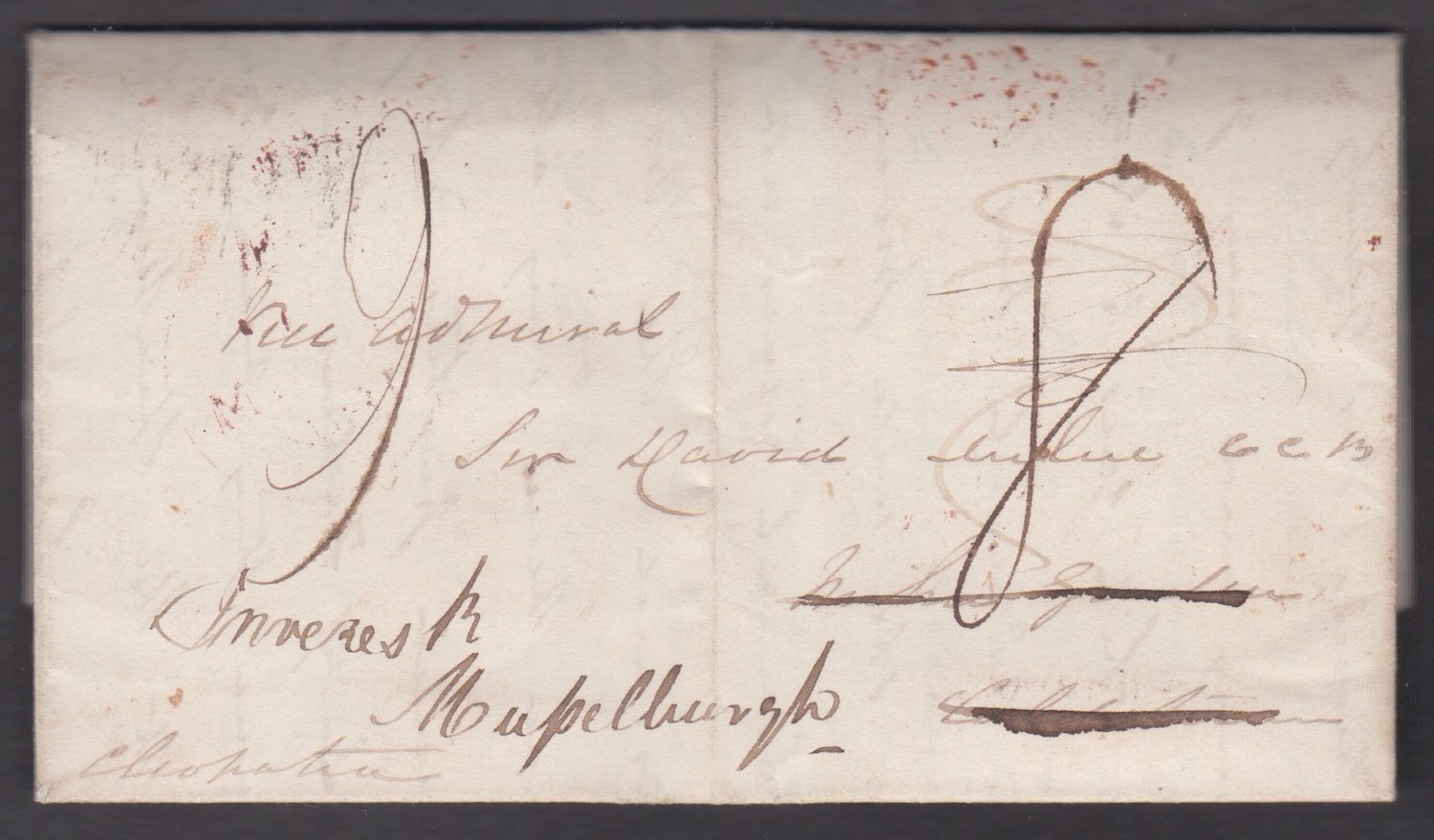
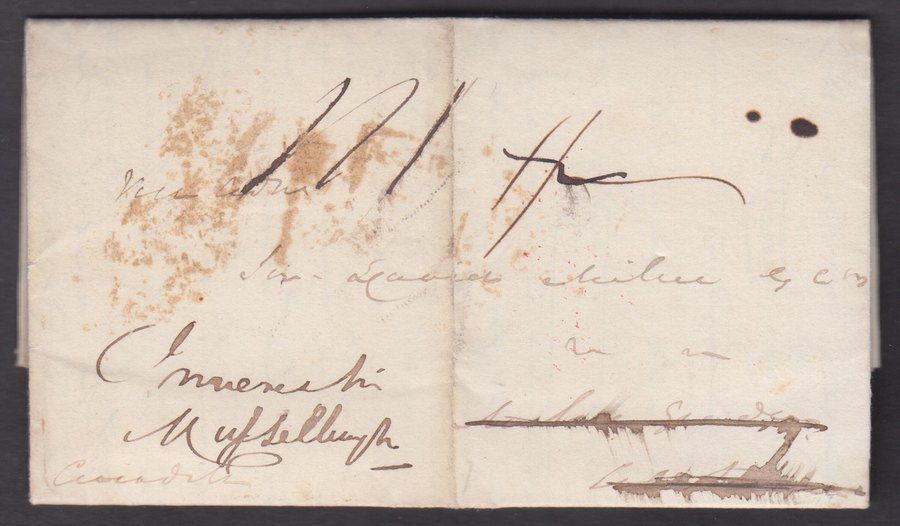
Folded entire addressed Vice Admiral Sir David Milne G.C.B., the original address Milne Graden, Coldstream struck through and redirected Inveresk, Musselburgh, charged 8 and then 9, with Cleopatra written faintly in the lower left corner
The entire folded, charged 8 then 9, with “Cleopatra” faint in the corner
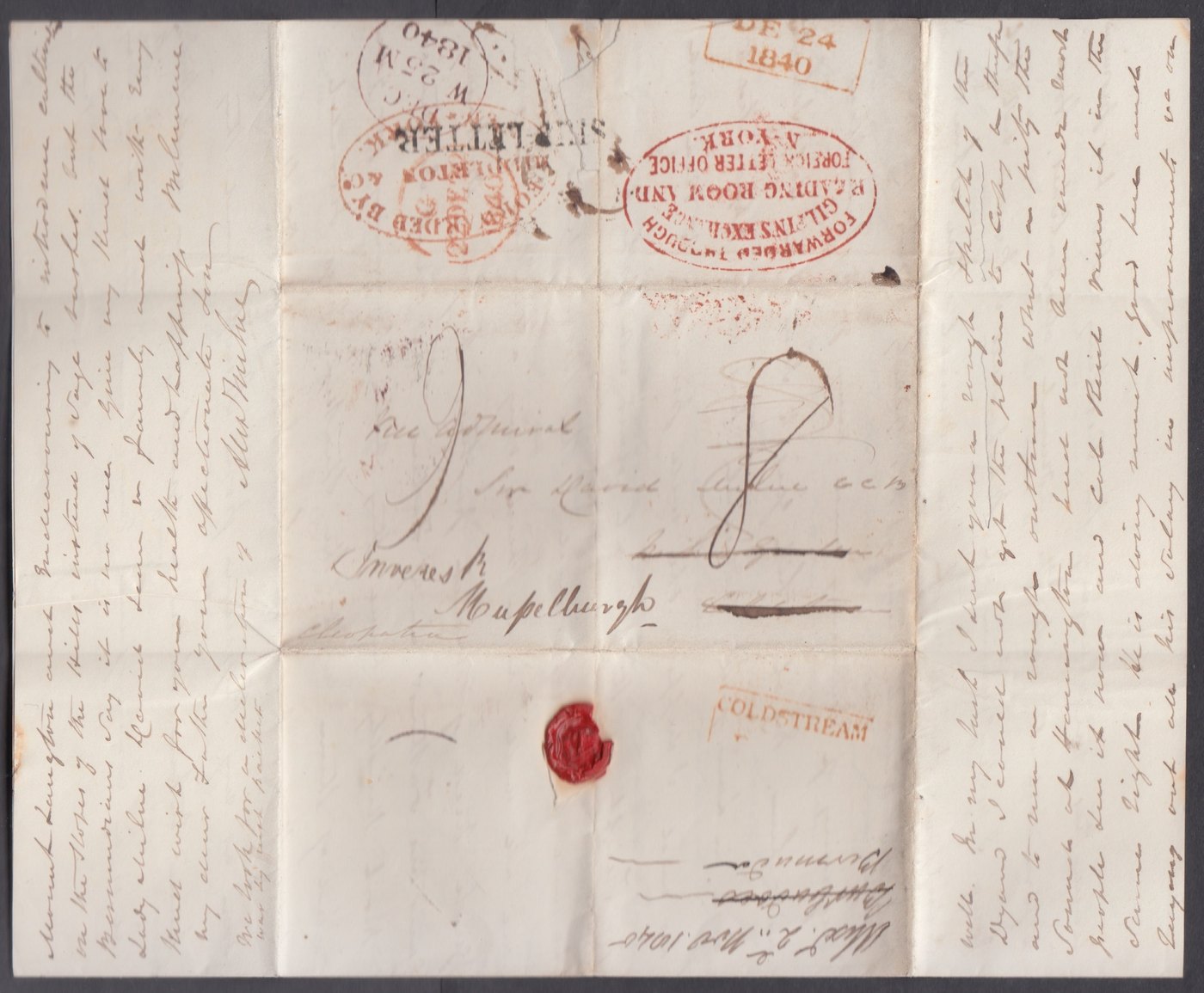
The outer sheet opened out, with the address panel in the centre, the side panels of the letter written up and down the edges, the New York forwarding agents’ red oval marks, the black SHIP LETTER and datestamps at the top upside down, the boxed DE 24 1840 and boxed COLDSTREAM in red, a red wax seal, and the docket at the foot
The outer sheet opened out: New York, London, Coldstream and Edinburgh
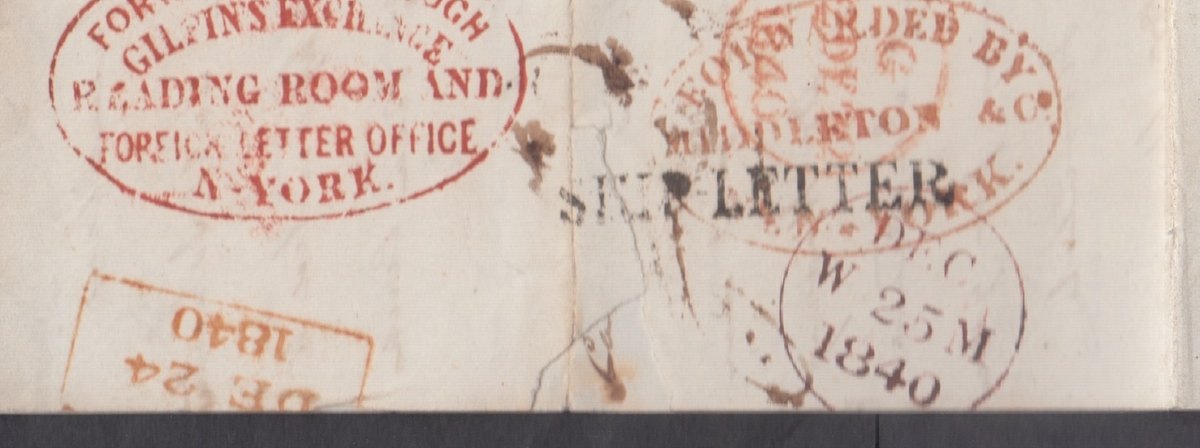
Close-up of the marks turned the right way up: the red oval FORWARDED THROUGH GILPIN’S EXCHANGE READING ROOM AND FOREIGN LETTER OFFICE N-YORK, the red oval FORWARDED BY MIDDLETON & Co NEW-YORK, the black SHIP LETTER, the black circular DEC W 25 M 1840, and the red boxed DE 24 1840 upside down at lower left
The two New York agents’ ovals, SHIP LETTER, and Edinburgh’s Christmas Day datestamp
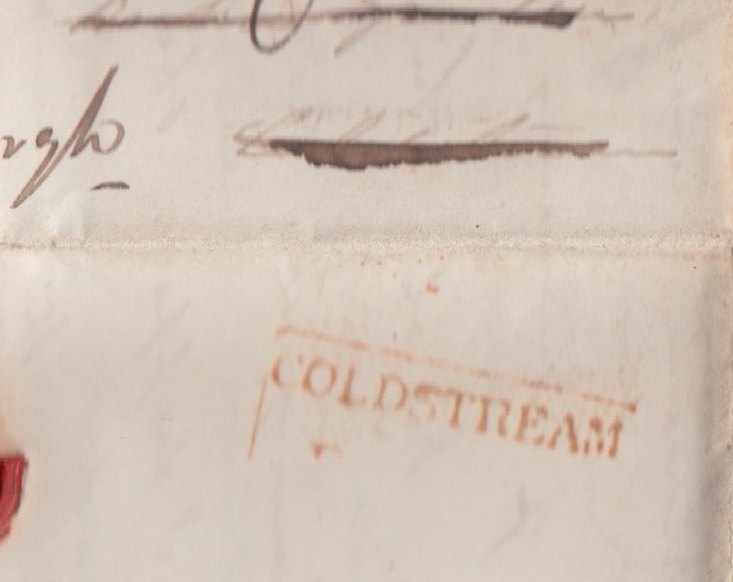
Close-up of the red boxed COLDSTREAM mark below the address panel
The boxed COLDSTREAM, with its date box DE 24 1840 struck separately
  • Item Entire letter, one sheet written on three sides and both outer panels
  • From Captain Alexander Milne, H.M.S. Cleopatra
  • To Vice-Admiral Sir David Milne, G.C.B., Milne Graden, Coldstream; redirected to Inveresk, Musselburgh
  • Written Bermuda, 2 November 1840 (“No. 35”)
  • Rate 8d ship letter rate, raised to 9d when sent on
  • Markings FORWARDED BY / MIDDLETON & Co / NEW-YORK and FORWARDED THROUGH / GILPIN’S EXCHANGE / READING ROOM AND / FOREIGN LETTER OFFICE / N-YORK, red ovals; SHIP LETTER, black; London, 22 December 1840; boxed COLDSTREAM and DE 24 1840, red; Edinburgh, 25 December 1840
  • Route With the Admiral’s despatches by private vessel to New York, probably the schooner Sally Evans; then by sea to London

Like the Crocodile letter, it’s an entire, addressed to “Vice Admiral / Sir David Milne G.C.B.” at Milne Graden, near Coldstream. It was sent on to Inveresk, Musselburgh, in the same darker hand, and in the bottom left corner, faint, is “Cleopatra”, in the same spot where he’d written “Crocodile” three days before. That settled it for me: Milne put his ship’s name in the corner of his letters home.

The back is crowded. Two New York forwarding agents handled it, and each put on its oval mark in red: “Forwarded by Middleton & Co, New-York” and “Forwarded through Gilpin’s Exchange Reading Room and Foreign Letter Office, N-York”. Agents like these collected letters arriving from the islands and passed them on to the next ship for Britain. Beside them is a plain black SHIP LETTER, the mark for a letter that came in by a private ship rather than a mail packet, and London’s datestamp of 22 December 1840. Then it went north: a boxed COLDSTREAM with a boxed date of 24 December, and Edinburgh’s datestamp of 25 December. It was in Edinburgh on Christmas Day.

It was charged 8d, the ship letter rate from 1840, and 9d when it was sent on from Coldstream. The Crocodile letter by Halifax had cost 1/-.

Sir David docketed it as usual, “Alexr 2nd Nov 1840”, and then wrote “Barbadoes” and crossed it out for “Bermuda”. The letter does say he was on his way to Barbados.
II

“In Command of my New Ship”

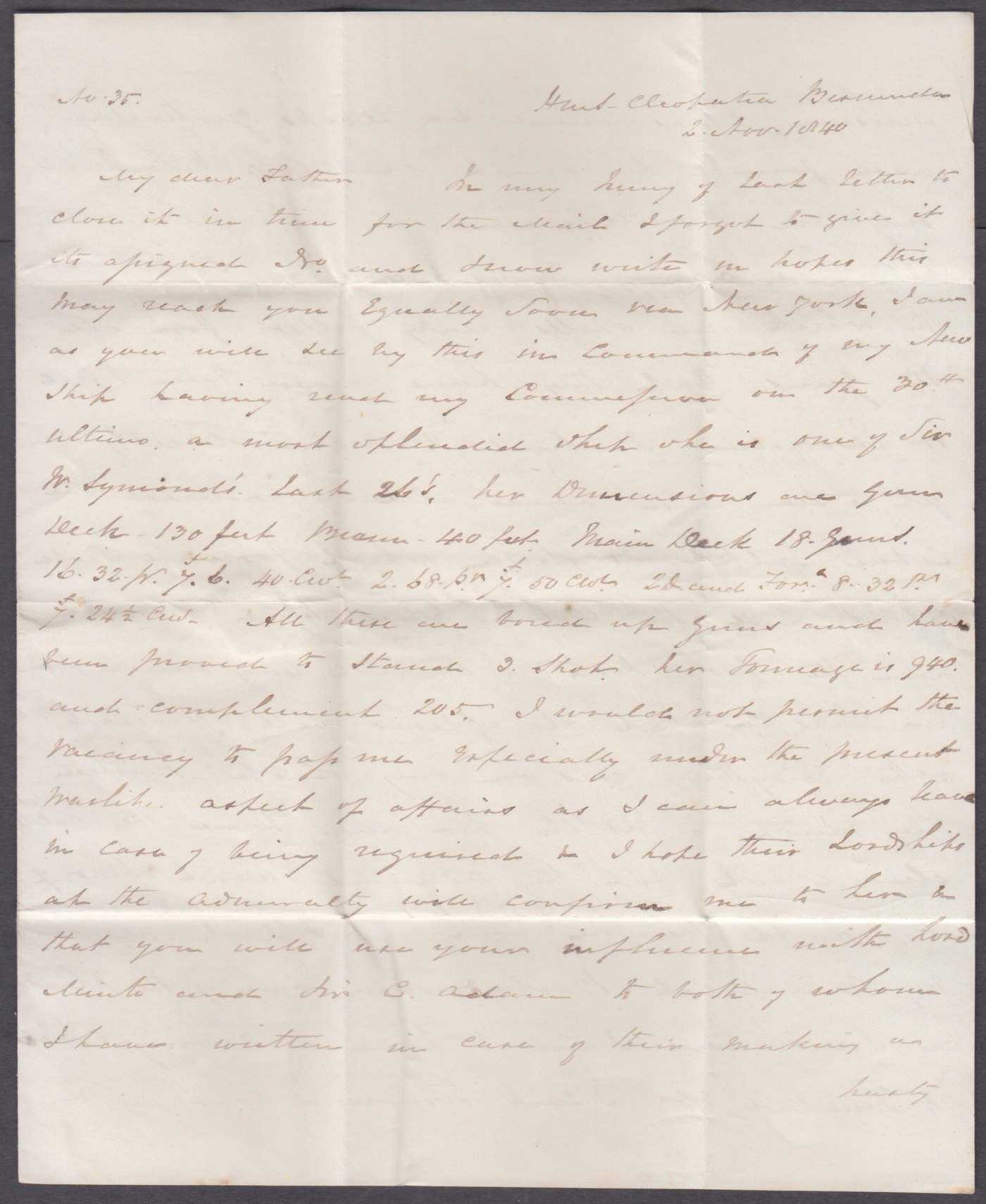
First page of the letter, headed No. 35, HMS Cleopatra Bermuda 2 Nov 1840, My dear Father, In my hurry of last letter to close it in time for the Mail I forgot to give it its assigned No.
“No. 35. H.M.S. Cleopatra Bermuda 2 Nov. 1840”: the first page
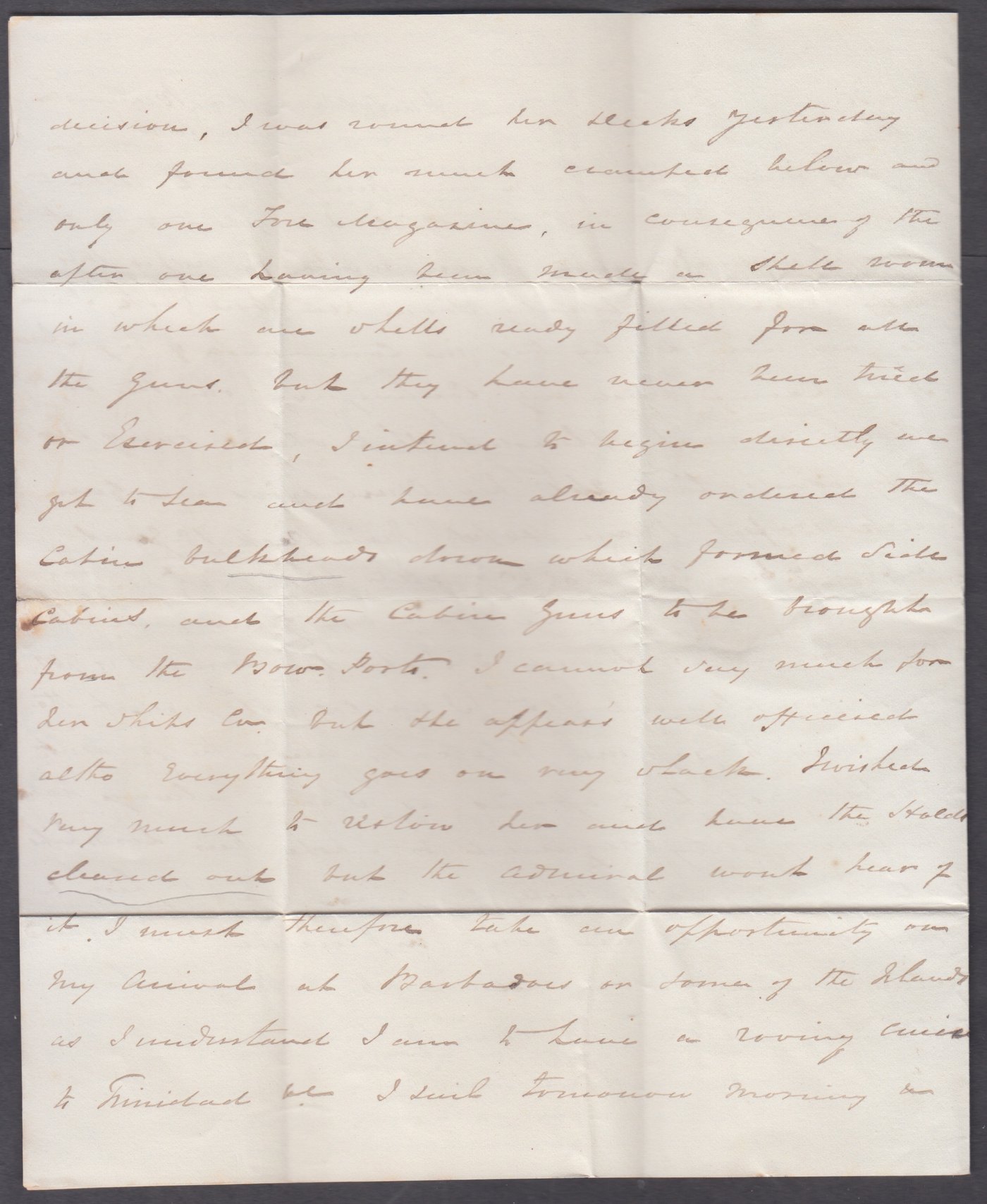
Second page of the letter, describing going round her decks, the shell room, the cabin bulkheads, her ship’s company, and the Admiral refusing to let him restow her
The second page: round her decks

He starts with an apology:

“In my hurry of last letter to close it in time for the Mail I forgot to give it its assigned No. and I now write in hopes this may reach you Equally soon via New York.”

So the Crocodile letter would have been No. 34, and he’d been numbering his letters home so his father could tell if one went missing.

“I am as you will see by this in Command of my New Ship having recd my Commission on the 30th ultimo, a most splendid ship she is one of Sir W. Symonds’ last 26s.”

He gives the details a naval father would want: 130 feet on the gun deck, 40 feet in the beam, eighteen guns on the main deck, 32-pounders and a pair of 68s, more 32s on the quarterdeck and forecastle, “her Tonnage is 940 and complement 205.” He makes no secret of why he took her: “I would not permit the vacancy to pass me especially under the present warlike aspect of affairs”. He hopes “their Lordships at the Admiralty will confirm me to her”, and asks his father to “use your influence with Lord Minto and Sir C. Adam to both of whom I have written”.

He’d been round her decks the day before and wasn’t impressed. He found her “much cramped below”, with only one magazine, because the after one had been made a shell room with “shells ready filled for all the Guns. But they have never been tried or Exercised.” He’d already ordered the cabin bulkheads down and the cabin guns brought from the bow ports. “I cannot say much for her Ship’s Co. but she appears well officered altho Everything goes on very slack.” He wanted to restow her and clear out the holds, as he’d just done with the Crocodile in the Basin, “but the Admiral won’t hear of it”. That would have to wait for Barbados, “as I understand I am to have a roving cruise to Trinidad &c.”

He sailed the next morning, he thought, and left the letter “in charge of the Secretary who has promised to forward it with the Admiral[’s] dispatches.” In fact the Cleopatra didn’t sail until Thursday 5 November.

III

“Quite tired of dinner parties”

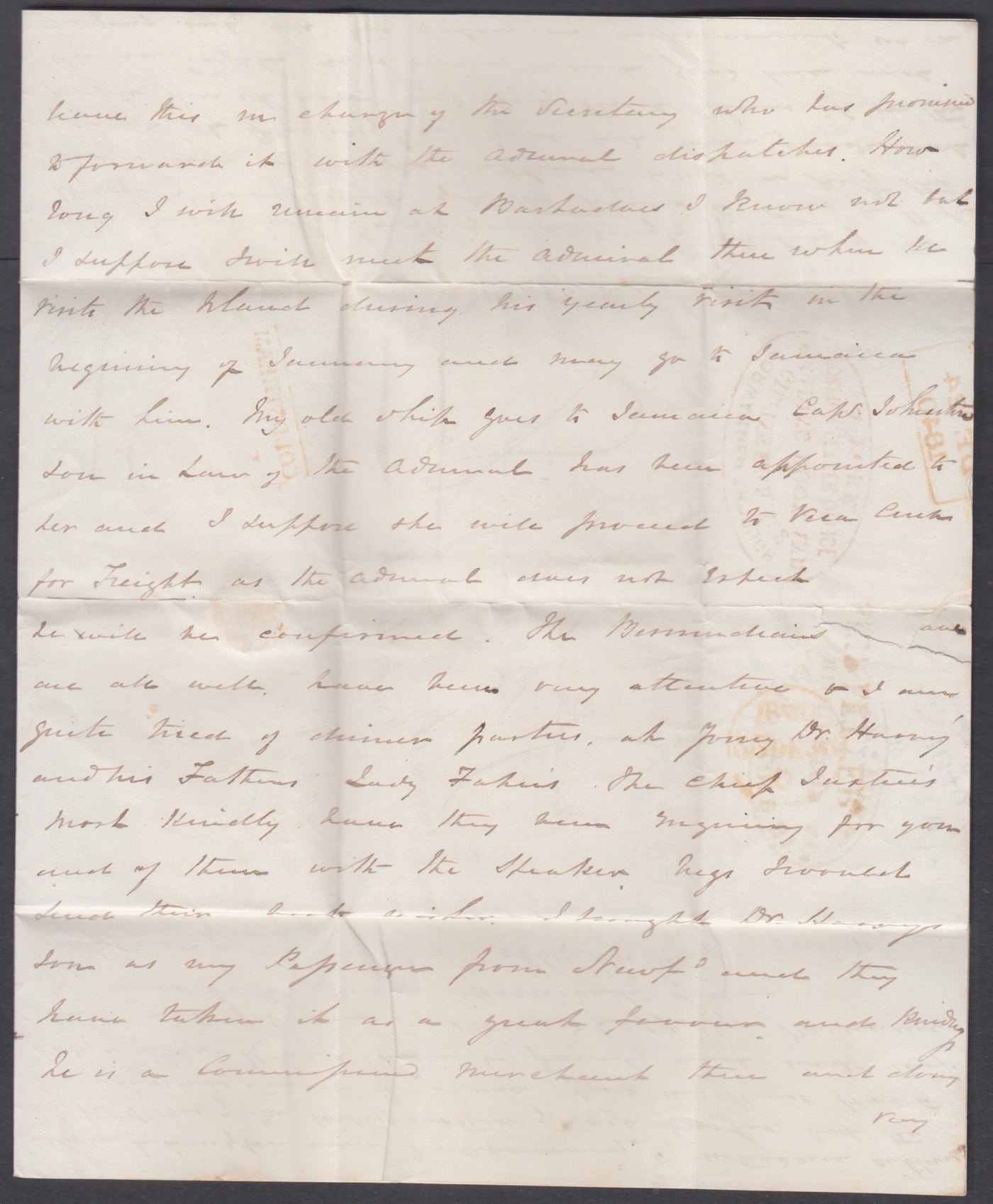
Third page of the letter, about the Admiral’s visit to the islands, his old ship going to Jamaica under Captain Johnson, and the Bermudians and their dinner parties
The third page: “My old ship goes to Jamaica”, and the dinner parties
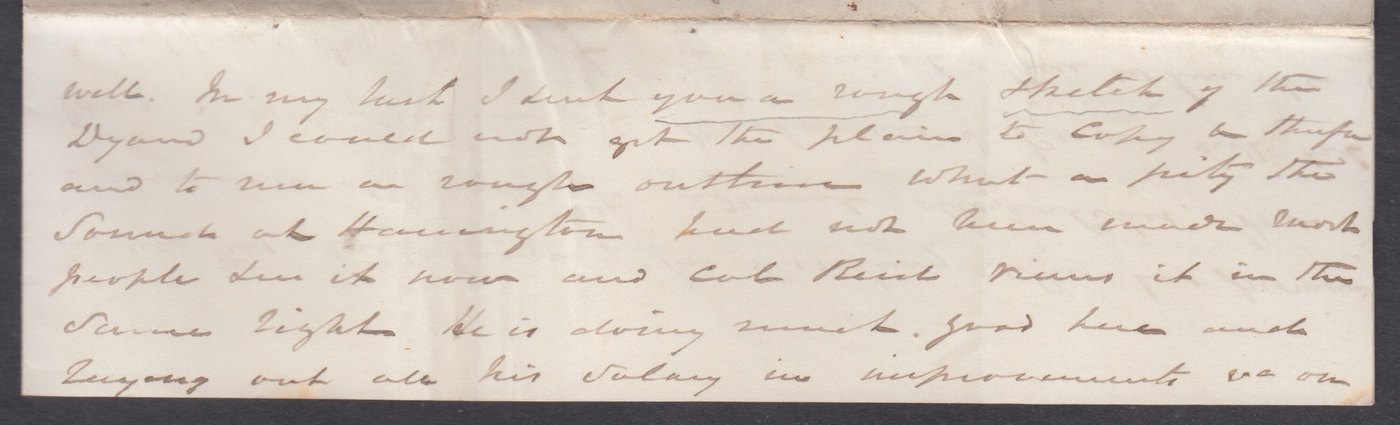
The letter continued on the right-hand outer panel: In my last I sent you a rough sketch of the Dyard, what a pity the Sound at Harrington had not been made, Col Reid views it in the same light, he is doing much good here
The right-hand outer panel: the sketch, Harrington Sound and Colonel Reid
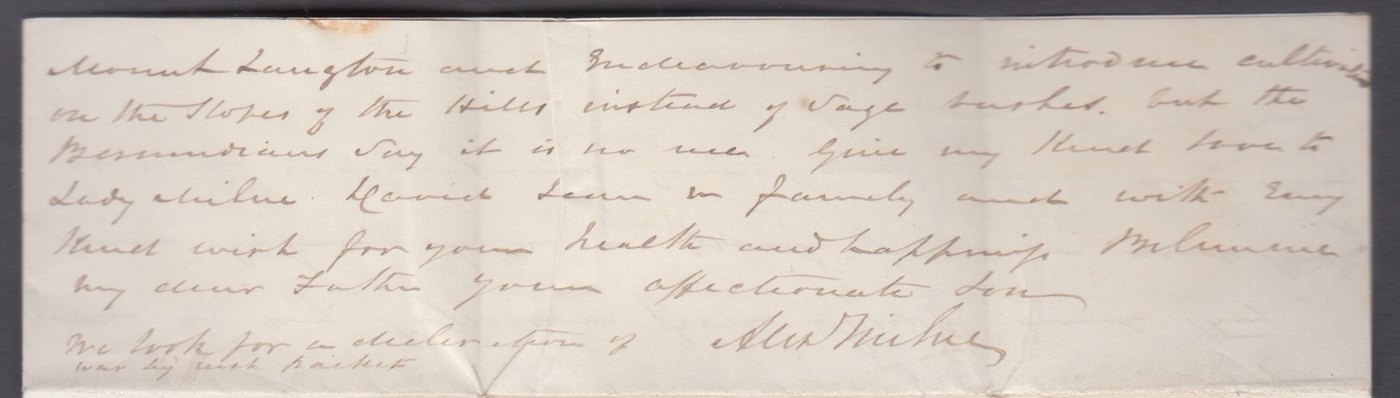
The end of the letter on the left-hand outer panel: Mount Langton and endeavouring to introduce cultivation on the slopes of the hills instead of sage bushes, love to Lady Milne, signed Alexr Milne, with a note below: We look for a declaration of war by next packet
The left-hand panel: Mount Langton, his signature, and “a declaration of war by next packet”
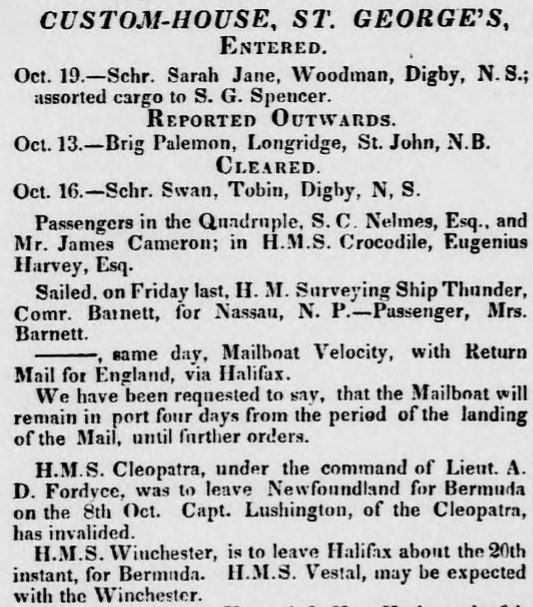
Royal Gazette shipping column naming Eugenius Harvey, Esq., as passenger in H.M.S. Crocodile, and reporting that H.M.S. Cleopatra under Lieut. A. D. Fordyce was to leave Newfoundland on the 8th October, Captain Lushington having been invalided
Royal Gazette, 20 October 1840: “in H.M.S. Crocodile, Eugenius Harvey, Esq.”
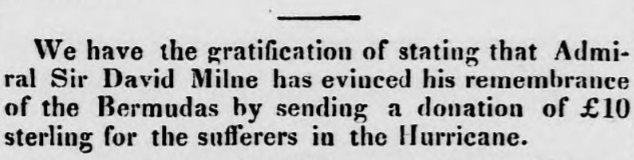
Royal Gazette: We have the gratification of stating that Admiral Sir David Milne has evinced his remembrance of the Bermudas by sending a donation of 10 pounds sterling for the sufferers in the Hurricane.
Royal Gazette, 17 November 1840: Sir David remembers Bermuda

He expected to meet the Admiral again at Barbados in January, on his yearly visit round the islands, and perhaps go on to Jamaica with him. Meanwhile:

“My old ship goes to Jamaica. Capt. Johnston Son in Law of the Admiral has been appointed to her and I suppose she will proceed to Vera Cruz for Freight as the Admiral does not expect he will be confirmed.”

“Freight” was the money a captain earned for carrying specie, and Vera Cruz was where the silver came from. If I’ve read it right, the Admiral expected the Admiralty to turn down his son-in-law’s acting command, and was giving him a profitable trip while he had it. The Gazette calls him Commander Johnson, from the Winchester, and in April 1841 it has him going back to the Winchester. I haven’t yet confirmed that he was Harvey’s son-in-law.

Then Bermuda society. “The Bermudians are all well, have been very attentive & I am quite tired of dinner parties”, at young Dr Harvey’s and his father’s, at Lady Fahie’s, and at the Chief Justice’s. Lady Fahie was the widow of Admiral Sir William Fahie, who had flown his flag at Bermuda in the Salisbury. He’d done the Harveys a good turn:

“I brought Dr Harvey’s son as my Passenger from Newfd and they have taken it as a great favour and kindness. He is a Commission Merchant there and doing very well.”

That’s the “Eugenius Harvey, Esq.” whom the Royal Gazette of 20 October lists as a passenger in the Crocodile.

On the outer panels he comes back to the dockyard: “In my last I sent you a rough sketch of the Dyard. I could not get the plans to copy & therefore send you a rough outline.” That’s the sketch in the Crocodile letter. He still thinks it “a pity the Sound at Harrington had not been made” the harbour, and says the Governor, Colonel Reid, “views it in the same light”. William Reid was spending his salary on improvements and, at Mount Langton, “endeavouring to introduce cultivation on the slopes of the hills instead of sage bushes, but the Bermudians say it is no use.”

He sends his love to Lady Milne, his stepmother, and the family, and signs off. Then, squeezed in under the signature:

“We look for a declaration of war by next packet.”

It never came. And a fortnight later the Royal Gazette reported that Sir David had sent £10 for the sufferers of the Bermuda hurricane, and I wonder whether his son had a hand in that.

IV

Two letters, two routes

The front of the Crocodile entire of 29 October 1840, addressed to Vice Admiral Sir David Milne, redirected to Inveresk, Musselburgh, charged 1/- and 1/1, with Crocodile written faintly in the corner
The Crocodile letter of 29 October, sent by Halifax
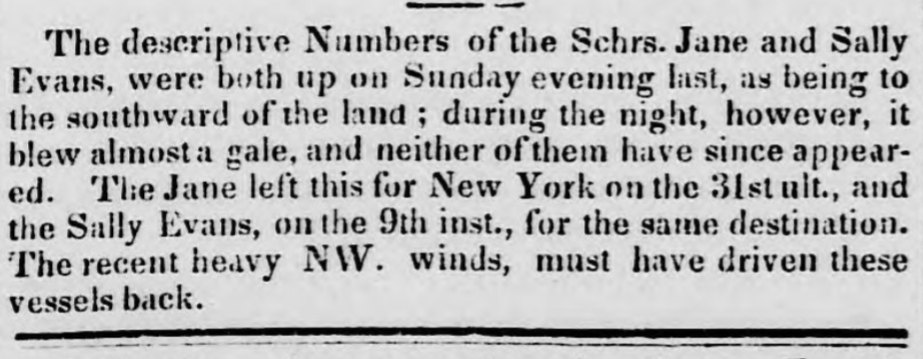
Royal Gazette: The descriptive Numbers of the Schrs. Jane and Sally Evans were both up on Sunday evening last, as being to the southward of the land; during the night however it blew almost a gale, and neither of them have since appeared. The Jane left this for New York on the 31st ult., and the Sally Evans on the 9th inst., for the same destination.
Royal Gazette, 17 November 1840: the Jane and the Sally Evans, both for New York

He wrote these two letters three days apart, to the same address, and sent them home by different routes.

  • Crocodile, 29–30 October Mail-boat to Halifax, then steamer. 1/- packet rate, 1/1 redirected. Coldstream 17 December, Edinburgh 18 December.
  • Cleopatra, 2 November Admiral’s despatches by private vessel to New York, then by sea to London. 8d ship letter, 9d redirected. London 22 December, Coldstream 24 December, Edinburgh 25 December.

The packet letter cost more and got there first.

In the Crocodile letter he’d said “a vessel sails for New York on Monday”, meaning 2 November, the date of this letter. The Royal Gazette shows two schooners leaving for New York: the Jane on 31 October and the Sally Evans on Monday 9 November. The Sally Evans was reported outwards for New York on 3 November, so she’s probably the one, a week late. If so, the letter had a rough start. The paper of 17 November says both schooners were sighted south of the island on the Sunday evening, then it blew almost a gale, and neither had been seen since.

V

“Vice A. Milne, to the Crocodile”

Royal Gazette: H. M. Ships Seringapatam, Cleopatra, Ringdove, and Griffon, at Barbados, 16th ult.
Royal Gazette, 19 January 1841: Cleopatra at Barbados on 16 December
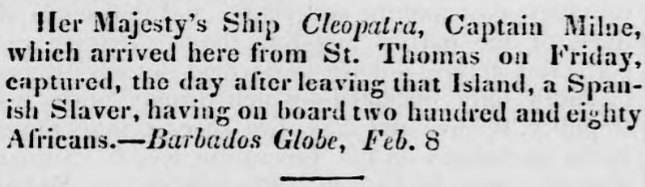
Royal Gazette quoting the Barbados Globe of 8 February: Her Majesty’s Ship Cleopatra, Captain Milne, which arrived here from St. Thomas on Friday, captured, the day after leaving that Island, a Spanish Slaver, having on board two hundred and eighty Africans.
Royal Gazette, 6 April 1841, from the Barbados Globe of 8 February: a Spanish slaver taken
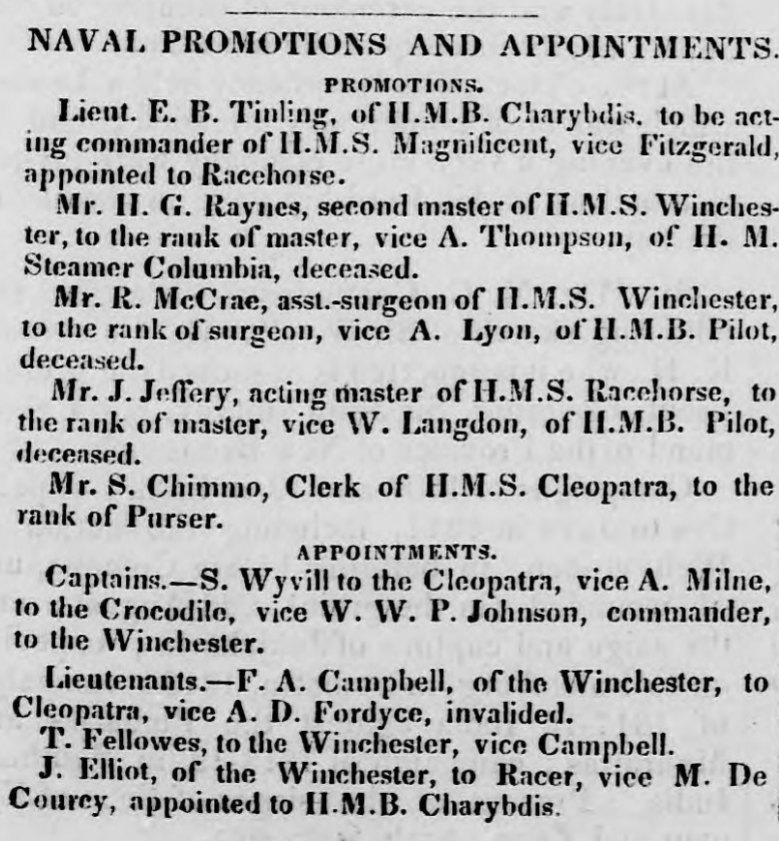
Royal Gazette: Naval Promotions and Appointments. Appointments. Captains: S. Wyvill to the Cleopatra, vice A. Milne, to the Crocodile, vice W. W. P. Johnson, commander, to the Winchester. Lieutenants: F. A. Campbell, of the Winchester, to Cleopatra, vice A. D. Fordyce, invalided.
Royal Gazette, 6 April 1841: Wyvill to the Cleopatra, Milne back to the Crocodile

The Cleopatra was at Barbados with the Seringapatam, Ringdove and Griffon on 16 December. Milne got his roving cruise, and it paid off. The Barbados Globe of 8 February 1841, copied into the Royal Gazette, reported that the Cleopatra, “Captain Milne, which arrived here from St. Thomas on Friday, captured, the day after leaving that Island, a Spanish Slaver, having on board two hundred and eighty Africans.” That was probably the Mercedita, the Spanish slaver that O’Byrne records as Milne’s prize.

But the confirmation he’d asked his father to help with never came. The Admiralty had already chosen its own man. Christopher Wyvill was appointed to the Cleopatra from home in January 1841, and Milne handed her over on 16 February and went back to the Crocodile. The Royal Gazette of 6 April 1841 printed the appointments in one line: “Captains. S. Wyvill to the Cleopatra, vice A. Milne, to the Crocodile, vice W. W. P. Johnson, commander, to the Winchester.” (The Gazette has “S.” for Wyvill’s initial.) Johnson went back to the flagship, so the Admiral had been right about him too.

Milne took the Crocodile home that autumn and paid her off. In 1842 he became flag captain to his father at Plymouth, and he went on to become Admiral of the Fleet Sir Alexander Milne. Four years before these letters, a letter on the President page has him waiting for any ship at all.

October 1840 to February 1841

The ship on one side, the letter on the other.

The ship
The letter
8 Oct
The shipCleopatra leaves Newfoundland under Lieutenant Fordyce; Captain Lushington has been invalided.
Tue 20 Oct
The shipArrives at Bermuda, a day behind the Crocodile.
Thu 29 Oct
The shipThe Admiral arrives in the Winchester.
The letterMilne’s Crocodile letter, No. 34, goes by Halifax.
Fri 30 Oct
The shipMilne receives his commission for Cleopatra.
Sat 31 Oct
The shipHe joins her.
Sun 1 Nov
The shipHe goes round her decks.
Mon 2 Nov
The letterNo. 35 written; left with the Admiral’s secretary.
Thu 5 Nov
The shipSails for Barbados; the Crocodile for Jamaica.
Mon 9 Nov
The letterThe schooner Sally Evans sails for New York, probably with the despatches.
16 Dec
The shipAt Barbados.
22–25 Dec
The letterLondon 22 December, Coldstream 24 December, Edinburgh on Christmas Day.
Early Feb 1841
The shipCaptures a Spanish slaver with 280 Africans on board after leaving St Thomas.
16 Feb 1841
The shipMilne hands her over to Wyvill and goes back to the Crocodile.

The Ship

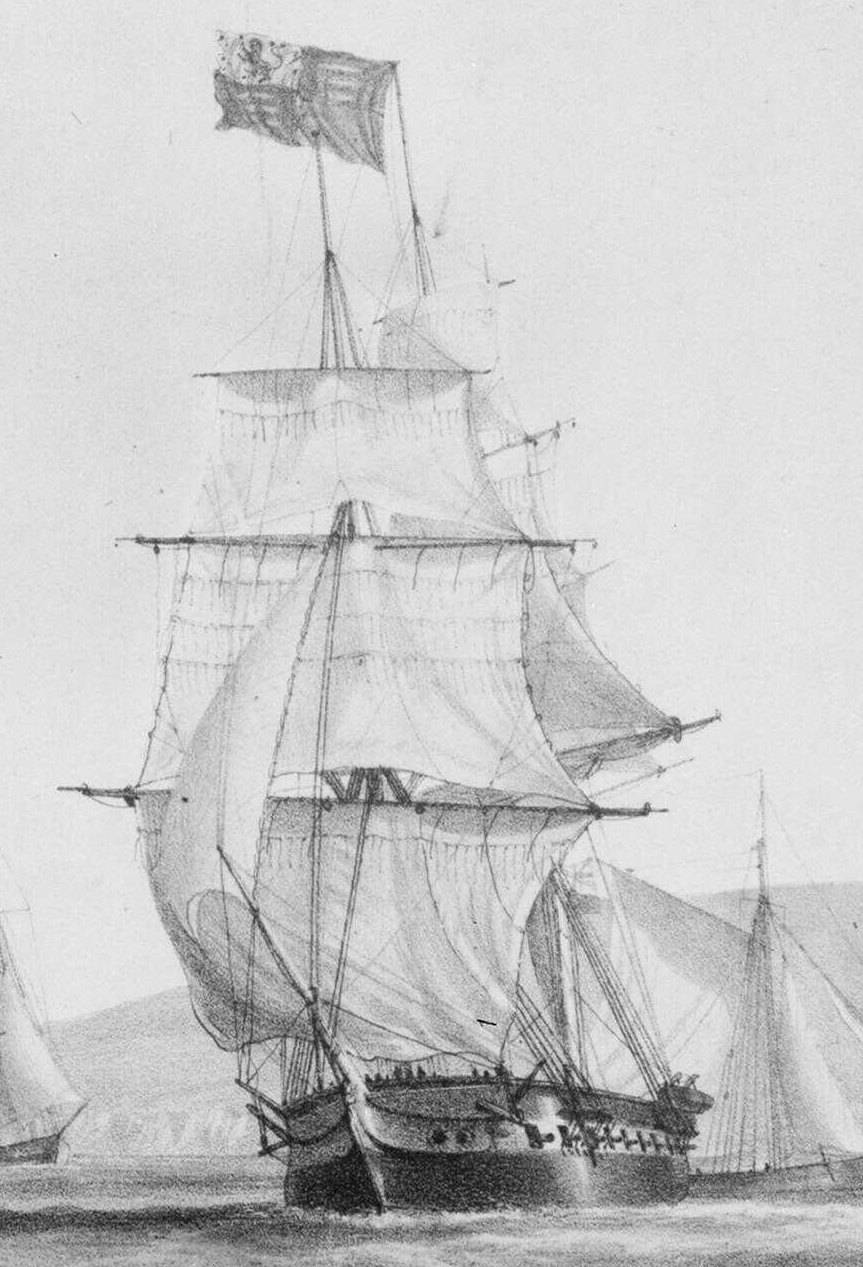
Lithograph after John Christian Schetky of H.M.S. Vestal, sister ship of the Cleopatra, under sail with the Royal Standard flying at the main

H.M.S. Cleopatra

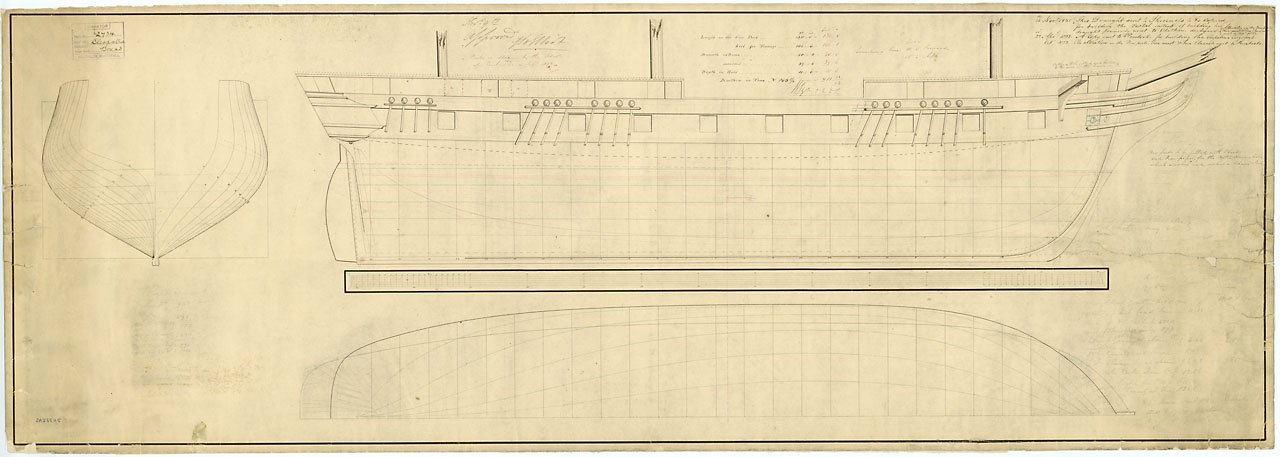
H.M.S. Cleopatra was one of three Vestal-class 26-gun sixth rates designed by Sir William Symonds, Surveyor of the Navy, the “Sir W. Symonds’ last 26s” of Milne’s letter. She was built at Pembroke Dockyard and launched on 28 April 1835. After service in South America she came out to the North America and West Indies station in 1839 under Captain Stephen Lushington. Lushington was invalided in the autumn of 1840, which made the vacancy Milne took. Milne had her from 31 October 1840 to 16 February 1841, and Christopher Wyvill from then until she went home to pay off in 1842. She was an accommodation ship in 1857–58 and was sold for breaking up in 1862.

There’s no picture of the Cleopatra herself that I know of. The lithograph above is her sister ship Vestal, flying the Royal Standard because the Duchess of Kent and the young Princess Victoria were on board.

BuiltPembroke, 1835
Type26-gun sixth rate (Vestal class)
Tonnage940 (Milne’s figure); complement 205
CaptainAlexander Milne, 31 October 1840 – 16 February 1841
FateSold, 1862

His Majesty’s Ship the Vestal frigate, after John Christian Schetky, engraved by George Philip Reinagle, printed by Charles Joseph Hullmandel, published by J. Dickinson. Royal Museums Greenwich, via Wikimedia Commons (public domain). Plan below: © National Maritime Museum, Greenwich, London.

Admiralty plan of the Cleopatra showing the body plan, sheer profile with gun ports, and half breadth
Admiralty plan of the Cleopatra. National Maritime Museum, Greenwich.

Still to find out

If you can help with any of these, I’d be very pleased to hear from you.

Provenance and references

I like to think of Sir David opening this one on Christmas Day, a week after the Crocodile letter, and finding the same son, already settled in, complaining about the crew and the dinner parties. Two weeks later the Admiralty gave the ship he was so pleased with to someone else. Neither of them knew that yet.