Postal History · Packet Letter · Royal Navy

H.M.S. Salisbury

Guernsey · Falmouth · Halifax · Bermuda · December 1823 – March 1824

Written the day before his aunt’s letter, to the same young man, and sent the other way.

◆

This entire was written in Guernsey on Christmas Eve 1823, to “Mr D. De Sausmarez, H.M. Ship Salisbury, Bermuda”. It’s the same young man as my Argus letter, which his aunt wrote the very next day. Hers went out from London by private ship. This one went by the Falmouth packet, paid 2/3 in Guernsey, and it is crossed so densely that it takes real patience to read.

It’s from one of his sisters, with a postscript from their father, and it’s full of the news he was waiting for: Sir James Saumarez had been given the Plymouth command, and had promised to help with Durell’s promotion. It’s amazing to me that the two letters, written a day apart, have ended up together in my collection. They are the two earliest items addressed to a ship at Bermuda that I have seen.

I

“Mr”, not “Lieutenant”

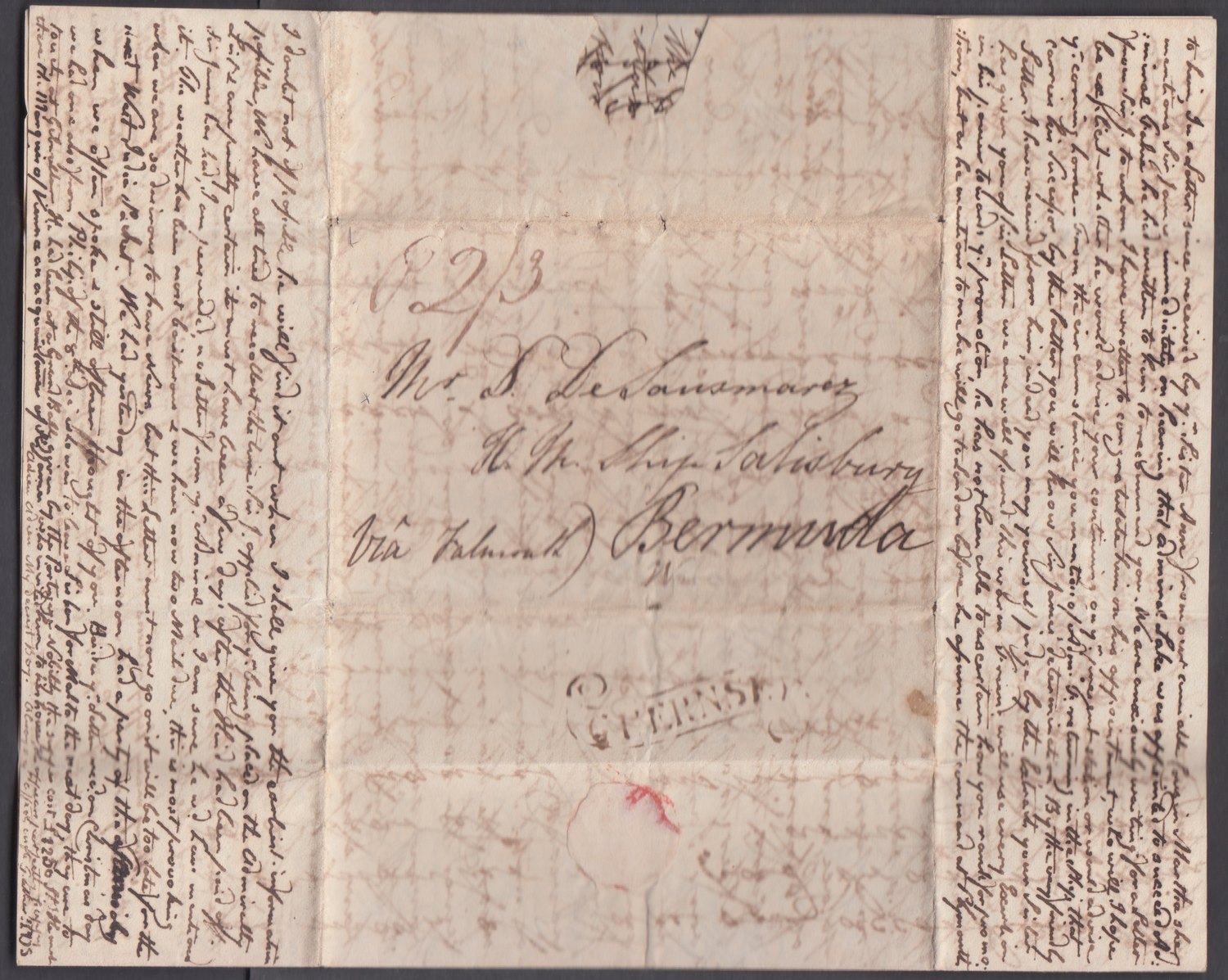
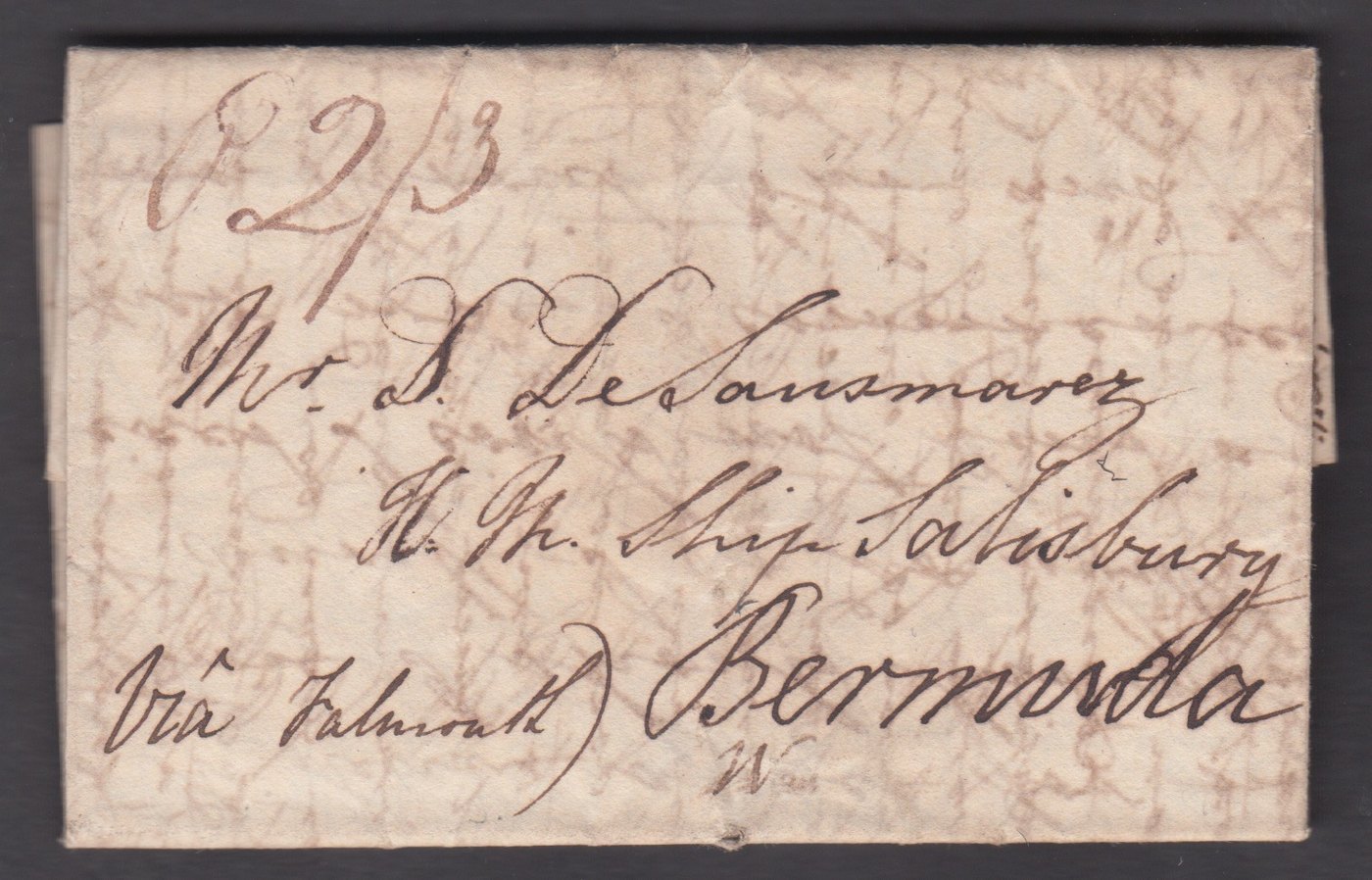
The folded entire, addressed in ink to Mr D. De Sausmarez, H.M. Ship Salisbury, Bermuda, with via Falmouth at the left and a large manuscript P 2/3 in red-brown ink at the top left; the whole sheet is cross-written, with the lines of the letter showing faintly through
The entire folded, as it went through the post
The outer sheet opened out: the address panel in the middle with P 2/3, the GUERNSEY scroll namestamp below the address, the broken red wax seal at the foot, and the father’s postscript written up the side panels
The outer sheet opened, with the GUERNSEY scroll and the red seal
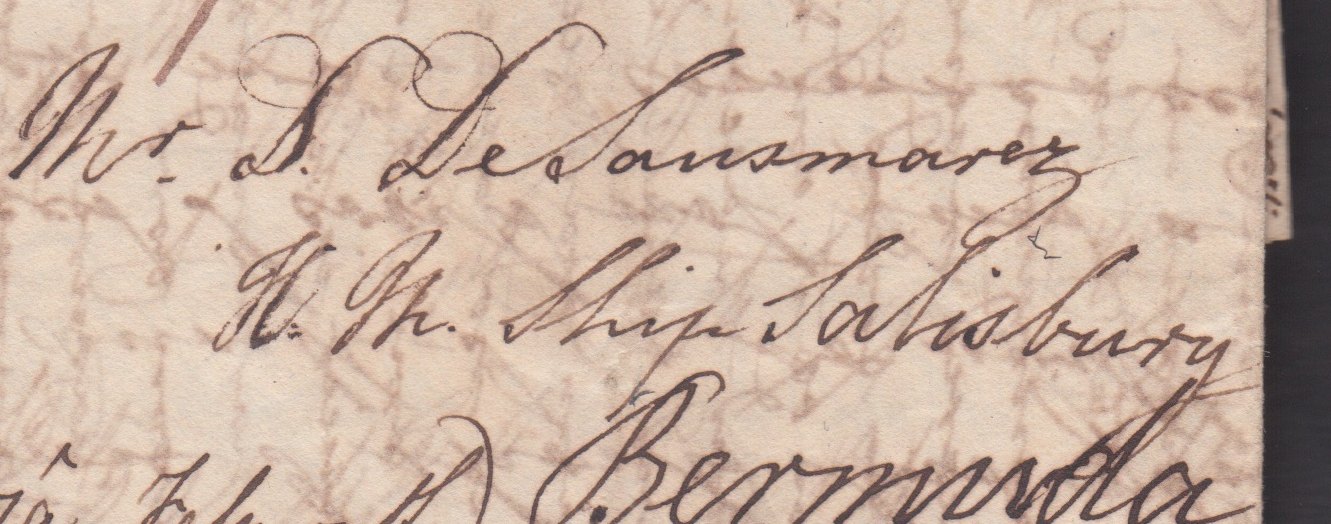
Close-up of the address: Mr D. De Sausmarez, H.M. Ship Salisbury, Bermuda, with via Falmouth at the left; nothing is crossed out or changed
“Mr D. De Sausmarez, H.M. Ship Salisbury”, never changed
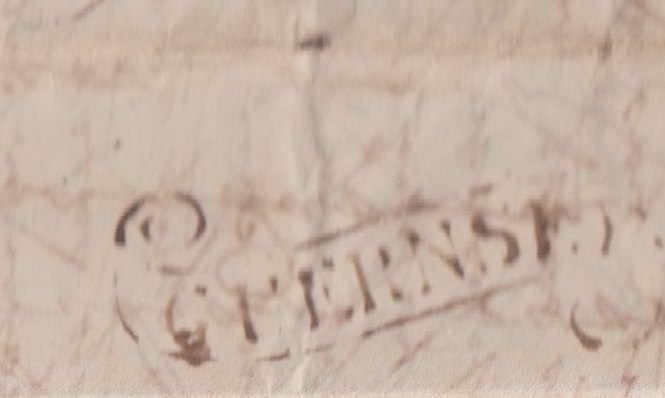
Close-up of the GUERNSEY namestamp in a curved scroll frame, struck in black, partly faint at the end
The GUERNSEY scroll namestamp, second type, without a full stop
  • Item Entire, cross-written, red wax seal
  • Written Guernsey, 24 and 26 December 1823; postscript 7 January 1824
  • From one of his sisters, with a postscript from his father, Thomas de Sausmarez (“T.D.S.”)
  • To Mr D. De Sausmarez, H.M. Ship Salisbury, Bermuda, “via Falmouth”
  • Handstamp GUERNSEY in a scroll, second type (no full stop)
  • Charge P 2/3 in manuscript, paid: 1/1 packet postage across the Atlantic, 1/2 from Guernsey to Falmouth
  • Carried by the January packet, the Lady Wellington, to Halifax; down to Bermuda in H.M.S. Argus, 11 March 1824

Look at the address first: “Mr D. De Sausmarez, H.M. Ship Salisbury, Bermuda”. In 1823 “Mr” was how you addressed a midshipman or master’s mate, a young officer still waiting for his commission. On my Argus entire, written by his aunt the very next day, someone has struck out the “Mr” and written “Lt” in its place, and crossed out “Salisbury” for “Argus”. This one was never touched. It still says “Mr”, and it still says “Salisbury”, just as his family wrote it.

That fits the letter exactly. The whole family was waiting on his promotion, and Sir James Saumarez was promising to “accelerate” it. It didn’t come until 10 May 1824. So the two entires, side by side, show both halves of the story: “Mr” while they waited, and “Lt” once it came through.

The address is in his father’s hand, with “via Falmouth” at the left. The red-brown “P 2/3” at the top means it was paid in Guernsey: two shillings and threepence. Of that, 1/1 was the packet postage from Falmouth across the Atlantic. That was the rate the General Post Office set for any letter by packet between Britain and the West Indies or North America, “over and above all other rates”, with the inland postage to Falmouth added on top (Edward B. Proud, The Postal History of Bermuda, p. 142). The other 1/2 took it from Guernsey to Weymouth by the Channel Islands packet and on by road to Falmouth. The album page it came to me on splits the rate differently, with 1/3 for the sea passage, but that doesn’t fit the regulation.

On the outer sheet, under the address, is the GUERNSEY namestamp in a curved scroll frame. The album page explains that there were two types: the first with a full stop after GUERNSEY, recorded 1810–17 and again 1829–30, and the second without one, recorded 1817–30. They wore out slowly, and a datestamp came in in 1830. Mine is the second type, without the full stop, which fits a letter of 1823. The album page also notes that “Only a handful of pre-1840 letters from the Channel Islands to Bermuda have been recorded.”

II

“You proved yourself a true prophet”

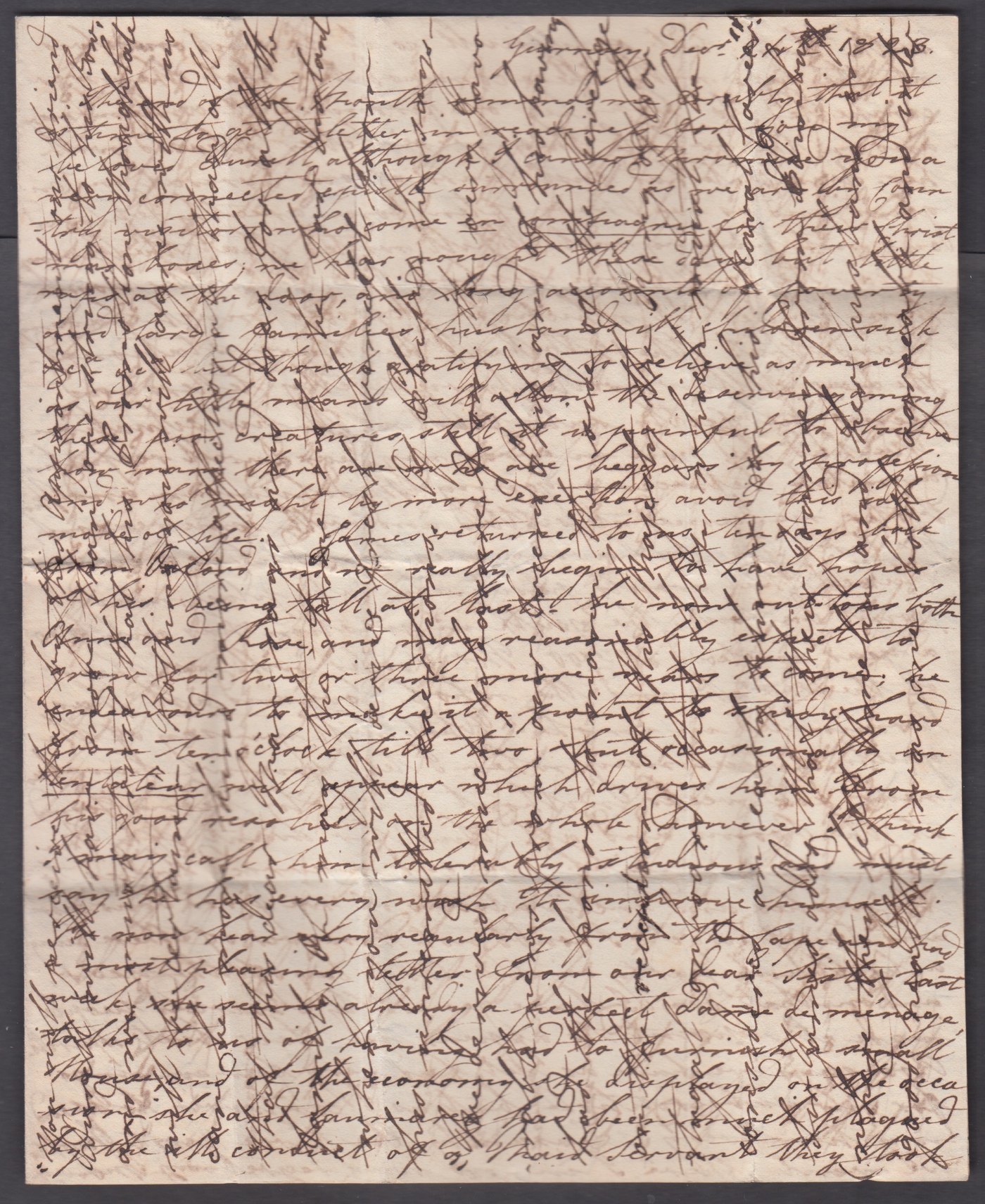
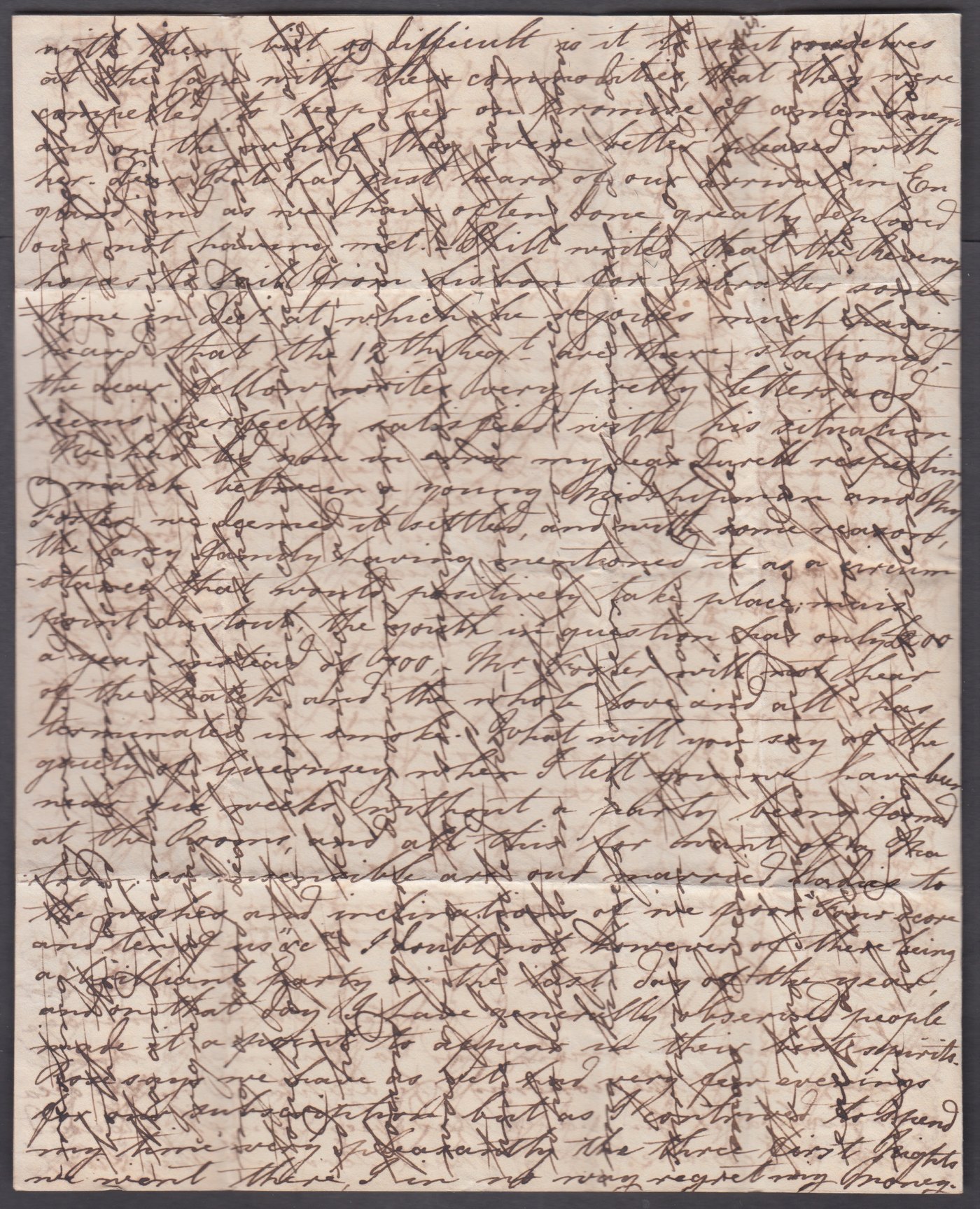
The first page of the letter, headed Guernsey, Decr 24th 1823, written in a neat sloping hand and then cross-written at right angles over the whole page
Page one: “Guernsey, Decr 24th 1823”
The second page of the letter, cross-written, with news of Kate at the Cape and Phil at Lisbon and the gaiety of Guernsey
Page two: Kate, Phil, and six weeks without a party
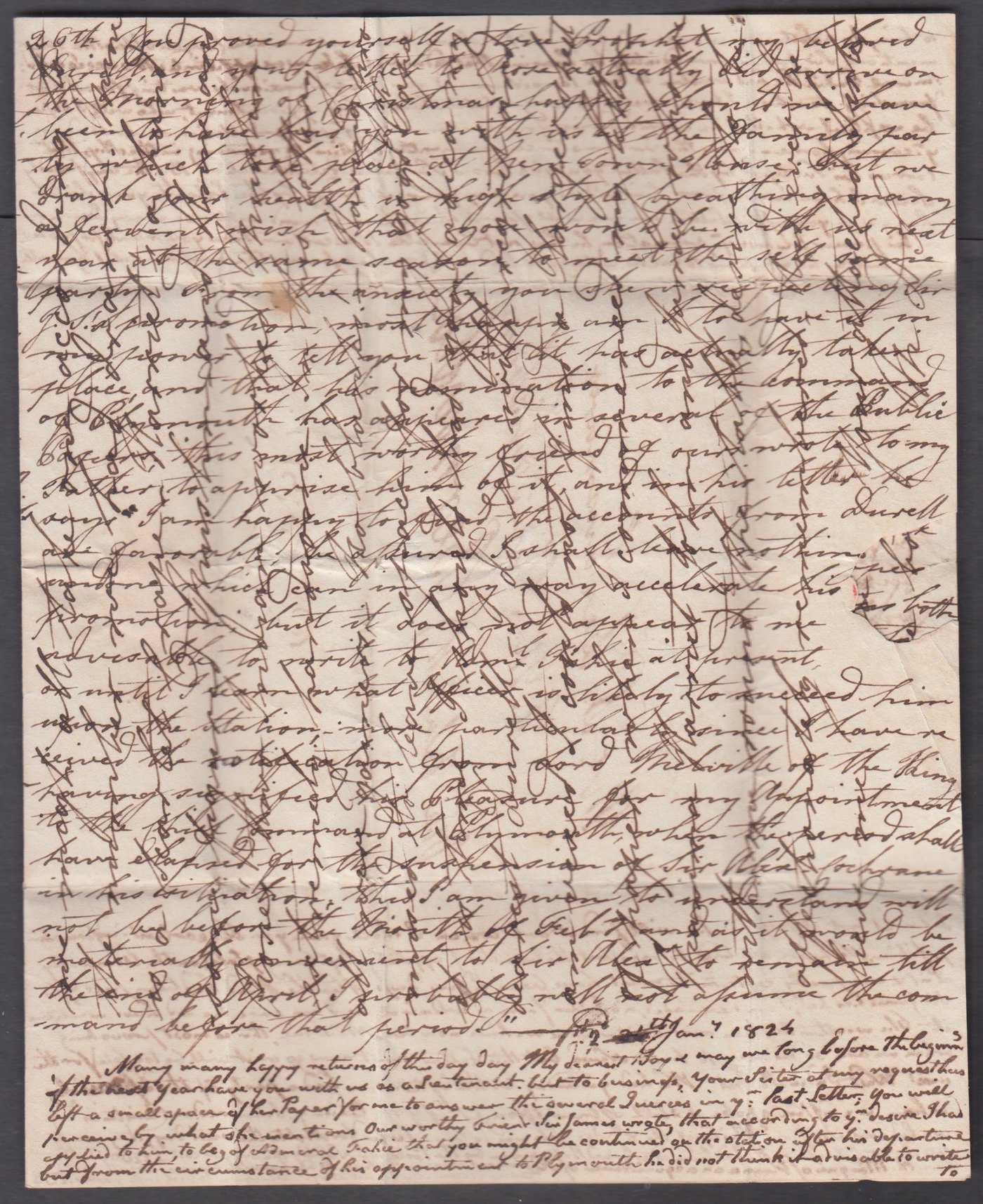
The third page of the letter, cross-written, continued on the 26th with the copy of Sir James Saumarez’s letter, and the father’s postscript dated 7th Jany 1824 squeezed in at the foot
Page three: the 26th, Sir James’s letter, and the father’s postscript

The letter is from one of his sisters. She doesn’t sign a name I can read, and her signature is lost in the tear on the third page. It reads like Christmas in a big, busy house, which it was: their father, Thomas de Sausmarez, is said to have had 28 children.

“The end of the month reminds me forcibly that it is time to get a letter in readiness for you my beloved Durell, although I cannot promise you a very connected epistle”

The house was full of callers asking for their Christmas boxes, with “long accounts of poverty and large families, husbands ill, children sick”. Brother James was home from Oxford, and “we really begin to have hopes of his being tall at last! he now out-tops both Anne and Rose”. Their sister Kate was at the Cape, already “a perfect Dame de ménage”, though she and Saumarez had been “much plagued by the ill conduct of a maid servant”. Phil wrote that the Revenge hoped to sail from Lisbon for Gibraltar. Philip de Sausmarez had joined the Revenge as a first-class volunteer that June. There’s Guernsey gossip too: a match that came to nothing, and near six weeks “without a party being formed at the Rooms”.

Then on the 26th she picks it up again:

“You proved yourself a true prophet my beloved Durell, and your letter to Rose actually did arrive on the morning of Christmas day; how happy should we have been to have had you with us at the family party which took place at New Town House”

New Town House is where Aunt Mary de Havilland wrote my Argus letter that same Christmas Day, and she’s in this letter too, as “your dear Aunt Mary who delights in nothing so much as bestowing kindness on others”.

The real news was Sir James Saumarez, the admiral and family friend. His appointment to the Plymouth command “has appeared in several of the Public papers”, and she copies out what he had written to their father:

“I am happy to find the accounts from Durell are favourable; be assured I shall leave nothing undone which can in any way accelerate his promotion, but it does not appear to me advisable to write to Admiral Fahie at present”

Sir James explained that he wasn’t to take over at Plymouth from Sir Alexander Cochrane until the end of April. The crossed lines carry on with the same letter: “our friend Durell will have more than one string to his bow”.

III

“Many many happy returns of the day”

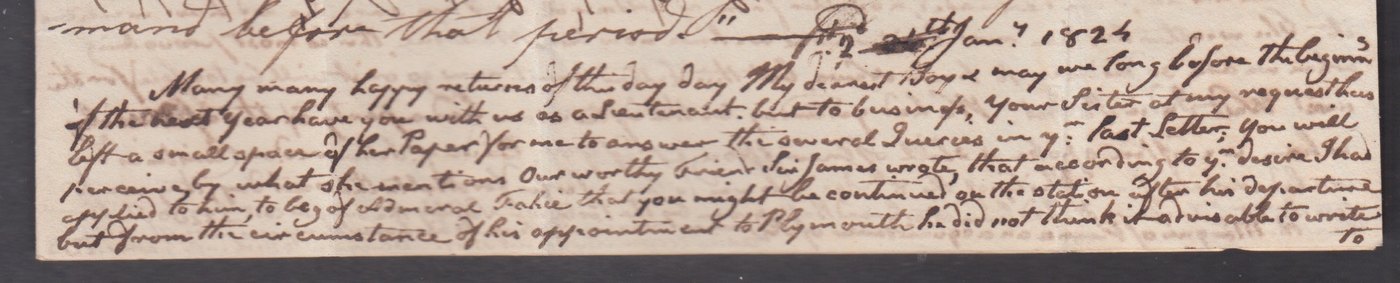
The father’s postscript at the foot of page three, dated 7th Jany 1824, beginning Many many happy returns of the day My dearest Boy, in a different, more upright hand
The postscript begins, 7 January 1824
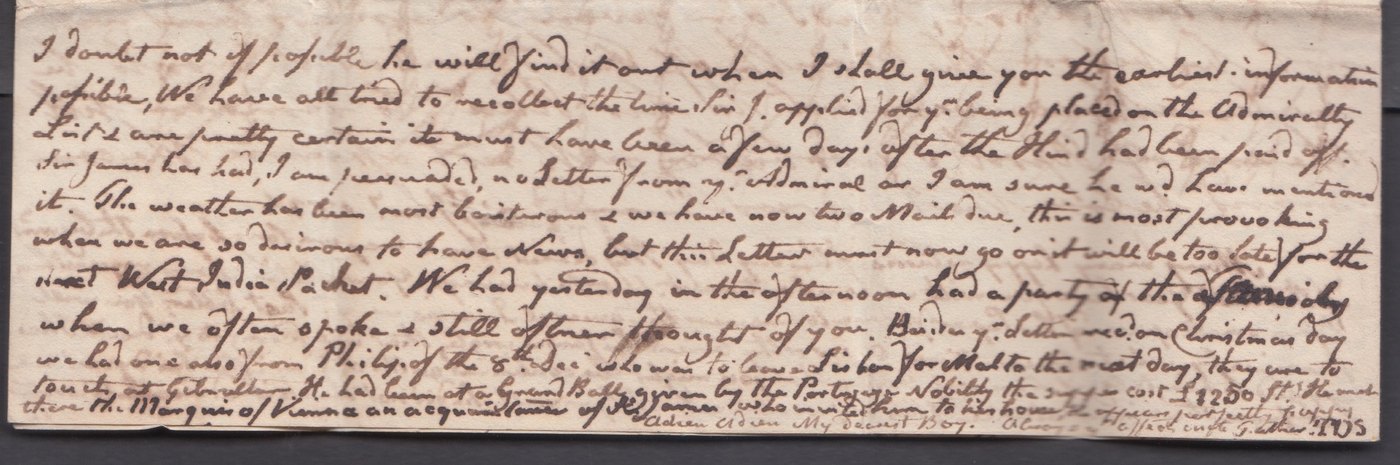
The postscript continued up the side panel of the outer sheet, ending Adieu Adieu My dearest Boy, Always yr affecte Father T.D.S.
Continued round the outer sheet, signed “T.D.S.”

Their father wrote the rest on 7 January, in the space she had left him, and then right round the outer sheet. He signs it “T.D.S.”: Thomas de Sausmarez, Durell’s father.

“Many many happy returns of the day My dearest Boy & may we long before the beginning of the next Year have you with us as a Lieutenant, but to business.”

“Many happy returns of the day” on 7 January makes me think it was Durell’s birthday. Then down to business. Sir James, on hearing that Admiral Lake was to succeed Admiral Fahie, had written to recommend him. The father had written to congratulate Sir James and hoped he would say whether Durell should stay on the station or come home. They had all tried to remember when Sir James had applied for him to go on the Admiralty list, and thought it was a few days after the Hind had been paid off.

Then the weather and the mails:

“The weather has been most boisterous & we have now two Mails due, this is most provoking when we are so desirous to have News, but this Letter must now go or it will be too late for the next West India Packet.”

They had Durell’s letter on Christmas Day and one from Philip of 8 December, who was to leave Lisbon for Malta the next day. Philip had been to a grand ball given by the Portuguese nobility, where the supper cost £1,250. It ends “Adieu Adieu My dearest Boy. Always yr affecte Father T.D.S.”

IV

Out by the January packet, down in the Argus

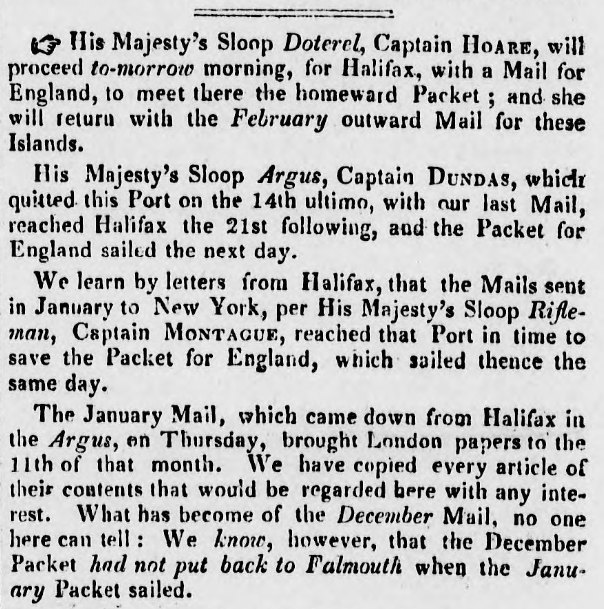
Bermuda Gazette: the sloop Doterel to take a mail to Halifax; His Majesty’s Sloop Argus, Captain Dundas, which quitted this Port on the 14th ultimo with our last Mail, reached Halifax the 21st following; the January Mail, which came down from Halifax in the Argus on Thursday, brought London papers to the 11th of that month
Bermuda Gazette, 13 March 1824: Argus in with the January mail
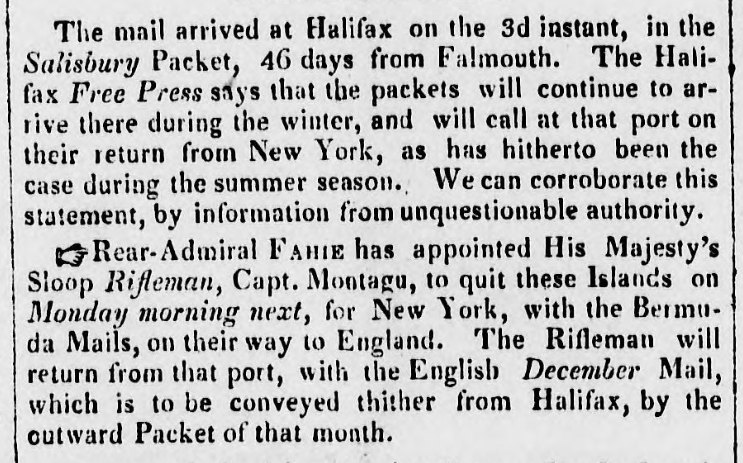
Bermuda Gazette: The mail arrived at Halifax on the 3d instant, in the Salisbury Packet, 46 days from Falmouth. Rear-Admiral Fahie has appointed His Majesty’s Sloop Rifleman, Capt. Montagu, to quit these Islands on Monday morning next, for New York, with the Bermuda Mails, on their way to England
Bermuda Gazette, 17 January 1824: the “Salisbury Packet” is a Falmouth packet, not the flagship
  • Paid Guernsey, 7 January 1824
  • Packet Lady Wellington, sailed Falmouth 11 January 1824
  • At Halifax 27 February 1824
  • Halifax to Bermuda H.M.S. Argus, arrived Thursday 11 March 1824

The father was hurrying to catch the January packet. It left Falmouth on 11 January 1824, and the packet that month was the Lady Wellington. She reached Halifax on 27 February. By then the Bermuda mails didn’t come by packet at all: they went between Halifax and the island in whatever naval vessel the admiral could spare.

That winter it was often Argus. She left Bermuda on 14 February with the island’s mail, reached Halifax on the 21st, waited for the packet, and was back at Bermuda on Thursday 11 March with the January mail. The Gazette says it “brought London papers to the 11th of that month”. That must be this letter’s mail.

The admiral and his flagship were at Bermuda that winter. On 27 December 1823 “the band of music belonging to the flag ship” led the masonic procession at Ireland Island (Bermuda Gazette, 10 January 1824). In January Admiral Fahie was sending the Rifleman to New York with the island’s mails. I can’t prove where Durell was by March, still in Salisbury or already in Argus. Either way, a letter to the flagship came down to Bermuda in the brig-sloop he served in. Unlike his aunt’s letter, nobody readdressed this one.

Two Salisburys. The Gazette from that winter can catch you out. On 17 January 1824 it reported that “The mail arrived at Halifax on the 3d instant, in the Salisbury Packet, 46 days from Falmouth.” That isn’t the flagship. It’s the Falmouth packet Marquess of Salisbury, which had left Falmouth on 17 November 1823 with the November mail. H.M.S. Salisbury, the 50-gun flagship, was on station with Admiral Fahie, and the same paragraph has Fahie at Bermuda sending the Rifleman off with the mails.

V

The flagship goes home

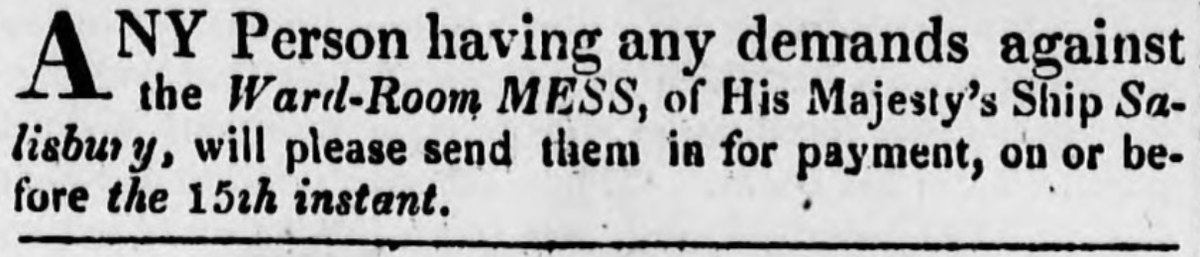
Bermuda Gazette notice: Any Person having any demands against the Ward-Room Mess, of His Majesty’s Ship Salisbury, will please send them in for payment, on or before the 15th instant
Bermuda Gazette, 12 June 1824: the wardroom settles its bills
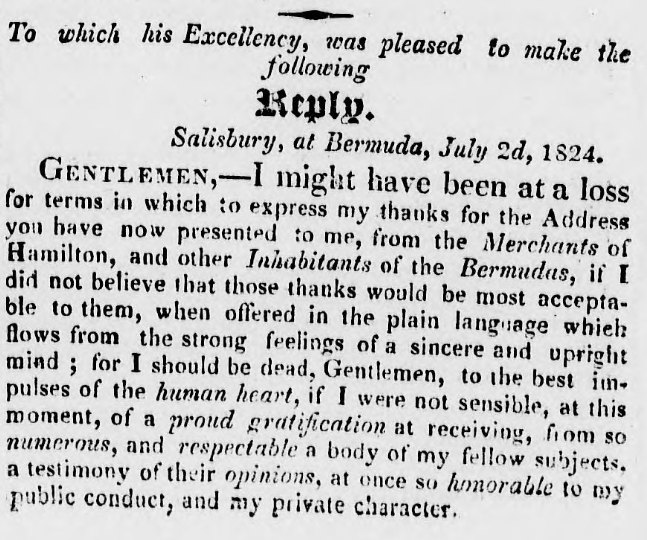
Bermuda Gazette: To which his Excellency was pleased to make the following Reply. Salisbury, at Bermuda, July 2d, 1824. Gentlemen, I might have been at a loss for terms in which to express my thanks for the Address you have now presented to me, from the Merchants of Hamilton
Bermuda Gazette, 3 July 1824: Fahie’s reply, “Salisbury, at Bermuda, July 2d, 1824”

The family in Guernsey knew in January that Fahie’s time was up. The Bermuda Gazette had the news in February: Rear-Admiral Lake was appointed “to relieve Rear-Admiral Fahie, C.B., whose term of service has expired” (Bermuda Gazette, 21 February 1824).

Fahie was still at Bermuda in Salisbury that summer. On 12 June her wardroom asked for any bills to be sent in by the 15th. At the end of June the merchants of Hamilton and the inhabitants of St. George’s each presented him with an address on his leaving the station, and he answered them from on board: “Salisbury, at Bermuda, July 2d, 1824”. By 31 July there were letters for two of her men lying uncollected at the Hamilton post office, so I think she had gone, and Fahie with her. His father had expected the admiral to go home in the ship that brought his successor, but it looks as if Fahie went home in his own flagship.

Durell’s commission is dated 10 May 1824, while Fahie was still Commander-in-Chief. I’d guess it was one of the admiral’s own promotions before he left, but I can’t prove that yet.

Two letters, one Christmas

This entire on one side, his aunt’s Argus entire on the other.

To the Salisbury
To the Argus
24 Dec 1823
SalisburyHis sister begins her letter in Guernsey.
25 Dec
SalisburyDurell’s letter to Rose arrives on Christmas morning; family party at New Town House.
ArgusAunt Mary de Havilland writes at New Town House.
26 Dec
SalisburyHis sister adds the news of Sir James’s Plymouth command.
30 Dec
ArgusPaid 1/1 in London as a ship letter.
7 Jan 1824
SalisburyHis father adds a postscript; paid 2/3 in Guernsey, “via Falmouth”.
11 Jan
SalisburyThe January packet, Lady Wellington, sails from Falmouth.
By 21 Feb
ArgusThe Archibald is in at St. George’s from London, probably with the aunt’s letter.
27 Feb
SalisburyThe packet reaches Halifax, where Argus is waiting.
Thu 11 Mar
SalisburyArgus brings the January mail down to Bermuda.
10 May
ArgusDurell commissioned lieutenant; his aunt’s letter is readdressed “Lt”, “Argus”.

The Ship

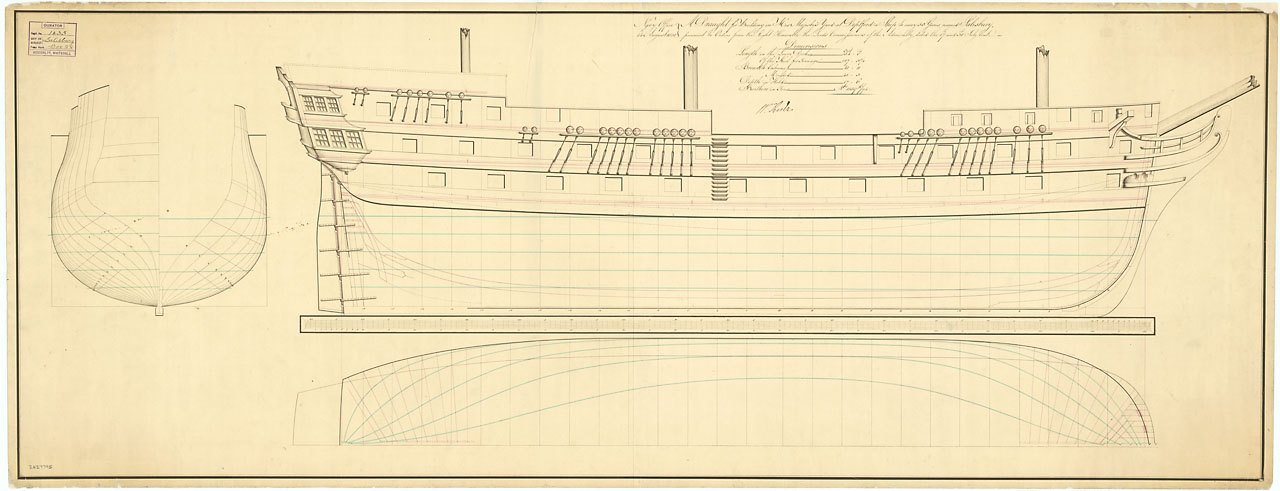
Navy Office plan of 1810, signed by William Rule: the body plan, sheer lines and longitudinal half-breadth for building Salisbury, a 50-gun fourth rate two-decker, at Deptford Dockyard, showing the hull in side view with two tiers of gunports

H.M.S. Salisbury

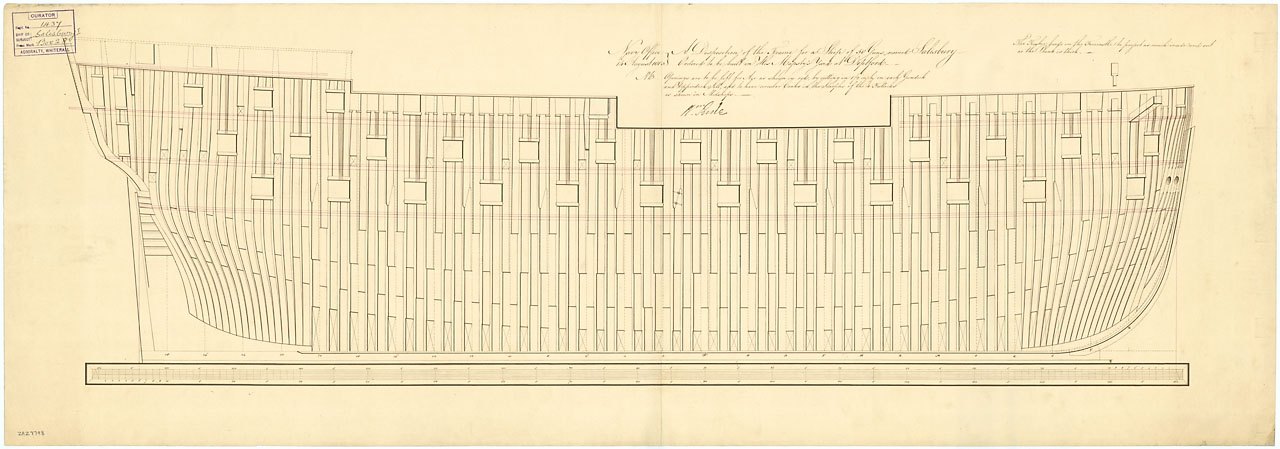
Salisbury was a 50-gun fourth rate, a two-decker built at Deptford Dockyard and launched in 1814. No picture of her that I know of survives, but her building plans do, at Greenwich. The plan above shows her lines, signed by William Rule, Surveyor of the Navy, in 1810, and the one below shows the disposition of her frame.

Navy Office plan showing the framing profile, the disposition of the frame timbers, for building Salisbury, a 50-gun fourth rate two-decker, at Deptford Dockyard
The framing profile for building Salisbury at Deptford

In the early 1820s she was the flagship on the North America station, flying the flag of Rear-Admiral William Charles Fahie, with Captain Maude in command in 1823. She went between Bermuda and Halifax with the seasons, wintering at Bermuda. Fahie’s term ended in 1824, and Rear-Admiral Willoughby Lake took over the station in May. Salisbury was still at Bermuda with Fahie aboard in early July 1824, and I think she then took him home. She was sold in 1837.

BuiltDeptford Dockyard; launched 1814
TypeFourth rate, two-decker
Guns50 (some lists give 58)
Flag, 1823–24Rear-Admiral W. C. Fahie
FateSold 1837

Plans: © Crown copyright, National Maritime Museum, Greenwich, London (ZAZ7795, J3507; ZAZ7798, J3504).

Still to find out

If you can help with any of these, I’d be very pleased to hear from you.

Read the transcription (so far)

The letter is written across each page and then crossed at right angles, and the father’s postscript runs round the outer sheet. This is my reading of the straight lines and the postscript. Words in square brackets are guesses, and “…” marks what I can’t yet read. The crossed lines are only partly read.

Guernsey, Decr 24th 1823.

The end of the month reminds me forcibly that it is time to get a letter in readiness for you my beloved Durell, although I cannot promise you a very connected epistle surrounded as we are by continual [interruptions] from those come to [ask] for their Christmas boxes; we hear nought these days but little [rap] at the door, and long accounts of poverty and large families, husbands ill, children sick &c &c — but though gratifying to relieve as much as our little means will allow the deserving among these poor creatures, still it is painful to observe how many there are who are beggars by profession and who might by more exertion avoid this sad mode of life. — James returned to us ten days back from Oxford and we really begin to have hopes of his being tall at last! he now out-tops both Anne and Rose, and may reasonably expect to grow for two or three more years to come; he endeavours to make it a point to study hard from ten o’clock till two, but occasionally … which drives him from his good resolves; on the whole however I think I may call him tolerably studious and must say he has every wish to improve himself. — We now hear very regularly from the Cape and had a most pleasing letter from our dear Sister last week, she seems already a perfect Dame de ménage … and of the economy she displayed on the occasion she and Saumarez had been much plagued by the ill conduct of a maid servant they took with them, but so difficult is it to suit ourselves at the Cape with these commodities that they were compelled to keep her on promise of amendment and on the whole they were better pleased with her. — Dear Kate had just heard of our arrival in England, and as we have often done greatly deplored our not having met. — Phil writes that the Revenge hopes to sail from Lisbon for Gibraltar some time in Decr at which he rejoices much having heard that the 12th Regt are there stationed — the dear fellow writes very pretty letters and seems perfectly satisfied with his situation. … What will you say of the gaiety of Guernsey when I tell you we have been near six weeks without a party being formed at the Rooms … I doubt not however of there being a brilliant party on the last day of the year, and on that day I have generally observed people made it a point to appear in their best spirits. …

26th. You proved yourself a true prophet my beloved Durell, and your letter to Rose actually did arrive on the morning of Christmas day; how happy should we have been to have had you with us at the family party which took place at New Town House; but we drank your health in high style, breathing many a fervent wish that you would be with us next year at the same season to meet the self same party. From the anxiety you show respecting Sir J.’s promotion, most happy am I to have it in my power to tell you that it has actually taken place, and that his nomination to the command of Plymouth has appeared in several of the Public papers; this most worthy friend of ours wrote to my Father to apprise him of it, and in his letter he says, “I am happy to find the accounts from Durell are favourable; be assured I shall leave nothing undone which can in any way accelerate his promotion, but it does not appear to me advisable to write to Admiral Fahie at present, or until I learn what officer is likely to succeed him upon the station — more particularly since I have received the notification from Lord Melville of the King having signified his pleasure for my appointment to the chief command at Plymouth, when the period shall have elapsed for the [expiration] of Sir Alexr Cochrane in his [situation], which I am given to understand will not be before the month of Feby and as it would be materially convenient to Sir Alexr to remain till the end of April, I probably will not assume the command before that period.”

[Crossed lines, partly read:] “You will perceive that by this appointment our friend Durell will have more than one string to his bow …” … your dear Aunt Mary who delights in nothing so much as bestowing kindness on others … Harriet … and James … desire to be affectionately remembered … Your attached Sister

[The father’s postscript] 7th Jany 1824

Many many happy returns of the day My dearest Boy & may we long before the beginning of the next Year have you with us as a Lieutenant, but to business. Your Sister at my request has left a small space of her Paper for me to answer the several queries in yr last Letter. You will perceive by what she mentions Our worthy friend Sir James wrote, that according to yr desire I had applied to him, to beg of Admiral Fahie that you might be continued on the station after his departure but from the circumstance of his appointment to Plymouth he did not think it advisable to write to him. In a Letter since received by yr Sister Ann from our amiable Cousin Martha she mentions Sir James immediately on hearing that Admiral Lake was appointed to succeed Adl Fahie he had written to him to recommend you. We are anxiously waiting for a Letter from Sir J. to whom I have written to congratulate him on his appointment, who will I hope be explicit whether he would advise your continuing on yr present station or would advise yr coming home — From the circumstance you mention of Adml F. returning in the Ship that carries his Successor, by the Letter you will know Sir James’ determination. By the very friendly Letter I have received from him, indeed you may yourself judge by the Extracts your Sister has given you of his Letter we are well assured this warm Friend will use every Exertion in his power towards yr promotion, he has not been able to ascertain how you rank for promotion, but as he mentions to me he will go to London before he assumes the command at Plymouth I doubt not if possible he will find it out when I shall give you the earliest information possible. We have all tried to recollect the time Sir J. applied for yr being placed on the Admiralty List & are pretty certain it must have been a few days after the Hind had been paid off. Sir James has had, I am persuaded, no Letter from yr Admiral or I am sure he wd have mentioned it. The weather has been most boisterous & we have now two Mails due, this is most provoking when we are so desirous to have News, but this Letter must now go or it will be too late for the next West India Packet. We had yesterday in the afternoon a party of the … when we often spoke & still oftener thought of you. Besides yr Letter recd on Christmas day we had one also from Philip of the 8th Decr who was to leave Lisbon for Malta the next day, they are to touch at Gibraltar. He had been at a Grand Ball given by the Portuguese Nobility the supper cost £1250 Stg. He met there the Marquis of [Vianna] an acquaintance of Sir James who invited him to his house …

Adieu Adieu My dearest Boy. Always yr affecte Father T.D.S.
Provenance and references

A sister writing on Christmas Eve, a father squeezing in the business round the edges, and every line crossed to save the 2/3. Put it beside his aunt’s letter of the next day and you can see the whole family willing him on to his lieutenancy. I like that one says “Mr” and the other ended up saying “Lt”.