Postal History · Ship Letter · Royal Navy

H.M.S. Argus

Guernsey · London · Bermuda · December 1823

A Christmas Day letter from an aunt in Guernsey, hoping her nephew would be a lieutenant by next Christmas.

◆

This is a lovely little item. It’s an entire, a folded letter sheet with no envelope, written on Christmas Day 1823 by an aunt in Guernsey to her nephew, a young naval officer, and addressed to him at “H.M.S. Argus, Bermuda”. It was paid in London on 30 December and sent out as a ship letter.

This entire and my Salisbury entire, written to him by his sister the day before, are the two earliest items addressed to a ship at Bermuda that I have seen. Inside, his aunt hopes that next Christmas will find him “a happy and contented Lieutenant”. He was one within five months.

I

Salisbury crossed out, Argus written in

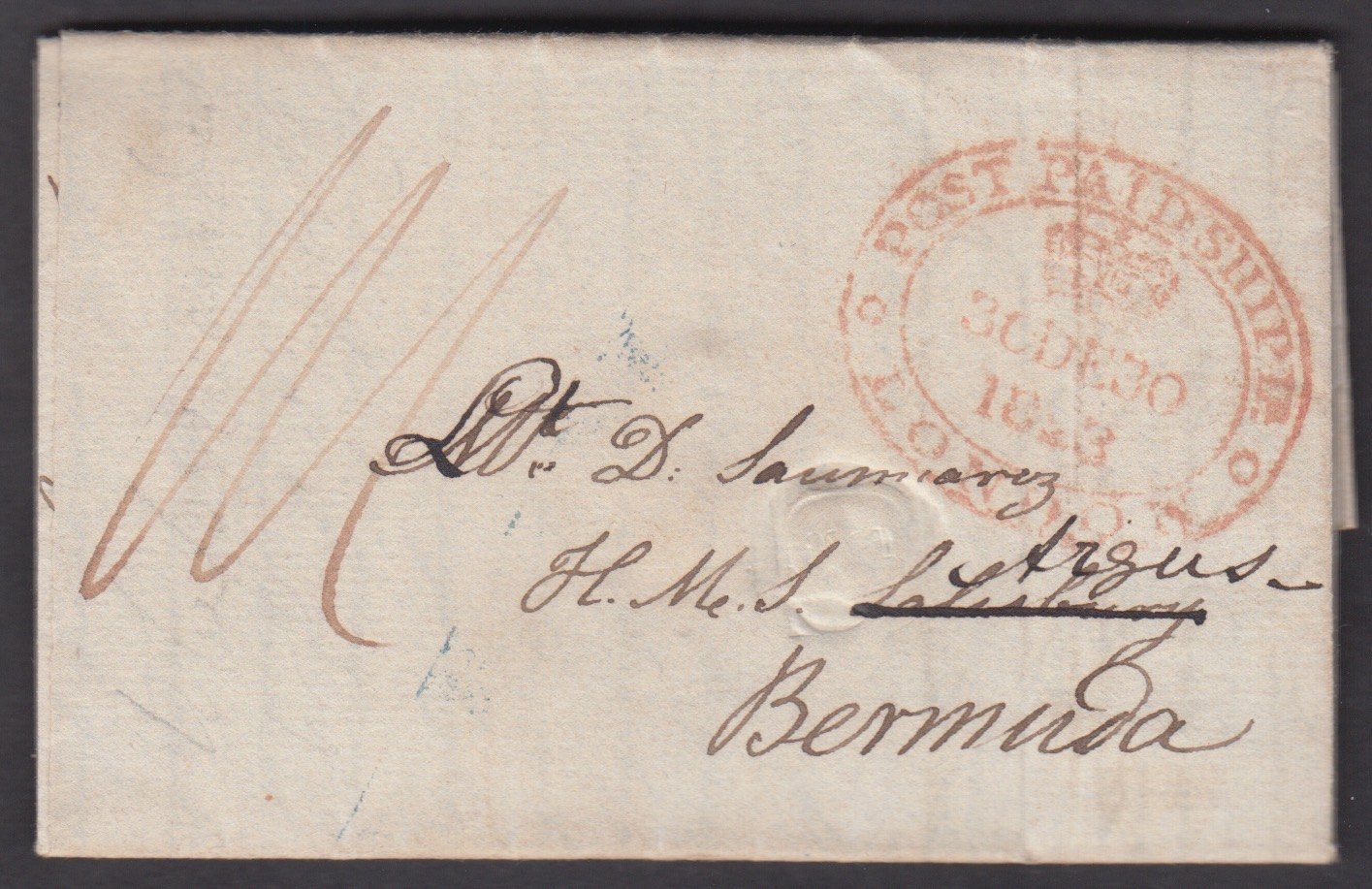
The folded entire, addressed in ink to Lieut. D. Saumarez, H.M.S. Argus, Bermuda; the word Salisbury is struck through with Argus written above it. At right is a red crowned double-oval handstamp reading POST PAID SHIP LR LONDON, 30 DE 30 1823, and at left a large manuscript charge in red-brown ink
The entire folded, as it went through the post
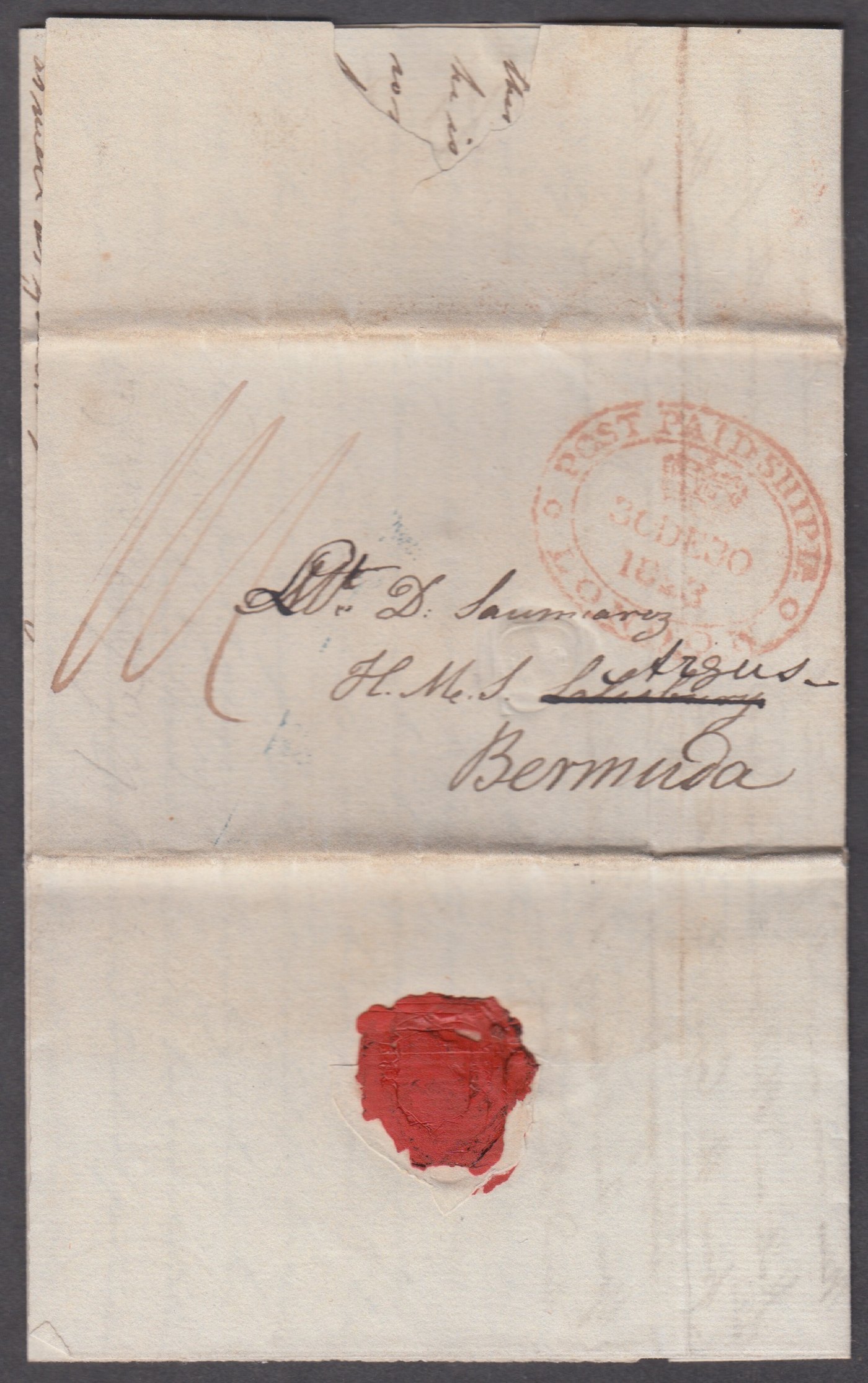
The outer sheet partly opened out, showing the address panel with the red London handstamp in the middle and a broken red wax seal on the lower panel
Opened out, with the red wax seal
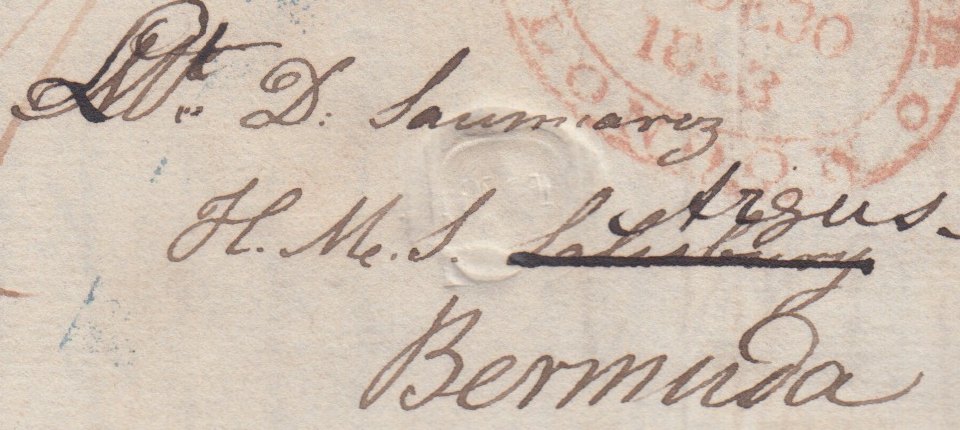
Close-up of the address: the original Mr has been crossed through and Lt written over it, and the ship’s name Salisbury is struck through with Argus written above in a different hand
Mr changed to Lt, Salisbury changed to Argus
  • Item Entire, red wax seal
  • Written New Town House, Guernsey, 25 December 1823
  • From his aunt, Mary de Havilland
  • To D. Saumarez, H.M.S. Salisbury, Bermuda; amended to Lt. D. Saumarez, H.M.S. Argus
  • Postmark crowned double oval POST PAID SHIP LR / LONDON, 30 DE 30 1823, red
  • Charge 1/1 in manuscript, paid: half the 2/2 packet postage
  • Carried by private ship, probably the snow Archibald, at Bermuda by 21 February 1824
  • Back no markings; the last quarter of the back page cut away

It was first addressed to “Mr. D. Saumarez, H.M.S. Salisbury, Bermuda”. Salisbury was the flagship on the North America station, flying the flag of Rear-Admiral Fahie. Then someone in a different hand struck out the “Mr” and wrote “Lt” in its place, and struck out “Salisbury” and wrote “Argus” above it. Whoever it was knew that young Saumarez had moved from the flagship to the brig-sloop Argus, and knew he was a lieutenant, or soon would be. I don’t know who made the change, or when.

On the front is the red crowned oval “POST PAID SHIP LR / LONDON”, dated 30 December 1823. That’s the London mark for a letter paid to go out by a private ship rather than by the Falmouth packet.

The big scribble at the left is the charge. I read it as 1/1, one shilling and a penny. Under the Ship Letter Act of 1799, a letter sent out from Britain by private ship paid half the packet rate, and the packet postage from London to Halifax and Bermuda was then 2/2. Half of that is 1/1, and it was paid in London. Edward Proud sets out the rates of the period in The Postal History of Bermuda, Chapter 3.

There’s nothing on the back. The last quarter of the back page has been cut away, but no writing is missing. I think it was cut to take out the bank draft she mentions in the letter.
II

“A happy and contented Lieutenant”

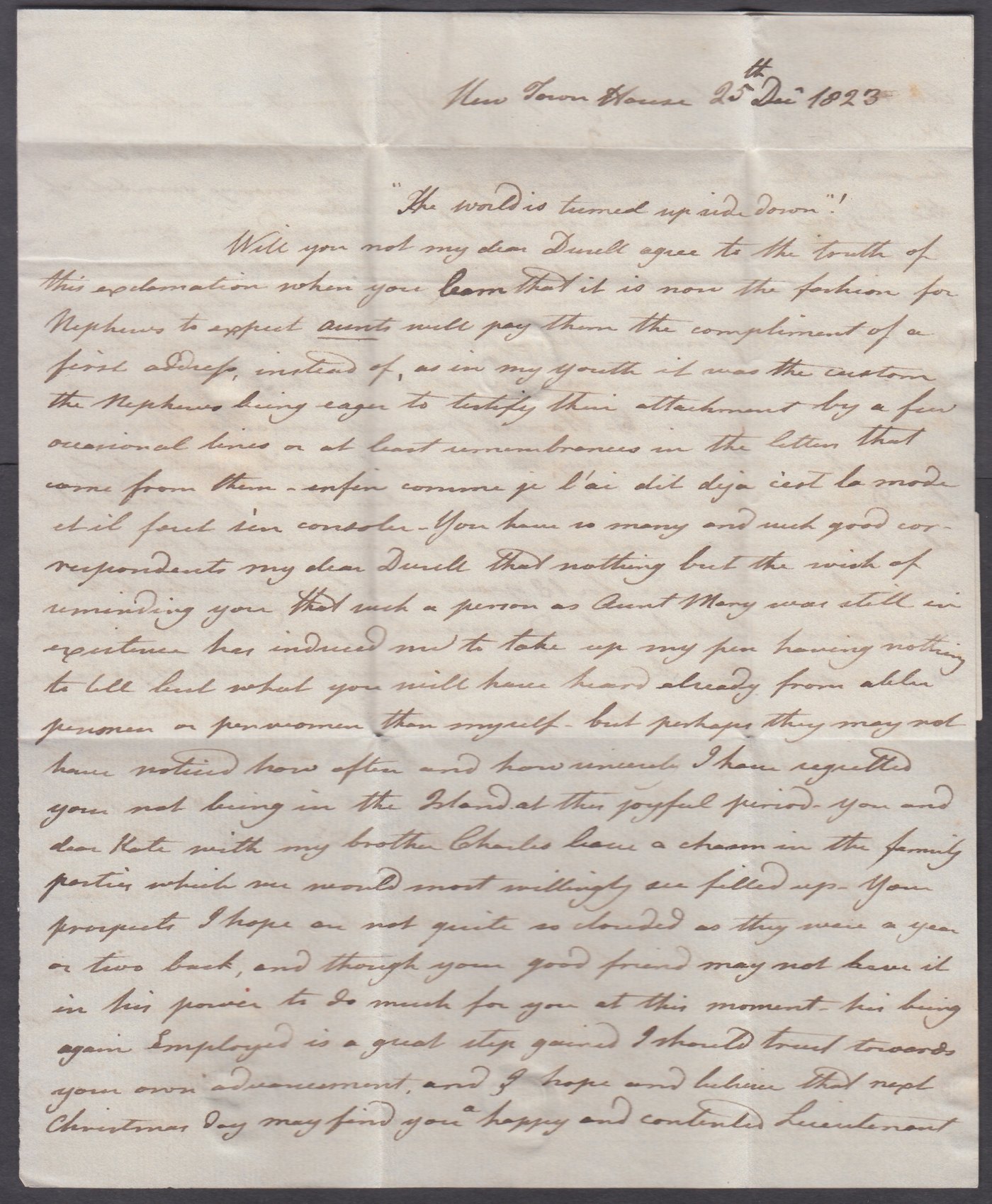
The first page of the letter, headed New Town House 25th Decr 1823, opening with the quotation The world is turned upside down, written in a neat sloping hand in brown ink
Page one: “The world is turned upside down”!
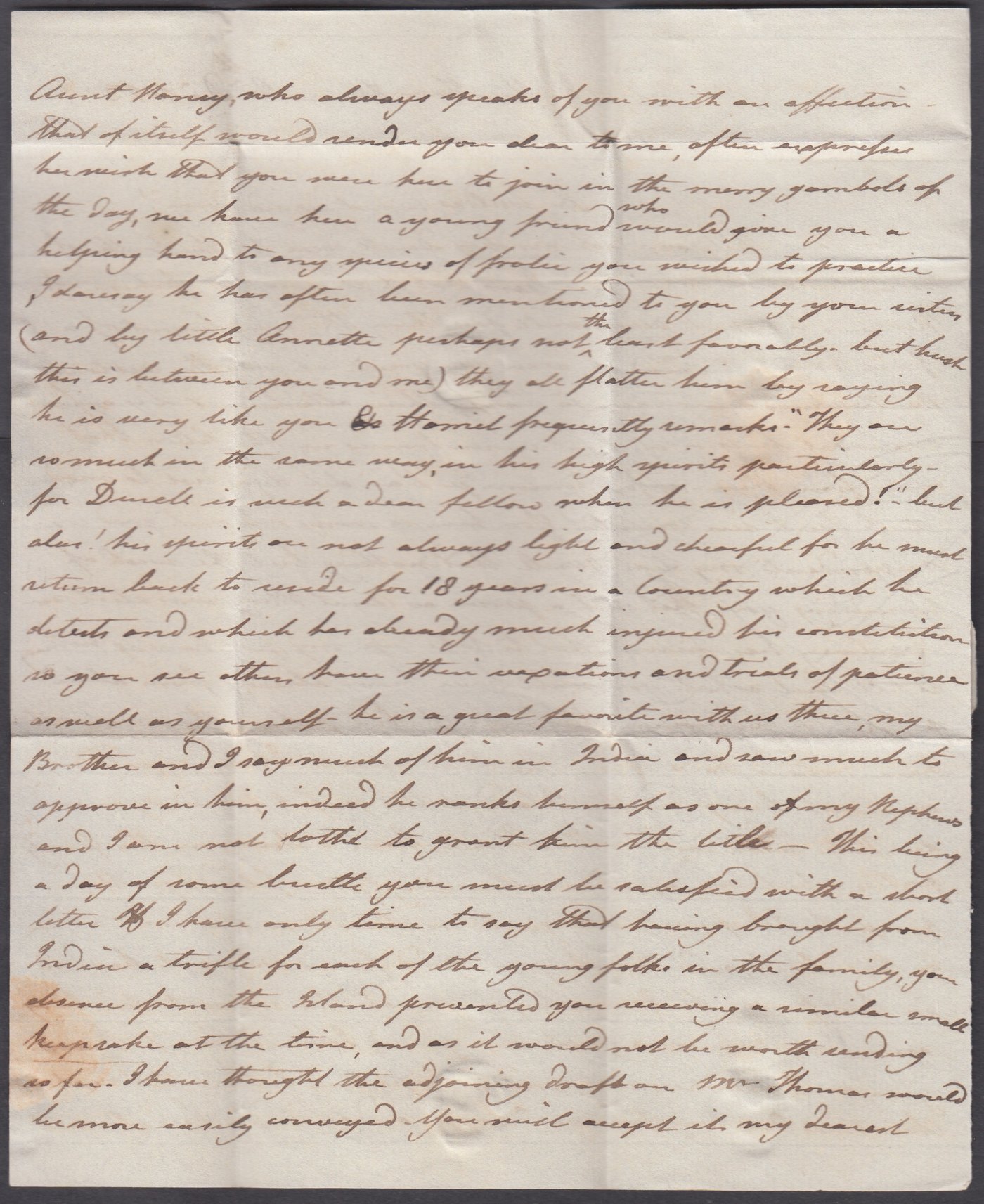
The second page of the letter, closely written, about Aunt Nancy, a young friend back from India, and the draft on Mr Thomas
Page two: the young friend from India, and the draft
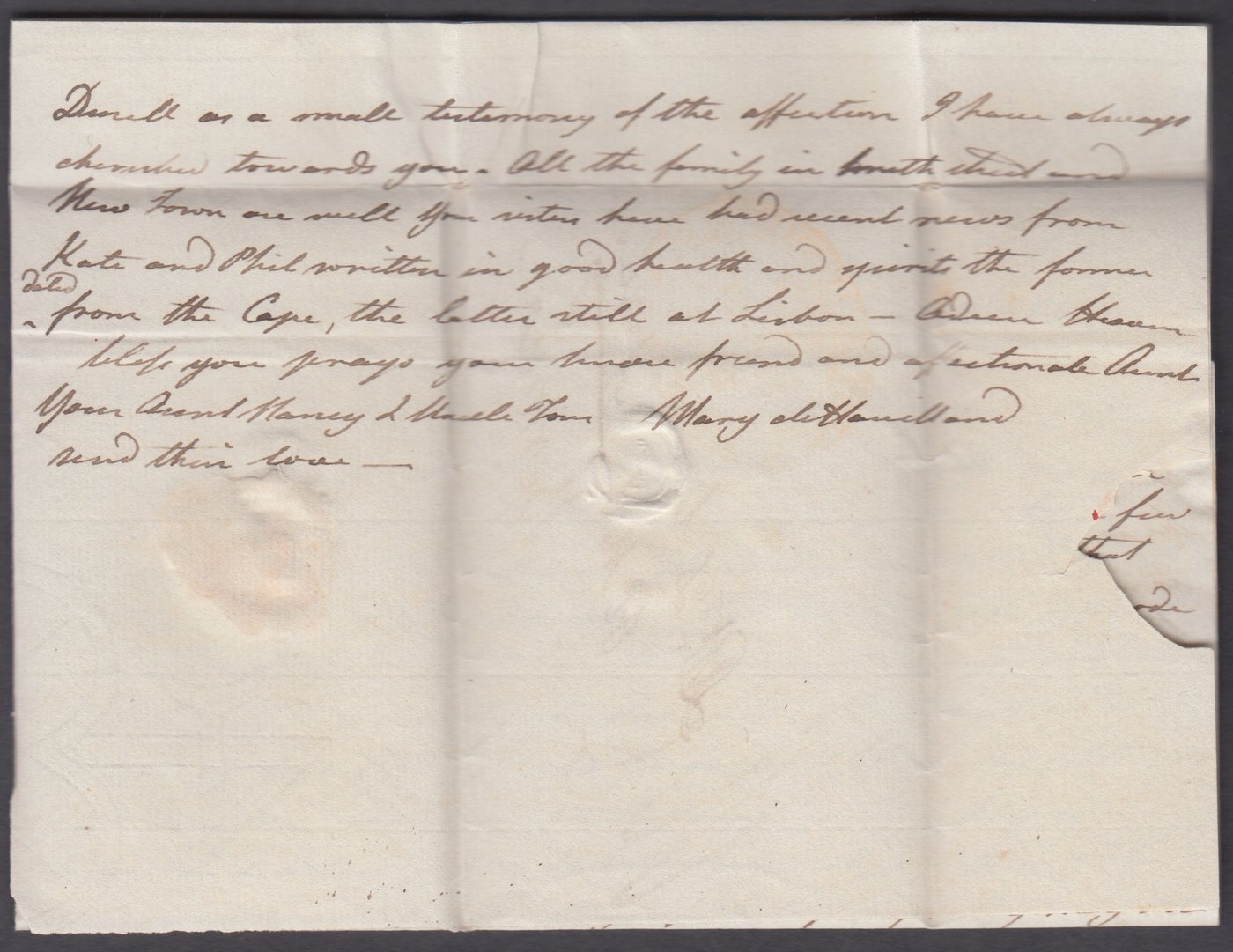
The last page of the letter, ending with family news and signed Mary de Havilland, with a postscript from Aunt Nancy and Uncle Tom; the lower right corner of the sheet is torn and cut away
Page three: signed Mary de Havilland

The letter is headed “New Town House 25th Decr 1823”, and it’s from Guernsey. The New Town in St Peter Port was laid out by the de Havilland family, and the de Havillands and the de Sausmarez were two of the island’s best-known families, married into each other more than once. She signs herself his “affectionate Aunt”, Mary de Havilland.

She opens with a mock complaint:

“The world is turned upside down”! Will you not my dear Durell agree to the truth of this exclamation when you learn that it is now the fashion for Nephews to expect aunts will pay them the compliment of a first address”

In her youth, she says, it was the nephews who wrote first. Then a line of French, “enfin comme je l’ai dit déjà c’est la mode et il faut s’en consoler”, which is Guernsey all over.

It was Christmas Day, and the family missed him: “You and dear Kate with my brother Charles leave a chasm in the family parties which we would most willingly see filled up”. Then she turns to his career, and to the line I like most:

“Your prospects I hope are not quite so clouded as they were a year or two back, and though your good friend may not have it in his power to do much for you at this moment his being again Employed is a great step gained I should trust towards your own advancement, and I hope and believe that next Christmas day may find you a happy and contented Lieutenant”

The second page is family gossip. A young friend staying with them for Christmas, whom she and her brother had seen much of in India, was said to be very like Durell, “for Durell is such a dear fellow when he is pleased!” The poor man had to go back to India for eighteen years, to “a country which he detests and which has already much injured his constitution”.

She had brought back from India “a trifle for each of the young folks in the family”. Durell was away, so instead “I have thought the adjoining draft on Mr Thomas would be more easily conveyed — You will accept it my dearest Durell as a small testimony of the affection I have always cherished towards you.” I think that draft is why the last quarter of the back page is missing. It would have been cut off and cashed.

She ends with the news: “All the family in Smith (?) Street and New Town are well”, and his sisters had heard from “Kate and Phil … the former dated from the Cape, the latter still at Lisbon”. Aunt Nancy and Uncle Tom sent their love.

III

Out by private ship

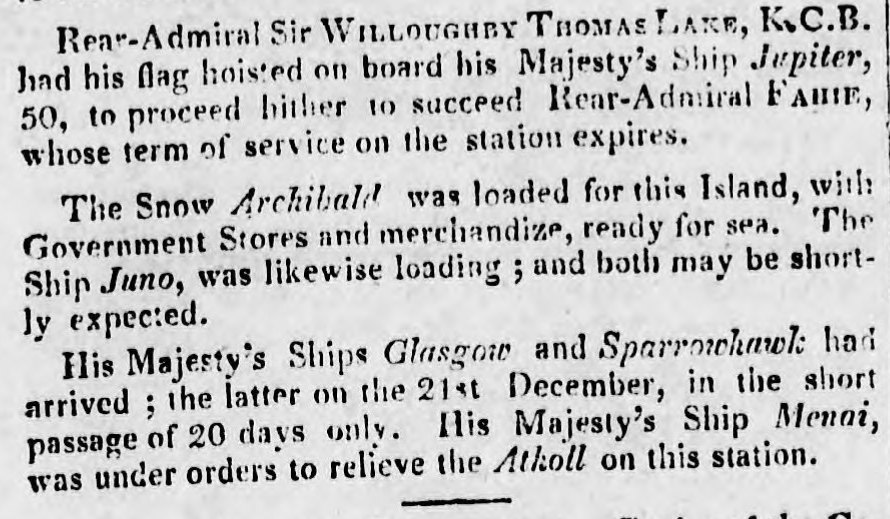
Bermuda Gazette: Rear-Admiral Sir Willoughby Thomas Lake had his flag hoisted on board His Majesty’s Ship Jupiter, 50, to proceed hither to succeed Rear-Admiral Fahie. The Snow Archibald was loaded for this Island, with Government Stores and merchandize, ready for sea. The Ship Juno was likewise loading; and both may be shortly expected
Bermuda Gazette, 14 February 1824: the Archibald “ready for sea”
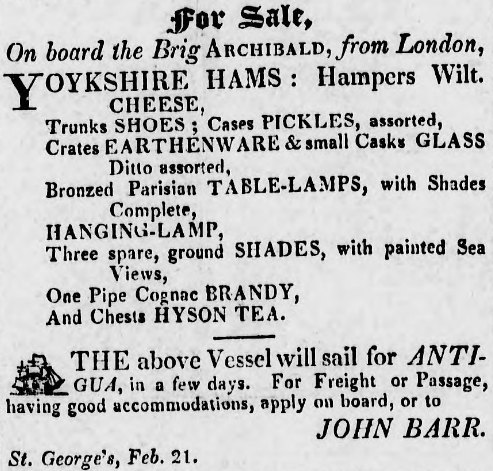
Bermuda Gazette advertisement: For Sale, on board the Brig Archibald, from London, Yorkshire hams, cheese, shoes, pickles, earthenware, glass, bronzed Parisian table-lamps, a hanging-lamp, a pipe of Cognac brandy and chests of hyson tea. The above vessel will sail for Antigua in a few days. John Barr, St. George’s, Feb. 21
Bermuda Gazette, 21 February 1824: the Archibald in at St. George’s
Bermuda Gazette: His Majesty’s Sloop Argus, Capt. Dundas, arrived from Jamaica on Wednesday last, with Government specie for this Colony and Quebec
Bermuda Gazette, 7 February 1824: Argus in from Jamaica
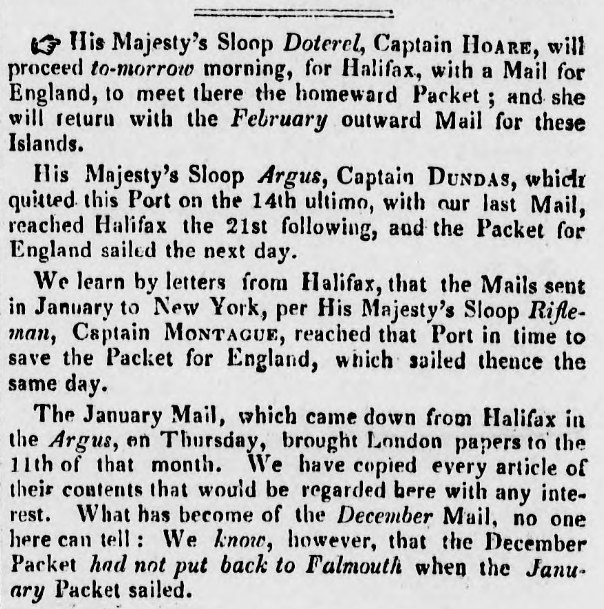
Bermuda Gazette: the sloop Doterel to take a mail to Halifax; His Majesty’s Sloop Argus, Captain Dundas, which quitted this Port on the 14th ultimo with our last Mail, reached Halifax the 21st following; the January Mail, which came down from Halifax in the Argus on Thursday, brought London papers to the 11th of that month; what has become of the December Mail no one here can tell
Bermuda Gazette, 13 March 1824: Argus back with the January mail
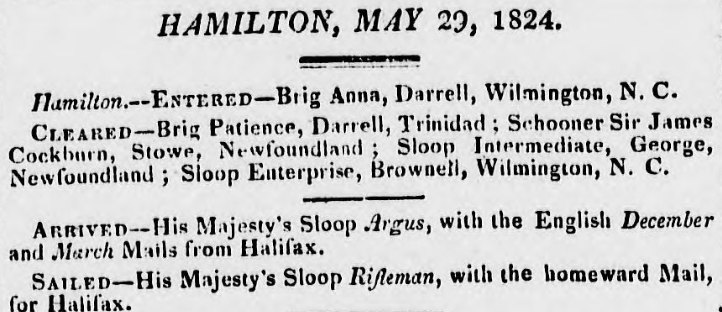
Bermuda Gazette shipping news, Hamilton, May 29, 1824: Arrived, His Majesty’s Sloop Argus, with the English December and March Mails from Halifax. Sailed, His Majesty’s Sloop Rifleman, with the homeward Mail, for Halifax
Bermuda Gazette, 29 May 1824: Argus with the December and March mails
  • Paid London, 30 December 1823, as a ship letter
  • Probably carried in the snow (or brig) Archibald, from London
  • Archibald at Bermuda by 21 February 1824
  • Argus away to Halifax 14 February; back 11 March 1824

It was written in Guernsey on Christmas Day and paid in London five days later. There’s no Guernsey marking, so how it got to London isn’t known.

In 1823 the Falmouth packets ran to Halifax, and the Bermuda mail went back and forth between Halifax and the island in whatever naval vessel the admiral could spare. That winter it was often Argus herself. This letter didn’t go that way. It was paid as a ship letter, to go out by a merchant ship sailing from London to Bermuda.

The most likely ship is the Archibald. On 14 February 1824 the Bermuda Gazette passed on the English news that “The Snow Archibald was loaded for this Island, with Government Stores and merchandize, ready for sea. The Ship Juno, was likewise loading; and both may be shortly expected.” A week later her cargo was being advertised at St. George’s, Yorkshire hams, Wiltshire cheese, Parisian table-lamps and all. A ship loaded and ready for sea around the turn of the year fits a letter paid in London on 30 December, and the passage of about seven weeks is about right. The Juno didn’t sail from Portsmouth until 2 February. Nothing on the entire names the ship, so I can’t prove it, but the Archibald is likely.

A snow was a two-masted square-rigger, much like a brig, with a small extra mast just behind the mainmast for the big fore-and-aft sail. That’s why the Gazette calls her “the Snow Archibald” in one place and “the Brig Archibald” in another.

If she was the ship, the letter had a short wait at the other end. Argus had come in from Jamaica on 4 February “with Government specie for this Colony and Quebec”, and sailed for Halifax with the island’s mail on the 14th, just before the Archibald arrived. She was back on 11 March with the January mail. The December mail went missing for a while: “What has become of the December Mail, no one here can tell”. Argus finally brought it down in late May, with the March mail as well. By then Saumarez had his commission, dated 10 May 1824.

IV

Durell de Sausmarez

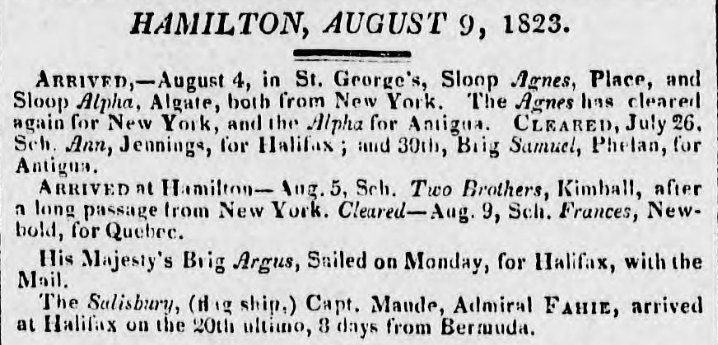
Bermuda Gazette, Hamilton, August 9, 1823: His Majesty’s Brig Argus sailed on Monday for Halifax with the Mail. The Salisbury (flag ship), Capt. Maude, Admiral Fahie, arrived at Halifax on the 20th ultimo, 8 days from Bermuda
Bermuda Gazette, 9 August 1823: Argus, and the flagship Salisbury
  • Name Durell de Sausmarez (Saumarez on the entire)
  • Entered the Navy 6 April 1812
  • Lieutenant 10 May 1824
  • Commander 23 July 1830; sloop Zebra, East Indies
  • Invalided New South Wales, 1832

The family name is written several ways, Saumarez and de Sausmarez among them, and the most famous of them was Admiral Lord de Saumarez, a Guernseyman himself. On the entire it’s plain “Saumarez”. In the navy lists the nephew is Durell de Sausmarez.

He entered the Navy on 6 April 1812 and was still waiting for his first commission at the end of 1823, which explains his aunt’s hopes. She had her wish well before next Christmas. His commission as lieutenant is dated 10 May 1824. Later he was flag lieutenant to Sir James Saumarez, the Commander-in-Chief at Plymouth. He was promoted commander in 1830 and given the sloop Zebra on the East India station, and was invalided home from New South Wales in 1832.

The letter has a whole family in it: Kate at the Cape, Phil at Lisbon, sisters at home, Aunt Nancy and Uncle Tom, Harriet and little Annette. I haven’t yet worked out exactly how Mary de Havilland was his aunt. With families as closely intermarried as these two, it may take a while.

I now have a second letter to Durell from the same Christmas, on my H.M.S. Salisbury page. One of his sisters wrote it in Guernsey the day before this one, and their father, Thomas de Sausmarez, added a postscript on 7 January. It went out by the Falmouth packet instead and came down from Halifax in Argus herself. That one is still addressed to “Mr” D. De Sausmarez in the Salisbury. Nobody ever changed it, so between them the two entires show him before and after his promotion. It also explains Phil: he was Durell’s brother Philip, a first-class volunteer in the Revenge at Lisbon.

Winter and spring, 1823–24

The ship on one side, the letter on the other.

The ship
The letter
25 Dec 1823
The letterWritten at New Town House, Guernsey.
30 Dec
The letterPaid 1/1 in London as a ship letter.
Wed 4 Feb 1824
The shipArgus arrives from Jamaica with Government specie.
Sat 14 Feb
The shipArgus sails for Halifax with the island’s mail.
The letterThe Gazette expects the Archibald shortly.
By 21 Feb
The letterThe Archibald is in at St. George’s from London, probably with the letter.
Thu 11 Mar
The shipArgus back from Halifax with the January mail.
Wed 14 Apr
The shipArgus sails for Halifax again with a mail for the homeward packet.
10 May
The letterDurell de Sausmarez commissioned lieutenant.
By 29 May
The shipArgus back with the English December and March mails.

The Ship

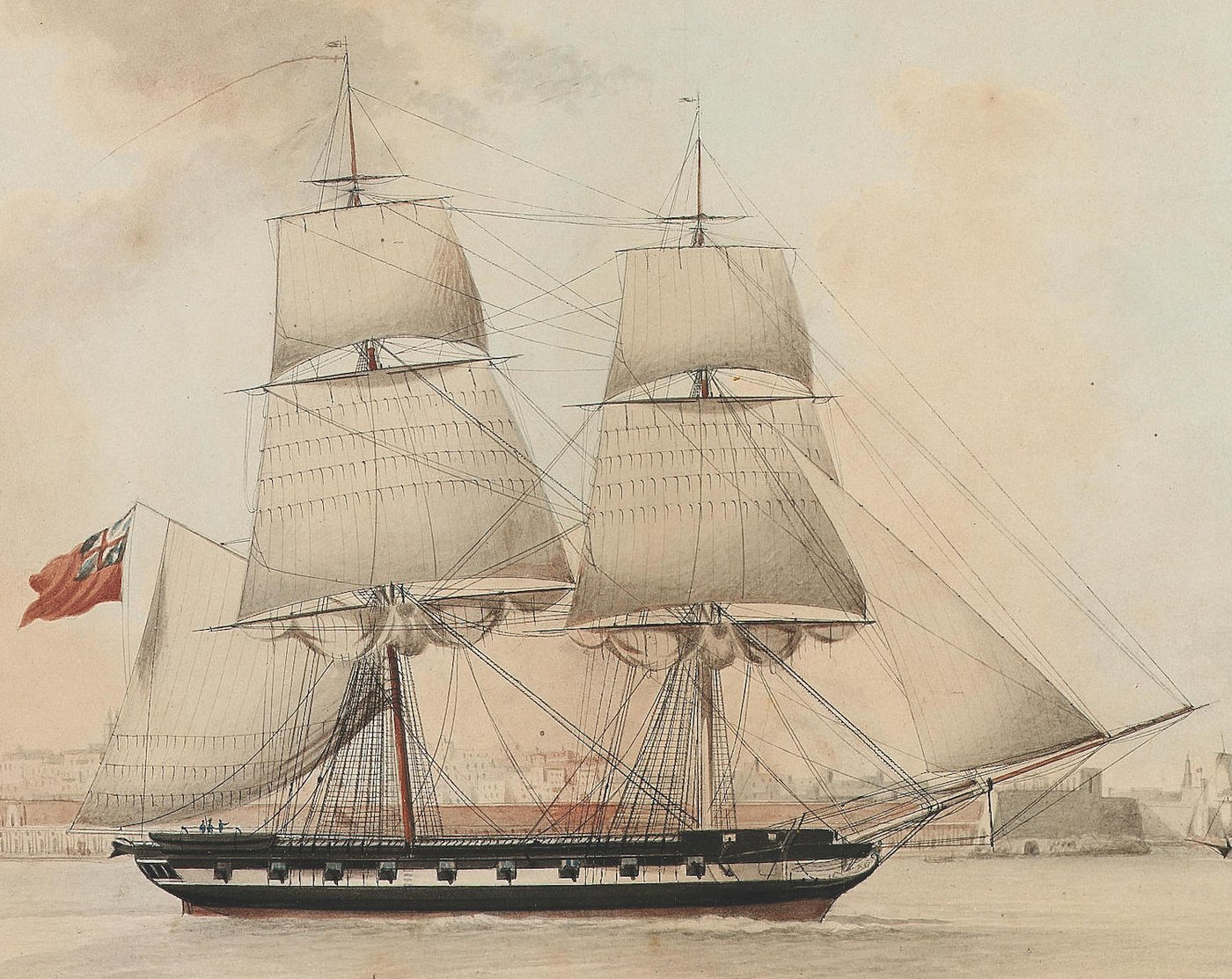
Watercolour of the brig-sloop HMS Pelican under full sail, flying a red ensign, leaving the Grand Harbour at Malta with the fortifications and town behind: a two-masted square-rigged naval brig of the Cruizer class, the same class as Argus

H.M.S. Argus

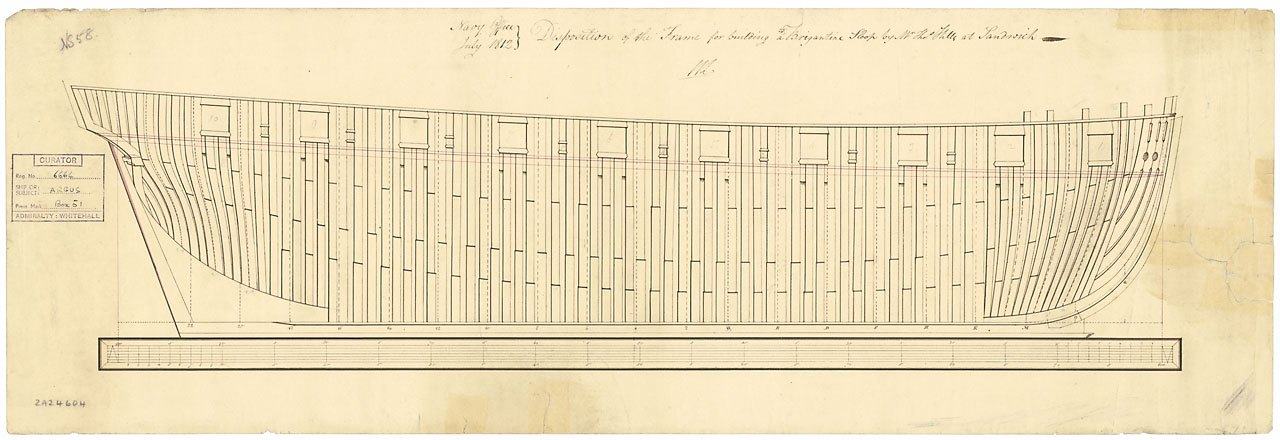
Argus was an 18-gun brig-sloop of the Cruizer class. She was built at Sandwich in Kent by Thomas Hills and launched in 1813. No picture of her that I know of survives, so the painting above is her sister Pelican leaving Malta in 1833. But her building plans do survive at Greenwich, and the framing plan below, dated July 1812, is Argus herself.

Navy Office plan dated July 1812: Disposition of the Frame for building a Brigantine Sloop by Mr Thos Hills at Sandwich, a side profile of the hull showing every frame timber and the gunports, with a label reading Argus
“Disposition of the Frame for building a Brigantine Sloop by Mr Thos Hills at Sandwich”, July 1812
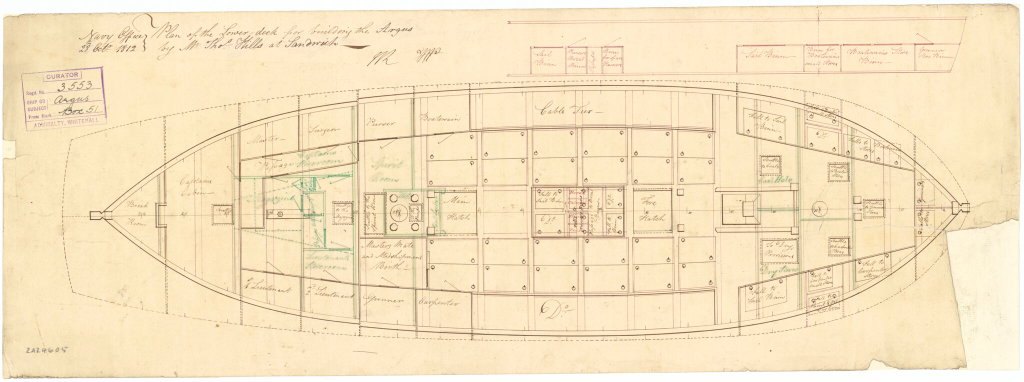
Navy Office plan of the lower deck of the brig-sloop Argus, showing the layout of cabins, storerooms and bins, with elevations of the sail and food storage
Her lower deck, with the sail room, bread room and bins

In 1823 and 1824 she served on the North America station, out of Bermuda. In June 1823 her captain, Commander Arabin, was posted, and Lieutenant J. B. Dundas of the Niemen was promoted into her. Under Dundas she was the station’s workhorse that winter, carrying Bermuda’s mails to and from the packet at Halifax and bringing Government specie up from Jamaica. She was sold in 1827; the sale was cancelled, and she was sold again in 1828.

BuiltThomas Hills, Sandwich; launched 1813
TypeCruizer-class brig-sloop
Guns18
Commander, 1823–24J. B. Dundas
FateSold 1827; sale cancelled, resold 1828

Painting: H.M.S. Pelican off Ricasoli Point, leaving the Grand Harbour, Malta, 1833, by Nicolas S. Cammillieri, via Wikimedia Commons. Plans: © Crown copyright, National Maritime Museum, Greenwich, London (ZAZ4604; J0045).

Still to find out

If you can help with any of these, I’d be very pleased to hear from you.

Read the full transcription

New Town House 25th Decr 1823

“The world is turned upside down”!

Will you not my dear Durell agree to the truth of this exclamation when you learn that it is now the fashion for Nephews to expect aunts will pay them the compliment of a first address, instead of, as in my youth it was the custom the Nephews being eager to testify their attachment by a few occasional lines or at least remembrances in the letters that came from them — enfin comme je l’ai dit déjà c’est la mode et il faut s’en consoler — You have so many and such good correspondents my dear Durell that nothing but the wish of reminding you that such a person as Aunt Mary was still in existence has induced me to take up my pen having nothing to tell but what you will have heard already from abler penmen or penwomen than myself — but perhaps they may not have noticed how often and how sincerely I have regretted your not being in the Island at this joyful period — You and dear Kate with my brother Charles leave a chasm in the family parties which we would most willingly see filled up — Your prospects I hope are not quite so clouded as they were a year or two back, and though your good friend may not have it in his power to do much for you at this moment his being again Employed is a great step gained I should trust towards your own advancement, and I hope and believe that next Christmas day may find you a happy and contented Lieutenant — Aunt Nancy, who always speaks of you with an affection that of itself would render you dear to me, often expresses her wish that you were here to join in the merry gambols of the day, we have here a young friend who would give you a helping hand to any species of frolic you wished to practice, I daresay he has often been mentioned to you by your sisters (and by little Annette perhaps not the least favorably — but hush this is between you and me) they all flatter him by saying he is very like you & Harriet frequently remarks “They are so much in the same way, in his high spirits particularly — for Durell is such a dear fellow when he is pleased!” — but alas! his spirits are not always light and cheerful for he must return back to reside for 18 years in a country which he detests and which has already much injured his constitution so you see others have their vexations and trials of patience as well as yourself — he is a great favorite with us three, my Brother and I saw much of him in India and saw much to approve in him, indeed he ranks himself as one of my Nephews and I am not loth to grant him the title — This being a day of some bustle you must be satisfied with a short letter as I have only time to say that having brought from India a trifle for each of the young folks in the family, your absence from the Island prevented you receiving a similar small keepsake at the time, and as it would not be worth sending so far, I have thought the adjoining draft on Mr Thomas would be more easily conveyed — You will accept it my dearest Durell as a small testimony of the affection I have always cherished towards you — All the family in Smith (?) Street and New Town are well. Your sisters have had recent news from Kate and Phil written in good health and spirits the former dated from the Cape, the latter still at Lisbon — Adieu Heaven bless you prays your sincere friend and affectionate Aunt

Mary de Havilland

Your Aunt Nancy & Uncle Tom send their love —

References

One sheet of paper from a Guernsey drawing room on Christmas Day, carried across the Atlantic in a merchant ship full of hams and cheese, to a young man waiting for his promotion on the other side of the world. I like that she got her wish.