Postal History · Packet Mail · Bermuda Station

H.M.S. Rifleman

London · Halifax · Bermuda · October–November 1823

A London merchant’s letter to Wadson & Astwood, brought down from Halifax with the October mail.

◆

This entire was sold to me as an Argus item: a letter from London brought to Bermuda by the brig-sloop Argus in September 1823. Once I looked at the letter itself, that didn’t work. It was written in October, not in the summer. So I went to the Bermuda Gazette for that autumn, week by week, and it told me the whole journey: by the Montagu packet from Falmouth to Halifax, and from there down to Bermuda in H.M. Sloop Rifleman, which anchored on 27 November 1823 with “the October Mail for these islands”. Two days later the Gazette listed a letter waiting at the Hamilton post office for Messrs Wadson & Astwood. I’m fairly sure it was this one. It isn’t a naval letter in the usual sense. Nobody on board wrote it or was waiting for it. Rifleman was simply doing what the station’s brigs did in those years, carrying Bermuda’s mail between Halifax and the island, and this letter happened to be in the bag. That’s why it’s here: without the navy, there was no other way for it to get to Bermuda.

I

“(Single Sheet)” “(p Packet)”

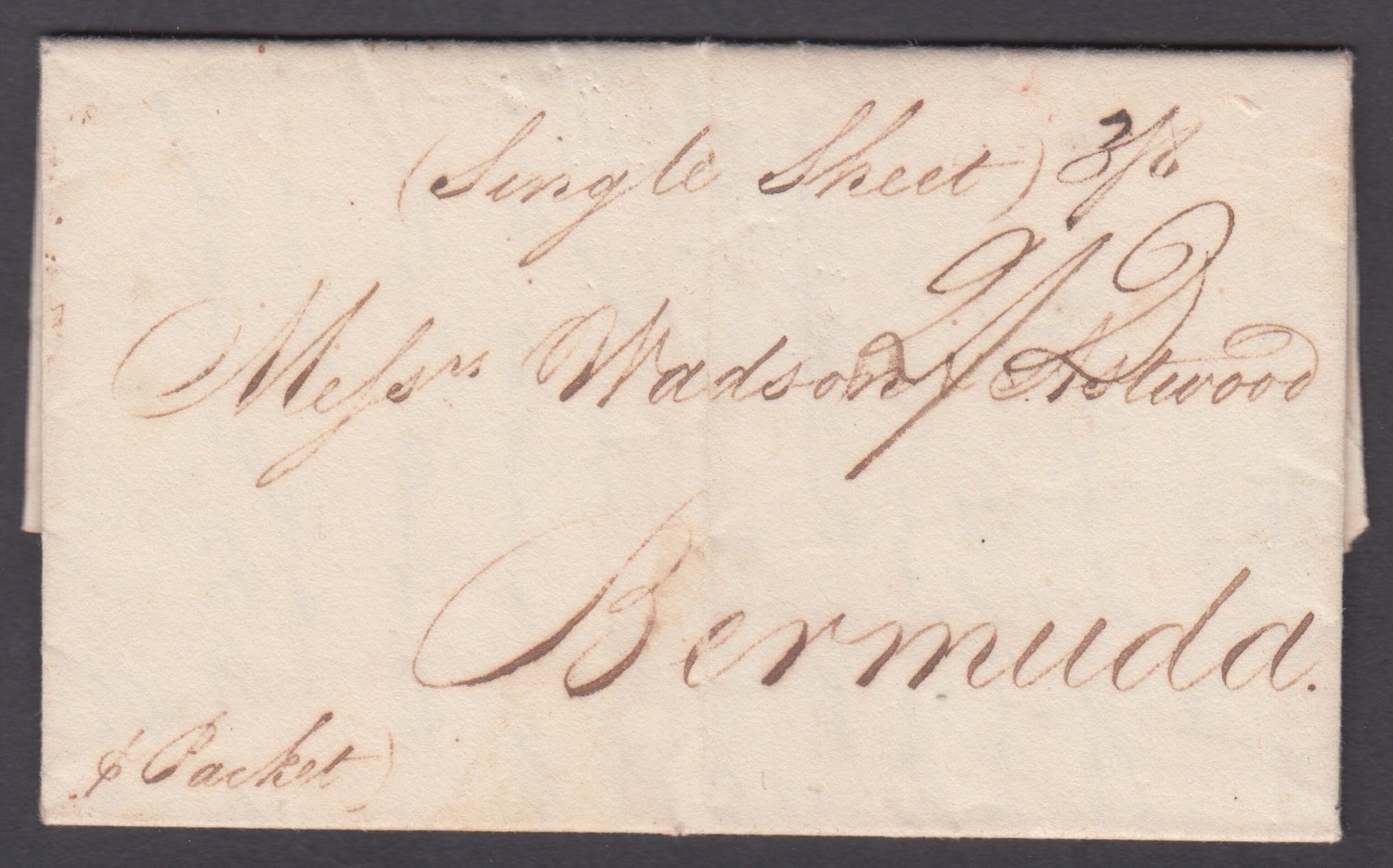
Folded entire addressed in ink to Messrs Wadson & Astwood, Bermuda, endorsed (Single Sheet) 3/8 at the top and (p Packet) at lower left, with a large manuscript 2/2
The entire folded: “Messrs Wadson & Astwood, Bermuda”
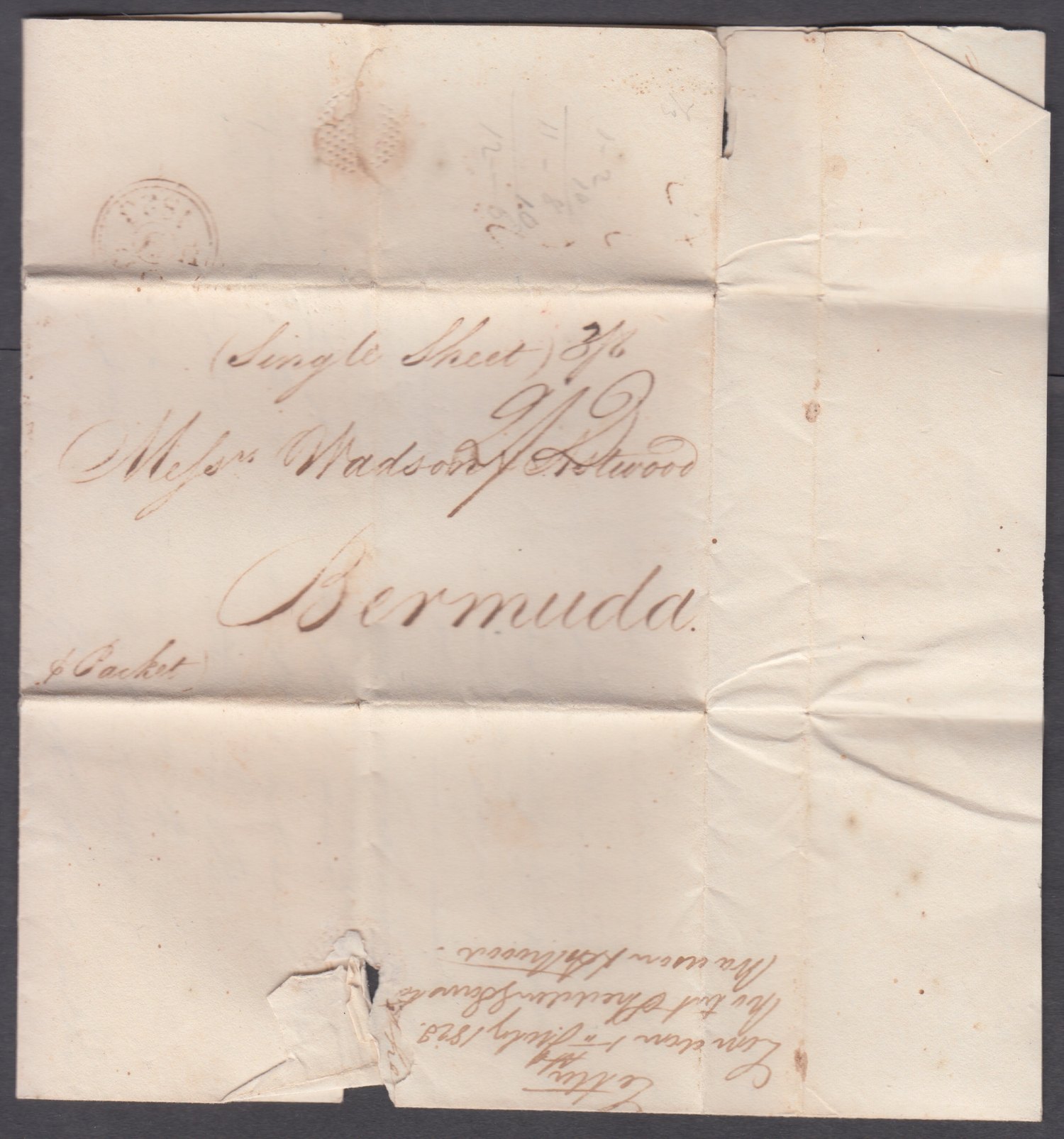
The outer sheet opened out, with the address panel in the centre, a faint double-ring datestamp at upper left and the recipients’ docket upside down at the foot
The outer sheet opened out, with the datestamp at upper left and the docket at the foot
  • Item Entire: outer sheet with two letters inside
  • From Robert Shedden & Sons, London
  • To Messrs Wadson & Astwood, Bermuda
  • Written Copy of 1 July 1823; letter of 1 October; P.S. 9 October
  • Postmark Double-ring datestamp, OC 9 1823
  • Markings “(Single Sheet)”, “(p Packet)”, 2/2 and 3/8 in manuscript
  • Route Montagu packet, Falmouth to Halifax; H.M. Sloop Rifleman, Halifax to Bermuda
  • Arrived Bermuda, Thursday 27 November 1823

It’s an entire, a sheet folded to make its own cover, addressed “Messrs Wadson & Astwood, Bermuda”. At the top the writer put “(Single Sheet)”, and at the lower left “(p Packet)”, to say how it was to be charged and how it was to go.

There are two postage figures. The big 2/2 is the packet postage in sterling, two shillings and twopence. Below “Single Sheet” is 3/8, written with the address and the 2/2. I take it to be the 2/2 sterling turned into Bermuda currency, so the amount to pay was settled before the letter left London. There’s no “Paid” mark, so Wadson & Astwood paid it when they collected the letter. Edward Proud sets out the rates of the period in The Postal History of Bermuda, Chapter 3.

On the back is a faint double-ring datestamp. I read it as OC 9 1823, which is the same day as the postscript inside. Upside down at the foot, one of the partners docketed it as a letter from “London 1st July 1823” from the Sheddens. They filed it by the first of the two letters inside, which is a little misleading, because the letter that actually travelled is the one of October.
II

“Now on board the Mary”

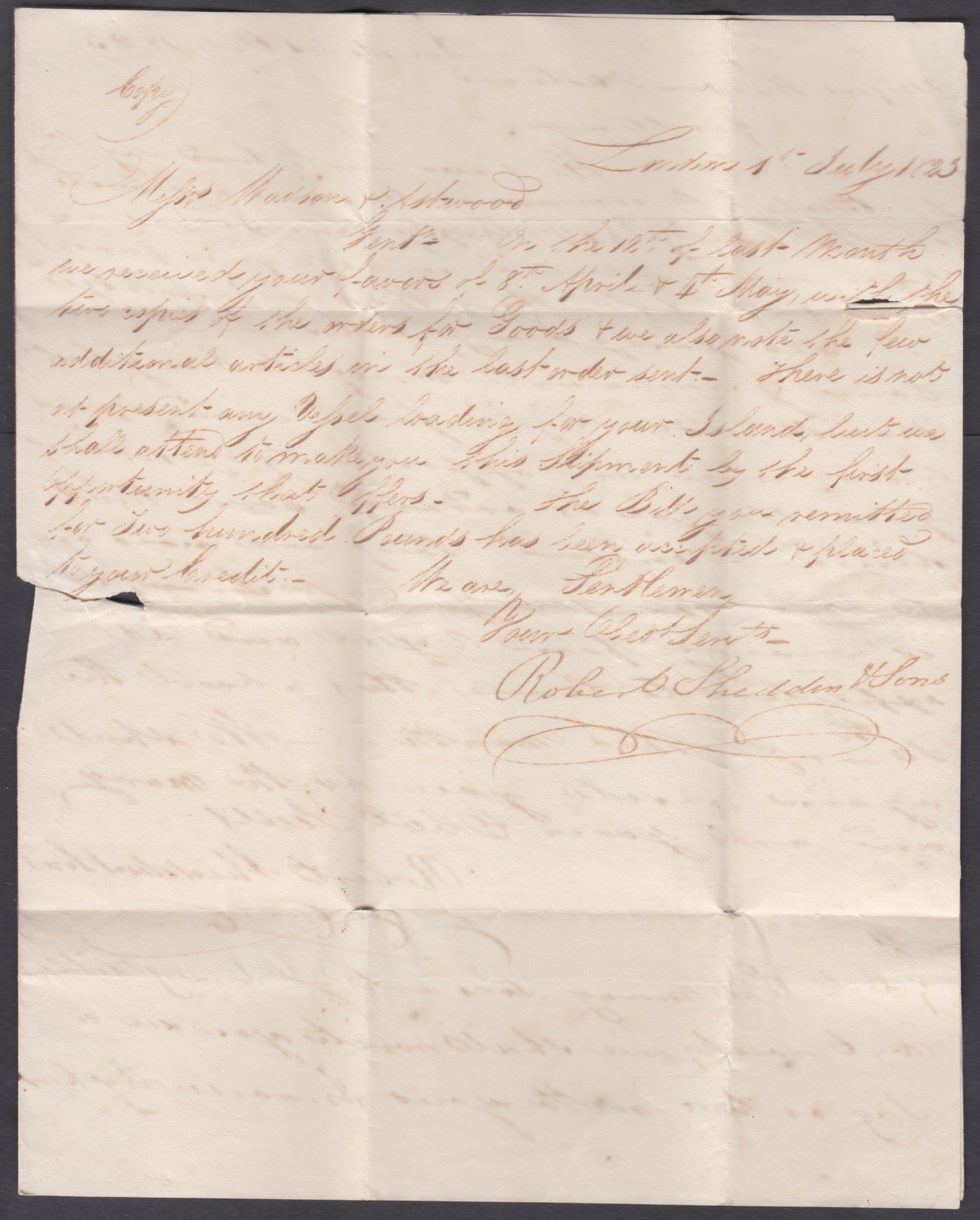
Letter headed Copy, London 1st July 1823, to Messrs Wadson & Astwood, about their orders for goods and a bill for two hundred pounds, signed Robert Shedden & Sons
The copy of the July letter, sent again with the new one
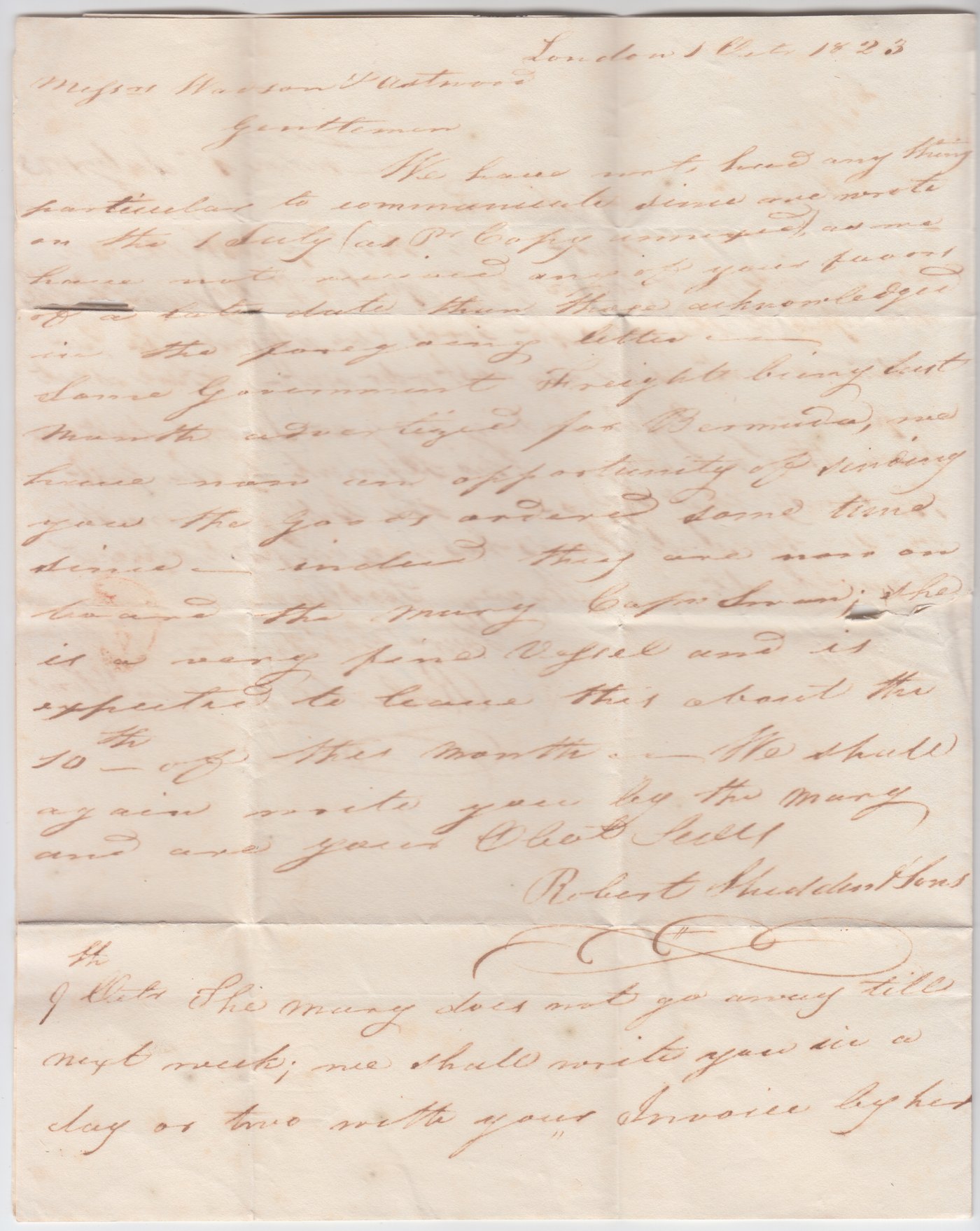
Letter headed London 1 Octr 1823, to Messrs Wadson & Astwood, saying the goods ordered are now on board the Mary, Captain Swann, signed Robert Shedden & Sons, with a postscript dated 9th Octr
London, 1 October 1823, with the P.S. of the 9th

Inside are two letters on the one sheet. The first is headed “Copy”. It’s the Sheddens’ letter of 1 July written out again, as merchants often did in case the first copy had gone astray. They had received Wadson & Astwood’s letters of 8 April and 4 May “with the two copies of the orders for Goods”, but “There is not at present any Vessel loading for your Islands”. The bill Wadson & Astwood had sent “for two hundred Pounds has been accepted & placed to your credit”.

Three months later, on 1 October, they had better news:

“Some Government Freight being last month advertized for Bermuda, we have now an opportunity of sending you the goods ordered some time since — indeed they are now on board the Mary, Captn Swann; she is a very fine Vessel and is expected to leave this about the 10th of this month.”

Then a postscript dated “9th Octr”: “The Mary does not go away till next week; we shall write you in a day or two with your Invoice by her.” So the goods went by merchant ship and the letter went by the packet. It was posted the same day, and the race was on.

III

Sold as Argus, carried by Rifleman

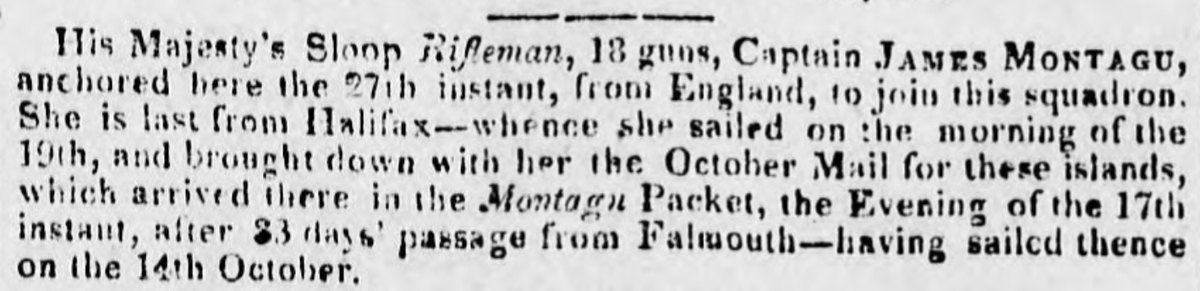
Bermuda Gazette paragraph: His Majesty’s Sloop Rifleman, 18 guns, Captain James Montagu, anchored here the 27th instant from England to join this squadron, last from Halifax, bringing the October Mail which arrived there in the Montagu Packet on the 17th after 33 days’ passage from Falmouth, having sailed thence on the 14th October
Bermuda Gazette, 29 November 1823: Rifleman brings the October mail

The dealer’s note dated it 2 September 1823 and said it came out to Halifax in the packet Lord Sidmouth and on to Bermuda in H.M.S. Argus. Argus did carry Bermuda’s mails to and from Halifax that year, and she came down from Halifax with the English July mail on Tuesday 2 September. But this letter was written in October, so it can’t have been in that mail. As for the Lord Sidmouth, she was a homeward packet that autumn: the Gazette of 15 November reports her leaving Halifax for England on 20 October, having waited for the Bermuda mail to arrive.

In 1823 there was no packet to Bermuda. The Falmouth packets ran to Halifax, and the Bermuda mail was carried between Halifax and the island by whatever naval vessel the admiral could spare. On 15 November the Gazette said the brig Sparrowhawk would bring the October mail down. A week later the plan had changed: “The October Mail is to be brought down from Halifax in the Rifleman, and may be hourly expected.” On 29 November it reported her arrival:

“His Majesty’s Sloop Rifleman, 18 guns, Captain James Montagu, anchored here the 27th instant, from England, to join this squadron. She is last from Halifax—whence she sailed on the morning of the 19th, and brought down with her the October Mail for these islands, which arrived there in the Montagu Packet, the Evening of the 17th instant, after 33 days’ passage from Falmouth—having sailed thence on the 14th October.”

That fits the letter exactly. Posted in London on 9 October, it would have reached Falmouth in time for the Montagu sailing on the 14th. She made Halifax on 17 November, and Rifleman sailed two mornings later and anchored at Bermuda on the 27th. Forty-nine days from the postscript to Bermuda.

There’s a nice twist. Rifleman herself had come out from England that same October, leaving Sheerness on the 9th and Land’s End on the 20th, six days after the packet left Falmouth. She still reached Halifax on 7 November, ten days ahead of it. The Gazette noted that as Rifleman “was only 18 days from the Land’s-End, the Packet was momently looked for at Halifax”. So the ship that brought the letter on its last leg had already beaten its mail across the Atlantic.

IV

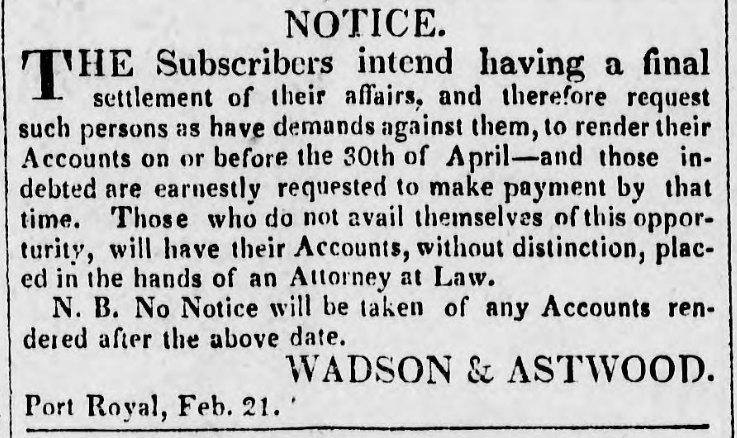
Messrs Wadson & Astwood, Port Royal

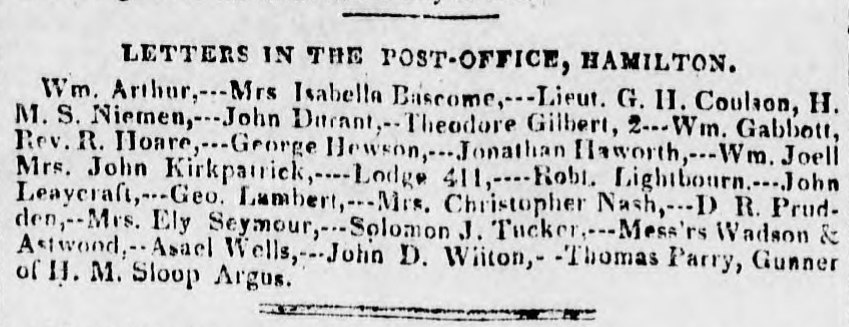
Bermuda Gazette list headed Letters in the Post-Office, Hamilton, including Messrs Wadson & Astwood and Thomas Parry, Gunner of H. M. Sloop Argus
Bermuda Gazette, 29 November 1823: a letter waiting at Hamilton for Wadson & Astwood
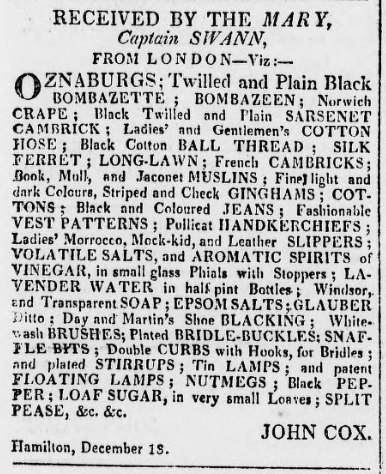
Bermuda Gazette advertisement: Received by the Mary, Captain Swann, from London, a long list of cloth, haberdashery and household goods, John Cox, Hamilton, December 13
Bermuda Gazette, 13 December 1823: the Mary, Captain Swann, is in
Bermuda Gazette notice: The Subscribers intend having a final settlement of their affairs and request accounts by the 30th of April, signed Wadson & Astwood, Port Royal, Feb. 21
Bermuda Gazette, 21 February 1824: Wadson & Astwood settle their affairs

Wadson and Astwood are both old Bermuda names, and the Gazette shows where this firm was. They traded at Port Royal, in Southampton parish at the west end of the island, a long way from the post office at Hamilton. Perhaps that’s why their name keeps turning up in the lists of uncollected letters: in 1821 and 1822, on 29 November 1823, and again in January 1824.

The 29 November list was printed two days after Rifleman came in with the October mail. A letter for Wadson & Astwood waiting at Hamilton that week is very probably this one, though of course I can’t prove it. The same list has a letter for “Thomas Parry, Gunner of H. M. Sloop Argus”, which made me smile.

The goods weren’t far behind. By 13 December Hamilton merchants were advertising what had come “By the Mary, from London”, and the Gazette gave her master as Captain Swann. She seems to have had a rough passage, because on 20 December damaged goods “imported per Ship Mary, Capt. Swann, from London” were sold at auction “for the Benefit of Owners, Underwriters, and others concerned”. So the letter beat the goods by two or three weeks. I’d love to know whether Wadson & Astwood’s order was among the damaged goods.

The firm didn’t last much longer. On 22 June 1822 George Wadson of Southampton had asked anyone with claims against “the firm of WADSON & ASTWOOD, or against the Estate of WILLIAM ASTWOOD, Esq. deceased, late of Southampton Parish” to send in their accounts. So the Astwood partner had died the year before this letter was written. In February 1824 the firm itself announced from Port Royal that it intended “having a final settlement of their affairs”.

A Colonel William Astwood of Warwick, who died in the Turks Islands in 1818, was married to a Frances Wadson, so the two families were connected. He is probably the same family as the firm’s William Astwood, but I haven’t proved it.

Robert Shedden & Sons

The London firm had a Bermuda past of its own. Robert Shedden was born at Beith in Ayrshire in 1741 and became a merchant at Norfolk, Virginia. When the American Revolution came he took the King’s side, escaped with his family to the British fleet and came to Bermuda, where he carried on a large business during the war. In 1783 he settled in London, and his sons joined him as partners in Robert Shedden & Sons. When this letter was written he was 81. He died in September 1826. UCL’s Legacies of British Slavery database lists the firm as West India merchants.

There was still a Shedden in Bermuda in 1823. In May that year a notice in the Gazette asked for goods saved from a wrecked American schooner to be brought to “the Wharf of ARCHIBALD SHEDDEN, Esq.” at St George’s. I don’t know yet whether he was family.

July 1823 to February 1824

The ships on one side, the letter on the other.

The ships
The letter
1 Jul 1823
The letterThe Sheddens write: no vessel loading for Bermuda.
2 Sep
The shipsArgus brings the English July mail down from Halifax.
1 Oct
The letterThe Sheddens write again: the goods are on board the Mary.
9 Oct
The shipsRifleman leaves Sheerness for Halifax.
The letterThe P.S., and the London datestamp, OC 9 1823.
14 Oct
The shipsThe Montagu packet sails from Falmouth.
7 Nov
The shipsRifleman reaches Halifax, 18 days from Land’s End.
17 Nov
The shipsThe Montagu reaches Halifax, 33 days from Falmouth.
19 Nov
The shipsRifleman sails for Bermuda with the October mail.
Thu 27 Nov
The shipsRifleman anchors at Bermuda.
The letterIn Bermuda, 49 days after the P.S.
29 Nov
The letterA letter for Wadson & Astwood waits at Hamilton.
13 Dec
The shipsThe Mary, Captain Swann, is in; her goods advertised.
21 Feb 1824
The letterWadson & Astwood announce a final settlement of their affairs.

The Ship

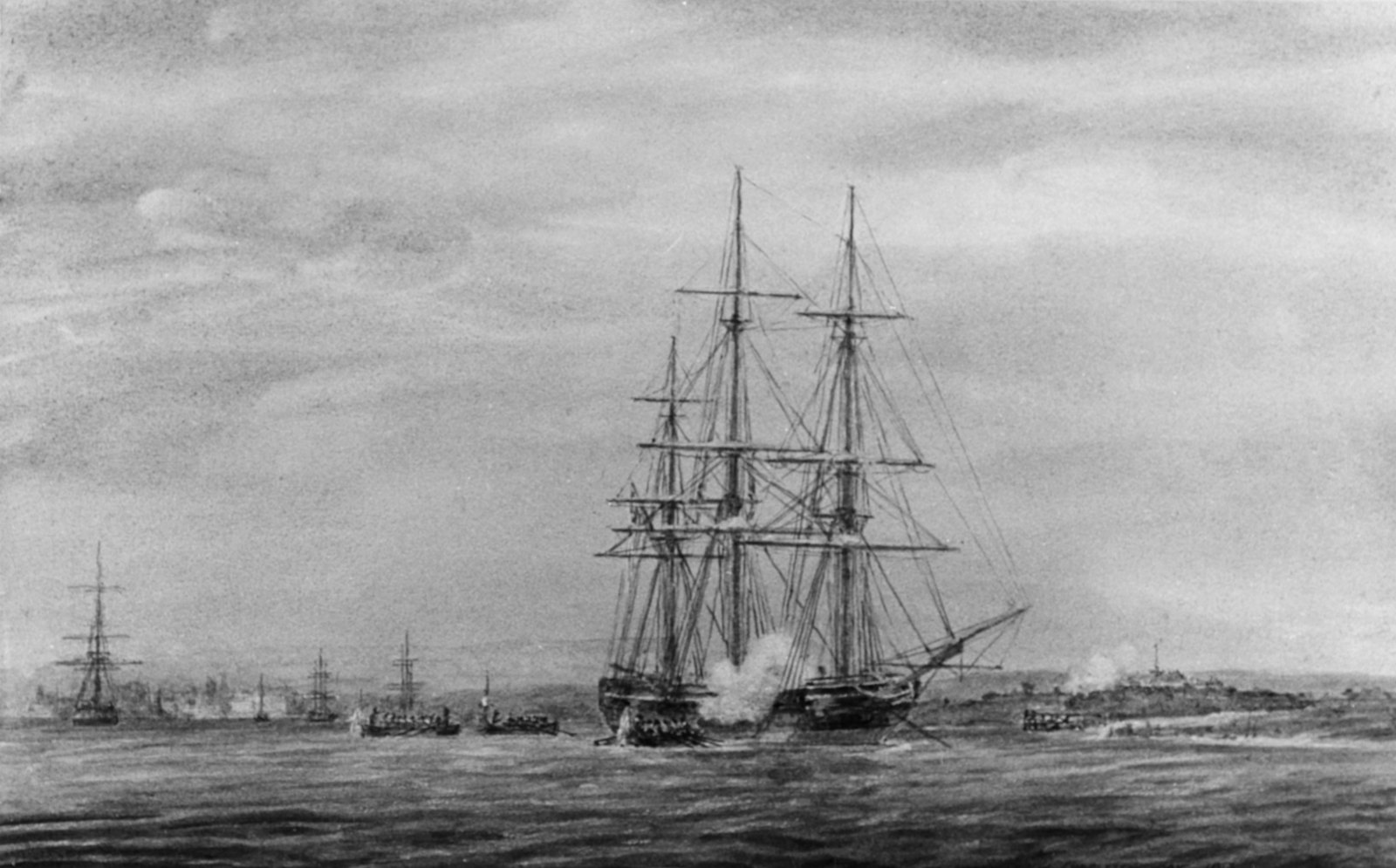
Watercolour of the Cruizer-class brig-sloop HMS Moselle under sail in Charleston Bay, about 1813, a sister ship of Rifleman

H.M.S. Rifleman

HMS Rifleman was a Cruizer-class brig-sloop of 18 guns, built by John King at Upnor on the Medway and launched on 12 August 1809. The Cruizer class was the Navy’s workhorse, with more than a hundred built, and Espoir on this site was another of them. Rifleman served in the North Sea and then on the Halifax station during the War of 1812. After some years laid up she was fitted out again in 1823, and Commander James Montagu took her out to the Halifax station that October. Her first job on arriving was to bring Bermuda its October mail, and in January 1824 she was given the island’s mails to take to New York. Her service also took her to the Jamaica station and the Mediterranean. The Navy sold her in 1836, and she ended her days as a whaler, making three voyages between 1837 and 1856.

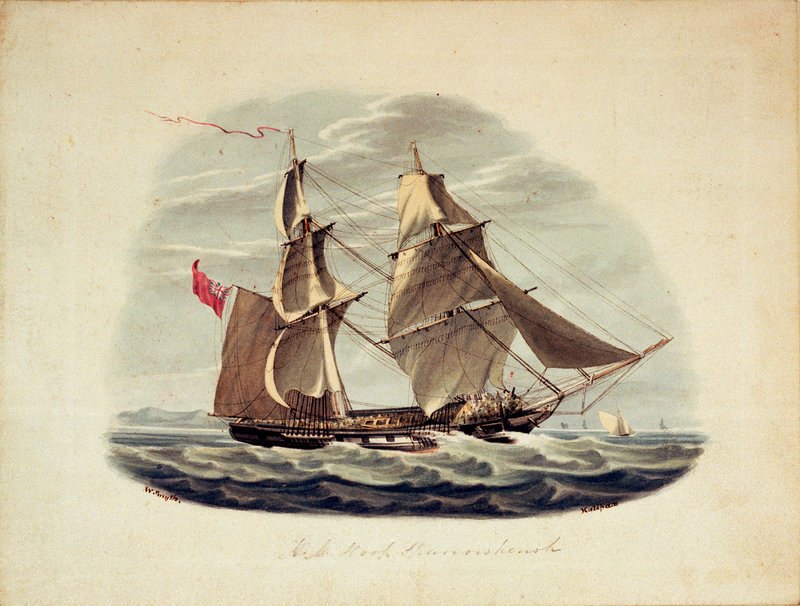
I haven’t found a picture of Rifleman herself, so the watercolour above is her sister ship Moselle, built to the same design. Below is the brig Sparrowhawk, another of the class. She was meant to bring this October mail down from Halifax until the job went to Rifleman.

BuiltJohn King, Upnor, launched 12 August 1809
TypeCruizer-class brig-sloop, 18 guns
Guns16 × 32-pdr carronades, 2 × 6-pdrs
Commander, 1823James Montagu
FateSold 1836; a whaler until 1856

HMS Moselle in Charleston Bay, watercolour attributed to Warren, about 1813. U.S. Naval History and Heritage Command (NH 56787), via Wikimedia Commons.

Painting by William Smyth of the brig-sloop HM Sloop Sparrowhawk under sail, about 1830
H.M. Sloop Sparrowhawk, by William Smyth, about 1830. National Maritime Museum, Greenwich, via Wikimedia Commons.

Still to find out

If you can help with any of these, I’d be very pleased to hear from you.

References

It’s an ordinary business letter about an order of goods and a bill for two hundred pounds. What I like is that the Gazette lets me follow it from London to Port Royal almost day by day: posted on the 9th, out of Falmouth on the 14th, into Halifax on 17 November and down to Bermuda in the Rifleman ten days later. And it reminds me that a dealer’s description is only a starting point.