Postal History · Royal Navy · Bahamas to Bermuda

H.M.S. Pincher

Nassau · Hamilton · July–August 1833

A merchant’s letter brought up from Nassau by a Bermuda-built naval schooner, with the reply drafted inside.

◆

This entire came up in an Argyll Etkin sale in November 2025, described as “privately carried, unusual”. It is unusual, but not quite for that reason. It’s a business letter written at Nassau on 2 July 1833 to Danl. & Hy. J. Tucker, merchants of Hamilton, and in the lower corner the writer put “H.M. Schr. Pincher”. There’s no postage and no postmark, because it never went near a post office. A naval schooner carried it up from the Bahamas as a favour. What makes it for me is the inside page. Six weeks later the Tuckers drafted their answer on the same sheet, and it begins “Yours July 2d by H.M. Schr Pincher reached us”. So both ends of the correspondence are on one piece of paper, and the Royal Gazette fills in nearly everything between them.

I

“H.M. Schr. Pincher”

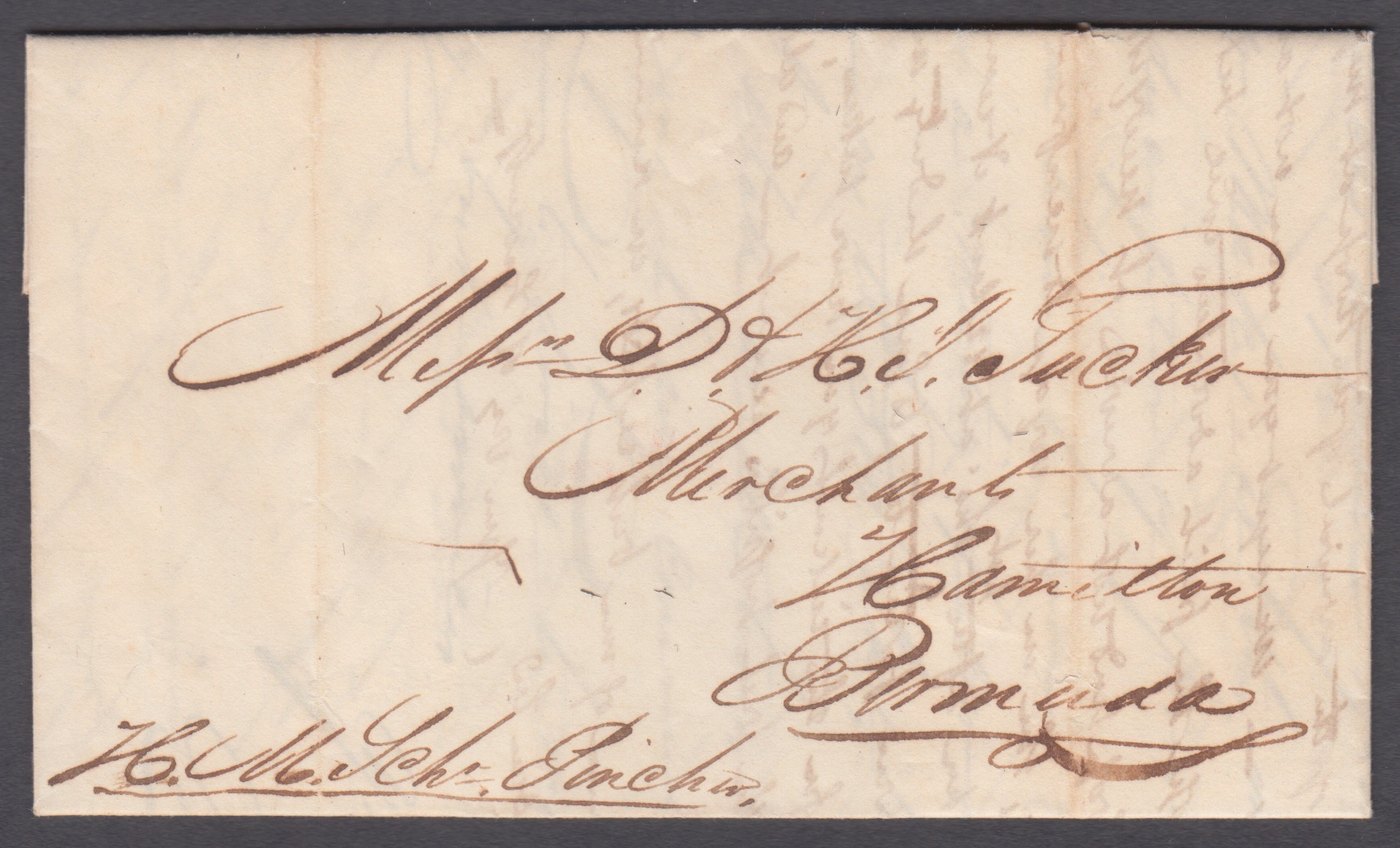
Folded entire addressed in ink to Messrs D. & H. J. Tucker, Merchants, Hamilton, Bermuda, endorsed H.M. Schr. Pincher and underlined at lower left, with no postal markings
The entire folded: “Messrs D & H. J. Tucker, Merchants, Hamilton, Bermuda”
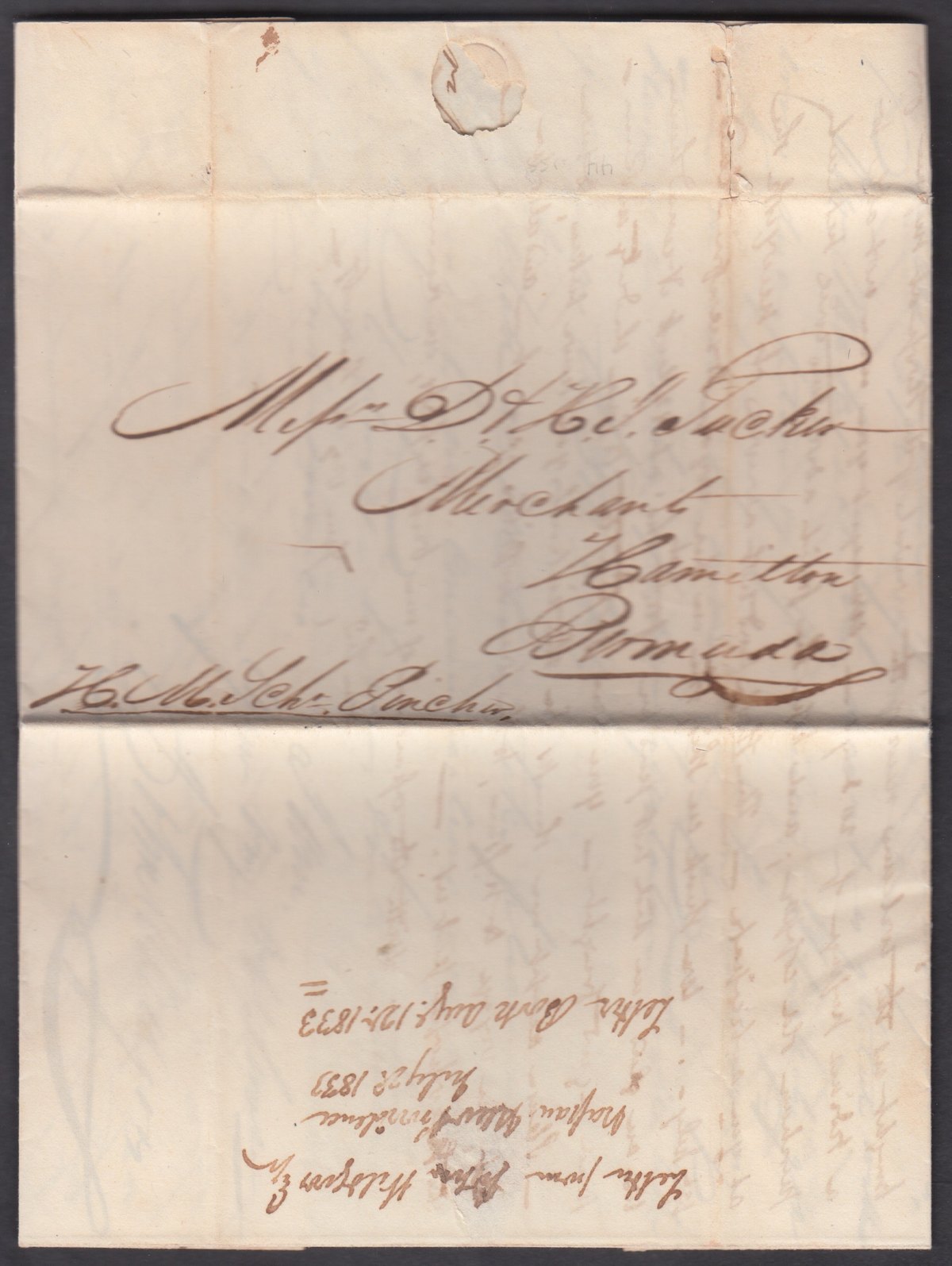
The outer sheet opened out, showing the address panel, the remains of a red wax seal at the top and the Tuckers’ docket upside down at the foot
The outer sheet opened out, with the seal at the top and the Tuckers’ docket at the foot
  • Item Entire letter, with the reply drafted inside
  • From John Wildgoos, Nassau, New Providence
  • To Danl. & Hy. J. Tucker, Merchants, Hamilton, Bermuda
  • Written 2 July 1833
  • Endorsed “H.M. Schr. Pincher”
  • Markings None: carried outside the post, free
  • Arrived Bermuda, Thursday 11 July 1833
  • Reply Drafted on the inside page, 12 August 1833

It’s an entire, a single sheet folded to make its own cover. Folded, it shows only the address and, underlined at the lower left, “H.M. Schr. Pincher”. That was the writer telling whoever took charge of it which vessel it was meant for.

There are no postal markings and no charge, and none were needed. Bermuda had gone without any official inland mail service at all from 1821 to 1830 (Edward Proud, The Postal History of Bermuda, p. 141), and as far as I know there was no regular mail of any kind between Bermuda and Nassau. Letters between the two went by trading sloop, or by favour of a naval vessel passing through. This one went in the schooner Pincher, so the Tuckers paid nothing for it.

Opened out, the back still has the remains of the red wax seal. Upside down at the foot, one of the partners docketed it: “Letter from John Wildgoos Esqr, Nassau, New Providence, July 2d 1833”, and below that “Letter Book Augt 12th 1833”. That second line is the date they answered it and copied the answer into their letter book. It isn’t the date the letter arrived, which was a month earlier.
II

“After a very tedious passage of twenty days”

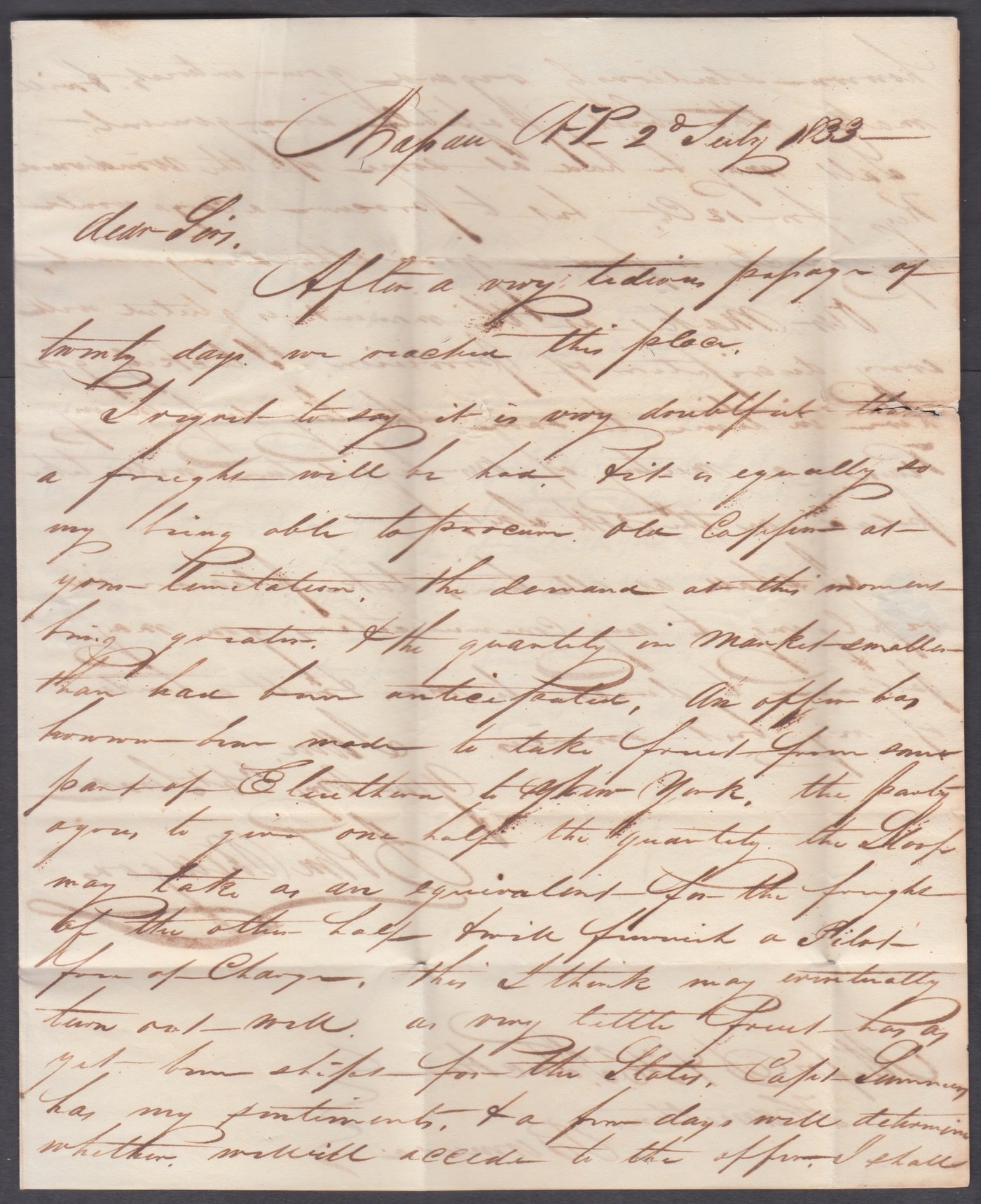
First page of the letter, headed Nassau N.P. 2d July 1833, Dear Sirs, After a very tedious passage of twenty days we reached this place
Nassau, 2 July 1833: the first page
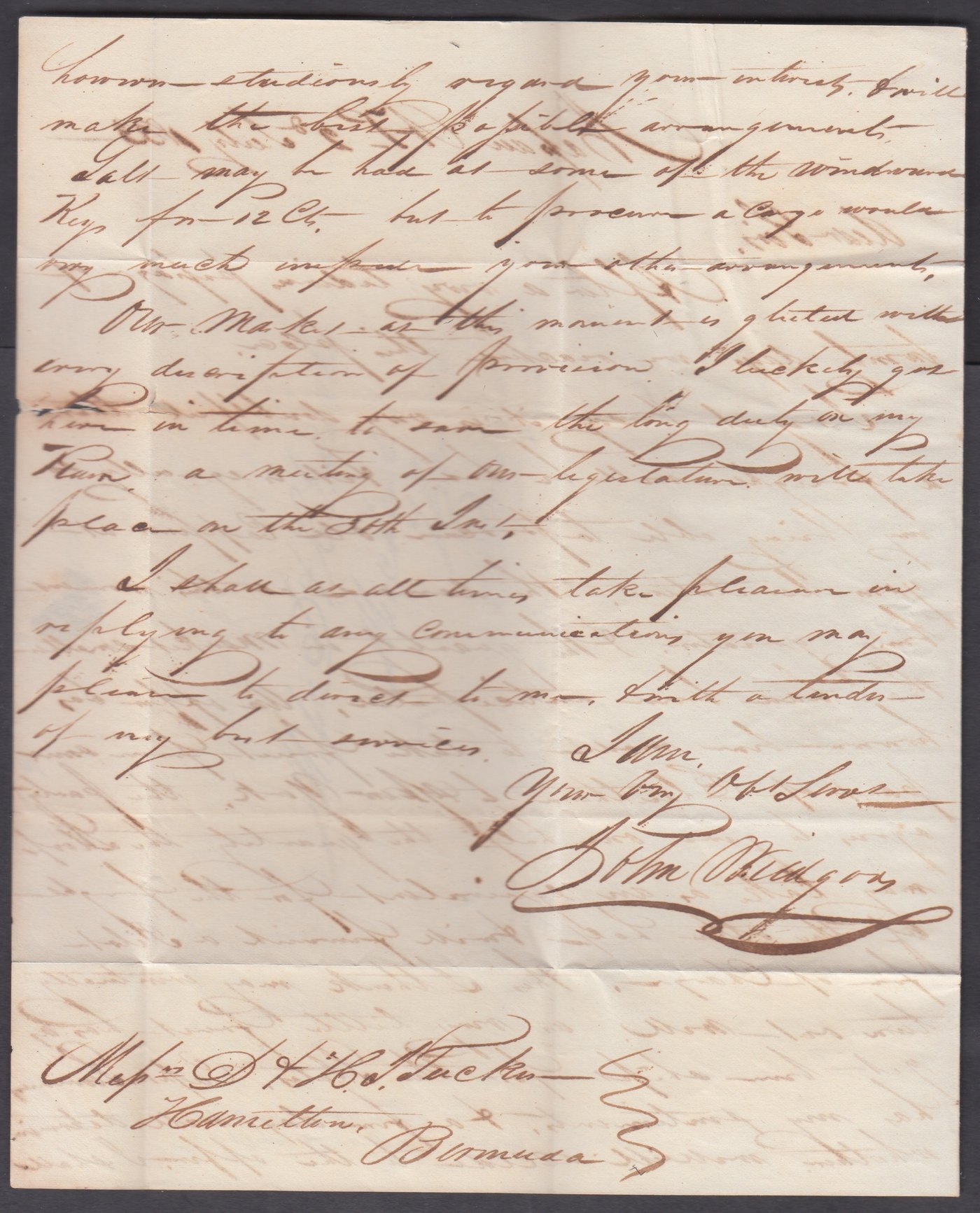
Second page of the letter, ending with an offer of his best services and signed John Wildgoos, addressed at the foot to Messrs D & H. J. Tucker, Hamilton, Bermuda
The second page, signed John Wildgoos
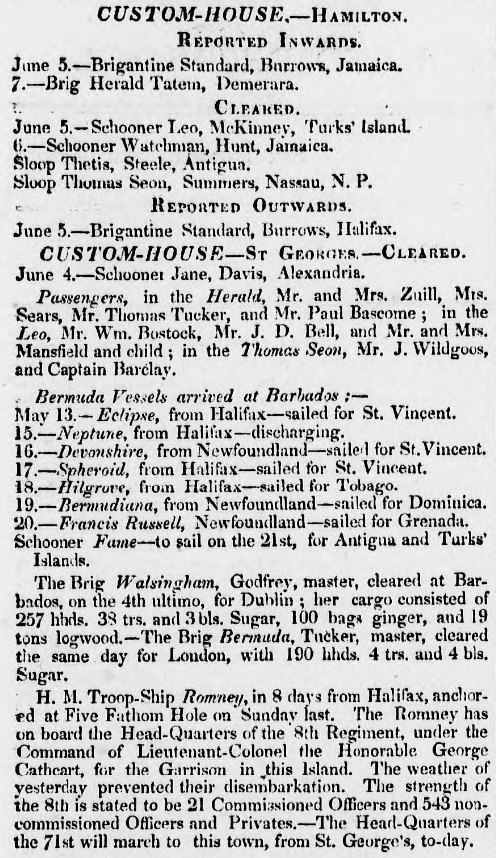
Royal Gazette custom-house lists of 11 June 1833: among vessels cleared, Sloop Thomas Seon, Summers, Nassau N.P.; and among passengers, in the Thomas Seon, Mr. J. Wildgoos and Captain Barclay
Royal Gazette, 11 June 1833: the sloop Thomas Seon clears for Nassau, with Mr J. Wildgoos on board

The Royal Gazette of 11 June 1833 gives the start of the story. Among the vessels cleared at Hamilton that week was the “Sloop Thomas Seon, Summers, Nassau, N.P.”, and among the passengers, “in the Thomas Seon, Mr. J. Wildgoos, and Captain Barclay”. A month later Wildgoos wrote to the Tuckers from Nassau:

“After a very tedious passage of twenty days we reached this place. I regret to say it is very doubtful that a freight will be had, & it is equally so my being able to procure old Copper at your limitation…”

Twenty days out from the first week of June brings them to Nassau at the very end of the month, so he wrote within a few days of landing. The rest is a business report, and not a cheerful one. Copper was dearer and scarcer than expected. Instead, someone had offered to have the sloop carry fruit from Eleuthera to New York, taking half the cargo as payment for carrying the other half, with a pilot free of charge. He thought that might turn out well, “as very little Fruit has as yet been shipped for the States”. Capt. Summers, the sloop’s master, had his opinion, and a few days would decide it. Salt could be had in the Windward Keys at 12 cents, but loading it would get in the way of everything else. The market at Nassau was glutted with every kind of provision.

He had got in just in time to save the duty on his rum, and the Bahamas Legislature was about to meet. He talks of “our Market” and “our Legislature”, so I take him to be a Nassau man who had come over to Bermuda and gone back with the Tuckers’ sloop to look after their business. He closes with “a tender of my best services” and signs himself John Wildgoos. I haven’t found out anything more about him yet.

I like it because it’s so ordinary: a small Bermuda trading voyage, going about as well as most of them did.

III

“Touched here on Thursday from Nassau”

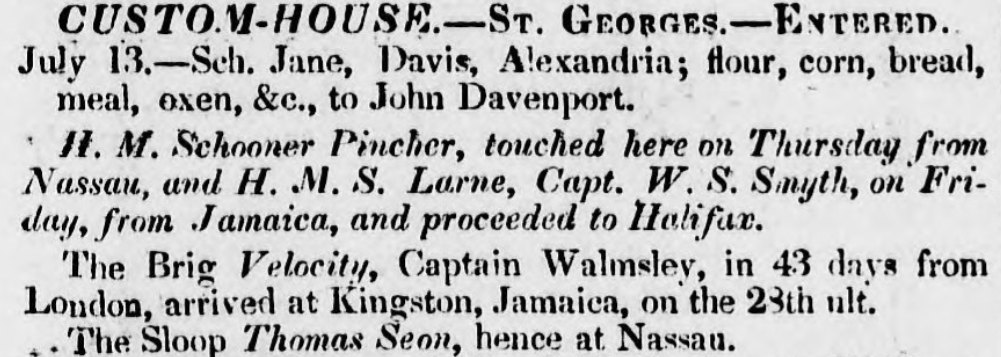
Royal Gazette, St George’s custom-house entries for July 1833: H. M. Schooner Pincher, touched here on Thursday from Nassau, and H. M. S. Larne, Capt. W. S. Smyth, on Friday, from Jamaica, and proceeded to Halifax; and a few lines below, The Sloop Thomas Seon, hence at Nassau
Royal Gazette, 16 July 1833: Pincher touches at St George’s from Nassau, and the Thomas Seon is reported at Nassau

The letter’s previous owner had pencilled a note inside it from the Royal Gazette of 16 July 1833: Pincher “touched here on Thursday from Nassau & proceeded to Halifax on Friday”. The Gazette itself puts it a little differently:

“H. M. Schooner Pincher, touched here on Thursday from Nassau, and H. M. S. Larne, Capt. W. S. Smyth, on Friday, from Jamaica, and proceeded to Halifax.”

So the Friday belongs to the Larne, not to Pincher. The paper came out on Tuesdays, which puts Pincher at St George’s on Thursday 11 July, nine days after the letter was written. She only touched there, long enough to land a bag of letters and any news, and this one was among them.

Three lines further down is the news the Tuckers had been waiting for: “The Sloop Thomas Seon, hence at Nassau.” Pincher brought that up too.

IV

“Yours July 2d by H.M. Schr Pincher”

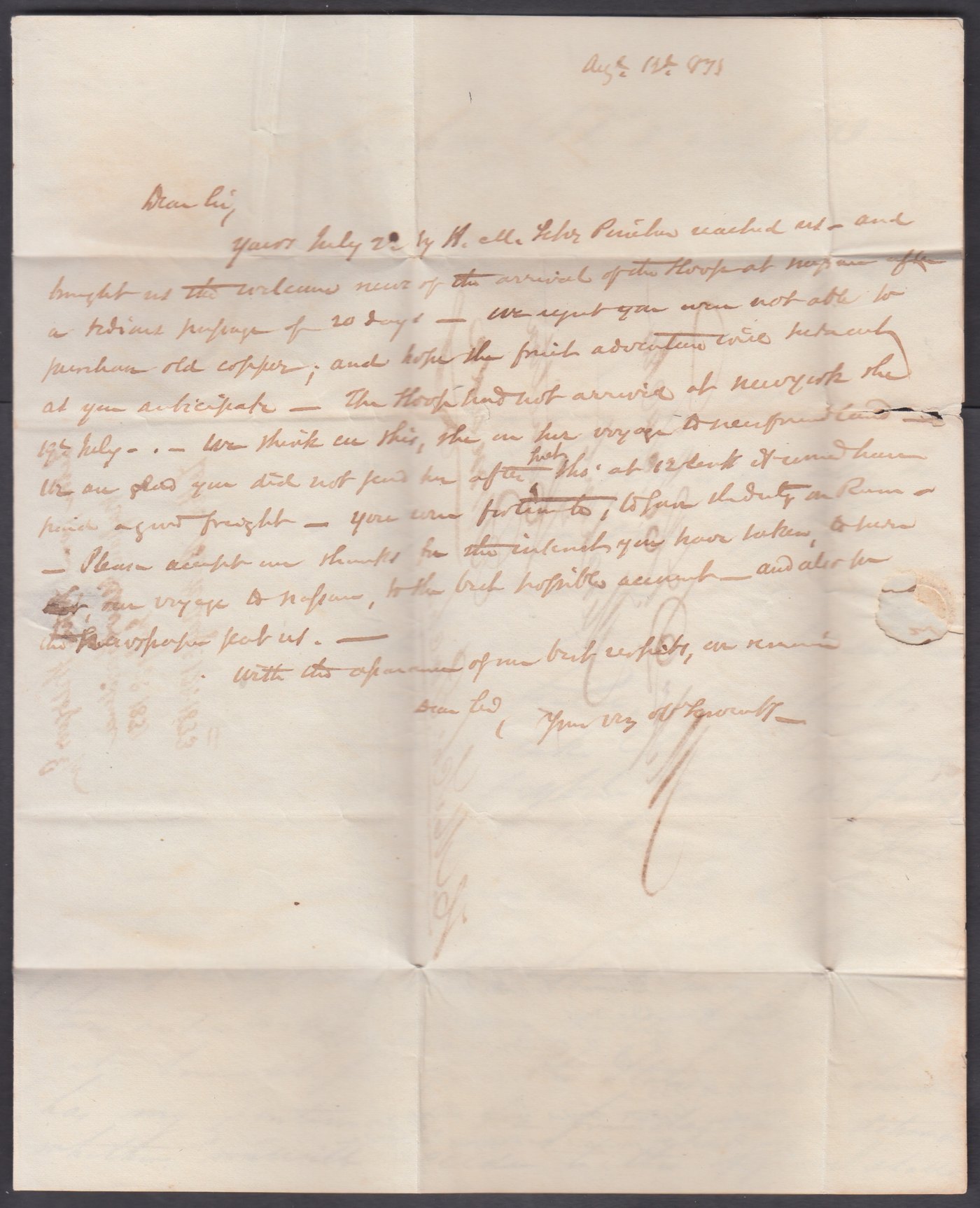
The inside page of the entire with the Tuckers’ draft reply dated Augt 12th 1833, beginning Dear Sir, Yours July 2d by H.M. Schr Pincher reached us
The Tuckers’ draft reply on the inside page, 12 August 1833
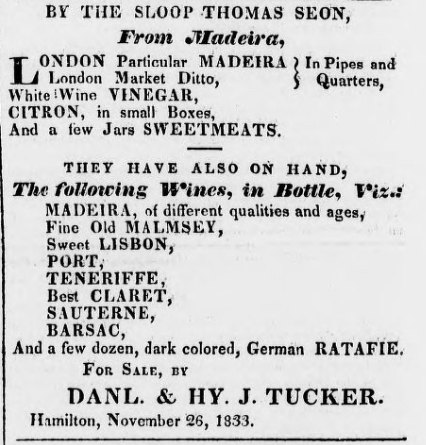
Royal Gazette advertisement: By the Sloop Thomas Seon, from Madeira, London Particular Madeira, vinegar, citron and sweetmeats, with wines in bottle, for sale by Danl. & Hy. J. Tucker, Hamilton, November 26, 1833
Royal Gazette, 26 November 1833: the Thomas Seon back from Madeira, for Danl. & Hy. J. Tucker

The Tuckers answered on the inside page of Wildgoos’s own sheet, dated “Augt 12th 1833”:

“Yours July 2d by H.M. Schr Pincher reached us and brought us the welcome news of the arrival of the Sloop at Nassau after a tedious passage of 20 days…”

They were sorry he hadn’t been able to buy old copper, and hoped the fruit venture would succeed as he expected. They had heard that the sloop hadn’t reached New York by 19 July. They were glad he hadn’t sent her after salt, though at 12 cents it would have paid a good freight, and they thought him fortunate to save the duty on the rum. They thanked him for the trouble he had taken to turn their voyage to Nassau to the best account, “and also for the newspaper sent us”.

This is a draft. The docket on the outside says the answer went into the letter book the same day, so the fair copy went back to Nassau and this sheet stayed in Hamilton with the firm’s papers. That’s presumably why it survived.

The address reads “D & H. J. Tucker”, and their own advertisements give the names in full: Danl. & Hy. J. Tucker, that is Daniel and Henry J. Tucker of Hamilton. In November the Thomas Seon, Summers, came into Hamilton from Madeira with wine, fruit and onion seed for them, and on 26 November they advertised the Madeira, vinegar, citron and sweetmeats “By the Sloop Thomas Seon”. So the sloop was still working for the Tuckers that autumn, though I don’t know whether the fruit voyage to New York ever came off.

Pincher in the Royal Gazette

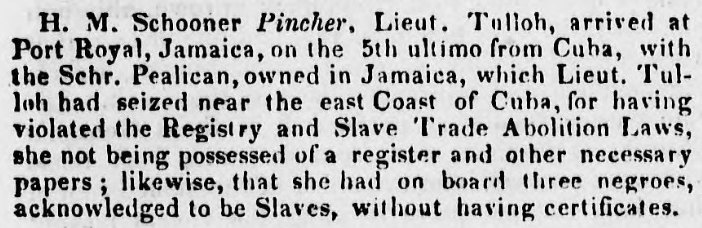
Royal Gazette paragraph: H. M. Schooner Pincher, Lieut. Tulloh, arrived at Port Royal, Jamaica, on the 5th ultimo from Cuba, with the Schr. Pealican, owned in Jamaica, seized near the east coast of Cuba for violating the Registry and Slave Trade Abolition Laws, with three negroes on board acknowledged to be slaves without certificates
Royal Gazette, 17 January 1832: Pincher brings the Pelican into Port Royal
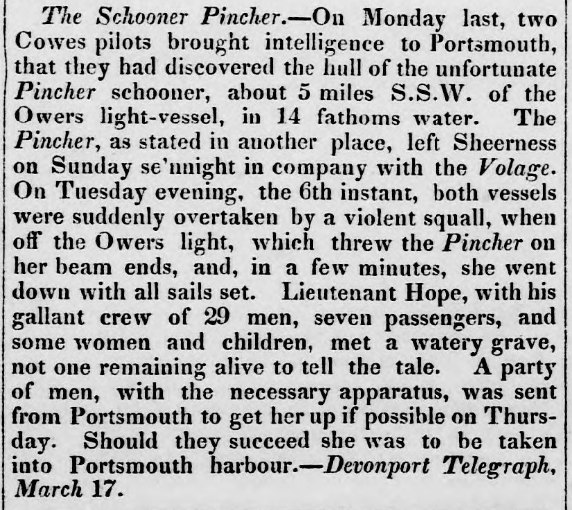
Royal Gazette paragraph from the Devonport Telegraph: the schooner Pincher, overtaken by a violent squall off the Owers light on Tuesday evening the 6th, went down with all sails set; Lieutenant Hope, his crew of 29 men, seven passengers and some women and children were lost
Royal Gazette, 15 May 1838: the loss of the Pincher off the Owers

Pincher was a familiar name in the Royal Gazette in the early 1830s, coming and going between Bermuda, Nassau, Jamaica, Havana and Halifax. In August 1831 she sailed from Bermuda for Nassau and Jamaica under Lieutenant William S. Tulloh. In January 1832 the Gazette reported that Tulloh had brought her into Port Royal, Jamaica, on 5 December 1831 with the schooner Pelican (the paper spells it “Pealican”). He had seized her near the east coast of Cuba for breaking the registry and slave trade abolition laws: she had no register, and had three enslaved people on board without certificates.

Tulloh didn’t live to see the next year. The Gazette of 30 October 1832 reported that he had died at Havana on 23 August, “in the 32d year of his age”. By December Pincher was in at Bermuda under a Mr Lockyer as acting commander, and in October 1833 she came in from Halifax under Lieutenant Freemantle. The Gazette doesn’t name whoever had her in July 1833, when she carried this letter.

Her best-known work came later. In February 1836 the Gazette reported that she had taken an “African free trader” into Havana with 419 enslaved people on board, and in July 1836, under Lieutenant Byng, she chased the Spanish slaver Preciosa from Cape Ginger to Cay Sal and took her with 300 more.

Her end was sudden. She went home in 1837, and in March 1838 she left Sheerness in company with the Volage. On the evening of Tuesday 6 March a violent squall caught both ships off the Owers light, on the Sussex coast. It threw Pincher on her beam ends, and within minutes she “went down with all sails set”. Lieutenant Hope, her crew of 29, seven passengers and some women and children were all lost. In the summer she was raised and towed into Portsmouth, and the Gazette of 31 July 1838 reported that she was found nearly as she had sunk, with the bodies of six of those on board still inside her.

June to November 1833

The schooner on one side, the letter and the sloop on the other.

The schooner
The letter
Early Jun 1833
The letterThe sloop Thomas Seon, Summers, clears Hamilton for Nassau, with John Wildgoos aboard.
Late Jun
The letterThe sloop reaches Nassau after “a very tedious passage of twenty days”.
2 Jul
The letterWildgoos writes to the Tuckers, “H.M. Schr. Pincher”.
Thu 11 Jul
The schoonerPincher touches at St George’s from Nassau.
The letterIn Bermuda, nine days after it was written.
16 Jul
The schoonerThe Gazette reports Pincher in from Nassau, and the Thomas Seon “hence at Nassau”.
12 Aug
The letterThe Tuckers draft their reply on the inside page and enter it in their letter book.
22 Oct
The schoonerPincher in again, Lieutenant Freemantle, nine days from Halifax.
23 Nov
The letterThe Thomas Seon comes into Hamilton from Madeira with wine for the Tuckers.

The Ship

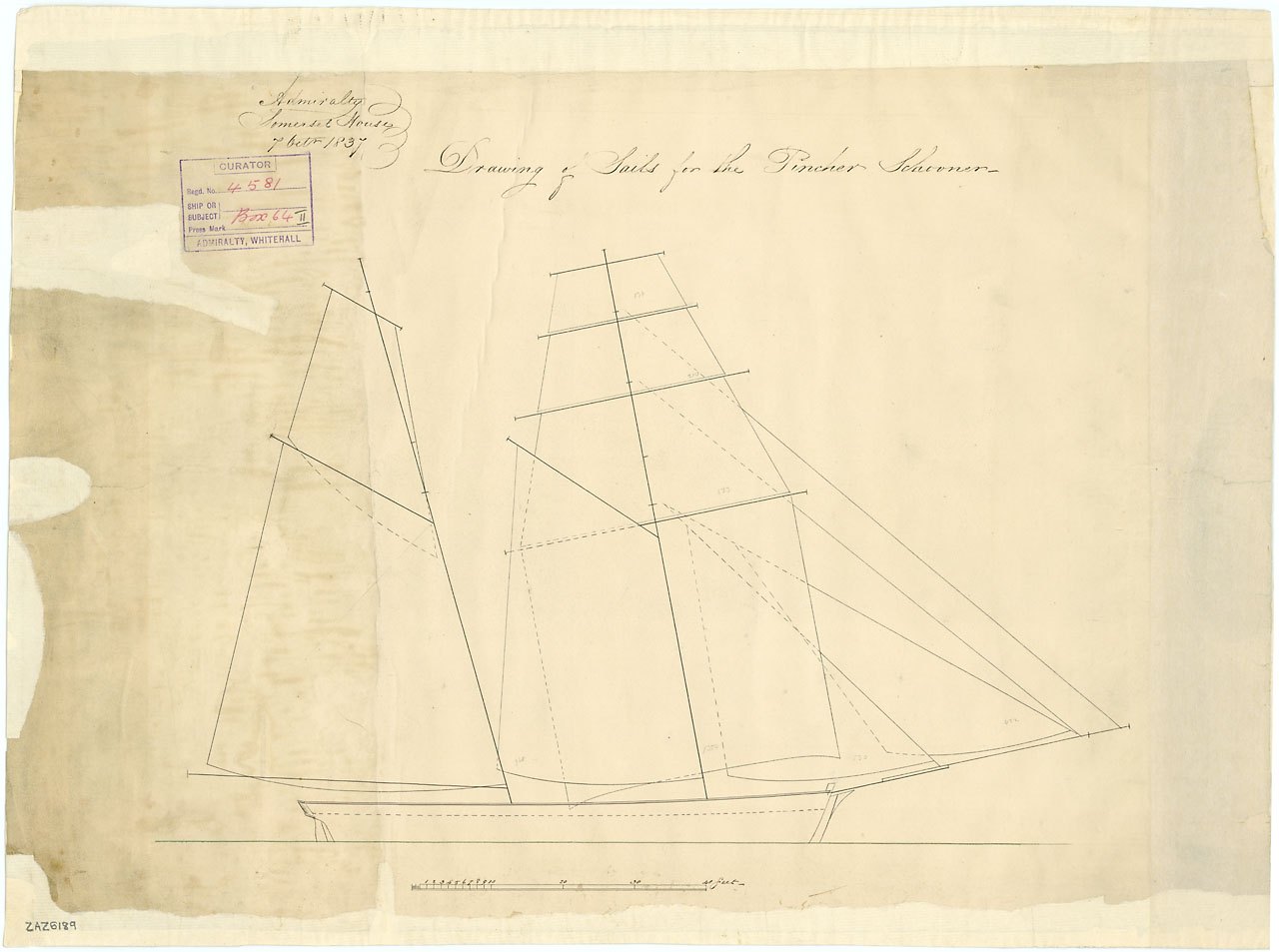
Admiralty drawing titled Drawing of Sails for the Pincher Schooner, dated Somerset House 7 October 1837, showing a two-masted topsail schooner’s sails in outline

H.M.S. Pincher

H.M. Schooner Pincher was one of three small schooners built of Bermuda cedar for the Navy in 1827, with Pickle and Skipjack, on the lines of the fast schooner Assiduous. She was about 118 tons, and her armament is given as three or five guns: the Admiralty plans of 1837 call her a three-gun schooner. She spent her working life on the North America and West Indies station, carrying despatches and passengers between Bermuda, the Bahamas, Jamaica, Havana and Halifax, and hunting slavers off Cuba. She went home in 1837, and was surveyed at Chatham that September. In March 1838 she capsized in a squall off the Owers, with the loss of everyone on board. She was raised that summer and sold.

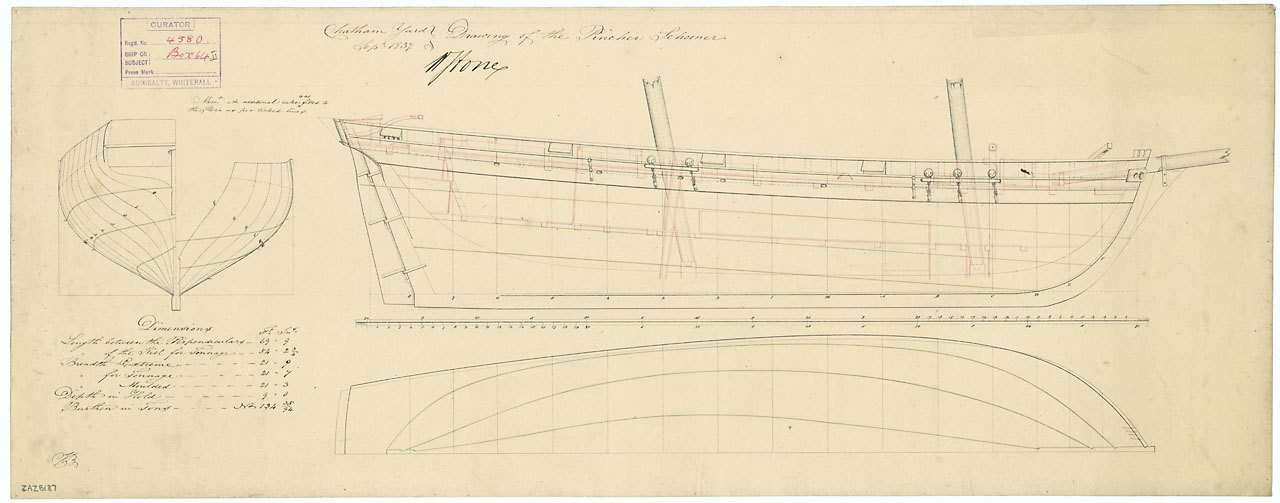
There is no picture of her that I know of. The drawing above, “Drawing of Sails for the Pincher Schooner”, was made at the Admiralty on 7 October 1837, five months before she went down “with all sails set”. Below is her lines plan, taken off at Chatham the month before.

BuiltBermuda, 1827
TypeSchooner, about 118 tons
Guns3 (some sources give 5)
StationNorth America and West Indies
FateCapsized off the Owers, 6 March 1838; raised and sold

Sail plan (ZAZ6189) and lines plan (ZAZ6187), 1837. © National Maritime Museum, Greenwich, London.

Lines plan of the schooner Pincher as taken off at Chatham Dockyard in September 1837, showing her sheer, body plan and half-breadth, signed by William Stone, Master Shipwright
Pincher’s lines, as taken off at Chatham Dockyard, September 1837. National Maritime Museum, Greenwich.

Still to find out

If you can help with any of these, I’d be very pleased to hear from you.

Provenance and references

It’s a small piece of business between Nassau and Hamilton: a sloop that took twenty days to get there, copper that couldn’t be had, and a hopeful idea about fruit for New York. What I like is that it carries its own answer, and that the Gazette lets me follow it from the sloop clearing Hamilton in June to the schooner touching at St George’s in July, with the letter in her bag.