Postal History · Penny Black · Bermuda Station

H.M.S. Illustrious & H.M.S. Winchester

Bermuda · 4 February 1842

Two Penny Blacks on a letter written aboard Illustrious on the day she became flagship, and carried home in the ship she replaced.

◆

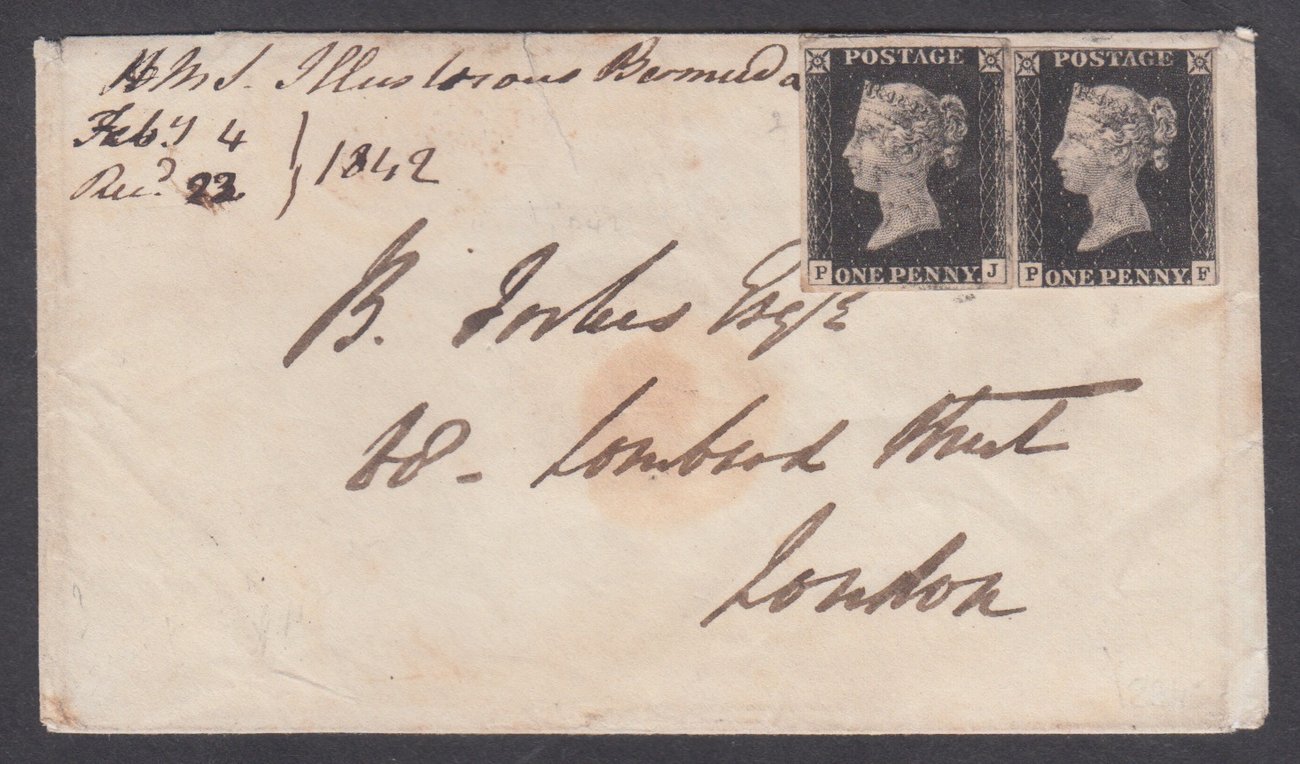
This cover is endorsed “H.M.S. Illustrious Bermuda, Feby 4, 1842” and franked with two Penny Blacks. David Pitts described it as the only recorded use of the Penny Black from Bermuda, and one of the more remarkable military covers from the island. But the more I looked into it, the more it became a story about two ships, not one. On the morning of 4 February 1842 the Commander-in-Chief moved his flag from HMS Winchester to HMS Illustrious. The same day this letter was written aboard Illustrious, and the next morning Winchester sailed for England with it in her mail.

I

The cover

1842 cover endorsed H.M.S. Illustrious Bermuda, Feby 4, Rec'd 23, 1842, addressed to B. Forbes Esq., 28 Lombard Street, London, franked with two Penny Blacks lettered PJ and PF
Endorsed “H.M.S. Illustrious Bermuda, Feby 4, Rec’d 23, 1842”, franked with two Penny Blacks, Plate 2, lettered PJ and PF
  • Endorsed “H.M.S. Illustrious Bermuda”, “Feby 4”, “1842”
  • Franking two GB 1840 1d black, Plate 2, lettered PJ & PF
  • Tie the “a” of “Bermuda” runs onto and ties PJ
  • Addressed to B. Forbes Esq., 28 Lombard Street, London (Forbes correspondence)
  • Size 12 × 6.5 cm
  • Carried by H.M.S. Winchester, sealed letter-bag, sailed Bermuda 5 February 1842
  • Cancelled faint black Maltese Crosses, Portsmouth
  • Transit PORTSMOUTH FE 21 1842, reverse
  • Received “Rec’d 23”, i.e. 23 February 1842
  • Certificate British Philatelic Association Expert Committee, 17 November 1969

The letter is addressed to B. Forbes Esq., 28 Lombard Street, London, and is part of the known Forbes correspondence. It is franked with two Great Britain 1840 1d blacks from Plate 2, lettered PJ and PF.

The key detail is at top left. The tail of the “a” in “Bermuda” runs onto the PJ stamp and ties it to the cover. That tells us the stamps were already on the envelope when “H.M.S. Illustrious Bermuda” was written.

The British Philatelic Association Expert Committee certificate of 17 November 1969 describes it as genuine, “the stamps having been affixed on board”. It doesn’t say which ship. But the letter is dated and endorsed for Illustrious on 4 February, and the endorsement physically ties one of the stamps, so Illustrious is by far the most likely.

Beneath the date is “Rec’d 23”, the recipient’s note that it reached him on 23 February.
II

Two ships at Bermuda

HMS Illustrious reached Bermuda on 10 January 1842, five days out of New York. She had crossed from England with Sir Charles Bagot, the new Governor-General of Canada, putting into Falmouth for a day or two on the way and having what the Royal Gazette called “an exceedingly boisterous passage out”. Even so, she reached New York on 31 December, ten days before she was expected and ahead of the packet that had left England a fortnight before her. The Mayor and other dignitaries went down to her off Staten Island to bring Sir Charles ashore.

New York had one more thing to say about her visit. The Albion reported that her pilotage in and out of the harbour had cost six hundred dollars, because Captain Erskine had taken two pilots, “being, as we believe, under the impression that such was the usage of the port”. The Gazette reprinted it in February, presumably as a warning to other captains.

At Bermuda she was taken in tow by the Carron steamer soon after entering the channel near St George’s and towed round to the anchorage at Grassy Bay. The Gazette complained that she had brought no American papers. A week later it corrected itself: it had received New York papers to 3 January, brought by Illustrious, although “they likewise are barren of information”.

Winchester was already on the station as the flagship of Vice-Admiral Sir Charles Adam, Commander-in-Chief of the North America and West Indies Station. The Gazette of 8 February records that the Admiral “changed his Flag from the Winchester to the Illustrious, on Friday morning last”. That Friday was 4 February, the date on this cover.

III

“A letter bag, to go by this ship”

The same day, 4 February, the Gazette carried this:

“H. M. S. Winchester, Captain Carter, sails to-morrow morning for England. A letter bag, to go by this ship will be closed at the Post Office, Hamilton, this afternoon, at 5 o’clock.”

The Post Office’s own notice in the same issue shows there were two ways home that week. A mail for England via Halifax, by the mail boat Lady Ogle, would close on Monday the 7th. Or there was a “Sealed Letter-Bag per H. M. S. Winchester, for ENGLAND direct”, closing that afternoon. This letter went the direct way.

The Gazette of 8 February confirms that Winchester “sailed, on Saturday last, for Portsmouth”. So the sequence is unusually tight. The flag moves to Illustrious in the morning; the letter is written and stamped aboard her that day; it goes ashore in time for the Hamilton letter bag at 5 p.m.; and Winchester carries it straight to England.

At Portsmouth the Penny Blacks were lightly cancelled with black Maltese Crosses, and the reverse was struck PORTSMOUTH FE 21 1842, sixteen days after Winchester sailed. Two days later it was in Lombard Street.

Neither ship stayed long in the story. Winchester, the Gazette reported, was to be recommissioned immediately to carry the flag of Rear-Admiral the Hon. Jocelyn Percy at the Cape and Rio de Janeiro. The Admiral was expected to leave for the West Indies “about Thursday next” with Spartan and Victor. In the event Illustrious sailed on Saturday 12 February, “bearing the Flag of Vice Admiral Sir Charles Adam, K.C.B., for Barbados”, with HMS Spartan and HMS Rover in company. All three arrived at Barbados on the 20th, eight days out.

IV

The stamps, and the rate

The Tucker sale catalogue made an important observation: the stamps on this cover are from the same plate and the same row as those on another cover to the same addressee, sent from Barbados in March 1842. The catalogue called this conclusive evidence that the stamps were applied to both covers at the time of despatch. The Gazette shows why Barbados fits so neatly: it was Illustrious’s next stop, and she arrived there on 20 February. I’d put it slightly more carefully than “conclusive”. But taken together with the PJ stamp tied by the Bermuda endorsement, it’s very strong evidence that the stamps were applied at origin and not added later in Britain.

Why 2d is another matter, and I haven’t been able to settle it. David Pitts and Art Gruton suggest a penny for the sender plus a penny captain’s fee, since it wasn’t sent by packet, accepted even though it isn’t countersigned. Pitts’ RPSL display describes it instead as a double internal rate. I’m not yet convinced by the first, as the naval concession normally needed the commanding officer’s countersignature. It’s also a small cover, only 12 × 6.5 cm, which makes a double-weight letter seem less likely, though without the contents that can’t be proved. Until I can pin down how the Post Office treated letters like this in 1842, I’d rather leave the question open.

Bermuda, early 1842

The ships on one side, the cover on the other.

The ships
The cover
31 Dec 1841
The shipsIllustrious reaches New York with Sir Charles Bagot.
10 Jan
The shipsIllustrious arrives at Bermuda and is towed round to Grassy Bay.
Fri 4 Feb
The shipsMorning: Adam shifts his flag from Winchester to Illustrious.
The coverWritten and stamped aboard Illustrious. The Winchester letter-bag closes at Hamilton at 5 p.m.
Sat 5 Feb
The shipsWinchester sails for Portsmouth.
The coverAt sea aboard Winchester.
Sat 12 Feb
The shipsIllustrious sails for Barbados with Spartan and Rover.
20 Feb
The shipsIllustrious, Spartan and Rover arrive at Barbados.
21 Feb
The coverLanded at Portsmouth: Maltese Crosses and PORTSMOUTH FE 21 1842.
23 Feb
The cover“Rec’d 23” at 28 Lombard Street.
March
The coverA further Forbes cover sent from Barbados, stamps from the same plate and row.

The Ships · I

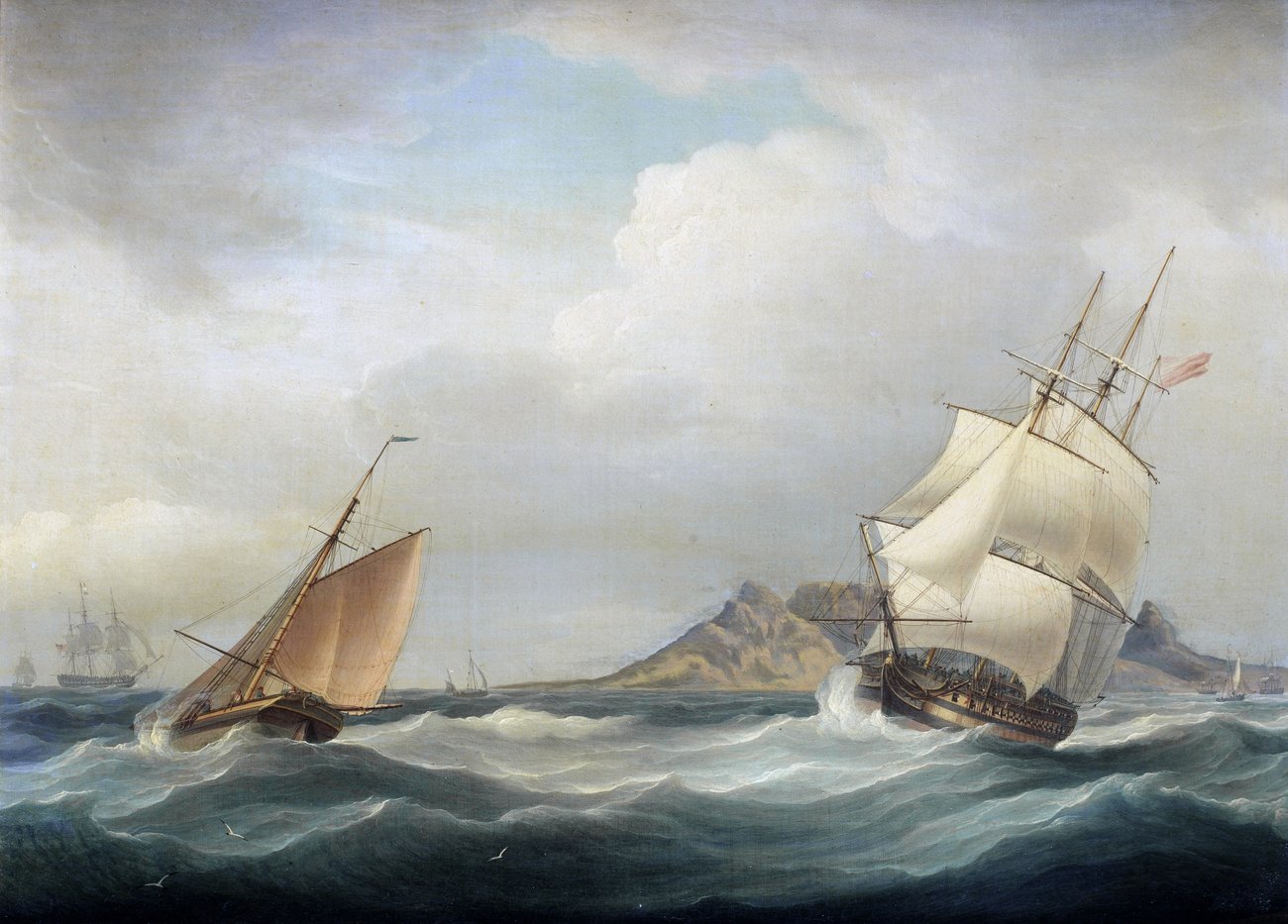
Contemporary painting of HMS Illustrious under sail

H.M.S. Illustrious

The second Illustrious, a 74-gun third-rate ship of the line, was built by Randall & Brent at Rotherhithe and launched on 3 September 1803. She had a busy Napoleonic career, including Basque Roads in 1809, the capture of Mauritius in 1810 and the invasion of Java in 1811.

She was recommissioned in August 1841 as Adam’s flagship on the North America and West Indies Station, under Captain John Elphinstone Erskine, who commanded her until June 1845. She was broken up at Portsmouth in 1868.

Rate74 guns, third rate
LaunchedRotherhithe, 1803
Flag captainCapt. John E. Erskine
Flagship from4 February 1842

The Ships · II

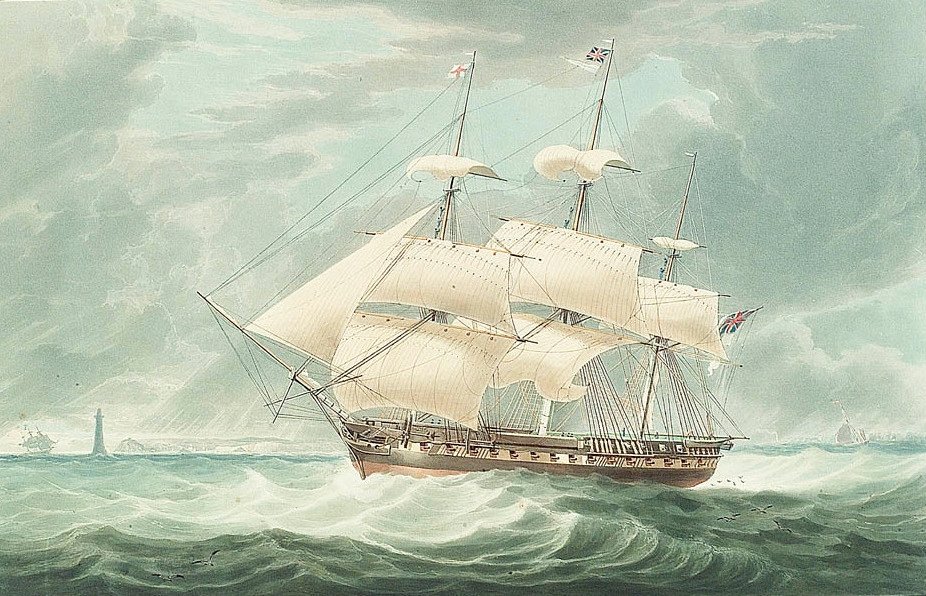
Contemporary painting of HMS Winchester in heavy seas

H.M.S. Winchester

Launched at Woolwich in 1822. She was designed as a 60-gun fourth rate but normally carried 52 guns. She had a long association with the North America and West Indies Station and was Adam’s flagship until the morning of 4 February 1842. In early 1842 she was commanded by Captain Thomas Wren Carter.

Relieved of the flag, she sailed for Portsmouth the next morning with the Hamilton letter-bag aboard, to be recommissioned for Rear-Admiral Percy’s command at the Cape and Rio de Janeiro.

Rate60 guns (fourth rate), usually 52
LaunchedWoolwich, 1822
Commander, 1842Capt. Thomas Wren Carter
Sailed for England5 February 1842

Provenance, certificate and literature

Still to find out

If you can help with any of these, I’d be very pleased to hear from you.

Illustrious and Winchester only really shared Bermuda for a few weeks, and their roles changed over on a single morning. This cover was written in that window and carried home by the ship that had just been replaced. It’s two Penny Blacks on an envelope, but it’s also a very precise snapshot of the Royal Navy at Bermuda in February 1842.